



Die Steel H13
now browsing by category
H13 vs H11 Tool Steel – Complete Comparison (Properties, Hardness, Applications, Price & Selection Guide)
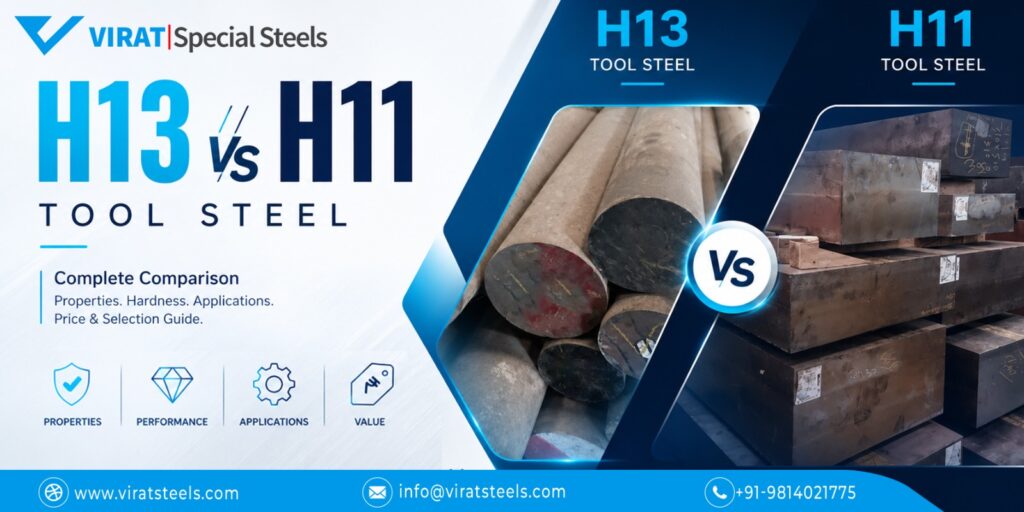
H13 vs H11 Tool Steel, Which One Should You Choose?
Walk into any tool room, forging shop, or die manufacturing unit in India, and you’ll hear the same debate.
“Should this die be made from H13 or H11?”
At first glance, both steels look nearly the same. They are both part of the Hot Work Tool Steel family, contain chromium and molybdenum, and are built to perform in extreme temperatures. However, choosing the wrong material can significantly decrease die life.
- Choose H13 where H11 should have been used, and the die may crack under repeated impact.
- Choose H11 where H13 belongs, and excessive wear can shorten production life.
This complete guide explains everything you need to know before selecting either grade.
You’ll learn about:
- H13 vs H11 Chemical Composition
- Hardness Comparison
- Mechanical Properties
- Heat Treatment
- Price Comparison
- Tool Life
- Equivalent Grades
- Applications
- Availability in India
- Supplier Selection Guide
- 25+ Frequently Asked Questions
H13 vs H11 Tool Steel – Quick Comparison
| Property | H13 (DIN 1.2344 / SKD61) | H11 (DIN 1.2343 / SKD6) |
| Main Strength | Excellent wear resistance and hot hardness | Great toughness and impact resistance |
| Wear Resistance | Excellent | Very Good |
| Toughness | Very Good | Excellent |
| Hot Hardness | Excellent | Very Good |
| Resistance to Thermal Fatigue | Excellent | Very Good |
| Shock/Impact resistance | Excellent | Good |
| Machinability (Annealed) | Better | Moderate |
| Maximum Working Hardness | Up to 54 HRC | Up to 52 HRC |
| Typical Working Hardness | 44–48 HRC | 42–46 HRC |
| Best Suited For | Die Casting, Extrusion Dies, Plastic Moulds | Forging Dies, Hammer Dies, Fastener Tooling |
| Relative Tool Life | Longer in wear-intensive applications | Longer in impact-intensive applications |
| Relative Cost | 10–20% Higher | More Economical |
| Best Choice When | Heat, wear and long production runs are the priority | High impact, shock loading and toughness are the priority |
What is H13 Tool Steel?
H13 Tool Steel (DIN 1.2344, SKD61) is one of the world’s most widely used chromium hot work tool steels.
Its high vanadium content forms extremely hard carbides that improve:
- Wear resistance
- Hot hardness
- Heat checking resistance
- Tool life
- Surface finish
This makes H13 the preferred steel for:
- Aluminium Die Casting Dies
- Zinc Die Casting
- Plastic Injection Moulds
- Extrusion Dies
- Hot Shear Blades
- Forging Punches
What is H11 Tool Steel?
H11 Tool Steel (DIN 1.2343, SKD6) is also a Hot Work Tool Steel, but with a lower vanadium content.
The lower carbide volume gives H11:
- Better toughness
- Better impact resistance
- Better crack resistance
- Easier machining
It is commonly selected for:
- Hammer Dies
- Forging Dies
- Fastener Tooling
- Hand Tool Dies
- Heavy Stamping
Comparison of Chemical Composition H13 vs H11 Tool Steel
| Element | H13 (DIN 1.2344) | H11 (DIN 1.2343) |
| Carbon | 0.32–0.45% | 0.33–0.43% |
| Chromium | 4.75–5.50% | 4.75–5.50% |
| Molybdenum | 1.10–1.75% | 1.10–1.60% |
| Vanadium | 0.80–1.20% | 0.30–0.50% |
| Silicon | 0.80–1.20% | 0.80–1.20% |
| Manganese | 0.20–0.50% | 0.20–0.50% |
Main Difference:
The H13 with higher vanadium content has much better wear resistance and longer tool life.
Mechanical Property Comparison
| Property | H13 | H11 |
| Wear Resistance | Excellent | Good |
| Toughness | Good | Excellent |
| Hot Hardness | Excellent | Good |
| Thermal Fatigue | Excellent | Very Good |
| Heat Checking Resistance | Excellent | Very Good |
| Impact Resistance | Good | Excellent |
| Machinability | Moderate | Better |
| Polishability | Excellent | Good |
Hardness Comparison
| Condition | H13 | H11 |
| Annealed | 180–220 HB | 180–220 HB |
| Working Hardness | 44–52 HRC | 42–50 HRC |
| Maximum Practical Hardness | 54 HRC | 52 HRC |
Heat Treatment Process
1. Preheating (650–750°C)
2. Austenitizing
o H13: 1010-1025 °C
3. Air, Oil, or Vacuum Quenching
4. Double or Triple Tempering (550-650 °C)
Vacuum heat treatment is recommended for precision dies to minimise distortion.
One of the most asked questions from buyers is:
“What’s the cheapest steel?
Generally,
Why?
- Higher Vanadium content
- Better wear resistance
- Longer production life
- Higher performance in die casting applications
Although the initial purchase price is higher, H13 often delivers a lower cost per component because of its longer service life.
Price depends on:
- ESR or Conventional Grade
- Forged or Rolled Material
- Imported or Domestic Mill
- Size
- Heat Treatment
- Quantity
No fixed market price exists, so always request a quotation based on current stock.
H13 vs H21
| Feature | H13 | H21 |
| Toughness | Better | Lower |
| Hot Hardness | Excellent | Outstanding |
| Wear Resistance | Excellent | Excellent |
| Typical Use | Die Casting | Hot Forging & Extreme Heat |
H13 vs DIN 1.2367
| Property | H13 | 1.2367 |
| Toughness | Excellent | Higher |
| Hot Strength | Excellent | Excellent |
| Large Forging Dies | Good | Better |
There is virtually no practical difference. SKD61 is the Japanese JIS designation equivalent to AISI H13 and DIN 1.2344. Selection should focus on material quality, cleanliness, ESR option, testing, and supplier reliability rather than the grade designation alone.
H13 vs DB6
| Feature | H13 | DB6 |
| Type | Hot Work | Hot Work |
| Toughness | Excellent | Very High |
| Nickel Content | No | Yes |
| Large Forging Dies | Good | Excellent |
| Heavy Impact | Good | Better |
Tool Life Comparison
| Application | Better Grade |
| Die Casting | H13 |
| Extrusion | H13 |
| Plastic Moulds | H13 |
| Hammer Dies | H11 |
| Forging Dies | H11 |
| Heavy Impact Tools | H11 |
H13 & H11 Equivalent Grades
H13 and H11 are common hot work tool steels, but they have different names depending on the international standard used. Use the table below to identify the equivalent grades used in different countries.
| Standard | H13 Equivalent | H11 Equivalent |
| AISI (USA) | H13 | H11 |
| DIN / EN (Germany) | 1.2344 / X40CrMoV5-1 | 1.2343 / X38CrMoV5-1 |
| JIS (Japan) | SKD61 | SKD6 |
Sizes Available
H13 (DIN 1.2344 / SKD61) and H11 (DIN 1.2343 / SKD6) tool steel are available in a wide range of sizes to suit different tooling applications.
| Product Form | Available Sizes |
| Round Bars | Ø13 mm to Ø500+ mm |
| Flat Bars | Thickness: 20–305 mm, Width: 50–600 mm |
| Cut-to-Size Blocks | As per customer drawing and specifications |
Custom sizes and large forged sections can also be supplied based on project requirements.
| Property | Conventional | ESR |
| Cleanliness | Good | Excellent |
| Inclusion Level | Higher | Lower |
| Polishability | Good | Excellent |
| Fatigue Life | Better | Best |
| Tool Life | Longer | Longest |
ESR H13 is recommended for premium die casting and mould applications requiring maximum reliability.
Industries Using H13
- Aluminium Die Casting
- Zinc Die Casting
- Plastic Injection Moulding
- Extrusion
- Aerospace
- Automotive
- Pressure Die Casting
- Hot Shear Blades
Industries Using H11
- Forging
- Hammer Dies
- Fastener Manufacturing
- Hand Tools
- Heavy Engineering
- Structural Components
Why Buy H13 or H11 from Virat Steels?
Virat Steels has been supplying premium tool steels to Indian manufacturers for 70+ years.
Why customers choose Virat Steels
- 70+ Years of Experience
- 2000+ Industrial Customers
- Supplier of material from reputed international mills
- Ready Stock Available
- Mill Test Certificate (MTC)
- UT Tested Material
- Spectro Tested Material
- PAN India Delivery
- Custom Cutting
- Fast Dispatch
- Technical Material Recommendation
Whether you’re looking to Buy H13 Steel, Buy H11 Steel, DIN 1.2344, DIN 1.2343, SKD61, SKD6, ESR H13, or Forged H13 Blocks, our team can recommend the right material based on your application
Our Supply Network Across India
Virat Steels is a trusted supplier of Hot Work Tool Steel to customers across the major industrial hubs of India including Ahmedabad, Rajkot, Pune, Nashik, Aurangabad, Kolhapur, Belgaum, Chennai, Coimbatore, Hosur, Bengaluru, Hyderabad, Faridabad, Manesar, Bhiwadi, Gurugram, Delhi NCR, Ludhiana, Chandigarh, Haryana, Punjab, Jamshedpur.
Our strong logistic network and efficient distribution system enable us to ensure timely PAN India dispatch to meet the requirement of tool rooms, die manufacturers, forging industries and engineering companies across the country.
- H13 Tool Steel
- H11 Tool Steel
- DIN 1.2344 Tool Steel
- DIN 1.2343 Tool Steel
- ESR Tool Steel
- Plastic Mould Steel
- Hot Work Tool Steel
- Forged Tool Steel Blocks
Download Free PDF:
H13 vs H11 Tool Steel Comparison Guide
https://www.viratsteels.com/downloads/h13-vs-h11-comparison.pdf
Request a Quote
Searching for the right Hot Work Tool Steel?
Our technical team can suggest the correct grade for your application whether you require H13, H11, DIN 1.2344, DIN 1.2343, SKD61, SKD6, ESR H13 or Forged H13 Blocks.
Request a Quote Today
✔ Material Recommendation
✔ Ready Stock
✔ MTC Available
✔ UT Tested
✔ Spectro Tested
✔ PAN India Delivery
Call us or send your drawing to receive a customised material recommendation.
Call us: +91-98140 21775 Email: info@viratsteels.com Visit us: Gurgaon (Haryana) | Ludhiana (Punjab)
FAQs (Frequently Asked Questions)
1. What is the difference between H11 and H13 tool steel?
H11 is tougher and more impact resistant while H13 has more wear resistance, hot hardness and resistance to thermal fatigue.
2. Which steel is best for aluminum die casting dies?
H13 is generally preferred as it has a longer die life and is more resistant to heat checking.
3. What grade is recommended for hot forging dies?
H11 is often chosen for heavy-impact forging work and H13 is appropriate for moderate-impact forging applications.
4. What are the common industries that use H11 and H13 tool steel?
These grades are widely used in die casting, forging, extrusion, automobile, aerospace, plastic molding and general engineering industry.
5. What is the working temperature range of H13 tool steel?
H13 has good strength and hardness up to about 600°C and is used for hot working.
6. Is H11 impact strength better than H13?
Yes. H11 has a lower vanadium content which makes it tougher and more resistant to impact loading.
7. Which tool steel has better dimensional stability in heat treatment?
H13 generally has better dimensional stability when properly heat treated.
8. Is it possible to nitride H11 and H13?
Yes. Both grades can be nitrided to increase surface hardness and wear resistance.
9. What is the best grade for extrusion tooling?
H13 is most often recommended for aluminum extrusion dies as it has the best hot strength and wear resistance.
10. Are H11 and H13 available on forged blocks?
Yes. Both grades are available as forged blocks, rounds, flats and in customer specific sizes.
11. What inspections are performed before dispatch?
Material usually comes with Spectro Test Reports, Ultrasonic Testing (UT), Material Test Certificates (MTC), and hardness testing if requested.
12. Can H11 and H13 be supplied in pre-hardened condition?
Yes. Based on customer needs, both grades can be offered annealed, pre-hardened, or heat-treated.
13. Which grade is easier to polish?
H13 generally provides an excellent polished finish, making it good for high-quality tooling applications.
14. Are H11 and H13 suitable for plastic mould applications?
Yes. H13 is commonly used for plastic moulds that work at high temperatures or need great wear resistance.
15. What shapes are available in H11 and H13 tool steel?
These grades come in round bars, flat bars, square bars, forged blocks, plates, and custom-cut sizes.
16. How do I choose between H11 and H13?
The choice depends on the application. Use H11 for maximum toughness, and H13 for better wear resistance and a longer service life.
17. What surface finish options are available?
Materials are available in black, peeled, rough machined, bright, or fully machined condition based on customer needs.
18. Can custom sizes be supplied?
Yes. Custom dimensions and cut-to-size materials are available to reduce machining time and material waste.
19. What certifications are available with the material?
Materials can come with Mill Test Certificates (MTC), chemical composition reports, mechanical property reports, and UT inspection certificates.
20. Does Virat Steels offer technical support in selecting tool steel?
Yes. Our technical team helps customers choose the right grade based on the application, operating temperature, and service conditions.
21. Does Virat Steels deliver across India?
Yes. We provide fast and dependable delivery across India to major industrial cities and manufacturing hubs.
22. How can I place an order with Virat Steels?
Just share your required grade, dimensions, quantity, or technical drawing with our sales team. We will recommend the right material, offer technical guidance, and provide a competitive quote.
Why H13 tool steel Is Widely Used for Aluminium Extrusion Dies
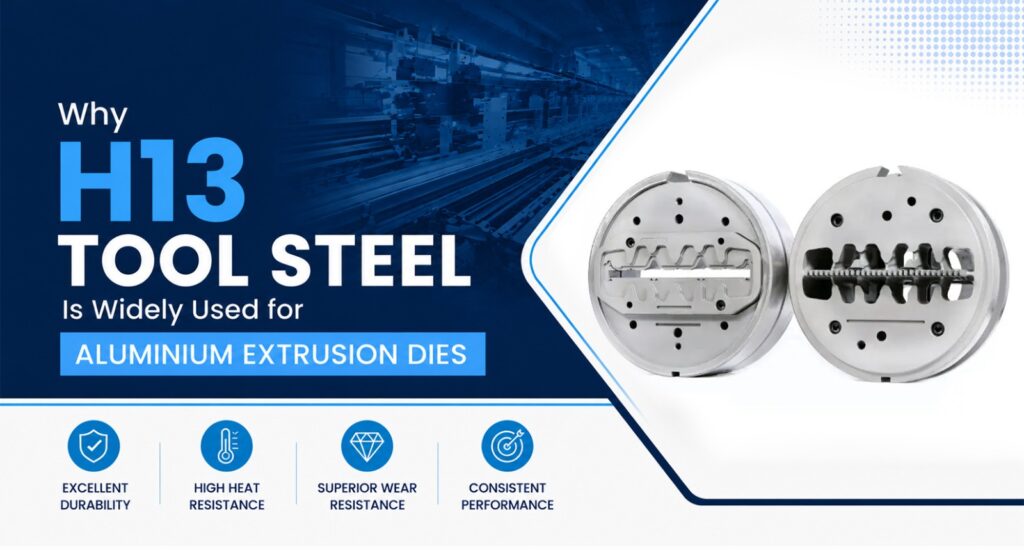
The aluminium extrusion industry demands tooling that can withstand extreme heat, pressure, wear, and continuous production cycles. Choosing the wrong die steel can lead to premature cracking, dimensional loss, downtime, and high replacement costs.
That is why H13 tool steel has become the industry’s preferred choice for aluminium extrusion dies.
Known for its excellent combination of hot strength, toughness, thermal fatigue resistance, and wear resistance, H13 steel delivers reliable performance in demanding extrusion applications.
What is H13 Tool Steel?
H13 tool steel is a chromium-molybdenum-vanadium hot work tool steel designed for high-temperature tooling applications.
Equivalent grades include:
- DIN 1.2344
- SKD61
- X40CrMoV5-1
H13 is widely used in:
- Aluminium extrusion dies
- Die casting dies
- Forging dies
- Plastic injection moulds
Why Aluminium Extrusion Dies Need Special Tool Steel
During extrusion, aluminium billets are heated to high temperatures and forced through the die under massive pressure.
This creates:
- High thermal stress
- Severe wear
- Continuous friction
- Cyclic heating and cooling
Ordinary steels cannot withstand these conditions for long. The die material must maintain:
- Hardness at high temperatures
- Toughness against cracking
- Wear resistance under pressure
This is where H13 tool steel performs exceptionally well.
ESR H13 vs Standard H13 for Extrusion Dies
What is ESR H13?
ESR stands for:
Electro Slag Remelting
This secondary refining process produces cleaner steel with:
✔ Lower inclusions
✔ Better toughness
✔ Improved fatigue resistance
✔ More uniform carbide distribution
For demanding extrusion applications, many manufacturers prefer:
👉 ESR-grade H13 tool steel
How to Increase H13 Extrusion Die Life
Manufacturers can significantly improve die life by:
✔ Using ESR-grade H13
Cleaner steel improves fatigue resistance.
✔ Maintaining Correct Hardness
Recommended:48–52 HRC
✔ Proper Preheating
Reduces thermal shock during startup.
✔ Nitriding Surface Treatment
Improves:
- Wear resistance
- Oxidation resistance
- Surface hardness
✔ Correct Cooling Practices
Avoid aggressive cooling that causes thermal stress.
Why Manufacturers Prefer Virat Steels for H13 Tool Steel
Virat Steels is a trusted supplier of:
- H13 / DIN 1.2344
- ESR H13
- SKD61 tool steel
We supply:
✔ Rounds
✔ Flats
✔ Blocks
✔ Ultrasonic tested material
✔ Mill test certificates
Industries served:
- Aluminium extrusion
- Die casting
- Forging
- Plastic moulding
Why Choose Virat Steels?
✔ Ready Stock Available
Fast dispatch across India.
✔ ESR & Standard Grades
Application-based recommendations.
✔ Technical Support
We help customers choose:
- Correct grade
- Correct HRC
- Correct size
✔ Trusted by Manufacturers Across India
We are supplying to major industrial regions across Pan India .
Contact Virat Steels for H13 Tool Steel
Looking for a reliable supplier of H13 tool steel for aluminium extrusion dies?
Contact Virat Steels today:
📞 +91 98140-21775
https://www.viratsteels.com/h13.html
✉ info@viratsteels.com
Get expert guidance on:
✔ Grade selection
✔ ESR vs standard
✔ Hardness recommendations
✔ Size availability
Frequently Asked Questions (FAQs)
1. Why is H13 tool steel widely used for aluminium extrusion dies?
H13 steel is widely used because of its excellent hot strength, thermal fatigue resistance, toughness, and wear resistance. These properties help extrusion dies perform reliably under high temperature and pressure.
2. What hardness is recommended for H13 extrusion dies?
The recommended hardness for aluminium extrusion dies is typically: 48–52 HRC
3. What is the equivalent grade of H13 steel?
Equivalent grades of H13 tool steel include:
- DIN 1.2344
- SKD61
- X40CrMoV5-1
4. What are the common failures in aluminium extrusion dies?
Common extrusion die failures include:
- Heat checking
- Thermal fatigue cracking
- Surface wear
- Gross cracking
- Dimensional loss
These failures are often caused by improper heat treatment, poor cooling, or low-quality steel.
5. What is ESR H13 steel?
ESR stands for Electro Slag Remelting.
ESR-grade H13 tool steel offers:
✔ Cleaner microstructure
✔ Better toughness
✔ Improved fatigue resistance
✔ Longer die life
6. How can extrusion die life be increased?
Extrusion die life can be improved by:
- Using ESR-quality H13 steel
- Maintaining proper hardness
- Applying nitriding
- Using correct cooling practices
- Proper die preheating
7. Is H13 steel suitable for high-pressure applications?
Yes. H13 tool steel performs very well in high-pressure applications because of its excellent toughness and heat resistance.
8. What industries use H13 steel in India?
H13 steel is widely used in:
- Aluminium extrusion industry
- Die casting industry
- Forging industry
- Plastic mould manufacturing
- Automotive tooling applications
9. Where can I buy genuine H13 steel in India?
You can buy genuine H13 tool steel from trusted suppliers like Virat Steels, offering ESR and standard grades with test certificates and ultrasonic-tested material.
Hot Work vs Cold Work Tool Steel | H13 vs D2 | Virat Steels
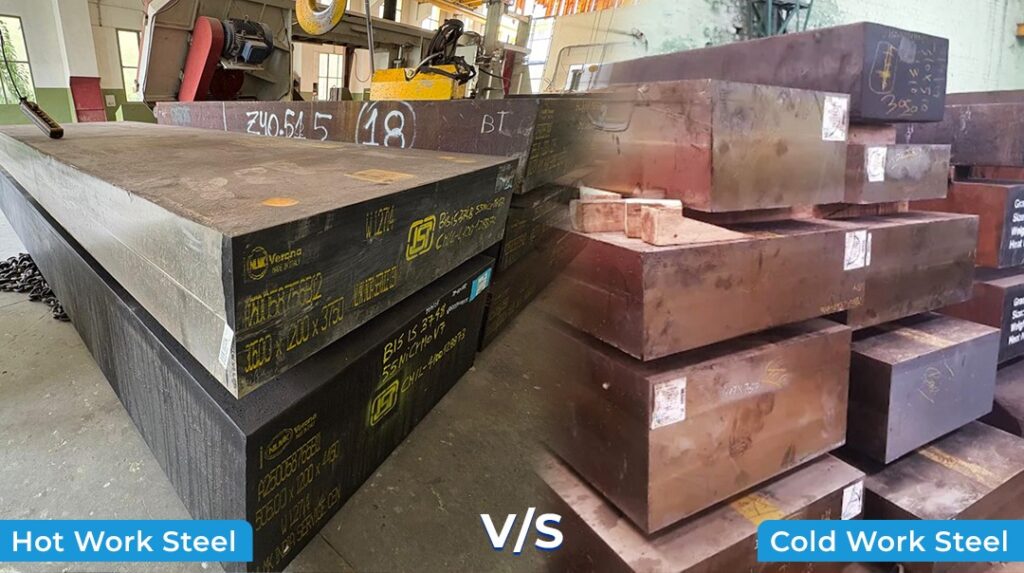
In tooling, one decision quietly determines tool life, rejection rate, and production cost: choosing the right tool steel.
Yet many failures on the shop floor come down to one mistake—using hot work steel where cold work is needed, or vice versa.
This guide will give you a clear, practical comparison between hot work and cold work tool steels—so you can make the right decision the first time.
Hot Work Tool Steel (For High Temperature Applications)
The most widely used grade: H13 tool steel
Best For:
- Aluminium die casting
- Forging dies
- Extrusion tools
- High-temperature moulds
Key Benefits:
✔ Handles extreme heat (200–700°C)
✔ Resists thermal cracking
✔ High toughness under load
Cold Work Tool Steel (For Wear Resistance)
A leading grade: D2 tool steel
Best For:
- Blanking & punching dies
- Shear blades
- Cold forming tools
- Sheet metal industry
Key Benefits:
✔ Very high hardness (up to 60+ HRC)
✔ Excellent wear resistance
✔ Long life in cutting operations
Hot Work vs Cold Work Steel — Quick Comparison
| Feature | Hot Work Steel (H13) | Cold Work Steel (D2) |
| Temperature | High | Low |
| Hardness | Medium | Very High |
| Toughness | High | Moderate |
| Wear Resistance | Medium | Very High |
| Heat Resistance | Excellent | Poor |
| Best Use | Die casting, forging | Cutting, punching |
Using the Wrong Steel? Here’s What Happens
- Cold work steel in hot application → Cracks & failure
- Hot work steel in wear application → Rapid wear & loss of accuracy
Result: Downtime, rejection, and higher cost per component
How to Choose the Right Tool Steel
Choose Hot Work Steel if:
- Temperature > 200°C
- Thermal cycling is involved
- Impact load is high
Choose Cold Work Steel if:
- Application is at room temperature
- Wear resistance is critical
- Cutting or shearing is involved
Industry-Wise Recommendation
| Industry | Recommended Steel |
| Die Casting | H13 |
| Forging | H13 / H11 |
| Sheet Metal | D2 |
| Blanking | D2 / D3 |
| Plastic Mould (High Temp) | H13 |
Increase Tool Life — Proven Methods
For Hot Work Steels:
- Use ESR quality material
- Apply nitriding
- Ensure proper preheating
- Control cooling cycles
For Cold Work Steels:
- Maintain correct hardness
- Use coatings (PVD)
- Avoid shock loading
- Ensure lubrication
Virat Steels — Your Tool Steel Partner
At Virat Steels, we help manufacturers reduce failure and increase tool life with the right material selection.
What You Get:
✔ Ready stock (rounds, flats, blocks)
✔ Ultrasonic tested material
✔ Fast delivery across India
✔ Technical guidance (not just supply)
FAQs?
1-Which is better: H13 or D2?
It depends on application.
- High temperature → H13
- High wear → D2
2-Can D2 be used for hot work?
No. D2 tool steel becomes brittle at high temperatures and may crack.
3-Does higher hardness mean better tool life?
Not always. Excess hardness reduces toughness and increases cracking risk.
4-What is the best steel for die casting?
H13 tool steel is the industry standard.
5. How does heat treatment differ between the two?
Hot work steels are heat-treated to maintain strength at high temperatures
Cold work steels are treated to achieve maximum hardness and wear resistance
6. Which is more expensive: hot work or cold work steel?
Hot work steels are often more expensive due to alloying elements and processing required for high-temperature performance.
7. What industries rely heavily on hot work steel?
Automotive forging, Aluminium die casting, Aerospace component manufacturing
8. What industries rely on cold work steel?
Sheet metal fabrication, Tool and die making, Packaging and appliance manufacturing
9. Which steel has longer tool life?
It depends on the application:
- Hot work steel lasts longer in high-temperature application.
- Cold work steel lasts longer in abrasive, low-temperature operations.
Get Expert Recommendation (Free Consultation)
Choosing the right steel can double your tool life.
- Stop tool failures before they happen.
- Choose the right steel with expert guidance from Virat Steels.
Share your application—we’ll recommend:
- Best grade with quality
- Ideal hardness
- Heat treatment process
Talk to our experts today:
🌐 viratsteels.com 📞 +91 98140-21775 ✉info@viratsteels.com
Why H13 Dies Fail Prematurely — And How to Prevent It
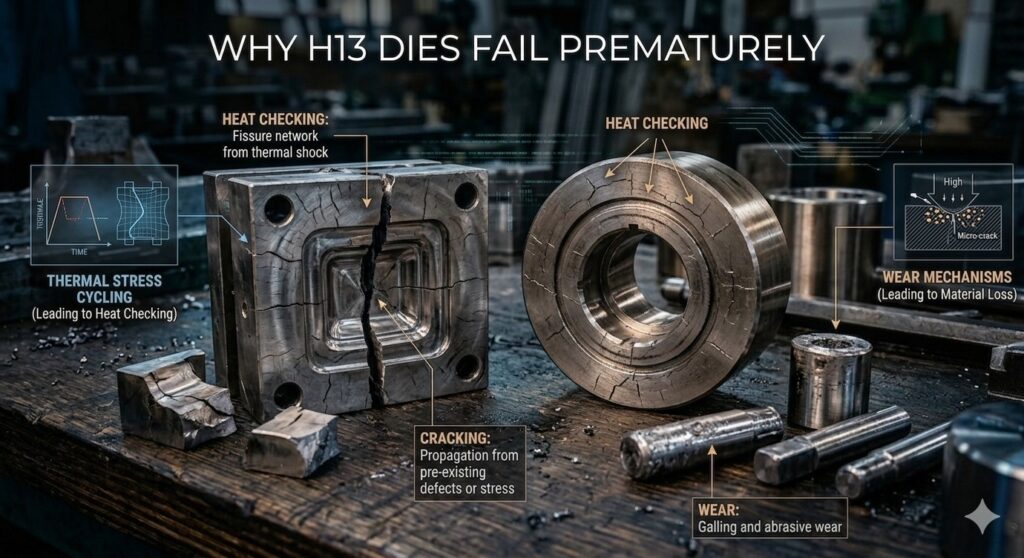
H13 tool steel is the backbone of hot work tooling—widely used in die casting, forging, extrusion, and moulding. When processed correctly, it delivers long life and consistent performance.
Yet many H13 dies fail far earlier than expected.
That’s not a material problem—it’s a process problem.
What is Premature Failure?
Premature failure means a die cracks, wears out, or loses accuracy well before its expected production life—leading to downtime, rejection, and high tooling costs.
Top Reasons H13 Dies Fail Early
1. Heat Checking (Thermal Fatigue)
Repeated heating and cooling creates fine surface cracks (like dry mud). Over time, these cracks grow and damage the die surface.
Why it happens faster:
- Excessive cooling (thermal shock)
- Over-hardening (brittleness)
- No preheating before production
Prevention: Controlled cooling, correct hardness, nitriding, ESR-grade steel.
2. Gross Cracking & Fracture
Deep cracks or sudden die breakage.
Causes:
- Over-hardening
- Poor tempering (retained austenite)
- Sharp corners (stress concentration)
- Thermal shock
Prevention: Proper heat treatment, multiple tempering cycles, better die design.
3. Abrasive Wear & Erosion
Gradual loss of dimension and surface finish.
Causes:
- Low hardness
- High temperatures
- Poor lubrication
- High metal flow (in die casting)
Prevention: Correct hardness, lubrication, nitriding/PVD coatings.
4. Poor Heat Treatment
Even premium H13 fails if heat treatment is wrong.
Common mistakes:
- Incorrect hardening temperature
- Uneven quenching
- Single tempering
- Surface decarburisation
Prevention: Vacuum heat treatment + double/triple tempering.
5. Low Steel Quality
Not all H13 is equal.
Standard grades may contain inclusions and segregation—leading to early cracks.
Better choice:
ESR process H13 — cleaner, tougher, longer life.
6. Design & Machining Errors
Even perfect steel fails with poor design.
Common issues:
- Sharp corners
- Thin sections
- Poor cooling line placement
- EDM layer without re-tempering
Prevention: Smooth radii, balanced design, proper finishing.
7. Poor Lubrication & Cooling
Operational mistakes accelerate failure.
- Uneven cooling → thermal stress
- Poor lubrication → wear & soldering
- Hard water scaling → overheating
8. No Preheating
A cold die entering production faces instant thermal shock.
Recommended:
- Die casting: 180–250°C
- Forging: 150–200°C
How to Extend H13 Die Life
- Use ESR-quality H13 steel
- Maintain correct hardness (not “harder is better”)
- Ensure proper heat treatment (multi-temper)
- Apply nitriding or coatings
- Design with proper radii & cooling layout
- Always preheat before production
Conclusion
H13 failure is rarely random—it’s almost always preventable.
The biggest difference between short life and long life?
Material quality + process control.
Start with the right steel. Execute the process right.
And H13 will deliver the performance it’s known for.
Frequently Asked Questions
Q1: Why is H13 preferred for hot work dies?
Excellent hot strength
Good thermal fatigue resistance
High toughness
Q2: What is the main cause of heat checking in H13?
Repeated thermal cycling (heating + cooling)
Q3: How can heat checking be reduced?
Proper die preheating (150–300°C typically)
Controlled cooling (avoid sudden quenching)
Use of thermal barrier coatings
Q4: What hardness is ideal for H13 dies?
Typically 44–52 HRC depending on application
Too hard → cracking
Too soft → wear
Q5: How does nitriding help H13 dies?
Increases surface hardness
Improves wear resistance
Delays crack initiation
Q6: What is the role of cooling channels?
Maintain uniform temperature
Reduce thermal gradients
Prevent hot spots → reduce cracking
Q7: Can coatings completely prevent wear?
No, but they significantly delay it
Coatings improve life, not eliminate failure
Q8: Why do dies soften over time?
Overexposure to high temperatures beyond tempering limit
Q9: What industries commonly face H13 die failure?
Die casting (aluminum, zinc)
Forging
Extrusion
| Ready to Source H13 Smarter? Contact Virat Special Steels Today |
Fast quotes | Grade recommendations | Pan-India delivery
https://www.viratsteels.com/h13.html📧 info@viratsteels.com | 📱 +91 98140-21775
H13 vs D2 Steel – Which is Better for Hot Work vs Cold Work Dies?
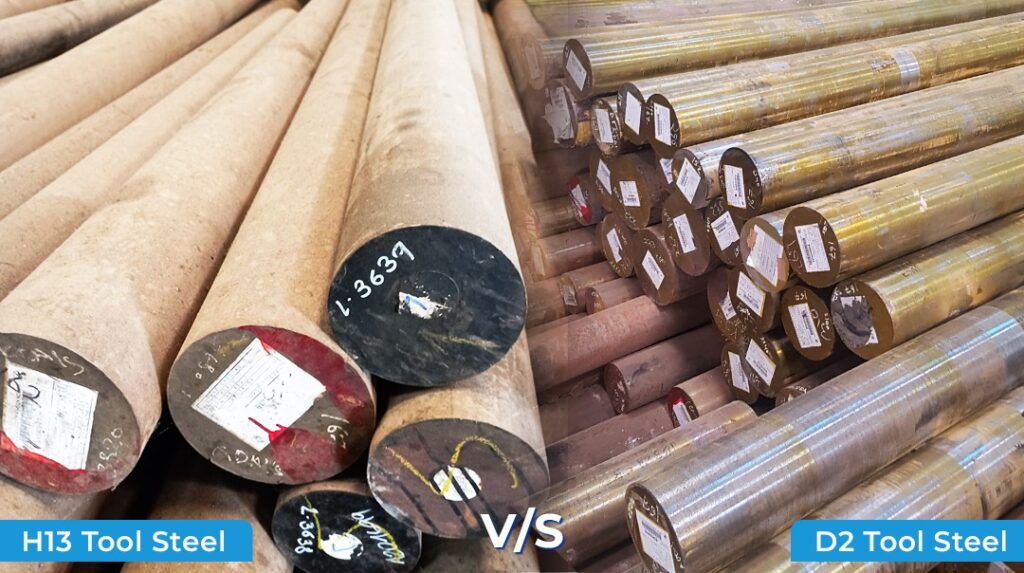
[The definitive guide to selecting the right die steel for forging, extrusion, stamping, and forming applications.]
In the tool and die manufacturing industry, selecting the right tool steel grade directly impacts die life, productivity, and cost efficiency. Among the most widely used grades, H13 tool steel and D2 tool steel are industry standards. but they’re specialists in different temperature.
At Virat Steels, we help manufacturers choose the right steel based on application, performance, and long-term value.
Understanding Tool Steel Categories
Tool steels are broadly classified into:
- Hot Work Tool Steel – Designed for high-temperature operations
- Cold Work Tool Steel – Used at room temperature for cutting and forming
What is H13 Steel? (Hot Work Tool Steel)
H13 steel (DIN 1.2344 / SKD61) is a chromium-molybdenum hot work tool steel known for its ability to withstand extreme heat and thermal cycling.
Key Properties:
- Excellent hot hardness & thermal fatigue resistance
- High toughness and crack resistance
- Strong performance under repeated heating & cooling cycles
H13 retains hardness even above 500°C, making it ideal for high-temperature applications.
Applications:
- Die casting dies
- Hot forging dies
- Extrusion tooling
- Injection mould cores
H13 is the best choice for hot work dies where heat resistance and durability are required.
What is D2 Steel? (Cold Work Tool Steel)
D2 steel is a high carbon, high chromium cold work tool steel designed for maximum wear resistance and hardness.
Key Properties:
- Very high wear resistance
- High hardness (up to 62 HRC)
- Excellent edge retention
- Good dimensional stability
Applications:
- Cold stamping dies
- Blanking and punching tools
- Shear blades
- Cutting tools
D2 performs best in low-temperature, high-wear environments.
H13 vs D2 Steel — Detailed Comparison
| Property | H13 Tool Steel (Hot Work) | D2 Tool Steel (Cold Work) |
| Type | Hot work steel | Cold work steel |
| Hardness | Medium (48–52 HRC) | Very high (58–62 HRC) |
| Heat Resistance | Excellent | Poor at high temperature |
| Wear Resistance | Good | Excellent |
| Toughness | High | Moderate |
| Thermal Fatigue | Excellent | Low |
| Best Use | Hot dies & high-temp tools | Cutting, stamping & cold dies |
Key difference:
- H13 = Heat resistance + toughness
- D2 = Wear resistance + hardness
When to Choose H13 Steel?
Choose H13 tool steel when your application involves:
- High operating temperatures
- Continuous heating & cooling cycles
- Risk of thermal cracking
Typical industries:
- Automotive die casting
- Aluminium extrusion
- Forging industries
H13 provides longer die life and reduced downtime in hot work applications.
When to Choose D2 Steel?
Choose D2 steel when your requirement is:
- High wear resistance
- Sharp cutting edges
- Dimensional stability
Typical industries:
- Sheet metal stamping
- Tool manufacturing
- Cold forming operations
D2 provides superior wear life in cold work applications.
H13 vs D2: Which One is Better?
The H13 vs D2 decision comes down to one primary question: Will your die contact hot workpieces above 200°C?
If the answer is yes: if you’re doing die casting, hot forging, or extrusion, then H13 is your steel. Its thermal fatigue resistance is unmatched in the tool steel sector, and using D2 in these applications will result in catastrophic heat checking and premature failure.
If the answer is no: if your application is stamping, blanking, forming, or precision cold work, then D2 is almost always the superior choice. Its wear resistance, dimensional stability during hardening, and edge-holding capability far exceed what H13 can deliver at ambient temperatures.
In simple terms:
- Heat present? → Go with H13
- Only wear & cutting? → Go with D2
Why Choose Virat Steels for Tool Steel?
At Virat Steels, we supply premium quality:
- H13 tool steel (hot work applications)
- D2 tool steel (cold work applications)
- Custom-cut tool steel blocks
- Ultrasonic tested materials for reliability
What sets us apart:
- Consistent quality & certified grades
- Fast delivery across industrial hubs
- Technical guidance for grade selection
We don’t just supply steel—we help you choose the right steel for maximum performance.
Frequently Asked Questions –
1. Can D2 steel be used for hot work applications?
No. D2 is not suitable for hot work. It becomes brittle at high temperatures and cracks under thermal cycling. For applications above 200–250°C, use H13 or other H-series steels.
2. Is D2 or H13 harder?
D2 is harder (up to 62 HRC) than H13 (up to ~54 HRC). However, H13 performs better in high-temperature conditions due to its toughness.
3. What is the difference between H13 and H11?
H13 has higher wear resistance and hot strength, while H11 offers slightly better toughness. H13 is more commonly used for die casting and forging.
4. Is D2 the same as Cr12MoV?
Almost. Cr12MoV is the Chinese equivalent of D2 with very similar composition and performance, and they are generally interchangeable.
5. How do I weld H13 steel die inserts?
Preheat to 300–400°C, use matching filler wire, maintain temperature, and cool slowly. Post-weld tempering is essential. Welding D2 is not recommended due to crack risk.
Final Thoughts
Choosing between H13 vs D2 steel depends entirely on your application:
- H13 dominates in heat-intensive operations
- D2 leads in wear-intensive, cold conditions
Making the right choice can significantly improve: Tool life , Production efficiency, Overall cost savings.
Need D2 or H13 for Your Next tool steels project?
Get a fast quote — certified stock, ready to dispatch across India:
www.viratsteels.com | 📧 info@viratsteels.com | 📱 +91 98140-21775
P20 vs H13 — Best Choice for Long-Run Plastic Moulds Plastic Mould Steel · Grade Comparison · Virat Special Steels
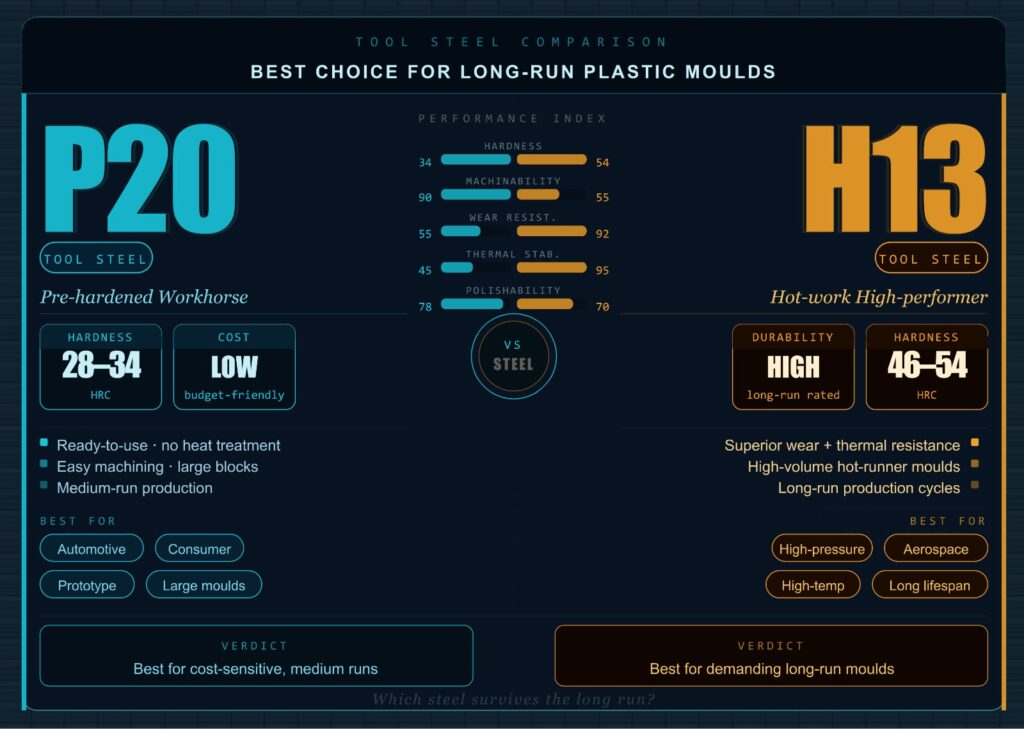
A practical, application-first guide for mould makers, tool rooms, and procurement teams choosing between two most popular plastic mould steel grades.
Choosing the wrong mould steel doesn’t just cost money — it costs production runs, surface finish quality, and mould life. Here’s how to pick the right one.
At a Glance: P20 vs H13
The table below gives a side-by-side view of both grades across the most critical properties mould buyers evaluate:
| P20 Steel Pre-hardened Mould Steel | H13 Steel Hot Work Tool Steel |
|---|---|
| Hardness 28–34 HRC (pre-hardened) | Hardness 44–52 HRC |
| Toughness High | Toughness Very High |
| Polishability Good | Polishability Excellent |
| Machinability Excellent | Machinability Moderate |
| Mould Life Up to 5,00,000 shots | Mould Life 10,00,000+ shots |
| Heat Treatment Not required | Heat Treatment Required (vacuum) |
| Tool Cost Lower | Tool Cost Higher |
| Lead Time Short | Lead Time Longer |
Detailed Property Comparison
| Property | P20 Steel | H13 Steel |
|---|---|---|
| Hardness after HT | 28–34 HRC (pre-hardened) | 44–52 HRC |
| Wear Resistance | Moderate | High |
| Toughness | High | Very High |
| Machinability | Excellent (no HT needed) | Moderate (HT required) |
| Thermal Fatigue Resistance | Low | Very High |
| Tool Cost | Lower | Higher |
| Lead Time | Short (ready to machine) | Longer (HT required) |
| Mould Life | Up to 5,00,000 shots | 10,00,000+ shots |
| Corrosion Resistance | Low | Moderate |
Which Steel is Best for Long-Run Moulds?
✅ Choose P20 if:
· Production volume is moderate
· Budget is limited
· Faster delivery is required
· Plastic material is non-abrasive
✅ Choose H13 if:
· Production volume is very high
· You need long mould life
· Material is abrasive or high temperature
· Dimensional stability is critical
| Which Grade Should You Pick? P20 for speed & cost · H13 for volume & finish |
If you need a mould quickly, at a lower cost, for regular plastics and medium production, go with P20.But if you’re producing in high volumes, using abrasive or glass-filled materials, or need a long-lasting, mirror-finish mould (over 10 lakh shots), choose H13.
Industry Applications in India
Both P20 and H13 are widely used across India’s plastics and automotive tooling industry. Here’s where each grade dominates:
| Industry | Recommended Grade | Reason |
| Automotive | H13 | High volume, tight tolerances, long mould life |
| Consumer Appliances | P20 | Medium run, cost-sensitive, faster delivery |
| Packaging (Caps & Closures) | H13 | Very high shot count, abrasion resistance |
| Electronics Housing | P20 / H13 | Depends on run volume and finish requirements |
| Medical Device Components | H13 (ESR Grade) | Mirror finish, cleanliness, long run |
| Soft Tooling | P20 | Quick machining, lower cost, short lead time |
Conclusion
Both P20 and H13 have their place in mould manufacturing—but the choice depends on your production goals:
· P20 = Cost-effective + faster production
· H13 = Long life + high performance
Sourcing P20 and H13 in India
Virat Special Steels stocks both P20 and H13 in ready inventory — supplied with full mill test certificates, hardness test reports, and chemical analysis. Available in round bars, flat bars, and pre-machined blocks across a wide size range.
| Need P20 or H13 for Your Next Mould? Get a fast quote — certified stock, ready to dispatch across India |
Contact our team to get more details about available sizes and technical specifications suitable for your applications.
https://www.viratsteels.com/products.html info@viratsteels.com
+91 98140-21775
Frequently Asked Questions
1. Which is better for long-run plastic moulds, P20 or H13?
H13 — higher hardness, wear resistance, and heat tolerance make it ideal for long runs.
2. What is the difference between P20 and H13?
P20: Pre-hardened, easier to machine, lower cost — best for short/medium runs. H13: Heat-treated, stronger, better for high-temp and high-volume applications.
3. Is H13 worth the higher cost?
Yes — for high-volume production, H13 delivers better ROI over time.
4. When should you choose P20 over H13?
When volume is low/medium, budget is tight, or faster machining/delivery is needed.
5. Which is better for high-temperature injection molding?
H13 — superior thermal fatigue resistance handles higher temps without deformation.
6. Can P20 be used for long-run moulds?
Yes, but it wears faster with abrasive materials and isn’t ideal for very long runs.
7. Which industries prefer H13?
Automotive, electronics, and high-volume packaging — anywhere durability matters.
8. What’s the cost difference?
P20: Lower upfront. H13: Higher initial cost, but better long-term value.
9. Best steel for 1 million cycle production?
H13 — built to withstand extended wear, heat, and stress over massive run counts.
How Virat Special Steels Delivers High-Quality Steel Across India
From raw material sourcing to pan-India distribution — a comprehensive look at India’s trusted special steel supplier and manufacturer.
In India where infrastructure is booming and industrial demand for precision tool & die steel is higher, Virat Special Steels has emerged as one of India’s most dependable names in high-quality steel supply and distribution.
| 1957 | 3500 tons | 35+ | 1.5K+ |
| Existence | Stock | Grades | Satisfied Clients |
Who Is Virat Special Steels?
Virat Special Steels is a leading stockist, supplier, and distributor of special and alloy steel products across India. With decades of domain expertise, the company serves industries ranging from automotive and aerospace to defence, tooling, and heavy engineering.
What sets Virat Special Steels apart in the crowded Indian steel market is its unwavering commitment to quality assurance, grade certification, and on-time delivery whether you are a small machine shop or a large-scale manufacturer.
Product Range: Every Grade, Every Need
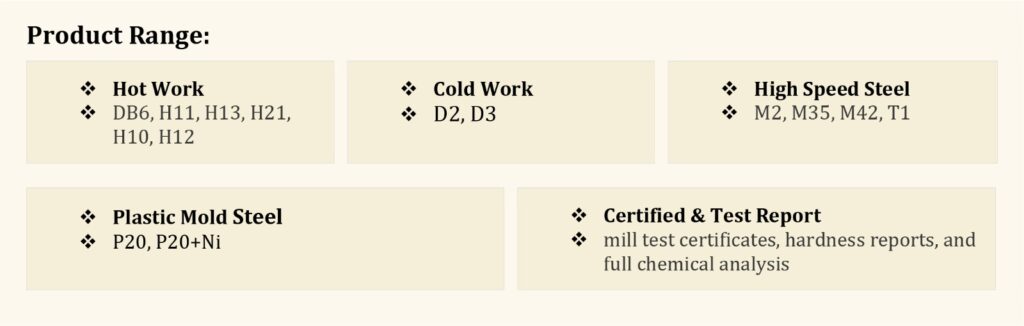
One of the key reasons Virat Special Steels commands trusts across sectors is its vast and diverse product portfolio The company stocks and supplies:
1. Hot Work Steel
DB6, H11, H13, H21, H10, H12—for dies, moulds, and tools that work with heated metals like forging dies, die casting dies, extrusion tools, and hot shearing blades operating at high temperatures (300–700°C).
2. Cold Work Steel
D2, D3– for cutting, punching, blanking, and forming tools that operate at room temperature on unheated workpieces.
3. High-Speed Steel (HSS)
M2, M35, M42, T1— engineered for extreme heat resistance and wear durability in high-speed machining operations.
3. Plastic Mold Steel
P20+Ni , P20 — for manufacturing injection moulds, blow moulds, and compression moulds that shape plastic products in mass production.
4. Certified & Test-Report Backed Steel
Every batch is supplied with original mill test certificates, hardness reports, and full chemical analysis — ensuring complete traceability.
The Supply Chain: How Quality Reaches You
Virat Special Steels operates a streamlined supply chain that ensures product integrity from steel mill to customer workshop. Here is how the process works:
- Sourcing from Certified Global & Domestic Mills — Raw steel is procured from ISO-certified mills in India, Europe, China, Japan, ensuring chemical composition and mechanical properties meet international standards like DIN, AISI, and IS.
- In-House Quality Inspection & Testing — Each incoming lot undergoes spectrometric testing, hardness verification, and dimensional checks before being added to inventory.
- Inventory Management — With large, well-organised warehouses, Virat Steels maintains ready stock of over 35+grades, enabling same-day dispatch for urgent industrial requirements.
- Custom Cutting— Steel is supplied in round bars, flat bars with cutting-to-size services to reduce waste and machining time for buyers.
- Pan-India Logistics & Timely Delivery — Our logistics partners ensure safe, on-time delivery across Pan India. With our offices at GURGAON, LUDHIANA, PUNE & CHENNAI to provide efficient business services to the Industrial undertaking at the location in India.
| Serving India’s Most Critical Industries — Where Failure Is Not an Option |
Why Industries Trust Virat Special Steels
Technical Expertise
Unlike generic steel traders, Virat’s team includes technical team who guide clients on grade selection — ensuring the right steel is used for the right application, reducing rejection rates and improving the productivity .
Consistent Quality with Traceability
Every supply comes with full traceability — heat numbers, TC, composition reports — making Virat’s steel compatible with ISO 9001 quality frameworks.
Competitive Pricing & Fast Quotes
Virat Steels offers market-competitive Quotes are processed quickly, supporting buyers’ procurement timelines without delay.
After-Sales Technical Support
Virat’s technical support team stays with you beyond the sale — helping with heat treatment parameters, machinability ratings, and surface hardness queries.
Frequently Asked Questions
Q1: What makes Virat Special Steels different from regular steel traders?
Virat Special Steels focuses exclusively on tool & die steels offering deep technical knowledge, certified inventory, and grade-specific expertise that other steel traders cannot match.
Q2: Do you supply steel to small businesses and individual buyers?
Yes. Virat serves a wide spectrum from large OEMs to small machine shops. Minimum order quantities are flexible, and enquiries are welcome for any quantity.
Q3: Is same-day or next-day dispatch available?
For grades available in ready stock which covers the majority of popular engineering and tool steel grades same-day dispatch is possible for orders placed before the cut-off time.
Q4: Are mill test certificates provided with every order?
Absolutely. Every supply from Virat Special Steels comes with original mill test certificates covering chemical composition ensuring full traceability.
Q5: Can Virat Steels supply cut to specific sizes?
Yes. Virat offers cutting-to-size and profiling services for round bars, flat bars reducing your raw material waste and machining effort significantly.
Conclusion
By combining advanced infrastructure, a wide product range, and a strong commitment to quality, Virat Special Steels continues to lead as a trusted Tool steel supplier across PAN India. Whether you need a plastic mould steel, tool & die steel, or high-speed steel, the brand delivers unmatched performance, durability, and trust.
| Ready to Source Smarter? Contact Virat Special Steels Today |
Fast quotes | Grade recommendations | Pan-India delivery
📧 info@viratsteels.com | 📱 +91 98140-21775
DB6 vs H13 Tool Steel: Which is Better for Forging Applications?
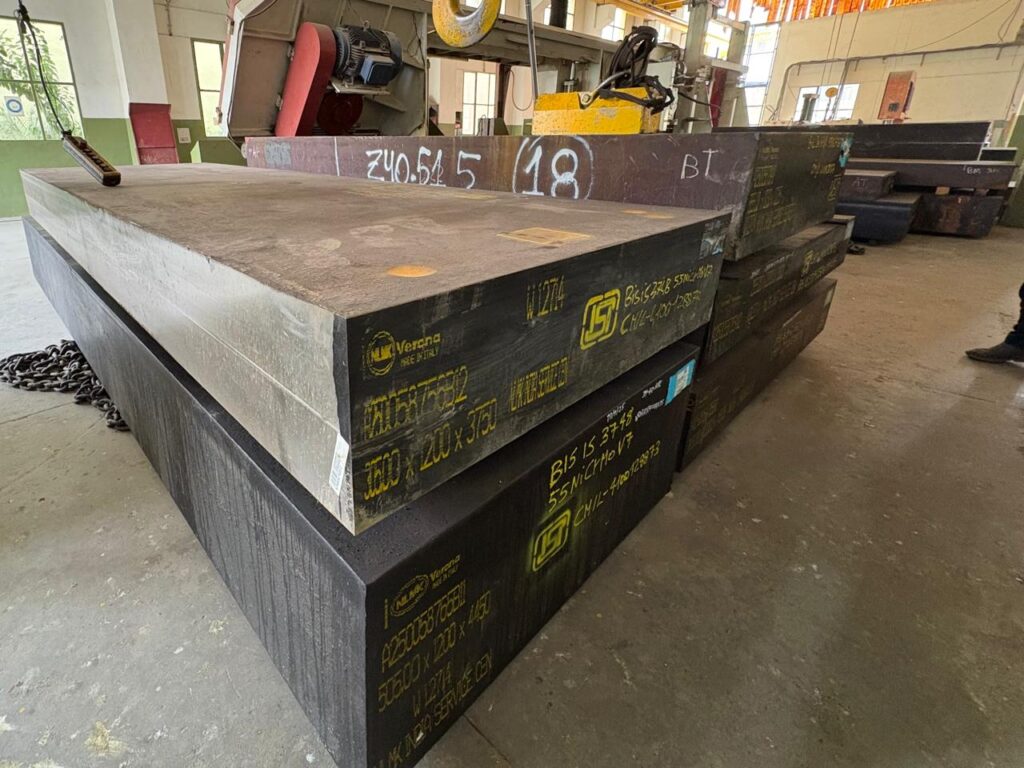
In forging, every die tells a story. Its steel grade decides how long it lasts, how smooth production runs, and how good the final product looks. Some last longer, some deliver sharper precision, and some balance cost with performance. Behind each of these outcomes lies one major choice is the steel grade used to craft the die.
Two steels often step into this role: DB6 and H13. Both are strong, both resist wear, but they shine in different ways. DB6 is the tough fighter, built to handle shock loads in heavy-duty forging. H13 is the precision player, balancing hardness and heat resistance for high-performance dies.
Choosing between them isn’t just technical, it’s about selecting the right steel need for your operations. Whether you’re in automotive forging, heavy engineering, or industrial equipment manufacturing, understanding the differences between DB6 and H13 can help you decide which steel will carry your production forward.
Overview of DB6 Tool Steel
DB6 is a high-toughness hot work tool steel commonly used for hammer forging dies and heavy-duty tooling. It is generally considered equivalent to DIN 1.2714.
Key features of DB6 steel:
- Very high toughness
- Excellent resistance to impact loads
- Good wear resistance
- Ideal for hammer forging operations
Because of its toughness, DB6 is preferred where tools face repeated mechanical shock.
Overview of H13 Tool Steel
H13 is one of the most widely used hot work tool steels due to its strong heat resistance and hardness stability at high temperatures.
Key features of H13 steel:
- Excellent heat resistance
- Good wear resistance
- High hardness retention at elevated temperatures
- Suitable for hot work tooling
H13 is commonly used in die casting, extrusion, and hot forging applications.
Chemical Composition Comparison
The chemical composition of these steels influences their mechanical properties and performance.
| Element | DB6 Steel | H13 Steel |
| Carbon | 0.50 – 0.60% | 0.35 – 0.42% |
| Chromium | 1.00 – 1.30% | 4.75 – 5.50% |
| Nickel | 1.50 – 1.80% | — |
| Molybdenum | 0.40 – 0.50% | 1.10 – 1.75% |
| Vanadium | — | 0.80 – 1.20% |
Nickel in DB6 increases toughness, while chromium and vanadium in H13 improve heat resistance.
Hardness Comparison
Hardness plays an important role in determining the wear resistance and durability of tool steels.
| Condition | DB6 Steel | H13 Steel |
| Annealed Condition | 200 – 240 HB | 190 – 220 HB |
| Hardened & tempered | 50 – 54 HRC | 48 – 52 HRC |
Both steels achieve similar hardness, but their performance differs due to toughness and heat resistance.
Applications of DB6 Steel
DB6 steel is widely used in industries requiring tools that can withstand high impact forces includes.
- Hammer forging dies
- Heavy duty forging tools
- Shear blades
- Industrial punches
- Large forming dies
These tools often experience repeated mechanical shock, making DB6 steel an ideal choice.
Applications of H13 Steel
H13 steel is commonly used in hot work tooling where high temperatures are involved includes.
- Die casting dies
- Hot extrusion tools
- Aluminum die casting molds
- Plastic injection molds
- Hot forging dies
Its excellent thermal stability makes it suitable for processes involving molten metals or continuous heating.
Key Differences Between DB6 and H13 Steel
| Toughness | Very high | High |
| Heat resistance | Good | Excellent |
| Wear resistance | Good | Very good |
| Impact resistance | Excellent | Moderate |
| Typical use | Hammer forging dies | Hot work dies |
This comparison highlights that both steels serve different purposes in industrial tooling.
Which Steel Should You Choose?
The choice between DB6 and H13 steel depends on the operating conditions of the tooling.
| Choose DB6 Steel for | Choose H13 Steel for |
| Heavy hammer forging | High temp applications |
| High impact loads | Die Casting |
| Large forging dies | Hot Extrusion process |
Understanding the working conditions helps engineers select the most suitable tool steel.
Tips for Improving Die Life
when selecting high-quality die steel, manufacturers must follow several practices to improve die performance:
- Ensure Proper heat treatment
- Maintain Correct die design
- Use appropriate lubrication during forging
- Control operating temperatures
These practices help reduce tool wear and prevent premature failure.
Frequently Asked Questions (FAQs)
1.Is DB6 better than H13 steel?
DB6 steel is better for applications requiring high toughness and impact resistance excels in heavy forging applications, while H13 steel is better for high-temperature hot work processes.
2.What is DB6 steel equivalent to?
DB6 steel is commonly considered equivalent to DIN 1.2714 tool steel.
3.What is the hardness of DB6 steel?
After heat treatment, DB6 steel typically reaches a hardness of approximately 50 to 54 HRC.
4.Which steel is better for hammer forging dies?
DB6 steel is generally preferred due to its superior toughness and impact resistance.
5.Which steel offers better value for money in the long term?
H13 offers superior durability in extreme conditions, while DB6 provides cost-efficiency for general use.
6.Is DB6 steel suitable for hot work applications?
Yes, DB6 steel performs well in hot work applications due to its strength and resistance to elevated temperatures.
7.Where can I source premium DB6 and H13 steels?
Virat Special Steels provides premium quality DB6 and H13 steel for forging and industrial tooling applications across India.
8.Is Virat Steels a reliable supplier for DB6 tool steel?
Yes, Virat Steels is known as a major importer, exporter, and stockiest of tools and die steels including DB6 / DIN 1.2714.
9.Do suppliers in India stock European grades?
Yes. Virat Special Steels is one of the best stockiest and suppliers of European grades such as DIN 1.2714, DIN 1.2344 etc.
10. Can DB6 be welded or re‑hardened?
Yes, DB6 tool steel can be welded and re-hardened, but it must be done carefully to maintain its mechanical properties and avoid cracking.
Looking for high-quality DB6 or H13 tool steel?
Virat Steels supplies premium tool and die steel grades for industries across India. Contact our team to get more details about available sizes and technical specifications suitable for your applications.
https://www.viratsteels.com/db6.html info@viratsteels.com +91 98140-21775
Why is H13 Steel Ideal for Hot Work Tool Applications?
H13 steel is one of the most widely used hot work tool steels, known for its exceptional performance in high-temperature environments. Classified as an air-hardening chromium-molybdenum-vanadium steel, H13 offers an excellent combination of heat resistance, toughness, and wear resistance.
Tool steels like H13 are crucial in industries that require durable and long-lasting tools, such as die casting, forging, and extrusion. Their ability to withstand extreme temperatures without losing mechanical integrity makes them the preferred choice for demanding applications.
What Are Hot Work Tool Applications?
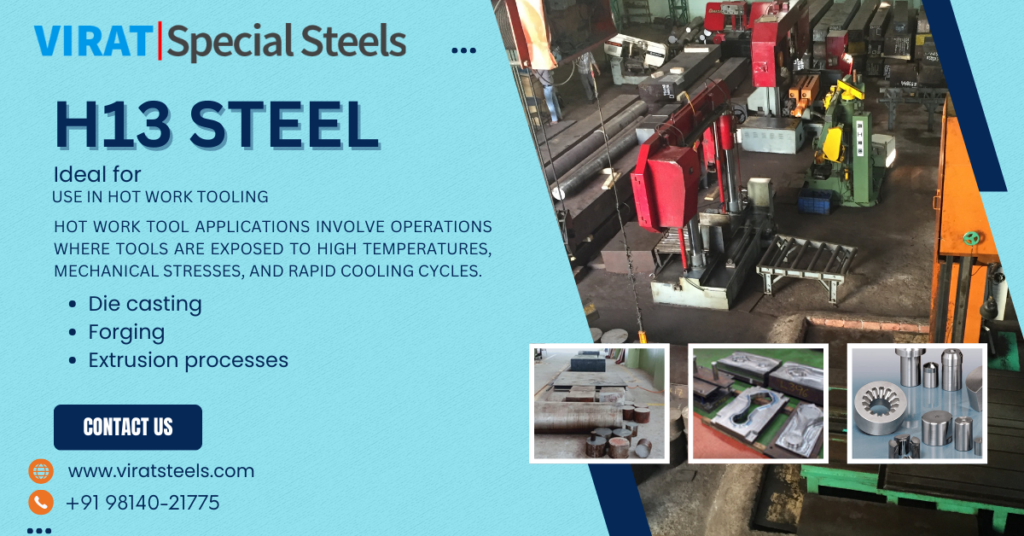
Hot work tool applications involve operations where tools are exposed to high temperatures, mechanical stresses, and rapid cooling cycles. These conditions demand materials that can maintain their properties without deformation, cracking, or excessive wear.
Industries Using Hot Work Tools
Several industries rely on hot work tools, including:
- Die casting – for producing metal components with intricate shapes
- Forging – shaping metals under extreme pressure
- Extrusion – forming materials into continuous profiles
- Plastic molding – high-heat plastic injection processes
Challenges in Hot Work Environments
Hot work tools face significant challenges, such as:
- High-temperature exposure leading to softening
- Thermal fatigue causing cracks
- Abrasive wear from repeated contact with molten metals
- Mechanical stress-induced failure
This is where H13 steel shines, offering unparalleled resistance to these harsh conditions.
Key Properties of H13 Steel
High Heat Resistance
H13 steel can endure temperatures up to 600°C (1112°F) without losing hardness. This makes it ideal for tools that come into direct contact with molten metals and other high-temperature environments.
Excellent Toughness and Ductility
Toughness is a critical factor in preventing cracking and chipping in hot work tools. H13’s balanced alloy composition provides excellent impact resistance, ensuring tools can withstand mechanical shocks and stress without failure.
Superior Wear Resistance
H13 offers outstanding wear resistance due to its alloying elements, particularly chromium and vanadium. This helps tools maintain their shape and performance over extended periods, reducing downtime and replacement costs.
Good Thermal Conductivity
Efficient heat dissipation is crucial in preventing overheating and thermal fatigue. H13 steel’s thermal conductivity allows it to distribute heat evenly, reducing localized stress and extending tool life.
High Hardenability and Stability
H13 retains its mechanical properties even after repeated heating and cooling cycles. It undergoes heat treatment effectively, ensuring a consistent hardness level and making it easier to machine.
Applications of H13 Steel in Hot Work Tools
Die Casting Molds
Die casting molds require materials that can withstand molten metal injections at high speeds and pressures. H13 steel’s resistance to heat checking and wear makes it ideal for casting aluminum, zinc, and magnesium.
Forging Dies
H13 is widely used in hammer and press forging dies, where it must endure extreme pressure and temperature fluctuations. Its ability to resist thermal fatigue helps prevent premature failure.
Extrusion Dies
Metal extrusion processes generate intense heat and stress. H13 steel ensures dimensional accuracy and prolonged die life, making it the go-to choice for aluminum and steel extrusion dies.
Plastic Molding Dies
In plastic injection molding, molds are subjected to repeated heating and cooling. H13’s stability ensures it can handle continuous cycles without deforming, making it perfect for high-volume production.
Comparing H13 Steel with Other Tool Steels
| Property | H13 Steel | D2 Steel | A2 Steel | P20 Steel |
| Heat Resistance | High | Medium | Low | Medium |
| Wear Resistance | High | Very High | Medium | Low |
| Toughness | High | Low | High | Medium |
| Thermal Conductivity | High | Low | Medium | High |
| Applications | Hot work | Cold work | General-purpose | Plastic molds |
H13 stands out as the best choice for hot work applications, offering a balance of wear resistance, toughness, and heat resistance.
Conclusion
H13 steel is a top-tier material for hot work tool applications, thanks to its:
- Exceptional heat resistance for high-temperature environments
- Toughness and durability to withstand mechanical stress
- Superior wear resistance for prolonged tool life
- Thermal stability to prevent overheating and deformation
With its outstanding properties, H13 remains the preferred steel for industries requiring high-performance hot work tools.
Mode of Supply
Virat Special Steels is the largest stockiest and supplier of H13 tool steel in flat, square and round bar. We provide steel in all sizes as your requirements. H13 die steel is available in flat, square and round shape. Consult our team who will assist you for h13 steel query.
FAQs
- What makes H13 better than other tool steels for hot work applications?
- H13 offers a superior combination of heat resistance, toughness, and wear resistance, making it ideal for demanding applications.
- Can H13 steel be used for cold work applications?
- While possible, H13 is specifically designed for hot work applications and may not perform as well in cold work environments.
- What is the typical hardness range of H13 steel after heat treatment?
- After proper heat treatment, H13 steel can achieve a hardness of 48-52 HRC.
- How does H13 resist thermal fatigue in die casting?
- H13’s heat resistance and thermal conductivity prevent cracking and deformation in extreme temperatures.
- What industries benefit the most from H13 steel?
Die casting, forging, extrusion, and plastic molding industries rely on H13 for durable tooling solutions.
H13 Tool Steel Hardness: Methods to Test and Optimize Performance
Introduction
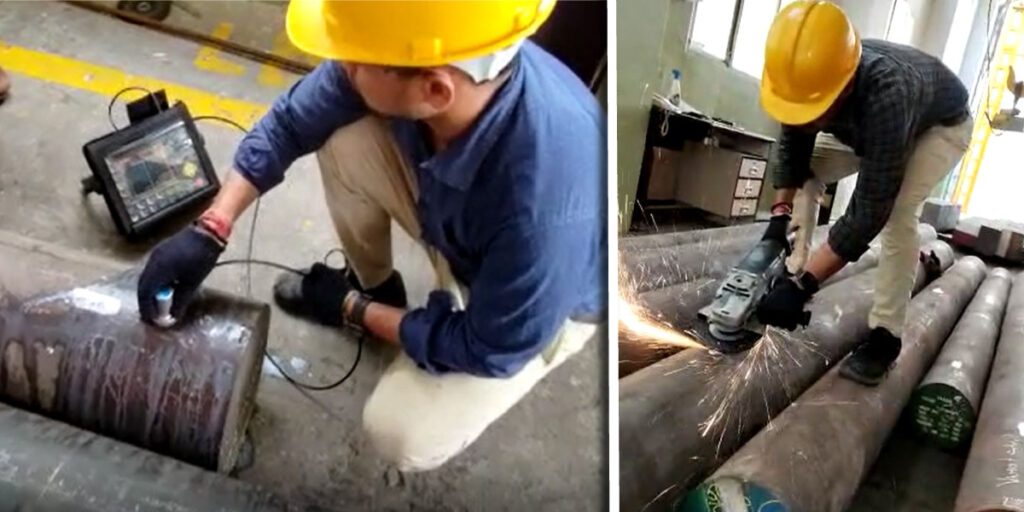
H13 tool steel stands out for its remarkable durability and thermal resistance, making it a preferred choice in industries such as automotive, aerospace, and manufacturing. However, its effectiveness hinges on maintaining optimal hardness, which directly impacts wear resistance, toughness, and performance under stress. This article explores various methods for testing H13 steel hardness and strategies to optimize it for maximum utility.
What is H13 Tool Steel?
H13 is a chromium-molybdenum hot work tool steel renowned for its exceptional strength and heat resistance. It contains:
- Chromium for enhanced corrosion resistance.
- Molybdenum and vanadium for superior toughness and wear resistance.
H13’s properties make it ideal for applications like:
- Forging dies.
- Injection molding tools.
- Extrusion dies.
- Die-casting components.
This robust tool steel withstands thermal fatigue, making it invaluable in environments with rapid temperature fluctuations.
Read More >