



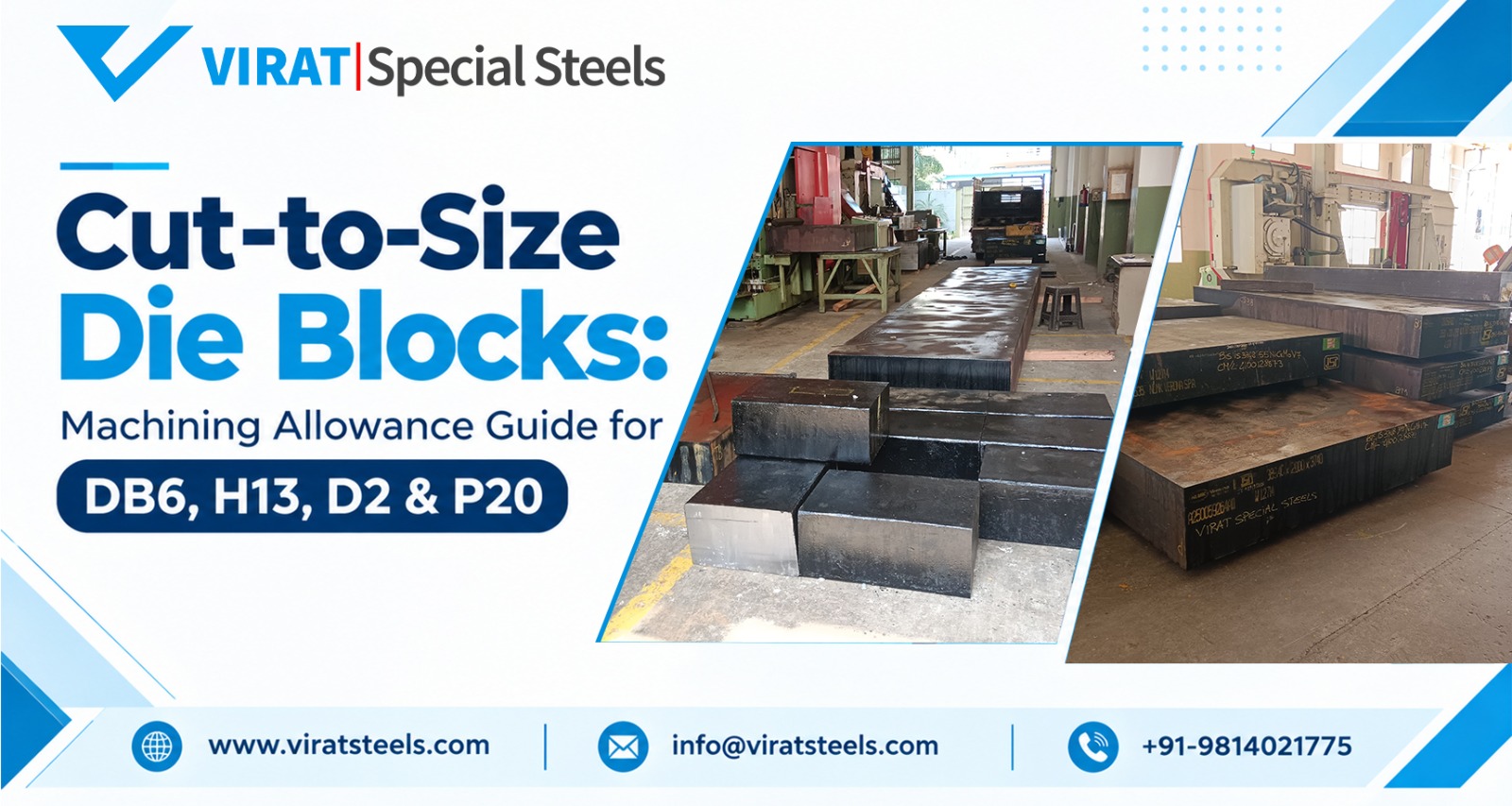
Cut-to-Size Die Blocks: Machining Allowance Guide for DB6, H13, D2 & P20
Technical guide by Virat Special Steels · Die and tool steel stockists since 1957
Order a Cut-to-Size Die Blocks with too little allowance and it can’t be cleaned up after heat treatment, so it ends up as scrap. Order too much and you pay for steel, sawing and machine time that turns into chips.
This manual provides us with a summary of the allowance for machining based on the requirements of the various categories from the Indian forging, die-casting, and toolroom industries including DB6 (DIN 1.2714), H13, H11, D2, D3, and P20.
Machining Allowance for Cut-to-Size Die Blocks
Plan these ranges per side (per face), then confirm with your supplier:
| Delivery condition | Allowance per side | What it has to cover |
| Black (hot-rolled or forged) | 3–6 mm for most sizes; more on wide sections | Scale, seams, decarburized skin, bow |
| Saw-cut and rough-milled | 1–2 mm | Remaining geometry error, semi-finishing |
| Six-side milled | 0.2–0.4 mm | Final sizing; standard programmes ship +0.4 to +0.8 mm over nominal overall |
| Precision ground with allowance | 0.15–0.3 mm | Final sizing only |
If hardening is going to be done after machining the piece, allow for at least 0.15% of each dimension on each side for the final finishing of the piece. For instance, a 200 mm face would require about 0.3 mm to be kept.
These figures are based on available data from the mills and actual shop practice; they should not be considered standard values. The actual numbers may depend on the type of alloy, the shape of the section and the method you use. Therefore, make sure to send an engineering drawing before you finish up.
What Is Machining Allowance on a Die Block?
The machining allowance refers to the additional material requested to have the workpiece in its finished form. This is often defined by a number for each side, such as 3 mm per side for a 6 mm allowance in total. With cut-to-size die blocks, you would incorporate this allowance in your order specifications and make sure to mention it on the order.
Breakdown of Machining Allowance Layers
Total allowance is a stack of four layers, and each one exists for a reason.
| Layer | What it covers | Planning figure per side |
| 1. Surface | Scale, seams, laps and the decarburized skin left by hot working | 1.6% of the dimension, usually not under 2 mm |
| 2. Geometry | Bow, camber, out-of-flat and cutting tolerance | 0.3–0.5 mm |
| 3. Heat treatment | Hardening movement, residual scale or decarburization | 0.15% of the dimension, minimum about 0.3 mm |
| 4. Finishing | EDM recast removal, polishing | Small; set by the finishing process |
Layer 1: surface. Hot rolling and forging leave scale, seams and a skin where carbon has burned out. That soft skin won’t harden properly, so it must go. The AISI benchmark for hot-rolled flats and squares is removal of at least 1.6% of the dimension per side (2.4% for resulfurized steel). It was written for carbon and alloy bars, so treat it as a floor for tool steel. Decarburization depth is measured to ASTM E1077 or ISO 3887.
Layer 2: geometry. No bar is perfectly straight or flat, and long pieces bow more. Cutting adds tolerance, and length is the loosest dimension: +3/+8 mm on Uddeholm’s saw-cut stock, up to +35 mm in some precision flat programmes. Never rely on sawn length for a fit.
Layer 3: heat treatment. The sound workflow is rough machine, stress relieve, semi-finish, harden, grind. Uddeholm recommends 650°C for two hours after roughing H13; Virat’s DB6 guidance is 600–650°C. The Böhler-Uddeholm D2 data sheet sets a minimum of 0.15% per side, but only with stress relief, and Uddeholm’s oil-hardening Arne steel lists 0.25%. Movement can be small: on a 100 × 100 × 25 mm H13 sample, thickness changes 0 to +0.05% after air hardening and up to +0.30% after oil hardening. Scale and decarburization from hardening must also be ground off, so the allowance is never just the movement figure.
Layer 4: finishing. Wire EDM leaves a recast layer. Uddeholm advises removing it by grinding or stoning, then re-tempering about 25°C below the previous tempering temperature. Polishing needs little stock.
Formula and Worked Example
Per side: cleanup (the greater of 2 mm or 1.6% of the dimension) + geometry buffer (0.5 mm) + grinding stock (0.15% of the dimension, minimum 0.3 mm). Order size = finished size + 2 × that total.
For instance, a D2 block, which has a final measurement of 250 × 150 × 50 mm owing to the black flat finish, requires a thickness of 4.9, 3.2 and 2.8 mm on each side. This means that one should order something in the order of 260 × 157 × 56 mm with the understanding that this is merely an estimate rather than a guarantee.
Seven mistakes that cost money
- Writing “+5 mm” without saying per side or total.
- Using one allowance for every grade and condition.
- Ignoring bow on long flats.
- Skipping stress relief between roughing and finishing.
- Accepting a gas-cut block to save a few rupees.
- Expecting ESR to shrink the allowance. ESR cleans the inside of the steel. The surface still carries scale and decarb.
- Hoping allowance will fix internal defects. It won’t. For critical blocks, ask for ultrasonic testing.
What to send with your enquiry
- Grade and drawing, with finished size (L × W × T)
- Process route: use as supplied, or harden after machining
- Heat-treatment method: vacuum or atmosphere furnace
- Supply condition wanted: black, milled or ground
- Cutting method and tolerance (saw cut, plus-only or plus-minus)
- Documents needed: MTC, UT, spectro check
- Quantity and delivery location
Specific Scenarios and Add-Ons
Pre-hardened die blocks (DB6, H13, P20). Virat supplies DB6 annealed or hardened and tempered, typically at 38–44 HRC. If you machine the block as supplied, Layer 3 disappears. Keep Layers 1, 2 and 4, and confirm the condition at order stage.
Hardening after machining (D2, D3, soft H13). Use all four layers. Machine soft, stress relieve, harden, then grind.
Wire EDM. Blocks for eroding are often bought hardened and ground, sometimes with start holes. Allow for recast removal and agree finishing stock with your EDM shop.
Flame or plasma-cut blanks. Avoid them for alloy tool steel. Thermal cutting leaves a hardened heat-affected zone and cracking risk, and needs far more stock. Band-sawing is the safer route.
Large forged blocks. Allowance grows with size, so never reuse a 100 mm figure on a 400 mm block. For heavy die blocks, ask for ultrasonic testing. Virat supplies DB6 die blocks with extra forging reduction and double tempering for better UT quality.
Nitriding. Nitrided cases are shallow (about 0.12–0.20 mm in Uddeholm’s H13 examples), so finish the block first and treat nitriding as a surface step, not an allowance layer.
Add-ons to request on your enquiry:
- Bandsaw cut-to-size and surface machining
- Annealed or hardened-and-tempered supply; ESR or non-ESR
- Ultrasonic testing
- Mill Test Certificate (EN 10204 3.1 where applicable), spectro and hardness reports
- Ground reference faces with squareness and parallelism limits
- Batch-wise traceability
Common Material Grades for Cut-to-Size Die Blocks
Allowance logic changes with the grade and its supply condition:
| Grade (AISI / DIN) | Typical use | Allowance note |
| DB6 / 1.2714 (L6) | Hammer and press forging dies | Often supplied hardened and tempered, so no heat-treatment layer |
| H13 / 1.2344 | Die casting, extrusion, hot forging | Air or vacuum hardening keeps movement small; stress relief still applies |
| H11 / 1.2343 | Forging and aluminium extrusion dies | Plan like H13 |
| D2 (HCHCr) / 1.2379 | Blanking and forming dies, punches | Air hardening; keep at least 0.15% per side with stress relief |
| D3 (HCHCr) / 1.2080 | High-abrasion, long-run tooling | Oil hardening; leave more grinding stock than D2 |
| P20 / 1.2311 | Plastic mould blocks | Usually pre-hardened; no heat-treatment layer |
| P20+Ni / 1.2738 | Large mould blocks | Better through-hardening in thick sections |
Sourcing and Customization Options
Virat Special Steels has nearly 3,500 tons in over 35 grades available at its yards in Ludhiana and Gurugram, resulting in large amounts of cut-to-size die blocks shipped out from stock. The billets originate from mills such as Swiss Steel, NLMK Verona, Lucchini and ThyssenKrupp. Blocks reach you in four conditions, each trading price for convenience:
- Saw-cut black block: lowest cost per kg, most allowance to remove.
- Rough-milled: surface layer gone, flatter.
- Six-side milled: close to size, less machining time. Check the stock left if you will harden.
- Hardened and ground: ready for EDM or fitting, with no allowance for further heat treatment.
Include these on your enquiry:
- Grade and delivery condition
- Finished size and order size, stating per side or overall
- Faces to be ground, with tolerances
- Hardening plan and target hardness
- Testing and certificates needed
- Quantity and delivery date
Contact VIRAT for Drawing-Based Sizing and a Quotation
Let us know your engineering drawing, steel grade, dimensions after machining (L x W x T), desired supply condition, volume, and destination point for supply by Virat Special Steels. Our experts will assist you in estimating machining allowance and provide appropriate die blocks as per your needs.
You may get in touch with us at +91-98140 21775 or write to us at info@viratsteels.com to request for a quotation. We manufacture DB6, H13, H11, D2, D3, and P20 tool and die steels from our Gurugram and Ludhiana plants, supplied across India as per availability.
Frequently Asked Questions
1. How much machining allowance should I leave on a die block? Plan 3–6 mm per side on black stock, 1–2 mm on rough-milled and 0.2–0.4 mm on six-side milled blocks, plus grinding stock if you will harden afterwards.
2. Is machining allowance per side or total? Normally per side. A 3 mm allowance adds 6 mm to each dimension, so always state “per side” or “overall” on your enquiry.
3. How much allowance should I keep for grinding after heat treatment? At least 0.15% of the dimension per side for D2 after stress relief. Oil-hardening grades need more; Uddeholm lists 0.25% for its O1-type Arne steel.
4. Do pre-hardened DB6 (DIN 1.2714) die blocks need heat-treatment allowance? Not if you machine them as supplied, typically 38–44 HRC. Keep the surface, geometry and finishing allowances only.
5. What do black, rough-milled and six-side milled mean? Black keeps the as-forged or as-rolled skin. Rough-milled has the skin removed with stock left. Six-side milled is square and parallel, close to final size, so you can start machining straight away.
6. What do “hot die steel”, “HCHCr”, “OHNS” and “die block” mean? Hot die steel is hot-work steel such as H13, H11 and DB6. HCHCr is high-carbon, high-chromium cold-work steel (D2 and D3). OHNS is oil-hardening non-shrinking steel, usually O1. A die block is a large forged or rolled block used for forging and casting dies.
7. Can I flame-cut or plasma-cut a die block? Avoid it for alloy tool steel. These processes will create a hardened heat-affected area, with the possibility of fracture and wasted material. Instead, consider using a band saw.
8. How much stock should I leave for wire EDM? Enough to remove the recast layer by grinding or stoning, followed by re-tempering about 25°C below the last tempering temperature. Agree exact stock with your EDM shop.
9. What tolerance can I expect on cut length? Length is the loosest dimension. Published saw-cut tolerances run from +3/+8 mm to +35 mm, so ask your supplier for its tolerance and never rely on sawn length for a fit.
10. Db6 or H13 for forging die blocks? The typical material for hammering and press dies is DB6 (DIN 1.2714), while H13 (DIN 1.2344) is the preferred alloy for hot-working conditions like die casting, extrusion, and hot forging. This depends on temperature, impact loads, die configuration, and service life.
11. Does D2 or O1 (OHNS) need more allowance? O1, an oil-hardening grade, needs more grinding stock than air-hardening D2. “Non-shrinking” does not mean no movement.
12. Can I buy a small cut piece instead of a full bar? Yes. Virat Special Steels can provide steel that is cut to size depending on the grade, dimensions and availability of stock. Please inform us of your desired dimensions and quantities.
13. Is cut-to-size priced per kg or per piece? Most manufacturers charge according to the overall weight including the costs of cutting and machining. The extra allowance will be reflected in the weight, too, so you should size it accurately and ask them for your cutting estimate.
14. How can I check I received the grade I ordered? Ensure that the heat number on the material marking is the same as stated in the Mill Test Certificate (MTC). Another way would be to ask for an OES analysis to prove the steel grade. Spark testing cannot be considered a reliable way of verifying the alloy tool steel grade.
15. Can I get MTC and ultrasonic testing on cut-to-size blocks? Yes, request them at order stage. Virat supplies MTC (EN 10204 3.1 where applicable), UT-tested material and spectro verification, subject to grade and product.
16. How fast can I get a quotation and delivery? To receive a quotation from Virat Special Steels, share your steel grade, drawing or size, quantity, and the place where the delivery will take place. The lead time varies from time to time, based on availability of material, any cutting/machining work, testing, and transport.
17. How do I calculate die block weight? Length × width × thickness in mm ÷ 1,000,000 × 7.85 gives kg, using a typical tool steel density of 7.85 g/cm³. A 250 × 150 × 50 mm block weighs about 14.7 kg.
18. Where can I buy cut-to-size die blocks in India? Virat Special Steels supplies DB6, H13, H11, D2, D3 and P20 die blocks from ready stock at Ludhiana and Gurugram, with PAN India delivery, subject to grade and size.
NLMK Verona Tool Steel DB6 (DIN 1.2714): Properties, Applications & Supply in India
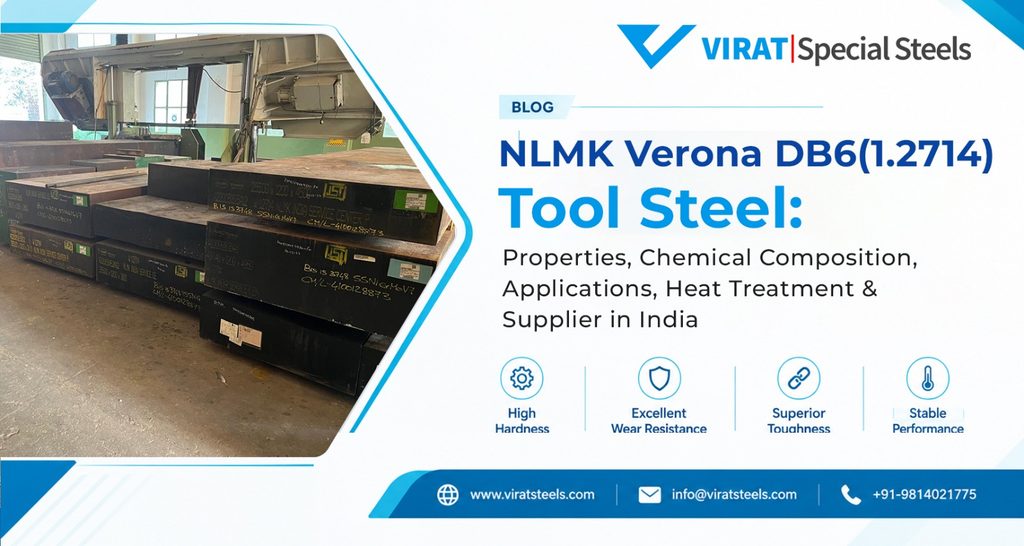
If you own a forging shop, die-making unit or heavy tooling operation, you know that the difference between a die that lasts one production run and one that lasts hundreds comes down to the steel underneath it. NLMK Verona Tool Steel DB6 is one of the European grades that is increasingly being specified by Indian manufacturers for close die forging, hammer dies and heavy-impact tooling – and with good reason.
This guide will explain what NLMK Verona DB6 really is, its real composition and mechanical properties, how it machines and heat-treats, where it is used and how to decide if it is the right grade for your application – all from verified technical data.
What Is NLMK Verona Tool Steel DB6?
NLMK Verona Tool Steel DB6 is a specialty tool steel plant of the NLMK Group, located in the north of Italy, close to Verona. The plant produces forged blocks, plates, and ingots for tool and die applications, and currently supplies its hot-work die steel to the Indian market under the DB6 designation — the specific grade Virat Steels stocks and distributes from this mill.
DB6 is not a proprietary or obscure code. It corresponds to well-established international standards:
| Designation | Standard |
| DB6 | Commercial/trade name |
| DIN 1.2714 | German (Werkstoff) standard |
| AISI L6 | American standard |
| AFNOR 55NCDVV7 | French standard |
| Standard family | 55NiCrMoV (Cr-Ni-Mo-V alloyed hot-work steel) |
To summarize, a buyer searching for “NLMK Verona DB6”, “db6 nmlk verona” or “nmlk verona die steel” is looking for this specific chromium-nickel-molybdenum-vanadium alloyed hot-work die steel, a popular grade in the European and Indian tooling supply chains, now available from NLMK Verona’s Italian production.
Chemical Composition of NLMK Verona Tool Steel DB6 / DIN 1.2714
DB6 is a Cr-Ni-Mo-V alloy system which provides a balance of toughness and hardness:
| Element | C | Si | Mn | P | S | Cr | Ni | Mo | V |
| % Range | 0.50–0.60 | 0.10–0.40 | 0.65–0.95 | ≤0.03 | ≤0.03 | 1.00–1.20 | 1.50–1.80 | 0.45–0.55 | 0.07–0.12 |
DB6 has high toughness and impact resistance (compared to more common hot-work grades such as H13) and high nickel content (compared to more common hot-work grades such as H13) for exceptional toughness and impact resistance rather than pure high-temperature hardness retention.
Mechanical Properties
| Property | Value |
| Tensile Strength | 1000–1400 MPa |
| Yield Strength | 1045 MPa |
| Elongation | 15%–20% |
| Impact Toughness | 20–25 J/cm² |
| Hardness (working) | 50–55 HRC |
| Compressive Strength | 2500 MPa |
| Modulus of Elasticity | 205 GPa |
Typical supply hardness ranges (depending on treatment condition):
- Annealed condition: 255 BHN max
- Hardened & tempered: 38–42 HRC (die-ready condition), with tools further hardened up to 50–55 HRC for service
- Hardness variation, surface to core: 20–25 BHN
Physical Properties
| Coefficient of Thermal Expansion (10⁻⁶ m/m·K) | 20–100°C | 20–200°C | 20–300°C | 20–400°C | 20–500°C | 20–600°C |
| Value | 12.1 | 13.1 | 13.2 | 13.5 | 14.1 | 14.3 |
| Thermal Conductivity (W/m·K) | 20°C | 350°C | 700°C |
| Value | 35.0 | 39.0 | 36.0 |
Note: Exact physical values can vary slightly with heat treatment and section size — always cross-check against the mill test certificate for critical applications.
Machinability of NLMK Verona DB6
DB6 is easy to work and the machinability can be rated at about 90 % relative to W-group water-hardening low-alloy steels taken as the 100 % reference. This makes it much easier to machine than many high-alloy cold-work or high-speed steel grades, and still retains the toughness needed for heavy forging dies.
Practical machining notes:
- Best machined in the annealed condition (≤255 BHN) before final hardening
- Finish machining should ideally be completed before final hardening and tempering, with only grinding/polishing done after
- Stress-relief before hardening reduces distortion risk in large die blocks
Heat Treatment Guide
| Process | Parameters |
| Annealing | Soak at 740–760°C, furnace-cool at max 10°C/hr down to 600°C, then air cool |
| Hardening | Preheat to 650°C, raise quickly to 900–950°C, quench in oil |
| Hardening (mill data) | 840–880°C oil quench → 57 HRC; 860–900°C air quench → 55 HRC |
| Tempering | Multiple tempers; hardness drops from ~56 HRC (100°C temper) to ~34 HRC (650°C temper) |
| Stress Relieving | Heat to 600–650°C, soak 2 hrs per 25mm section, slow cool |
| Forging | Warm to 700°C, raise to 1050°C, keep forging above 800°C, cool slowly in furnace/vermiculite |
| Nitriding | Possible after hardening + tempering; done ~50°C above nitriding temperature |
| Normalizing | Not recommended — DB6 is air-hardening |
Applications of NLMK Verona DB6 Tool Steel
DB6’s high toughness and impact resistance make it especially suited to heavy-impact forging applications rather than pure high-temperature die casting:
- Dies for drop forging hammers & mechanical presses
- Die holders, cassettes, and shoe blocks
- Hot shear blades
- Piston rods, cranks, and boosters
- Punches and blanking/forming dies
- Trimmer dies
- Clutch parts, pawls, shafts, knuckle pins
- Forming rolls, spindles, and rollers
Industries: Automotive component manufacturing, heavy forging, aerospace tooling, general engineering, and metalworking.
Advantages of NLMK Verona DB6 Tool Steel
- Superior toughness and impact resistance compared to many hot-work alternatives — ideal where shock loading, not just heat, is the main stress
- Good hardenability through thick sections, suited to large forging die blocks
- European mill origin (NLMK Verona, Italy) with documented alloy composition
- Good machinability (~90% relative rating) compared to many alloy tool steels
- Nitriding-compatible for surface wear resistance without sacrificing core toughness
- Supplied by Virat Steels with extra forging reduction, upsetting, and double tempering for improved ultrasonic quality in die blocks
DB6 vs H13 vs D2 — Comparison Table
| Factor | DB6 (DIN 1.2714) | H13 (DIN 1.2344) | D2 (Cold Work) |
| Category | Hot-work, high-toughness | Hot-work, high-temp hardness | Cold-work, high wear resistance |
| Key strength | Toughness & impact resistance | Thermal fatigue resistance | Abrasion/wear resistance |
| Typical hardness | 50–55 HRC | ~50 HRC | 58–62 HRC |
| Best suited to | Hammer/press forging dies, shock loading | Die casting, extrusion dies | Blanking, punching, cold forming |
| Machinability | Good (~90% rating) | Good | Moderate (high alloy content) |
| Nickel content | High (1.5–1.8%) | None | None |
How to Choose Between NLMK Verona Tool Steel DB6 (and Other Grades)?
- Is your tooling exposed to repeated impact/shock loading? DB6 is specifically strong here — hammer forging and heavy press dies benefit most from its toughness.
- Is your process purely high-temperature (die casting, hot extrusion) with less shock? H13 (DIN 1.2344) may be a better fit than DB6 due to superior thermal fatigue resistance.
- What supply condition do you need? DB6 is available annealed or hardened & tempered — confirm this at order stage based on your in-house heat treatment capability.
- What section size does your die need? Large forged blocks require good through-thickness hardenability — DB6’s alloy design supports this.
- Do you need surface hardening? DB6 can be nitrided after hardening/tempering for improved wear resistance while keeping core toughness.
- Do you need ultrasonic-tested quality die blocks? Ask specifically for extra forging reduction and double-tempered blocks — Virat Steels supplies DB6 this way for critical forging applications.
Why Source NLMK Verona DB6 Through Virat Steels?
- NLMK Verona origin DB6/DIN 1.2714 Steel – Official stockist and supplier
- PAN-India supply network covering major forging & auto hubs (Ahmedabad, Pune, Chennai, Bengaluru, Delhi NCR, Ludhiana etc.)
- Flat, square, and round bar available in project-based quantities
- Extra forging reduction and double tempering for improved ultrasonic quality on die blocks
- Technical support to confirm the right grade — DB6 vs H13 vs other die steels — for your specific application
Frequently Asked Questions
1. What is NLMK Verona Tool Steel DB6?
It is a Cr-Ni-Mo-V alloyed hot-work die steel (DIN 1.2714 / AISI L6) produced by NLMK Verona, Italy and supplied in India by Virat Steels.
2. What is DB6 steel equivalent to?
DB6 is commonly equivalent to DIN 1.2714, AISI L6, and AFNOR 55NCDVV7.
3. What is the hardness of DB6 steel?
Working hardness is typically 50–55 HRC after hardening and tempering; annealed condition is supplied at 255 BHN max.
4. Is DB6 better than H13 steel?
DB6 provides higher toughness and impact resistance, hence better suited for heavy forging, whereas H13 is more suitable for high temperature hot-work processes such as die casting.
5. Which steel is better for hammer forging dies?
DB6 is generally preferred for hammer forging dies due to its superior toughness and shock resistance.
6. What is the chemical composition of DB6?
Approximately 0.50–0.60% C, 1.00–1.20% Cr, 1.50–1.80% Ni, 0.45–0.55% Mo, and 0.07–0.12% V.
7. Can DB6 steel be welded or re-hardened?
Yes, but it must be done carefully — with stress tempering for pre-hardened condition — to avoid cracking.
8. Is DB6 steel suitable for hot work applications?
Yes, DB6 performs well in hot-work applications due to its strength and toughness at elevated stress conditions.
9. What is the machinability of DB6 steel?
DB6 rates roughly 90% machinability relative to W-group water-hardening steels (100% baseline) — considered good.
10. Should DB6 be normalized?
No — DB6 is air-hardening and should not be normalized.
11. Can DB6 be nitrided?
Yes, after hardening and tempering, at approximately 50°C above the intended nitriding temperature.
12. What shapes is NLMK Verona DB6 available in?
Flat, square, and round bar, supplied by Virat Steels across India.
13. Does Virat Steels supply NLMK Verona DB6 in India?
Yes, Virat Steels is a stockist and supplier of NLMK Verona-origin DB6/DIN 1.2714 tool steel.
14. What industries use DB6 tool steel?
Automotive components, heavy forging, aerospace tooling and general engineering.
15. What is the forging temperature range for DB6?
Heat to 700°C and then raise rapidly to 1050°C. Keep forging temperature above 800°C.
16. What’s the distinction between DB6 and DIN 2713?
The DIN 2713 is improved for better die performance and is called DIN 2714 (DB6).
17. What tensile and yield strength does DB6 offer?
Tensile strength 1000–1400 MPa, yield strength ~1045 MPa.
18. Does DB6 require oil or air quenching?
Both are used. Oil quenching at 840-880 °C gives ~57 HRC. Air quenching at 860-900 °C gives ~55 HRC.
19. What documentation should I request when ordering NLMK Verona DB6?
Always request a mill test certificate (MTC) confirming the heat/batch chemical composition and mechanical test results.
20. Where can I buy NLMK Verona DB6 tool steel in India?
Virat Steels supplies and stocks NLMK Verona DB6/DIN 1.2714 steel PAN-India, including to Gurugram, Delhi NCR, Pune, Chennai, and other major industrial hubs.
Conclusion
NLMK Verona Tool Steel DB6 (DIN 1.2714 / AISI L6) is the best solution for one simple reason: toughness where it counts – in heavy forging dies subject to repeated shock loading. Its Cr-Ni-Mo-V alloy design, excellent machinability and good hardenability make it a preferred choice for forging shops and die makers across India.
Need NLMK Verona DB6 die blocks, flats, squares, or round bars for your next forging project? Get in touch with Virat Steels — share your drawing and section size requirement, and our team will confirm grade, stock availability, and delivery timelines.
+91-98140 21775 | info@viratsteels.com
D2 vs D3 Material: Composition, Hardness, Properties & Selection Guide
If you manufacture dies, punches, molds or precision tooling, you may need to choose between D2 vs D3 material. Both are high-carbon, high-chromium cold-work tool steels, but their chemical composition, carbide structure, heat-treatment response, toughness, machinability and wear resistance differ.
D2 material contains molybdenum and vanadium and provides a good balance of wear resistance, toughness and dimensional stability. D3 material has higher carbon and carbide content and is generally considered for applications where high abrasion resistance is required and impact loading is relatively low.
In this guide, we compare D2 vs D3 material in terms of chemical composition, hardness, properties, machinability, applications, cost considerations and grade equivalents to help you understand the factors involved in selecting between the two grades.
What Is D2 Material?
D2 material is a type of air-hardening cold work tool steel that has a high carbon content and high chromium content. It is used in making die and punch tools. It has good dimensional stability in heat treatment and excellent wear resistance. It is sometimes called a “semi-stainless” steel because of its relatively high chromium content.
D2 Steel is popular in many industries, from metal stamping and forming to knife making. It offers a good balance of hardness, edge retention and reasonable toughness.
D2 Chemical Composition
Based on Virat Steels’ own AISI D2 technical data, the typical D2 steel chemical composition is:
| Element | Typical % (D2 material composition) |
| Carbon (C) | 1.40 – 1.60% |
| Chromium (Cr) | 11.00 – 13.00% |
| Molybdenum (Mo) | 0.70 – 1.20% |
| Vanadium (V) | 0.50 – 1.10% |
| Manganese (Mn) | 0.10 – 0.60% |
| Silicon (Si) | 0.10 – 0.60% |
| Iron (Fe) | Balance |
D2 has high carbon and chromium content, which results in large volumes of hard carbides being formed, contributing to its excellent abrasion resistance. Vanadium refines the primary grain structure and forms strong carbides which increase wear resistance, edge holding and high temperature strength. Molybdenum increases the hardenability in conjunction with other alloying elements. This Mo + V combo is the big metallurgy difference from D3, and why D2 generally holds a sharper edge longer.
D2 Material Hardness in HRC
This is one of the most searched questions about the grade, so let’s separate the two conditions clearly:
- D2 material hardness in HRC before heat treatment (annealed/as-supplied condition): D2 comes in a soft condition for ease of machining. D2 in the annealed condition is normally 217-255 HB (Brinell) – which is approximately equivalent to low to mid 20’s on the HRC scale, but Brinell is the standard way this soft condition is actually measured and reported.
- D2 hardness after heat treatment (hardened & tempered): D2 hardness after hardening is 58-62 HRC with a tensile strength of approximately 1,900 MPa and a compressive strength of more than 2,700 MPa. Some suppliers quote a maximum hardness closer to 62 HRC.
Thus, if one asks for “d2 hrc” or “d2 hardness in hrc” without mentioning the state of the material, then the correct response would be that “it depends on whether you are referring to the ‘as supplied’ state (which is soft and machinable) or ‘post heat treatment’ state (which is hard).”
D2 Properties & Applications
D2 grade steel is known for:
- High abrasion and wear resistance
- Good dimensional stability during hardening (it’s air-hardening, so distortion is minimal).
- Mo/V carbides offer good edge retention
- Semi-stainless behavior in dry environment (mild corrosion resistance)
- Toughness is relatively lower than shock-resisting grades such as S7
Typical applications:blanking and piercing dies, forming dies, thread rolling dies, punches, shear blades, slitter knives, cold extrusion tooling and wear-critical mold components such as guide pins, wear plates and cavity inserts where abrasion – not impact – is the dominant failure mode.
What Is D3 Material?
D3 grade material (AISI/ASTM D3) is another form of high-carbon and high-chromium cold-work tool steel, but it has completely distinct characteristics when it comes to its quenching process. One of the differences of D3 material from other D-series steels lies in the fact that it does not contain 1% of molybdenum. D3 is oil-quenched instead of air-hardened, but small sections can be vacuum/gas-quenched. This oil-hardening route makes tools made from D3 more susceptible to brittleness during the hardening. Internationally, D3 is equivalent to DIN/Werkstoff 1.2080 (X210Cr12) – also known as SKD1 in Japan and Cr12 in China.
D3 Chemical Composition
| Element | Typical % (D3 material composition) |
| Carbon (C) | ~1.90 – 2.20%* |
| Chromium (Cr) | ~11.00 – 13.50%* |
| Manganese (Mn) | ≤ 0.60% |
| Silicon (Si) | ≤ 0.60% |
| Molybdenum / Vanadium | Not a defining addition (unlike D2) |
| Iron (Fe) | Balance |
D3 has a higher carbon content and about the same chromium content as D2, but without the Mo/V additions . This results in a larger volume of primary chromium carbides . That’s the main reason, D3 usually beats D2 on raw abrasion resistance at the expense of toughness.
D3 Material Hardness in HRC
D3 can be heat treated to 58-64 HRC hardness. This is supported by many independent technical data sources for the grade. Like D2, the material hardness of D3 in HRC is highly dependent on the tempering temperature chosen and the section thickness being hardened — for a given tool, verify the target hardness with your heat treatment partner before nailing down the process route.
In the annealed/as supplied condition D3 is also kept soft for machining, generally in line with the rest of the D-series family, but exact annealed hardness should be verified on the supplier’s certificate rather than assumed.
D3 Properties & Applications
- Superior wear and abrasion resistance – Usually rated better than D2 because of increased carbide volume
- Excellent dimensional stability in heat treatment, size retention almost as good as air hardening types such as D2
- High compression strength
- It is less tough than D2 and more prone to chip when subjected to shock or impact loading
- Due to its abrasion resistance, machining should generally be restricted to finish grinding after hardening
Typical applications: forming rolls, drawing dies, powder compaction tooling and lamination dies as well as blanking dies, punches, shear blades, gages and thread rolling dies. Basically high volume, low shock, high abrasion tooling.
D2 vs D3 Material: Key Differences
| Parameter | D2 Material | D3 Material |
| Standard / Equivalent | AISI D2, DIN 1.2379 | AISI D3, DIN 1.2080 |
| Hardening method | Air-hardening | Oil-hardening (air/vacuum for small sections) |
| Carbon content | 1.40–1.60% | ~1.90–2.20%* |
| Chromium content | 11.00–13.00% | ~11.00–13.50%* |
| Mo / V alloying | Present (0.7–1.2% Mo, 0.5–1.1% V) | Not a defining addition |
| Annealed hardness | ~217–255 HB | Similar soft range (verify per MTC) |
| Hardened hardness | 58–62 HRC | 58–64 HRC |
| Wear resistance | Very good | Excellent (typically higher than D2) |
| Toughness | Better of the two | Lower — more brittle |
| Dimensional stability | Excellent | Good, slightly more distortion risk |
| Machinability | Low | Lower than D2 |
| Corrosion resistance | Mild (semi-stainless behaviour) | Similar chromium level, comparable behaviour |
| Best suited for | Long-run dies, punches, wear parts needing edge retention | High-abrasion, low-impact forming/drawing tooling |
| Relative cost | Generally carries an alloy premium (Mo + V) | Often positioned as the more economical D-series option |
*See composition notes above — verify exact figures with your supplier’s mill certificate.
Machinability: D2 vs D3
Both grades have their reputation as “difficult but worth it” in machinability. D2 has a machinability of about 27% of AISI 1112 steel. This is poor compared to general engineering steels, but typical for high performance tool steels of this class.
D3 is generally considered more difficult to machine than D2, because of its higher carbon content and greater volume of carbides. In practice many fabricators machine D3 in the annealed condition and then rely mainly on grinding to bring it to the hardened state, rather than attempting conventional cutting once the hardness is achieved.
Practical takeaway: D2 is the more forgiving option if you have a lot of machining to do after heat treat. If the bulk of the shaping is done before hardening (with finish grinding done after), the lower machinability of D3 is less of a concern.
Which Industries Use D2 and D3?
The two grades cater to different, though similar, parts of the tool and die market segment:
- Tool & die manufacturing: Blanker, piercer and former dies ( grades D2 and D3)
- Mould manufacturing / injection moulding: Wear plates, guide pins, ejector parts and mold cavities exposed to abrasive plastic or filler material (grade D2 where toughness and machinability are important in addition to wear resistance)
- Metal stamping & press tooling: Long run punches and dies (grade D2 for edge wear; grade D3 for abrasion resistance only)
- Wire and thread rolling: thread rolling dies (both grades)
- Sheet metal forming: forming rolls and drawing dies (D3’s strength)
- Powder metallurgy & compaction tooling: compaction dies (D3)
D2 vs D3: Price Considerations
Pricing is specific to section size, quantity, prevailing raw material and alloy surcharge rates, and finishing requirements (rolled, forged, ground, ESR, etc.). We will not give a fixed figure here as this would quickly become outdated and is order dependent.
For example, in general terms: The inclusion of molybdenum and vanadium in D2 usually makes it a slightly more expensive alloy choice than the D3 alloy, which mostly uses carbon and chromium for its composition. For that reason, the D3 alloy can be marketed as the relatively cheaper high-chromium cold work alloy, while D2 comes at a higher cost due to its superior toughness and machinability properties. A quotation request can be made from the manufacturer regarding your required quantity.
How to Choose Between D2 vs D3 Material?
Use these questions to guide the decision:
- Is toughness or pure wear resistance more critical? If your tool sees any shock loading, impact, or lateral force, lean toward D2 (or reconsider A2/S7 for high-shock jobs). If it’s a steady, high-volume abrasive wear situation with minimal impact, D3’s extra hardness pays off.
- How much post-hardening machining is required? If your design needs precision machining after heat treatment, D2’s better machinability makes it the safer choice.
- What’s your quenching setup? D2’s air-hardening gives more forgiving dimensional control for complex geometries; D3’s oil-hardening needs more careful process control, especially on larger sections.
- What’s the production volume and expected tool life target? For very long die life with less concern about impact, D3’s superior abrasion resistance can extend service intervals.
- What’s the budget? If cost-per-kg is a tight constraint and the application doesn’t demand D2’s toughness, D3 is usually the more economical route.
- Does the component need any corrosion resistance in service? Both offer mild, comparable resistance — neither is a substitute for stainless grades in wet/corrosive environments.
If you’re unsure after weighing these factors, share your drawing and application details with Virat Steels’ technical team — grade selection is easier with a specific load case in front of you rather than generic comparisons.
FAQs: D2 vs D3 Material
- What is the difference between D2 and D3 material? D2 and D3 differ in composition and hardening method: D2 contains added molybdenum and vanadium and is air-hardened, while D3 has higher carbon content, no defining Mo/V addition, and is oil-hardened.
- What is D2 material? D2 Steel is an air hardening tool steel that consists of high carbon and chromium content (AISI D2 / DIN 1.2379).
- What is D2 material’s chemical composition? composition is 1.40–1.60% carbon, 11.00–13.00% chromium, 0.70–1.20% molybdenum, 0.50–1.10% vanadium, plus manganese and silicon in the 0.10–0.60% range.
- What is D2 material hardness in HRC? The D2 material usually attains 58-62 HRC after heat treatment. When it is annealed (or before heat treatment), it is provided in the softer form, which is around 217-255 HB.
- What is D2 material hardness in HRC before heat treatment? D2 material is provided in the soft or annealed state before heat treatment, and hence it is not provided in HRC but is provided in Brinell hardness scale (i.e., roughly 217-255 HB).
- What is D3 material’s hardness in HRC? The hardness of the D3 material in HRC ranges from 58-64 HRC after heat treatment.
- Is D2 or D3 harder? D3 has a slightly higher maximum hardness, up to about 64 HRC, compared to D2’s maximum of around 62 HRC, due to its higher carbon content and carbide volume.
- Which is tougher, D2 or D3? D2 is tougher due to fine, balanced carbide formation, while D3’s higher carbon content makes it less tough.
- Can D2 and D3 be used interchangeably? No. Although D2 and D3 have similar properties, there are differences that make D3 inadequate in certain applications where D2 works fine and vice versa.
- Which is better for injection moulds — D2 or D3? D2 can be used for wear-resistant mould components such as guide parts, wear plates and selected inserts, where good wear resistance, dimensional stability and machinability are required. D3 is generally more suitable for applications where very high abrasion resistance is the primary requirement and impact loading is low. The appropriate grade depends on the mould material, filler content, loading conditions, required hardness and manufacturing process. .
- What is D2 material grade used for? D2 grade is suitable for blanking and piercing dies, forming dies, thread rolling dies, punches, shear blades, and wear-related mold inserts..
- Is D2 a stainless steel? No, it is not stainless steel as it contains sufficient chromium content to resist corrosion in dry environments (also known as “semi-stainless”).
- Why is D3 harder to machine than D2? The carbon content in D3 is higher, and the volume of primary chromium carbides in D3 is higher than that of D2, making it more abrasive but at the same time leading to faster wear of the cutting tools during machining.
- What is the price difference between D2 and D3? The price of D2 is slightly higher than that of D3 since D2 contains molybdenum and vanadium. However, the actual price is dependent on the section size, volume and market prices.
- What are the DIN/international equivalents of D2 and D3? D2 is equivalent to DIN/Werkstoff 1.2379 (X153CrMoV12). D3 is equivalent to DIN/Werkstoff 1.2080 (X210Cr12), known as SKD1 (Japan) and Cr12 (China).
Conclusion
While both D2 and D3 have been confirmed as having high carbon and high chromium content cold work tool steel, it does not mean that they are one and the same only branded differently. The addition of molybdenum and vanadium in D2 makes it tougher and easier to machine, hence it is better used in dies, punches, and die elements. The increased carbon in D3 increases its wear resistance and hardness; however, it reduces toughness.
The right grade depends on your specific load conditions, production volume, and machining process — not a generic “which is better” answer.
Need help selecting between D2 and D3 for your next tooling project? Virat Steels supplies both grades with full mill test certification and technical support to match the right steel to your application. Get in touch with our team for a quote or a grade recommendation based on your drawing.
Our technical team will confirm grade equivalence, available sizes and delivery timeline within 24 hours.
Prefer to talk directly?
Gurugram, Haryana | Ludhiana, PunjabPhone: +91-98140-21775
Email: info@viratsteels.com
P20 vs P20+Ni Tool Steel: Properties, Comparison, Applications & Selection Guide
The choice of the correct mold steel directly influences machining time, surface finish, dimensional stability, mold life and total tooling cost. P20 vs P20+Ni tool steel are two of the most common choices for plastic injection molds and related tooling.
Both grades relate to plastic mold manufacturing, but are not interchangeable in all applications. P20 is usually chosen for its combination of machinability, toughness, polishability and cost. Nickel-alloyed P20 grades are often considered for larger sections which require more uniform through-hardening.
This guide will explain the differences between P20 vs P20+Ni tool steel their properties, applications, machinability and what mold makers and procurement teams should be looking for when ordering material.
Virat Steels is a leading supplier of tool and die steel to manufacturers of the plastic molding, die casting and precision tooling industries. The P20-family of steels are amongst the most requested grades. Let’s get into the nitty gritty.
What Is P20 Tool Steel?
P20 tool steel is a low alloy mold steel which is commonly used for plastic injection molds, mold bases, tooling components and some die applications.
In Europe the common designation is 1.2311 / 40CrMnMo7 but it is normally linked to AISI P20. For example, Industeel describes 1.2311 as a pre-hardened mold steel for plastic mold applications that is approximately equivalent to P20.
P20 is valued for offering a practical balance between:
- Good machinability
- Good toughness
- Good polishability
- Useful strength in the pre-hardened condition
- Suitable dimensional stability for mould manufacturing
- Good suitability for general-purpose plastic mould tooling
Depending on the producer and supply condition, P20 may be supplied annealed or pre-hardened. Therefore, the actual hardness and machinability should be confirmed against the supplier’s technical datasheet and material certificate.
What Is P20+Ni Tool Steel?
P20+Ni tool steel is a mold steel alloyed with nickel, developed to enhance through hardening properties relative to conventional P20 type grades.
One common designation is DIN 1.2738 / 40CrMnNiMo8-6-4. Nickel addition is especially helpful for a mold or die with a relatively large section in which a more consistent hardness from surface to core is desired.
P20+Ni is widely associated with applications requiring a combination of:
- Good toughness
- Good machinability
- Good polishability
- More uniform hardness in larger sections
- Good dimensional stability
- Reliable performance in plastic mould tooling
The actual performance will depend on the steelmaker, the manufacturing route, the section size and the heat-treatment condition; the mill certificate should always be quoted in the procurement specifications.
P20 Tool Steel Properties
The main attraction of P20 is its balanced performance rather than one extreme property.
1. Good machinability
P20 is usually supplied in a condition that is readily machinable by mold makers to produce cavities, cores, bases and other components. Its machinability is practical for complex mold geometries and general tool making.
2. Good polishability
Surface finish is critical in plastic injection moulding. A properly produced P20-grade steel can provide good polishability, making it suitable for mould surfaces where appearance and surface quality are important.
The final achievable finish, however, depends on steel cleanliness, homogeneity, heat treatment, machining practice and polishing technique.
3. Toughness
P20 offers a useful combination of strength and toughness for general mould applications. This makes it suitable when the mold has to withstand repeated clamping, injection and mechanical stresses without becoming too hard and brittle.
4. Pre-hardened availability
Many P20 products are supplied in a pre-hardened condition. This can reduce or eliminate the need for additional hardening before machining, depending on the required application and supplied condition.
For example, Industeel will specify its 1.2311 mold steel in a pre-hardened condition at around 280-325 HB, while other producers may specify different delivery conditions.
Confirm the actual hardness range with the supplier before machining or designing the mold.
P20+Ni Tool Steel Properties
P20+Ni has several practical features of P20 but has nickel added to raise hardenability.
1. Improved through-hardening
A key reason for choosing P20+Ni is that it provides more uniform hardness over larger sections.
This is particularly important for large mold blocks where a large difference between surface and core properties may have an impact on machining, dimensional stability or service performance.
2. Good toughness
P20+Ni has been developed to provide optimum hardness and toughness rather than just maximum hardness.
This makes it suitable for molds that are subject to repeated mechanical stresses and applications where cracking or premature failure would be costly.
3. Good polishability
P20+Ni grades are commonly selected for moulds requiring good surface finishing and polishing performance. Steel cleanliness and low sulphur practice can be particularly important when high-quality polished surfaces are required.
4. Good machinability
Despite its enhanced hardenability, P20+Ni is still used extensively for mould manufacturing because it provides a useful combination of machinability, toughness and polishability.
P20 vs P20+Ni tool steel: Quick Comparison Table
| Parameter | P20 Tool Steel | P20+Ni Tool Steel |
| Common designation | 1.2311 / P20* | 1.2738 / P20+Ni* |
| Steel type | Plastic mould steel | Nickel-alloyed plastic mould steel |
| Main advantage | Balanced performance and machinability | Improved through-hardening |
| Machinability | Good | Good |
| Toughness | Good | Good to very good, depending on grade/condition |
| Polishability | Good | Good to excellent, depending on quality |
| Large-section performance | Suitable, but section-dependent | Generally preferred for larger sections |
| Typical mould use | General plastic moulds and mould bases | Large/deeper moulds and demanding mould blocks |
| Supply condition | Often pre-hardened | Often supplied pre-hardened |
| Cost | Generally lower | Generally higher |
| Selection priority | General-purpose tooling | Large sections and more uniform core properties |
Exact grade equivalence and specifications should be verified against the applicable standard and mill certificate.
H13 vs P20 vs P20+Ni tool steel: How Does a Hot-Work Steel Compare?
P20 vs P20+Ni tool steel are both cold/warm-work mould steels. H13 (DIN 1.2344) belongs to a different family entirely — it’s a chromium-molybdenum-vanadium hot-work tool steel, built to hold its hardness under sustained heat rather than to machine and polish easily at room temperature. It’s included here because mould makers sometimes weigh it against the P20 family when a tool will see higher thermal or mechanical loading than a standard plastic mould.
Chemical Composition (wt %)
| Element | P20 (1.2311) | P20+Ni (1.2738) | H13 (1.2344) |
| Carbon (C) | 0.35 – 0.45 | 0.35 – 0.45 | 0.32 – 0.45 |
| Silicon (Si) | 0.20 – 0.40 | 0.20 – 0.40 | 0.80 – 1.25 |
| Manganese (Mn) | 1.30 – 1.60 | 1.30–1.60 | 0.20 – 0.60 |
| Phosphorus (P), max | 0.03 | 0.03 | 0.03 |
| Sulphur (S), max | 0.03 | 0.03 | 0.03 |
| Chromium (Cr) | 1.80 – 2.10 | 1.80 – 2.10 | 4.75 – 5.50 |
| Molybdenum (Mo) | 0.15 – 0.25 | 0.15 – 0.25 | 1.10 – 1.75 |
| Vanadium (V) | — | — | 0.80 – 1.20 |
| Nickel (Ni) | — | 0.90–1.20 | — |
H13‘s much higher chromium and the addition of vanadium and higher molybdenum are what separate it from the P20 family — those elements are what give it hot hardness and resistance to thermal fatigue, at the cost of some room-temperature machinability.
Property & Application Comparison
| Parameter | P20 | P20+Ni | H13 |
| Steel family | Cold/warm-work mould steel | Nickel-alloyed cold/warm-work mould steel | Hot-work tool steel |
| Typical supply hardness | 240–280 BHN (pre-hardened) | 280–320 HB (pre-hardened) | Annealed, or pre-hard ~460–500 BHN; hardened & tempered 45–52 HRC |
| Tensile strength | ~965–1030 MPa | ~850–1100 MPa | ~1550–2050 MPa |
| Key strength | Machinability, polishability, cost | Uniform through-hardening in large sections | Hot hardness, thermal fatigue resistance |
| Best suited to | General-purpose plastic moulds | Large/deep mould blocks needing uniform hardness | Die casting, extrusion dies, forging dies, hot-runner components |
| Operating temperature | Ambient/moderate | Ambient/moderate | High, with repeated heating/cooling cycles |
| Typical limitation | Not for high-temperature or high-wear service | Costs more than plain P20; still not a hot-work grade | Lower machinability/polishability than P20; higher material cost |
When to Choose H13 Over the P20 Family
Choose H13 when:
- The tool will see repeated heating and cooling cycles — aluminium or zinc die casting, hot forging dies, or extrusion tooling.
- Resistance to heat checking and thermal fatigue matters more than mirror polish.
- The mould or die runs at elevated temperature for extended periods, where P20 or P20+Ni would soften or lose dimensional stability over time.
Stay with P20 vs P20+Ni tool steel when:
- The tool is a plastic injection mould running at typical moulding temperatures, not a high-heat forming or casting die.
- Machinability, polishability and cost matter more than hot hardness.
- The section size and cavity finish requirements are the deciding factors rather than thermal cycling.
In short: P20 vs P20+Ni tool steel is a choice about section size and through-hardening within the same mould-steel family, while H13 is a different grade altogether — brought in when the application shifts from ambient-temperature plastic moulding to something that runs hot.
P20 Tool Steel Applications
P20 tool steel applications span a wide range of tooling and mould-making needs, including:
- Injection mould cavities and cores for plastic components
- Mould bases for plastic injection moulding tools
- Die-casting dies for lower-volume or less thermally demanding runs
- Blow moulding tools
- Extrusion tooling components
- Structural and holder blocks within larger tool assemblies
- Zinc die-casting dies (in some applications)
Because of its balance of machinability and moderate strength, P20 is often the “workhorse” grade specified when a mould doesn’t require the extreme wear resistance or hardness of tool steels like H13 or D2.
P20+Ni Tool Steel Applications
P20+Ni is typically specified for the same broad categories of tooling as P20, but where the design calls for something more demanding:
- Large injection mould cavity and core blocks, where uniform hardness through a thick section matters
- High-cavitation moulds requiring more consistent wear behavior across a large tool
- Moulds for engineering plastics that place higher mechanical demands on the tool steel
- Precision moulds where dimensional consistency across a large block is critical to part quality
- Die-casting and moulding applications needing slightly better toughness than standard P20 can offer
Machinability: P20 vs P20+Ni tool steel
For mould manufacturers, machinability is an important purchasing consideration because machining can represent a significant portion of mould manufacturing cost.
Both P20 vs P20+Ni tool steel are commonly selected because they can be machined effectively in suitable delivery conditions.
However, machining performance is not determined by the grade name alone.
It can be affected by:
- Actual hardness
- Steelmaking quality
- Inclusion content
- Section size
- Heat-treatment condition
- Cutting tool grade
- Cutting parameters
- Milling strategy
- Coolant or lubrication
- Required surface finish
For this reason, machining parameters should be established from the actual material condition and tooling manufacturer’s recommendations rather than relying only on a generic P20 cutting-speed chart.
How to Choose Between P20 vs P20+Ni tool steel?
The best choice depends on the mould design and production requirements.
Choose P20 when:
- The mould is small to medium-sized.
- General-purpose plastic moulding is involved.
- Good machinability is a priority.
- The application does not demand exceptional through-hardening.
- Initial material cost is an important consideration.
- A conventional pre-hardened mould steel is sufficient.
Choose P20+Ni when:
- The mould contains large or deep sections.
- More uniform hardness through the section is important.
- The mould design has demanding dimensional requirements.
- Toughness and polishability are important.
- The additional material cost is justified by the tooling requirements.
- You want a mould steel specifically selected for improved hardenability.
The decision should ultimately be based on the mould size, plastic material, production volume, required surface finish, machining method, hardness requirement and expected service conditions.
Advantages and Limitations
Advantages of P20
Advantages
- Good machinability
- Good toughness
- Good polishability
- Widely available
- Suitable for general mould manufacturing
- Often available pre-hardened
- Cost-effective for many applications
Limitations
- Not intended to be the best solution for every high-performance mould
- Through-hardening becomes more important as section size increases
- Wear and corrosion requirements may call for another grade
- Actual performance depends strongly on steel quality and condition
Advantages of P20+Ni
Advantages
- Improved hardenability
- Better suitability for larger sections
- Good toughness
- Good machinability
- Good polishability
- Suitable for demanding mould applications
Limitations
- Generally costs more than standard P20
- The benefits may not justify the additional cost for smaller, less demanding moulds
- Exact properties vary by producer and delivery condition
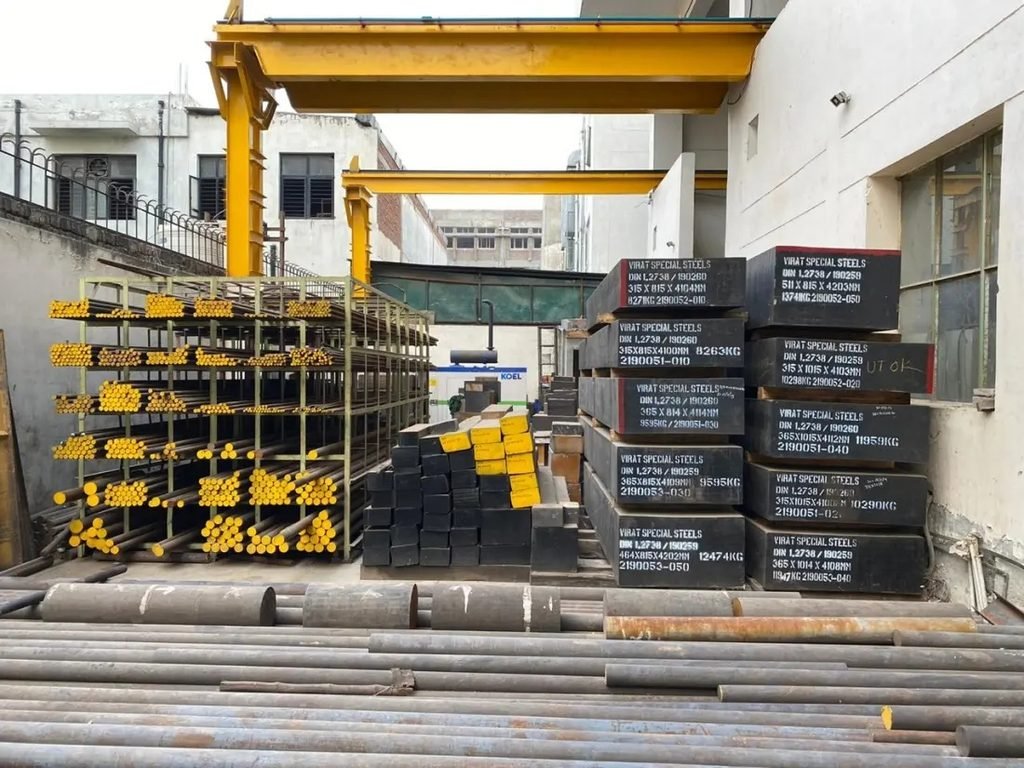
What Should Buyers Check Before Ordering P20 vs P20+Ni tool steel ?
Procurement teams should avoid specifying only “P20 steel” on a purchase order.
A stronger purchasing specification should identify:
- Exact grade designation (e.g., 1.2311 for P20, 1.2738 for P20+Ni)
- Applicable standard
- Required dimensions and section size — especially important for P20+Ni, where the block thickness directly affects through-hardening performance
- Delivery condition (annealed vs. pre-hardened)
- Required hardness range, including surface-to-core hardness uniformity for P20+Ni in larger sections
- Surface condition
- Ultrasonic testing requirements, if applicable
- Material test certificate requirements
- Chemical analysis requirements (nickel content confirmation for P20+Ni)
- Required cutting or machining tolerances
For example, ASTM A681 covers chemical, mechanical and physical requirements for wrought alloy tool-steel products and emphasizes that material selection is based on application, service conditions and properties desired. ISO 4957:2018 specifies requirements for various categories of wrought tool steels and is the current edition.
For P20+Ni specifically, buyers should also request a core hardness test report rather than relying only on surface hardness, since the primary reason to select this grade over standard P20 is uniform hardness through a large section.
Why Material Certification Matters
For critical moulds, the steel supplier should be able to provide appropriate documentation for the supplied material.
Depending on the project, buyers may request:
- Mill Test Certificate (MTC)
- Heat number
- Chemical analysis
- Hardness report
- Ultrasonic testing report
- Dimensional inspection
- Additional inspection documents where specified
The exact inspection requirements should be agreed before purchase.
This is especially important for large mould blocks, where internal quality and consistency can have a major effect on machining and mould performance.
P20 vs P20+Ni tool steel for Indian Mould Manufacturers
Indian mold makers serving the automotive, consumer goods, appliances, electronics, packaging and engineering industries often require steel that offers a combination of performance, availability, machining time and overall tooling cost.
This means that P20 is still a practical option for many general purpose tools, whilst P20+Ni may make more sense for larger and more demanding tooling.
The right material is not always the hardest or the most expensive steel. It is the grade that delivers the required performance without adding extraneous material and processing costs.
Our Supply Network Across India
With dispatch centers in Gurugram and Ludhiana, we regularly serve mould makers and tool rooms across India, including Delhi, Gurugram, Faridabad, Noida, Ghaziabad, Jaipur, Agra, Ahmedabad, Vadodara, Surat, Rajkot, Mumbai, Pune, Nashik, Indore, Bhopal, Rudrapur, Hyderabad, Kolkata, Belgaum, Chennai, Coimbatore, Hyderabad, Faridabad, Manesar, Bhiwadi,Ludhiana, Chandigarh, Haryana, Punjab and Jamshedpur.
We can offer our P20 vs P20+Ni tool steel in standard or custom sizes, cut to size material, annealed or heat treated condition and material test certificates (MTC) as required. This supply network caters to mold makers, tool rooms, automotive component manufacturers, plastic injection molders and other engineering industries throughout India.
Conclusion
P20 vs P20+Ni tool steel are both valuable choices for mould manufacturing, but they serve slightly different priorities.
P20 tool steel is a practical, versatile choice for many general-purpose plastic moulds because of its machinability, toughness and polishability. P20+Ni becomes particularly attractive when the mould is larger or deeper and more uniform through-hardening is required.
Before purchasing, always verify the exact grade, standard, hardness, section size, delivery condition and material certification rather than selecting steel based only on the commercial name “P20.”
Looking for P20 or P20+Ni Tool Steel in India?
Virat Special Steels supplies tool and mould steels for mould manufacturers, tool rooms, engineering companies and industrial buyers. P20 and P20+Ni can be supplied in suitable forms and sizes subject to grade and stock availability, with cutting and technical support for industrial requirements.
Our technical team will confirm grade equivalence, available sizes and delivery timeline within 24 hours.
Prefer to talk directly?
Gurugram, Haryana | Ludhiana, Punjab
Phone: +91-98140-21775
Email: info@viratsteels.com
Ask the Virat Steels team to verify the required grade, dimensions, hardness, testing and MTC requirements before placing your order.
Frequently Asked Questions
1. What is P20 tool steel?
P20 tool steel is a mould and tool steel commonly used for plastic injection moulds, mould bases, cavities, cores and related tooling. A commonly referenced grade is 1.2311.
2. What is P20+Ni tool steel?
P20+Ni is a nickel-alloyed mould steel, commonly associated with 1.2738, designed to provide improved through-hardening compared with conventional P20-type grades.
3. What is the difference between P20 vs P20+Ni Tool Steel ?
The main difference is the alloy design. P20+Ni contains nickel and is generally selected where improved hardenability and more uniform properties through larger sections are important.
4. Is P20 good for plastic injection moulds?
Yes. P20 is widely used for plastic injection moulds because of its balance of machinability, toughness, polishability and strength.
5. Is P20+Ni better than P20?
Not automatically. P20+Ni can be a better choice for large mould blocks or applications where through-hardening is important. Standard P20 can be more economical for general-purpose tooling.
6. Is P20 supplied pre-hardened?
Many P20 products are available in pre-hardened conditions, but the exact hardness depends on the supplier and product specification. Always confirm the delivery condition before ordering.
7. Can P20 be polished?
Yes. P20 is commonly used for mould applications requiring good polishing performance. Final surface quality also depends on steel cleanliness, machining and polishing practices.
8. Is P20 easy to machine?
P20 is generally considered machinable in appropriate delivery conditions. Actual machining performance depends on hardness, steel quality, cutting tools and machining parameters.
9. What is P20+Ni used for?
P20+Ni is commonly used for large plastic injection moulds, mould blocks, deep cavities and tooling where improved through-hardening and uniform properties are important.
10. Is 1.2311 the same as P20?
1.2311 is commonly associated with P20 and is often marketed as a P20 equivalent. However, buyers should verify the exact standard and chemical/mechanical requirements rather than assuming that every P20-labelled product is identical.
11. Is 1.2738 the same as P20+Ni?
1.2738 is a commonly referenced P20+Ni grade. The exact specification should be confirmed from the producer’s technical documentation and material certificate.
12. Which is better for large moulds: P20+Ni Tool Steel ?
P20+Ni is often preferred for larger sections because its nickel-alloyed composition provides improved through-hardening. The final selection should consider the actual mould dimensions and required hardness profile.
13. Can P20 be used for die casting?
P20 can be used for selected tooling and die applications, but it should not automatically be selected for demanding high-temperature die-casting applications. The operating temperature, thermal cycling, wear and required tool life should be evaluated first.
14. How do I specify P20 steel when buying?
Specify the exact grade, standard, dimensions, delivery condition, hardness requirement and inspection/documentation requirements. For critical applications, request the applicable MTC and testing documentation.
15. Where can I buy P20 vs P20+Ni Tool Steel in India?
Industrial buyers can source P20 and P20+Ni from specialised tool-steel suppliers such as Virat Special Steels, subject to available grade, size, mill and delivery condition.
Lucchini DB6 Tool Steel (DIN 1.2714): Complete Guide to Grades, Properties & Applications in India
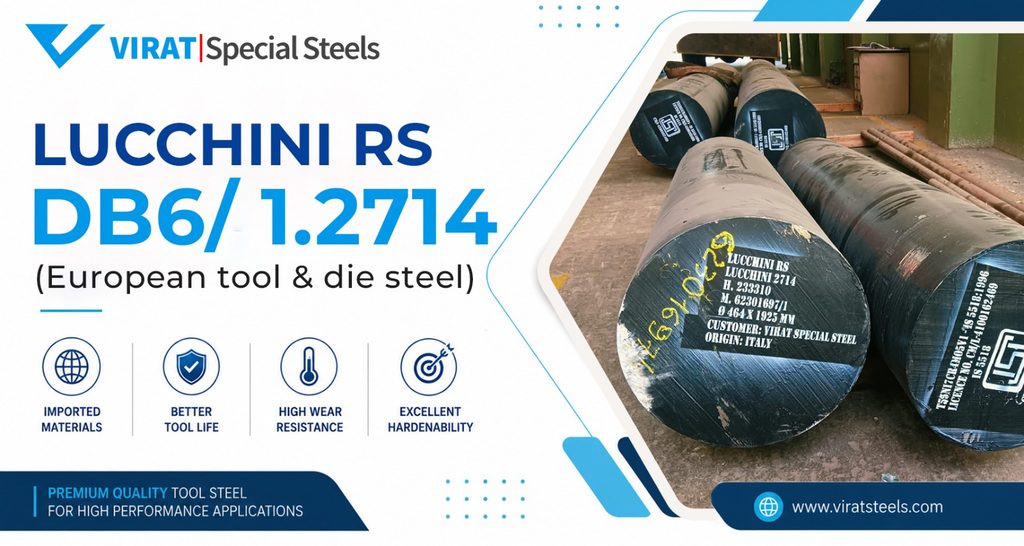
The choice of the appropriate tool steel involves a compromise between hardness, wear resistance, impact toughness, thermal fatigue resistance and the general tool life. While generic steel grades are common, specialized imported tool steels are vital for demanding applications such as hot work, forging and cold stamping.
Lucchini Italy is the international reference for ultra-clean tool steels with high durability. Complete guide on technical properties, international & IS standards, manufacturing processes, detailed grade comparison and procurement of tool steel in India.
What is Lucchini DB6 Tool Steel?
Lucchini DB6 is a low-alloy steel for hot work and impact tools. High Nickel content (1.50″–” 1.80%) formulated and secondary metallurgical refined (EAF->LF->Vacuum Degassing->ESR) This process provides structural purity and minimum non-metallic inclusions with uniform hardenability from core to surface.
Material Standards & Cross-Reference
- DIN / EN Standard: DIN 1.2714 / EN ISO 4957 (56NiCrMoV7)
- AISI Standard: AISI L6 (Modified)
- JIS Standard: SKT4
- IS Standard (India): T55Ni7Cr4Mo5V1 equivalent
Mechanical and Physical Properties
| Property | Value / Specification | Remarks |
| Toughness | Excellent | Resists cracking under heavy shock |
| Impact Resistance | High | Critical for hammer and forging dies |
| Wear Resistance | Good to moderate | Suitable for high-impact hot work |
| Hardenability | Good | Provides consistent through-hardening |
| Dimensional Stability | Good | Maintains shape during thermal cycles |
| Large Section Performance | Excellent | Ideal for heavy forging die blocks |
Same Chemistry on Paper, a Different Story on the Ground
On a certificate, Lucchini DB6 Tool steel and local DB6 tool steels can look almost identical — both fall within the same DIN 1.2714 tool steels chemical window. The real difference shows up upstream of the numbers, in how tightly that chemistry is held, batch after batch, and how clean the steel is once it’s melted and forged.
| Element | Lucchini DB6 / 1.2714 (%) DOCX | Standard Local 1.2714 (%) DOCX | Metallurgical Function DOCX |
| Carbon (C) | 0.50 – 0.60 | 0.50 – 0.60 | Controls baseline hardness and yield strength. |
| Silicon (Si) | 0.10 – 0.40 | 0.10 – 0.40 | Increases oxidation resistance and strength. |
| Manganese (Mn) | 0.60 – 0.95 | 0.60 – 0.95 | Enhances deep hardenability. |
| Chromium (Cr) | 0.80 – 1.20 | 0.80 – 1.20 | Enhances wear resistance and hardenability. |
| Molybdenum (Mo) | 0.35 – 0.55 | 0.35 – 0.55 | Retains high-temperature yield strength. |
| Nickel (Ni) | 1.50 – 1.80 | 1.50 – 1.80 | Primary driver for extreme impact toughness. |
| Vanadium (V) | 0.07 – 0.15 | 0.05 – 0.15 | Refines grain structure and carbide formation. |
| Phosphorus (P) | max 0.015 | max 0.030 | Kept low to prevent cold shortness/brittleness. |
| Sulfur (S) | max 0.010 | max 0.030 | Kept low to preserve steel cleanliness and fatigue life. |
Key takeaway: nominal composition alone doesn’t separate premium DB6 from ordinary DB6 tool steels. What matters far more is the consistency of chemistry control, steel cleanliness, and manufacturing discipline behind that certificate — and that is precisely where an established European mill like Lucchini has a structural advantage over less consistent local supply.
Manufacturing & Heat Treatment Parameters
- Soft Annealing: Heated to 680–720°C, slowly furnace cooled. Delivered (annealed) Hardness: max 229–248 HB (≈ 22–24 HRC)
- Stress Relieving: 600–650°C, following rough machining, then air cooled slowly.
- Hardening (Quenching): Austenitized at 840–870°C, quenched in oil or vacuum pressure gas.
- Double Tempering: Reheated to 540–600°C (minimum 2 cycles) to stabilize dimensions and relieve retained austenite.
Recommended Working Hardness by Application
| Application | Target Hardness |
| Drop Hammer Dies & Heavy Impact Tooling | 38 – 42 HRC |
| Press Forging Dies & Inserts | 44 – 48 HRC |
| Hot Shear Blades & Trimming Tools | 48 – 52 HRC |
NOTE: Lower hardness (38-42 HRC) is more shock and impact resistant; higher hardness (48-52 HRC) is more wear resistant and holds a sharper edge. Choose based on whether you experience more impact load or more abrasive wear in your tooling.
Comparison Table: Lucchini DB6 Tool Steel vs. Local Indian DB6 Tool Steel
| Parameter / Feature | Lucchini Italy DB6 Steel (DIN 1.2714) | Local Indian DB6 Tool Steel | Practical / Industrial Impact |
| Manufacturing & Melting Route | Electric Arc Furnace (EAF) + Ladle Furnace (LF) + Vacuum Degassing (VD) / ESR option | Standard EAF or Induction Furnace melting | Superior steel cleanliness, lower gas content, and higher purity in Lucchini steel. |
| Forging Reduction Ratio | Multi-directional 3D forging (Min. 4:1 upsetting ratio) | Standard 2D forging or conventional rolling | Higher structural integrity and better grain flow alignment. |
| Microstructural Uniformity | Extremely high and consistent throughout the block | May vary across core to surface | Predictable machining, heat treatment, and die performance. |
| Purity & Inclusion Levels | Strictly controlled Sulfur (≤ 0.030%) & Phosphorus (≤ 0.030%) | Controlled to basic standards (0.035%) | Lower inclusion levels directly improve fatigue life and crack resistance. |
| Impact Toughness | Outstanding and uniform (20–25 J/cm²) | Moderate to high (can vary by batch) | Higher crack resistance under extreme hammer shock loads. |
| Through-Hardening (Large Blocks) | Uniform hardness even in large sections (400 mm) | Depends on forging quality and section size | Prevents soft core issues in massive die blocks. |
| Heat Treatment Response | Highly predictable and repeatable across batches | May vary slightly between batches | Minimal distortion risk and consistent target HRC achievement. |
| Thermal Fatigue Resistance | Superior resistance to heat checking | Application dependent | Withstands repeated heating/cooling cycles longer during hot forging. |
| Impact Toughness | Up to 30% – 40% increase in production cycles | Baseline standard die life | Significantly reduces shop floor downtime and tooling replacement costs. |
| Quality Documentation | 100% EN 10204 3.1 MTC with SEP 1921 Class D/d UT certification | Standard MTC and basic UT reporting | Complete global batch traceability and defect-free guarantee. |
| Initial Material Cost | Premium / Higher investment | Cost-effective / Lower initial price | Higher initial cost of Lucchini steel is offset by lower tooling cost-per-component. |
Key Advantages of Lucchini DB6 tool steel (DIN 1.2714)
- Extreme Impact Toughness: High nickel (1.50–1.80%) prevents cracking under heavy drop-hammer shock loading.
- In demanding forging applications, premium-quality DB6 with controlled metallurgy, cleanliness and appropriate heat treatment can help improve die reliability and service life compared with lower-quality material.
- Deep Through-Hardening: Delivers uniform core-to-surface hardness in large blocks (400 mm).
- Thermal Fatigue Resistance: Withstands heat checking from repeated heating and cooling cycles.
- High Metallurgical Cleanliness: Low sulfur and phosphorus reduce inclusions and enhance fatigue strength.
- Perfect Quality Assurance: Certified by 100% Ultrasonic Testing (UT) and EN 10204 3.1 Mill Test Certificates. Available Sizes of DB6 Tool Steel
Virat Special Steels supplies Lucchini DB6 Tool Steel in a wide range of standard and custom sizes to meet the requirements of die makers, tool rooms, automotive, engineering, and precision manufacturing industries.
Custom Processing Services
To minimize machining time and material wastage, we also offer:
- Precision cut-to-size material
- Bandsaw cutting
- Surface machining (on request)
- Bulk supply with batch-wise traceability
- Material Test Certificate (MTC) and EN 10204 3.1 certification (where applicable)
Case Study: DB6 Increases Die Life by 40%
Customer Challenge
A drop-forging plant for automotive components experienced premature die cracking of crankshaft forging dies made from standard hot work steels leading to expensive downtime.
Solution
The tooling was upgraded to DB6 (DIN 1.2714) supplied by Virat Special Steels, vacuum heat treated and double tempered to an optimized 46-48 HRC.
Results
40% increased die service life Eliminate catastrophic die cracking in high energy impact Lower maintenance and machine downtime Forged at a lower cost per part
Certifications Available
Reputable suppliers typically provide:
- Mill Test Certificate (MTC)
- Ultrasonic Tested Material
- Hardness Test Report
- Chemical Test Report
Buyer’s Guide: Selecting the Appropriate DB6 Tool Steel
Some important points to consider before buying DB6 Tool Steel (DIN 1.2714) to get the best out of your application:
1. Choose the Right Hardness
Pick the hardness for your application:
- 38-42 HRC – Greater toughness and impact resistance
- 50-56 HRC – Increased wear resistance and extended tool life
2. Choose the required form of material
DB6 Tool Steel is supplied in:
- Forged and Rolled blocks
- Round and Flat Bars
- ESR and Non ESR Blocks
3. Material Quality Inspection
Always ask for:
- Mill Test Certificate (MTC) Ultrasonic Tested Material
- Material Traceability Spectro Tested Material
4. Match the App
Select DB6, depending on your tooling needs, such as:
- Forging Dies
- Hammer Dies
- Extrusion
- Holders for
- Casting Dies
5. Select a Trusted Supplier
Join hands with a supplier who can support with ready stock, custom machining, technical support and PAN India delivery for consistent quality and timely supply.
Why Choose Virat Special Steels for Lucchini DB6?
Virat Special Steels is a trusted supplier of imported tool steels to forging, die-making, automotive, engineering and manufacturing industries across India. With over 70 years of experience in special and tool steels, we provide quality-assured material, trusted sourcing, technical support and application-driven solutions.
Imported Lucchini DB6 Tool Steel We supply Lucchini DB6 Tool Steel (DIN 1.2714) for applications where high toughness, impact resistance, hardenability, and reliable tooling performance are required, with relevant mill documentation and material traceability subject to the specific product and supply condition.
Ready Stock Availability Our ready-stock inventory helps customers reduce procurement lead times and maintain production schedules. DB6 material can be supplied in different forms and sizes depending on availability and project requirements.
DB6 Round Bars & Flat Bars We supply DB6 round bars and flat bars in standard and customized dimensions — diameter, thickness, width, and length — subject to stock availability.
Forged DB6 Blocks For heavy-duty tooling and die applications, we offer forged DB6 blocks in suitable dimensions for machining large dies, die inserts, and other industrial tooling components.
Cut-to-Size Services DB6 Tool Steel can be supplied in cut-to-size dimensions according to customer requirements, helping reduce material wastage and bring material closer to final machining dimensions.
Machining Services Where required, we provide machining and material preparation services for DB6 Tool Steel, reducing in-house preparation time before the material moves to further tooling operations.
UT-Tested Material For applications where internal material quality is critical, Ultrasonic Testing (UT) can be provided according to applicable inspection requirements, helping identify internal discontinuities and support quality verification.
Mill Test Certificate (MTC) DB6 Tool Steel can be supplied with a Mill Test Certificate where applicable, covering heat/lot identification, chemical composition, mechanical properties, and other specified inspection results.
Spectro & Chemical Verification Spectro/chemical verification can be carried out where applicable to support material identification and chemistry verification — customers can discuss specific testing and certification requirements with our technical team before ordering.
PAN India Delivery Our logistics network supports PAN India delivery for forging companies, die makers, tool rooms, automotive manufacturers, engineering companies, and other industrial users.
Technical Support Choosing the right DB6 material involves more than selecting a grade. Our technical team can assist with grade selection, material form, dimensions, hardness requirements, heat-treatment considerations, testing requirements, and application suitability.
Whether you require Lucchini DB6 round bars, flat bars, forged blocks, cut-to-size material, or machined components, Virat Special Steels can help you source the appropriate material for your application.
Our Supply Network Across India
Virat Steels is one of the leading suppliers of DB6 Tool Steel (DIN 1.2714) to the manufacturers in the major industrial hubs of India like Ahmedabad, Rajkot, Pune, Nashik, Aurangabad, Kolhapur, Belgaum, Chennai, Coimbatore, Hosur,Bengaluru, Hyderabad, Faridabad, Manesar, Bhiwadi, Gurugram, Delhi NCR, Ludhiana, Chandigarh, Haryana, Punjab and Jamshedpur.
Our strong logistics network, ready stock and technical knowledge enable us to provide fast PAN India delivery to forging companies, die makers, tool rooms, plastic mould manufacturers, die casting industries and heavy engineering businesses.
Conclusion
The right tool steel choice directly affects the tooling cost per component, production downtime, and product quality. For low volume applications standard die steels may be sufficient but major advantages are available for high duty forging and hammer die work with certified imported grades such as Lucchini DB6 (DIN 1.2714).
An experienced stockiest like Virat Special Steels offers manufacturers across India the facility of genuine imported DB6, ready stock, cut-to-size material and complete metallurgical documentation.
Need DB6 tool steel for your next project? Contact our technical team for availability, required sizes, testing documentation, and quotations.
Get a Quote for Lucchini DB6 Tool Steel
Looking for Lucchini DB6 Tool Steel (DIN 1.2714) or other hot work tool steel in India? Virat Special Steels supplies imported DB6 in round bars, flat bars, forged blocks, rolled blocks, and cut-to-size material, subject to stock availability.
We can also support your requirements with ready stock, MTC, UT-tested material, spectro/chemical verification where applicable, custom machining, and PAN India delivery. Our technical team can assist with material selection, dimensions, hardness requirements, testing documentation, and application-specific requirements.
For other hot work tool steel, cold work tool steels, plastic mould steels, Alloy steel, high speed steel requirements
Call: +91-98140 21775
Email: info@viratsteels.com
Locations: Gurgaon (Haryana) | Ludhiana (Punjab)
Frequently Asked Questions
1. What is Lucchini Tool Steel?
Lucchini tool steel refers to specialized high-cleanliness alloy steels manufactured by Lucchini Italy for forging, die casting, and industrial tooling.
2. Is DB6 a hot work or cold work steel?
DB6 (DIN 1.2714) is classified as a low-alloy hot work tool steel valued for extreme impact toughness.
3. What is the AISI equivalent of DB6 steel?
The closest approximate AISI equivalent is AISI L6.
4. What is the standard hardness of annealed DB6?
In soft annealed condition, DB6 has a maximum hardness of 250 HB (25 HRC).
5. Can DB6 steel be pre-hardened?
Yes, DB6 is frequently supplied in a pre-hardened state (360-430 / 38-44 HRC).
6. Why is Nickel (Ni) added to DB6 tool steel?
Nickel (1.50-1.80) provides deep hardenability and structural impact toughness.
7. What is the quenching medium for DIN 1.2714?
It is typically quenched in oil or vacuum pressure gas after austenitizing at (840-870)
8. Why is double tempering necessary?
Double tempering ensures full transformation of retained austenite and stabilizes dimensional accuracy.
9. How does Ultrasonic Testing (UT) protect buyers?
UT inspection ensures blocks are 100% free of internal voids, pipe shrinkage, or sub-surface cracks.
10. Is DB6 suitable for plastic injection moulds?
Yes, pre-hardened DB6 is widely used for large plastic mould frames requiring core toughness.
11. What is the density of DIN 1.2714 tool steel?
The density is 7.85 g/cm³ (7,850 kg/m³).
12. What is the IS Standard equivalent for 1.2714 steel?
It corresponds to Indian Standard classifications such as T55Ni7Cr4Mo5V1.
13. Why choose Lucchini DB6 over standard local die blocks?
Lucchini DB6 provides superior structural cleanliness, higher impact toughness, and up to 30–40% longer die life.
14.What is stress relieving and when is it done?
Stress relieving involves heating machined tooling to 600–650°C to release internal machining stresses before hardening.
15. What industry sectors heavily consume Lucchini DB6?
Automotive forging, drop-forging plants, aluminum extrusion, and heavy machinery tooling.
16. How can I get authentic Lucchini tool steel in India?
Contact technical stockists like Virat Special Steels, who supply genuine certified imported tool steels with complete MTC documentation.
17. What is the density of DB6 (DIN 1.2714) tool steel?
The density is 7.85 g/cm³ (7,850 kg/m³).
18.Can DB6 steel be supplied pre-hardened?
Yes, DB6 can be supplied pre-hardened, typically in the 38–42 HRC range depending on the intended application.
19. How can I source genuine Lucchini DB6 tool steel in India?
Work with a technical stockist like Virat Special Steels, which supplies certified imported DB6 with complete MTC documentation and batch traceability.
Hot Work Tool Steel: Grades, Properties, Hardness, Heat Treatment & Applications
Hot work tool steel is designed for one purpose – to resist heat that would ruin common steel. It is the material behind the dies, molds, punches and blades that are hammered and squeezed and repeatedly heated and cooled – in die casting, forging, extrusion, hot stamping and hot shearing.
And what makes it different is easy to say and hard to engineer. It keeps its hardness, toughness, strength and dimensional stability, even when it’s hot. The most common grades you’ll come across are H13 (DIN 1.2344), H11 (DIN 1.2343) and DB6 (DIN 1.2714) — which one you need depends on your operating temperature, impact load, die size and how long you want the tool to last.
What Is Hot Work Tool Steel?
It’s an alloy tool steel for tools that get hot and cycle between hot and cold, again and again. It must be a combination of hot hardness, toughness, wear resistance, thermal-fatigue resistance and dimensional stability — all at the same time.
The Three Grades You Should Know:
- H13 / DIN 1.2344 – the go-to grade for die casting, aluminum extrusion and hot forging.
- H11 / DIN 1.2343 — good balance of toughness and hot strength, for forging and extrusion.
- DB6 / DIN 1.2714 – the choice for large forging dies, hammer dies and heavy-impact work where toughness is the most important property.
The final choice should always be based on the application and the steel maker’s datasheet, not on a general guide like this.
Hot work tool steel is a high-alloy steel for tooling operating at temperatures above about 200°C. Hot work grades are designed to resist the direct action of molten metal and hot workpieces, as opposed to cold-work steels, which are designed for cutting and forming at room temperature.
You will find it in aluminum and brass die-casting dies, forging dies, extrusion dies, hot shear blades, punches, mandrels, hot trimming dies, glass molds and copper alloy dies. It is their resistance to heat checking, deformation and softening that keeps these tools dimensionally stable and working reliably, cycle after cycle.
Popular Hot Work Tool Steel Grades
| Steel Grade | DIN Standard | Equivalent | Common Applications |
| H13 | 1.2344 | AISI H13 / JIS SKD61 | Die casting, forging, aluminium extrusion |
| H11 | 1.2343 | AISI H11 / JIS SKD6 | Forging dies, aluminium dies, extrusion |
| DB6 | 1.2714 | No exact AISI match; closest reference ~L6 | Hammer dies, press dies, forging dies |
| H21 | 1.2581 | AISI H21 | High-temperature tooling |
| H10 | 1.2365 | AISI H10 | Hot-work applications |
| H12 | 1.2606 | AISI H12 | Hot-work applications |
Mechanical Properties
| Property | H13 | DB6 |
| Density | 7.75–7.85 g/cm³ | 7.70–7.85 g/cm³ |
| Tensile Strength | 1550–2100 MPa | High |
| Hardness | 44–54 HRC | 38–42 HRC (working); refer to supplier datasheet |
| Toughness | Excellent | Excellent |
| Wear Resistance | Excellent | Excellent |
| Thermal Fatigue Resistance | Excellent | Excellent |
Chemical Composition
The alloying elements are what actually give hot work tool steel its personality — hardness, toughness, wear resistance and how it behaves under heat.
| Element | H13 (%) | DB6 (%) |
| Carbon (C) | 0.32–0.45 | 0.50–0.60 |
| Silicon (Si) | 0.80–1.25 | 0.10–0.40 |
| Manganese (Mn) | 0.20–0.60 | 0.65–0.95 |
| Chromium (Cr) | 4.75–5.50 | 1.00–1.20 |
| Molybdenum (Mo) | 1.10–1.75 | 0.45–0.55 |
| Vanadium (V) | 0.80–1.20 | 0.07–0.12 |
| Nickel (Ni) | — | 1.50–1.80 |
Hardness (HRC Scale)
Hardness is usually the first thing buyers ask about and it is really a trade-off push hardness up and you get wear resistance but you risk giving up toughness and a tool that is too hard cracks before it wears out.
| Grade | Typical Working Hardness |
| H13 | 44–54 HRC |
| H11 | 42–50 HRC |
| DB6 (1.2714) | 38–42 HRC |
DB6 is designed for lower working hardness than H13 tool steels – it is selected for hammer and large forging dies because it sacrifices some wear resistance for superior toughness, so it is tempered back further to prevent cracking under heavy impact.
Tip: The right hardness is not the hardest, it is the one that works for your application and duty cycle. Always verify the exact range with the datasheet of your supplier, as this may differ with section size and delivery condition.
How Hot Work Tool Steel Is Made
Good performance from hot work tool steel is not just a matter of choosing the right grade on paper – it is a matter of how well the steel was melted, forged, heat treated and inspected along the way.
1. Raw Material Selection
Everything starts with the alloying mix, and each element earns its place:
| Element | Main Function |
| Carbon | Hardness and strength |
| Chromium | Wear resistance and hardenability |
| Molybdenum | High-temperature strength |
| Vanadium | Grain refinement and wear resistance |
| Nickel | Toughness |
| Silicon | Strength and heat resistance |
| Manganese | Strength and hardenability |
2. Smelting & Refining
The steel is melted in an Electric Arc Furnace (EAF) and then further refined to the desired chemistry and cleanliness.
Ladle refining improves alloy composition, controls temperature and reduces contamination
Vacuum degassing removes dissolved gasses, mainly hydrogen, leading to better toughness, improved fatigue life, fewer internal defects and a more reliable material overall.
3. Electro-Slag Remelting (ESR)
ESR is a must when cleanliness and consistency counts. It provides a more homogeneous microstructure, better toughness and fatigue life, less segregation and a significantly improved polishability – which is why ESR grades are found in precision dies, high pressure die casting and plastic molds.
4. VAR (Vacuum Arc Remelting)
For the most demanding applications VAR takes purity one step further – lower inclusion levels, more uniform microstructure and better fatigue resistance.
5. Ingots casting
Molten steel is poured into ingots before forging, under controlled solidification conditions to minimize segregation and shrinkage.
6. Forging
Forging turns the cast ingot into dense blocks and bars by controlled heating and deformation. It increases the toughness, the grain structure, the internal flaws and gives more consistent mechanical properties to the material. Typical outputs are forged blocks, die blocks, round bars, flat bars and ESR blocks.
7. Annealing
Annealing is the process that softens the steel for machining and preparation for hardening — heat, soak evenly, then cool in a controlled fashion.
| Grade | Approx. Annealed Hardness |
| H13 | 190–230 HB |
| H11 | 180–230 HB |
| DB6 (1.2714) | 255 HB max |
Hardening is the method by which steel is given strength and wear resistance. It involves controlled pre-heating, austenitising, soaking and controlled cooling or quenching.
| Grade | Typical Austenitizing Range |
| H13 | 1,020–1,050°C |
| H11 | 1,000–1,030°C |
| DB6 (1.2714) | ~850–900°C (typical for this Ni-Cr-Mo grade; noticeably lower than the Cr-Mo-V H-series) |
DB6 is a lower alloy nickel chromium molybdenum steel and hardens at a substantially lower temperature than H13 or H11. Always stick to the manufacturer’s datasheet for the exact cycle – especially if you are working with large sections where getting this wrong is expensive.
9. Tempering
Tempering is done after hardening to reduce brittleness and to obtain the final balance between hardness and toughness. It relieves residual stress, increases toughness and helps dimensional stability. Depending on the grade, multiple cycles of tempering may be utilized.
Heat Treatment at a Glance
| Stage | Purpose |
| Annealing | Improve machinability |
| Stress Relieving | Reduce machining stresses |
| Hardening | Increase hardness and strength |
| Tempering | Improve toughness and stability |
| Final Inspection | Verify required properties |
10. Quality Inspection
The material is examined from every point of view before being shipped:
Ultrasonic Testing (UT) — identifies internal cracks, inclusions, laminations and shrinkage-related defects, especially important on large forged blocks.
Chemical composition testing – a spectrometer tests carbon, chromium, molybdenum, vanadium, nickel, silicon, manganese, sulfur and phosphorus against the specified grade.
Hardness and dimensional inspection: Rockwell or Brinell testing, checks of length, width, thickness, flatness, squareness, straightness and surface finish.
11. MTC (Material Test Certificate)
An MTC links grade, heat number, chemical composition, mechanical properties, hardness, heat-treatment condition, inspection results and manufacturer details. It provides buyers with a paper trail they can verify.
| Document / Test | Purpose |
| MTC / EN 10204 3.1 | Material traceability and test results |
| UT Report | Internal quality verification |
| Spectrometer Report | Chemical composition |
| Hardness Report | Hardness verification |
| Heat Number | Batch traceability |
| Dimensional Report | Size verification |
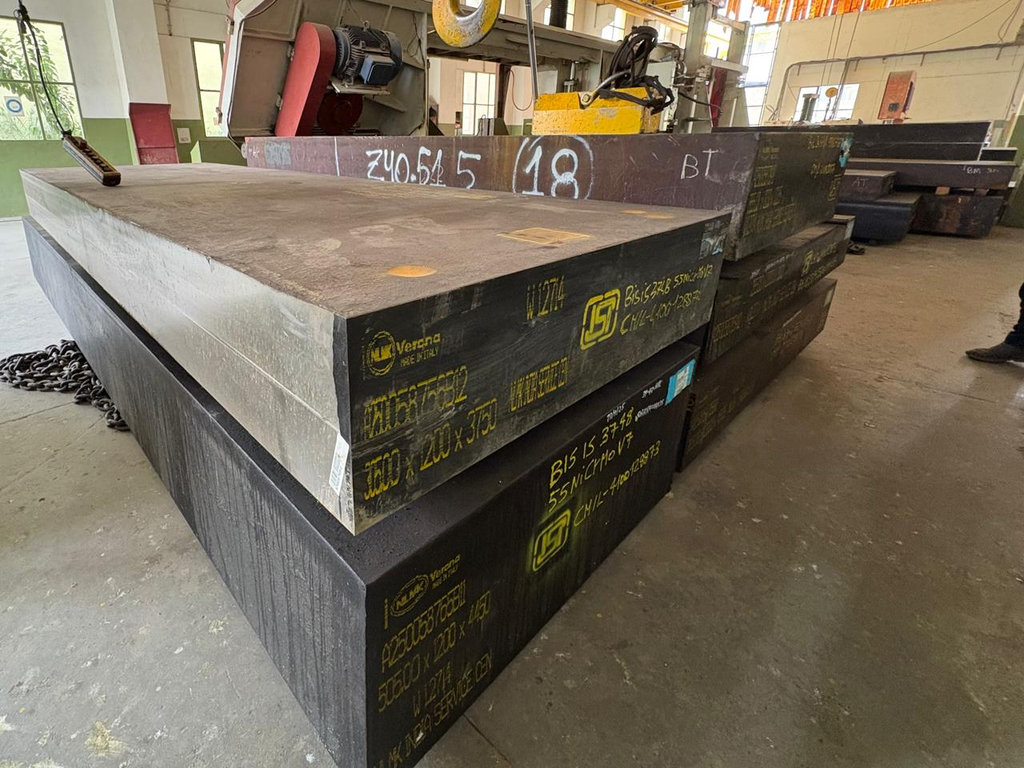
Where Hot Work Tool Steel Is Used
Aluminum diecast molds H13 tool steel is the material of choice here because it can be repeatedly heated and cooled without losing dimensional stability – think engine blocks, gear housings, transmission components, pump bodies, LED housings and other automotive parts.
Hot-forging dies They are pounded by impact loads and heat, which is why DB6 and H11—valued for toughness and resistance to thermal cracking—are the usual choices. Common on crankshafts, connecting rods, railroad components and heavy engineering components.
Extrusion Dies High hot strength and wear resistance is needed to keep profiles – used for aluminum profiles, window frames, heat sinks and electrical conductors.
Brass and copper die cast. These alloys run hotter than aluminum so H13 and H11 earn their keep with better hot hardness.
Hot shear blades, for cutting red-hot blooms, billets and bars in rolling mills;
Hot punches, made for hot piercing, making and punching where wear and impact resistance both count.
Glass molds on the basis of thermal stability and resistance to heat checking.
Plastic mold parts: ESR H13 material tool preferred for polishability and wear resistance.
Industries That Rely on It
| Industry | Applications |
| Automotive | Die casting, forging |
| Aerospace | Forging tools |
| Defence | Heavy-duty dies |
| Railways | Forged components |
| Aluminium | Extrusion dies |
| Plastic Moulding | Mould inserts |
| Steel Plants | Hot shear blades |
| Heavy Engineering | Forging tools |
| Energy | Turbine & valve tooling |
Hot Work vs. Cold Work vs. Plastic Mould Steel
| Feature | Hot Work Tool Steel | Cold Work Tool Steel | Plastic Mould Steel |
| Primary Use | High-temperature tooling | Room-temperature cutting/forming | Plastic injection & moulding |
| Operating Temperature | High | Low to moderate | Low to moderate |
| Key Property | Hot hardness & thermal fatigue resistance | Wear resistance & hardness | Toughness, polishability & machinability |
| Important Grades | H13, H11, DB6 | D2, D3, EN31 | P20, P20+Ni, 1.2083 |
| Common Applications | Die casting, forging, extrusion | Dies, punches, blanking, shear blades | Injection moulds, plastic moulds |
| Typical Hardness | 44–54 HRC | 55–62 HRC | 28–52 HRC |
| Main Advantage | Retains strength at elevated temperatures | Excellent wear & edge retention | Good machinability and surface finish |
| Typical Industries | Automotive, forging, die casting | Tool & die, automotive, engineering | Plastic, packaging, automotive |
| Parameter | H13 | DB6 |
| Type | Chromium hot work steel | Nickel-chromium-molybdenum tool steel |
| Hardness | 44–54 HRC | 38–42 HRC |
| Toughness | Excellent | Outstanding |
| Wear Resistance | Higher | Moderate |
| Thermal Fatigue | Excellent | Very good |
| Large Dies | Good | Excellent |
| Forging Applications | Very good | Excellent |
| Impact Resistance | Good | Superior |
| Aluminium Die Casting | Excellent | Good |
H13/DB6 comparison table in die casting and extrusion; go with DB6 for large forging dies, hammer dies and heavy-impact work.
Advantages & Limitations
| Advantages | Limitations |
| Excellent hot hardness | Higher material cost |
| High thermal fatigue resistance | Needs proper heat treatment |
| Excellent toughness | Harder to machine once hardened |
| Good wear resistance | Limited corrosion resistance |
| Good machinability when annealed | Large sections need controlled processing |
| Excellent dimensional stability | |
| Long tool life |
How to Choose the Right Grade
1. Match the grade to the application.
| Application | Recommended Grade |
| Aluminium die casting | H13 (1.2344) |
| Brass die casting | H13 |
| Hot forging dies | H11 (1.2343) |
| Hammer dies | DB6 (1.2714) |
| Extrusion dies | H13 |
| Plastic mould inserts | ESR H13 |
| Large forging blocks | DB6 |
Get the size right. Think about how long it’s how wide it is, how thick it is, Think about length, width, thickness, weight, machining allowance, and expected dimensional change during heat treatment.. Available forms include forged blocks, round bars, flat bars, ESR blocks and pieces that are already cut to size.
Settle on a delivery condition with your supplier — annealed, pre-hardened, hardened and tempered, soft annealed, or stress relieved. With your supplier.
Check the quality before you make a decision. Ask for testing results, spectrometer reports, material test certificates, heat-number traceability and confirmation of surface finish, straightness and mechanical properties.
Plan the amounts you need based on prototypes, regular production, yearly use, extra stock and any growth that is coming up.
Choose a supplier who can support you. One that has stock, imported materials, forged and ESR blocks, fast delivery, technical help, certificates and custom machining.
Certifications Worth Looking For
| Certification | Purpose |
| ISO 9001 | Quality management system |
| EN 10204 3.1 | Material test certificate |
| Ultrasonic Testing (UT) | Detects internal defects |
| Spectrometer Analysis | Verifies chemical composition |
| Hardness Test Report | Confirms HRC/HB values |
| Heat Number Traceability | Tracks production batch |
Why Manufacturing Quality Matters
How the steel is made has a direct line to how it performs on the shop floor. Controlled melting, refining, forging, annealing, hardening, tempering and inspection are what separate a die that lasts from one that fails early — particularly in die casting, hot forging, aluminium extrusion and heavy-duty tooling, where the cost of a bad batch shows up fast.
Key Takeaways
- Controlled melting and refining keep the chemistry consistent.
- Forging improves structural uniformity and toughness.
- Annealing gets the material ready for machining.
- Hardening builds the strength and hardness.
- Tempering balances hardness against toughness.
- UT, chemical analysis, hardness testing and dimensional inspection confirm quality before shipping.
- MTCs and heat-number traceability give buyers the documentation they need.
Why Choose Virat Special Steels?
Virat Special Steels Pvt. Ltd. has been supplying manufacturers with quality imported tool steels for over 70 years.
- Over 70 years of industry experience.
- 3,500+ tons of tool steel in stock, ready to use
- Sourced from established international mills.
- “Wide grade range: H13, H11, DB6, D2, D3, P20, M2, M35, and ESR grades“.
- “Every order comes with an EN 10204 3.1 MTC”
- “UT and spectrometer testing on all material”
- “Cut-to-size and custom machining available”
- “Fast delivery across India”
- “Trusted by automotive, forging, aerospace, plastic moulding, railway, and heavy engineering customers”.
Our Supply Network Across India
We supply H13, DB6, H11, H12, H10 and H21 across major industrial hubs — Delhi, Gurugram, Faridabad, Noida, Ghaziabad, Jaipur, agra, Ahmedabad, Vadodara, Surat, Rajkot, Mumbai, Pune, Nashik, Indore, Bhopal, Rudrapur , Chennai, Coimbatore, Hyderabad, Kolkata, Jamshedpur, Secunderabad and Nellore — with standard and custom sizes, cut-to-size material, annealed or heat-treated condition, and material test certificates as required.
Conclusion
H13 and DB6 remain the two most dependable choices for high-temperature tooling, offering a solid mix of hardness, toughness, wear resistance, hot strength and thermal-fatigue resistance. Get the grade selection, heat treatment, machining and maintenance right, and both can deliver excellent tool life. We supply H13, DB6 and other tool steel grades across major industrial cities in India for a wide range of manufacturing needs.
Get a Quote
Looking for reliable H13, DB6 or other hot work tool steel? Virat Special Steels supplies round & flat bars, forged & rolled blocks, ESR/non-ESR blocks and cut-to-size material — complete with MTC, UT testing, spectro testing, custom machining, ready stock and PAN India delivery.
Call: +91-98140 21775 Email: info@viratsteels.com Locations: Gurgaon (Haryana) | Ludhiana (Punjab)
Frequently Asked Questions
1. What is Hot Work Tool Steel?
Alloy steel for tools and dies exposed to high temperatures, thermal cycling, wear and mechanical stress.
2. What are the primary types?
Typical grades are H13, H11, H12, H10 and H21 – H13 tool is the most common.
3. H13 tool steel – what is it?
A hot work Cr-Mo-V grade that is known for its excellent hot strength, toughness, wear resistance and thermal-fatigue resistance.
4. What is the HRC of H13?
44-54 HRC depending on the application and heat treatment condition.
5. What is the maximum service temperature of H13?
Typically up to around 550–600°C, depending on load, thermal cycling and cooling conditions. Confirm the exact limit with your supplier’s datasheet.
6. Is H13 material good for high temperature applications?
Yes, it is used heavily where there is high heat and heating and cooling over and over again.
7. Can H13 be machined?
Yes, if annealed. It is much more difficult to machine once hardened.
8. How to Improve H13 Machinability?
Use proper cutting tools. Use appropriate speeds and feeds. Use adequate cooling. Machine in the annealed state where possible.
9. What is H13 used for?
Die casting dies, extrusion dies, forging dies, hot punches, mandrels and other similar hot work tooling.
10. H13 wear resistant?
Yes, if they are heat treated properly and matched to the proper operating conditions.
11. Is H13 hard enough?
Yes, gives a good balance of hardness and toughness which is what you need in demanding die work.
12. What is resistance to thermal fatigue?
It’s the ability of the steel to be heat cycled over and over again without heat checking or cracking.
13. Is H13 heat treatable?
Yes. Usually it is hardened and tempered so that it can obtain the desired hardness, toughness and hot strength.
14. Is H13 air hardenable?
Yes, which means it can achieve high hardness by means of appropriate heat treatment without a drastic quench.
15. Can H13 be used for nitriding?
Yes, nitriding can improve surface hardness, wear resistance and die life in suitable applications.
16. What is the chemical composition of H13?
Carbon, silicon, manganese, chromium, molybdenum and vanadium. Chromium, molybdenum and vanadium do most of the work.
17. What is the difference between H11 and H13?
Both are hot working grades but H13 tool steels gives generally a better combination of hot hardness, wear resistance, toughness and thermal-fatigue resistance.
18. What’s the difference between H13 and D2?
D2 is a cold-work grade built primarily for high wear resistance. H13 tool steel is a hot-work grade.
19. Is H13 tool steels appropriate for die casting dies?
Yes, it is widely used for aluminum, zinc and magnesium die casting because of its resistance to thermal fatigue and its hot strength.
20. Can H13 tool steels be used for hot extrusion die?
Yes, commonly used for extrusion dies, mandrels and related tooling.
DB6 Tool Steel Hardness (HRC): Complete Guide to Heat Treatment & Applications
DB6 Material Hardness in HRC
DB6 Tool Steel (DIN 1.2714) is a widely used hot work tool steel for forging, die casting, heavy engineering and plastic mould industries. It offers an excellent balance of toughness, wear resistance, impact strength, and heat resistance, making it suitable for demanding industrial applications.
Hardness of DB6 Tool Steel is an important factor that defines its performance properties, tool life, machinability and ability to resist deformation under high pressure and high temperature conditions. The right heat treatment to the correct Rockwell Hardness (HRC) will ensure optimum performance in forging dies, extrusion dies, hammer dies and pressure die casting application.
In this comprehensive guide, we cover DB6 Tool Steel hardness (HRC), heat treatment process, mechanical properties, applications, comparison with other tool steels, pricing considerations, and why Virat Steels is one of India’s trusted suppliers of premium-quality DB6 Tool Steel.
What is DB6 Steel?
DB6 Tool Steel is a high quality hot work tool steel, equivalent to DIN 1.2714, (AISI L6), (55NiCrMoV7). It is a nickel-chromium-molybdenum-vanadium alloy steel known for outstanding toughness and excellent resistance to thermal fatigue.
Compared to conventional hot work steels, DB6 provides:
- Superior impact strength
- High toughness
- Excellent wear resistance
- Good hardenability
- Outstanding resistance to cracking
- Longer die life
- Excellent polishability
- Good machinability
These characteristics make DB6 an ideal choice for large forging dies, hammer dies, die holders, extrusion tooling, pressure die casting dies, and heavy-duty industrial tools.
International Equivalents of DB6 Tool Steel
DB6 Tool Steel is internationally recognized under the DIN 1.2714 standard and is equivalent to EN 55NiCrMoV7. It is also considered an approximate equivalent to AISI L6 in certain applications. In India, DB6 is widely known by its trade name and is commonly used as a premium hot work tool steel for forging dies, die casting dies, extrusion tooling, and heavy engineering applications.
Chemical Composition of DB6 Tool Steel
DB6 Tool Steel contains a balanced combination of carbon, chromium, nickel, molybdenum, and vanadium, providing excellent toughness, wear resistance, and hot strength. This alloy composition ensures superior impact resistance, good hardenability, and extended tool life in demanding hot work applications.
| Element | Composition (%) |
| Carbon (C) | 0.50–0.60 |
| Silicon (Si) | 0.10–0.40 |
| Manganese (Mn) | 0.65–0.95 |
| Chromium (Cr) | 1.00–1.20 |
| Nickel (Ni) | 1.50–1.80 |
| Molybdenum (Mo) | 0.45–0.55 |
| Vanadium (V) | 0.07–0.12 |
Mechanical Properties of DB6 Tool Steel
DB6 Tool Steel offers an excellent combination of toughness, wear resistance, and heat resistance, making it ideal for high-impact and hot work applications such as forging and die casting.
| Property | Typical Value |
| Density | 7.85 g/cm³ |
| Tensile Strength | High |
| Toughness | Excellent |
| Wear Resistance | Excellent |
| Heat Resistance | Excellent |
| Thermal Fatigue Resistance | Excellent |
DB6 Tool Steel Hardness (HRC)
Hardness is the most important property when selecting DB6 Tool Steel for industrial tooling.
Different hardness according to different Tempering temperature conditions.
– Annealed condition – 255 BHN max
– Hardened and Tempered condition- 38 to 42 HRC
annealed stock measures up to 255 BHN, standard mill-supply condition is tempered to 38–42 HRC for machining, and finished dies are re-hardened and tempered to a working hardness of 45–56 HRC depending on whether the application prioritizes toughness or wear resistance.
Heat Treatment of DB6 Tool Steel
Proper heat treatment is essential to achieve the desired hardness and mechanical properties.
The process generally involves:
- Annealing
- Stress Relieving
- Hardening
- Quenching
- Tempering
Each stage contributes to the final balance of hardness, toughness, and dimensional stability.
Annealing
Annealing softens the material, improves machinability, and relieves internal stresses before hardening.
Recommended Process:
- Heat slowly to 840–860°C
- Hold for sufficient soaking time
- Cool slowly inside the furnace
Resulting Hardness:
Approximately 220–250 HB
Stress Relieving
Stress relieving is recommended after rough machining.
- Temperature: 600–650°C
- Hold for 2 hours
- Furnace cool slowly
This minimizes distortion during final hardening.
Hardening
The hardening process significantly increases hardness and wear resistance.
Procedure:
- Preheat: 600 – 650°C
- Austenitize: 840–870°C
- Oil or polymer quench
- Air cooling where appropriate
The resulting hardness typically reaches 54–56 HRC before tempering.
Tempering
Tempering reduces brittleness while maintaining the desired hardness.
It is recommended to temper immediately after quenching.
Typical Tempering Range:
450–650°C
Double tempering is often recommended for improved dimensional stability and toughness.
Advantages of Proper Heat Treatment
By improving the mechanical properties and durability of the steel, proper heat treatment can improve the performance and service life of DB6 Tool Steel.
- Enhanced wear resistance
- Greater durability
- Improved thermal fatigue resistance
- Less risk of cracking
- Longer life of die
- Reduced maintenance costs
Applications of DB6 Tool Steel
DB6 Tool Steel (DIN 1.2714) is a popular choice for hot work applications requiring high toughness, wear resistance and resistance to thermal fatigue. It is ideal for the manufacture of heavy duty dies and tools used under extreme operating conditions.
| Industry | Typical Applications |
| Forging | Closed forging dies, hammer dies |
| Die Casting | Aluminium die casting dies |
| Extrusion | Extrusion dies |
| Automotive | Crankshaft and connecting rod dies |
| Plastic Moulding | Large mould bases |
| Heavy Engineering | Die holders and forging blocks |
| Aerospace & Defence | Heavy-duty tooling |
| Steel Plants | Hot shearing blades and press tools |
DB6 Tool Steel Advantages & Disadvantages
| Advantages | Disadvantages |
| Good impact resistance and toughness | More expensive than the usual alloy steels |
| Good wear and heat fatigue resistance | Needs proper heat treatment |
| Longer die life with less cracking | Not the best choice for high abrasive cold work applications (D2 is preferred) |
| Good hardenability and dimensional stability | Special tools are required for machining after hardening |
| Suitable for large forging dies, hot working tools | Material costs are higher for more expensive alloys |
DB6 vs H13 Tool Steel Comparison
| Property | DB6 Tool Steel (DIN 1.2714) | H13 Tool Steel (DIN 1.2344) |
| Steel Type | Hot Work Tool Steel | Hot Work Tool Steel |
| Toughness | Excellent | Very Good |
| Wear Resistance | Very Good | Excellent |
| Impact Resistance | Excellent | Very Good |
| Thermal Fatigue Resistance | Excellent | Excellent |
| Hot Hardness | Very Good | Excellent |
| Best Applications | Forging Dies, Hammer Dies | Die Casting & Extrusion Dies |
| Large Die Blocks | Excellent | Very Good |
| Relative Cost | Moderate | Moderate to High |
Best Choice: Choose DB6 for heavy-impact forging applications requiring superior toughness, while H13 is ideal for high-temperature die casting and aluminium extrusion tooling.
DB6 vs H11 Tool Steel
| Property | DB6 | H11 |
| Toughness | Excellent | Excellent |
| Wear Resistance | Higher | Good |
| Hardness | 45–56 HRC | 44–52 HRC |
| Thermal Shock | Excellent | Excellent |
| Large Blocks | Excellent | Good |
| Service Life | Longer | Good |
Best Choice: DB6 is preferred where higher wear resistance and longer tool life are required.
DB6 vs D2 Tool Steel
| Property | DB6 | D2 |
| Type | Hot Work | Cold Work |
| Toughness | Excellent | Moderate |
| Wear Resistance | High | Very High |
| Hot Strength | Excellent | Poor |
| Impact Resistance | Excellent | Moderate |
| Forging Dies | Excellent | Not Recommended |
| Cold Blanking | Not Ideal | Excellent |
Best Choice: Use DB6 for hot work and D2 for cold work applications.
DB6 vs P20 Tool Steel
| Property | DB6 | P20 |
| Toughness | Excellent | Good |
| Hardness | Up to 56 HRC | 28–34 HRC |
| Plastic Moulds | Good | Excellent |
| Forging | Excellent | Not Recommended |
| Wear Resistance | High | Moderate |
| Tool Life | Longer | Moderate |
DB6 vs EN31
| Property | DB6 | EN31 |
| Steel Type | Hot Work Tool Steel | High Carbon Steel |
| Toughness | Excellent | Moderate |
| Hardness | 56 HRC | 60–64 HRC |
| Impact Resistance | Excellent | Low |
| Hot Applications | Excellent | Poor |
| Bearings | Not Suitable | Excellent |
DB6 Tool Steel vs Other Tool Steel Grades
| Steel Grade | Toughness | Wear Resistance | Heat Resistance | Typical Hardness | Ideal Applications |
| DB6 (DIN 1.2714) | Excellent | Very Good | Excellent | 45–56 HRC | Forging Dies , Hammer Dies |
| H13 (DIN 1.2344) | Very Good | Excellent | Excellent | 44–54 HRC | Die Casting, Extrusion Dies |
| H11 (DIN 1.2343) | Excellent | Good | Very Good | 44–52 HRC | Hot Work & Extrusion Tooling |
| D2 (DIN 1.2379) | Good | Excellent | Moderate | 58–62 HRC | Cold Work Dies, Punches |
| P20 (DIN 1.2311) | Good | Moderate | Moderate | 28–34 HRC | Plastic Injection Moulds |
| EN31 | Moderate | Excellent | Low | 60–64 HRC | Bearings, Rollers & Wear Parts |
“DB6 Tool Steel Equivalents Explained: SKT4, 55NiCrMoV7, L6 & DIN 1.2714 Compared”
| Property | DB6 | SKT4 | 55NiCrMoV7 | L6 | DIN 1.2714 |
| Standard | Commercial | JIS | EN | AISI | DIN |
| Steel Type | Hot Work | Hot Work | Hot Work | Low Alloy | Hot Work |
| Toughness | Excellent | Excellent | Excellent | Excellent | Excellent |
| Wear Resistance | Excellent | Very Good | Excellent | Good | Excellent |
| Hardness | 45–56 HRC | 45–54 HRC | 45–56 HRC | 45–55 HRC | 45–56 HRC |
| Hot Work Performance | Excellent | Very Good | Excellent | Moderate | Excellent |
| Main Difference | Trade Name | JIS Grade | EN Grade | Approx. Equivalent | DIN Grade |
DB6, DIN 1.2714, and 55NiCrMoV7 are essentially the same steel grade with different designations. SKT4 is a close Japanese equivalent, while AISI L6 is an approximate equivalent with similar toughness but comparatively lower hot-work performance.
Available Sizes of DB6 Tool Steel
Virat Special Steels supplies DB6 Tool Steel in a wide range of standard and custom sizes to meet the requirements of die makers, tool rooms, automotive, engineering, and precision manufacturing industries.
Available Sizes (Flat)
- Thickness: 13 mm – 1500 mm
- Width: 13 mm – 3000 mm
- Length: Available in standard mill lengths or custom-cut sizes on request.
Available Sizes (Round)
- Diameter: 13 mm – 1500 mm
- Length: Standard mill lengths and customized cut-to-size options available.
Custom Processing Services
To minimize machining time and material wastage, we also offer:
- Precision cut-to-size material
- Bandsaw cutting
- Surface machining (on request)
- Bulk supply with batch-wise traceability
- Material Test Certificate (MTC) and EN 10204 3.1 certification (where applicable)
DB6 Case Study 40% Improvement in Die Life in Forging
Operations Customer Challenge
A drop-forging plant for automotive components experienced premature die cracking of crankshaft forging dies made from standard hot work steels leading to expensive downtime.
Solution
The tooling was upgraded to DB6 (DIN 1.2714) supplied by Virat Special Steels, vacuum heat treated and double tempered to an optimized 46-48 HRC.
Results
40% increased die service life Eliminate catastrophic die cracking in high energy impact Lower maintenance and machine downtime Forged at a lower cost per part
Certifications Available
Reputable suppliers typically provide:
- Mill Test Certificate (MTC)
- Ultrasonic Tested Material
- Hardness Test Report
- Chemical Test Report
Buyer’s Guide: Selecting the Appropriate DB6 Tool Steel
Some important points to consider before buying DB6 Tool Steel (DIN 1.2714) to get the best out of your application:
1. Choose the Right Hardness
Pick the hardness for your application:
- 38-42 HRC – Greater toughness and impact resistance
- 50-56 HRC – Increased wear resistance and extended tool life
2. Choose the required form of material
DB6 Tool Steel is supplied in:
- Forged and Rolled blocks
- Round and Flat Bars
- ESR and Non ESR Blocks
3. Material Quality Inspection
Always ask for:
- Mill Test Certificate (MTC) Ultrasonic Tested Material
- Material Traceability Spectro Tested Material
4. Match the App
Select DB6, depending on your tooling needs, such as:
- Forging Dies
- Hammer Dies
- Extrusion
- Holders for
- Casting Dies
5. Select a Trusted Supplier
Join hands with a supplier who can support with ready stock, custom machining, technical support and PAN India delivery for consistent quality and timely supply.
Why purchase DB6 Tool Steel from Virat Steels?
Selecting the right supplier is critical to maximizing tool life, performance and productivity. With over 70 years of experience in the industry, Virat Steels is one of the trusted suppliers of high quality imported and domestic tool steels in India with more than 2000 customers in the automotive, forging, die casting, aerospace, plastic mould, heavy engineering, railways and defence industries.
Why do manufacturers trust us?
- 70+ Years Experience supplying quality tool steels.
- 2,000+ Happy Customers in India’s Manufacturing Industry.
- Supplier of Materials from Reputed International Mills for consistent quality and performance.
- Tool Steel Ready Stock: DB6, H13, H11, D2, D3, P20, P20+Ni, M2, M35, EN31, OHNS and other grades.
- Mill Test Certificate (MTC) with full traceability of material.
- UT Tested & Spectro Tested Material for proven quality and internal soundness.
- Custom Cutting & Machining Services to suit your required sizes.
- Material Selection Assistance from experienced technical professionals.
- Fast PAN India Delivery, timely supply & reduced production downtime.
Virat Steels offers authentic quality, certified material and dependable service for all your tool steel needs. Whether DB6 Round Bars, Forged Blocks, ESR Blocks, Flat Blocks or Cut-to-size Material, we have it all.
Our Supply Network Across India
Virat Steels is one of the leading suppliers of DB6 Tool Steel (DIN 1.2714) to the manufacturers in the major industrial hubs of India like Ahmedabad, Rajkot, Pune, Nashik, Aurangabad, Kolhapur, Belgaum, Chennai, Coimbatore, Hosur, Bengaluru, Hyderabad, Faridabad, Manesar, Bhiwadi, Gurugram, Delhi NCR, Ludhiana, Chandigarh, Haryana, Punjab and Jamshedpur.
Our strong logistics network, ready stock and technical knowledge enable us to provide fast PAN India delivery to forging companies, die makers, tool rooms, plastic mould manufacturers, die casting industries and heavy engineering businesses.
Conclusion
DB6 Tool Steel (DIN 1.2714) is a high-performance hot work tool steel, known for its excellent toughness, wear resistance and thermal fatigue resistance. Proper heat treatment gives it hardness in the range of 45–56 HRC and makes it ideal for forging dies, extrusion tooling, die casting dies, and other demanding industrial applications.
Virat Steels is your trusted partner for premium quality DB6 Tool Steel with 70+ years of experience, 2000+ customers, ready stock, MTC, UT & Spectro Tested materials and PAN India delivery.
Call us or send your drawing to receive a customised material recommendation.
Request a Quote
Looking for premium-quality DB6 Tool Steel (DIN 1.2714)?
Virat Steels supplies DB6 Round and Flat Bars & Forged and Rolled Blocks, ESR /non ESR Blocks, Cut-to-Size Material with:
- ✔ 70+ Years of Industry Experience
- ✔ 2,000+ Satisfied Customers
- ✔ Ready Stock
- ✔ MTC Available
- ✔ UT Tested Material
- ✔ Spectro Tested Material
- ✔ Custom Machining
- ✔ PAN India Delivery
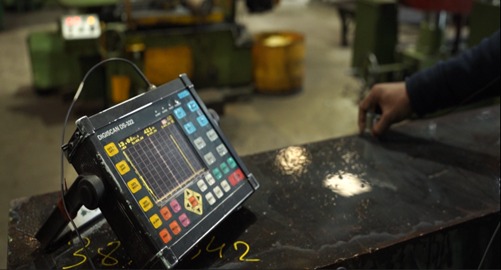
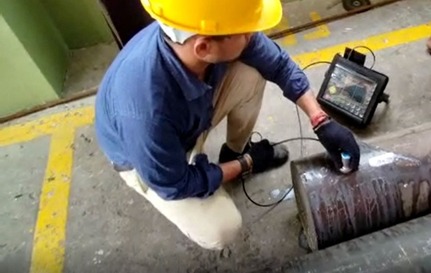
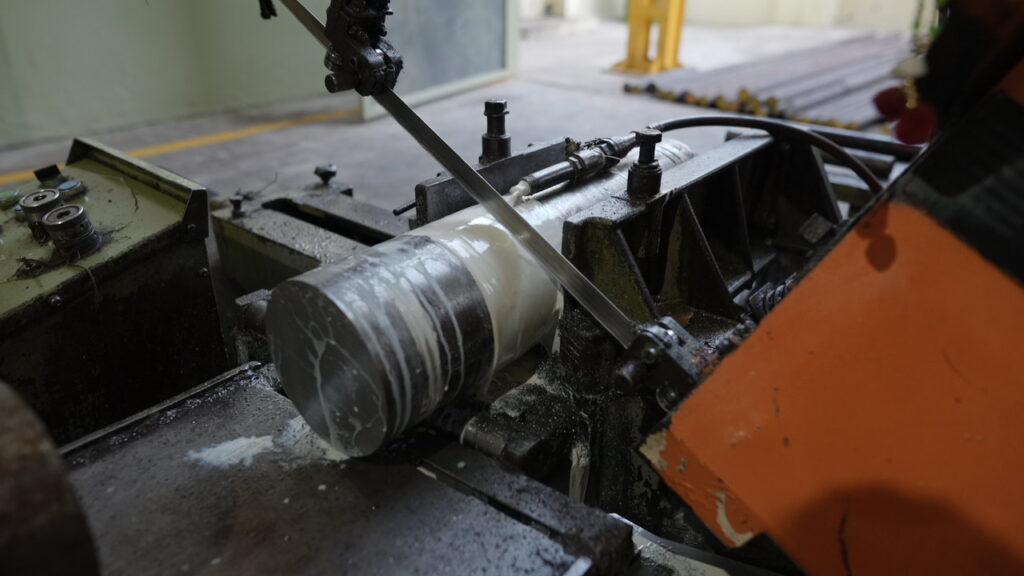
Contact Virat Steels today for technical guidance and a customized quotation for your DB6 Tool Steel requirements.
Download PDF:
https://www.viratsteels.com/downloads/DB6_vs_H13_H11_D2_Comparison.pdf
https://www.youtube.com/shorts/qf8SFJDCtlE
https://www.youtube.com/shorts/5hnQ_qp3WsA
Call us: +91-98140 21775 Email: info@viratsteels.com Visit us: Gurgaon (Haryana) | Ludhiana (Punjab)
Frequently Asked Questions
1. What is the working hardness of DB6 steel?
DB6 steel is typically tempered to a working hardness of 44–50 HRC depending on the forging application.
2. Is DB6 a hot work or cold work tool steel?
DB6 (DIN 1.2714) is a premium hot work alloy tool steel containing Nickel, Chromium, Molybdenum, and Vanadium.
3. What is the annealed hardness of DB6?
In annealed condition, DB6 has a hardness of 220–250 HB (Brinell Hardness) for easy machining.
4. What is the hardening temperature for DB6?
The recommended hardening (austenitizing) temperature is 840–870°C followed by oil, polymer, or air quenching.
5. How many tempering cycles are required for DB6?
At least two tempering cycles (double tempering) are required to relieve stress and stabilize the micro-structure.
6. Is DB6 equivalent to D2 or SKD11?
No. DB6 is a hot work steel (1.2714). D2 / SKD11 (1.2379) is a cold work steel used for cold punching and blanking.
7. What is the DIN equivalent of DB6?
The exact DIN equivalent is DIN 1.2714 (55NiCrMoV7) (L6).
8. What makes DB6 tough?
The presence of 1.50–1.80% Nickel (Ni) gives DB6 exceptional core toughness and resistance to impact cracking.
9. Can DB6 be used for blanking dies?
No, cold blanking requires cold work steels like D2 or DC53. DB6 is engineered for hot forging and high-impact dies.
10. What industries rely on DB6 tool steel?
Drop forging, press forging, automotive component manufacturing, heavy engineering, and defense.
11. Is pre-hardened DB6 available?
Yes, DB6 is often supplied in a pre-hardened condition (~35–40 HRC) for direct die cavity machining.
12. Can DB6 steel be welded?
Welding DB6 is difficult due to its high hardenability. Preheating to 300–400°C and post-weld stress relief are essential if welding is necessary.
13. Why does DB6 outperform H13 in drop forging hammer dies?
DB6 has higher Nickel content, offering superior impact energy absorption compared to H13, preventing die shattering under heavy hammer blows.
14. Why is stress relieving important before hardening DB6?
It removes machining stresses, preventing warping and dimensional movement during quenching.
15. What quality reports come with DB6 from Virat Special Steels?
Material Test Certificate (EN 10204 3.1), Ultrasonic Testing (UT) report, and Hardness/Chemical test reports.
16. Does DB6 resist thermal fatigue?
Yes, its balanced Cr-Ni-Mo composition gives high resistance to heat checking (thermal fatigue).
17. What supply forms are available for DB6?
Round bars, flat blocks, forged blocks, and custom cut plates.
18. What is the primary advantage of DB6?
High impact toughness combined with excellent hardenability across large block sizes.
19. What should buyers check before buying DB6?
Ensure ultrasonic soundness (UT testing) to prevent internal defects in large die blocks.
20. Why choose Virat Special Steels for DB6?
Extensive stock, certified quality, precision cutting facilities, quick delivery, and decades of technical expertise.
H13 vs H11 Tool Steel – Complete Comparison (Properties, Hardness, Applications, Price & Selection Guide)
H13 vs H11 Tool Steel, Which One Should You Choose?
Walk into any tool room, forging shop, or die manufacturing unit in India, and you’ll hear the same debate.
“Should this die be made from H13 or H11?”
At first glance, both steels look nearly the same. They are both part of the Hot Work Tool Steel family, contain chromium and molybdenum, and are built to perform in extreme temperatures. However, choosing the wrong material can significantly decrease die life.
- Choose H13 where H11 should have been used, and the die may crack under repeated impact.
- Choose H11 where H13 belongs, and excessive wear can shorten production life.
This complete guide explains everything you need to know before selecting either grade.
You’ll learn about:
- H13 vs H11 Chemical Composition
- Hardness Comparison
- Mechanical Properties
- Heat Treatment
- Price Comparison
- Tool Life
- Equivalent Grades
- Applications
- Availability in India
- Supplier Selection Guide
- 25+ Frequently Asked Questions
H13 vs H11 Tool Steel – Quick Comparison
| Property | H13 (DIN 1.2344 / SKD61) | H11 (DIN 1.2343 / SKD6) |
| Main Strength | Excellent wear resistance and hot hardness | Great toughness and impact resistance |
| Wear Resistance | Excellent | Very Good |
| Toughness | Very Good | Excellent |
| Hot Hardness | Excellent | Very Good |
| Resistance to Thermal Fatigue | Excellent | Very Good |
| Shock/Impact resistance | Excellent | Good |
| Machinability (Annealed) | Better | Moderate |
| Maximum Working Hardness | Up to 54 HRC | Up to 52 HRC |
| Typical Working Hardness | 44–48 HRC | 42–46 HRC |
| Best Suited For | Die Casting, Extrusion Dies, Plastic Moulds | Forging Dies, Hammer Dies, Fastener Tooling |
| Relative Tool Life | Longer in wear-intensive applications | Longer in impact-intensive applications |
| Relative Cost | 10–20% Higher | More Economical |
| Best Choice When | Heat, wear and long production runs are the priority | High impact, shock loading and toughness are the priority |
What is H13 Tool Steel?
H13 Tool Steel (DIN 1.2344, SKD61) is one of the world’s most widely used chromium hot work tool steels.
Its high vanadium content forms extremely hard carbides that improve:
- Wear resistance
- Hot hardness
- Heat checking resistance
- Tool life
- Surface finish
This makes H13 the preferred steel for:
- Aluminium Die Casting Dies
- Zinc Die Casting
- Plastic Injection Moulds
- Extrusion Dies
- Hot Shear Blades
- Forging Punches
What is H11 Tool Steel?
H11 Tool Steel (DIN 1.2343, SKD6) is also a Hot Work Tool Steel, but with a lower vanadium content.
The lower carbide volume gives H11:
- Better toughness
- Better impact resistance
- Better crack resistance
- Easier machining
It is commonly selected for:
- Hammer Dies
- Forging Dies
- Fastener Tooling
- Hand Tool Dies
- Heavy Stamping
Comparison of Chemical Composition H13 vs H11 Tool Steel
| Element | H13 (DIN 1.2344) | H11 (DIN 1.2343) |
| Carbon | 0.32–0.45% | 0.33–0.43% |
| Chromium | 4.75–5.50% | 4.75–5.50% |
| Molybdenum | 1.10–1.75% | 1.10–1.60% |
| Vanadium | 0.80–1.20% | 0.30–0.50% |
| Silicon | 0.80–1.20% | 0.80–1.20% |
| Manganese | 0.20–0.50% | 0.20–0.50% |
Main Difference:
The H13 with higher vanadium content has much better wear resistance and longer tool life.
Mechanical Property Comparison
| Property | H13 | H11 |
| Wear Resistance | Excellent | Good |
| Toughness | Good | Excellent |
| Hot Hardness | Excellent | Good |
| Thermal Fatigue | Excellent | Very Good |
| Heat Checking Resistance | Excellent | Very Good |
| Impact Resistance | Good | Excellent |
| Machinability | Moderate | Better |
| Polishability | Excellent | Good |
Hardness Comparison
| Condition | H13 | H11 |
| Annealed | 180–220 HB | 180–220 HB |
| Working Hardness | 44–52 HRC | 42–50 HRC |
| Maximum Practical Hardness | 54 HRC | 52 HRC |
Heat Treatment Process
1. Preheating (650–750°C)
2. Austenitizing
o H13: 1010-1025 °C
3. Air, Oil, or Vacuum Quenching
4. Double or Triple Tempering (550-650 °C)
Vacuum heat treatment is recommended for precision dies to minimise distortion.
One of the most asked questions from buyers is:
“What’s the cheapest steel?
Generally,
Why?
- Higher Vanadium content
- Better wear resistance
- Longer production life
- Higher performance in die casting applications
Although the initial purchase price is higher, H13 often delivers a lower cost per component because of its longer service life.
Price depends on:
- ESR or Conventional Grade
- Forged or Rolled Material
- Imported or Domestic Mill
- Size
- Heat Treatment
- Quantity
No fixed market price exists, so always request a quotation based on current stock.
H13 vs H21
| Feature | H13 | H21 |
| Toughness | Better | Lower |
| Hot Hardness | Excellent | Outstanding |
| Wear Resistance | Excellent | Excellent |
| Typical Use | Die Casting | Hot Forging & Extreme Heat |
H13 vs DIN 1.2367
| Property | H13 | 1.2367 |
| Toughness | Excellent | Higher |
| Hot Strength | Excellent | Excellent |
| Large Forging Dies | Good | Better |
There is virtually no practical difference. SKD61 is the Japanese JIS designation equivalent to AISI H13 and DIN 1.2344. Selection should focus on material quality, cleanliness, ESR option, testing, and supplier reliability rather than the grade designation alone.
H13 vs DB6
| Feature | H13 | DB6 |
| Type | Hot Work | Hot Work |
| Toughness | Excellent | Very High |
| Nickel Content | No | Yes |
| Large Forging Dies | Good | Excellent |
| Heavy Impact | Good | Better |
Tool Life Comparison
| Application | Better Grade |
| Die Casting | H13 |
| Extrusion | H13 |
| Plastic Moulds | H13 |
| Hammer Dies | H11 |
| Forging Dies | H11 |
| Heavy Impact Tools | H11 |
H13 & H11 Equivalent Grades
H13 and H11 are common hot work tool steels, but they have different names depending on the international standard used. Use the table below to identify the equivalent grades used in different countries.
| Standard | H13 Equivalent | H11 Equivalent |
| AISI (USA) | H13 | H11 |
| DIN / EN (Germany) | 1.2344 / X40CrMoV5-1 | 1.2343 / X38CrMoV5-1 |
| JIS (Japan) | SKD61 | SKD6 |
Sizes Available
H13 (DIN 1.2344 / SKD61) and H11 (DIN 1.2343 / SKD6) tool steel are available in a wide range of sizes to suit different tooling applications.
| Product Form | Available Sizes |
| Round Bars | Ø13 mm to Ø500+ mm |
| Flat Bars | Thickness: 20–305 mm, Width: 50–600 mm |
| Cut-to-Size Blocks | As per customer drawing and specifications |
Custom sizes and large forged sections can also be supplied based on project requirements.
| Property | Conventional | ESR |
| Cleanliness | Good | Excellent |
| Inclusion Level | Higher | Lower |
| Polishability | Good | Excellent |
| Fatigue Life | Better | Best |
| Tool Life | Longer | Longest |
ESR H13 is recommended for premium die casting and mould applications requiring maximum reliability.
Industries Using H13
- Aluminium Die Casting
- Zinc Die Casting
- Plastic Injection Moulding
- Extrusion
- Aerospace
- Automotive
- Pressure Die Casting
- Hot Shear Blades
Industries Using H11
- Forging
- Hammer Dies
- Fastener Manufacturing
- Hand Tools
- Heavy Engineering
- Structural Components
Why Buy H13 or H11 from Virat Steels?
Virat Steels has been supplying premium tool steels to Indian manufacturers for 70+ years.
Why customers choose Virat Steels
- 70+ Years of Experience
- 2000+ Industrial Customers
- Supplier of material from reputed international mills
- Ready Stock Available
- Mill Test Certificate (MTC)
- UT Tested Material
- Spectro Tested Material
- PAN India Delivery
- Custom Cutting
- Fast Dispatch
- Technical Material Recommendation
Whether you’re looking to Buy H13 Steel, Buy H11 Steel, DIN 1.2344, DIN 1.2343, SKD61, SKD6, ESR H13, or Forged H13 Blocks, our team can recommend the right material based on your application
Our Supply Network Across India
Virat Steels is a trusted supplier of Hot Work Tool Steel to customers across the major industrial hubs of India including Ahmedabad, Rajkot, Pune, Nashik, Aurangabad, Kolhapur, Belgaum, Chennai, Coimbatore, Hosur, Bengaluru, Hyderabad, Faridabad, Manesar, Bhiwadi, Gurugram, Delhi NCR, Ludhiana, Chandigarh, Haryana, Punjab, Jamshedpur.
Our strong logistic network and efficient distribution system enable us to ensure timely PAN India dispatch to meet the requirement of tool rooms, die manufacturers, forging industries and engineering companies across the country.
- H13 Tool Steel
- H11 Tool Steel
- DIN 1.2344 Tool Steel
- DIN 1.2343 Tool Steel
- ESR Tool Steel
- Plastic Mould Steel
- Hot Work Tool Steel
- Forged Tool Steel Blocks
Download Free PDF:
H13 vs H11 Tool Steel Comparison Guide
https://www.viratsteels.com/downloads/h13-vs-h11-comparison.pdf
Request a Quote
Searching for the right Hot Work Tool Steel?
Our technical team can suggest the correct grade for your application whether you require H13, H11, DIN 1.2344, DIN 1.2343, SKD61, SKD6, ESR H13 or Forged H13 Blocks.
Request a Quote Today
✔ Material Recommendation
✔ Ready Stock
✔ MTC Available
✔ UT Tested
✔ Spectro Tested
✔ PAN India Delivery
Call us or send your drawing to receive a customised material recommendation.
Call us: +91-98140 21775 Email: info@viratsteels.com Visit us: Gurgaon (Haryana) | Ludhiana (Punjab)
FAQs (Frequently Asked Questions)
1. What is the difference between H11 and H13 tool steel?
H11 is tougher and more impact resistant while H13 has more wear resistance, hot hardness and resistance to thermal fatigue.
2. Which steel is best for aluminum die casting dies?
H13 is generally preferred as it has a longer die life and is more resistant to heat checking.
3. What grade is recommended for hot forging dies?
H11 is often chosen for heavy-impact forging work and H13 is appropriate for moderate-impact forging applications.
4. What are the common industries that use H11 and H13 tool steel?
These grades are widely used in die casting, forging, extrusion, automobile, aerospace, plastic molding and general engineering industry.
5. What is the working temperature range of H13 tool steel?
H13 has good strength and hardness up to about 600°C and is used for hot working.
6. Is H11 impact strength better than H13?
Yes. H11 has a lower vanadium content which makes it tougher and more resistant to impact loading.
7. Which tool steel has better dimensional stability in heat treatment?
H13 generally has better dimensional stability when properly heat treated.
8. Is it possible to nitride H11 and H13?
Yes. Both grades can be nitrided to increase surface hardness and wear resistance.
9. What is the best grade for extrusion tooling?
H13 is most often recommended for aluminum extrusion dies as it has the best hot strength and wear resistance.
10. Are H11 and H13 available on forged blocks?
Yes. Both grades are available as forged blocks, rounds, flats and in customer specific sizes.
11. What inspections are performed before dispatch?
Material usually comes with Spectro Test Reports, Ultrasonic Testing (UT), Material Test Certificates (MTC), and hardness testing if requested.
12. Can H11 and H13 be supplied in pre-hardened condition?
Yes. Based on customer needs, both grades can be offered annealed, pre-hardened, or heat-treated.
13. Which grade is easier to polish?
H13 generally provides an excellent polished finish, making it good for high-quality tooling applications.
14. Are H11 and H13 suitable for plastic mould applications?
Yes. H13 is commonly used for plastic moulds that work at high temperatures or need great wear resistance.
15. What shapes are available in H11 and H13 tool steel?
These grades come in round bars, flat bars, square bars, forged blocks, plates, and custom-cut sizes.
16. How do I choose between H11 and H13?
The choice depends on the application. Use H11 for maximum toughness, and H13 for better wear resistance and a longer service life.
17. What surface finish options are available?
Materials are available in black, peeled, rough machined, bright, or fully machined condition based on customer needs.
18. Can custom sizes be supplied?
Yes. Custom dimensions and cut-to-size materials are available to reduce machining time and material waste.
19. What certifications are available with the material?
Materials can come with Mill Test Certificates (MTC), chemical composition reports, mechanical property reports, and UT inspection certificates.
20. Does Virat Steels offer technical support in selecting tool steel?
Yes. Our technical team helps customers choose the right grade based on the application, operating temperature, and service conditions.
21. Does Virat Steels deliver across India?
Yes. We provide fast and dependable delivery across India to major industrial cities and manufacturing hubs.
22. How can I place an order with Virat Steels?
Just share your required grade, dimensions, quantity, or technical drawing with our sales team. We will recommend the right material, offer technical guidance, and provide a competitive quote.
Why Manufacturers Across India Choose Virat Steels as Their Trusted Tool Steel Supplier
Importance of the Right Tool Steel Supplier
In the current competitive environment, the quality of Tool Steel Supplier plays an important role when it comes to efficiency in production, quality of the product, and cost of the operations. It really does not matter if you are working with cars or airplanes or making parts or doing precise engineering work. What is important is that you have a company that supplies the right kind of steel tools.
Virat Special Steels Pvt Ltd has been doing this work for over 68 years. We have been supplying quality steel tools to people who make cars, airplanes and other things. We know the problems that people face when they are trying to choose the kind of steel tool, for their work. We are a company that people trust to supply steel tools in India. We give our customers quality materials and also help them with technical problems. We have steel tools to be delivered and we can also cut them to the size that our customers need. We deliver our tools over the country on time. This helps our customers to work waste less time and get good results.
1. Extensive Portfolio of PremiumTool Steel Supplier Grades
There is an extensive portfolio of different grades of tool steel Supplier available at Virat Steels, appropriate for varied industrial uses.
The list includes the following:
2. Premium Quality Tool Steel Supplier You Can Rely On
Quality forms the basis of all products manufactured by Virat Steels.
Every steel alloy is selected, tested, and inspected for the following qualities:
• Hardness
• Wear Resistance
• Toughness
• Tolerance
• Machinability
Manufacturers get products which perform reliably in difficult conditions of manufacture.
3. Ready Stocks Available for Quicker Deliveries
Production delays usually happen when there is a lack of raw materials.
Having ready stocks means that Virat Steels will be able to supply its clients with the necessary tool steel Supplier grades without any delay.
Advantages include:
• Downtime reduction
• Project completion
• Better stock control
• Better scheduling
4. Custom Cutting & Sizing
Each manufacturing company has its own material needs. The Virat Steels offer:
• Custom-cutting services
• Sizes as per the requirement
• Machine-ready sizes
• Bulk availability
This minimizes wastage on the machine and saves time for customers.
5. Technical Competence and Materials Information
Choosing the right grade of tool steel Supplier may not be an easy task always.
The skilled and knowledgeable professionals from Virat Steels assist clients by advising on the most appropriate material considering the following factors:
• Application
• Heat-treating needs
• Wear resistance
• Toughness
• Machinability requirements
• Economic considerations
6. Price Competitiveness without Sacrificing Quality
Producers are always trying to find that delicate balance between the two.
Virat Steels delivers:
• Market competitive rates
• High value products
• Value-for-money materials
Customers get high-end steel within their procurement budget.
7. Industries That Trust Virat Steels
Virat Steels provides services to various industrial sectors such as:
• Automobile Manufacturing
• Plastic Injection Moulding
• Forging Sector
• Manufacturing of Dies and Moulds
• Engineering Workshops
• Aerospace Parts
• Machine Tools Manufacturing
• Precision Engineering
• Industrial Machinery Manufacturing
The capability of serving different sectors highlights their level of professionalism.
8. Fast Tool Steel Supplier Delivery Across India
Indian manufacturers need timely deliveries to keep their operations running smoothly and efficiently.
Virat Steels have an effective supply chain system in place which allows quick deliveries in industrial towns and manufacturing centres. They offer a reliable logistics system that guarantees on-time material delivery.
9. Building Strong Customer Relationships
Virat Steels does not concentrate only on transactions; rather, it builds strong relationships.
Customer needs include:
• Quick communication
• Professional assistance
• Readily available products
• Post sales support
• Long term relationship
This customer first approach has helped create a loyal clientele across India.
10. Commitment to Continuous Improvement
Technology in manufacturing continues to develop, while material demands increase.
Virat Steels keeps abreast of changes in industry through:
• Evolving product line
• Quality assurance
• Better inventory control
• Exceptional customer service
• Efficient supply chain
How Premium Tool Steel Supplier Benefits Manufacturers?
| Manufacturing Challenge | How Virat Steels Helps |
| Production delays | Ready stock and reliable dispatch |
| Incorrect material selection | Technical guidance for grade selection |
| Excess machining | Custom-cut and machine-ready sizes |
| Frequent tool replacement | Premium-quality tool steel designed for demanding applications |
| Procurement delays | Reliable pan-India supply network |
Why Manufacturers Choose Virat Steels
Manufacturers across India choose Virat Steels because we combine high-quality tool steel Supplier with dependable service and technical expertise. Our customers benefit from:
• Premium-quality tool steel
• Wide range of steel grades
• Competitive pricing
• Fast delivery across India
• Custom cutting services
• Expert technical guidance
• Reliable stock availability
• Trusted industry experience
• Excellent customer support
• Long-term supply partnership
| Feature | Virat Steels | Typical Supplier |
| Tool Steel Supplier Grades | Wide range of premium grades | Limited availability |
| Stock Availability | Ready stock for quick dispatch | May require longer lead times |
| Custom Cutting | ✓ Available | Not always available |
| Technical Guidance | Expert material selection support | Limited technical assistance |
| Delivery | Reliable pan-India delivery | Varies by supplier |
| Industries Served | Automotive, Aerospace, Die & Mould, Forging, Precision Engineering | May focus on fewer industries |
| Customer Support | Dedicated and responsive | Varies |
Conclusion
Looking for a trusted Tool Steel Supplier in India ?
No matter where your business is located—North, South, East, or West—Virat Special Steels is here to support your manufacturing needs with premium-quality tool steel Supplier .
From dies and moulds to cutting tools and precision engineering applications, we supply high-performance tool steel Supplier that delivers strength, durability, and consistent results. With expert technical guidance, reliable quality, and timely delivery across India, we help manufacturers keep production running smoothly and efficiently.
Choose Virat Special Steels—your dependable partner for quality tool steel Supplier and long-term manufacturing success.
Contact Virat Special Steels today for expert guidance and premium tool steel Supplier supply.
Need help choosing between DIN 1.2714 Steel , DB6, and H13 for your next die?
Talk to our technical sales team before you place the order — it’s a five-minute call that can save you a failed die six months from now.
Call us: +91-98140 21775 Email: info@viratsteels.com Visit us: Gurgaon (Haryana) | Ludhiana (Punjab)
Frequently Asked Questions (FAQs)
1. What types of tool steel Supplier does Virat Steels supply?
Virat Steels supplies Cold Work Tool Steel, Hot Work Tool Steel Supplier and Plastic Mold Steel. They also provide High-Speed Steel, Alloy Steel, Die Steel and Engineering Steel. Additionally they offer special steel grades.
2. Why should manufacturers choose Virat Steels?
Manufacturers choose Virat Steels because they provide high-quality materials. They have an inventory and offer competitive pricing. Virat Steels also provides expertise and custom cutting services. They ensure delivery across the nation.
3. Does Virat Steels provide sized tool steel Supplier ?
Yes Virat Steels offers custom cutting services. They supply tool steel Supplier in sizes that match customer requirements. This helps reduce machining time and material waste.
4. Which industries use Virat Steels products?
Virat Steels serves industries. These include automotive, aerospace and plastic moulding. They also serve die and mould manufacturing, forging and precision engineering. Machine tools and general engineering are also among their clients.
5. Does Virat Steels maintain stock?
Yes Virat Steels maintains an inventory. They stock used tool steel grades. This ensures dispatch and minimizes production delays.
6. Can Virat Steels help select the tool steel Supplier grade?
Yes Virat Steels has a technical team. They assist customers in choosing the suitable steel grade. The team considers application, hardness wear resistance, toughness and machining requirements.
7. Does Virat Steels deliver across India?
Yes Virat Steels delivers tool steel across India. They have a logistics and distribution network.
8. How does quality tool steel improve manufacturing?
High-quality tool steel offers better wear resistance. It also provides tool life and improved machining performance. Additionally it reduces downtime. Lowers maintenance costs. This leads to productivity and cost savings.
9. Does Virat Steels supply materials for die and mould manufacturing?
Yes Virat Steels offers specialized die steel and mould steel grades. These are suitable, for stamping dies, injection moulds, forging dies and precision tooling applications.
10. How can I contact Virat Steels for a quotation?
You can contact Virat Steels through their website. You can also email them. Reach out to their customer support team. They will discuss your tool steel requirements. Provide a customized quotation.
11. How do I pick the right tool steel for my needs?
The right tool steel depends on what you’re using it for, temperature, wear and tear how hard it needs to be and how easy it is to work with. For example hot work tool steels are good for forging and die-casting while cold work tool steels are often used for cutting tools. If you’re not sure Virat Special Steels technical team can help you choose the tool steel for your project.
12. Why is it important to buy tool steel from a supplier who knows what they’re doing?
A supplier who knows what they’re doing doesn’t just provide tool steel they also help you pick the right one make sure they always have it in stock and deliver it on time. This means you won’t have to delay production your tools will last longer and you’ll spend money making things.
13. What are the benefits of using high-quality tool steel?
High-quality tool steel lasts is stronger keeps its shape and makes your tools last longer. It also means you don’t have to replace tools often you can work without stopping and you get consistent results even when you’re making things in large quantities.
14. What kinds of businesses use tool steel from Virat Special Steels?
Tool steel, from Virat Special Steels is used in industries including making cars, airplanes, molds and dies, forging, making plastic parts, machine tools, precision engineering, and making general equipment.
15. Can Virat Special Steels cut tool steel to the sizes I need?
Yes Virat Special Steels can cut tool steel to the sizes you need. Getting tool steel that’s already the size helps you make things faster use less material and work more efficiently.
Lucchini Italy Tool Steel Supplier in India | DIN 1.2714 & Hot Work Tool Steels
DIN 1.2714, H13, H11 & Hot Work Tool Steels | Pan India Delivery
In precision manufacturing, the right tool steel is not just a material choice — it is a productivity decision. Tool life, dimensional stability, surface finish, and downtime all depend heavily on the steel used in dies, moulds, punches, cutters, and hot-work tooling.
For manufacturers sourcing imported, high-performance tool steel across India — Lucchini Italy Tool Steel is the benchmark for consistent quality and advanced metallurgy. As an authorised Tool Steel Supplier in India, Virat Special Steels stocks and supplies premium Lucchini grades for automotive, aerospace, forging, die casting, plastic moulding, and precision engineering industries.
What Makes Lucchini Italy Tool Steel Special?
Lucchini, headquartered in Italy, has decades of experience manufacturing specialised tool steels to the most demanding international standards. As a trusted Imported Tool Steel supplier in India, Virat Steels sources directly from Lucchini to ensure authenticity and traceability.
- Exceptional hardness and wear resistance
- Superior toughness under impact and shock loading
- Excellent dimensional stability after heat treatment
- Batch-to-batch consistency for repeatable manufacturing results
- Lower inclusion levels through advanced melting and refining
Why Choose Italian Tool Steel?
Italian tool steel from Lucchini consistently outperforms standard grades due to superior steel-making practices. Here is why engineers and toolmakers prefer it:
| Advantage | What It Means for Your Tools |
| Cleaner Metallurgy | Lower sulphur, phosphorus and inclusion content; fewer micro-cracks in service |
| Better Toughness | Tools resist chipping and cracking even under heavy impact loads |
| Lower Rejection Rates | Uniform chemistry and microstructure reduce scrap during heat treatment and machining |
| Longer Tool Life | Customers consistently report 20–35% longer die life compared to standard grades |
| Consistent Heat Treatment | Predictable hardness response reduces rework; saves time and cost in toolrooms |
Lucchini Italy Tool Steel Grades Available in India
Virat Special Steels, a leading Special Steel Supplier and Industrial Tool Steel distributor, stocks the following Lucchini grades for immediate supply across India:
DIN 1.2714 — Hot Work Die Steel (L6 / BH 224 Equivalent)
DIN 1.2714 is the most widely used forging die steel in India. Its combination of high toughness, good wear resistance, and thermal shock resistance makes it the preferred choice for hot forging dies, hammer dies, and press tools.
- Applications: Forging Dies, Hot Stamping Tools, Hammer Dies, Press Tools
- Typical Hardness: 38–42 HRC depending on application
- Keywords: Forging Die Steel, Hot Work Tool Steel, Die Steel Supplier India
Hot Work Tool Steel — Full Range
Complete range of Lucchini hot work grades for forging, extrusion, die casting, and high-temperature tooling applications across Indian industry.
- Applications: Hot Work Dies, Extrusion Containers, Pressure Casting Dies
- Keywords: Hot Work Tool Steel India, Imported Tool Steel Supplier
Technical Data — Key Lucchini Tool Steel Grades
All values are typical and may vary with specific heat treatment parameters. Request mill test certificates for exact batch data.
| Grade | C % | Cr % | Mo % | V % | Hardness (HRC) | Key Property |
| DIN 1.2714 | 0.54–0.60 | 0.90–1.20 | 0.45–0.55 | 0.08–0.15 | 38–52 | Toughness |
| H13 / 1.2344 | 0.37–0.42 | 4.80–5.50 | 1.20–1.50 | 0.90–1.10 | 44–52 | Heat Resistance |
| H11 / 1.2343 | 0.37–0.41 | 4.80–5.50 | 1.10–1.40 | 0.30–0.50 | 44–50 | Impact Toughness |
| Plastic Mould | 0.28–0.40 | 1.60–2.00 | 0.15–0.25 | — | 28–34 (Pre-H) | Polishability |
Lucchini 1.2714 vs Standard 1.2714 — Performance Comparison
This comparison is based on customer feedback and industry data from Indian forging, die casting, and automotive tooling operations.
| Property | Lucchini 1.2714 | Standard 1.2714 | Advantage |
| Toughness | Higher | Medium | ✔ Lucchini — fewer cracks |
| Wear Resistance | High | Moderate | ✔ Lucchini — less edge wear |
| Tool Life | Longer (+20–25%) | Standard | ✔ Lucchini — lower tooling cost |
| Heat Treatment Response | Consistent | Variable | ✔ Lucchini — fewer rejects |
| Inclusion Level | Very Low | Moderate | ✔ Lucchini — cleaner steel |
| Surface Finish | Superior | Standard | ✔ Lucchini — better mould finish |
Customer Success Story — Real Results from Indian Industry
25% Longer Die Life for a Leading Forging Manufacturer
Challenge: A mid-size forging unit in Ludhiana was experiencing frequent die failure and inconsistent heat treatment results using domestically available DIN 1.2714.
Solution: Virat Special Steels recommended switching to Lucchini DIN 1.2714, supported by a full material certificate and application consultation.
Result: The customer achieved 25% longer die life, reduced rejection during heat treatment by over 30%, and lowered overall tooling cost per component — all within 3 production cycles.
Applications Across Indian Industries
| Industry | Common Tooling Application | Recommended Grade |
| Automotive | Stamping dies, forging dies, press tools | DIN 1.2714, H13 / 1.2344 |
| Die Casting | Aluminium, zinc & magnesium casting dies | H13 / 1.2344, H11 / 1.2343 |
| Forging & Extrusion | Hot-work dies, containers, mandrels | DIN 1.2714, H11 / 1.2343 |
| Plastic Processing | Injection moulds, blow moulds, inserts | Plastic Mould Steel |
| General Engineering | Punches, shear blades, wear parts, fixtures | DIN 1.2714, Cold Work Grades |
| Aerospace | Precision tooling, jigs & fixtures | H13 / 1.2344, High-Speed Steel |
Why Choose Virat Special Steels ?
Virat Special Steels is one of India’s most trusted Special Steel Suppliers and Tool Steel Distributors — backed by proven performance and a deep technical knowledge of tool steel applications.
| Credential | What It Means for You |
| Years in Business | Over 3 decades supplying special steels to Indian industry — deep market knowledge and trusted supplier relationships |
| Industries Served | Automotive, aerospace, forging, die casting, defence, railways, oil & gas, plastic processing — 20+ sectors |
| Stock Availability | Ready stock of popular Lucchini grades; no waiting for imports — immediate dispatch possible |
| Custom Cutting Facility | Cut-to-length, rough machined blanks, and custom sizes available — reduce waste and machining time |
| Pan India Supply | Delivering to Ludhiana, Delhi NCR, Mumbai, Pune, Chennai, Coimbatore, Rajkot, Hyderabad and all major industrial centres |
| Certified Material | Every batch supplied with Lucchini mill test certificates, chemical composition reports and hardness verification |
| Technical Consultation | Application-specific grade selection, heat treatment guidance, and after-sales technical support |
Tool Steel Supplier — Pan India Delivery
Virat Special Steels supplies Lucchini tool steel across India. Whether you need material in Punjab, Maharashtra, Tamil Nadu, Telangana, Gujarat, or anywhere else in India — we deliver fast with full traceability.
- Tool Steel Supplier in Ludhiana — Same-day dispatch from our warehouse
- Tool Steel Supplier in Delhi NCR — Serving Faridabad, Gurgaon, Manesar, Noida, Ghaziabad
- Tool Steel Distributor India — Mumbai, Chennai, Pune, bangalore, Karnataka
- Pan India Delivery — Special packaging for long-distance shipments, tracking on request
Explore Our Product Range
Browse our full range of Lucchini tool steel and special steel products:
DIN 1.2714 Tool Steel — Product Page
H13 Tool Steel (DIN 1.2344) — Product Page
H11 Tool Steel (DIN 1.2343) — Product Page
Hot Work Tool Steel — Full Range
Plastic Mould Steel — Product Page
Why Manufacturers Choose Lucchini Tool Steel
Greater Resistance to Wear
Designed for hard working conditions and repeated production cycles, Lucchini grades minimise edge wear and reduce the frequency of maintenance shutdowns — keeping production lines running longer.
High Toughness
Good for tooling subjected to shock, impact and heavy mechanical loads where brittle fracture is costly. Lucchini’s controlled microstructure delivers consistent toughness that standard grades cannot match.
Thermal Fatigue Strength
Critical for die casting, forging, and extrusion where tools are repeatedly heated and cooled. Lucchini hot work grades resist thermal cracking even in high-cycle aluminium die casting operations.
Dimensional Stability
Maintains tolerances after heat treatment and in production — essential for precision tooling where dimensional drift causes part rejection.
Steady Production Performance
Cleaner steel and uniform properties allow for repeatable machining, heat treatment, and shop floor results batch to batch — reducing uncertainty in your toolroom.
Frequently Asked Questions — Lucchini Tool Steel in India
1. What is DIN 1.2714 used for?
DIN 1.2714 is primarily used for hot forging dies, hammer dies, press tools, and hot stamping applications. Its combination of toughness and wear resistance at elevated temperatures makes it the most widely used forging die steel in India.
2. Is Lucchini better than Chinese tool steel?
Yes, for most demanding industrial applications. Lucchini steel offers cleaner metallurgy, lower inclusion levels, consistent chemical composition, and reliable batch-to-batch quality. While Chinese tool steel may have a lower initial cost, Lucchini grades often provide longer tool life, improved heat treatment results, reduced rejection rates, and more predictable performance, resulting in better long-term value.
3. What is the hardness of DIN 1.2714 steel?
Typical hardness for DIN 1.2714 in service is 38–52 HRC depending on the application. Forging dies for heavy hammers are typically hardened to 38–44 HRC for maximum toughness, while press tools and inserts may be taken to 48–52 HRC for better wear resistance.
4. What is the equivalent grade of DIN 1.2714?
DIN 1.2714 is equivalent to AISI L6 (USA), BH 224 (UK), 55NiCrMoV7 (EN), and is comparable to several Indian standard grades. Always verify exact chemistry before substituting, as minor differences in nickel or vanadium content can affect toughness and heat treatment response.
5. What is H13 tool steel used for?
H13 (DIN 1.2344) is the global standard for aluminium die casting dies, hot extrusion tooling, hot forging dies, and high-polish plastic injection moulds. Its high chromium and vanadium content provides excellent thermal fatigue resistance and hot hardness.
6. What is the difference between H13 and H11 tool steel?
H13 (1.2344) contains more vanadium (0.90–1.10%) than H11 (1.2343, 0.30–0.50%), giving it higher wear resistance and hot hardness. H11 has slightly better toughness due to lower carbon and vanadium. H13 is preferred for die casting; H11 for extrusion liners and applications requiring maximum impact resistance.
7. Where can I buy Lucchini tool steel in India?
Virat Special Steels stocks popular Lucchini Italy grades, including DIN 1.2714, H13, H11, and plastic mould steels, with supply across major industrial hubs in India.
8. Is Lucchini tool steel available with mill test certificates?
Yes. Lucchini tool steel is supplied with original mill test certificates, providing details of chemical composition, mechanical properties, and full traceability for quality assurance..
9. Can you supply custom sizes and cut-to-length pieces?
Yes. Virat Special Steels offers custom cutting and rough machining services. We can supply tool steel in cut-to-length bars, rough turned rounds, and custom blanks to reduce material waste and machining time in your toolroom.
10. What industries benefit most from Lucchini Tool Steel?
Premium Italian tool steel is trusted across automotive, forging, die casting, extrusion, plastic moulding, aerospace, railways, defence, and precision engineering industries for reliable performance and longer tool life.
11. What is the minimum order quantity for Lucchini tool steel?
Virat Special Steels can supply from small quantities (single piece) for toolroom requirements up to bulk tonnage for production facilities. There is no minimum order restriction on stocked grades.
12. Do you supply Lucchini steel outside Ludhiana?
Yes. We supply Lucchini tool steel Pan India — including Maharashtra, Gujarat, Tamil Nadu, Telangana, Karnataka, Rajasthan, Uttar Pradesh, and all major industrial regions. Courier, truck, and train transport options available.
Get in Touch — Request a Quote Today
For grade selection, pricing, stock availability, and technical support for Lucchini Italy Tool Steel — contact Virat Special Steels today.
📞 +91 98140-21775 ✉ info@viratsteels.com