



P20 tool steel supplier in India
now browsing by category
Cut-to-Size Die Blocks: Machining Allowance Guide for DB6, H13, D2 & P20
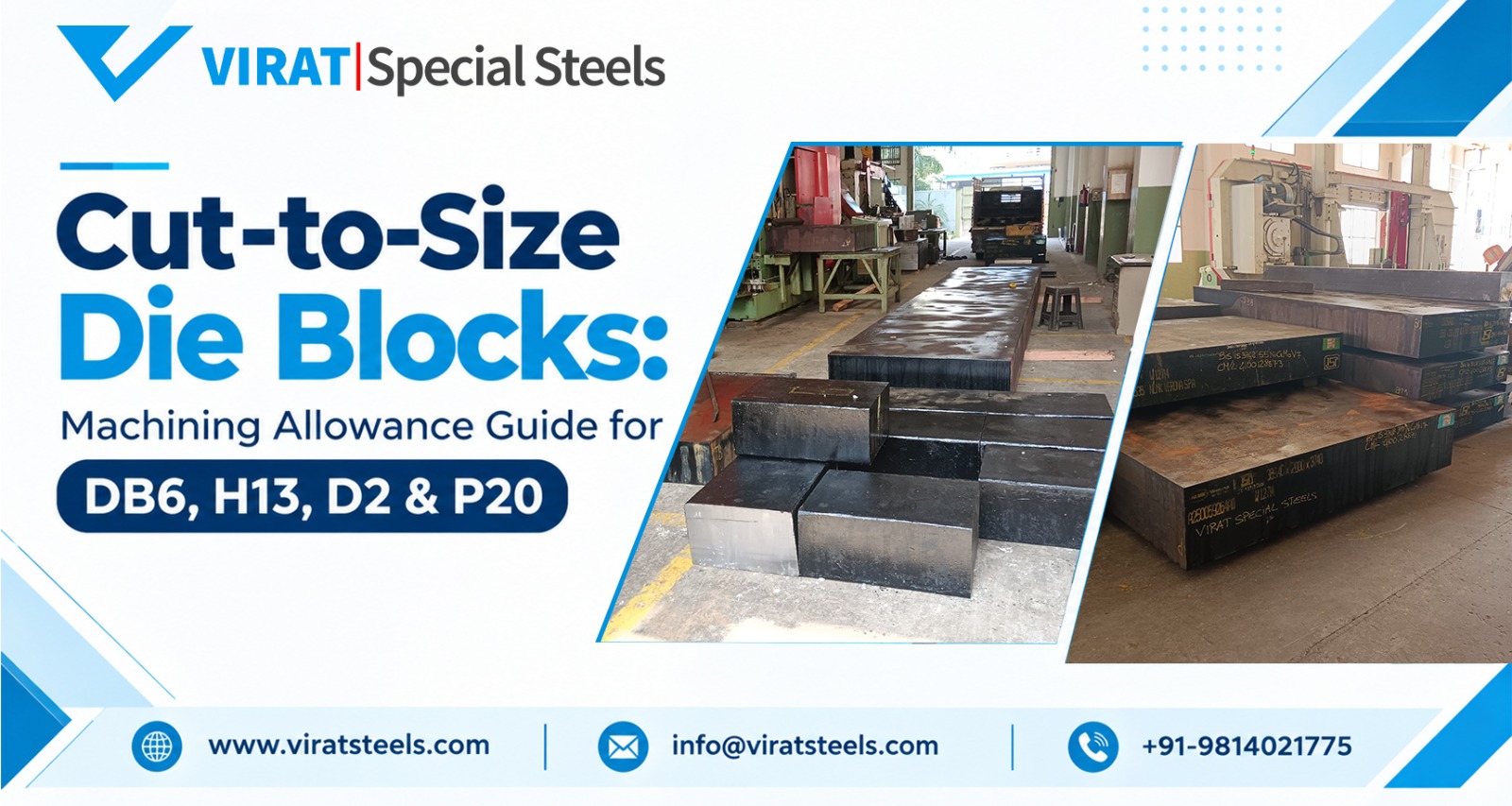
Technical guide by Virat Special Steels · Die and tool steel stockists since 1957
Order a Cut-to-Size Die Blocks with too little allowance and it can’t be cleaned up after heat treatment, so it ends up as scrap. Order too much and you pay for steel, sawing and machine time that turns into chips.
This manual provides us with a summary of the allowance for machining based on the requirements of the various categories from the Indian forging, die-casting, and toolroom industries including DB6 (DIN 1.2714), H13, H11, D2, D3, and P20.
Machining Allowance for Cut-to-Size Die Blocks
Plan these ranges per side (per face), then confirm with your supplier:
| Delivery condition | Allowance per side | What it has to cover |
| Black (hot-rolled or forged) | 3–6 mm for most sizes; more on wide sections | Scale, seams, decarburized skin, bow |
| Saw-cut and rough-milled | 1–2 mm | Remaining geometry error, semi-finishing |
| Six-side milled | 0.2–0.4 mm | Final sizing; standard programmes ship +0.4 to +0.8 mm over nominal overall |
| Precision ground with allowance | 0.15–0.3 mm | Final sizing only |
If hardening is going to be done after machining the piece, allow for at least 0.15% of each dimension on each side for the final finishing of the piece. For instance, a 200 mm face would require about 0.3 mm to be kept.
These figures are based on available data from the mills and actual shop practice; they should not be considered standard values. The actual numbers may depend on the type of alloy, the shape of the section and the method you use. Therefore, make sure to send an engineering drawing before you finish up.
What Is Machining Allowance on a Die Block?
The machining allowance refers to the additional material requested to have the workpiece in its finished form. This is often defined by a number for each side, such as 3 mm per side for a 6 mm allowance in total. With cut-to-size die blocks, you would incorporate this allowance in your order specifications and make sure to mention it on the order.
Breakdown of Machining Allowance Layers
Total allowance is a stack of four layers, and each one exists for a reason.
| Layer | What it covers | Planning figure per side |
| 1. Surface | Scale, seams, laps and the decarburized skin left by hot working | 1.6% of the dimension, usually not under 2 mm |
| 2. Geometry | Bow, camber, out-of-flat and cutting tolerance | 0.3–0.5 mm |
| 3. Heat treatment | Hardening movement, residual scale or decarburization | 0.15% of the dimension, minimum about 0.3 mm |
| 4. Finishing | EDM recast removal, polishing | Small; set by the finishing process |
Layer 1: surface. Hot rolling and forging leave scale, seams and a skin where carbon has burned out. That soft skin won’t harden properly, so it must go. The AISI benchmark for hot-rolled flats and squares is removal of at least 1.6% of the dimension per side (2.4% for resulfurized steel). It was written for carbon and alloy bars, so treat it as a floor for tool steel. Decarburization depth is measured to ASTM E1077 or ISO 3887.
Layer 2: geometry. No bar is perfectly straight or flat, and long pieces bow more. Cutting adds tolerance, and length is the loosest dimension: +3/+8 mm on Uddeholm’s saw-cut stock, up to +35 mm in some precision flat programmes. Never rely on sawn length for a fit.
Layer 3: heat treatment. The sound workflow is rough machine, stress relieve, semi-finish, harden, grind. Uddeholm recommends 650°C for two hours after roughing H13; Virat’s DB6 guidance is 600–650°C. The Böhler-Uddeholm D2 data sheet sets a minimum of 0.15% per side, but only with stress relief, and Uddeholm’s oil-hardening Arne steel lists 0.25%. Movement can be small: on a 100 × 100 × 25 mm H13 sample, thickness changes 0 to +0.05% after air hardening and up to +0.30% after oil hardening. Scale and decarburization from hardening must also be ground off, so the allowance is never just the movement figure.
Layer 4: finishing. Wire EDM leaves a recast layer. Uddeholm advises removing it by grinding or stoning, then re-tempering about 25°C below the previous tempering temperature. Polishing needs little stock.
Formula and Worked Example
Per side: cleanup (the greater of 2 mm or 1.6% of the dimension) + geometry buffer (0.5 mm) + grinding stock (0.15% of the dimension, minimum 0.3 mm). Order size = finished size + 2 × that total.
For instance, a D2 block, which has a final measurement of 250 × 150 × 50 mm owing to the black flat finish, requires a thickness of 4.9, 3.2 and 2.8 mm on each side. This means that one should order something in the order of 260 × 157 × 56 mm with the understanding that this is merely an estimate rather than a guarantee.
Seven mistakes that cost money
- Writing “+5 mm” without saying per side or total.
- Using one allowance for every grade and condition.
- Ignoring bow on long flats.
- Skipping stress relief between roughing and finishing.
- Accepting a gas-cut block to save a few rupees.
- Expecting ESR to shrink the allowance. ESR cleans the inside of the steel. The surface still carries scale and decarb.
- Hoping allowance will fix internal defects. It won’t. For critical blocks, ask for ultrasonic testing.
What to send with your enquiry
- Grade and drawing, with finished size (L × W × T)
- Process route: use as supplied, or harden after machining
- Heat-treatment method: vacuum or atmosphere furnace
- Supply condition wanted: black, milled or ground
- Cutting method and tolerance (saw cut, plus-only or plus-minus)
- Documents needed: MTC, UT, spectro check
- Quantity and delivery location
Specific Scenarios and Add-Ons
Pre-hardened die blocks (DB6, H13, P20). Virat supplies DB6 annealed or hardened and tempered, typically at 38–44 HRC. If you machine the block as supplied, Layer 3 disappears. Keep Layers 1, 2 and 4, and confirm the condition at order stage.
Hardening after machining (D2, D3, soft H13). Use all four layers. Machine soft, stress relieve, harden, then grind.
Wire EDM. Blocks for eroding are often bought hardened and ground, sometimes with start holes. Allow for recast removal and agree finishing stock with your EDM shop.
Flame or plasma-cut blanks. Avoid them for alloy tool steel. Thermal cutting leaves a hardened heat-affected zone and cracking risk, and needs far more stock. Band-sawing is the safer route.
Large forged blocks. Allowance grows with size, so never reuse a 100 mm figure on a 400 mm block. For heavy die blocks, ask for ultrasonic testing. Virat supplies DB6 die blocks with extra forging reduction and double tempering for better UT quality.
Nitriding. Nitrided cases are shallow (about 0.12–0.20 mm in Uddeholm’s H13 examples), so finish the block first and treat nitriding as a surface step, not an allowance layer.
Add-ons to request on your enquiry:
- Bandsaw cut-to-size and surface machining
- Annealed or hardened-and-tempered supply; ESR or non-ESR
- Ultrasonic testing
- Mill Test Certificate (EN 10204 3.1 where applicable), spectro and hardness reports
- Ground reference faces with squareness and parallelism limits
- Batch-wise traceability
Common Material Grades for Cut-to-Size Die Blocks
Allowance logic changes with the grade and its supply condition:
| Grade (AISI / DIN) | Typical use | Allowance note |
| DB6 / 1.2714 (L6) | Hammer and press forging dies | Often supplied hardened and tempered, so no heat-treatment layer |
| H13 / 1.2344 | Die casting, extrusion, hot forging | Air or vacuum hardening keeps movement small; stress relief still applies |
| H11 / 1.2343 | Forging and aluminium extrusion dies | Plan like H13 |
| D2 (HCHCr) / 1.2379 | Blanking and forming dies, punches | Air hardening; keep at least 0.15% per side with stress relief |
| D3 (HCHCr) / 1.2080 | High-abrasion, long-run tooling | Oil hardening; leave more grinding stock than D2 |
| P20 / 1.2311 | Plastic mould blocks | Usually pre-hardened; no heat-treatment layer |
| P20+Ni / 1.2738 | Large mould blocks | Better through-hardening in thick sections |
Sourcing and Customization Options
Virat Special Steels has nearly 3,500 tons in over 35 grades available at its yards in Ludhiana and Gurugram, resulting in large amounts of cut-to-size die blocks shipped out from stock. The billets originate from mills such as Swiss Steel, NLMK Verona, Lucchini and ThyssenKrupp. Blocks reach you in four conditions, each trading price for convenience:
- Saw-cut black block: lowest cost per kg, most allowance to remove.
- Rough-milled: surface layer gone, flatter.
- Six-side milled: close to size, less machining time. Check the stock left if you will harden.
- Hardened and ground: ready for EDM or fitting, with no allowance for further heat treatment.
Include these on your enquiry:
- Grade and delivery condition
- Finished size and order size, stating per side or overall
- Faces to be ground, with tolerances
- Hardening plan and target hardness
- Testing and certificates needed
- Quantity and delivery date
Contact VIRAT for Drawing-Based Sizing and a Quotation
Let us know your engineering drawing, steel grade, dimensions after machining (L x W x T), desired supply condition, volume, and destination point for supply by Virat Special Steels. Our experts will assist you in estimating machining allowance and provide appropriate die blocks as per your needs.
You may get in touch with us at +91-98140 21775 or write to us at info@viratsteels.com to request for a quotation. We manufacture DB6, H13, H11, D2, D3, and P20 tool and die steels from our Gurugram and Ludhiana plants, supplied across India as per availability.
Frequently Asked Questions
1. How much machining allowance should I leave on a die block? Plan 3–6 mm per side on black stock, 1–2 mm on rough-milled and 0.2–0.4 mm on six-side milled blocks, plus grinding stock if you will harden afterwards.
2. Is machining allowance per side or total? Normally per side. A 3 mm allowance adds 6 mm to each dimension, so always state “per side” or “overall” on your enquiry.
3. How much allowance should I keep for grinding after heat treatment? At least 0.15% of the dimension per side for D2 after stress relief. Oil-hardening grades need more; Uddeholm lists 0.25% for its O1-type Arne steel.
4. Do pre-hardened DB6 (DIN 1.2714) die blocks need heat-treatment allowance? Not if you machine them as supplied, typically 38–44 HRC. Keep the surface, geometry and finishing allowances only.
5. What do black, rough-milled and six-side milled mean? Black keeps the as-forged or as-rolled skin. Rough-milled has the skin removed with stock left. Six-side milled is square and parallel, close to final size, so you can start machining straight away.
6. What do “hot die steel”, “HCHCr”, “OHNS” and “die block” mean? Hot die steel is hot-work steel such as H13, H11 and DB6. HCHCr is high-carbon, high-chromium cold-work steel (D2 and D3). OHNS is oil-hardening non-shrinking steel, usually O1. A die block is a large forged or rolled block used for forging and casting dies.
7. Can I flame-cut or plasma-cut a die block? Avoid it for alloy tool steel. These processes will create a hardened heat-affected area, with the possibility of fracture and wasted material. Instead, consider using a band saw.
8. How much stock should I leave for wire EDM? Enough to remove the recast layer by grinding or stoning, followed by re-tempering about 25°C below the last tempering temperature. Agree exact stock with your EDM shop.
9. What tolerance can I expect on cut length? Length is the loosest dimension. Published saw-cut tolerances run from +3/+8 mm to +35 mm, so ask your supplier for its tolerance and never rely on sawn length for a fit.
10. Db6 or H13 for forging die blocks? The typical material for hammering and press dies is DB6 (DIN 1.2714), while H13 (DIN 1.2344) is the preferred alloy for hot-working conditions like die casting, extrusion, and hot forging. This depends on temperature, impact loads, die configuration, and service life.
11. Does D2 or O1 (OHNS) need more allowance? O1, an oil-hardening grade, needs more grinding stock than air-hardening D2. “Non-shrinking” does not mean no movement.
12. Can I buy a small cut piece instead of a full bar? Yes. Virat Special Steels can provide steel that is cut to size depending on the grade, dimensions and availability of stock. Please inform us of your desired dimensions and quantities.
13. Is cut-to-size priced per kg or per piece? Most manufacturers charge according to the overall weight including the costs of cutting and machining. The extra allowance will be reflected in the weight, too, so you should size it accurately and ask them for your cutting estimate.
14. How can I check I received the grade I ordered? Ensure that the heat number on the material marking is the same as stated in the Mill Test Certificate (MTC). Another way would be to ask for an OES analysis to prove the steel grade. Spark testing cannot be considered a reliable way of verifying the alloy tool steel grade.
15. Can I get MTC and ultrasonic testing on cut-to-size blocks? Yes, request them at order stage. Virat supplies MTC (EN 10204 3.1 where applicable), UT-tested material and spectro verification, subject to grade and product.
16. How fast can I get a quotation and delivery? To receive a quotation from Virat Special Steels, share your steel grade, drawing or size, quantity, and the place where the delivery will take place. The lead time varies from time to time, based on availability of material, any cutting/machining work, testing, and transport.
17. How do I calculate die block weight? Length × width × thickness in mm ÷ 1,000,000 × 7.85 gives kg, using a typical tool steel density of 7.85 g/cm³. A 250 × 150 × 50 mm block weighs about 14.7 kg.
18. Where can I buy cut-to-size die blocks in India? Virat Special Steels supplies DB6, H13, H11, D2, D3 and P20 die blocks from ready stock at Ludhiana and Gurugram, with PAN India delivery, subject to grade and size.
P20 vs P20+Ni Tool Steel: Properties, Comparison, Applications & Selection Guide
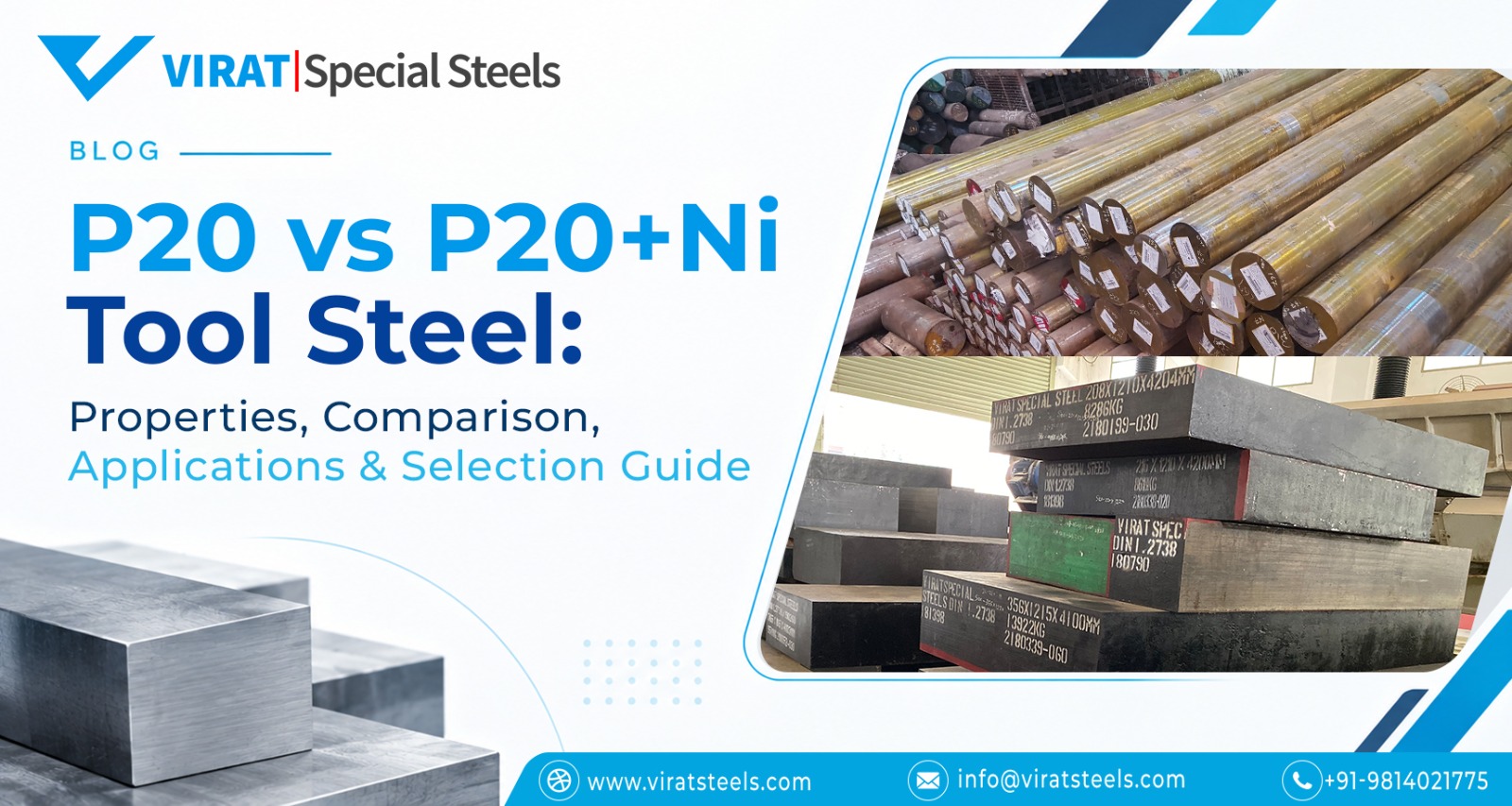
The choice of the correct mold steel directly influences machining time, surface finish, dimensional stability, mold life and total tooling cost. P20 vs P20+Ni tool steel are two of the most common choices for plastic injection molds and related tooling.
Both grades relate to plastic mold manufacturing, but are not interchangeable in all applications. P20 is usually chosen for its combination of machinability, toughness, polishability and cost. Nickel-alloyed P20 grades are often considered for larger sections which require more uniform through-hardening.
This guide will explain the differences between P20 vs P20+Ni tool steel their properties, applications, machinability and what mold makers and procurement teams should be looking for when ordering material.
Virat Steels is a leading supplier of tool and die steel to manufacturers of the plastic molding, die casting and precision tooling industries. The P20-family of steels are amongst the most requested grades. Let’s get into the nitty gritty.
What Is P20 Tool Steel?
P20 tool steel is a low alloy mold steel which is commonly used for plastic injection molds, mold bases, tooling components and some die applications.
In Europe the common designation is 1.2311 / 40CrMnMo7 but it is normally linked to AISI P20. For example, Industeel describes 1.2311 as a pre-hardened mold steel for plastic mold applications that is approximately equivalent to P20.
P20 is valued for offering a practical balance between:
- Good machinability
- Good toughness
- Good polishability
- Useful strength in the pre-hardened condition
- Suitable dimensional stability for mould manufacturing
- Good suitability for general-purpose plastic mould tooling
Depending on the producer and supply condition, P20 may be supplied annealed or pre-hardened. Therefore, the actual hardness and machinability should be confirmed against the supplier’s technical datasheet and material certificate.
What Is P20+Ni Tool Steel?
P20+Ni tool steel is a mold steel alloyed with nickel, developed to enhance through hardening properties relative to conventional P20 type grades.
One common designation is DIN 1.2738 / 40CrMnNiMo8-6-4. Nickel addition is especially helpful for a mold or die with a relatively large section in which a more consistent hardness from surface to core is desired.
P20+Ni is widely associated with applications requiring a combination of:
- Good toughness
- Good machinability
- Good polishability
- More uniform hardness in larger sections
- Good dimensional stability
- Reliable performance in plastic mould tooling
The actual performance will depend on the steelmaker, the manufacturing route, the section size and the heat-treatment condition; the mill certificate should always be quoted in the procurement specifications.
P20 Tool Steel Properties
The main attraction of P20 is its balanced performance rather than one extreme property.
1. Good machinability
P20 is usually supplied in a condition that is readily machinable by mold makers to produce cavities, cores, bases and other components. Its machinability is practical for complex mold geometries and general tool making.
2. Good polishability
Surface finish is critical in plastic injection moulding. A properly produced P20-grade steel can provide good polishability, making it suitable for mould surfaces where appearance and surface quality are important.
The final achievable finish, however, depends on steel cleanliness, homogeneity, heat treatment, machining practice and polishing technique.
3. Toughness
P20 offers a useful combination of strength and toughness for general mould applications. This makes it suitable when the mold has to withstand repeated clamping, injection and mechanical stresses without becoming too hard and brittle.
4. Pre-hardened availability
Many P20 products are supplied in a pre-hardened condition. This can reduce or eliminate the need for additional hardening before machining, depending on the required application and supplied condition.
For example, Industeel will specify its 1.2311 mold steel in a pre-hardened condition at around 280-325 HB, while other producers may specify different delivery conditions.
Confirm the actual hardness range with the supplier before machining or designing the mold.
P20+Ni Tool Steel Properties
P20+Ni has several practical features of P20 but has nickel added to raise hardenability.
1. Improved through-hardening
A key reason for choosing P20+Ni is that it provides more uniform hardness over larger sections.
This is particularly important for large mold blocks where a large difference between surface and core properties may have an impact on machining, dimensional stability or service performance.
2. Good toughness
P20+Ni has been developed to provide optimum hardness and toughness rather than just maximum hardness.
This makes it suitable for molds that are subject to repeated mechanical stresses and applications where cracking or premature failure would be costly.
3. Good polishability
P20+Ni grades are commonly selected for moulds requiring good surface finishing and polishing performance. Steel cleanliness and low sulphur practice can be particularly important when high-quality polished surfaces are required.
4. Good machinability
Despite its enhanced hardenability, P20+Ni is still used extensively for mould manufacturing because it provides a useful combination of machinability, toughness and polishability.
P20 vs P20+Ni tool steel: Quick Comparison Table
| Parameter | P20 Tool Steel | P20+Ni Tool Steel |
| Common designation | 1.2311 / P20* | 1.2738 / P20+Ni* |
| Steel type | Plastic mould steel | Nickel-alloyed plastic mould steel |
| Main advantage | Balanced performance and machinability | Improved through-hardening |
| Machinability | Good | Good |
| Toughness | Good | Good to very good, depending on grade/condition |
| Polishability | Good | Good to excellent, depending on quality |
| Large-section performance | Suitable, but section-dependent | Generally preferred for larger sections |
| Typical mould use | General plastic moulds and mould bases | Large/deeper moulds and demanding mould blocks |
| Supply condition | Often pre-hardened | Often supplied pre-hardened |
| Cost | Generally lower | Generally higher |
| Selection priority | General-purpose tooling | Large sections and more uniform core properties |
Exact grade equivalence and specifications should be verified against the applicable standard and mill certificate.
H13 vs P20 vs P20+Ni tool steel: How Does a Hot-Work Steel Compare?
P20 vs P20+Ni tool steel are both cold/warm-work mould steels. H13 (DIN 1.2344) belongs to a different family entirely — it’s a chromium-molybdenum-vanadium hot-work tool steel, built to hold its hardness under sustained heat rather than to machine and polish easily at room temperature. It’s included here because mould makers sometimes weigh it against the P20 family when a tool will see higher thermal or mechanical loading than a standard plastic mould.
Chemical Composition (wt %)
| Element | P20 (1.2311) | P20+Ni (1.2738) | H13 (1.2344) |
| Carbon (C) | 0.35 – 0.45 | 0.35 – 0.45 | 0.32 – 0.45 |
| Silicon (Si) | 0.20 – 0.40 | 0.20 – 0.40 | 0.80 – 1.25 |
| Manganese (Mn) | 1.30 – 1.60 | 1.30–1.60 | 0.20 – 0.60 |
| Phosphorus (P), max | 0.03 | 0.03 | 0.03 |
| Sulphur (S), max | 0.03 | 0.03 | 0.03 |
| Chromium (Cr) | 1.80 – 2.10 | 1.80 – 2.10 | 4.75 – 5.50 |
| Molybdenum (Mo) | 0.15 – 0.25 | 0.15 – 0.25 | 1.10 – 1.75 |
| Vanadium (V) | — | — | 0.80 – 1.20 |
| Nickel (Ni) | — | 0.90–1.20 | — |
H13‘s much higher chromium and the addition of vanadium and higher molybdenum are what separate it from the P20 family — those elements are what give it hot hardness and resistance to thermal fatigue, at the cost of some room-temperature machinability.
Property & Application Comparison
| Parameter | P20 | P20+Ni | H13 |
| Steel family | Cold/warm-work mould steel | Nickel-alloyed cold/warm-work mould steel | Hot-work tool steel |
| Typical supply hardness | 240–280 BHN (pre-hardened) | 280–320 HB (pre-hardened) | Annealed, or pre-hard ~460–500 BHN; hardened & tempered 45–52 HRC |
| Tensile strength | ~965–1030 MPa | ~850–1100 MPa | ~1550–2050 MPa |
| Key strength | Machinability, polishability, cost | Uniform through-hardening in large sections | Hot hardness, thermal fatigue resistance |
| Best suited to | General-purpose plastic moulds | Large/deep mould blocks needing uniform hardness | Die casting, extrusion dies, forging dies, hot-runner components |
| Operating temperature | Ambient/moderate | Ambient/moderate | High, with repeated heating/cooling cycles |
| Typical limitation | Not for high-temperature or high-wear service | Costs more than plain P20; still not a hot-work grade | Lower machinability/polishability than P20; higher material cost |
When to Choose H13 Over the P20 Family
Choose H13 when:
- The tool will see repeated heating and cooling cycles — aluminium or zinc die casting, hot forging dies, or extrusion tooling.
- Resistance to heat checking and thermal fatigue matters more than mirror polish.
- The mould or die runs at elevated temperature for extended periods, where P20 or P20+Ni would soften or lose dimensional stability over time.
Stay with P20 vs P20+Ni tool steel when:
- The tool is a plastic injection mould running at typical moulding temperatures, not a high-heat forming or casting die.
- Machinability, polishability and cost matter more than hot hardness.
- The section size and cavity finish requirements are the deciding factors rather than thermal cycling.
In short: P20 vs P20+Ni tool steel is a choice about section size and through-hardening within the same mould-steel family, while H13 is a different grade altogether — brought in when the application shifts from ambient-temperature plastic moulding to something that runs hot.
P20 Tool Steel Applications
P20 tool steel applications span a wide range of tooling and mould-making needs, including:
- Injection mould cavities and cores for plastic components
- Mould bases for plastic injection moulding tools
- Die-casting dies for lower-volume or less thermally demanding runs
- Blow moulding tools
- Extrusion tooling components
- Structural and holder blocks within larger tool assemblies
- Zinc die-casting dies (in some applications)
Because of its balance of machinability and moderate strength, P20 is often the “workhorse” grade specified when a mould doesn’t require the extreme wear resistance or hardness of tool steels like H13 or D2.
P20+Ni Tool Steel Applications
P20+Ni is typically specified for the same broad categories of tooling as P20, but where the design calls for something more demanding:
- Large injection mould cavity and core blocks, where uniform hardness through a thick section matters
- High-cavitation moulds requiring more consistent wear behavior across a large tool
- Moulds for engineering plastics that place higher mechanical demands on the tool steel
- Precision moulds where dimensional consistency across a large block is critical to part quality
- Die-casting and moulding applications needing slightly better toughness than standard P20 can offer
Machinability: P20 vs P20+Ni tool steel
For mould manufacturers, machinability is an important purchasing consideration because machining can represent a significant portion of mould manufacturing cost.
Both P20 vs P20+Ni tool steel are commonly selected because they can be machined effectively in suitable delivery conditions.
However, machining performance is not determined by the grade name alone.
It can be affected by:
- Actual hardness
- Steelmaking quality
- Inclusion content
- Section size
- Heat-treatment condition
- Cutting tool grade
- Cutting parameters
- Milling strategy
- Coolant or lubrication
- Required surface finish
For this reason, machining parameters should be established from the actual material condition and tooling manufacturer’s recommendations rather than relying only on a generic P20 cutting-speed chart.
How to Choose Between P20 vs P20+Ni tool steel?
The best choice depends on the mould design and production requirements.
Choose P20 when:
- The mould is small to medium-sized.
- General-purpose plastic moulding is involved.
- Good machinability is a priority.
- The application does not demand exceptional through-hardening.
- Initial material cost is an important consideration.
- A conventional pre-hardened mould steel is sufficient.
Choose P20+Ni when:
- The mould contains large or deep sections.
- More uniform hardness through the section is important.
- The mould design has demanding dimensional requirements.
- Toughness and polishability are important.
- The additional material cost is justified by the tooling requirements.
- You want a mould steel specifically selected for improved hardenability.
The decision should ultimately be based on the mould size, plastic material, production volume, required surface finish, machining method, hardness requirement and expected service conditions.
Advantages and Limitations
Advantages of P20
Advantages
- Good machinability
- Good toughness
- Good polishability
- Widely available
- Suitable for general mould manufacturing
- Often available pre-hardened
- Cost-effective for many applications
Limitations
- Not intended to be the best solution for every high-performance mould
- Through-hardening becomes more important as section size increases
- Wear and corrosion requirements may call for another grade
- Actual performance depends strongly on steel quality and condition
Advantages of P20+Ni
Advantages
- Improved hardenability
- Better suitability for larger sections
- Good toughness
- Good machinability
- Good polishability
- Suitable for demanding mould applications
Limitations
- Generally costs more than standard P20
- The benefits may not justify the additional cost for smaller, less demanding moulds
- Exact properties vary by producer and delivery condition
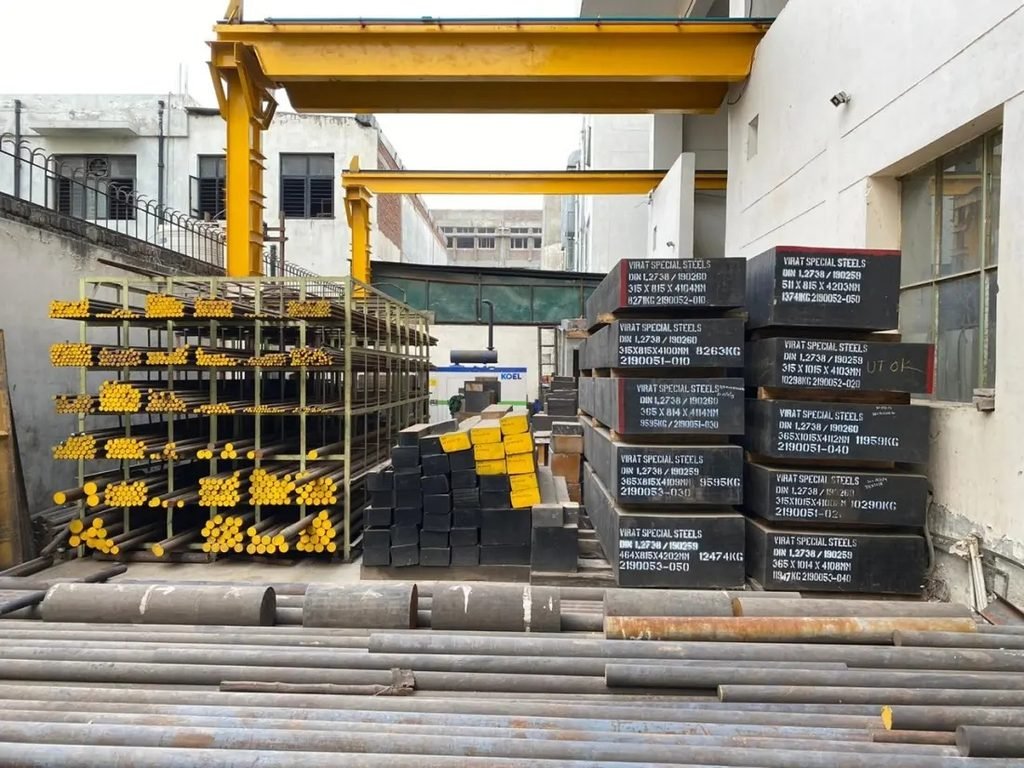
What Should Buyers Check Before Ordering P20 vs P20+Ni tool steel ?
Procurement teams should avoid specifying only “P20 steel” on a purchase order.
A stronger purchasing specification should identify:
- Exact grade designation (e.g., 1.2311 for P20, 1.2738 for P20+Ni)
- Applicable standard
- Required dimensions and section size — especially important for P20+Ni, where the block thickness directly affects through-hardening performance
- Delivery condition (annealed vs. pre-hardened)
- Required hardness range, including surface-to-core hardness uniformity for P20+Ni in larger sections
- Surface condition
- Ultrasonic testing requirements, if applicable
- Material test certificate requirements
- Chemical analysis requirements (nickel content confirmation for P20+Ni)
- Required cutting or machining tolerances
For example, ASTM A681 covers chemical, mechanical and physical requirements for wrought alloy tool-steel products and emphasizes that material selection is based on application, service conditions and properties desired. ISO 4957:2018 specifies requirements for various categories of wrought tool steels and is the current edition.
For P20+Ni specifically, buyers should also request a core hardness test report rather than relying only on surface hardness, since the primary reason to select this grade over standard P20 is uniform hardness through a large section.
Why Material Certification Matters
For critical moulds, the steel supplier should be able to provide appropriate documentation for the supplied material.
Depending on the project, buyers may request:
- Mill Test Certificate (MTC)
- Heat number
- Chemical analysis
- Hardness report
- Ultrasonic testing report
- Dimensional inspection
- Additional inspection documents where specified
The exact inspection requirements should be agreed before purchase.
This is especially important for large mould blocks, where internal quality and consistency can have a major effect on machining and mould performance.
P20 vs P20+Ni tool steel for Indian Mould Manufacturers
Indian mold makers serving the automotive, consumer goods, appliances, electronics, packaging and engineering industries often require steel that offers a combination of performance, availability, machining time and overall tooling cost.
This means that P20 is still a practical option for many general purpose tools, whilst P20+Ni may make more sense for larger and more demanding tooling.
The right material is not always the hardest or the most expensive steel. It is the grade that delivers the required performance without adding extraneous material and processing costs.
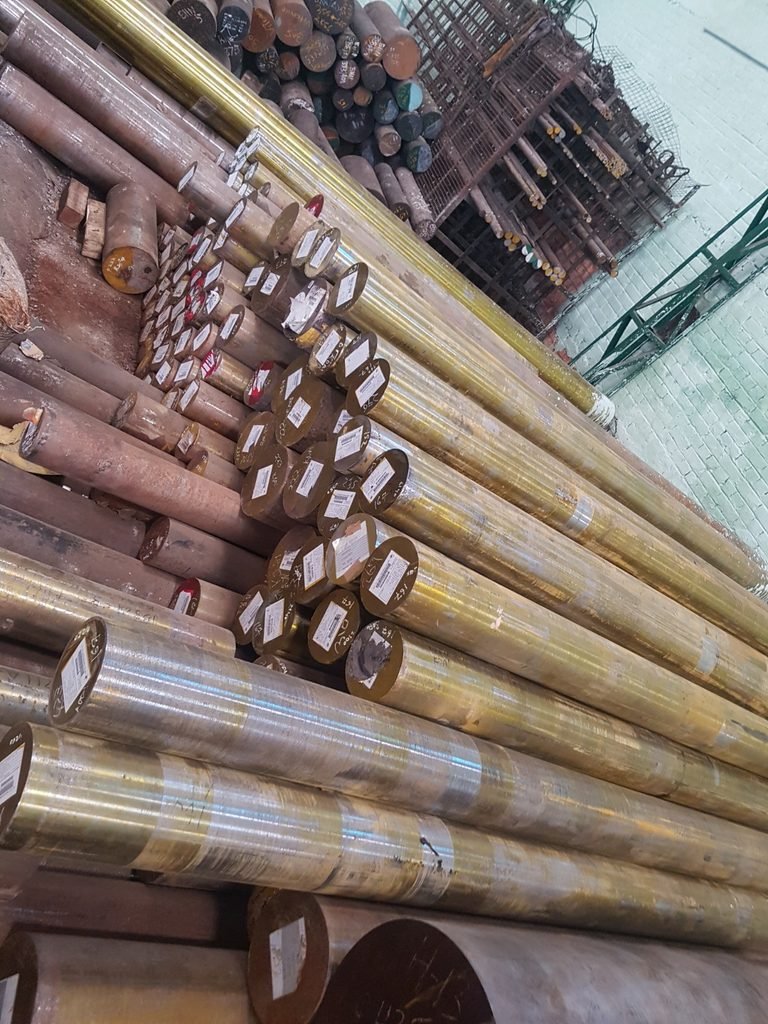
Our Supply Network Across India
With dispatch centers in Gurugram and Ludhiana, we regularly serve mould makers and tool rooms across India, including Delhi, Gurugram, Faridabad, Noida, Ghaziabad, Jaipur, Agra, Ahmedabad, Vadodara, Surat, Rajkot, Mumbai, Pune, Nashik, Indore, Bhopal, Rudrapur, Hyderabad, Kolkata, Belgaum, Chennai, Coimbatore, Hyderabad, Faridabad, Manesar, Bhiwadi,Ludhiana, Chandigarh, Haryana, Punjab and Jamshedpur.
We can offer our P20 vs P20+Ni tool steel in standard or custom sizes, cut to size material, annealed or heat treated condition and material test certificates (MTC) as required. This supply network caters to mold makers, tool rooms, automotive component manufacturers, plastic injection molders and other engineering industries throughout India.
Conclusion
P20 vs P20+Ni tool steel are both valuable choices for mould manufacturing, but they serve slightly different priorities.
P20 tool steel is a practical, versatile choice for many general-purpose plastic moulds because of its machinability, toughness and polishability. P20+Ni becomes particularly attractive when the mould is larger or deeper and more uniform through-hardening is required.
Before purchasing, always verify the exact grade, standard, hardness, section size, delivery condition and material certification rather than selecting steel based only on the commercial name “P20.”
Looking for P20 or P20+Ni Tool Steel in India?
Virat Special Steels supplies tool and mould steels for mould manufacturers, tool rooms, engineering companies and industrial buyers. P20 and P20+Ni can be supplied in suitable forms and sizes subject to grade and stock availability, with cutting and technical support for industrial requirements.
Our technical team will confirm grade equivalence, available sizes and delivery timeline within 24 hours.
Prefer to talk directly?
Gurugram, Haryana | Ludhiana, Punjab
Phone: +91-98140-21775
Email: info@viratsteels.com
Ask the Virat Steels team to verify the required grade, dimensions, hardness, testing and MTC requirements before placing your order.
Frequently Asked Questions
1. What is P20 tool steel?
P20 tool steel is a mould and tool steel commonly used for plastic injection moulds, mould bases, cavities, cores and related tooling. A commonly referenced grade is 1.2311.
2. What is P20+Ni tool steel?
P20+Ni is a nickel-alloyed mould steel, commonly associated with 1.2738, designed to provide improved through-hardening compared with conventional P20-type grades.
3. What is the difference between P20 vs P20+Ni Tool Steel ?
The main difference is the alloy design. P20+Ni contains nickel and is generally selected where improved hardenability and more uniform properties through larger sections are important.
4. Is P20 good for plastic injection moulds?
Yes. P20 is widely used for plastic injection moulds because of its balance of machinability, toughness, polishability and strength.
5. Is P20+Ni better than P20?
Not automatically. P20+Ni can be a better choice for large mould blocks or applications where through-hardening is important. Standard P20 can be more economical for general-purpose tooling.
6. Is P20 supplied pre-hardened?
Many P20 products are available in pre-hardened conditions, but the exact hardness depends on the supplier and product specification. Always confirm the delivery condition before ordering.
7. Can P20 be polished?
Yes. P20 is commonly used for mould applications requiring good polishing performance. Final surface quality also depends on steel cleanliness, machining and polishing practices.
8. Is P20 easy to machine?
P20 is generally considered machinable in appropriate delivery conditions. Actual machining performance depends on hardness, steel quality, cutting tools and machining parameters.
9. What is P20+Ni used for?
P20+Ni is commonly used for large plastic injection moulds, mould blocks, deep cavities and tooling where improved through-hardening and uniform properties are important.
10. Is 1.2311 the same as P20?
1.2311 is commonly associated with P20 and is often marketed as a P20 equivalent. However, buyers should verify the exact standard and chemical/mechanical requirements rather than assuming that every P20-labelled product is identical.
11. Is 1.2738 the same as P20+Ni?
1.2738 is a commonly referenced P20+Ni grade. The exact specification should be confirmed from the producer’s technical documentation and material certificate.
12. Which is better for large moulds: P20+Ni Tool Steel ?
P20+Ni is often preferred for larger sections because its nickel-alloyed composition provides improved through-hardening. The final selection should consider the actual mould dimensions and required hardness profile.
13. Can P20 be used for die casting?
P20 can be used for selected tooling and die applications, but it should not automatically be selected for demanding high-temperature die-casting applications. The operating temperature, thermal cycling, wear and required tool life should be evaluated first.
14. How do I specify P20 steel when buying?
Specify the exact grade, standard, dimensions, delivery condition, hardness requirement and inspection/documentation requirements. For critical applications, request the applicable MTC and testing documentation.
15. Where can I buy P20 vs P20+Ni Tool Steel in India?
Industrial buyers can source P20 and P20+Ni from specialised tool-steel suppliers such as Virat Special Steels, subject to available grade, size, mill and delivery condition.
P20 vs P20+Ni Tool Steel: Which is Better for Plastic Mould Applications?
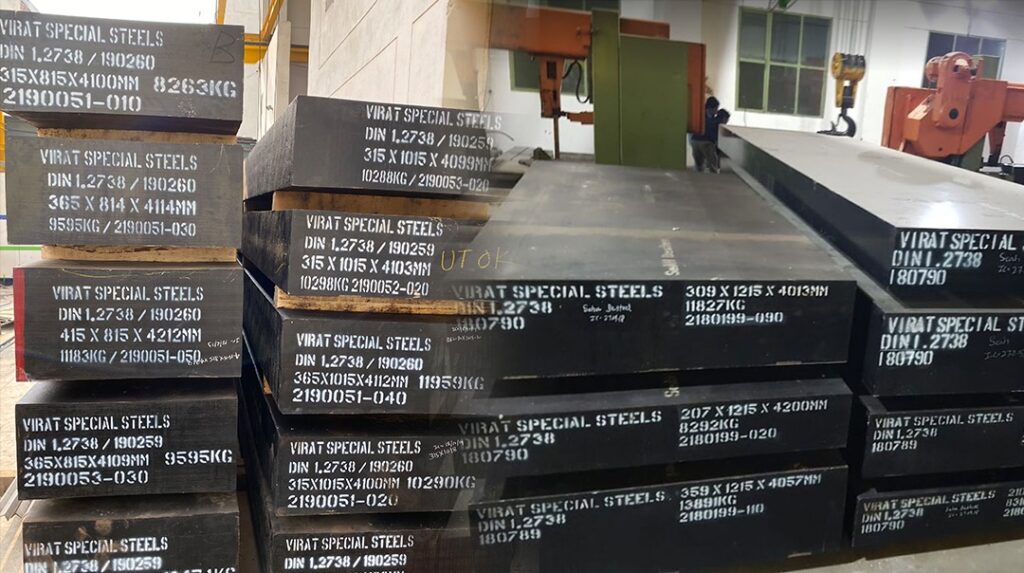
In the plastic mould industry, selecting the right material plays a crucial role in determining tool life, surface finish, and production efficiency. Two of the most used mould steels are P20 and P20+Ni tool steel (Nickel Alloyed P20 Steel).
But which one is better for your application?
In this blog, we compare P20 vs P20+Ni tool steel to help manufacturers make the right decision.
What is P20 Tool Steel?
P20 is a pre-hardened plastic mould steel widely used in the manufacturing of:
- Plastic injection moulds
- Die casting dies
- Automotive components
- Mold bases
Key Properties of P20 Steel
- Hardness: 280–320 BHN
- Good machinability
- Moderate toughness
- Cost-effective solution
- Suitable for medium production runs
What is P20+Ni Tool Steel?
P20+Ni is an enhanced version of P20 steel with Nickel (Ni) added, improving its performance significantly.
Key Properties of P20+Ni Steel
- Improved toughness
- Better hardness uniformity
- Superior polishability
- Enhanced core strength
- Ideal for high-quality moulds
P20 vs P20+Ni: Key Differences
| Property | P20 Steel | P20+Ni Steel |
| Toughness | Moderate | High |
| Hardness Uniformity | Standard | Excellent |
| Polishability | Good | Superior (Mirror Finish) |
| Core Strength | Average | Strong |
| Cost | Lower | Slightly Higher |
| Best Use | General moulds | High precision & glossy moulds |
Why Choose P20+Ni for Plastic Moulds?
If your application requires:
✔ High surface finish (mirror polish)
✔ Large mould sizes
✔ Better durability and longer tool life
✔ Uniform hardness across thick sections
Then P20+Ni steel is the better choice.
Applications of P20 & P20+Ni Steel
Both grades are widely used in:
- Plastic injection moulds
- Blow moulds
- Die casting dies
- Automotive plastic components
- Consumer product moulds
Result:
- Choose P20 → for general-purpose moulds
- Choose P20+Ni → for high-end, precision moulds
Why Choose Virat Special Steels?
At Virat Special Steels, we provide premium quality P20 and P20+Ni tool steel with:
- Large ready stock
- Assured material quality
- Custom sizes available
- Competitive pricing
- Fast delivery across India
We are a trusted tool and die steel supplier in India, serving Pan India industries including key industrial hubs such as Pune, Nashik, Ahmedabad, Rajkot, Ludhiana, Faridabad, Ghaziabad, Gurgaon, and the entire South India region.
Conclusion
Both P20 and P20+Ni tool steels have their own advantages, but the right choice depends on your application.
If you’re looking for a reliable P20 / P20+Ni steel supplier in India, Virat Special Steels is your trusted partner.
Contact our team to get more details about available sizes and technical specifications suitable for your applications.
https://www.viratsteels.com/p20ni.htmlinfo@viratsteels.com
+91 98140-21775
FAQs
1. What is the difference between P20 and P20+Ni steel?
P20+Ni contains nickel, which improves toughness, polishability, and hardness uniformity compared to standard P20.
2. What is the hardness of P20 steel?
Typically 280–320 BHN in pre-hardened condition.
3. Which steel is better for mirror finish moulds?
P20+Ni steel is preferred due to its superior polishability.
4. Where can I buy P20+Ni tool steel in India?
You can source high-quality P20 and P20+Ni steel from Virat Special Steels.