




Comparing DIN 2344 and H13 Tool Steels
now browsing by category
Why H13 tool steel Is Widely Used for Aluminium Extrusion Dies
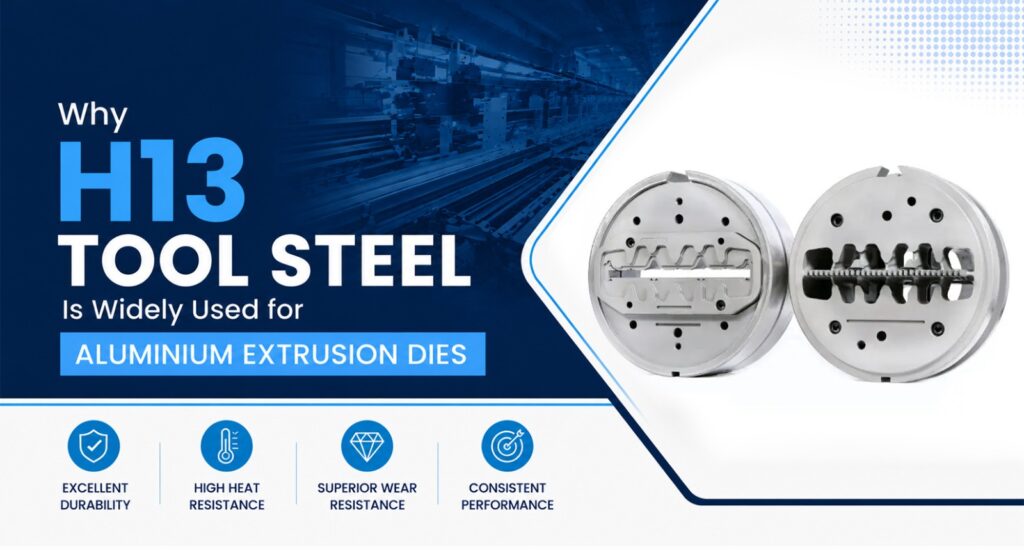
The aluminium extrusion industry demands tooling that can withstand extreme heat, pressure, wear, and continuous production cycles. Choosing the wrong die steel can lead to premature cracking, dimensional loss, downtime, and high replacement costs.
That is why H13 tool steel has become the industry’s preferred choice for aluminium extrusion dies.
Known for its excellent combination of hot strength, toughness, thermal fatigue resistance, and wear resistance, H13 steel delivers reliable performance in demanding extrusion applications.
What is H13 Tool Steel?
H13 tool steel is a chromium-molybdenum-vanadium hot work tool steel designed for high-temperature tooling applications.
Equivalent grades include:
- DIN 1.2344
- SKD61
- X40CrMoV5-1
H13 is widely used in:
- Aluminium extrusion dies
- Die casting dies
- Forging dies
- Plastic injection moulds
Why Aluminium Extrusion Dies Need Special Tool Steel
During extrusion, aluminium billets are heated to high temperatures and forced through the die under massive pressure.
This creates:
- High thermal stress
- Severe wear
- Continuous friction
- Cyclic heating and cooling
Ordinary steels cannot withstand these conditions for long. The die material must maintain:
- Hardness at high temperatures
- Toughness against cracking
- Wear resistance under pressure
This is where H13 tool steel performs exceptionally well.
ESR H13 vs Standard H13 for Extrusion Dies
What is ESR H13?
ESR stands for:
Electro Slag Remelting
This secondary refining process produces cleaner steel with:
✔ Lower inclusions
✔ Better toughness
✔ Improved fatigue resistance
✔ More uniform carbide distribution
For demanding extrusion applications, many manufacturers prefer:
👉 ESR-grade H13 tool steel
How to Increase H13 Extrusion Die Life
Manufacturers can significantly improve die life by:
✔ Using ESR-grade H13
Cleaner steel improves fatigue resistance.
✔ Maintaining Correct Hardness
Recommended:48–52 HRC
✔ Proper Preheating
Reduces thermal shock during startup.
✔ Nitriding Surface Treatment
Improves:
- Wear resistance
- Oxidation resistance
- Surface hardness
✔ Correct Cooling Practices
Avoid aggressive cooling that causes thermal stress.
Why Manufacturers Prefer Virat Steels for H13 Tool Steel
Virat Steels is a trusted supplier of:
- H13 / DIN 1.2344
- ESR H13
- SKD61 tool steel
We supply:
✔ Rounds
✔ Flats
✔ Blocks
✔ Ultrasonic tested material
✔ Mill test certificates
Industries served:
- Aluminium extrusion
- Die casting
- Forging
- Plastic moulding
Why Choose Virat Steels?
✔ Ready Stock Available
Fast dispatch across India.
✔ ESR & Standard Grades
Application-based recommendations.
✔ Technical Support
We help customers choose:
- Correct grade
- Correct HRC
- Correct size
✔ Trusted by Manufacturers Across India
We are supplying to major industrial regions across Pan India .
Contact Virat Steels for H13 Tool Steel
Looking for a reliable supplier of H13 tool steel for aluminium extrusion dies?
Contact Virat Steels today:
📞 +91 98140-21775
https://www.viratsteels.com/h13.html
✉ info@viratsteels.com
Get expert guidance on:
✔ Grade selection
✔ ESR vs standard
✔ Hardness recommendations
✔ Size availability
Frequently Asked Questions (FAQs)
1. Why is H13 tool steel widely used for aluminium extrusion dies?
H13 steel is widely used because of its excellent hot strength, thermal fatigue resistance, toughness, and wear resistance. These properties help extrusion dies perform reliably under high temperature and pressure.
2. What hardness is recommended for H13 extrusion dies?
The recommended hardness for aluminium extrusion dies is typically: 48–52 HRC
3. What is the equivalent grade of H13 steel?
Equivalent grades of H13 tool steel include:
- DIN 1.2344
- SKD61
- X40CrMoV5-1
4. What are the common failures in aluminium extrusion dies?
Common extrusion die failures include:
- Heat checking
- Thermal fatigue cracking
- Surface wear
- Gross cracking
- Dimensional loss
These failures are often caused by improper heat treatment, poor cooling, or low-quality steel.
5. What is ESR H13 steel?
ESR stands for Electro Slag Remelting.
ESR-grade H13 tool steel offers:
✔ Cleaner microstructure
✔ Better toughness
✔ Improved fatigue resistance
✔ Longer die life
6. How can extrusion die life be increased?
Extrusion die life can be improved by:
- Using ESR-quality H13 steel
- Maintaining proper hardness
- Applying nitriding
- Using correct cooling practices
- Proper die preheating
7. Is H13 steel suitable for high-pressure applications?
Yes. H13 tool steel performs very well in high-pressure applications because of its excellent toughness and heat resistance.
8. What industries use H13 steel in India?
H13 steel is widely used in:
- Aluminium extrusion industry
- Die casting industry
- Forging industry
- Plastic mould manufacturing
- Automotive tooling applications
9. Where can I buy genuine H13 steel in India?
You can buy genuine H13 tool steel from trusted suppliers like Virat Steels, offering ESR and standard grades with test certificates and ultrasonic-tested material.
Why H13 Dies Fail Prematurely — And How to Prevent It
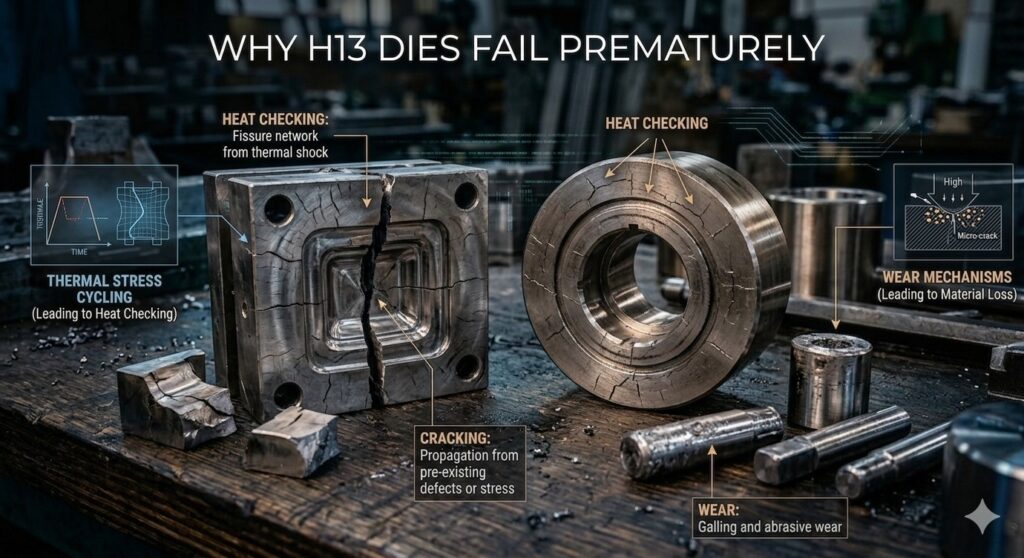
H13 tool steel is the backbone of hot work tooling—widely used in die casting, forging, extrusion, and moulding. When processed correctly, it delivers long life and consistent performance.
Yet many H13 dies fail far earlier than expected.
That’s not a material problem—it’s a process problem.
What is Premature Failure?
Premature failure means a die cracks, wears out, or loses accuracy well before its expected production life—leading to downtime, rejection, and high tooling costs.
Top Reasons H13 Dies Fail Early
1. Heat Checking (Thermal Fatigue)
Repeated heating and cooling creates fine surface cracks (like dry mud). Over time, these cracks grow and damage the die surface.
Why it happens faster:
- Excessive cooling (thermal shock)
- Over-hardening (brittleness)
- No preheating before production
Prevention: Controlled cooling, correct hardness, nitriding, ESR-grade steel.
2. Gross Cracking & Fracture
Deep cracks or sudden die breakage.
Causes:
- Over-hardening
- Poor tempering (retained austenite)
- Sharp corners (stress concentration)
- Thermal shock
Prevention: Proper heat treatment, multiple tempering cycles, better die design.
3. Abrasive Wear & Erosion
Gradual loss of dimension and surface finish.
Causes:
- Low hardness
- High temperatures
- Poor lubrication
- High metal flow (in die casting)
Prevention: Correct hardness, lubrication, nitriding/PVD coatings.
4. Poor Heat Treatment
Even premium H13 fails if heat treatment is wrong.
Common mistakes:
- Incorrect hardening temperature
- Uneven quenching
- Single tempering
- Surface decarburisation
Prevention: Vacuum heat treatment + double/triple tempering.
5. Low Steel Quality
Not all H13 is equal.
Standard grades may contain inclusions and segregation—leading to early cracks.
Better choice:
ESR process H13 — cleaner, tougher, longer life.
6. Design & Machining Errors
Even perfect steel fails with poor design.
Common issues:
- Sharp corners
- Thin sections
- Poor cooling line placement
- EDM layer without re-tempering
Prevention: Smooth radii, balanced design, proper finishing.
7. Poor Lubrication & Cooling
Operational mistakes accelerate failure.
- Uneven cooling → thermal stress
- Poor lubrication → wear & soldering
- Hard water scaling → overheating
8. No Preheating
A cold die entering production faces instant thermal shock.
Recommended:
- Die casting: 180–250°C
- Forging: 150–200°C
How to Extend H13 Die Life
- Use ESR-quality H13 steel
- Maintain correct hardness (not “harder is better”)
- Ensure proper heat treatment (multi-temper)
- Apply nitriding or coatings
- Design with proper radii & cooling layout
- Always preheat before production
Conclusion
H13 failure is rarely random—it’s almost always preventable.
The biggest difference between short life and long life?
Material quality + process control.
Start with the right steel. Execute the process right.
And H13 will deliver the performance it’s known for.
Frequently Asked Questions
Q1: Why is H13 preferred for hot work dies?
Excellent hot strength
Good thermal fatigue resistance
High toughness
Q2: What is the main cause of heat checking in H13?
Repeated thermal cycling (heating + cooling)
Q3: How can heat checking be reduced?
Proper die preheating (150–300°C typically)
Controlled cooling (avoid sudden quenching)
Use of thermal barrier coatings
Q4: What hardness is ideal for H13 dies?
Typically 44–52 HRC depending on application
Too hard → cracking
Too soft → wear
Q5: How does nitriding help H13 dies?
Increases surface hardness
Improves wear resistance
Delays crack initiation
Q6: What is the role of cooling channels?
Maintain uniform temperature
Reduce thermal gradients
Prevent hot spots → reduce cracking
Q7: Can coatings completely prevent wear?
No, but they significantly delay it
Coatings improve life, not eliminate failure
Q8: Why do dies soften over time?
Overexposure to high temperatures beyond tempering limit
Q9: What industries commonly face H13 die failure?
Die casting (aluminum, zinc)
Forging
Extrusion
| Ready to Source H13 Smarter? Contact Virat Special Steels Today |
Fast quotes | Grade recommendations | Pan-India delivery
https://www.viratsteels.com/h13.html📧 info@viratsteels.com | 📱 +91 98140-21775
The Future of Tool Steel: Innovations with DIN 2344 and H13
In the evolving world of manufacturing, the materials used to shape, mold, and cut have a direct impact on productivity and quality. Tool steels play a critical role in this landscape, with DIN 2344 and H13 standing out as industry leaders. Known for their exceptional thermal resistance, hardness, and strength, these grades are the backbone of tools, molds, and dies in industries such as automotive, aerospace, and die-casting. In this article, we’ll explore the significance of these materials, examine ongoing innovations, and understand how companies like Virat Special Steels contribute to shaping the future of tool steel.
The Role of Tool Steel in Manufacturing and Industry
Tool steels are indispensable for industries that demand precision and durability. Used extensively in the production of cutting tools, molds, and dies, these alloys must endure extreme conditions, from high temperatures to heavy wear. Without them, high-quality manufacturing would simply not be possible. Automotive industries rely on tool steels for die-casting, while aerospace engineering depends on these materials for components exposed to high temperatures and stresses. In short, tool steels are the unsung heroes enabling modern engineering feats.
What Makes DIN 2344 and H13 Stand Out?
Composition and Properties of DIN 2344
DIN 2344 is a chromium-molybdenum-vanadium alloyed steel prized for its high thermal resistance and toughness. It maintains hardness even at elevated temperatures, making it a preferred choice for hot-working tools like forging dies and extrusion presses. Key properties include:
- Exceptional wear resistance.
- High tensile strength.
- Excellent machinability.
Characteristics and Features of H13
H13 steel, part of the H-series family, is well-known for its versatility and toughness. It’s often chosen for die-casting and plastic mold tooling, thanks to its outstanding thermal fatigue resistance and ease of fabrication. Its main properties are:
- Superior thermal conductivity.
- Resistance to cracking under repeated heating and cooling cycles.
- High flexibility for complex shaping.
Innovations Driving the Future of Tool Steel
The tool steel industry has seen several groundbreaking advancements. Let’s delve into some of the most significant ones:
- Advanced Alloying Techniques
Researchers are experimenting with alloying elements like cobalt and niobium to improve the thermal and wear resistance of tool steels. Such innovations push the limits of performance. - Additive Manufacturing and 3D Printing
3D printing is revolutionizing tool steel production by enabling intricate designs and reducing material waste. Industries are now combining traditional methods with 3D technologies for optimal results. - Improved Heat Treatment Processes
Heat treatment plays a pivotal role in enhancing tool steel properties. Modern techniques such as vacuum hardening ensure precision in achieving desired hardness and toughness.
Advantages of Modern Tool Steel Innovations
New innovations in DIN 2344 and H13 steels offer several benefits:
- Durability: These steels withstand high temperatures and extreme pressures without significant wear.
- Longevity: Enhanced resistance to thermal fatigue and cracking translates into longer tool lifespans, reducing downtime and maintenance costs.
- Efficiency: Advanced manufacturing techniques improve energy usage and reduce material waste.
Comparing DIN 2344 and H13 Tool Steels
Below is a snapshot of their key differences:
| Property | DIN 2344 | H13 |
| Composition | Cr, Mo, V | Cr, Mo, Si, V |
| Thermal Resistance | High | Very High |
| Applications | Forging, extrusion | Die-casting, molds |
Applications of DIN 2344 and H13
Both steels are tailored to specific needs:
- DIN 2344: Ideal for extrusion tooling and hot forging, thanks to its resistance to thermal shock.
- H13: Perfect for plastic injection molding, die-casting, and high-temperature aerospace components.
Environmental Sustainability and Tool Steels
Modern practices focus on sustainability. From reducing energy-intensive processes to emphasizing recycling, the industry is working toward a smaller environmental footprint. The longevity of DIN 2344 and H13 further minimizes the need for replacements, aligning with eco-friendly goals.
Future Prospects of DIN 2344 and H13
As industries move toward automation and more advanced technologies, the demand for high-performing materials like DIN 2344 and H13 is set to rise. Innovations in metallurgy and 3D printing will only increase their applications.
Challenges in the Tool Steel Industry
Despite advancements, challenges persist. Manufacturers face supply chain disruptions, the rising cost of raw materials, and the need to balance quality with affordability. Addressing these challenges requires collective efforts from stakeholders, including suppliers like Virat Special Steels.
The Role of Companies Like Virat Special Steels
Virat Special Steels is a pioneer in the distribution of high-quality tool steels, including DIN 2344 and H13. By committing to innovation, stringent quality checks, and customer satisfaction, they remain at the forefront of the industry.
Key Takeaways
- Tool steels like DIN 2344 and H13 are integral to modern manufacturing.
- Innovations are enhancing their performance and extending their applications.
- Companies like Virat Special Steels are instrumental in meeting the growing demands of the industry.
FAQs About Tool Steel
- What makes DIN 2344 unique compared to other tool steels?
Its ability to maintain hardness at high temperatures and resist wear sets it apart. - Why is H13 preferred in certain industries?
H13 combines versatility and thermal fatigue resistance, making it ideal for die-casting and molds. - How does Virat Special Steels ensure the quality of its products?
Rigorous testing, advanced manufacturing techniques, and expert handling ensure top-notch quality. - Can DIN 2344 and H13 be recycled efficiently?
Yes, their high-grade compositions make them suitable for recycling without significant loss of quality. - What industries are likely to adopt future innovations in tool steels?
Automotive, aerospace, and renewable energy sectors will likely benefit the most.
Virat Special Steels is the largest Supplier & Stockiest of H13 Steel in India. Consult our team who will assist you for H-13/ DIN 2344 / AISI H13 steel query. https://www.viratsteels.com/h13.html
Size Range in Forged / Rolled Bars:
Rounds: 13mm Dia to 1500mm Dia
Rectangular: Thickness 13mm – 500mm / Width 13mm to 1500mm
For more information or to discuss your steel needs, Virat Special Steels invites you to reach out through their contact details provided, ensuring a professional and informative experience.
Any further queries feel free to contact us :
🌐https://www.viratsteel.in 📬 info@viratsteels.com ☎+91 98140-21775