



Global Reach of Virat Special Steels
now browsing by category
DB6 Tool Steel Hardness (HRC): Complete Guide to Heat Treatment & Applications
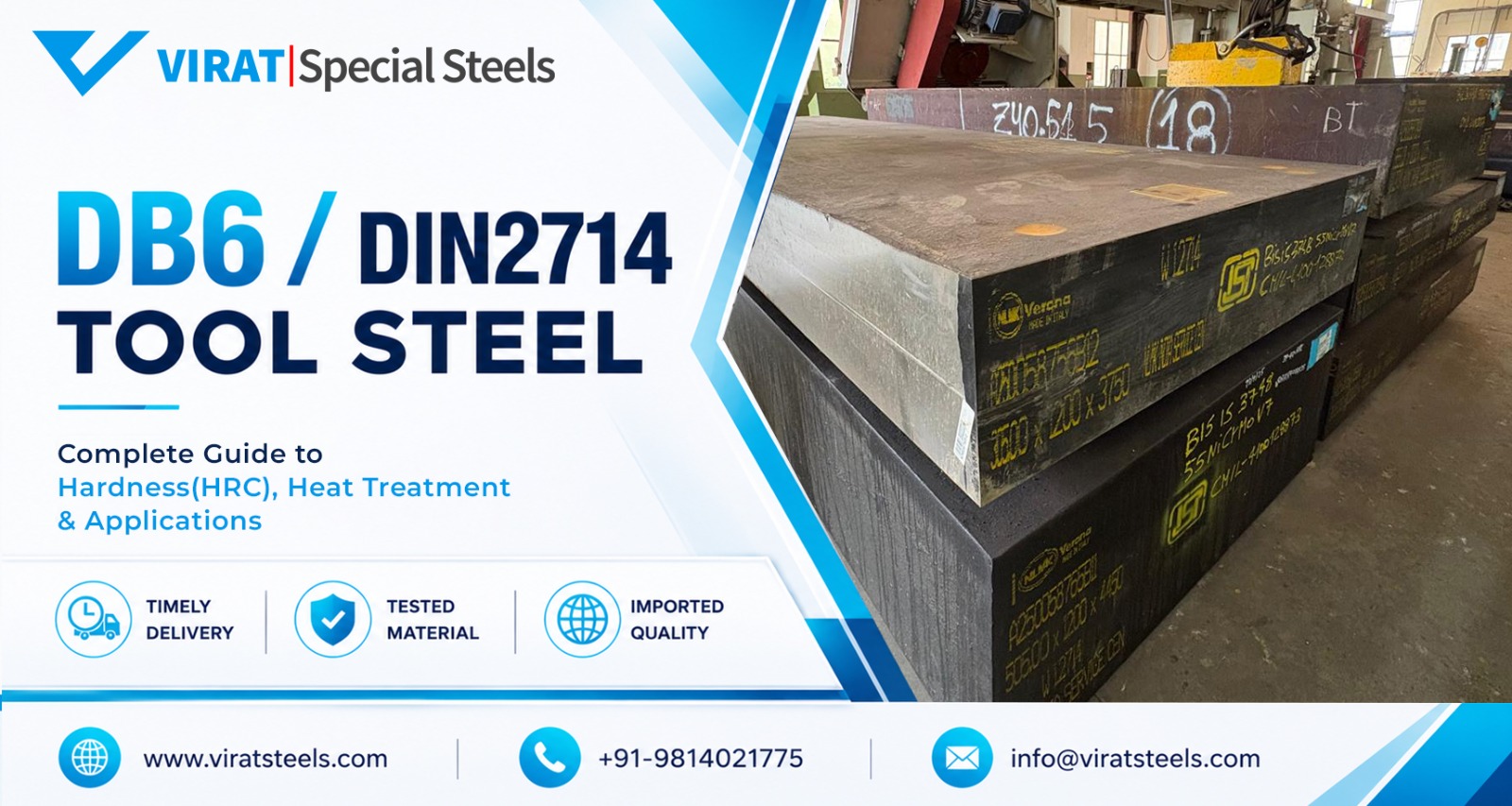
DB6 Material Hardness in HRC
DB6 Tool Steel (DIN 1.2714) is a widely used hot work tool steel for forging, die casting, heavy engineering and plastic mould industries. It offers an excellent balance of toughness, wear resistance, impact strength, and heat resistance, making it suitable for demanding industrial applications.
Hardness of DB6 Tool Steel is an important factor that defines its performance properties, tool life, machinability and ability to resist deformation under high pressure and high temperature conditions. The right heat treatment to the correct Rockwell Hardness (HRC) will ensure optimum performance in forging dies, extrusion dies, hammer dies and pressure die casting application.
In this comprehensive guide, we cover DB6 Tool Steel hardness (HRC), heat treatment process, mechanical properties, applications, comparison with other tool steels, pricing considerations, and why Virat Steels is one of India’s trusted suppliers of premium-quality DB6 Tool Steel.
What is DB6 Steel?
DB6 Tool Steel is a high quality hot work tool steel, equivalent to DIN 1.2714, (AISI L6), (55NiCrMoV7). It is a nickel-chromium-molybdenum-vanadium alloy steel known for outstanding toughness and excellent resistance to thermal fatigue.
Compared to conventional hot work steels, DB6 provides:
- Superior impact strength
- High toughness
- Excellent wear resistance
- Good hardenability
- Outstanding resistance to cracking
- Longer die life
- Excellent polishability
- Good machinability
These characteristics make DB6 an ideal choice for large forging dies, hammer dies, die holders, extrusion tooling, pressure die casting dies, and heavy-duty industrial tools.
International Equivalents of DB6 Tool Steel
DB6 Tool Steel is internationally recognized under the DIN 1.2714 standard and is equivalent to EN 55NiCrMoV7. It is also considered an approximate equivalent to AISI L6 in certain applications. In India, DB6 is widely known by its trade name and is commonly used as a premium hot work tool steel for forging dies, die casting dies, extrusion tooling, and heavy engineering applications.
Chemical Composition of DB6 Tool Steel
DB6 Tool Steel contains a balanced combination of carbon, chromium, nickel, molybdenum, and vanadium, providing excellent toughness, wear resistance, and hot strength. This alloy composition ensures superior impact resistance, good hardenability, and extended tool life in demanding hot work applications.
| Element | Composition (%) |
| Carbon (C) | 0.50–0.60 |
| Silicon (Si) | 0.10–0.40 |
| Manganese (Mn) | 0.65–0.95 |
| Chromium (Cr) | 1.00–1.20 |
| Nickel (Ni) | 1.50–1.80 |
| Molybdenum (Mo) | 0.45–0.55 |
| Vanadium (V) | 0.07–0.12 |
Mechanical Properties of DB6 Tool Steel
DB6 Tool Steel offers an excellent combination of toughness, wear resistance, and heat resistance, making it ideal for high-impact and hot work applications such as forging and die casting.
| Property | Typical Value |
| Density | 7.85 g/cm³ |
| Tensile Strength | High |
| Toughness | Excellent |
| Wear Resistance | Excellent |
| Heat Resistance | Excellent |
| Thermal Fatigue Resistance | Excellent |
DB6 Tool Steel Hardness (HRC)
Hardness is the most important property when selecting DB6 Tool Steel for industrial tooling.
Different hardness according to different Tempering temperature conditions.
– Annealed condition – 255 BHN max
– Hardened and Tempered condition- 38 to 42 HRC
annealed stock measures up to 255 BHN, standard mill-supply condition is tempered to 38–42 HRC for machining, and finished dies are re-hardened and tempered to a working hardness of 45–56 HRC depending on whether the application prioritizes toughness or wear resistance.
Heat Treatment of DB6 Tool Steel
Proper heat treatment is essential to achieve the desired hardness and mechanical properties.
The process generally involves:
- Annealing
- Stress Relieving
- Hardening
- Quenching
- Tempering
Each stage contributes to the final balance of hardness, toughness, and dimensional stability.
Annealing
Annealing softens the material, improves machinability, and relieves internal stresses before hardening.
Recommended Process:
- Heat slowly to 840–860°C
- Hold for sufficient soaking time
- Cool slowly inside the furnace
Resulting Hardness:
Approximately 220–250 HB
Stress Relieving
Stress relieving is recommended after rough machining.
- Temperature: 600–650°C
- Hold for 2 hours
- Furnace cool slowly
This minimizes distortion during final hardening.
Hardening
The hardening process significantly increases hardness and wear resistance.
Procedure:
- Preheat: 600 – 650°C
- Austenitize: 840–870°C
- Oil or polymer quench
- Air cooling where appropriate
The resulting hardness typically reaches 54–56 HRC before tempering.
Tempering
Tempering reduces brittleness while maintaining the desired hardness.
It is recommended to temper immediately after quenching.
Typical Tempering Range:
450–650°C
Double tempering is often recommended for improved dimensional stability and toughness.
Advantages of Proper Heat Treatment
By improving the mechanical properties and durability of the steel, proper heat treatment can improve the performance and service life of DB6 Tool Steel.
- Enhanced wear resistance
- Greater durability
- Improved thermal fatigue resistance
- Less risk of cracking
- Longer life of die
- Reduced maintenance costs
Applications of DB6 Tool Steel
DB6 Tool Steel (DIN 1.2714) is a popular choice for hot work applications requiring high toughness, wear resistance and resistance to thermal fatigue. It is ideal for the manufacture of heavy duty dies and tools used under extreme operating conditions.
| Industry | Typical Applications |
| Forging | Closed forging dies, hammer dies |
| Die Casting | Aluminium die casting dies |
| Extrusion | Extrusion dies |
| Automotive | Crankshaft and connecting rod dies |
| Plastic Moulding | Large mould bases |
| Heavy Engineering | Die holders and forging blocks |
| Aerospace & Defence | Heavy-duty tooling |
| Steel Plants | Hot shearing blades and press tools |
DB6 Tool Steel Advantages & Disadvantages
| Advantages | Disadvantages |
| Good impact resistance and toughness | More expensive than the usual alloy steels |
| Good wear and heat fatigue resistance | Needs proper heat treatment |
| Longer die life with less cracking | Not the best choice for high abrasive cold work applications (D2 is preferred) |
| Good hardenability and dimensional stability | Special tools are required for machining after hardening |
| Suitable for large forging dies, hot working tools | Material costs are higher for more expensive alloys |
DB6 vs H13 Tool Steel Comparison
| Property | DB6 Tool Steel (DIN 1.2714) | H13 Tool Steel (DIN 1.2344) |
| Steel Type | Hot Work Tool Steel | Hot Work Tool Steel |
| Toughness | Excellent | Very Good |
| Wear Resistance | Very Good | Excellent |
| Impact Resistance | Excellent | Very Good |
| Thermal Fatigue Resistance | Excellent | Excellent |
| Hot Hardness | Very Good | Excellent |
| Best Applications | Forging Dies, Hammer Dies | Die Casting & Extrusion Dies |
| Large Die Blocks | Excellent | Very Good |
| Relative Cost | Moderate | Moderate to High |
Best Choice: Choose DB6 for heavy-impact forging applications requiring superior toughness, while H13 is ideal for high-temperature die casting and aluminium extrusion tooling.
DB6 vs H11 Tool Steel
| Property | DB6 | H11 |
| Toughness | Excellent | Excellent |
| Wear Resistance | Higher | Good |
| Hardness | 45–56 HRC | 44–52 HRC |
| Thermal Shock | Excellent | Excellent |
| Large Blocks | Excellent | Good |
| Service Life | Longer | Good |
Best Choice: DB6 is preferred where higher wear resistance and longer tool life are required.
DB6 vs D2 Tool Steel
| Property | DB6 | D2 |
| Type | Hot Work | Cold Work |
| Toughness | Excellent | Moderate |
| Wear Resistance | High | Very High |
| Hot Strength | Excellent | Poor |
| Impact Resistance | Excellent | Moderate |
| Forging Dies | Excellent | Not Recommended |
| Cold Blanking | Not Ideal | Excellent |
Best Choice: Use DB6 for hot work and D2 for cold work applications.
DB6 vs P20 Tool Steel
| Property | DB6 | P20 |
| Toughness | Excellent | Good |
| Hardness | Up to 56 HRC | 28–34 HRC |
| Plastic Moulds | Good | Excellent |
| Forging | Excellent | Not Recommended |
| Wear Resistance | High | Moderate |
| Tool Life | Longer | Moderate |
DB6 vs EN31
| Property | DB6 | EN31 |
| Steel Type | Hot Work Tool Steel | High Carbon Steel |
| Toughness | Excellent | Moderate |
| Hardness | 56 HRC | 60–64 HRC |
| Impact Resistance | Excellent | Low |
| Hot Applications | Excellent | Poor |
| Bearings | Not Suitable | Excellent |
DB6 Tool Steel vs Other Tool Steel Grades
| Steel Grade | Toughness | Wear Resistance | Heat Resistance | Typical Hardness | Ideal Applications |
| DB6 (DIN 1.2714) | Excellent | Very Good | Excellent | 45–56 HRC | Forging Dies , Hammer Dies |
| H13 (DIN 1.2344) | Very Good | Excellent | Excellent | 44–54 HRC | Die Casting, Extrusion Dies |
| H11 (DIN 1.2343) | Excellent | Good | Very Good | 44–52 HRC | Hot Work & Extrusion Tooling |
| D2 (DIN 1.2379) | Good | Excellent | Moderate | 58–62 HRC | Cold Work Dies, Punches |
| P20 (DIN 1.2311) | Good | Moderate | Moderate | 28–34 HRC | Plastic Injection Moulds |
| EN31 | Moderate | Excellent | Low | 60–64 HRC | Bearings, Rollers & Wear Parts |
“DB6 Tool Steel Equivalents Explained: SKT4, 55NiCrMoV7, L6 & DIN 1.2714 Compared”
| Property | DB6 | SKT4 | 55NiCrMoV7 | L6 | DIN 1.2714 |
| Standard | Commercial | JIS | EN | AISI | DIN |
| Steel Type | Hot Work | Hot Work | Hot Work | Low Alloy | Hot Work |
| Toughness | Excellent | Excellent | Excellent | Excellent | Excellent |
| Wear Resistance | Excellent | Very Good | Excellent | Good | Excellent |
| Hardness | 45–56 HRC | 45–54 HRC | 45–56 HRC | 45–55 HRC | 45–56 HRC |
| Hot Work Performance | Excellent | Very Good | Excellent | Moderate | Excellent |
| Main Difference | Trade Name | JIS Grade | EN Grade | Approx. Equivalent | DIN Grade |
DB6, DIN 1.2714, and 55NiCrMoV7 are essentially the same steel grade with different designations. SKT4 is a close Japanese equivalent, while AISI L6 is an approximate equivalent with similar toughness but comparatively lower hot-work performance.
Available Sizes of DB6 Tool Steel
Virat Special Steels supplies DB6 Tool Steel in a wide range of standard and custom sizes to meet the requirements of die makers, tool rooms, automotive, engineering, and precision manufacturing industries.
Available Sizes (Flat)
- Thickness: 13 mm – 1500 mm
- Width: 13 mm – 3000 mm
- Length: Available in standard mill lengths or custom-cut sizes on request.
Available Sizes (Round)
- Diameter: 13 mm – 1500 mm
- Length: Standard mill lengths and customized cut-to-size options available.
Custom Processing Services
To minimize machining time and material wastage, we also offer:
- Precision cut-to-size material
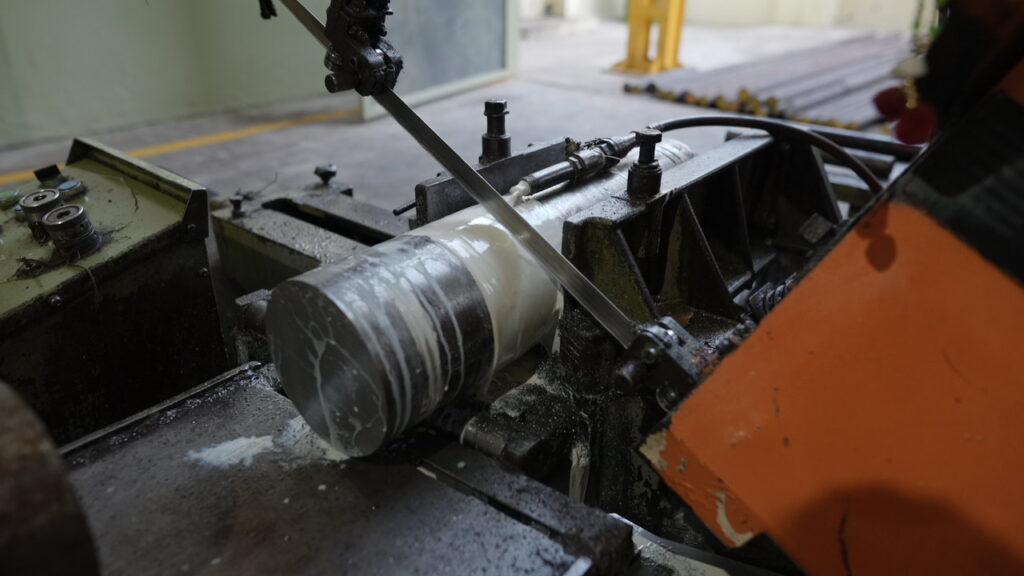
- Bandsaw cutting
- Surface machining (on request)
- Bulk supply with batch-wise traceability
- Material Test Certificate (MTC) and EN 10204 3.1 certification (where applicable)
DB6 Case Study 40% Improvement in Die Life in Forging
Operations Customer Challenge
A drop-forging plant for automotive components experienced premature die cracking of crankshaft forging dies made from standard hot work steels leading to expensive downtime.
Solution
The tooling was upgraded to DB6 (DIN 1.2714) supplied by Virat Special Steels, vacuum heat treated and double tempered to an optimized 46-48 HRC.
Results
40% increased die service life Eliminate catastrophic die cracking in high energy impact Lower maintenance and machine downtime Forged at a lower cost per part
Certifications Available
Reputable suppliers typically provide:
- Mill Test Certificate (MTC)
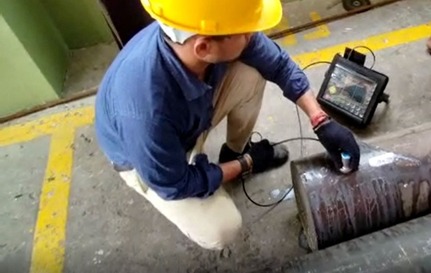
- Ultrasonic Tested Material
- Hardness Test Report
- Chemical Test Report
Buyer’s Guide: Selecting the Appropriate DB6 Tool Steel
Some important points to consider before buying DB6 Tool Steel (DIN 1.2714) to get the best out of your application:
1. Choose the Right Hardness
Pick the hardness for your application:
- 38-42 HRC – Greater toughness and impact resistance
- 50-56 HRC – Increased wear resistance and extended tool life
2. Choose the required form of material
DB6 Tool Steel is supplied in:
- Forged and Rolled blocks
- Round and Flat Bars
- ESR and Non ESR Blocks
3. Material Quality Inspection
Always ask for:
- Mill Test Certificate (MTC) Ultrasonic Tested Material
- Material Traceability Spectro Tested Material
4. Match the App
Select DB6, depending on your tooling needs, such as:
- Forging Dies
- Hammer Dies
- Extrusion
- Holders for
- Casting Dies
5. Select a Trusted Supplier
Join hands with a supplier who can support with ready stock, custom machining, technical support and PAN India delivery for consistent quality and timely supply.
Why purchase DB6 Tool Steel from Virat Steels?
Selecting the right supplier is critical to maximizing tool life, performance and productivity. With over 70 years of experience in the industry, Virat Steels is one of the trusted suppliers of high quality imported and domestic tool steels in India with more than 2000 customers in the automotive, forging, die casting, aerospace, plastic mould, heavy engineering, railways and defence industries.
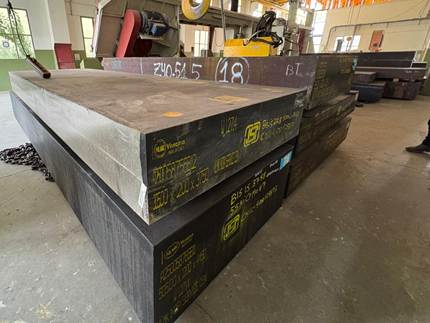
Why do manufacturers trust us?
- 70+ Years Experience supplying quality tool steels.
- 2,000+ Happy Customers in India’s Manufacturing Industry.
- Supplier of Materials from Reputed International Mills for consistent quality and performance.
- Tool Steel Ready Stock: DB6, H13, H11, D2, D3, P20, P20+Ni, M2, M35, EN31, OHNS and other grades.
- Mill Test Certificate (MTC) with full traceability of material.
- UT Tested & Spectro Tested Material for proven quality and internal soundness.
- Custom Cutting & Machining Services to suit your required sizes.
- Material Selection Assistance from experienced technical professionals.
- Fast PAN India Delivery, timely supply & reduced production downtime.
Virat Steels offers authentic quality, certified material and dependable service for all your tool steel needs. Whether DB6 Round Bars, Forged Blocks, ESR Blocks, Flat Blocks or Cut-to-size Material, we have it all.
Our Supply Network Across India
Virat Steels is one of the leading suppliers of DB6 Tool Steel (DIN 1.2714) to the manufacturers in the major industrial hubs of India like Ahmedabad, Rajkot, Pune, Nashik, Aurangabad, Kolhapur, Belgaum, Chennai, Coimbatore, Hosur, Bengaluru, Hyderabad, Faridabad, Manesar, Bhiwadi, Gurugram, Delhi NCR, Ludhiana, Chandigarh, Haryana, Punjab and Jamshedpur.
Our strong logistics network, ready stock and technical knowledge enable us to provide fast PAN India delivery to forging companies, die makers, tool rooms, plastic mould manufacturers, die casting industries and heavy engineering businesses.
Conclusion
DB6 Tool Steel (DIN 1.2714) is a high-performance hot work tool steel, known for its excellent toughness, wear resistance and thermal fatigue resistance. Proper heat treatment gives it hardness in the range of 45–56 HRC and makes it ideal for forging dies, extrusion tooling, die casting dies, and other demanding industrial applications.
Virat Steels is your trusted partner for premium quality DB6 Tool Steel with 70+ years of experience, 2000+ customers, ready stock, MTC, UT & Spectro Tested materials and PAN India delivery.
Call us or send your drawing to receive a customised material recommendation.
Request a Quote
Looking for premium-quality DB6 Tool Steel (DIN 1.2714)?
Virat Steels supplies DB6 Round and Flat Bars & Forged and Rolled Blocks, ESR /non ESR Blocks, Cut-to-Size Material with:
- ✔ 70+ Years of Industry Experience
- ✔ 2,000+ Satisfied Customers
- ✔ Ready Stock
- ✔ MTC Available
- ✔ UT Tested Material
- ✔ Spectro Tested Material
- ✔ Custom Machining
- ✔ PAN India Delivery
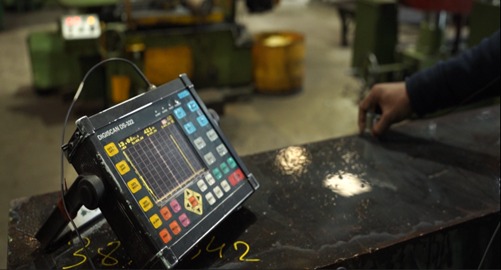
Contact Virat Steels today for technical guidance and a customized quotation for your DB6 Tool Steel requirements.
Download PDF:
https://www.viratsteels.com/downloads/DB6_vs_H13_H11_D2_Comparison.pdf
https://www.youtube.com/shorts/qf8SFJDCtlE
https://www.youtube.com/shorts/5hnQ_qp3WsA
Call us: +91-98140 21775 Email: info@viratsteels.com Visit us: Gurgaon (Haryana) | Ludhiana (Punjab)
Frequently Asked Questions
1. What is the working hardness of DB6 steel?
DB6 steel is typically tempered to a working hardness of 44–50 HRC depending on the forging application.
2. Is DB6 a hot work or cold work tool steel?
DB6 (DIN 1.2714) is a premium hot work alloy tool steel containing Nickel, Chromium, Molybdenum, and Vanadium.
3. What is the annealed hardness of DB6?
In annealed condition, DB6 has a hardness of 220–250 HB (Brinell Hardness) for easy machining.
4. What is the hardening temperature for DB6?
The recommended hardening (austenitizing) temperature is 840–870°C followed by oil, polymer, or air quenching.
5. How many tempering cycles are required for DB6?
At least two tempering cycles (double tempering) are required to relieve stress and stabilize the micro-structure.
6. Is DB6 equivalent to D2 or SKD11?
No. DB6 is a hot work steel (1.2714). D2 / SKD11 (1.2379) is a cold work steel used for cold punching and blanking.
7. What is the DIN equivalent of DB6?
The exact DIN equivalent is DIN 1.2714 (55NiCrMoV7) (L6).
8. What makes DB6 tough?
The presence of 1.50–1.80% Nickel (Ni) gives DB6 exceptional core toughness and resistance to impact cracking.
9. Can DB6 be used for blanking dies?
No, cold blanking requires cold work steels like D2 or DC53. DB6 is engineered for hot forging and high-impact dies.
10. What industries rely on DB6 tool steel?
Drop forging, press forging, automotive component manufacturing, heavy engineering, and defense.
11. Is pre-hardened DB6 available?
Yes, DB6 is often supplied in a pre-hardened condition (~35–40 HRC) for direct die cavity machining.
12. Can DB6 steel be welded?
Welding DB6 is difficult due to its high hardenability. Preheating to 300–400°C and post-weld stress relief are essential if welding is necessary.
13. Why does DB6 outperform H13 in drop forging hammer dies?
DB6 has higher Nickel content, offering superior impact energy absorption compared to H13, preventing die shattering under heavy hammer blows.
14. Why is stress relieving important before hardening DB6?
It removes machining stresses, preventing warping and dimensional movement during quenching.
15. What quality reports come with DB6 from Virat Special Steels?
Material Test Certificate (EN 10204 3.1), Ultrasonic Testing (UT) report, and Hardness/Chemical test reports.
16. Does DB6 resist thermal fatigue?
Yes, its balanced Cr-Ni-Mo composition gives high resistance to heat checking (thermal fatigue).
17. What supply forms are available for DB6?
Round bars, flat blocks, forged blocks, and custom cut plates.
18. What is the primary advantage of DB6?
High impact toughness combined with excellent hardenability across large block sizes.
19. What should buyers check before buying DB6?
Ensure ultrasonic soundness (UT testing) to prevent internal defects in large die blocks.
20. Why choose Virat Special Steels for DB6?
Extensive stock, certified quality, precision cutting facilities, quick delivery, and decades of technical expertise.
Why Manufacturers Are Choosing DB6 / DIN2714 Steel for Industrial Tooling Applications
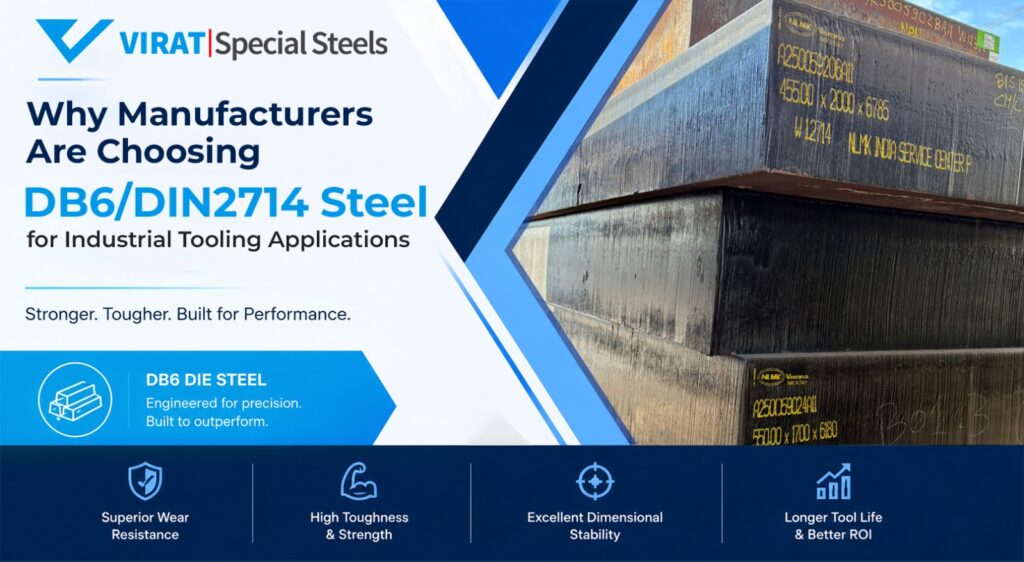
DB6 / DIN 1.2714 steel is a preferred choice for heavy-duty industrial applications because of its toughness, strength, wear resistance, and heat resistance. It is widely used in tooling, forging, die manufacturing, and engineering, delivering reliable performance under demanding conditions.
VIRAT Special Steels supplies high-quality DB6 / DIN 1.2714 steel that meets strict industrial standards and delivers consistent performance across various applications.
Industries today require materials that can withstand high pressure, repeated impact, elevated temperatures, and continuous wear. DB6 steel fulfills these requirements efficiently, making it a trusted choice for manufacturers looking to improve productivity, reduce downtime, and increase tool life.
1. Exceptional Wear Resistance
One of the biggest advantages of DB6 steel is its excellent wear resistance. In high-friction and heavy-duty industrial operations, components are constantly exposed to abrasion and mechanical stress. DB6 steel maintains its performance and dimensional stability even under continuous use.
Common applications include:
- Forging dies
- Cutting tools
- Punches and molds
- Shear blades
- Heavy-duty machine components
Its superior wear resistance helps reduce frequent replacement of tools and components, resulting in lower maintenance costs and improved operational efficiency.
2. High Toughness and Strength
DIN 1.2714 steel is specially designed to provide high toughness along with excellent mechanical strength. Unlike many conventional tool steels, DB6 steel can withstand repeated impact loading without cracking or deformation.
Key benefits include:
- High impact resistance
- Better load-bearing capacity
- Resistance to deformation
- Improved structural stability
- Reliable performance under heavy stress
These properties make DB6 steel highly suitable for demanding forging and tooling applications.
3. Excellent Heat Resistance
DB6 / DIN 1.2714 steel offers excellent resistance to heat and thermal fatigue. It retains its hardness and strength even at elevated operating temperatures, making it ideal for hot work applications.
This property is especially beneficial in:
- Hot forging dies
- Press tools
- High-temperature tooling
- Heavy industrial processing
- Hot working operations
Its ability to perform consistently at high temperatures improves productivity and extends tool life.
4. Longer Tool Life
The balanced combination of toughness, strength, and wear resistance significantly increases the service life of tools manufactured from DB6 steel.
Advantages include:
- Reduced tool failure
- Lower downtime
- Reduced replacement frequency
- Higher production efficiency
- Lower overall production cost
Longer tool life directly contributes to improved manufacturing efficiency and cost savings.
5. Good Machinability
Despite its high strength and hardness, DB6 steel offers good machinability when processed under proper conditions. Manufacturers prefer this grade because it allows accurate machining with excellent surface finish quality.
Benefits include:
- Cleaner machining results
- Better dimensional accuracy
- Improved surface finish
- Reduced machining errors
- Consistent production quality
This makes DB6 steel suitable for precision engineering applications.
6. Reliable Performance in Harsh Industrial Conditions
Modern industries require materials that can consistently perform under extreme operating conditions involving pressure, heat, shock, and continuous usage. DB6 steel is widely appreciated for its reliability and durability.
Industries value DB6 steel for:
- Dimensional stability
- Resistance to cracking
- High toughness
- Thermal stability
- Long-term operational reliability
These characteristics make it one of the most dependable tool steel grades available today.
Industries Using DB6 / DIN 1.2714 Steel
DB6 steel is widely used across multiple industries due to its versatility and superior mechanical properties.
Major industries include:
- Automotive industry
- Forging industry
- Tool and die manufacturing
- Aerospace engineering
- Industrial machinery
- Metal fabrication
- Precision engineering
Common Applications of DB6 Steel
Typical applications of DIN 1.2714 / DB6 steel include:
- Forging dies
- Hammer dies
- Press tools
- Die holders
- Shear blades
- Extrusion tools
- Heavy-duty tooling components
FAQs
Is DB6 steel suitable for heavy-duty industrial applications?
Yes. DB6 / DIN 1.2714 steel is highly suitable for heavy-duty industrial applications because of its excellent toughness, strength, wear resistance, and heat resistance.
Can DB6 steel improve production efficiency?
Yes. Its longer tool life and reliable performance help reduce downtime, maintenance, and replacement costs, leading to higher productivity.
Is DB6 steel cost-effective?
Yes. Although it is a premium-grade tool steel, its durability and extended service life make it highly cost-effective over the long term.
Which industries commonly use DB6 steel?
Automotive, forging, tooling, aerospace, metal fabrication, and heavy engineering industries commonly use DB6 steel.
Why choose DB6 steel from VIRAT Special Steels?
VIRAT Special Steels offers premium-quality DB6 / DIN 1.2714 steel with reliable quality, accurate sizes, and dependable industrial performance.
Conclusion
DB6 / DIN 1.2714 steel is an excellent choice for manufacturers seeking high performance, durability, toughness, and long service life in demanding industrial applications. Its superior mechanical properties make it ideal for forging dies, tooling applications, and heavy engineering industries.
By choosing premium-quality DB6 steel, industries can improve productivity, reduce operational costs, and achieve reliable long-term performance.
For high-quality DB6 / DIN 1.2714 steel solutions, connect with:
Email: info@viratsteels.com
Phone: +91 98140-21775
Virat Steels-Trusted Tool & Die Steel Supplier in India
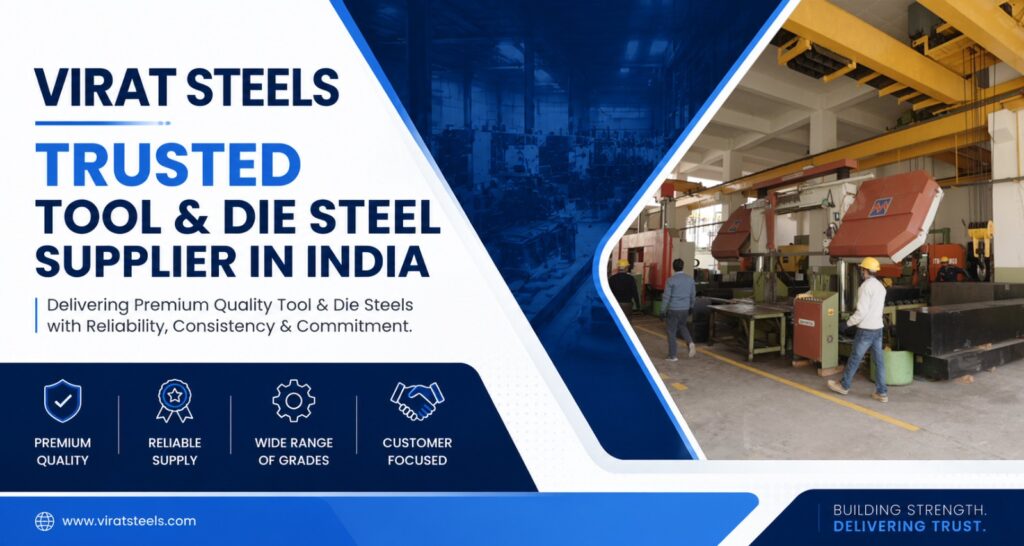
In the tool and die steel industry, quality material and reliable service are very essential for consistent production performance. Manufacturers today need more than just steel. Hence, they need a trusted supply partner.
That’s why industries across India choose Virat Special Steels for premium tool steel solutions.
With decades of domain expertise, the company serves high-quality tool & die steels industries ranging from automotive and aerospace to defence, tooling, and heavy engineering.
Premium Quality Steel
Virat Steels provide genuine and reliable tool steel with:
- Consistent hardness
- Better machinability
- Improved tool life
- Genuine quality
Available in:
✔ Rounds
✔ Flats
✔ Blocks
Ready Stock Availability
Ready stock available for major grades including:
ensuring quick dispatch and reduced downtime.
Ultrasonic Tested Material
Virat Steels supplies UT Tested Tool Steel
Ultrasonic testing helps detect:
- Internal defects
- Cracks
ensuring better reliability and performance.
Precision Cutting Facility
We offer precision cutting services for:
- Accurate dimensions
- Reduced machining allowance
- Faster processing
Helping customers save time and improve productivity.
Strong Logistics Support
We deliver across India with:
- Fast dispatch
- Safe handling
- Timely delivery
Supplying to major industrial regions across India .
Technical Support
Our team helps customers choose:
- Suitable steel grade
- Recommended Hardness
- ESR vs standard grades
- Application-based solutions
Certified & Test Report
- Material Test Certification (MTC)
Looking for a reliable tool and die steel supplier in India?
Contact Virat Special Steels:
📞 +91 98140-21775
🌐 www.viratsteels.com
✉ info@viratsteels.com
Frequently Asked Questions (FAQs)
1. What products does Virat Steels supply?
Virat Steels supplies premium tool and die steels including Hot work steels, cold work steels, High Speed steels, Alloy steel grades etc.
2. Which industries use tool and die steel?
Tool and die steels are widely used in Forging, Extrusion, Plastic moulds, Automotive components, Pressure Die casting .
3. Does Virat Steels provide ultrasonic tested material?
Yes, Virat Steels supplies UT tested material to ensure better reliability, reduced internal defects, and improved tooling performance.
4. Does Virat Steels maintain ready stock?
Yes, Virat Steels maintains ready stock of major tool steel grades for quick dispatch and faster delivery across India.
5. Why choose Virat Steels as a tool steel supplier?
Manufacturers choose Virat Steels because of Genuine quality, UT tested steel, Precision cutting facility, ready stock, fast delivery, technical support
6. Does Virat Steels deliver across India?
Yes, Virat Steels supplies tool and die steel across major industrial regions in India with reliable logistics and timely delivery support.
7. How can I contact Virat Steels for tool steel requirements?
You can contact Virat Steels on 📞 +91 98140-21775 for grade recommendations, stock availability, and pricing.
P20 vs H13 — Best Choice for Long-Run Plastic Moulds Plastic Mould Steel · Grade Comparison · Virat Special Steels
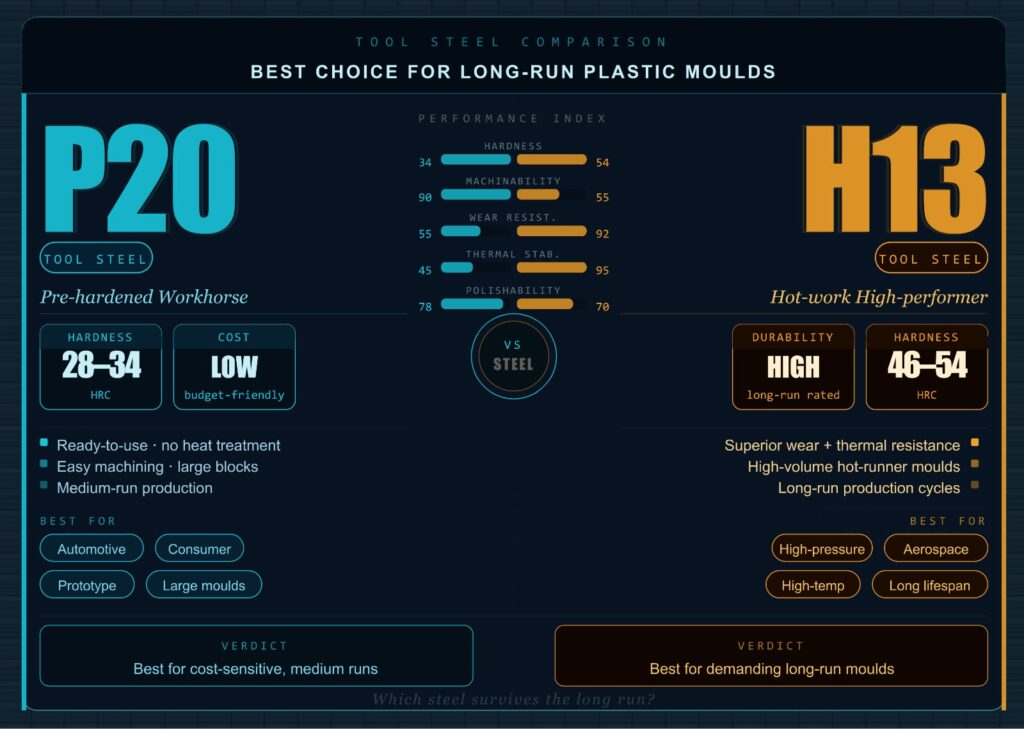
A practical, application-first guide for mould makers, tool rooms, and procurement teams choosing between two most popular plastic mould steel grades.
Choosing the wrong mould steel doesn’t just cost money — it costs production runs, surface finish quality, and mould life. Here’s how to pick the right one.
At a Glance: P20 vs H13
The table below gives a side-by-side view of both grades across the most critical properties mould buyers evaluate:
| P20 Steel Pre-hardened Mould Steel | H13 Steel Hot Work Tool Steel |
|---|---|
| Hardness 28–34 HRC (pre-hardened) | Hardness 44–52 HRC |
| Toughness High | Toughness Very High |
| Polishability Good | Polishability Excellent |
| Machinability Excellent | Machinability Moderate |
| Mould Life Up to 5,00,000 shots | Mould Life 10,00,000+ shots |
| Heat Treatment Not required | Heat Treatment Required (vacuum) |
| Tool Cost Lower | Tool Cost Higher |
| Lead Time Short | Lead Time Longer |
Detailed Property Comparison
| Property | P20 Steel | H13 Steel |
|---|---|---|
| Hardness after HT | 28–34 HRC (pre-hardened) | 44–52 HRC |
| Wear Resistance | Moderate | High |
| Toughness | High | Very High |
| Machinability | Excellent (no HT needed) | Moderate (HT required) |
| Thermal Fatigue Resistance | Low | Very High |
| Tool Cost | Lower | Higher |
| Lead Time | Short (ready to machine) | Longer (HT required) |
| Mould Life | Up to 5,00,000 shots | 10,00,000+ shots |
| Corrosion Resistance | Low | Moderate |
Which Steel is Best for Long-Run Moulds?
✅ Choose P20 if:
· Production volume is moderate
· Budget is limited
· Faster delivery is required
· Plastic material is non-abrasive
✅ Choose H13 if:
· Production volume is very high
· You need long mould life
· Material is abrasive or high temperature
· Dimensional stability is critical
| Which Grade Should You Pick? P20 for speed & cost · H13 for volume & finish |
If you need a mould quickly, at a lower cost, for regular plastics and medium production, go with P20.But if you’re producing in high volumes, using abrasive or glass-filled materials, or need a long-lasting, mirror-finish mould (over 10 lakh shots), choose H13.
Industry Applications in India
Both P20 and H13 are widely used across India’s plastics and automotive tooling industry. Here’s where each grade dominates:
| Industry | Recommended Grade | Reason |
| Automotive | H13 | High volume, tight tolerances, long mould life |
| Consumer Appliances | P20 | Medium run, cost-sensitive, faster delivery |
| Packaging (Caps & Closures) | H13 | Very high shot count, abrasion resistance |
| Electronics Housing | P20 / H13 | Depends on run volume and finish requirements |
| Medical Device Components | H13 (ESR Grade) | Mirror finish, cleanliness, long run |
| Soft Tooling | P20 | Quick machining, lower cost, short lead time |
Conclusion
Both P20 and H13 have their place in mould manufacturing—but the choice depends on your production goals:
· P20 = Cost-effective + faster production
· H13 = Long life + high performance
Sourcing P20 and H13 in India
Virat Special Steels stocks both P20 and H13 in ready inventory — supplied with full mill test certificates, hardness test reports, and chemical analysis. Available in round bars, flat bars, and pre-machined blocks across a wide size range.
| Need P20 or H13 for Your Next Mould? Get a fast quote — certified stock, ready to dispatch across India |
Contact our team to get more details about available sizes and technical specifications suitable for your applications.
https://www.viratsteels.com/products.html info@viratsteels.com
+91 98140-21775
Frequently Asked Questions
1. Which is better for long-run plastic moulds, P20 or H13?
H13 — higher hardness, wear resistance, and heat tolerance make it ideal for long runs.
2. What is the difference between P20 and H13?
P20: Pre-hardened, easier to machine, lower cost — best for short/medium runs. H13: Heat-treated, stronger, better for high-temp and high-volume applications.
3. Is H13 worth the higher cost?
Yes — for high-volume production, H13 delivers better ROI over time.
4. When should you choose P20 over H13?
When volume is low/medium, budget is tight, or faster machining/delivery is needed.
5. Which is better for high-temperature injection molding?
H13 — superior thermal fatigue resistance handles higher temps without deformation.
6. Can P20 be used for long-run moulds?
Yes, but it wears faster with abrasive materials and isn’t ideal for very long runs.
7. Which industries prefer H13?
Automotive, electronics, and high-volume packaging — anywhere durability matters.
8. What’s the cost difference?
P20: Lower upfront. H13: Higher initial cost, but better long-term value.
9. Best steel for 1 million cycle production?
H13 — built to withstand extended wear, heat, and stress over massive run counts.
From India to the World: The Global Reach of Virat Special Steels!
Virat Special Steels has indeed made a notable impact in the global markets. Their strategic focus on maintaining high-quality standards and competitive pricing has helped them establish a strong presence internationally. Virat Special Steel has a significant presence not only in India but also on the global stage. Its products are exported to countries across Asia, Europe, and the Americas. The company’s competitive pricing, consistent quality, and ability to meet international standards have earned it a loyal customer base worldwide. Here are some key points about their global reach:
Global Presence
Asia: Virat Special Steels exports to several Asian countries, leveraging the region’s growing industrial and manufacturing sectors.
Europe: The company meets stringent European standards, making it a trusted supplier for various industries across the continent.
Americas: In North and South America, Virat Special Steels caters to diverse sectors, including automotive, aerospace, and construction.
Competitive Edge
Quality Assurance: Consistent quality control measures ensure that their products meet international standards.
Customer Loyalty: Their ability to customize products to meet specific client needs has fostered a loyal customer base.
Innovation: Continuous investment in research and development keeps them at the forefront of material innovations.
Future Prospects
Expansion Plans: With the global demand for high-quality tool and die steel on the rise, Virat Special Steels is well-positioned to expand its market share.
Sustainability Initiatives: Emphasizing sustainable practices will likely enhance their appeal in environmentally conscious markets.
Virat Steels supply their tool steel bars to forging and automobile engineering companies across all locations in the world… India, Nepal, Dubai, Thailand, Vietnam, Saudi Arabia, United Arab Emirates , Qatar, Kuwait, Iran, Turkey, Portugal, Spain, Poland, UK, USA, Canada, Brazil, Mexico, Belarus, Australia, New Zealand and many more..
Technological Innovations at Virat Special Steel:
To remain competitive, Virat Special Steel consistently invests in technological advancements. The company integrates automation and digital technologies to streamline operations, improve precision, and boost production efficiency. Research and development play a key role in enhancing steel properties, ensuring Virat’s products are at the forefront of innovation.