



H13 Steel for Die Casting
now browsing by category
Hot Work vs Cold Work Tool Steel | H13 vs D2 | Virat Steels
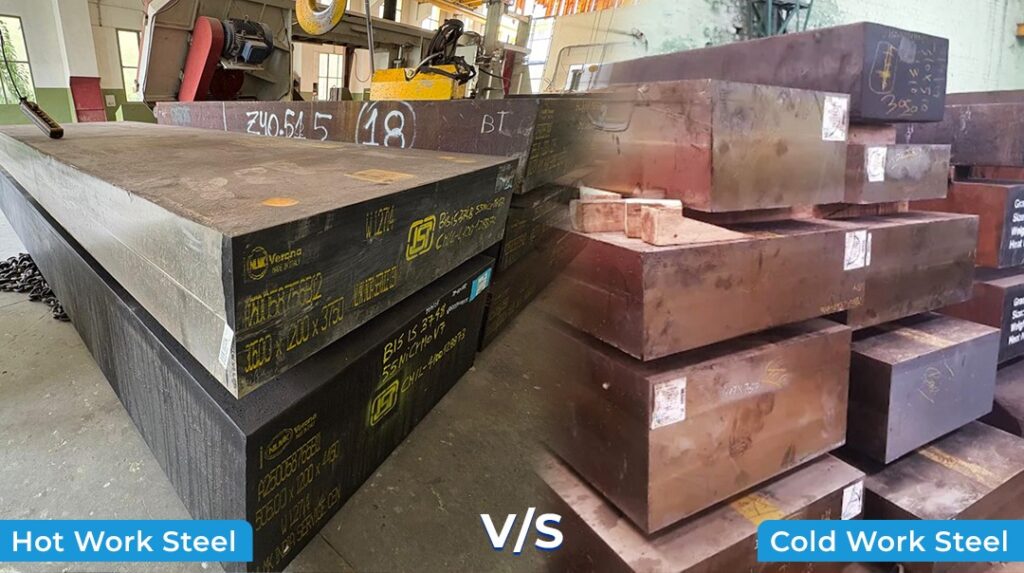
In tooling, one decision quietly determines tool life, rejection rate, and production cost: choosing the right tool steel.
Yet many failures on the shop floor come down to one mistake—using hot work steel where cold work is needed, or vice versa.
This guide will give you a clear, practical comparison between hot work and cold work tool steels—so you can make the right decision the first time.
Hot Work Tool Steel (For High Temperature Applications)
The most widely used grade: H13 tool steel
Best For:
- Aluminium die casting
- Forging dies
- Extrusion tools
- High-temperature moulds
Key Benefits:
✔ Handles extreme heat (200–700°C)
✔ Resists thermal cracking
✔ High toughness under load
Cold Work Tool Steel (For Wear Resistance)
A leading grade: D2 tool steel
Best For:
- Blanking & punching dies
- Shear blades
- Cold forming tools
- Sheet metal industry
Key Benefits:
✔ Very high hardness (up to 60+ HRC)
✔ Excellent wear resistance
✔ Long life in cutting operations
Hot Work vs Cold Work Steel — Quick Comparison
| Feature | Hot Work Steel (H13) | Cold Work Steel (D2) |
| Temperature | High | Low |
| Hardness | Medium | Very High |
| Toughness | High | Moderate |
| Wear Resistance | Medium | Very High |
| Heat Resistance | Excellent | Poor |
| Best Use | Die casting, forging | Cutting, punching |
Using the Wrong Steel? Here’s What Happens
- Cold work steel in hot application → Cracks & failure
- Hot work steel in wear application → Rapid wear & loss of accuracy
Result: Downtime, rejection, and higher cost per component
How to Choose the Right Tool Steel
Choose Hot Work Steel if:
- Temperature > 200°C
- Thermal cycling is involved
- Impact load is high
Choose Cold Work Steel if:
- Application is at room temperature
- Wear resistance is critical
- Cutting or shearing is involved
Industry-Wise Recommendation
| Industry | Recommended Steel |
| Die Casting | H13 |
| Forging | H13 / H11 |
| Sheet Metal | D2 |
| Blanking | D2 / D3 |
| Plastic Mould (High Temp) | H13 |
Increase Tool Life — Proven Methods
For Hot Work Steels:
- Use ESR quality material
- Apply nitriding
- Ensure proper preheating
- Control cooling cycles
For Cold Work Steels:
- Maintain correct hardness
- Use coatings (PVD)
- Avoid shock loading
- Ensure lubrication
Virat Steels — Your Tool Steel Partner
At Virat Steels, we help manufacturers reduce failure and increase tool life with the right material selection.
What You Get:
✔ Ready stock (rounds, flats, blocks)
✔ Ultrasonic tested material
✔ Fast delivery across India
✔ Technical guidance (not just supply)
FAQs?
1-Which is better: H13 or D2?
It depends on application.
- High temperature → H13
- High wear → D2
2-Can D2 be used for hot work?
No. D2 tool steel becomes brittle at high temperatures and may crack.
3-Does higher hardness mean better tool life?
Not always. Excess hardness reduces toughness and increases cracking risk.
4-What is the best steel for die casting?
H13 tool steel is the industry standard.
5. How does heat treatment differ between the two?
Hot work steels are heat-treated to maintain strength at high temperatures
Cold work steels are treated to achieve maximum hardness and wear resistance
6. Which is more expensive: hot work or cold work steel?
Hot work steels are often more expensive due to alloying elements and processing required for high-temperature performance.
7. What industries rely heavily on hot work steel?
Automotive forging, Aluminium die casting, Aerospace component manufacturing
8. What industries rely on cold work steel?
Sheet metal fabrication, Tool and die making, Packaging and appliance manufacturing
9. Which steel has longer tool life?
It depends on the application:
- Hot work steel lasts longer in high-temperature application.
- Cold work steel lasts longer in abrasive, low-temperature operations.
Get Expert Recommendation (Free Consultation)
Choosing the right steel can double your tool life.
- Stop tool failures before they happen.
- Choose the right steel with expert guidance from Virat Steels.
Share your application—we’ll recommend:
- Best grade with quality
- Ideal hardness
- Heat treatment process
Talk to our experts today:
🌐 viratsteels.com 📞 +91 98140-21775 ✉info@viratsteels.com
The Future of Tool Steel: Innovations with DIN 2344 and H13
In the evolving world of manufacturing, the materials used to shape, mold, and cut have a direct impact on productivity and quality. Tool steels play a critical role in this landscape, with DIN 2344 and H13 standing out as industry leaders. Known for their exceptional thermal resistance, hardness, and strength, these grades are the backbone of tools, molds, and dies in industries such as automotive, aerospace, and die-casting. In this article, we’ll explore the significance of these materials, examine ongoing innovations, and understand how companies like Virat Special Steels contribute to shaping the future of tool steel.
The Role of Tool Steel in Manufacturing and Industry
Tool steels are indispensable for industries that demand precision and durability. Used extensively in the production of cutting tools, molds, and dies, these alloys must endure extreme conditions, from high temperatures to heavy wear. Without them, high-quality manufacturing would simply not be possible. Automotive industries rely on tool steels for die-casting, while aerospace engineering depends on these materials for components exposed to high temperatures and stresses. In short, tool steels are the unsung heroes enabling modern engineering feats.
What Makes DIN 2344 and H13 Stand Out?
Composition and Properties of DIN 2344
DIN 2344 is a chromium-molybdenum-vanadium alloyed steel prized for its high thermal resistance and toughness. It maintains hardness even at elevated temperatures, making it a preferred choice for hot-working tools like forging dies and extrusion presses. Key properties include:
- Exceptional wear resistance.
- High tensile strength.
- Excellent machinability.
Characteristics and Features of H13
H13 steel, part of the H-series family, is well-known for its versatility and toughness. It’s often chosen for die-casting and plastic mold tooling, thanks to its outstanding thermal fatigue resistance and ease of fabrication. Its main properties are:
- Superior thermal conductivity.
- Resistance to cracking under repeated heating and cooling cycles.
- High flexibility for complex shaping.
Innovations Driving the Future of Tool Steel
The tool steel industry has seen several groundbreaking advancements. Let’s delve into some of the most significant ones:
- Advanced Alloying Techniques
Researchers are experimenting with alloying elements like cobalt and niobium to improve the thermal and wear resistance of tool steels. Such innovations push the limits of performance. - Additive Manufacturing and 3D Printing
3D printing is revolutionizing tool steel production by enabling intricate designs and reducing material waste. Industries are now combining traditional methods with 3D technologies for optimal results. - Improved Heat Treatment Processes
Heat treatment plays a pivotal role in enhancing tool steel properties. Modern techniques such as vacuum hardening ensure precision in achieving desired hardness and toughness.
Advantages of Modern Tool Steel Innovations
New innovations in DIN 2344 and H13 steels offer several benefits:
- Durability: These steels withstand high temperatures and extreme pressures without significant wear.
- Longevity: Enhanced resistance to thermal fatigue and cracking translates into longer tool lifespans, reducing downtime and maintenance costs.
- Efficiency: Advanced manufacturing techniques improve energy usage and reduce material waste.
Comparing DIN 2344 and H13 Tool Steels
Below is a snapshot of their key differences:
| Property | DIN 2344 | H13 |
| Composition | Cr, Mo, V | Cr, Mo, Si, V |
| Thermal Resistance | High | Very High |
| Applications | Forging, extrusion | Die-casting, molds |
Applications of DIN 2344 and H13
Both steels are tailored to specific needs:
- DIN 2344: Ideal for extrusion tooling and hot forging, thanks to its resistance to thermal shock.
- H13: Perfect for plastic injection molding, die-casting, and high-temperature aerospace components.
Environmental Sustainability and Tool Steels
Modern practices focus on sustainability. From reducing energy-intensive processes to emphasizing recycling, the industry is working toward a smaller environmental footprint. The longevity of DIN 2344 and H13 further minimizes the need for replacements, aligning with eco-friendly goals.
Future Prospects of DIN 2344 and H13
As industries move toward automation and more advanced technologies, the demand for high-performing materials like DIN 2344 and H13 is set to rise. Innovations in metallurgy and 3D printing will only increase their applications.
Challenges in the Tool Steel Industry
Despite advancements, challenges persist. Manufacturers face supply chain disruptions, the rising cost of raw materials, and the need to balance quality with affordability. Addressing these challenges requires collective efforts from stakeholders, including suppliers like Virat Special Steels.
The Role of Companies Like Virat Special Steels
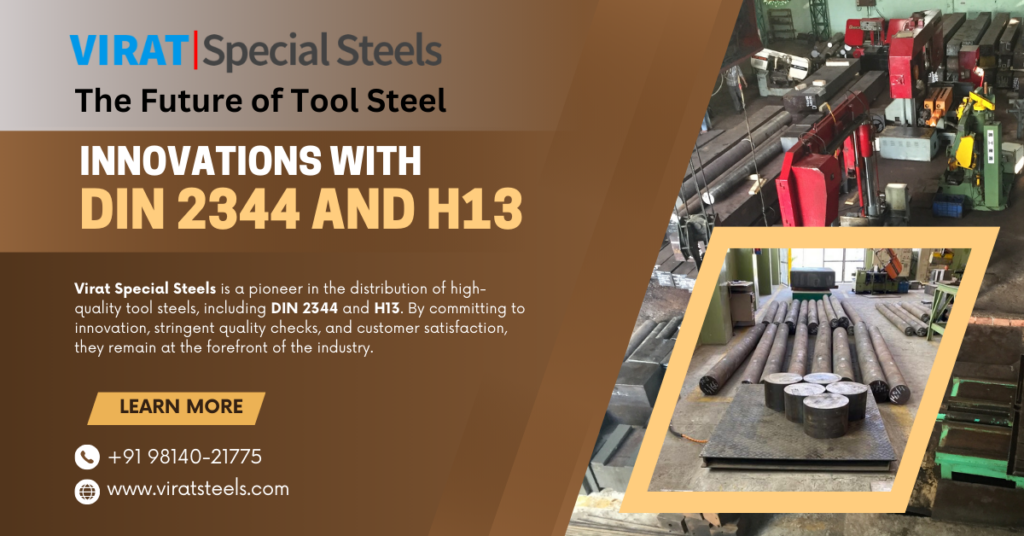
Virat Special Steels is a pioneer in the distribution of high-quality tool steels, including DIN 2344 and H13. By committing to innovation, stringent quality checks, and customer satisfaction, they remain at the forefront of the industry.
Key Takeaways
- Tool steels like DIN 2344 and H13 are integral to modern manufacturing.
- Innovations are enhancing their performance and extending their applications.
- Companies like Virat Special Steels are instrumental in meeting the growing demands of the industry.
FAQs About Tool Steel
- What makes DIN 2344 unique compared to other tool steels?
Its ability to maintain hardness at high temperatures and resist wear sets it apart. - Why is H13 preferred in certain industries?
H13 combines versatility and thermal fatigue resistance, making it ideal for die-casting and molds. - How does Virat Special Steels ensure the quality of its products?
Rigorous testing, advanced manufacturing techniques, and expert handling ensure top-notch quality. - Can DIN 2344 and H13 be recycled efficiently?
Yes, their high-grade compositions make them suitable for recycling without significant loss of quality. - What industries are likely to adopt future innovations in tool steels?
Automotive, aerospace, and renewable energy sectors will likely benefit the most.
Virat Special Steels is the largest Supplier & Stockiest of H13 Steel in India. Consult our team who will assist you for H-13/ DIN 2344 / AISI H13 steel query. https://www.viratsteels.com/h13.html
Size Range in Forged / Rolled Bars:
Rounds: 13mm Dia to 1500mm Dia
Rectangular: Thickness 13mm – 500mm / Width 13mm to 1500mm
For more information or to discuss your steel needs, Virat Special Steels invites you to reach out through their contact details provided, ensuring a professional and informative experience.
Any further queries feel free to contact us :
🌐https://www.viratsteel.in 📬 info@viratsteels.com ☎+91 98140-21775
H13 Steel for Die Casting: Key Benefits You Should Know
H13 steel stands as a cornerstone in the die casting industry. Known for its exceptional heat resistance and toughness, this versatile hot-work tool steel is widely used in demanding environments. As die casting often involves high-pressure and extreme thermal conditions, choosing the right material for dies is critical. Enter H13 steel – the ultimate material to enhance durability, improve performance, and maximize efficiency in casting operations.
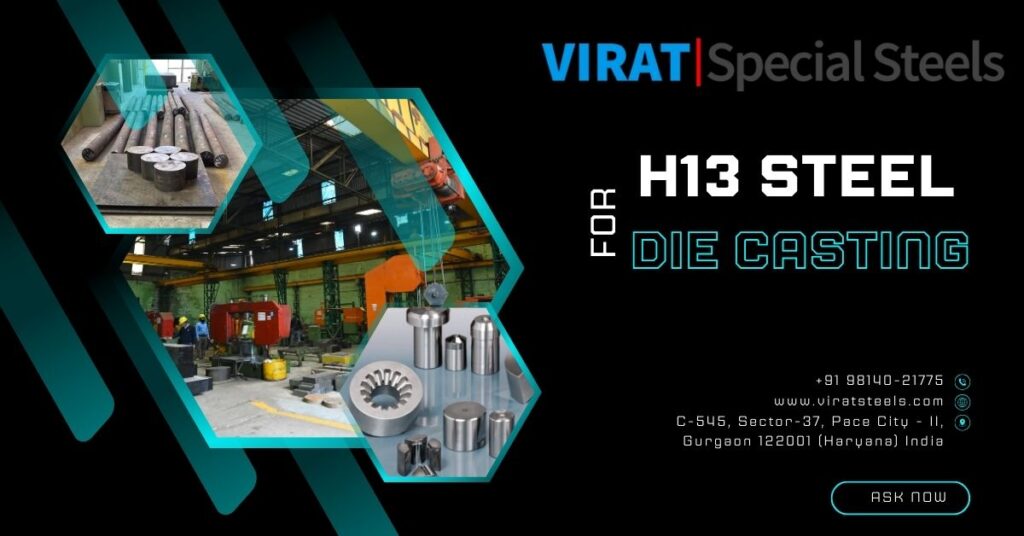
What sets H13 steel apart from the rest? Its outstanding properties make it highly sought after for both small-scale and large-scale die casting applications. But let’s dig deeper into what makes it so special.
Composition and Properties of H13 Steel
Chemical Composition
H13 steel is an alloy comprising a mix of critical elements that optimize its performance. Here’s a breakdown of its main components:
- Chromium (5%): Enhances corrosion resistance.
- Molybdenum (1.4%): Improves hardness and high-temperature strength.
- Vanadium (1%): Increases wear resistance and toughness.
- Carbon (0.4%): Adds strength and hardenability.
- Silicon (1%): Boosts resistance to oxidation.
Mechanical Properties
H13 steel is known for its high tensile strength, ductility, and excellent thermal conductivity. These properties ensure the material remains reliable under rigorous operating conditions. Additionally, H13 steel demonstrates impressive hardenability, making it an ideal choice for precision die applications.
What Makes H13 Steel Ideal for Die Casting?
Thermal Stability
One of the standout features of H13 steel is its remarkable thermal stability. In die casting, molds must endure rapid temperature fluctuations without cracking or deforming. H13’s ability to retain strength at elevated temperatures makes it indispensable.
Resistance to Thermal Fatigue
When dies repeatedly heat and cool during the casting cycle, they are prone to thermal fatigue. H13 steel offers resistance to such stresses, extending the lifespan of the tooling and reducing operational downtime.
Key Benefits of H13 Steel in Die Casting
1. Durability Under High Temperatures
Die casting requires materials that can handle intense heat without losing integrity. H13 steel delivers exceptional performance in such scenarios, maintaining structural stability even under prolonged exposure to molten metals.
2. Excellent Wear Resistance
The abrasive nature of die casting operations can wear down weaker materials quickly. With its robust wear resistance, H13 steel minimizes maintenance needs and offers long-lasting performance.
3. Cost-Effectiveness in Long Production Runs
Although the initial investment in H13 steel may be higher, its durability and resistance to damage translate into significant cost savings over time. Long production cycles benefit greatly from its ability to perform without frequent replacements or repairs.
Longevity and Durability of H13 Steel Dies
Improved Tool Life
When it comes to tooling materials, longevity matters. H13 steel excels in providing longer service life, reducing the need for frequent replacements. Its resilience against wear and deformation significantly adds to the efficiency of the production process.
Resistance to Deformation
Under the extreme pressures of die casting, lesser materials may deform, leading to suboptimal casting results. H13 steel’s resistance to deformation ensures precision and repeatability across countless cycles.
Challenges and Limitations of H13 Steel
Cost Considerations
While H13 steel is cost-effective in the long run, its upfront cost may deter smaller manufacturers. Investing in H13 tooling requires foresight and planning to maximize its return on investment.
Potential Limitations in Specific Environments
H13 steel thrives under high temperatures, but in applications involving extremely corrosive materials or environments, alternative alloys with specific properties might be better suited.
Future Trends in Die Casting Using H13 Steel
Advances in Steel Technologies
Research and innovation are leading to improved formulations of H13 steel with enhanced properties like higher thermal resistance and lower environmental impact. Such developments will further cement H13’s place in the future of die casting.
Emerging Applications and Industries
With rapid advancements in technology, H13 steel’s applications are expanding beyond traditional die casting. Sectors like robotics and renewable energy are beginning to explore its potential, showcasing the steel’s enduring versatility.
Conclusion
H13 steel has revolutionized the die casting industry with its unmatched thermal stability, wear resistance, and adaptability. From improving tool longevity to delivering consistent, high-quality results, it’s clear why this alloy is the material of choice for demanding casting operations. By investing in H13 steel, manufacturers can elevate their production standards, reduce costs over time, and lead the way in sustainable manufacturing.
FAQs
1. Why is H13 steel commonly used in die casting?
H13 steel is ideal for die casting due to its thermal stability, resistance to wear and deformation, and long service life. It is especially effective in high-temperature, high-pressure applications.
2. Can H13 steel be recycled?
Yes, H13 steel is 100% recyclable, making it a sustainable choice for manufacturers committed to reducing waste.
3. How does H13 steel compare to P20 steel?
H13 steel offers superior heat resistance and durability compared to P20, making it more suitable for demanding die casting operations.
4. What industries use H13 steel dies?
H13 steel is widely used in industries such as automotive, aerospace, electronics, and general manufacturing for creating precision die-cast components.
5. What maintenance is required for H13 steel dies?
Regular preventive maintenance, including cleaning, inspections, and refurbishments, is essential to extend the lifespan of H13 steel dies and ensure optimal performance.
Virat Special Steels: A Leader in H13 Steel Supplies
Virat Special Steels is a renowned name in delivering high-quality tool steels, including H13. With decades of industry expertise, Virat has built a reputation for reliability and superior service. Industries across automotive, aerospace, and plastic molding trust Virat for their steel requirements.
Virat Special Steels is the largest Supplier & Stockiest of H13 Steel in India. Consult our team who will assist you for H-13/ DIN 2344 / AISI H13 steel query. https://www.viratsteels.com/h13.html
Size Range in Forged / Rolled Bars:
Rounds: 13mm Dia to 1500mm Dia
Rectangular: Thickness 13mm – 500mm / Width 13mm to 1500mm
For more information or to discuss your steel needs, Virat Special Steels invites you to reach out through their contact details provided, ensuring a professional and informative experience.
Any further queries feel free to contact us :
🌐https://www.viratsteel.in 📬 info@viratsteels.com ☎+91 98140-21775