



July, 2026
now browsing by month
DB6 Tool Steel Hardness (HRC): Complete Guide to Heat Treatment & Applications
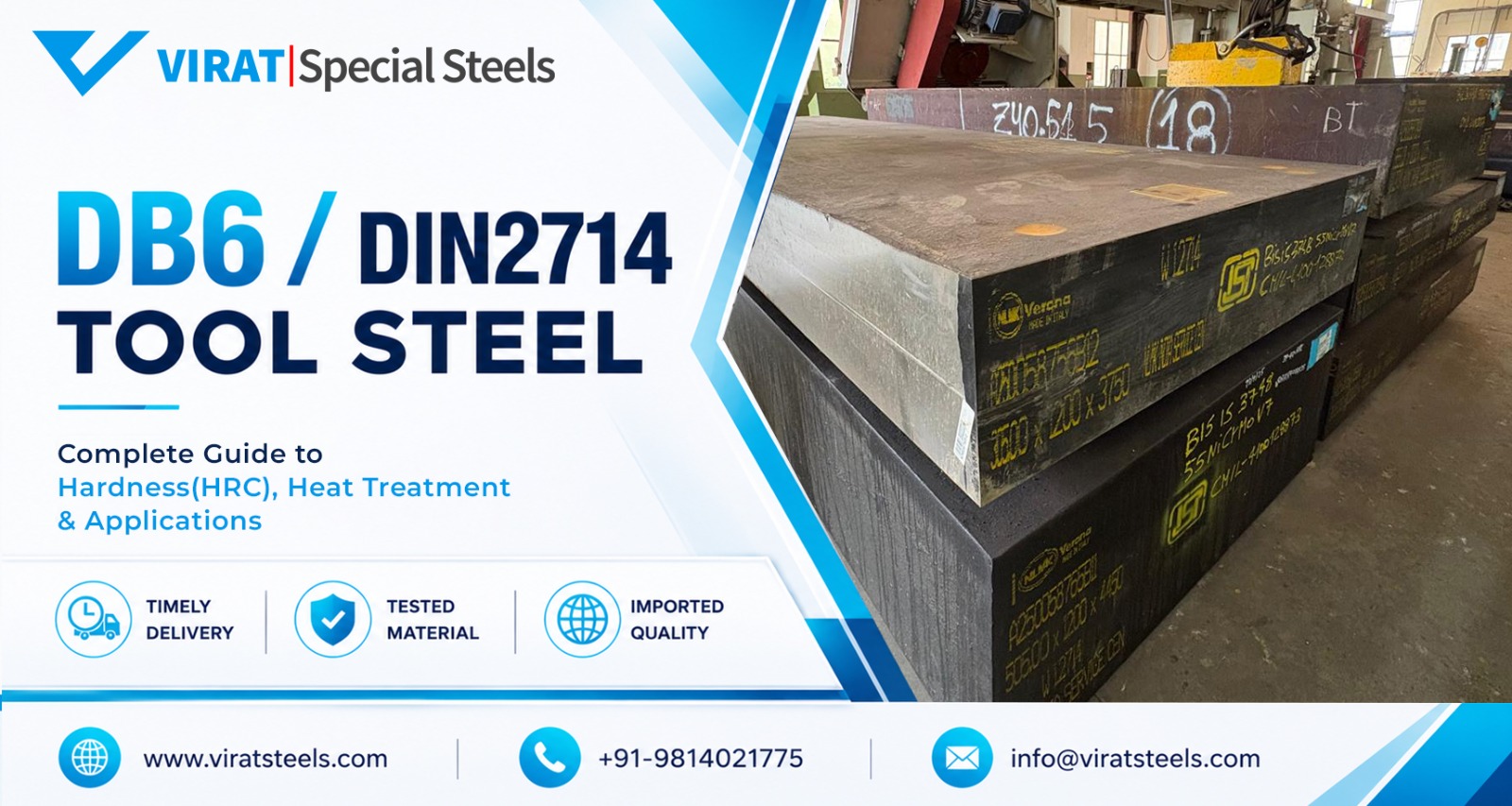
DB6 Material Hardness in HRC
DB6 Tool Steel (DIN 1.2714) is a widely used hot work tool steel for forging, die casting, heavy engineering and plastic mould industries. It offers an excellent balance of toughness, wear resistance, impact strength, and heat resistance, making it suitable for demanding industrial applications.
Hardness of DB6 Tool Steel is an important factor that defines its performance properties, tool life, machinability and ability to resist deformation under high pressure and high temperature conditions. The right heat treatment to the correct Rockwell Hardness (HRC) will ensure optimum performance in forging dies, extrusion dies, hammer dies and pressure die casting application.
In this comprehensive guide, we cover DB6 Tool Steel hardness (HRC), heat treatment process, mechanical properties, applications, comparison with other tool steels, pricing considerations, and why Virat Steels is one of India’s trusted suppliers of premium-quality DB6 Tool Steel.
What is DB6 Steel?
DB6 Tool Steel is a high quality hot work tool steel, equivalent to DIN 1.2714, (AISI L6), (55NiCrMoV7). It is a nickel-chromium-molybdenum-vanadium alloy steel known for outstanding toughness and excellent resistance to thermal fatigue.
Compared to conventional hot work steels, DB6 provides:
- Superior impact strength
- High toughness
- Excellent wear resistance
- Good hardenability
- Outstanding resistance to cracking
- Longer die life
- Excellent polishability
- Good machinability
These characteristics make DB6 an ideal choice for large forging dies, hammer dies, die holders, extrusion tooling, pressure die casting dies, and heavy-duty industrial tools.
International Equivalents of DB6 Tool Steel
DB6 Tool Steel is internationally recognized under the DIN 1.2714 standard and is equivalent to EN 55NiCrMoV7. It is also considered an approximate equivalent to AISI L6 in certain applications. In India, DB6 is widely known by its trade name and is commonly used as a premium hot work tool steel for forging dies, die casting dies, extrusion tooling, and heavy engineering applications.
Chemical Composition of DB6 Tool Steel
DB6 Tool Steel contains a balanced combination of carbon, chromium, nickel, molybdenum, and vanadium, providing excellent toughness, wear resistance, and hot strength. This alloy composition ensures superior impact resistance, good hardenability, and extended tool life in demanding hot work applications.
| Element | Composition (%) |
| Carbon (C) | 0.50–0.60 |
| Silicon (Si) | 0.10–0.40 |
| Manganese (Mn) | 0.65–0.95 |
| Chromium (Cr) | 1.00–1.20 |
| Nickel (Ni) | 1.50–1.80 |
| Molybdenum (Mo) | 0.45–0.55 |
| Vanadium (V) | 0.07–0.12 |
Mechanical Properties of DB6 Tool Steel
DB6 Tool Steel offers an excellent combination of toughness, wear resistance, and heat resistance, making it ideal for high-impact and hot work applications such as forging and die casting.
| Property | Typical Value |
| Density | 7.85 g/cm³ |
| Tensile Strength | High |
| Toughness | Excellent |
| Wear Resistance | Excellent |
| Heat Resistance | Excellent |
| Thermal Fatigue Resistance | Excellent |
DB6 Tool Steel Hardness (HRC)
Hardness is the most important property when selecting DB6 Tool Steel for industrial tooling.
Different hardness according to different Tempering temperature conditions.
– Annealed condition – 255 BHN max
– Hardened and Tempered condition- 38 to 42 HRC
annealed stock measures up to 255 BHN, standard mill-supply condition is tempered to 38–42 HRC for machining, and finished dies are re-hardened and tempered to a working hardness of 45–56 HRC depending on whether the application prioritizes toughness or wear resistance.
Heat Treatment of DB6 Tool Steel
Proper heat treatment is essential to achieve the desired hardness and mechanical properties.
The process generally involves:
- Annealing
- Stress Relieving
- Hardening
- Quenching
- Tempering
Each stage contributes to the final balance of hardness, toughness, and dimensional stability.
Annealing
Annealing softens the material, improves machinability, and relieves internal stresses before hardening.
Recommended Process:
- Heat slowly to 840–860°C
- Hold for sufficient soaking time
- Cool slowly inside the furnace
Resulting Hardness:
Approximately 220–250 HB
Stress Relieving
Stress relieving is recommended after rough machining.
- Temperature: 600–650°C
- Hold for 2 hours
- Furnace cool slowly
This minimizes distortion during final hardening.
Hardening
The hardening process significantly increases hardness and wear resistance.
Procedure:
- Preheat: 600 – 650°C
- Austenitize: 840–870°C
- Oil or polymer quench
- Air cooling where appropriate
The resulting hardness typically reaches 54–56 HRC before tempering.
Tempering
Tempering reduces brittleness while maintaining the desired hardness.
It is recommended to temper immediately after quenching.
Typical Tempering Range:
450–650°C
Double tempering is often recommended for improved dimensional stability and toughness.
Advantages of Proper Heat Treatment
By improving the mechanical properties and durability of the steel, proper heat treatment can improve the performance and service life of DB6 Tool Steel.
- Enhanced wear resistance
- Greater durability
- Improved thermal fatigue resistance
- Less risk of cracking
- Longer life of die
- Reduced maintenance costs
Applications of DB6 Tool Steel
DB6 Tool Steel (DIN 1.2714) is a popular choice for hot work applications requiring high toughness, wear resistance and resistance to thermal fatigue. It is ideal for the manufacture of heavy duty dies and tools used under extreme operating conditions.
| Industry | Typical Applications |
| Forging | Closed forging dies, hammer dies |
| Die Casting | Aluminium die casting dies |
| Extrusion | Extrusion dies |
| Automotive | Crankshaft and connecting rod dies |
| Plastic Moulding | Large mould bases |
| Heavy Engineering | Die holders and forging blocks |
| Aerospace & Defence | Heavy-duty tooling |
| Steel Plants | Hot shearing blades and press tools |
DB6 Tool Steel Advantages & Disadvantages
| Advantages | Disadvantages |
| Good impact resistance and toughness | More expensive than the usual alloy steels |
| Good wear and heat fatigue resistance | Needs proper heat treatment |
| Longer die life with less cracking | Not the best choice for high abrasive cold work applications (D2 is preferred) |
| Good hardenability and dimensional stability | Special tools are required for machining after hardening |
| Suitable for large forging dies, hot working tools | Material costs are higher for more expensive alloys |
DB6 vs H13 Tool Steel Comparison
| Property | DB6 Tool Steel (DIN 1.2714) | H13 Tool Steel (DIN 1.2344) |
| Steel Type | Hot Work Tool Steel | Hot Work Tool Steel |
| Toughness | Excellent | Very Good |
| Wear Resistance | Very Good | Excellent |
| Impact Resistance | Excellent | Very Good |
| Thermal Fatigue Resistance | Excellent | Excellent |
| Hot Hardness | Very Good | Excellent |
| Best Applications | Forging Dies, Hammer Dies | Die Casting & Extrusion Dies |
| Large Die Blocks | Excellent | Very Good |
| Relative Cost | Moderate | Moderate to High |
Best Choice: Choose DB6 for heavy-impact forging applications requiring superior toughness, while H13 is ideal for high-temperature die casting and aluminium extrusion tooling.
DB6 vs H11 Tool Steel
| Property | DB6 | H11 |
| Toughness | Excellent | Excellent |
| Wear Resistance | Higher | Good |
| Hardness | 45–56 HRC | 44–52 HRC |
| Thermal Shock | Excellent | Excellent |
| Large Blocks | Excellent | Good |
| Service Life | Longer | Good |
Best Choice: DB6 is preferred where higher wear resistance and longer tool life are required.
DB6 vs D2 Tool Steel
| Property | DB6 | D2 |
| Type | Hot Work | Cold Work |
| Toughness | Excellent | Moderate |
| Wear Resistance | High | Very High |
| Hot Strength | Excellent | Poor |
| Impact Resistance | Excellent | Moderate |
| Forging Dies | Excellent | Not Recommended |
| Cold Blanking | Not Ideal | Excellent |
Best Choice: Use DB6 for hot work and D2 for cold work applications.
DB6 vs P20 Tool Steel
| Property | DB6 | P20 |
| Toughness | Excellent | Good |
| Hardness | Up to 56 HRC | 28–34 HRC |
| Plastic Moulds | Good | Excellent |
| Forging | Excellent | Not Recommended |
| Wear Resistance | High | Moderate |
| Tool Life | Longer | Moderate |
DB6 vs EN31
| Property | DB6 | EN31 |
| Steel Type | Hot Work Tool Steel | High Carbon Steel |
| Toughness | Excellent | Moderate |
| Hardness | 56 HRC | 60–64 HRC |
| Impact Resistance | Excellent | Low |
| Hot Applications | Excellent | Poor |
| Bearings | Not Suitable | Excellent |
DB6 Tool Steel vs Other Tool Steel Grades
| Steel Grade | Toughness | Wear Resistance | Heat Resistance | Typical Hardness | Ideal Applications |
| DB6 (DIN 1.2714) | Excellent | Very Good | Excellent | 45–56 HRC | Forging Dies , Hammer Dies |
| H13 (DIN 1.2344) | Very Good | Excellent | Excellent | 44–54 HRC | Die Casting, Extrusion Dies |
| H11 (DIN 1.2343) | Excellent | Good | Very Good | 44–52 HRC | Hot Work & Extrusion Tooling |
| D2 (DIN 1.2379) | Good | Excellent | Moderate | 58–62 HRC | Cold Work Dies, Punches |
| P20 (DIN 1.2311) | Good | Moderate | Moderate | 28–34 HRC | Plastic Injection Moulds |
| EN31 | Moderate | Excellent | Low | 60–64 HRC | Bearings, Rollers & Wear Parts |
“DB6 Tool Steel Equivalents Explained: SKT4, 55NiCrMoV7, L6 & DIN 1.2714 Compared”
| Property | DB6 | SKT4 | 55NiCrMoV7 | L6 | DIN 1.2714 |
| Standard | Commercial | JIS | EN | AISI | DIN |
| Steel Type | Hot Work | Hot Work | Hot Work | Low Alloy | Hot Work |
| Toughness | Excellent | Excellent | Excellent | Excellent | Excellent |
| Wear Resistance | Excellent | Very Good | Excellent | Good | Excellent |
| Hardness | 45–56 HRC | 45–54 HRC | 45–56 HRC | 45–55 HRC | 45–56 HRC |
| Hot Work Performance | Excellent | Very Good | Excellent | Moderate | Excellent |
| Main Difference | Trade Name | JIS Grade | EN Grade | Approx. Equivalent | DIN Grade |
DB6, DIN 1.2714, and 55NiCrMoV7 are essentially the same steel grade with different designations. SKT4 is a close Japanese equivalent, while AISI L6 is an approximate equivalent with similar toughness but comparatively lower hot-work performance.
Available Sizes of DB6 Tool Steel
Virat Special Steels supplies DB6 Tool Steel in a wide range of standard and custom sizes to meet the requirements of die makers, tool rooms, automotive, engineering, and precision manufacturing industries.
Available Sizes (Flat)
- Thickness: 13 mm – 1500 mm
- Width: 13 mm – 3000 mm
- Length: Available in standard mill lengths or custom-cut sizes on request.
Available Sizes (Round)
- Diameter: 13 mm – 1500 mm
- Length: Standard mill lengths and customized cut-to-size options available.
Custom Processing Services
To minimize machining time and material wastage, we also offer:
- Precision cut-to-size material
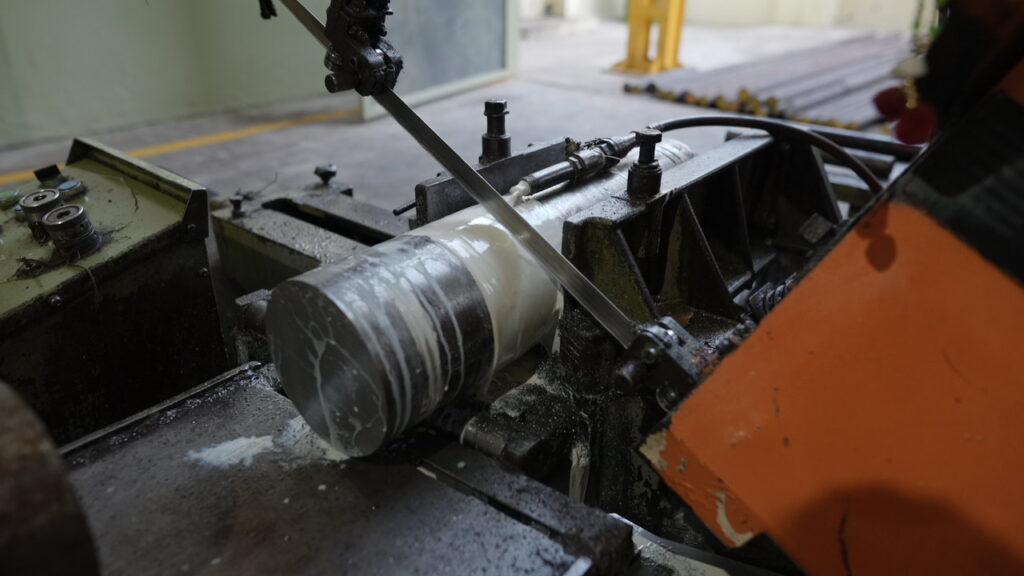
- Bandsaw cutting
- Surface machining (on request)
- Bulk supply with batch-wise traceability
- Material Test Certificate (MTC) and EN 10204 3.1 certification (where applicable)
DB6 Case Study 40% Improvement in Die Life in Forging
Operations Customer Challenge
A drop-forging plant for automotive components experienced premature die cracking of crankshaft forging dies made from standard hot work steels leading to expensive downtime.
Solution
The tooling was upgraded to DB6 (DIN 1.2714) supplied by Virat Special Steels, vacuum heat treated and double tempered to an optimized 46-48 HRC.
Results
40% increased die service life Eliminate catastrophic die cracking in high energy impact Lower maintenance and machine downtime Forged at a lower cost per part
Certifications Available
Reputable suppliers typically provide:
- Mill Test Certificate (MTC)
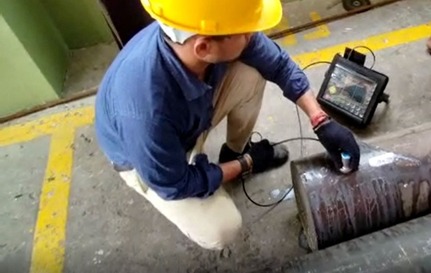
- Ultrasonic Tested Material
- Hardness Test Report
- Chemical Test Report
Buyer’s Guide: Selecting the Appropriate DB6 Tool Steel
Some important points to consider before buying DB6 Tool Steel (DIN 1.2714) to get the best out of your application:
1. Choose the Right Hardness
Pick the hardness for your application:
- 38-42 HRC – Greater toughness and impact resistance
- 50-56 HRC – Increased wear resistance and extended tool life
2. Choose the required form of material
DB6 Tool Steel is supplied in:
- Forged and Rolled blocks
- Round and Flat Bars
- ESR and Non ESR Blocks
3. Material Quality Inspection
Always ask for:
- Mill Test Certificate (MTC) Ultrasonic Tested Material
- Material Traceability Spectro Tested Material
4. Match the App
Select DB6, depending on your tooling needs, such as:
- Forging Dies
- Hammer Dies
- Extrusion
- Holders for
- Casting Dies
5. Select a Trusted Supplier
Join hands with a supplier who can support with ready stock, custom machining, technical support and PAN India delivery for consistent quality and timely supply.
Why purchase DB6 Tool Steel from Virat Steels?
Selecting the right supplier is critical to maximizing tool life, performance and productivity. With over 70 years of experience in the industry, Virat Steels is one of the trusted suppliers of high quality imported and domestic tool steels in India with more than 2000 customers in the automotive, forging, die casting, aerospace, plastic mould, heavy engineering, railways and defence industries.
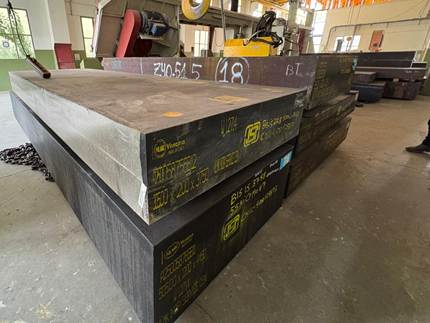
Why do manufacturers trust us?
- 70+ Years Experience supplying quality tool steels.
- 2,000+ Happy Customers in India’s Manufacturing Industry.
- Supplier of Materials from Reputed International Mills for consistent quality and performance.
- Tool Steel Ready Stock: DB6, H13, H11, D2, D3, P20, P20+Ni, M2, M35, EN31, OHNS and other grades.
- Mill Test Certificate (MTC) with full traceability of material.
- UT Tested & Spectro Tested Material for proven quality and internal soundness.
- Custom Cutting & Machining Services to suit your required sizes.
- Material Selection Assistance from experienced technical professionals.
- Fast PAN India Delivery, timely supply & reduced production downtime.
Virat Steels offers authentic quality, certified material and dependable service for all your tool steel needs. Whether DB6 Round Bars, Forged Blocks, ESR Blocks, Flat Blocks or Cut-to-size Material, we have it all.
Our Supply Network Across India
Virat Steels is one of the leading suppliers of DB6 Tool Steel (DIN 1.2714) to the manufacturers in the major industrial hubs of India like Ahmedabad, Rajkot, Pune, Nashik, Aurangabad, Kolhapur, Belgaum, Chennai, Coimbatore, Hosur, Bengaluru, Hyderabad, Faridabad, Manesar, Bhiwadi, Gurugram, Delhi NCR, Ludhiana, Chandigarh, Haryana, Punjab and Jamshedpur.
Our strong logistics network, ready stock and technical knowledge enable us to provide fast PAN India delivery to forging companies, die makers, tool rooms, plastic mould manufacturers, die casting industries and heavy engineering businesses.
Conclusion
DB6 Tool Steel (DIN 1.2714) is a high-performance hot work tool steel, known for its excellent toughness, wear resistance and thermal fatigue resistance. Proper heat treatment gives it hardness in the range of 45–56 HRC and makes it ideal for forging dies, extrusion tooling, die casting dies, and other demanding industrial applications.
Virat Steels is your trusted partner for premium quality DB6 Tool Steel with 70+ years of experience, 2000+ customers, ready stock, MTC, UT & Spectro Tested materials and PAN India delivery.
Call us or send your drawing to receive a customised material recommendation.
Request a Quote
Looking for premium-quality DB6 Tool Steel (DIN 1.2714)?
Virat Steels supplies DB6 Round and Flat Bars & Forged and Rolled Blocks, ESR /non ESR Blocks, Cut-to-Size Material with:
- ✔ 70+ Years of Industry Experience
- ✔ 2,000+ Satisfied Customers
- ✔ Ready Stock
- ✔ MTC Available
- ✔ UT Tested Material
- ✔ Spectro Tested Material
- ✔ Custom Machining
- ✔ PAN India Delivery
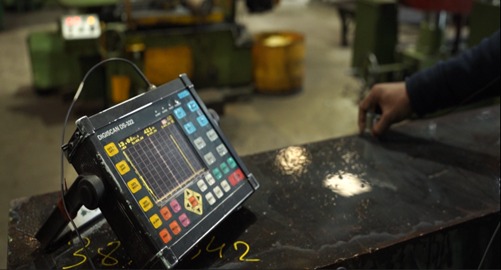
Contact Virat Steels today for technical guidance and a customized quotation for your DB6 Tool Steel requirements.
Download PDF:
https://www.viratsteels.com/downloads/DB6_vs_H13_H11_D2_Comparison.pdf
https://www.youtube.com/shorts/qf8SFJDCtlE
https://www.youtube.com/shorts/5hnQ_qp3WsA
Call us: +91-98140 21775 Email: info@viratsteels.com Visit us: Gurgaon (Haryana) | Ludhiana (Punjab)
Frequently Asked Questions
1. What is the working hardness of DB6 steel?
DB6 steel is typically tempered to a working hardness of 44–50 HRC depending on the forging application.
2. Is DB6 a hot work or cold work tool steel?
DB6 (DIN 1.2714) is a premium hot work alloy tool steel containing Nickel, Chromium, Molybdenum, and Vanadium.
3. What is the annealed hardness of DB6?
In annealed condition, DB6 has a hardness of 220–250 HB (Brinell Hardness) for easy machining.
4. What is the hardening temperature for DB6?
The recommended hardening (austenitizing) temperature is 840–870°C followed by oil, polymer, or air quenching.
5. How many tempering cycles are required for DB6?
At least two tempering cycles (double tempering) are required to relieve stress and stabilize the micro-structure.
6. Is DB6 equivalent to D2 or SKD11?
No. DB6 is a hot work steel (1.2714). D2 / SKD11 (1.2379) is a cold work steel used for cold punching and blanking.
7. What is the DIN equivalent of DB6?
The exact DIN equivalent is DIN 1.2714 (55NiCrMoV7) (L6).
8. What makes DB6 tough?
The presence of 1.50–1.80% Nickel (Ni) gives DB6 exceptional core toughness and resistance to impact cracking.
9. Can DB6 be used for blanking dies?
No, cold blanking requires cold work steels like D2 or DC53. DB6 is engineered for hot forging and high-impact dies.
10. What industries rely on DB6 tool steel?
Drop forging, press forging, automotive component manufacturing, heavy engineering, and defense.
11. Is pre-hardened DB6 available?
Yes, DB6 is often supplied in a pre-hardened condition (~35–40 HRC) for direct die cavity machining.
12. Can DB6 steel be welded?
Welding DB6 is difficult due to its high hardenability. Preheating to 300–400°C and post-weld stress relief are essential if welding is necessary.
13. Why does DB6 outperform H13 in drop forging hammer dies?
DB6 has higher Nickel content, offering superior impact energy absorption compared to H13, preventing die shattering under heavy hammer blows.
14. Why is stress relieving important before hardening DB6?
It removes machining stresses, preventing warping and dimensional movement during quenching.
15. What quality reports come with DB6 from Virat Special Steels?
Material Test Certificate (EN 10204 3.1), Ultrasonic Testing (UT) report, and Hardness/Chemical test reports.
16. Does DB6 resist thermal fatigue?
Yes, its balanced Cr-Ni-Mo composition gives high resistance to heat checking (thermal fatigue).
17. What supply forms are available for DB6?
Round bars, flat blocks, forged blocks, and custom cut plates.
18. What is the primary advantage of DB6?
High impact toughness combined with excellent hardenability across large block sizes.
19. What should buyers check before buying DB6?
Ensure ultrasonic soundness (UT testing) to prevent internal defects in large die blocks.
20. Why choose Virat Special Steels for DB6?
Extensive stock, certified quality, precision cutting facilities, quick delivery, and decades of technical expertise.
H13 vs H11 Tool Steel – Complete Comparison (Properties, Hardness, Applications, Price & Selection Guide)
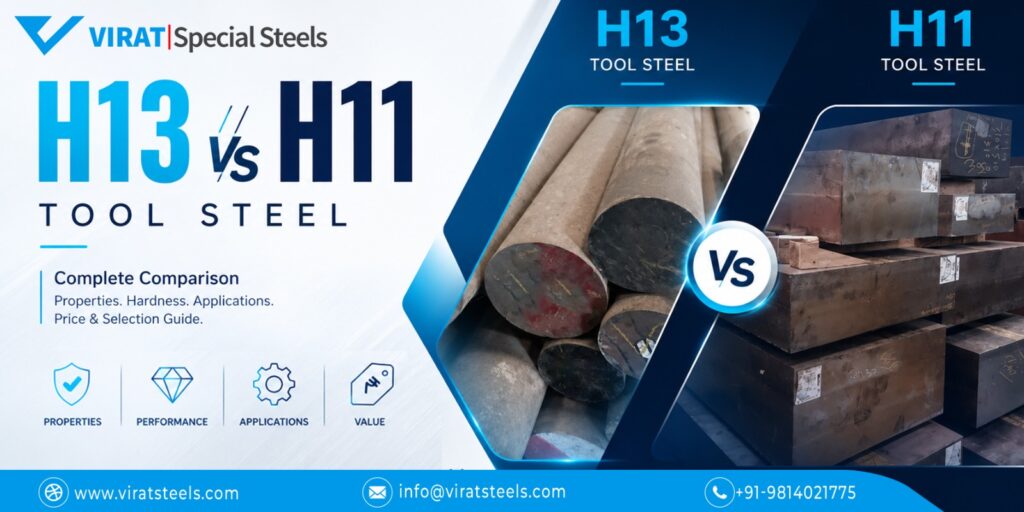
H13 vs H11 Tool Steel, Which One Should You Choose?
Walk into any tool room, forging shop, or die manufacturing unit in India, and you’ll hear the same debate.
“Should this die be made from H13 or H11?”
At first glance, both steels look nearly the same. They are both part of the Hot Work Tool Steel family, contain chromium and molybdenum, and are built to perform in extreme temperatures. However, choosing the wrong material can significantly decrease die life.
- Choose H13 where H11 should have been used, and the die may crack under repeated impact.
- Choose H11 where H13 belongs, and excessive wear can shorten production life.
This complete guide explains everything you need to know before selecting either grade.
You’ll learn about:
- H13 vs H11 Chemical Composition
- Hardness Comparison
- Mechanical Properties
- Heat Treatment
- Price Comparison
- Tool Life
- Equivalent Grades
- Applications
- Availability in India
- Supplier Selection Guide
- 25+ Frequently Asked Questions
H13 vs H11 Tool Steel – Quick Comparison
| Property | H13 (DIN 1.2344 / SKD61) | H11 (DIN 1.2343 / SKD6) |
| Main Strength | Excellent wear resistance and hot hardness | Great toughness and impact resistance |
| Wear Resistance | Excellent | Very Good |
| Toughness | Very Good | Excellent |
| Hot Hardness | Excellent | Very Good |
| Resistance to Thermal Fatigue | Excellent | Very Good |
| Shock/Impact resistance | Excellent | Good |
| Machinability (Annealed) | Better | Moderate |
| Maximum Working Hardness | Up to 54 HRC | Up to 52 HRC |
| Typical Working Hardness | 44–48 HRC | 42–46 HRC |
| Best Suited For | Die Casting, Extrusion Dies, Plastic Moulds | Forging Dies, Hammer Dies, Fastener Tooling |
| Relative Tool Life | Longer in wear-intensive applications | Longer in impact-intensive applications |
| Relative Cost | 10–20% Higher | More Economical |
| Best Choice When | Heat, wear and long production runs are the priority | High impact, shock loading and toughness are the priority |
What is H13 Tool Steel?
H13 Tool Steel (DIN 1.2344, SKD61) is one of the world’s most widely used chromium hot work tool steels.
Its high vanadium content forms extremely hard carbides that improve:
- Wear resistance
- Hot hardness
- Heat checking resistance
- Tool life
- Surface finish
This makes H13 the preferred steel for:
- Aluminium Die Casting Dies
- Zinc Die Casting
- Plastic Injection Moulds
- Extrusion Dies
- Hot Shear Blades
- Forging Punches
What is H11 Tool Steel?
H11 Tool Steel (DIN 1.2343, SKD6) is also a Hot Work Tool Steel, but with a lower vanadium content.
The lower carbide volume gives H11:
- Better toughness
- Better impact resistance
- Better crack resistance
- Easier machining
It is commonly selected for:
- Hammer Dies
- Forging Dies
- Fastener Tooling
- Hand Tool Dies
- Heavy Stamping
Comparison of Chemical Composition H13 vs H11 Tool Steel
| Element | H13 (DIN 1.2344) | H11 (DIN 1.2343) |
| Carbon | 0.32–0.45% | 0.33–0.43% |
| Chromium | 4.75–5.50% | 4.75–5.50% |
| Molybdenum | 1.10–1.75% | 1.10–1.60% |
| Vanadium | 0.80–1.20% | 0.30–0.50% |
| Silicon | 0.80–1.20% | 0.80–1.20% |
| Manganese | 0.20–0.50% | 0.20–0.50% |
Main Difference:
The H13 with higher vanadium content has much better wear resistance and longer tool life.
Mechanical Property Comparison
| Property | H13 | H11 |
| Wear Resistance | Excellent | Good |
| Toughness | Good | Excellent |
| Hot Hardness | Excellent | Good |
| Thermal Fatigue | Excellent | Very Good |
| Heat Checking Resistance | Excellent | Very Good |
| Impact Resistance | Good | Excellent |
| Machinability | Moderate | Better |
| Polishability | Excellent | Good |
Hardness Comparison
| Condition | H13 | H11 |
| Annealed | 180–220 HB | 180–220 HB |
| Working Hardness | 44–52 HRC | 42–50 HRC |
| Maximum Practical Hardness | 54 HRC | 52 HRC |
Heat Treatment Process
1. Preheating (650–750°C)
2. Austenitizing
o H13: 1010-1025 °C
3. Air, Oil, or Vacuum Quenching
4. Double or Triple Tempering (550-650 °C)
Vacuum heat treatment is recommended for precision dies to minimise distortion.
One of the most asked questions from buyers is:
“What’s the cheapest steel?
Generally,
Why?
- Higher Vanadium content
- Better wear resistance
- Longer production life
- Higher performance in die casting applications
Although the initial purchase price is higher, H13 often delivers a lower cost per component because of its longer service life.
Price depends on:
- ESR or Conventional Grade
- Forged or Rolled Material
- Imported or Domestic Mill
- Size
- Heat Treatment
- Quantity
No fixed market price exists, so always request a quotation based on current stock.
H13 vs H21
| Feature | H13 | H21 |
| Toughness | Better | Lower |
| Hot Hardness | Excellent | Outstanding |
| Wear Resistance | Excellent | Excellent |
| Typical Use | Die Casting | Hot Forging & Extreme Heat |
H13 vs DIN 1.2367
| Property | H13 | 1.2367 |
| Toughness | Excellent | Higher |
| Hot Strength | Excellent | Excellent |
| Large Forging Dies | Good | Better |
There is virtually no practical difference. SKD61 is the Japanese JIS designation equivalent to AISI H13 and DIN 1.2344. Selection should focus on material quality, cleanliness, ESR option, testing, and supplier reliability rather than the grade designation alone.
H13 vs DB6
| Feature | H13 | DB6 |
| Type | Hot Work | Hot Work |
| Toughness | Excellent | Very High |
| Nickel Content | No | Yes |
| Large Forging Dies | Good | Excellent |
| Heavy Impact | Good | Better |
Tool Life Comparison
| Application | Better Grade |
| Die Casting | H13 |
| Extrusion | H13 |
| Plastic Moulds | H13 |
| Hammer Dies | H11 |
| Forging Dies | H11 |
| Heavy Impact Tools | H11 |
H13 & H11 Equivalent Grades
H13 and H11 are common hot work tool steels, but they have different names depending on the international standard used. Use the table below to identify the equivalent grades used in different countries.
| Standard | H13 Equivalent | H11 Equivalent |
| AISI (USA) | H13 | H11 |
| DIN / EN (Germany) | 1.2344 / X40CrMoV5-1 | 1.2343 / X38CrMoV5-1 |
| JIS (Japan) | SKD61 | SKD6 |
Sizes Available
H13 (DIN 1.2344 / SKD61) and H11 (DIN 1.2343 / SKD6) tool steel are available in a wide range of sizes to suit different tooling applications.
| Product Form | Available Sizes |
| Round Bars | Ø13 mm to Ø500+ mm |
| Flat Bars | Thickness: 20–305 mm, Width: 50–600 mm |
| Cut-to-Size Blocks | As per customer drawing and specifications |
Custom sizes and large forged sections can also be supplied based on project requirements.
| Property | Conventional | ESR |
| Cleanliness | Good | Excellent |
| Inclusion Level | Higher | Lower |
| Polishability | Good | Excellent |
| Fatigue Life | Better | Best |
| Tool Life | Longer | Longest |
ESR H13 is recommended for premium die casting and mould applications requiring maximum reliability.
Industries Using H13
- Aluminium Die Casting
- Zinc Die Casting
- Plastic Injection Moulding
- Extrusion
- Aerospace
- Automotive
- Pressure Die Casting
- Hot Shear Blades
Industries Using H11
- Forging
- Hammer Dies
- Fastener Manufacturing
- Hand Tools
- Heavy Engineering
- Structural Components
Why Buy H13 or H11 from Virat Steels?
Virat Steels has been supplying premium tool steels to Indian manufacturers for 70+ years.
Why customers choose Virat Steels
- 70+ Years of Experience
- 2000+ Industrial Customers
- Supplier of material from reputed international mills
- Ready Stock Available
- Mill Test Certificate (MTC)
- UT Tested Material
- Spectro Tested Material
- PAN India Delivery
- Custom Cutting
- Fast Dispatch
- Technical Material Recommendation
Whether you’re looking to Buy H13 Steel, Buy H11 Steel, DIN 1.2344, DIN 1.2343, SKD61, SKD6, ESR H13, or Forged H13 Blocks, our team can recommend the right material based on your application
Our Supply Network Across India
Virat Steels is a trusted supplier of Hot Work Tool Steel to customers across the major industrial hubs of India including Ahmedabad, Rajkot, Pune, Nashik, Aurangabad, Kolhapur, Belgaum, Chennai, Coimbatore, Hosur, Bengaluru, Hyderabad, Faridabad, Manesar, Bhiwadi, Gurugram, Delhi NCR, Ludhiana, Chandigarh, Haryana, Punjab, Jamshedpur.
Our strong logistic network and efficient distribution system enable us to ensure timely PAN India dispatch to meet the requirement of tool rooms, die manufacturers, forging industries and engineering companies across the country.
- H13 Tool Steel
- H11 Tool Steel
- DIN 1.2344 Tool Steel
- DIN 1.2343 Tool Steel
- ESR Tool Steel
- Plastic Mould Steel
- Hot Work Tool Steel
- Forged Tool Steel Blocks
Download Free PDF:
H13 vs H11 Tool Steel Comparison Guide
https://www.viratsteels.com/downloads/h13-vs-h11-comparison.pdf
Request a Quote
Searching for the right Hot Work Tool Steel?
Our technical team can suggest the correct grade for your application whether you require H13, H11, DIN 1.2344, DIN 1.2343, SKD61, SKD6, ESR H13 or Forged H13 Blocks.
Request a Quote Today
✔ Material Recommendation
✔ Ready Stock
✔ MTC Available
✔ UT Tested
✔ Spectro Tested
✔ PAN India Delivery
Call us or send your drawing to receive a customised material recommendation.
Call us: +91-98140 21775 Email: info@viratsteels.com Visit us: Gurgaon (Haryana) | Ludhiana (Punjab)
FAQs (Frequently Asked Questions)
1. What is the difference between H11 and H13 tool steel?
H11 is tougher and more impact resistant while H13 has more wear resistance, hot hardness and resistance to thermal fatigue.
2. Which steel is best for aluminum die casting dies?
H13 is generally preferred as it has a longer die life and is more resistant to heat checking.
3. What grade is recommended for hot forging dies?
H11 is often chosen for heavy-impact forging work and H13 is appropriate for moderate-impact forging applications.
4. What are the common industries that use H11 and H13 tool steel?
These grades are widely used in die casting, forging, extrusion, automobile, aerospace, plastic molding and general engineering industry.
5. What is the working temperature range of H13 tool steel?
H13 has good strength and hardness up to about 600°C and is used for hot working.
6. Is H11 impact strength better than H13?
Yes. H11 has a lower vanadium content which makes it tougher and more resistant to impact loading.
7. Which tool steel has better dimensional stability in heat treatment?
H13 generally has better dimensional stability when properly heat treated.
8. Is it possible to nitride H11 and H13?
Yes. Both grades can be nitrided to increase surface hardness and wear resistance.
9. What is the best grade for extrusion tooling?
H13 is most often recommended for aluminum extrusion dies as it has the best hot strength and wear resistance.
10. Are H11 and H13 available on forged blocks?
Yes. Both grades are available as forged blocks, rounds, flats and in customer specific sizes.
11. What inspections are performed before dispatch?
Material usually comes with Spectro Test Reports, Ultrasonic Testing (UT), Material Test Certificates (MTC), and hardness testing if requested.
12. Can H11 and H13 be supplied in pre-hardened condition?
Yes. Based on customer needs, both grades can be offered annealed, pre-hardened, or heat-treated.
13. Which grade is easier to polish?
H13 generally provides an excellent polished finish, making it good for high-quality tooling applications.
14. Are H11 and H13 suitable for plastic mould applications?
Yes. H13 is commonly used for plastic moulds that work at high temperatures or need great wear resistance.
15. What shapes are available in H11 and H13 tool steel?
These grades come in round bars, flat bars, square bars, forged blocks, plates, and custom-cut sizes.
16. How do I choose between H11 and H13?
The choice depends on the application. Use H11 for maximum toughness, and H13 for better wear resistance and a longer service life.
17. What surface finish options are available?
Materials are available in black, peeled, rough machined, bright, or fully machined condition based on customer needs.
18. Can custom sizes be supplied?
Yes. Custom dimensions and cut-to-size materials are available to reduce machining time and material waste.
19. What certifications are available with the material?
Materials can come with Mill Test Certificates (MTC), chemical composition reports, mechanical property reports, and UT inspection certificates.
20. Does Virat Steels offer technical support in selecting tool steel?
Yes. Our technical team helps customers choose the right grade based on the application, operating temperature, and service conditions.
21. Does Virat Steels deliver across India?
Yes. We provide fast and dependable delivery across India to major industrial cities and manufacturing hubs.
22. How can I place an order with Virat Steels?
Just share your required grade, dimensions, quantity, or technical drawing with our sales team. We will recommend the right material, offer technical guidance, and provide a competitive quote.
Why Manufacturers Across India Choose Virat Steels as Their Trusted Tool Steel Supplier
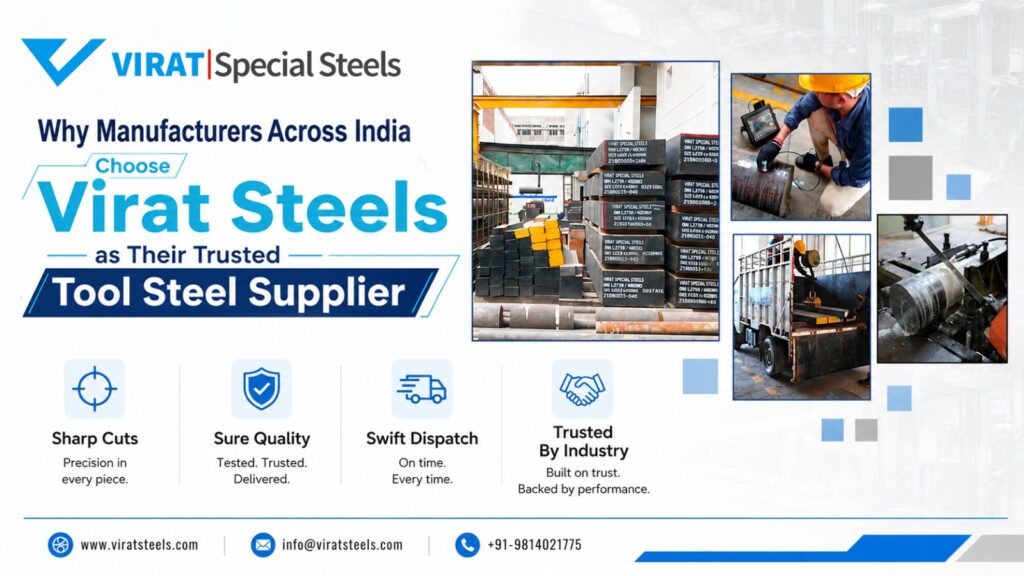
Importance of the Right Tool Steel Supplier
In the current competitive environment, the quality of Tool Steel Supplier plays an important role when it comes to efficiency in production, quality of the product, and cost of the operations. It really does not matter if you are working with cars or airplanes or making parts or doing precise engineering work. What is important is that you have a company that supplies the right kind of steel tools.
Virat Special Steels Pvt Ltd has been doing this work for over 68 years. We have been supplying quality steel tools to people who make cars, airplanes and other things. We know the problems that people face when they are trying to choose the kind of steel tool, for their work. We are a company that people trust to supply steel tools in India. We give our customers quality materials and also help them with technical problems. We have steel tools to be delivered and we can also cut them to the size that our customers need. We deliver our tools over the country on time. This helps our customers to work waste less time and get good results.
1. Extensive Portfolio of PremiumTool Steel Supplier Grades
There is an extensive portfolio of different grades of tool steel Supplier available at Virat Steels, appropriate for varied industrial uses.
The list includes the following:
2. Premium Quality Tool Steel Supplier You Can Rely On
Quality forms the basis of all products manufactured by Virat Steels.
Every steel alloy is selected, tested, and inspected for the following qualities:
• Hardness
• Wear Resistance
• Toughness
• Tolerance
• Machinability
Manufacturers get products which perform reliably in difficult conditions of manufacture.
3. Ready Stocks Available for Quicker Deliveries
Production delays usually happen when there is a lack of raw materials.
Having ready stocks means that Virat Steels will be able to supply its clients with the necessary tool steel Supplier grades without any delay.
Advantages include:
• Downtime reduction
• Project completion
• Better stock control
• Better scheduling
4. Custom Cutting & Sizing
Each manufacturing company has its own material needs. The Virat Steels offer:
• Custom-cutting services
• Sizes as per the requirement
• Machine-ready sizes
• Bulk availability
This minimizes wastage on the machine and saves time for customers.
5. Technical Competence and Materials Information
Choosing the right grade of tool steel Supplier may not be an easy task always.
The skilled and knowledgeable professionals from Virat Steels assist clients by advising on the most appropriate material considering the following factors:
• Application
• Heat-treating needs
• Wear resistance
• Toughness
• Machinability requirements
• Economic considerations
6. Price Competitiveness without Sacrificing Quality
Producers are always trying to find that delicate balance between the two.
Virat Steels delivers:
• Market competitive rates
• High value products
• Value-for-money materials
Customers get high-end steel within their procurement budget.
7. Industries That Trust Virat Steels
Virat Steels provides services to various industrial sectors such as:
• Automobile Manufacturing
• Plastic Injection Moulding
• Forging Sector
• Manufacturing of Dies and Moulds
• Engineering Workshops
• Aerospace Parts
• Machine Tools Manufacturing
• Precision Engineering
• Industrial Machinery Manufacturing
The capability of serving different sectors highlights their level of professionalism.
8. Fast Tool Steel Supplier Delivery Across India
Indian manufacturers need timely deliveries to keep their operations running smoothly and efficiently.
Virat Steels have an effective supply chain system in place which allows quick deliveries in industrial towns and manufacturing centres. They offer a reliable logistics system that guarantees on-time material delivery.
9. Building Strong Customer Relationships
Virat Steels does not concentrate only on transactions; rather, it builds strong relationships.
Customer needs include:
• Quick communication
• Professional assistance
• Readily available products
• Post sales support
• Long term relationship
This customer first approach has helped create a loyal clientele across India.
10. Commitment to Continuous Improvement
Technology in manufacturing continues to develop, while material demands increase.
Virat Steels keeps abreast of changes in industry through:
• Evolving product line
• Quality assurance
• Better inventory control
• Exceptional customer service
• Efficient supply chain
How Premium Tool Steel Supplier Benefits Manufacturers?
| Manufacturing Challenge | How Virat Steels Helps |
| Production delays | Ready stock and reliable dispatch |
| Incorrect material selection | Technical guidance for grade selection |
| Excess machining | Custom-cut and machine-ready sizes |
| Frequent tool replacement | Premium-quality tool steel designed for demanding applications |
| Procurement delays | Reliable pan-India supply network |
Why Manufacturers Choose Virat Steels
Manufacturers across India choose Virat Steels because we combine high-quality tool steel Supplier with dependable service and technical expertise. Our customers benefit from:
• Premium-quality tool steel
• Wide range of steel grades
• Competitive pricing
• Fast delivery across India
• Custom cutting services
• Expert technical guidance
• Reliable stock availability
• Trusted industry experience
• Excellent customer support
• Long-term supply partnership
| Feature | Virat Steels | Typical Supplier |
| Tool Steel Supplier Grades | Wide range of premium grades | Limited availability |
| Stock Availability | Ready stock for quick dispatch | May require longer lead times |
| Custom Cutting | ✓ Available | Not always available |
| Technical Guidance | Expert material selection support | Limited technical assistance |
| Delivery | Reliable pan-India delivery | Varies by supplier |
| Industries Served | Automotive, Aerospace, Die & Mould, Forging, Precision Engineering | May focus on fewer industries |
| Customer Support | Dedicated and responsive | Varies |
Conclusion
Looking for a trusted Tool Steel Supplier in India ?
No matter where your business is located—North, South, East, or West—Virat Special Steels is here to support your manufacturing needs with premium-quality tool steel Supplier .
From dies and moulds to cutting tools and precision engineering applications, we supply high-performance tool steel Supplier that delivers strength, durability, and consistent results. With expert technical guidance, reliable quality, and timely delivery across India, we help manufacturers keep production running smoothly and efficiently.
Choose Virat Special Steels—your dependable partner for quality tool steel Supplier and long-term manufacturing success.
Contact Virat Special Steels today for expert guidance and premium tool steel Supplier supply.
Need help choosing between DIN 1.2714 Steel , DB6, and H13 for your next die?
Talk to our technical sales team before you place the order — it’s a five-minute call that can save you a failed die six months from now.
Call us: +91-98140 21775 Email: info@viratsteels.com Visit us: Gurgaon (Haryana) | Ludhiana (Punjab)
Frequently Asked Questions (FAQs)
1. What types of tool steel Supplier does Virat Steels supply?
Virat Steels supplies Cold Work Tool Steel, Hot Work Tool Steel Supplier and Plastic Mold Steel. They also provide High-Speed Steel, Alloy Steel, Die Steel and Engineering Steel. Additionally they offer special steel grades.
2. Why should manufacturers choose Virat Steels?
Manufacturers choose Virat Steels because they provide high-quality materials. They have an inventory and offer competitive pricing. Virat Steels also provides expertise and custom cutting services. They ensure delivery across the nation.
3. Does Virat Steels provide sized tool steel Supplier ?
Yes Virat Steels offers custom cutting services. They supply tool steel Supplier in sizes that match customer requirements. This helps reduce machining time and material waste.
4. Which industries use Virat Steels products?
Virat Steels serves industries. These include automotive, aerospace and plastic moulding. They also serve die and mould manufacturing, forging and precision engineering. Machine tools and general engineering are also among their clients.
5. Does Virat Steels maintain stock?
Yes Virat Steels maintains an inventory. They stock used tool steel grades. This ensures dispatch and minimizes production delays.
6. Can Virat Steels help select the tool steel Supplier grade?
Yes Virat Steels has a technical team. They assist customers in choosing the suitable steel grade. The team considers application, hardness wear resistance, toughness and machining requirements.
7. Does Virat Steels deliver across India?
Yes Virat Steels delivers tool steel across India. They have a logistics and distribution network.
8. How does quality tool steel improve manufacturing?
High-quality tool steel offers better wear resistance. It also provides tool life and improved machining performance. Additionally it reduces downtime. Lowers maintenance costs. This leads to productivity and cost savings.
9. Does Virat Steels supply materials for die and mould manufacturing?
Yes Virat Steels offers specialized die steel and mould steel grades. These are suitable, for stamping dies, injection moulds, forging dies and precision tooling applications.
10. How can I contact Virat Steels for a quotation?
You can contact Virat Steels through their website. You can also email them. Reach out to their customer support team. They will discuss your tool steel requirements. Provide a customized quotation.
11. How do I pick the right tool steel for my needs?
The right tool steel depends on what you’re using it for, temperature, wear and tear how hard it needs to be and how easy it is to work with. For example hot work tool steels are good for forging and die-casting while cold work tool steels are often used for cutting tools. If you’re not sure Virat Special Steels technical team can help you choose the tool steel for your project.
12. Why is it important to buy tool steel from a supplier who knows what they’re doing?
A supplier who knows what they’re doing doesn’t just provide tool steel they also help you pick the right one make sure they always have it in stock and deliver it on time. This means you won’t have to delay production your tools will last longer and you’ll spend money making things.
13. What are the benefits of using high-quality tool steel?
High-quality tool steel lasts is stronger keeps its shape and makes your tools last longer. It also means you don’t have to replace tools often you can work without stopping and you get consistent results even when you’re making things in large quantities.
14. What kinds of businesses use tool steel from Virat Special Steels?
Tool steel, from Virat Special Steels is used in industries including making cars, airplanes, molds and dies, forging, making plastic parts, machine tools, precision engineering, and making general equipment.
15. Can Virat Special Steels cut tool steel to the sizes I need?
Yes Virat Special Steels can cut tool steel to the sizes you need. Getting tool steel that’s already the size helps you make things faster use less material and work more efficiently.