



September, 2026
now browsing by month
NLMK Verona Tool Steel DB6 (DIN 1.2714): Properties, Applications & Supply in India
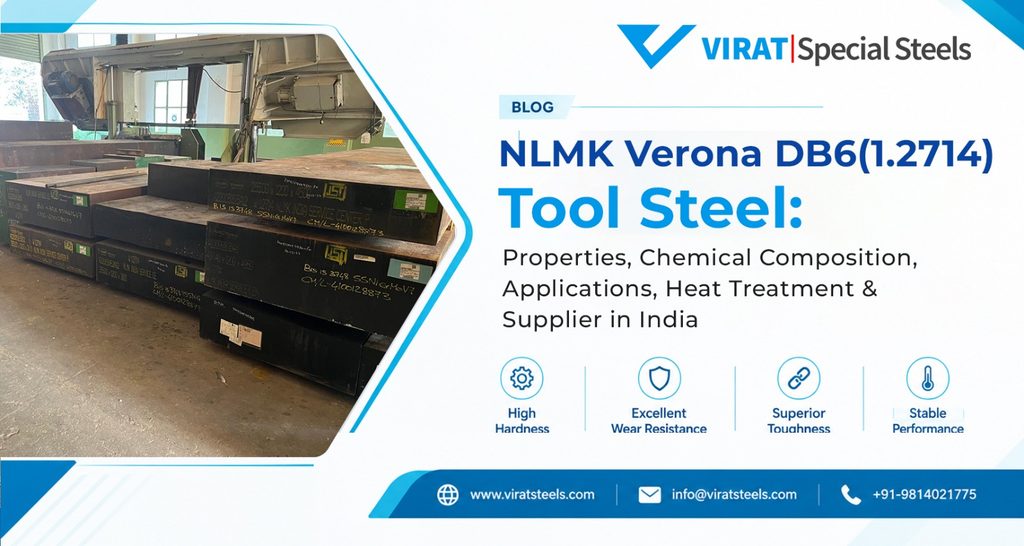
If you own a forging shop, die-making unit or heavy tooling operation, you know that the difference between a die that lasts one production run and one that lasts hundreds comes down to the steel underneath it. NLMK Verona Tool Steel DB6 is one of the European grades that is increasingly being specified by Indian manufacturers for close die forging, hammer dies and heavy-impact tooling – and with good reason.
This guide will explain what NLMK Verona DB6 really is, its real composition and mechanical properties, how it machines and heat-treats, where it is used and how to decide if it is the right grade for your application – all from verified technical data.
What Is NLMK Verona Tool Steel DB6?
NLMK Verona Tool Steel DB6 is a specialty tool steel plant of the NLMK Group, located in the north of Italy, close to Verona. The plant produces forged blocks, plates, and ingots for tool and die applications, and currently supplies its hot-work die steel to the Indian market under the DB6 designation — the specific grade Virat Steels stocks and distributes from this mill.
DB6 is not a proprietary or obscure code. It corresponds to well-established international standards:
| Designation | Standard |
| DB6 | Commercial/trade name |
| DIN 1.2714 | German (Werkstoff) standard |
| AISI L6 | American standard |
| AFNOR 55NCDVV7 | French standard |
| Standard family | 55NiCrMoV (Cr-Ni-Mo-V alloyed hot-work steel) |
To summarize, a buyer searching for “NLMK Verona DB6”, “db6 nmlk verona” or “nmlk verona die steel” is looking for this specific chromium-nickel-molybdenum-vanadium alloyed hot-work die steel, a popular grade in the European and Indian tooling supply chains, now available from NLMK Verona’s Italian production.
Chemical Composition of NLMK Verona Tool Steel DB6 / DIN 1.2714
DB6 is a Cr-Ni-Mo-V alloy system which provides a balance of toughness and hardness:
| Element | C | Si | Mn | P | S | Cr | Ni | Mo | V |
| % Range | 0.50–0.60 | 0.10–0.40 | 0.65–0.95 | ≤0.03 | ≤0.03 | 1.00–1.20 | 1.50–1.80 | 0.45–0.55 | 0.07–0.12 |
DB6 has high toughness and impact resistance (compared to more common hot-work grades such as H13) and high nickel content (compared to more common hot-work grades such as H13) for exceptional toughness and impact resistance rather than pure high-temperature hardness retention.
Mechanical Properties
| Property | Value |
| Tensile Strength | 1000–1400 MPa |
| Yield Strength | 1045 MPa |
| Elongation | 15%–20% |
| Impact Toughness | 20–25 J/cm² |
| Hardness (working) | 50–55 HRC |
| Compressive Strength | 2500 MPa |
| Modulus of Elasticity | 205 GPa |
Typical supply hardness ranges (depending on treatment condition):
- Annealed condition: 255 BHN max
- Hardened & tempered: 38–42 HRC (die-ready condition), with tools further hardened up to 50–55 HRC for service
- Hardness variation, surface to core: 20–25 BHN
Physical Properties
| Coefficient of Thermal Expansion (10⁻⁶ m/m·K) | 20–100°C | 20–200°C | 20–300°C | 20–400°C | 20–500°C | 20–600°C |
| Value | 12.1 | 13.1 | 13.2 | 13.5 | 14.1 | 14.3 |
| Thermal Conductivity (W/m·K) | 20°C | 350°C | 700°C |
| Value | 35.0 | 39.0 | 36.0 |
Note: Exact physical values can vary slightly with heat treatment and section size — always cross-check against the mill test certificate for critical applications.
Machinability of NLMK Verona DB6
DB6 is easy to work and the machinability can be rated at about 90 % relative to W-group water-hardening low-alloy steels taken as the 100 % reference. This makes it much easier to machine than many high-alloy cold-work or high-speed steel grades, and still retains the toughness needed for heavy forging dies.
Practical machining notes:
- Best machined in the annealed condition (≤255 BHN) before final hardening
- Finish machining should ideally be completed before final hardening and tempering, with only grinding/polishing done after
- Stress-relief before hardening reduces distortion risk in large die blocks
Heat Treatment Guide
| Process | Parameters |
| Annealing | Soak at 740–760°C, furnace-cool at max 10°C/hr down to 600°C, then air cool |
| Hardening | Preheat to 650°C, raise quickly to 900–950°C, quench in oil |
| Hardening (mill data) | 840–880°C oil quench → 57 HRC; 860–900°C air quench → 55 HRC |
| Tempering | Multiple tempers; hardness drops from ~56 HRC (100°C temper) to ~34 HRC (650°C temper) |
| Stress Relieving | Heat to 600–650°C, soak 2 hrs per 25mm section, slow cool |
| Forging | Warm to 700°C, raise to 1050°C, keep forging above 800°C, cool slowly in furnace/vermiculite |
| Nitriding | Possible after hardening + tempering; done ~50°C above nitriding temperature |
| Normalizing | Not recommended — DB6 is air-hardening |
Applications of NLMK Verona DB6 Tool Steel
DB6’s high toughness and impact resistance make it especially suited to heavy-impact forging applications rather than pure high-temperature die casting:
- Dies for drop forging hammers & mechanical presses
- Die holders, cassettes, and shoe blocks
- Hot shear blades
- Piston rods, cranks, and boosters
- Punches and blanking/forming dies
- Trimmer dies
- Clutch parts, pawls, shafts, knuckle pins
- Forming rolls, spindles, and rollers
Industries: Automotive component manufacturing, heavy forging, aerospace tooling, general engineering, and metalworking.
Advantages of NLMK Verona DB6 Tool Steel
- Superior toughness and impact resistance compared to many hot-work alternatives — ideal where shock loading, not just heat, is the main stress
- Good hardenability through thick sections, suited to large forging die blocks
- European mill origin (NLMK Verona, Italy) with documented alloy composition
- Good machinability (~90% relative rating) compared to many alloy tool steels
- Nitriding-compatible for surface wear resistance without sacrificing core toughness
- Supplied by Virat Steels with extra forging reduction, upsetting, and double tempering for improved ultrasonic quality in die blocks
DB6 vs H13 vs D2 — Comparison Table
| Factor | DB6 (DIN 1.2714) | H13 (DIN 1.2344) | D2 (Cold Work) |
| Category | Hot-work, high-toughness | Hot-work, high-temp hardness | Cold-work, high wear resistance |
| Key strength | Toughness & impact resistance | Thermal fatigue resistance | Abrasion/wear resistance |
| Typical hardness | 50–55 HRC | ~50 HRC | 58–62 HRC |
| Best suited to | Hammer/press forging dies, shock loading | Die casting, extrusion dies | Blanking, punching, cold forming |
| Machinability | Good (~90% rating) | Good | Moderate (high alloy content) |
| Nickel content | High (1.5–1.8%) | None | None |
How to Choose Between NLMK Verona Tool Steel DB6 (and Other Grades)?
- Is your tooling exposed to repeated impact/shock loading? DB6 is specifically strong here — hammer forging and heavy press dies benefit most from its toughness.
- Is your process purely high-temperature (die casting, hot extrusion) with less shock? H13 (DIN 1.2344) may be a better fit than DB6 due to superior thermal fatigue resistance.
- What supply condition do you need? DB6 is available annealed or hardened & tempered — confirm this at order stage based on your in-house heat treatment capability.
- What section size does your die need? Large forged blocks require good through-thickness hardenability — DB6’s alloy design supports this.
- Do you need surface hardening? DB6 can be nitrided after hardening/tempering for improved wear resistance while keeping core toughness.
- Do you need ultrasonic-tested quality die blocks? Ask specifically for extra forging reduction and double-tempered blocks — Virat Steels supplies DB6 this way for critical forging applications.
Why Source NLMK Verona DB6 Through Virat Steels?
- NLMK Verona origin DB6/DIN 1.2714 Steel – Official stockist and supplier
- PAN-India supply network covering major forging & auto hubs (Ahmedabad, Pune, Chennai, Bengaluru, Delhi NCR, Ludhiana etc.)
- Flat, square, and round bar available in project-based quantities
- Extra forging reduction and double tempering for improved ultrasonic quality on die blocks
- Technical support to confirm the right grade — DB6 vs H13 vs other die steels — for your specific application
Frequently Asked Questions
1. What is NLMK Verona Tool Steel DB6?
It is a Cr-Ni-Mo-V alloyed hot-work die steel (DIN 1.2714 / AISI L6) produced by NLMK Verona, Italy and supplied in India by Virat Steels.
2. What is DB6 steel equivalent to?
DB6 is commonly equivalent to DIN 1.2714, AISI L6, and AFNOR 55NCDVV7.
3. What is the hardness of DB6 steel?
Working hardness is typically 50–55 HRC after hardening and tempering; annealed condition is supplied at 255 BHN max.
4. Is DB6 better than H13 steel?
DB6 provides higher toughness and impact resistance, hence better suited for heavy forging, whereas H13 is more suitable for high temperature hot-work processes such as die casting.
5. Which steel is better for hammer forging dies?
DB6 is generally preferred for hammer forging dies due to its superior toughness and shock resistance.
6. What is the chemical composition of DB6?
Approximately 0.50–0.60% C, 1.00–1.20% Cr, 1.50–1.80% Ni, 0.45–0.55% Mo, and 0.07–0.12% V.
7. Can DB6 steel be welded or re-hardened?
Yes, but it must be done carefully — with stress tempering for pre-hardened condition — to avoid cracking.
8. Is DB6 steel suitable for hot work applications?
Yes, DB6 performs well in hot-work applications due to its strength and toughness at elevated stress conditions.
9. What is the machinability of DB6 steel?
DB6 rates roughly 90% machinability relative to W-group water-hardening steels (100% baseline) — considered good.
10. Should DB6 be normalized?
No — DB6 is air-hardening and should not be normalized.
11. Can DB6 be nitrided?
Yes, after hardening and tempering, at approximately 50°C above the intended nitriding temperature.
12. What shapes is NLMK Verona DB6 available in?
Flat, square, and round bar, supplied by Virat Steels across India.
13. Does Virat Steels supply NLMK Verona DB6 in India?
Yes, Virat Steels is a stockist and supplier of NLMK Verona-origin DB6/DIN 1.2714 tool steel.
14. What industries use DB6 tool steel?
Automotive components, heavy forging, aerospace tooling and general engineering.
15. What is the forging temperature range for DB6?
Heat to 700°C and then raise rapidly to 1050°C. Keep forging temperature above 800°C.
16. What’s the distinction between DB6 and DIN 2713?
The DIN 2713 is improved for better die performance and is called DIN 2714 (DB6).
17. What tensile and yield strength does DB6 offer?
Tensile strength 1000–1400 MPa, yield strength ~1045 MPa.
18. Does DB6 require oil or air quenching?
Both are used. Oil quenching at 840-880 °C gives ~57 HRC. Air quenching at 860-900 °C gives ~55 HRC.
19. What documentation should I request when ordering NLMK Verona DB6?
Always request a mill test certificate (MTC) confirming the heat/batch chemical composition and mechanical test results.
20. Where can I buy NLMK Verona DB6 tool steel in India?
Virat Steels supplies and stocks NLMK Verona DB6/DIN 1.2714 steel PAN-India, including to Gurugram, Delhi NCR, Pune, Chennai, and other major industrial hubs.
Conclusion
NLMK Verona Tool Steel DB6 (DIN 1.2714 / AISI L6) is the best solution for one simple reason: toughness where it counts – in heavy forging dies subject to repeated shock loading. Its Cr-Ni-Mo-V alloy design, excellent machinability and good hardenability make it a preferred choice for forging shops and die makers across India.
Need NLMK Verona DB6 die blocks, flats, squares, or round bars for your next forging project? Get in touch with Virat Steels — share your drawing and section size requirement, and our team will confirm grade, stock availability, and delivery timelines.
+91-98140 21775 | info@viratsteels.com
D2 vs D3 Material: Composition, Hardness, Properties & Selection Guide
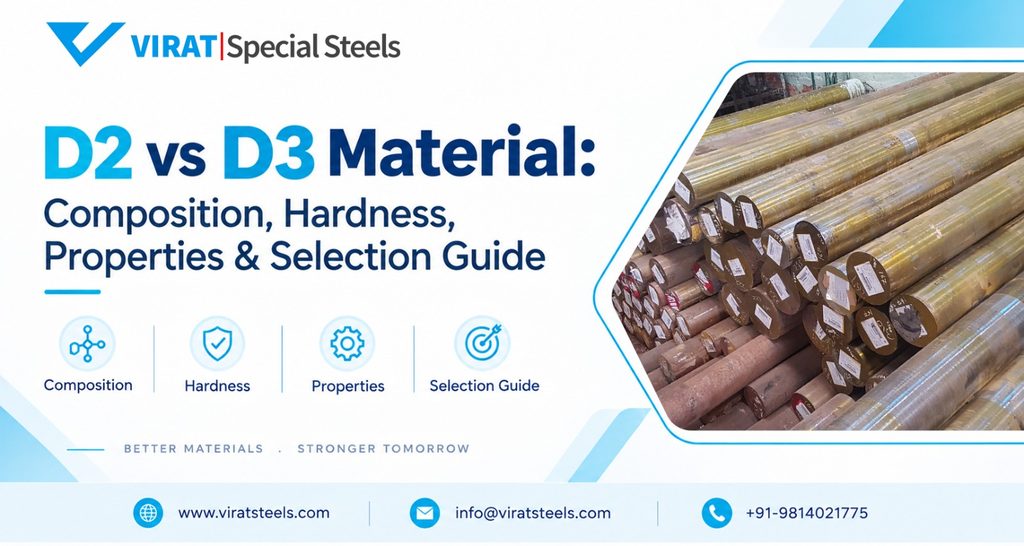
If you manufacture dies, punches, molds or precision tooling, you may need to choose between D2 vs D3 material. Both are high-carbon, high-chromium cold-work tool steels, but their chemical composition, carbide structure, heat-treatment response, toughness, machinability and wear resistance differ.
D2 material contains molybdenum and vanadium and provides a good balance of wear resistance, toughness and dimensional stability. D3 material has higher carbon and carbide content and is generally considered for applications where high abrasion resistance is required and impact loading is relatively low.
In this guide, we compare D2 vs D3 material in terms of chemical composition, hardness, properties, machinability, applications, cost considerations and grade equivalents to help you understand the factors involved in selecting between the two grades.
What Is D2 Material?
D2 material is a type of air-hardening cold work tool steel that has a high carbon content and high chromium content. It is used in making die and punch tools. It has good dimensional stability in heat treatment and excellent wear resistance. It is sometimes called a “semi-stainless” steel because of its relatively high chromium content.
D2 Steel is popular in many industries, from metal stamping and forming to knife making. It offers a good balance of hardness, edge retention and reasonable toughness.
D2 Chemical Composition
Based on Virat Steels’ own AISI D2 technical data, the typical D2 steel chemical composition is:
| Element | Typical % (D2 material composition) |
| Carbon (C) | 1.40 – 1.60% |
| Chromium (Cr) | 11.00 – 13.00% |
| Molybdenum (Mo) | 0.70 – 1.20% |
| Vanadium (V) | 0.50 – 1.10% |
| Manganese (Mn) | 0.10 – 0.60% |
| Silicon (Si) | 0.10 – 0.60% |
| Iron (Fe) | Balance |
D2 has high carbon and chromium content, which results in large volumes of hard carbides being formed, contributing to its excellent abrasion resistance. Vanadium refines the primary grain structure and forms strong carbides which increase wear resistance, edge holding and high temperature strength. Molybdenum increases the hardenability in conjunction with other alloying elements. This Mo + V combo is the big metallurgy difference from D3, and why D2 generally holds a sharper edge longer.
D2 Material Hardness in HRC
This is one of the most searched questions about the grade, so let’s separate the two conditions clearly:
- D2 material hardness in HRC before heat treatment (annealed/as-supplied condition): D2 comes in a soft condition for ease of machining. D2 in the annealed condition is normally 217-255 HB (Brinell) – which is approximately equivalent to low to mid 20’s on the HRC scale, but Brinell is the standard way this soft condition is actually measured and reported.
- D2 hardness after heat treatment (hardened & tempered): D2 hardness after hardening is 58-62 HRC with a tensile strength of approximately 1,900 MPa and a compressive strength of more than 2,700 MPa. Some suppliers quote a maximum hardness closer to 62 HRC.
Thus, if one asks for “d2 hrc” or “d2 hardness in hrc” without mentioning the state of the material, then the correct response would be that “it depends on whether you are referring to the ‘as supplied’ state (which is soft and machinable) or ‘post heat treatment’ state (which is hard).”
D2 Properties & Applications
D2 grade steel is known for:
- High abrasion and wear resistance
- Good dimensional stability during hardening (it’s air-hardening, so distortion is minimal).
- Mo/V carbides offer good edge retention
- Semi-stainless behavior in dry environment (mild corrosion resistance)
- Toughness is relatively lower than shock-resisting grades such as S7
Typical applications:blanking and piercing dies, forming dies, thread rolling dies, punches, shear blades, slitter knives, cold extrusion tooling and wear-critical mold components such as guide pins, wear plates and cavity inserts where abrasion – not impact – is the dominant failure mode.
What Is D3 Material?
D3 grade material (AISI/ASTM D3) is another form of high-carbon and high-chromium cold-work tool steel, but it has completely distinct characteristics when it comes to its quenching process. One of the differences of D3 material from other D-series steels lies in the fact that it does not contain 1% of molybdenum. D3 is oil-quenched instead of air-hardened, but small sections can be vacuum/gas-quenched. This oil-hardening route makes tools made from D3 more susceptible to brittleness during the hardening. Internationally, D3 is equivalent to DIN/Werkstoff 1.2080 (X210Cr12) – also known as SKD1 in Japan and Cr12 in China.
D3 Chemical Composition
| Element | Typical % (D3 material composition) |
| Carbon (C) | ~1.90 – 2.20%* |
| Chromium (Cr) | ~11.00 – 13.50%* |
| Manganese (Mn) | ≤ 0.60% |
| Silicon (Si) | ≤ 0.60% |
| Molybdenum / Vanadium | Not a defining addition (unlike D2) |
| Iron (Fe) | Balance |
D3 has a higher carbon content and about the same chromium content as D2, but without the Mo/V additions . This results in a larger volume of primary chromium carbides . That’s the main reason, D3 usually beats D2 on raw abrasion resistance at the expense of toughness.
D3 Material Hardness in HRC
D3 can be heat treated to 58-64 HRC hardness. This is supported by many independent technical data sources for the grade. Like D2, the material hardness of D3 in HRC is highly dependent on the tempering temperature chosen and the section thickness being hardened — for a given tool, verify the target hardness with your heat treatment partner before nailing down the process route.
In the annealed/as supplied condition D3 is also kept soft for machining, generally in line with the rest of the D-series family, but exact annealed hardness should be verified on the supplier’s certificate rather than assumed.
D3 Properties & Applications
- Superior wear and abrasion resistance – Usually rated better than D2 because of increased carbide volume
- Excellent dimensional stability in heat treatment, size retention almost as good as air hardening types such as D2
- High compression strength
- It is less tough than D2 and more prone to chip when subjected to shock or impact loading
- Due to its abrasion resistance, machining should generally be restricted to finish grinding after hardening
Typical applications: forming rolls, drawing dies, powder compaction tooling and lamination dies as well as blanking dies, punches, shear blades, gages and thread rolling dies. Basically high volume, low shock, high abrasion tooling.
D2 vs D3 Material: Key Differences
| Parameter | D2 Material | D3 Material |
| Standard / Equivalent | AISI D2, DIN 1.2379 | AISI D3, DIN 1.2080 |
| Hardening method | Air-hardening | Oil-hardening (air/vacuum for small sections) |
| Carbon content | 1.40–1.60% | ~1.90–2.20%* |
| Chromium content | 11.00–13.00% | ~11.00–13.50%* |
| Mo / V alloying | Present (0.7–1.2% Mo, 0.5–1.1% V) | Not a defining addition |
| Annealed hardness | ~217–255 HB | Similar soft range (verify per MTC) |
| Hardened hardness | 58–62 HRC | 58–64 HRC |
| Wear resistance | Very good | Excellent (typically higher than D2) |
| Toughness | Better of the two | Lower — more brittle |
| Dimensional stability | Excellent | Good, slightly more distortion risk |
| Machinability | Low | Lower than D2 |
| Corrosion resistance | Mild (semi-stainless behaviour) | Similar chromium level, comparable behaviour |
| Best suited for | Long-run dies, punches, wear parts needing edge retention | High-abrasion, low-impact forming/drawing tooling |
| Relative cost | Generally carries an alloy premium (Mo + V) | Often positioned as the more economical D-series option |
*See composition notes above — verify exact figures with your supplier’s mill certificate.
Machinability: D2 vs D3
Both grades have their reputation as “difficult but worth it” in machinability. D2 has a machinability of about 27% of AISI 1112 steel. This is poor compared to general engineering steels, but typical for high performance tool steels of this class.
D3 is generally considered more difficult to machine than D2, because of its higher carbon content and greater volume of carbides. In practice many fabricators machine D3 in the annealed condition and then rely mainly on grinding to bring it to the hardened state, rather than attempting conventional cutting once the hardness is achieved.
Practical takeaway: D2 is the more forgiving option if you have a lot of machining to do after heat treat. If the bulk of the shaping is done before hardening (with finish grinding done after), the lower machinability of D3 is less of a concern.
Which Industries Use D2 and D3?
The two grades cater to different, though similar, parts of the tool and die market segment:
- Tool & die manufacturing: Blanker, piercer and former dies ( grades D2 and D3)
- Mould manufacturing / injection moulding: Wear plates, guide pins, ejector parts and mold cavities exposed to abrasive plastic or filler material (grade D2 where toughness and machinability are important in addition to wear resistance)
- Metal stamping & press tooling: Long run punches and dies (grade D2 for edge wear; grade D3 for abrasion resistance only)
- Wire and thread rolling: thread rolling dies (both grades)
- Sheet metal forming: forming rolls and drawing dies (D3’s strength)
- Powder metallurgy & compaction tooling: compaction dies (D3)
D2 vs D3: Price Considerations
Pricing is specific to section size, quantity, prevailing raw material and alloy surcharge rates, and finishing requirements (rolled, forged, ground, ESR, etc.). We will not give a fixed figure here as this would quickly become outdated and is order dependent.
For example, in general terms: The inclusion of molybdenum and vanadium in D2 usually makes it a slightly more expensive alloy choice than the D3 alloy, which mostly uses carbon and chromium for its composition. For that reason, the D3 alloy can be marketed as the relatively cheaper high-chromium cold work alloy, while D2 comes at a higher cost due to its superior toughness and machinability properties. A quotation request can be made from the manufacturer regarding your required quantity.
How to Choose Between D2 vs D3 Material?
Use these questions to guide the decision:
- Is toughness or pure wear resistance more critical? If your tool sees any shock loading, impact, or lateral force, lean toward D2 (or reconsider A2/S7 for high-shock jobs). If it’s a steady, high-volume abrasive wear situation with minimal impact, D3’s extra hardness pays off.
- How much post-hardening machining is required? If your design needs precision machining after heat treatment, D2’s better machinability makes it the safer choice.
- What’s your quenching setup? D2’s air-hardening gives more forgiving dimensional control for complex geometries; D3’s oil-hardening needs more careful process control, especially on larger sections.
- What’s the production volume and expected tool life target? For very long die life with less concern about impact, D3’s superior abrasion resistance can extend service intervals.
- What’s the budget? If cost-per-kg is a tight constraint and the application doesn’t demand D2’s toughness, D3 is usually the more economical route.
- Does the component need any corrosion resistance in service? Both offer mild, comparable resistance — neither is a substitute for stainless grades in wet/corrosive environments.
If you’re unsure after weighing these factors, share your drawing and application details with Virat Steels’ technical team — grade selection is easier with a specific load case in front of you rather than generic comparisons.
FAQs: D2 vs D3 Material
- What is the difference between D2 and D3 material? D2 and D3 differ in composition and hardening method: D2 contains added molybdenum and vanadium and is air-hardened, while D3 has higher carbon content, no defining Mo/V addition, and is oil-hardened.
- What is D2 material? D2 Steel is an air hardening tool steel that consists of high carbon and chromium content (AISI D2 / DIN 1.2379).
- What is D2 material’s chemical composition? composition is 1.40–1.60% carbon, 11.00–13.00% chromium, 0.70–1.20% molybdenum, 0.50–1.10% vanadium, plus manganese and silicon in the 0.10–0.60% range.
- What is D2 material hardness in HRC? The D2 material usually attains 58-62 HRC after heat treatment. When it is annealed (or before heat treatment), it is provided in the softer form, which is around 217-255 HB.
- What is D2 material hardness in HRC before heat treatment? D2 material is provided in the soft or annealed state before heat treatment, and hence it is not provided in HRC but is provided in Brinell hardness scale (i.e., roughly 217-255 HB).
- What is D3 material’s hardness in HRC? The hardness of the D3 material in HRC ranges from 58-64 HRC after heat treatment.
- Is D2 or D3 harder? D3 has a slightly higher maximum hardness, up to about 64 HRC, compared to D2’s maximum of around 62 HRC, due to its higher carbon content and carbide volume.
- Which is tougher, D2 or D3? D2 is tougher due to fine, balanced carbide formation, while D3’s higher carbon content makes it less tough.
- Can D2 and D3 be used interchangeably? No. Although D2 and D3 have similar properties, there are differences that make D3 inadequate in certain applications where D2 works fine and vice versa.
- Which is better for injection moulds — D2 or D3? D2 can be used for wear-resistant mould components such as guide parts, wear plates and selected inserts, where good wear resistance, dimensional stability and machinability are required. D3 is generally more suitable for applications where very high abrasion resistance is the primary requirement and impact loading is low. The appropriate grade depends on the mould material, filler content, loading conditions, required hardness and manufacturing process. .
- What is D2 material grade used for? D2 grade is suitable for blanking and piercing dies, forming dies, thread rolling dies, punches, shear blades, and wear-related mold inserts..
- Is D2 a stainless steel? No, it is not stainless steel as it contains sufficient chromium content to resist corrosion in dry environments (also known as “semi-stainless”).
- Why is D3 harder to machine than D2? The carbon content in D3 is higher, and the volume of primary chromium carbides in D3 is higher than that of D2, making it more abrasive but at the same time leading to faster wear of the cutting tools during machining.
- What is the price difference between D2 and D3? The price of D2 is slightly higher than that of D3 since D2 contains molybdenum and vanadium. However, the actual price is dependent on the section size, volume and market prices.
- What are the DIN/international equivalents of D2 and D3? D2 is equivalent to DIN/Werkstoff 1.2379 (X153CrMoV12). D3 is equivalent to DIN/Werkstoff 1.2080 (X210Cr12), known as SKD1 (Japan) and Cr12 (China).
Conclusion
While both D2 and D3 have been confirmed as having high carbon and high chromium content cold work tool steel, it does not mean that they are one and the same only branded differently. The addition of molybdenum and vanadium in D2 makes it tougher and easier to machine, hence it is better used in dies, punches, and die elements. The increased carbon in D3 increases its wear resistance and hardness; however, it reduces toughness.
The right grade depends on your specific load conditions, production volume, and machining process — not a generic “which is better” answer.
Need help selecting between D2 and D3 for your next tooling project? Virat Steels supplies both grades with full mill test certification and technical support to match the right steel to your application. Get in touch with our team for a quote or a grade recommendation based on your drawing.
Our technical team will confirm grade equivalence, available sizes and delivery timeline within 24 hours.
Prefer to talk directly?
Gurugram, Haryana | Ludhiana, PunjabPhone: +91-98140-21775
Email: info@viratsteels.com
P20 vs P20+Ni Tool Steel: Properties, Comparison, Applications & Selection Guide
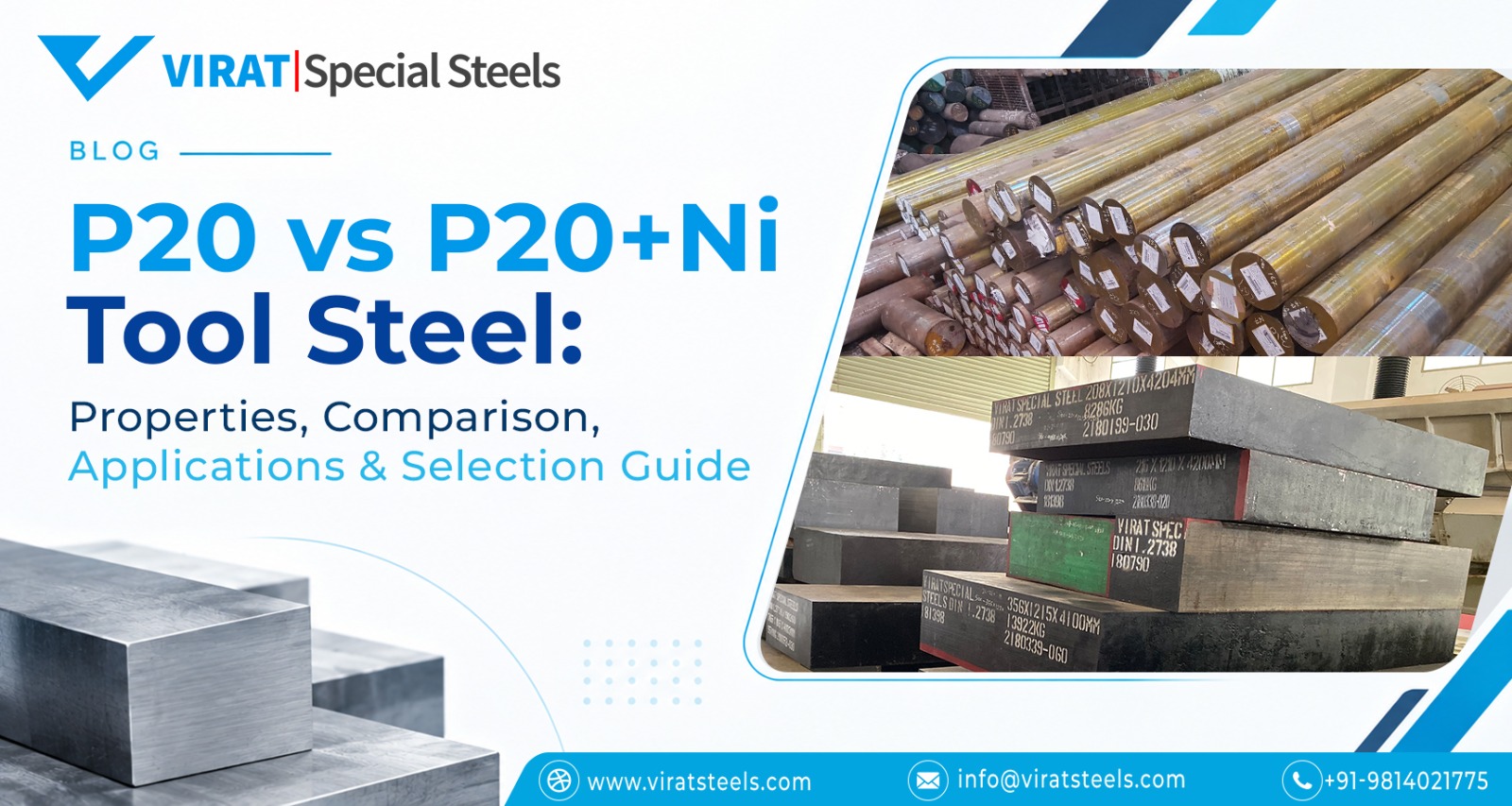
The choice of the correct mold steel directly influences machining time, surface finish, dimensional stability, mold life and total tooling cost. P20 vs P20+Ni tool steel are two of the most common choices for plastic injection molds and related tooling.
Both grades relate to plastic mold manufacturing, but are not interchangeable in all applications. P20 is usually chosen for its combination of machinability, toughness, polishability and cost. Nickel-alloyed P20 grades are often considered for larger sections which require more uniform through-hardening.
This guide will explain the differences between P20 vs P20+Ni tool steel their properties, applications, machinability and what mold makers and procurement teams should be looking for when ordering material.
Virat Steels is a leading supplier of tool and die steel to manufacturers of the plastic molding, die casting and precision tooling industries. The P20-family of steels are amongst the most requested grades. Let’s get into the nitty gritty.
What Is P20 Tool Steel?
P20 tool steel is a low alloy mold steel which is commonly used for plastic injection molds, mold bases, tooling components and some die applications.
In Europe the common designation is 1.2311 / 40CrMnMo7 but it is normally linked to AISI P20. For example, Industeel describes 1.2311 as a pre-hardened mold steel for plastic mold applications that is approximately equivalent to P20.
P20 is valued for offering a practical balance between:
- Good machinability
- Good toughness
- Good polishability
- Useful strength in the pre-hardened condition
- Suitable dimensional stability for mould manufacturing
- Good suitability for general-purpose plastic mould tooling
Depending on the producer and supply condition, P20 may be supplied annealed or pre-hardened. Therefore, the actual hardness and machinability should be confirmed against the supplier’s technical datasheet and material certificate.
What Is P20+Ni Tool Steel?
P20+Ni tool steel is a mold steel alloyed with nickel, developed to enhance through hardening properties relative to conventional P20 type grades.
One common designation is DIN 1.2738 / 40CrMnNiMo8-6-4. Nickel addition is especially helpful for a mold or die with a relatively large section in which a more consistent hardness from surface to core is desired.
P20+Ni is widely associated with applications requiring a combination of:
- Good toughness
- Good machinability
- Good polishability
- More uniform hardness in larger sections
- Good dimensional stability
- Reliable performance in plastic mould tooling
The actual performance will depend on the steelmaker, the manufacturing route, the section size and the heat-treatment condition; the mill certificate should always be quoted in the procurement specifications.
P20 Tool Steel Properties
The main attraction of P20 is its balanced performance rather than one extreme property.
1. Good machinability
P20 is usually supplied in a condition that is readily machinable by mold makers to produce cavities, cores, bases and other components. Its machinability is practical for complex mold geometries and general tool making.
2. Good polishability
Surface finish is critical in plastic injection moulding. A properly produced P20-grade steel can provide good polishability, making it suitable for mould surfaces where appearance and surface quality are important.
The final achievable finish, however, depends on steel cleanliness, homogeneity, heat treatment, machining practice and polishing technique.
3. Toughness
P20 offers a useful combination of strength and toughness for general mould applications. This makes it suitable when the mold has to withstand repeated clamping, injection and mechanical stresses without becoming too hard and brittle.
4. Pre-hardened availability
Many P20 products are supplied in a pre-hardened condition. This can reduce or eliminate the need for additional hardening before machining, depending on the required application and supplied condition.
For example, Industeel will specify its 1.2311 mold steel in a pre-hardened condition at around 280-325 HB, while other producers may specify different delivery conditions.
Confirm the actual hardness range with the supplier before machining or designing the mold.
P20+Ni Tool Steel Properties
P20+Ni has several practical features of P20 but has nickel added to raise hardenability.
1. Improved through-hardening
A key reason for choosing P20+Ni is that it provides more uniform hardness over larger sections.
This is particularly important for large mold blocks where a large difference between surface and core properties may have an impact on machining, dimensional stability or service performance.
2. Good toughness
P20+Ni has been developed to provide optimum hardness and toughness rather than just maximum hardness.
This makes it suitable for molds that are subject to repeated mechanical stresses and applications where cracking or premature failure would be costly.
3. Good polishability
P20+Ni grades are commonly selected for moulds requiring good surface finishing and polishing performance. Steel cleanliness and low sulphur practice can be particularly important when high-quality polished surfaces are required.
4. Good machinability
Despite its enhanced hardenability, P20+Ni is still used extensively for mould manufacturing because it provides a useful combination of machinability, toughness and polishability.
P20 vs P20+Ni tool steel: Quick Comparison Table
| Parameter | P20 Tool Steel | P20+Ni Tool Steel |
| Common designation | 1.2311 / P20* | 1.2738 / P20+Ni* |
| Steel type | Plastic mould steel | Nickel-alloyed plastic mould steel |
| Main advantage | Balanced performance and machinability | Improved through-hardening |
| Machinability | Good | Good |
| Toughness | Good | Good to very good, depending on grade/condition |
| Polishability | Good | Good to excellent, depending on quality |
| Large-section performance | Suitable, but section-dependent | Generally preferred for larger sections |
| Typical mould use | General plastic moulds and mould bases | Large/deeper moulds and demanding mould blocks |
| Supply condition | Often pre-hardened | Often supplied pre-hardened |
| Cost | Generally lower | Generally higher |
| Selection priority | General-purpose tooling | Large sections and more uniform core properties |
Exact grade equivalence and specifications should be verified against the applicable standard and mill certificate.
H13 vs P20 vs P20+Ni tool steel: How Does a Hot-Work Steel Compare?
P20 vs P20+Ni tool steel are both cold/warm-work mould steels. H13 (DIN 1.2344) belongs to a different family entirely — it’s a chromium-molybdenum-vanadium hot-work tool steel, built to hold its hardness under sustained heat rather than to machine and polish easily at room temperature. It’s included here because mould makers sometimes weigh it against the P20 family when a tool will see higher thermal or mechanical loading than a standard plastic mould.
Chemical Composition (wt %)
| Element | P20 (1.2311) | P20+Ni (1.2738) | H13 (1.2344) |
| Carbon (C) | 0.35 – 0.45 | 0.35 – 0.45 | 0.32 – 0.45 |
| Silicon (Si) | 0.20 – 0.40 | 0.20 – 0.40 | 0.80 – 1.25 |
| Manganese (Mn) | 1.30 – 1.60 | 1.30–1.60 | 0.20 – 0.60 |
| Phosphorus (P), max | 0.03 | 0.03 | 0.03 |
| Sulphur (S), max | 0.03 | 0.03 | 0.03 |
| Chromium (Cr) | 1.80 – 2.10 | 1.80 – 2.10 | 4.75 – 5.50 |
| Molybdenum (Mo) | 0.15 – 0.25 | 0.15 – 0.25 | 1.10 – 1.75 |
| Vanadium (V) | — | — | 0.80 – 1.20 |
| Nickel (Ni) | — | 0.90–1.20 | — |
H13‘s much higher chromium and the addition of vanadium and higher molybdenum are what separate it from the P20 family — those elements are what give it hot hardness and resistance to thermal fatigue, at the cost of some room-temperature machinability.
Property & Application Comparison
| Parameter | P20 | P20+Ni | H13 |
| Steel family | Cold/warm-work mould steel | Nickel-alloyed cold/warm-work mould steel | Hot-work tool steel |
| Typical supply hardness | 240–280 BHN (pre-hardened) | 280–320 HB (pre-hardened) | Annealed, or pre-hard ~460–500 BHN; hardened & tempered 45–52 HRC |
| Tensile strength | ~965–1030 MPa | ~850–1100 MPa | ~1550–2050 MPa |
| Key strength | Machinability, polishability, cost | Uniform through-hardening in large sections | Hot hardness, thermal fatigue resistance |
| Best suited to | General-purpose plastic moulds | Large/deep mould blocks needing uniform hardness | Die casting, extrusion dies, forging dies, hot-runner components |
| Operating temperature | Ambient/moderate | Ambient/moderate | High, with repeated heating/cooling cycles |
| Typical limitation | Not for high-temperature or high-wear service | Costs more than plain P20; still not a hot-work grade | Lower machinability/polishability than P20; higher material cost |
When to Choose H13 Over the P20 Family
Choose H13 when:
- The tool will see repeated heating and cooling cycles — aluminium or zinc die casting, hot forging dies, or extrusion tooling.
- Resistance to heat checking and thermal fatigue matters more than mirror polish.
- The mould or die runs at elevated temperature for extended periods, where P20 or P20+Ni would soften or lose dimensional stability over time.
Stay with P20 vs P20+Ni tool steel when:
- The tool is a plastic injection mould running at typical moulding temperatures, not a high-heat forming or casting die.
- Machinability, polishability and cost matter more than hot hardness.
- The section size and cavity finish requirements are the deciding factors rather than thermal cycling.
In short: P20 vs P20+Ni tool steel is a choice about section size and through-hardening within the same mould-steel family, while H13 is a different grade altogether — brought in when the application shifts from ambient-temperature plastic moulding to something that runs hot.
P20 Tool Steel Applications
P20 tool steel applications span a wide range of tooling and mould-making needs, including:
- Injection mould cavities and cores for plastic components
- Mould bases for plastic injection moulding tools
- Die-casting dies for lower-volume or less thermally demanding runs
- Blow moulding tools
- Extrusion tooling components
- Structural and holder blocks within larger tool assemblies
- Zinc die-casting dies (in some applications)
Because of its balance of machinability and moderate strength, P20 is often the “workhorse” grade specified when a mould doesn’t require the extreme wear resistance or hardness of tool steels like H13 or D2.
P20+Ni Tool Steel Applications
P20+Ni is typically specified for the same broad categories of tooling as P20, but where the design calls for something more demanding:
- Large injection mould cavity and core blocks, where uniform hardness through a thick section matters
- High-cavitation moulds requiring more consistent wear behavior across a large tool
- Moulds for engineering plastics that place higher mechanical demands on the tool steel
- Precision moulds where dimensional consistency across a large block is critical to part quality
- Die-casting and moulding applications needing slightly better toughness than standard P20 can offer
Machinability: P20 vs P20+Ni tool steel
For mould manufacturers, machinability is an important purchasing consideration because machining can represent a significant portion of mould manufacturing cost.
Both P20 vs P20+Ni tool steel are commonly selected because they can be machined effectively in suitable delivery conditions.
However, machining performance is not determined by the grade name alone.
It can be affected by:
- Actual hardness
- Steelmaking quality
- Inclusion content
- Section size
- Heat-treatment condition
- Cutting tool grade
- Cutting parameters
- Milling strategy
- Coolant or lubrication
- Required surface finish
For this reason, machining parameters should be established from the actual material condition and tooling manufacturer’s recommendations rather than relying only on a generic P20 cutting-speed chart.
How to Choose Between P20 vs P20+Ni tool steel?
The best choice depends on the mould design and production requirements.
Choose P20 when:
- The mould is small to medium-sized.
- General-purpose plastic moulding is involved.
- Good machinability is a priority.
- The application does not demand exceptional through-hardening.
- Initial material cost is an important consideration.
- A conventional pre-hardened mould steel is sufficient.
Choose P20+Ni when:
- The mould contains large or deep sections.
- More uniform hardness through the section is important.
- The mould design has demanding dimensional requirements.
- Toughness and polishability are important.
- The additional material cost is justified by the tooling requirements.
- You want a mould steel specifically selected for improved hardenability.
The decision should ultimately be based on the mould size, plastic material, production volume, required surface finish, machining method, hardness requirement and expected service conditions.
Advantages and Limitations
Advantages of P20
Advantages
- Good machinability
- Good toughness
- Good polishability
- Widely available
- Suitable for general mould manufacturing
- Often available pre-hardened
- Cost-effective for many applications
Limitations
- Not intended to be the best solution for every high-performance mould
- Through-hardening becomes more important as section size increases
- Wear and corrosion requirements may call for another grade
- Actual performance depends strongly on steel quality and condition
Advantages of P20+Ni
Advantages
- Improved hardenability
- Better suitability for larger sections
- Good toughness
- Good machinability
- Good polishability
- Suitable for demanding mould applications
Limitations
- Generally costs more than standard P20
- The benefits may not justify the additional cost for smaller, less demanding moulds
- Exact properties vary by producer and delivery condition
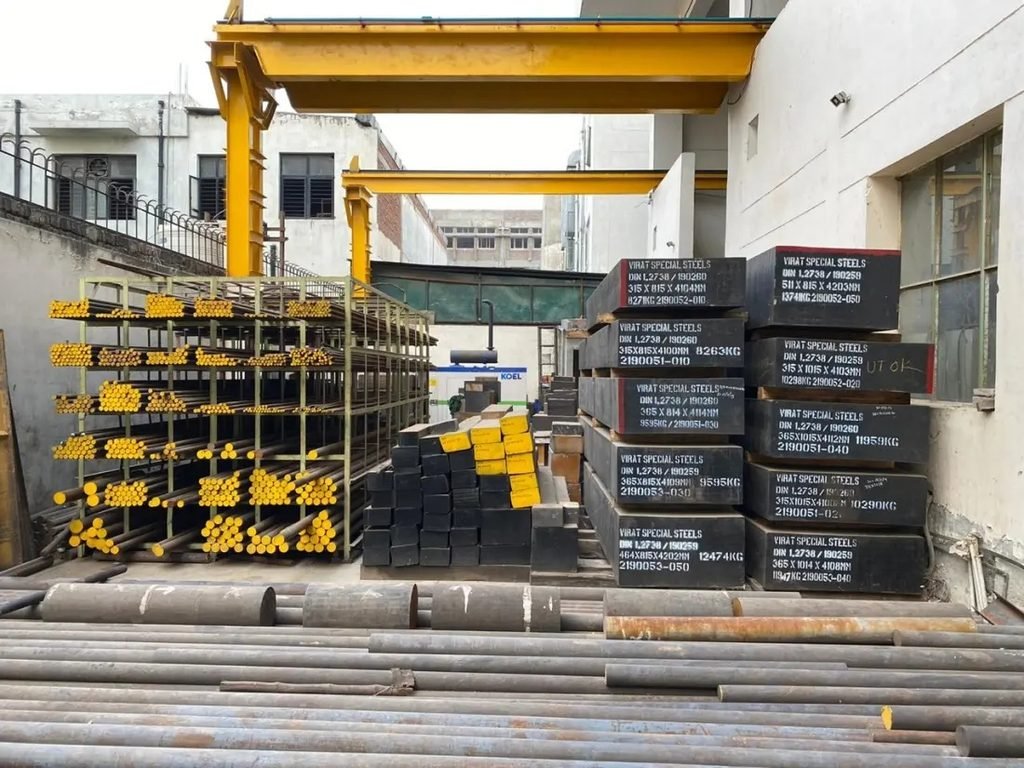
What Should Buyers Check Before Ordering P20 vs P20+Ni tool steel ?
Procurement teams should avoid specifying only “P20 steel” on a purchase order.
A stronger purchasing specification should identify:
- Exact grade designation (e.g., 1.2311 for P20, 1.2738 for P20+Ni)
- Applicable standard
- Required dimensions and section size — especially important for P20+Ni, where the block thickness directly affects through-hardening performance
- Delivery condition (annealed vs. pre-hardened)
- Required hardness range, including surface-to-core hardness uniformity for P20+Ni in larger sections
- Surface condition
- Ultrasonic testing requirements, if applicable
- Material test certificate requirements
- Chemical analysis requirements (nickel content confirmation for P20+Ni)
- Required cutting or machining tolerances
For example, ASTM A681 covers chemical, mechanical and physical requirements for wrought alloy tool-steel products and emphasizes that material selection is based on application, service conditions and properties desired. ISO 4957:2018 specifies requirements for various categories of wrought tool steels and is the current edition.
For P20+Ni specifically, buyers should also request a core hardness test report rather than relying only on surface hardness, since the primary reason to select this grade over standard P20 is uniform hardness through a large section.
Why Material Certification Matters
For critical moulds, the steel supplier should be able to provide appropriate documentation for the supplied material.
Depending on the project, buyers may request:
- Mill Test Certificate (MTC)
- Heat number
- Chemical analysis
- Hardness report
- Ultrasonic testing report
- Dimensional inspection
- Additional inspection documents where specified
The exact inspection requirements should be agreed before purchase.
This is especially important for large mould blocks, where internal quality and consistency can have a major effect on machining and mould performance.
P20 vs P20+Ni tool steel for Indian Mould Manufacturers
Indian mold makers serving the automotive, consumer goods, appliances, electronics, packaging and engineering industries often require steel that offers a combination of performance, availability, machining time and overall tooling cost.
This means that P20 is still a practical option for many general purpose tools, whilst P20+Ni may make more sense for larger and more demanding tooling.
The right material is not always the hardest or the most expensive steel. It is the grade that delivers the required performance without adding extraneous material and processing costs.
Our Supply Network Across India
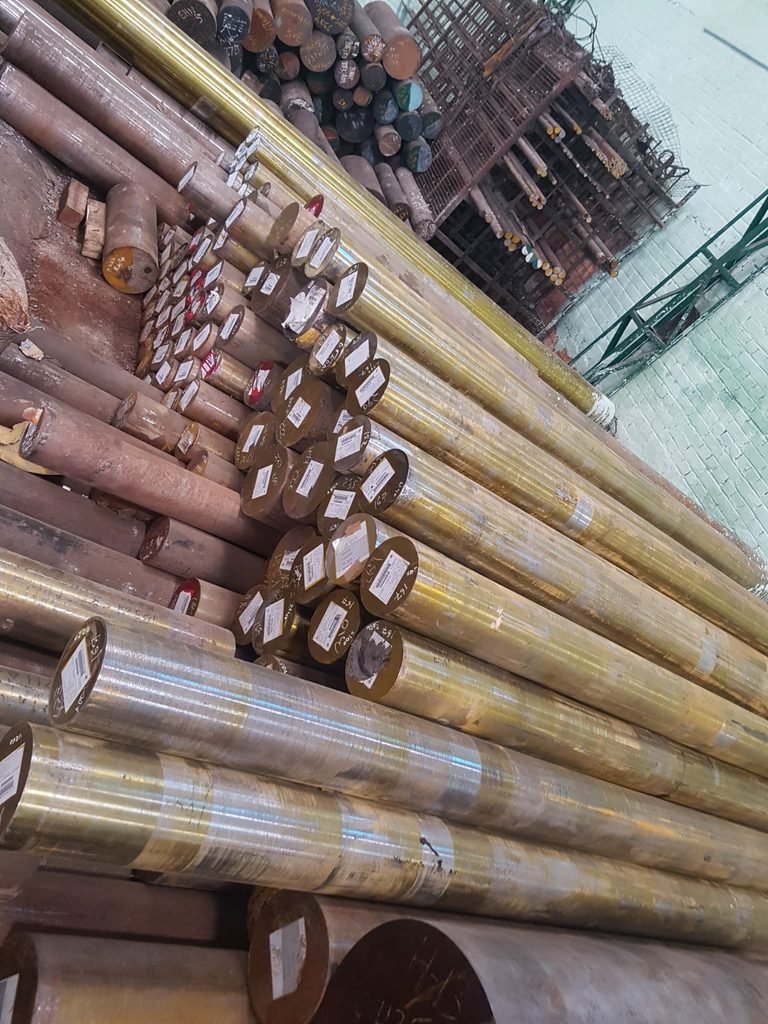
With dispatch centers in Gurugram and Ludhiana, we regularly serve mould makers and tool rooms across India, including Delhi, Gurugram, Faridabad, Noida, Ghaziabad, Jaipur, Agra, Ahmedabad, Vadodara, Surat, Rajkot, Mumbai, Pune, Nashik, Indore, Bhopal, Rudrapur, Hyderabad, Kolkata, Belgaum, Chennai, Coimbatore, Hyderabad, Faridabad, Manesar, Bhiwadi,Ludhiana, Chandigarh, Haryana, Punjab and Jamshedpur.
We can offer our P20 vs P20+Ni tool steel in standard or custom sizes, cut to size material, annealed or heat treated condition and material test certificates (MTC) as required. This supply network caters to mold makers, tool rooms, automotive component manufacturers, plastic injection molders and other engineering industries throughout India.
Conclusion
P20 vs P20+Ni tool steel are both valuable choices for mould manufacturing, but they serve slightly different priorities.
P20 tool steel is a practical, versatile choice for many general-purpose plastic moulds because of its machinability, toughness and polishability. P20+Ni becomes particularly attractive when the mould is larger or deeper and more uniform through-hardening is required.
Before purchasing, always verify the exact grade, standard, hardness, section size, delivery condition and material certification rather than selecting steel based only on the commercial name “P20.”
Looking for P20 or P20+Ni Tool Steel in India?
Virat Special Steels supplies tool and mould steels for mould manufacturers, tool rooms, engineering companies and industrial buyers. P20 and P20+Ni can be supplied in suitable forms and sizes subject to grade and stock availability, with cutting and technical support for industrial requirements.
Our technical team will confirm grade equivalence, available sizes and delivery timeline within 24 hours.
Prefer to talk directly?
Gurugram, Haryana | Ludhiana, Punjab
Phone: +91-98140-21775
Email: info@viratsteels.com
Ask the Virat Steels team to verify the required grade, dimensions, hardness, testing and MTC requirements before placing your order.
Frequently Asked Questions
1. What is P20 tool steel?
P20 tool steel is a mould and tool steel commonly used for plastic injection moulds, mould bases, cavities, cores and related tooling. A commonly referenced grade is 1.2311.
2. What is P20+Ni tool steel?
P20+Ni is a nickel-alloyed mould steel, commonly associated with 1.2738, designed to provide improved through-hardening compared with conventional P20-type grades.
3. What is the difference between P20 vs P20+Ni Tool Steel ?
The main difference is the alloy design. P20+Ni contains nickel and is generally selected where improved hardenability and more uniform properties through larger sections are important.
4. Is P20 good for plastic injection moulds?
Yes. P20 is widely used for plastic injection moulds because of its balance of machinability, toughness, polishability and strength.
5. Is P20+Ni better than P20?
Not automatically. P20+Ni can be a better choice for large mould blocks or applications where through-hardening is important. Standard P20 can be more economical for general-purpose tooling.
6. Is P20 supplied pre-hardened?
Many P20 products are available in pre-hardened conditions, but the exact hardness depends on the supplier and product specification. Always confirm the delivery condition before ordering.
7. Can P20 be polished?
Yes. P20 is commonly used for mould applications requiring good polishing performance. Final surface quality also depends on steel cleanliness, machining and polishing practices.
8. Is P20 easy to machine?
P20 is generally considered machinable in appropriate delivery conditions. Actual machining performance depends on hardness, steel quality, cutting tools and machining parameters.
9. What is P20+Ni used for?
P20+Ni is commonly used for large plastic injection moulds, mould blocks, deep cavities and tooling where improved through-hardening and uniform properties are important.
10. Is 1.2311 the same as P20?
1.2311 is commonly associated with P20 and is often marketed as a P20 equivalent. However, buyers should verify the exact standard and chemical/mechanical requirements rather than assuming that every P20-labelled product is identical.
11. Is 1.2738 the same as P20+Ni?
1.2738 is a commonly referenced P20+Ni grade. The exact specification should be confirmed from the producer’s technical documentation and material certificate.
12. Which is better for large moulds: P20+Ni Tool Steel ?
P20+Ni is often preferred for larger sections because its nickel-alloyed composition provides improved through-hardening. The final selection should consider the actual mould dimensions and required hardness profile.
13. Can P20 be used for die casting?
P20 can be used for selected tooling and die applications, but it should not automatically be selected for demanding high-temperature die-casting applications. The operating temperature, thermal cycling, wear and required tool life should be evaluated first.
14. How do I specify P20 steel when buying?
Specify the exact grade, standard, dimensions, delivery condition, hardness requirement and inspection/documentation requirements. For critical applications, request the applicable MTC and testing documentation.
15. Where can I buy P20 vs P20+Ni Tool Steel in India?
Industrial buyers can source P20 and P20+Ni from specialised tool-steel suppliers such as Virat Special Steels, subject to available grade, size, mill and delivery condition.
Lucchini DB6 Tool Steel (DIN 1.2714): Complete Guide to Grades, Properties & Applications in India
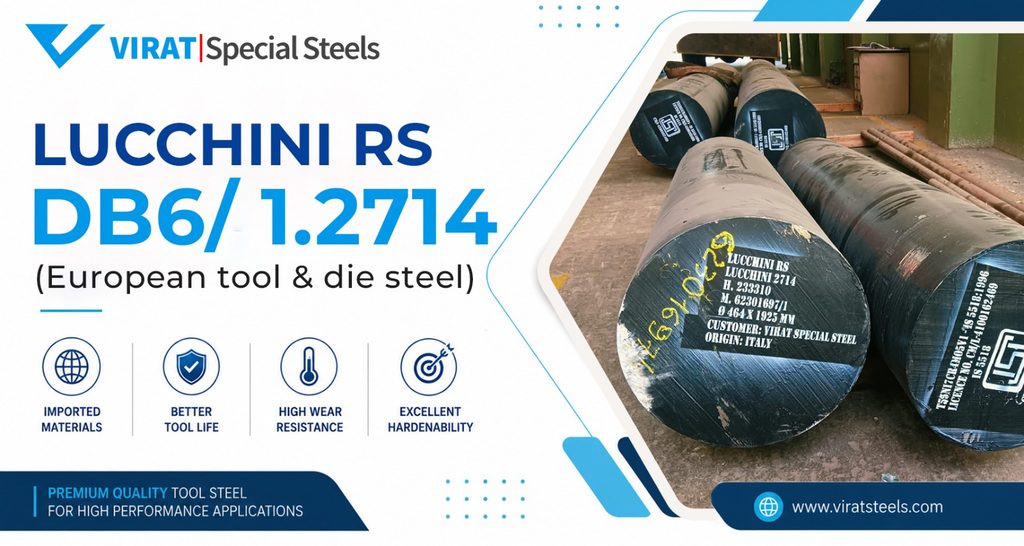
The choice of the appropriate tool steel involves a compromise between hardness, wear resistance, impact toughness, thermal fatigue resistance and the general tool life. While generic steel grades are common, specialized imported tool steels are vital for demanding applications such as hot work, forging and cold stamping.
Lucchini Italy is the international reference for ultra-clean tool steels with high durability. Complete guide on technical properties, international & IS standards, manufacturing processes, detailed grade comparison and procurement of tool steel in India.
What is Lucchini DB6 Tool Steel?
Lucchini DB6 is a low-alloy steel for hot work and impact tools. High Nickel content (1.50″–” 1.80%) formulated and secondary metallurgical refined (EAF->LF->Vacuum Degassing->ESR) This process provides structural purity and minimum non-metallic inclusions with uniform hardenability from core to surface.
Material Standards & Cross-Reference
- DIN / EN Standard: DIN 1.2714 / EN ISO 4957 (56NiCrMoV7)
- AISI Standard: AISI L6 (Modified)
- JIS Standard: SKT4
- IS Standard (India): T55Ni7Cr4Mo5V1 equivalent
Mechanical and Physical Properties
| Property | Value / Specification | Remarks |
| Toughness | Excellent | Resists cracking under heavy shock |
| Impact Resistance | High | Critical for hammer and forging dies |
| Wear Resistance | Good to moderate | Suitable for high-impact hot work |
| Hardenability | Good | Provides consistent through-hardening |
| Dimensional Stability | Good | Maintains shape during thermal cycles |
| Large Section Performance | Excellent | Ideal for heavy forging die blocks |
Same Chemistry on Paper, a Different Story on the Ground
On a certificate, Lucchini DB6 Tool steel and local DB6 tool steels can look almost identical — both fall within the same DIN 1.2714 tool steels chemical window. The real difference shows up upstream of the numbers, in how tightly that chemistry is held, batch after batch, and how clean the steel is once it’s melted and forged.
| Element | Lucchini DB6 / 1.2714 (%) DOCX | Standard Local 1.2714 (%) DOCX | Metallurgical Function DOCX |
| Carbon (C) | 0.50 – 0.60 | 0.50 – 0.60 | Controls baseline hardness and yield strength. |
| Silicon (Si) | 0.10 – 0.40 | 0.10 – 0.40 | Increases oxidation resistance and strength. |
| Manganese (Mn) | 0.60 – 0.95 | 0.60 – 0.95 | Enhances deep hardenability. |
| Chromium (Cr) | 0.80 – 1.20 | 0.80 – 1.20 | Enhances wear resistance and hardenability. |
| Molybdenum (Mo) | 0.35 – 0.55 | 0.35 – 0.55 | Retains high-temperature yield strength. |
| Nickel (Ni) | 1.50 – 1.80 | 1.50 – 1.80 | Primary driver for extreme impact toughness. |
| Vanadium (V) | 0.07 – 0.15 | 0.05 – 0.15 | Refines grain structure and carbide formation. |
| Phosphorus (P) | max 0.015 | max 0.030 | Kept low to prevent cold shortness/brittleness. |
| Sulfur (S) | max 0.010 | max 0.030 | Kept low to preserve steel cleanliness and fatigue life. |
Key takeaway: nominal composition alone doesn’t separate premium DB6 from ordinary DB6 tool steels. What matters far more is the consistency of chemistry control, steel cleanliness, and manufacturing discipline behind that certificate — and that is precisely where an established European mill like Lucchini has a structural advantage over less consistent local supply.
Manufacturing & Heat Treatment Parameters
- Soft Annealing: Heated to 680–720°C, slowly furnace cooled. Delivered (annealed) Hardness: max 229–248 HB (≈ 22–24 HRC)
- Stress Relieving: 600–650°C, following rough machining, then air cooled slowly.
- Hardening (Quenching): Austenitized at 840–870°C, quenched in oil or vacuum pressure gas.
- Double Tempering: Reheated to 540–600°C (minimum 2 cycles) to stabilize dimensions and relieve retained austenite.
Recommended Working Hardness by Application
| Application | Target Hardness |
| Drop Hammer Dies & Heavy Impact Tooling | 38 – 42 HRC |
| Press Forging Dies & Inserts | 44 – 48 HRC |
| Hot Shear Blades & Trimming Tools | 48 – 52 HRC |
NOTE: Lower hardness (38-42 HRC) is more shock and impact resistant; higher hardness (48-52 HRC) is more wear resistant and holds a sharper edge. Choose based on whether you experience more impact load or more abrasive wear in your tooling.
Comparison Table: Lucchini DB6 Tool Steel vs. Local Indian DB6 Tool Steel
| Parameter / Feature | Lucchini Italy DB6 Steel (DIN 1.2714) | Local Indian DB6 Tool Steel | Practical / Industrial Impact |
| Manufacturing & Melting Route | Electric Arc Furnace (EAF) + Ladle Furnace (LF) + Vacuum Degassing (VD) / ESR option | Standard EAF or Induction Furnace melting | Superior steel cleanliness, lower gas content, and higher purity in Lucchini steel. |
| Forging Reduction Ratio | Multi-directional 3D forging (Min. 4:1 upsetting ratio) | Standard 2D forging or conventional rolling | Higher structural integrity and better grain flow alignment. |
| Microstructural Uniformity | Extremely high and consistent throughout the block | May vary across core to surface | Predictable machining, heat treatment, and die performance. |
| Purity & Inclusion Levels | Strictly controlled Sulfur (≤ 0.030%) & Phosphorus (≤ 0.030%) | Controlled to basic standards (0.035%) | Lower inclusion levels directly improve fatigue life and crack resistance. |
| Impact Toughness | Outstanding and uniform (20–25 J/cm²) | Moderate to high (can vary by batch) | Higher crack resistance under extreme hammer shock loads. |
| Through-Hardening (Large Blocks) | Uniform hardness even in large sections (400 mm) | Depends on forging quality and section size | Prevents soft core issues in massive die blocks. |
| Heat Treatment Response | Highly predictable and repeatable across batches | May vary slightly between batches | Minimal distortion risk and consistent target HRC achievement. |
| Thermal Fatigue Resistance | Superior resistance to heat checking | Application dependent | Withstands repeated heating/cooling cycles longer during hot forging. |
| Impact Toughness | Up to 30% – 40% increase in production cycles | Baseline standard die life | Significantly reduces shop floor downtime and tooling replacement costs. |
| Quality Documentation | 100% EN 10204 3.1 MTC with SEP 1921 Class D/d UT certification | Standard MTC and basic UT reporting | Complete global batch traceability and defect-free guarantee. |
| Initial Material Cost | Premium / Higher investment | Cost-effective / Lower initial price | Higher initial cost of Lucchini steel is offset by lower tooling cost-per-component. |
Key Advantages of Lucchini DB6 tool steel (DIN 1.2714)
- Extreme Impact Toughness: High nickel (1.50–1.80%) prevents cracking under heavy drop-hammer shock loading.
- In demanding forging applications, premium-quality DB6 with controlled metallurgy, cleanliness and appropriate heat treatment can help improve die reliability and service life compared with lower-quality material.
- Deep Through-Hardening: Delivers uniform core-to-surface hardness in large blocks (400 mm).
- Thermal Fatigue Resistance: Withstands heat checking from repeated heating and cooling cycles.
- High Metallurgical Cleanliness: Low sulfur and phosphorus reduce inclusions and enhance fatigue strength.
- Perfect Quality Assurance: Certified by 100% Ultrasonic Testing (UT) and EN 10204 3.1 Mill Test Certificates. Available Sizes of DB6 Tool Steel
Virat Special Steels supplies Lucchini DB6 Tool Steel in a wide range of standard and custom sizes to meet the requirements of die makers, tool rooms, automotive, engineering, and precision manufacturing industries.
Custom Processing Services
To minimize machining time and material wastage, we also offer:
- Precision cut-to-size material
- Bandsaw cutting
- Surface machining (on request)
- Bulk supply with batch-wise traceability
- Material Test Certificate (MTC) and EN 10204 3.1 certification (where applicable)
Case Study: DB6 Increases Die Life by 40%
Customer Challenge
A drop-forging plant for automotive components experienced premature die cracking of crankshaft forging dies made from standard hot work steels leading to expensive downtime.
Solution
The tooling was upgraded to DB6 (DIN 1.2714) supplied by Virat Special Steels, vacuum heat treated and double tempered to an optimized 46-48 HRC.
Results
40% increased die service life Eliminate catastrophic die cracking in high energy impact Lower maintenance and machine downtime Forged at a lower cost per part
Certifications Available
Reputable suppliers typically provide:
- Mill Test Certificate (MTC)
- Ultrasonic Tested Material
- Hardness Test Report
- Chemical Test Report
Buyer’s Guide: Selecting the Appropriate DB6 Tool Steel
Some important points to consider before buying DB6 Tool Steel (DIN 1.2714) to get the best out of your application:
1. Choose the Right Hardness
Pick the hardness for your application:
- 38-42 HRC – Greater toughness and impact resistance
- 50-56 HRC – Increased wear resistance and extended tool life
2. Choose the required form of material
DB6 Tool Steel is supplied in:
- Forged and Rolled blocks
- Round and Flat Bars
- ESR and Non ESR Blocks
3. Material Quality Inspection
Always ask for:
- Mill Test Certificate (MTC) Ultrasonic Tested Material
- Material Traceability Spectro Tested Material
4. Match the App
Select DB6, depending on your tooling needs, such as:
- Forging Dies
- Hammer Dies
- Extrusion
- Holders for
- Casting Dies
5. Select a Trusted Supplier
Join hands with a supplier who can support with ready stock, custom machining, technical support and PAN India delivery for consistent quality and timely supply.
Why Choose Virat Special Steels for Lucchini DB6?
Virat Special Steels is a trusted supplier of imported tool steels to forging, die-making, automotive, engineering and manufacturing industries across India. With over 70 years of experience in special and tool steels, we provide quality-assured material, trusted sourcing, technical support and application-driven solutions.
Imported Lucchini DB6 Tool Steel We supply Lucchini DB6 Tool Steel (DIN 1.2714) for applications where high toughness, impact resistance, hardenability, and reliable tooling performance are required, with relevant mill documentation and material traceability subject to the specific product and supply condition.
Ready Stock Availability Our ready-stock inventory helps customers reduce procurement lead times and maintain production schedules. DB6 material can be supplied in different forms and sizes depending on availability and project requirements.
DB6 Round Bars & Flat Bars We supply DB6 round bars and flat bars in standard and customized dimensions — diameter, thickness, width, and length — subject to stock availability.
Forged DB6 Blocks For heavy-duty tooling and die applications, we offer forged DB6 blocks in suitable dimensions for machining large dies, die inserts, and other industrial tooling components.
Cut-to-Size Services DB6 Tool Steel can be supplied in cut-to-size dimensions according to customer requirements, helping reduce material wastage and bring material closer to final machining dimensions.
Machining Services Where required, we provide machining and material preparation services for DB6 Tool Steel, reducing in-house preparation time before the material moves to further tooling operations.
UT-Tested Material For applications where internal material quality is critical, Ultrasonic Testing (UT) can be provided according to applicable inspection requirements, helping identify internal discontinuities and support quality verification.
Mill Test Certificate (MTC) DB6 Tool Steel can be supplied with a Mill Test Certificate where applicable, covering heat/lot identification, chemical composition, mechanical properties, and other specified inspection results.
Spectro & Chemical Verification Spectro/chemical verification can be carried out where applicable to support material identification and chemistry verification — customers can discuss specific testing and certification requirements with our technical team before ordering.
PAN India Delivery Our logistics network supports PAN India delivery for forging companies, die makers, tool rooms, automotive manufacturers, engineering companies, and other industrial users.
Technical Support Choosing the right DB6 material involves more than selecting a grade. Our technical team can assist with grade selection, material form, dimensions, hardness requirements, heat-treatment considerations, testing requirements, and application suitability.
Whether you require Lucchini DB6 round bars, flat bars, forged blocks, cut-to-size material, or machined components, Virat Special Steels can help you source the appropriate material for your application.
Our Supply Network Across India
Virat Steels is one of the leading suppliers of DB6 Tool Steel (DIN 1.2714) to the manufacturers in the major industrial hubs of India like Ahmedabad, Rajkot, Pune, Nashik, Aurangabad, Kolhapur, Belgaum, Chennai, Coimbatore, Hosur,Bengaluru, Hyderabad, Faridabad, Manesar, Bhiwadi, Gurugram, Delhi NCR, Ludhiana, Chandigarh, Haryana, Punjab and Jamshedpur.
Our strong logistics network, ready stock and technical knowledge enable us to provide fast PAN India delivery to forging companies, die makers, tool rooms, plastic mould manufacturers, die casting industries and heavy engineering businesses.
Conclusion
The right tool steel choice directly affects the tooling cost per component, production downtime, and product quality. For low volume applications standard die steels may be sufficient but major advantages are available for high duty forging and hammer die work with certified imported grades such as Lucchini DB6 (DIN 1.2714).
An experienced stockiest like Virat Special Steels offers manufacturers across India the facility of genuine imported DB6, ready stock, cut-to-size material and complete metallurgical documentation.
Need DB6 tool steel for your next project? Contact our technical team for availability, required sizes, testing documentation, and quotations.
Get a Quote for Lucchini DB6 Tool Steel
Looking for Lucchini DB6 Tool Steel (DIN 1.2714) or other hot work tool steel in India? Virat Special Steels supplies imported DB6 in round bars, flat bars, forged blocks, rolled blocks, and cut-to-size material, subject to stock availability.
We can also support your requirements with ready stock, MTC, UT-tested material, spectro/chemical verification where applicable, custom machining, and PAN India delivery. Our technical team can assist with material selection, dimensions, hardness requirements, testing documentation, and application-specific requirements.
For other hot work tool steel, cold work tool steels, plastic mould steels, Alloy steel, high speed steel requirements
Call: +91-98140 21775
Email: info@viratsteels.com
Locations: Gurgaon (Haryana) | Ludhiana (Punjab)
Frequently Asked Questions
1. What is Lucchini Tool Steel?
Lucchini tool steel refers to specialized high-cleanliness alloy steels manufactured by Lucchini Italy for forging, die casting, and industrial tooling.
2. Is DB6 a hot work or cold work steel?
DB6 (DIN 1.2714) is classified as a low-alloy hot work tool steel valued for extreme impact toughness.
3. What is the AISI equivalent of DB6 steel?
The closest approximate AISI equivalent is AISI L6.
4. What is the standard hardness of annealed DB6?
In soft annealed condition, DB6 has a maximum hardness of 250 HB (25 HRC).
5. Can DB6 steel be pre-hardened?
Yes, DB6 is frequently supplied in a pre-hardened state (360-430 / 38-44 HRC).
6. Why is Nickel (Ni) added to DB6 tool steel?
Nickel (1.50-1.80) provides deep hardenability and structural impact toughness.
7. What is the quenching medium for DIN 1.2714?
It is typically quenched in oil or vacuum pressure gas after austenitizing at (840-870)
8. Why is double tempering necessary?
Double tempering ensures full transformation of retained austenite and stabilizes dimensional accuracy.
9. How does Ultrasonic Testing (UT) protect buyers?
UT inspection ensures blocks are 100% free of internal voids, pipe shrinkage, or sub-surface cracks.
10. Is DB6 suitable for plastic injection moulds?
Yes, pre-hardened DB6 is widely used for large plastic mould frames requiring core toughness.
11. What is the density of DIN 1.2714 tool steel?
The density is 7.85 g/cm³ (7,850 kg/m³).
12. What is the IS Standard equivalent for 1.2714 steel?
It corresponds to Indian Standard classifications such as T55Ni7Cr4Mo5V1.
13. Why choose Lucchini DB6 over standard local die blocks?
Lucchini DB6 provides superior structural cleanliness, higher impact toughness, and up to 30–40% longer die life.
14.What is stress relieving and when is it done?
Stress relieving involves heating machined tooling to 600–650°C to release internal machining stresses before hardening.
15. What industry sectors heavily consume Lucchini DB6?
Automotive forging, drop-forging plants, aluminum extrusion, and heavy machinery tooling.
16. How can I get authentic Lucchini tool steel in India?
Contact technical stockists like Virat Special Steels, who supply genuine certified imported tool steels with complete MTC documentation.
17. What is the density of DB6 (DIN 1.2714) tool steel?
The density is 7.85 g/cm³ (7,850 kg/m³).
18.Can DB6 steel be supplied pre-hardened?
Yes, DB6 can be supplied pre-hardened, typically in the 38–42 HRC range depending on the intended application.
19. How can I source genuine Lucchini DB6 tool steel in India?
Work with a technical stockist like Virat Special Steels, which supplies certified imported DB6 with complete MTC documentation and batch traceability.