



plastic mould steels
now browsing by tag
P20 vs P20+Ni Tool Steel: Properties, Comparison, Applications & Selection Guide
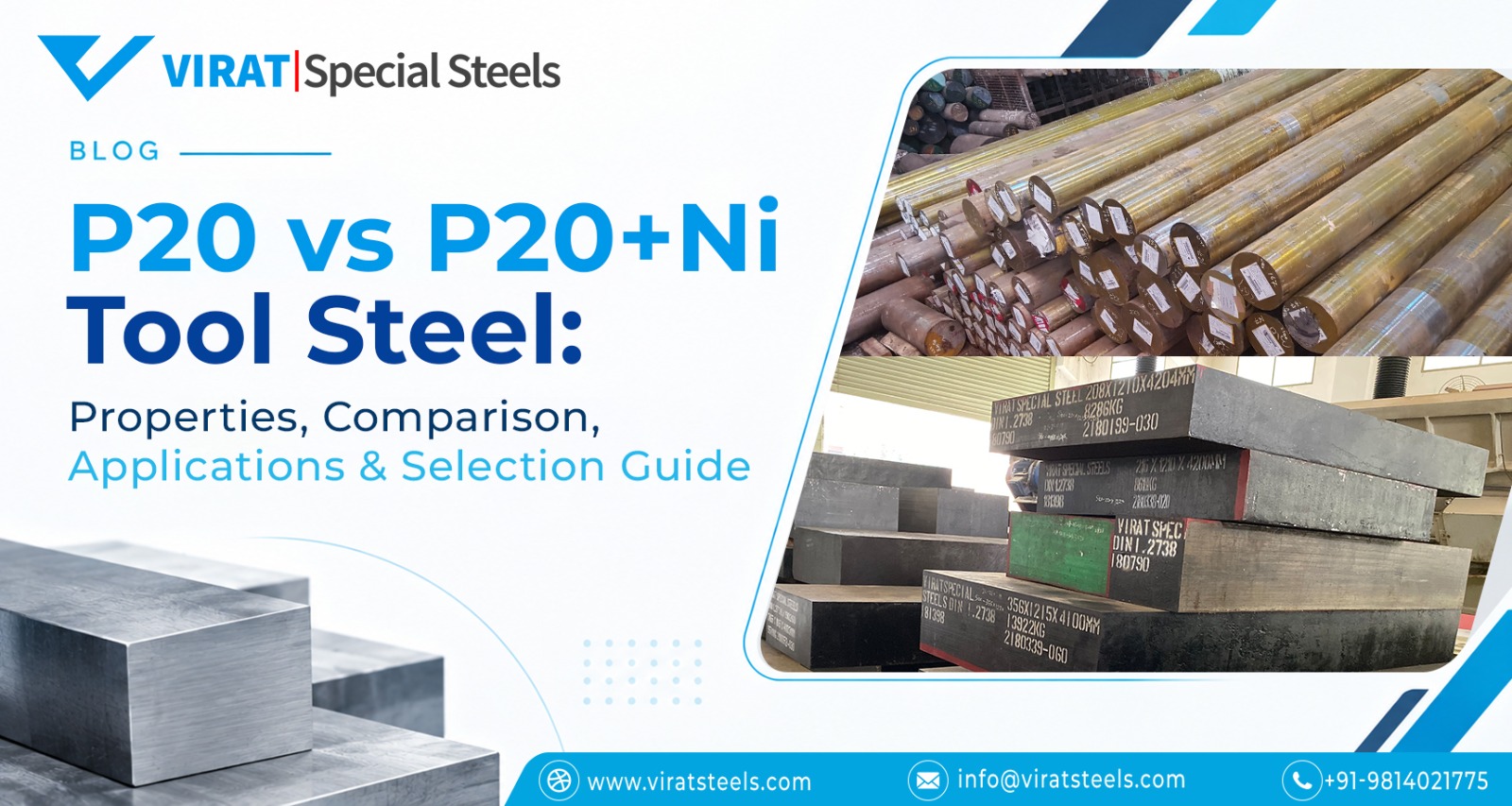
The choice of the correct mold steel directly influences machining time, surface finish, dimensional stability, mold life and total tooling cost. P20 vs P20+Ni tool steel are two of the most common choices for plastic injection molds and related tooling.
Both grades relate to plastic mold manufacturing, but are not interchangeable in all applications. P20 is usually chosen for its combination of machinability, toughness, polishability and cost. Nickel-alloyed P20 grades are often considered for larger sections which require more uniform through-hardening.
This guide will explain the differences between P20 vs P20+Ni tool steel their properties, applications, machinability and what mold makers and procurement teams should be looking for when ordering material.
Virat Steels is a leading supplier of tool and die steel to manufacturers of the plastic molding, die casting and precision tooling industries. The P20-family of steels are amongst the most requested grades. Let’s get into the nitty gritty.
What Is P20 Tool Steel?
P20 tool steel is a low alloy mold steel which is commonly used for plastic injection molds, mold bases, tooling components and some die applications.
In Europe the common designation is 1.2311 / 40CrMnMo7 but it is normally linked to AISI P20. For example, Industeel describes 1.2311 as a pre-hardened mold steel for plastic mold applications that is approximately equivalent to P20.
P20 is valued for offering a practical balance between:
- Good machinability
- Good toughness
- Good polishability
- Useful strength in the pre-hardened condition
- Suitable dimensional stability for mould manufacturing
- Good suitability for general-purpose plastic mould tooling
Depending on the producer and supply condition, P20 may be supplied annealed or pre-hardened. Therefore, the actual hardness and machinability should be confirmed against the supplier’s technical datasheet and material certificate.
What Is P20+Ni Tool Steel?
P20+Ni tool steel is a mold steel alloyed with nickel, developed to enhance through hardening properties relative to conventional P20 type grades.
One common designation is DIN 1.2738 / 40CrMnNiMo8-6-4. Nickel addition is especially helpful for a mold or die with a relatively large section in which a more consistent hardness from surface to core is desired.
P20+Ni is widely associated with applications requiring a combination of:
- Good toughness
- Good machinability
- Good polishability
- More uniform hardness in larger sections
- Good dimensional stability
- Reliable performance in plastic mould tooling
The actual performance will depend on the steelmaker, the manufacturing route, the section size and the heat-treatment condition; the mill certificate should always be quoted in the procurement specifications.
P20 Tool Steel Properties
The main attraction of P20 is its balanced performance rather than one extreme property.
1. Good machinability
P20 is usually supplied in a condition that is readily machinable by mold makers to produce cavities, cores, bases and other components. Its machinability is practical for complex mold geometries and general tool making.
2. Good polishability
Surface finish is critical in plastic injection moulding. A properly produced P20-grade steel can provide good polishability, making it suitable for mould surfaces where appearance and surface quality are important.
The final achievable finish, however, depends on steel cleanliness, homogeneity, heat treatment, machining practice and polishing technique.
3. Toughness
P20 offers a useful combination of strength and toughness for general mould applications. This makes it suitable when the mold has to withstand repeated clamping, injection and mechanical stresses without becoming too hard and brittle.
4. Pre-hardened availability
Many P20 products are supplied in a pre-hardened condition. This can reduce or eliminate the need for additional hardening before machining, depending on the required application and supplied condition.
For example, Industeel will specify its 1.2311 mold steel in a pre-hardened condition at around 280-325 HB, while other producers may specify different delivery conditions.
Confirm the actual hardness range with the supplier before machining or designing the mold.
P20+Ni Tool Steel Properties
P20+Ni has several practical features of P20 but has nickel added to raise hardenability.
1. Improved through-hardening
A key reason for choosing P20+Ni is that it provides more uniform hardness over larger sections.
This is particularly important for large mold blocks where a large difference between surface and core properties may have an impact on machining, dimensional stability or service performance.
2. Good toughness
P20+Ni has been developed to provide optimum hardness and toughness rather than just maximum hardness.
This makes it suitable for molds that are subject to repeated mechanical stresses and applications where cracking or premature failure would be costly.
3. Good polishability
P20+Ni grades are commonly selected for moulds requiring good surface finishing and polishing performance. Steel cleanliness and low sulphur practice can be particularly important when high-quality polished surfaces are required.
4. Good machinability
Despite its enhanced hardenability, P20+Ni is still used extensively for mould manufacturing because it provides a useful combination of machinability, toughness and polishability.
P20 vs P20+Ni tool steel: Quick Comparison Table
| Parameter | P20 Tool Steel | P20+Ni Tool Steel |
| Common designation | 1.2311 / P20* | 1.2738 / P20+Ni* |
| Steel type | Plastic mould steel | Nickel-alloyed plastic mould steel |
| Main advantage | Balanced performance and machinability | Improved through-hardening |
| Machinability | Good | Good |
| Toughness | Good | Good to very good, depending on grade/condition |
| Polishability | Good | Good to excellent, depending on quality |
| Large-section performance | Suitable, but section-dependent | Generally preferred for larger sections |
| Typical mould use | General plastic moulds and mould bases | Large/deeper moulds and demanding mould blocks |
| Supply condition | Often pre-hardened | Often supplied pre-hardened |
| Cost | Generally lower | Generally higher |
| Selection priority | General-purpose tooling | Large sections and more uniform core properties |
Exact grade equivalence and specifications should be verified against the applicable standard and mill certificate.
H13 vs P20 vs P20+Ni tool steel: How Does a Hot-Work Steel Compare?
P20 vs P20+Ni tool steel are both cold/warm-work mould steels. H13 (DIN 1.2344) belongs to a different family entirely — it’s a chromium-molybdenum-vanadium hot-work tool steel, built to hold its hardness under sustained heat rather than to machine and polish easily at room temperature. It’s included here because mould makers sometimes weigh it against the P20 family when a tool will see higher thermal or mechanical loading than a standard plastic mould.
Chemical Composition (wt %)
| Element | P20 (1.2311) | P20+Ni (1.2738) | H13 (1.2344) |
| Carbon (C) | 0.35 – 0.45 | 0.35 – 0.45 | 0.32 – 0.45 |
| Silicon (Si) | 0.20 – 0.40 | 0.20 – 0.40 | 0.80 – 1.25 |
| Manganese (Mn) | 1.30 – 1.60 | 1.30–1.60 | 0.20 – 0.60 |
| Phosphorus (P), max | 0.03 | 0.03 | 0.03 |
| Sulphur (S), max | 0.03 | 0.03 | 0.03 |
| Chromium (Cr) | 1.80 – 2.10 | 1.80 – 2.10 | 4.75 – 5.50 |
| Molybdenum (Mo) | 0.15 – 0.25 | 0.15 – 0.25 | 1.10 – 1.75 |
| Vanadium (V) | — | — | 0.80 – 1.20 |
| Nickel (Ni) | — | 0.90–1.20 | — |
H13‘s much higher chromium and the addition of vanadium and higher molybdenum are what separate it from the P20 family — those elements are what give it hot hardness and resistance to thermal fatigue, at the cost of some room-temperature machinability.
Property & Application Comparison
| Parameter | P20 | P20+Ni | H13 |
| Steel family | Cold/warm-work mould steel | Nickel-alloyed cold/warm-work mould steel | Hot-work tool steel |
| Typical supply hardness | 240–280 BHN (pre-hardened) | 280–320 HB (pre-hardened) | Annealed, or pre-hard ~460–500 BHN; hardened & tempered 45–52 HRC |
| Tensile strength | ~965–1030 MPa | ~850–1100 MPa | ~1550–2050 MPa |
| Key strength | Machinability, polishability, cost | Uniform through-hardening in large sections | Hot hardness, thermal fatigue resistance |
| Best suited to | General-purpose plastic moulds | Large/deep mould blocks needing uniform hardness | Die casting, extrusion dies, forging dies, hot-runner components |
| Operating temperature | Ambient/moderate | Ambient/moderate | High, with repeated heating/cooling cycles |
| Typical limitation | Not for high-temperature or high-wear service | Costs more than plain P20; still not a hot-work grade | Lower machinability/polishability than P20; higher material cost |
When to Choose H13 Over the P20 Family
Choose H13 when:
- The tool will see repeated heating and cooling cycles — aluminium or zinc die casting, hot forging dies, or extrusion tooling.
- Resistance to heat checking and thermal fatigue matters more than mirror polish.
- The mould or die runs at elevated temperature for extended periods, where P20 or P20+Ni would soften or lose dimensional stability over time.
Stay with P20 vs P20+Ni tool steel when:
- The tool is a plastic injection mould running at typical moulding temperatures, not a high-heat forming or casting die.
- Machinability, polishability and cost matter more than hot hardness.
- The section size and cavity finish requirements are the deciding factors rather than thermal cycling.
In short: P20 vs P20+Ni tool steel is a choice about section size and through-hardening within the same mould-steel family, while H13 is a different grade altogether — brought in when the application shifts from ambient-temperature plastic moulding to something that runs hot.
P20 Tool Steel Applications
P20 tool steel applications span a wide range of tooling and mould-making needs, including:
- Injection mould cavities and cores for plastic components
- Mould bases for plastic injection moulding tools
- Die-casting dies for lower-volume or less thermally demanding runs
- Blow moulding tools
- Extrusion tooling components
- Structural and holder blocks within larger tool assemblies
- Zinc die-casting dies (in some applications)
Because of its balance of machinability and moderate strength, P20 is often the “workhorse” grade specified when a mould doesn’t require the extreme wear resistance or hardness of tool steels like H13 or D2.
P20+Ni Tool Steel Applications
P20+Ni is typically specified for the same broad categories of tooling as P20, but where the design calls for something more demanding:
- Large injection mould cavity and core blocks, where uniform hardness through a thick section matters
- High-cavitation moulds requiring more consistent wear behavior across a large tool
- Moulds for engineering plastics that place higher mechanical demands on the tool steel
- Precision moulds where dimensional consistency across a large block is critical to part quality
- Die-casting and moulding applications needing slightly better toughness than standard P20 can offer
Machinability: P20 vs P20+Ni tool steel
For mould manufacturers, machinability is an important purchasing consideration because machining can represent a significant portion of mould manufacturing cost.
Both P20 vs P20+Ni tool steel are commonly selected because they can be machined effectively in suitable delivery conditions.
However, machining performance is not determined by the grade name alone.
It can be affected by:
- Actual hardness
- Steelmaking quality
- Inclusion content
- Section size
- Heat-treatment condition
- Cutting tool grade
- Cutting parameters
- Milling strategy
- Coolant or lubrication
- Required surface finish
For this reason, machining parameters should be established from the actual material condition and tooling manufacturer’s recommendations rather than relying only on a generic P20 cutting-speed chart.
How to Choose Between P20 vs P20+Ni tool steel?
The best choice depends on the mould design and production requirements.
Choose P20 when:
- The mould is small to medium-sized.
- General-purpose plastic moulding is involved.
- Good machinability is a priority.
- The application does not demand exceptional through-hardening.
- Initial material cost is an important consideration.
- A conventional pre-hardened mould steel is sufficient.
Choose P20+Ni when:
- The mould contains large or deep sections.
- More uniform hardness through the section is important.
- The mould design has demanding dimensional requirements.
- Toughness and polishability are important.
- The additional material cost is justified by the tooling requirements.
- You want a mould steel specifically selected for improved hardenability.
The decision should ultimately be based on the mould size, plastic material, production volume, required surface finish, machining method, hardness requirement and expected service conditions.
Advantages and Limitations
Advantages of P20
Advantages
- Good machinability
- Good toughness
- Good polishability
- Widely available
- Suitable for general mould manufacturing
- Often available pre-hardened
- Cost-effective for many applications
Limitations
- Not intended to be the best solution for every high-performance mould
- Through-hardening becomes more important as section size increases
- Wear and corrosion requirements may call for another grade
- Actual performance depends strongly on steel quality and condition
Advantages of P20+Ni
Advantages
- Improved hardenability
- Better suitability for larger sections
- Good toughness
- Good machinability
- Good polishability
- Suitable for demanding mould applications
Limitations
- Generally costs more than standard P20
- The benefits may not justify the additional cost for smaller, less demanding moulds
- Exact properties vary by producer and delivery condition
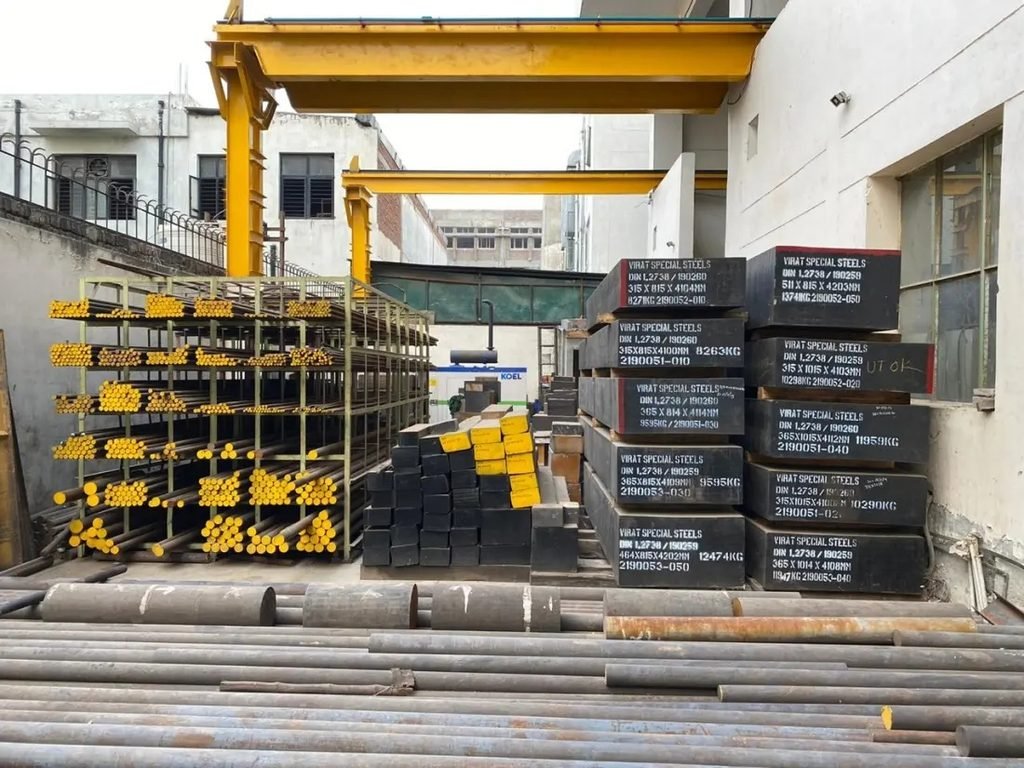
What Should Buyers Check Before Ordering P20 vs P20+Ni tool steel ?
Procurement teams should avoid specifying only “P20 steel” on a purchase order.
A stronger purchasing specification should identify:
- Exact grade designation (e.g., 1.2311 for P20, 1.2738 for P20+Ni)
- Applicable standard
- Required dimensions and section size — especially important for P20+Ni, where the block thickness directly affects through-hardening performance
- Delivery condition (annealed vs. pre-hardened)
- Required hardness range, including surface-to-core hardness uniformity for P20+Ni in larger sections
- Surface condition
- Ultrasonic testing requirements, if applicable
- Material test certificate requirements
- Chemical analysis requirements (nickel content confirmation for P20+Ni)
- Required cutting or machining tolerances
For example, ASTM A681 covers chemical, mechanical and physical requirements for wrought alloy tool-steel products and emphasizes that material selection is based on application, service conditions and properties desired. ISO 4957:2018 specifies requirements for various categories of wrought tool steels and is the current edition.
For P20+Ni specifically, buyers should also request a core hardness test report rather than relying only on surface hardness, since the primary reason to select this grade over standard P20 is uniform hardness through a large section.
Why Material Certification Matters
For critical moulds, the steel supplier should be able to provide appropriate documentation for the supplied material.
Depending on the project, buyers may request:
- Mill Test Certificate (MTC)
- Heat number
- Chemical analysis
- Hardness report
- Ultrasonic testing report
- Dimensional inspection
- Additional inspection documents where specified
The exact inspection requirements should be agreed before purchase.
This is especially important for large mould blocks, where internal quality and consistency can have a major effect on machining and mould performance.
P20 vs P20+Ni tool steel for Indian Mould Manufacturers
Indian mold makers serving the automotive, consumer goods, appliances, electronics, packaging and engineering industries often require steel that offers a combination of performance, availability, machining time and overall tooling cost.
This means that P20 is still a practical option for many general purpose tools, whilst P20+Ni may make more sense for larger and more demanding tooling.
The right material is not always the hardest or the most expensive steel. It is the grade that delivers the required performance without adding extraneous material and processing costs.
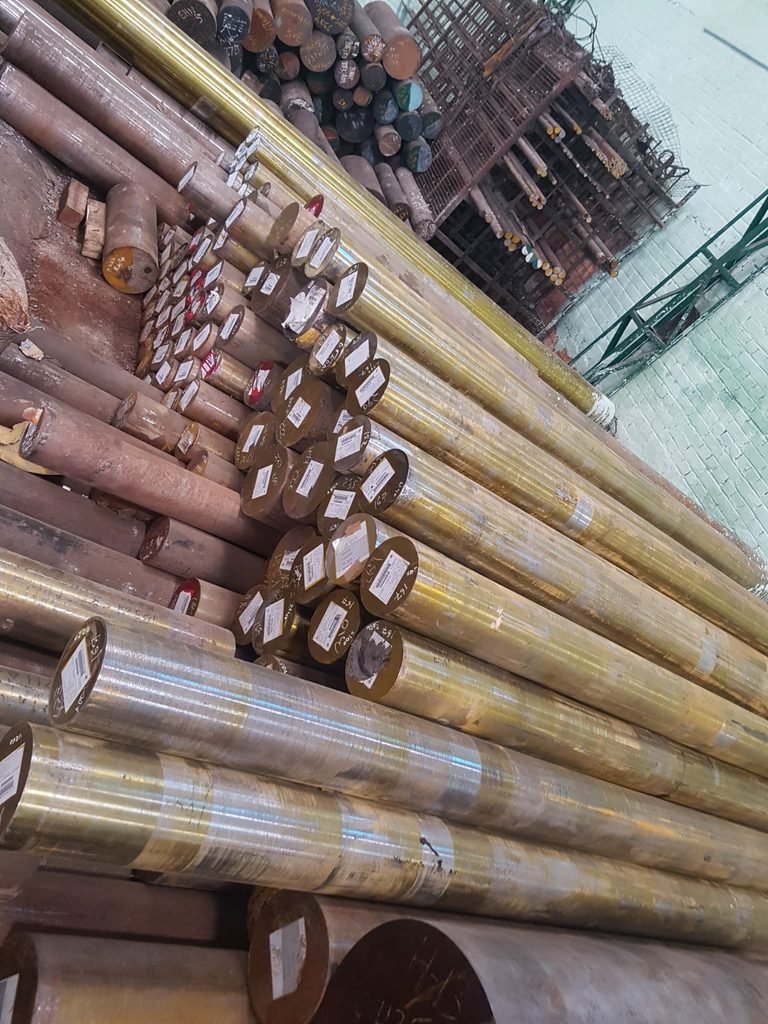
Our Supply Network Across India
With dispatch centers in Gurugram and Ludhiana, we regularly serve mould makers and tool rooms across India, including Delhi, Gurugram, Faridabad, Noida, Ghaziabad, Jaipur, Agra, Ahmedabad, Vadodara, Surat, Rajkot, Mumbai, Pune, Nashik, Indore, Bhopal, Rudrapur, Hyderabad, Kolkata, Belgaum, Chennai, Coimbatore, Hyderabad, Faridabad, Manesar, Bhiwadi,Ludhiana, Chandigarh, Haryana, Punjab and Jamshedpur.
We can offer our P20 vs P20+Ni tool steel in standard or custom sizes, cut to size material, annealed or heat treated condition and material test certificates (MTC) as required. This supply network caters to mold makers, tool rooms, automotive component manufacturers, plastic injection molders and other engineering industries throughout India.
Conclusion
P20 vs P20+Ni tool steel are both valuable choices for mould manufacturing, but they serve slightly different priorities.
P20 tool steel is a practical, versatile choice for many general-purpose plastic moulds because of its machinability, toughness and polishability. P20+Ni becomes particularly attractive when the mould is larger or deeper and more uniform through-hardening is required.
Before purchasing, always verify the exact grade, standard, hardness, section size, delivery condition and material certification rather than selecting steel based only on the commercial name “P20.”
Looking for P20 or P20+Ni Tool Steel in India?
Virat Special Steels supplies tool and mould steels for mould manufacturers, tool rooms, engineering companies and industrial buyers. P20 and P20+Ni can be supplied in suitable forms and sizes subject to grade and stock availability, with cutting and technical support for industrial requirements.
Our technical team will confirm grade equivalence, available sizes and delivery timeline within 24 hours.
Prefer to talk directly?
Gurugram, Haryana | Ludhiana, Punjab
Phone: +91-98140-21775
Email: info@viratsteels.com
Ask the Virat Steels team to verify the required grade, dimensions, hardness, testing and MTC requirements before placing your order.
Frequently Asked Questions
1. What is P20 tool steel?
P20 tool steel is a mould and tool steel commonly used for plastic injection moulds, mould bases, cavities, cores and related tooling. A commonly referenced grade is 1.2311.
2. What is P20+Ni tool steel?
P20+Ni is a nickel-alloyed mould steel, commonly associated with 1.2738, designed to provide improved through-hardening compared with conventional P20-type grades.
3. What is the difference between P20 vs P20+Ni Tool Steel ?
The main difference is the alloy design. P20+Ni contains nickel and is generally selected where improved hardenability and more uniform properties through larger sections are important.
4. Is P20 good for plastic injection moulds?
Yes. P20 is widely used for plastic injection moulds because of its balance of machinability, toughness, polishability and strength.
5. Is P20+Ni better than P20?
Not automatically. P20+Ni can be a better choice for large mould blocks or applications where through-hardening is important. Standard P20 can be more economical for general-purpose tooling.
6. Is P20 supplied pre-hardened?
Many P20 products are available in pre-hardened conditions, but the exact hardness depends on the supplier and product specification. Always confirm the delivery condition before ordering.
7. Can P20 be polished?
Yes. P20 is commonly used for mould applications requiring good polishing performance. Final surface quality also depends on steel cleanliness, machining and polishing practices.
8. Is P20 easy to machine?
P20 is generally considered machinable in appropriate delivery conditions. Actual machining performance depends on hardness, steel quality, cutting tools and machining parameters.
9. What is P20+Ni used for?
P20+Ni is commonly used for large plastic injection moulds, mould blocks, deep cavities and tooling where improved through-hardening and uniform properties are important.
10. Is 1.2311 the same as P20?
1.2311 is commonly associated with P20 and is often marketed as a P20 equivalent. However, buyers should verify the exact standard and chemical/mechanical requirements rather than assuming that every P20-labelled product is identical.
11. Is 1.2738 the same as P20+Ni?
1.2738 is a commonly referenced P20+Ni grade. The exact specification should be confirmed from the producer’s technical documentation and material certificate.
12. Which is better for large moulds: P20+Ni Tool Steel ?
P20+Ni is often preferred for larger sections because its nickel-alloyed composition provides improved through-hardening. The final selection should consider the actual mould dimensions and required hardness profile.
13. Can P20 be used for die casting?
P20 can be used for selected tooling and die applications, but it should not automatically be selected for demanding high-temperature die-casting applications. The operating temperature, thermal cycling, wear and required tool life should be evaluated first.
14. How do I specify P20 steel when buying?
Specify the exact grade, standard, dimensions, delivery condition, hardness requirement and inspection/documentation requirements. For critical applications, request the applicable MTC and testing documentation.
15. Where can I buy P20 vs P20+Ni Tool Steel in India?
Industrial buyers can source P20 and P20+Ni from specialised tool-steel suppliers such as Virat Special Steels, subject to available grade, size, mill and delivery condition.
Virat Steels-Trusted Tool & Die Steel Supplier in India
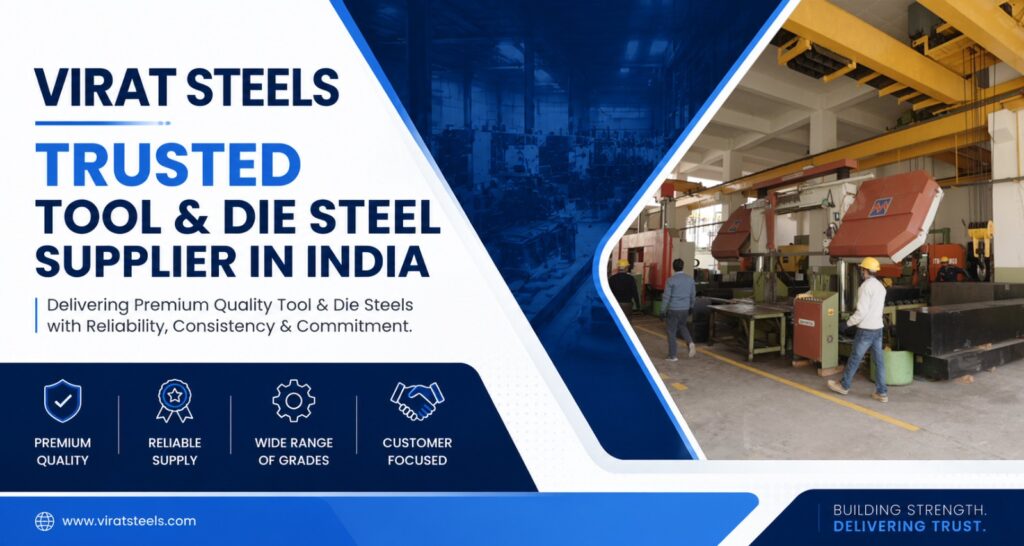
In the tool and die steel industry, quality material and reliable service are very essential for consistent production performance. Manufacturers today need more than just steel. Hence, they need a trusted supply partner.
That’s why industries across India choose Virat Special Steels for premium tool steel solutions.
With decades of domain expertise, the company serves high-quality tool & die steels industries ranging from automotive and aerospace to defence, tooling, and heavy engineering.
Premium Quality Steel
Virat Steels provide genuine and reliable tool steel with:
- Consistent hardness
- Better machinability
- Improved tool life
- Genuine quality
Available in:
✔ Rounds
✔ Flats
✔ Blocks
Ready Stock Availability
Ready stock available for major grades including:
ensuring quick dispatch and reduced downtime.
Ultrasonic Tested Material
Virat Steels supplies UT Tested Tool Steel
Ultrasonic testing helps detect:
- Internal defects
- Cracks
ensuring better reliability and performance.
Precision Cutting Facility
We offer precision cutting services for:
- Accurate dimensions
- Reduced machining allowance
- Faster processing
Helping customers save time and improve productivity.
Strong Logistics Support
We deliver across India with:
- Fast dispatch
- Safe handling
- Timely delivery
Supplying to major industrial regions across India .
Technical Support
Our team helps customers choose:
- Suitable steel grade
- Recommended Hardness
- ESR vs standard grades
- Application-based solutions
Certified & Test Report
- Material Test Certification (MTC)
Looking for a reliable tool and die steel supplier in India?
Contact Virat Special Steels:
📞 +91 98140-21775
🌐 www.viratsteels.com
✉ info@viratsteels.com
Frequently Asked Questions (FAQs)
1. What products does Virat Steels supply?
Virat Steels supplies premium tool and die steels including Hot work steels, cold work steels, High Speed steels, Alloy steel grades etc.
2. Which industries use tool and die steel?
Tool and die steels are widely used in Forging, Extrusion, Plastic moulds, Automotive components, Pressure Die casting .
3. Does Virat Steels provide ultrasonic tested material?
Yes, Virat Steels supplies UT tested material to ensure better reliability, reduced internal defects, and improved tooling performance.
4. Does Virat Steels maintain ready stock?
Yes, Virat Steels maintains ready stock of major tool steel grades for quick dispatch and faster delivery across India.
5. Why choose Virat Steels as a tool steel supplier?
Manufacturers choose Virat Steels because of Genuine quality, UT tested steel, Precision cutting facility, ready stock, fast delivery, technical support
6. Does Virat Steels deliver across India?
Yes, Virat Steels supplies tool and die steel across major industrial regions in India with reliable logistics and timely delivery support.
7. How can I contact Virat Steels for tool steel requirements?
You can contact Virat Steels on 📞 +91 98140-21775 for grade recommendations, stock availability, and pricing.
P20 vs P20+Ni Tool Steel: Which is Better for Plastic Mould Applications?
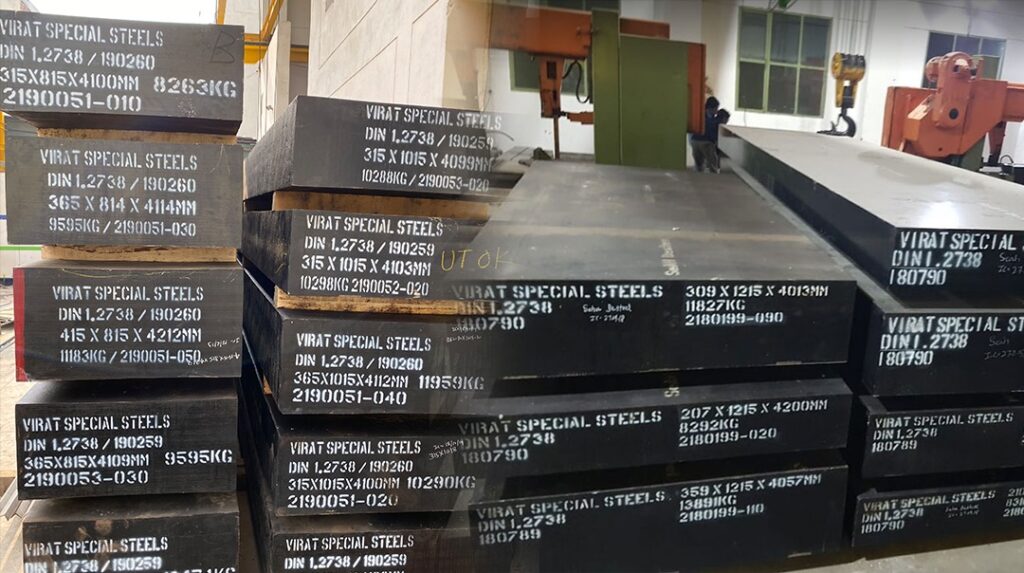
In the plastic mould industry, selecting the right material plays a crucial role in determining tool life, surface finish, and production efficiency. Two of the most used mould steels are P20 and P20+Ni tool steel (Nickel Alloyed P20 Steel).
But which one is better for your application?
In this blog, we compare P20 vs P20+Ni tool steel to help manufacturers make the right decision.
What is P20 Tool Steel?
P20 is a pre-hardened plastic mould steel widely used in the manufacturing of:
- Plastic injection moulds
- Die casting dies
- Automotive components
- Mold bases
Key Properties of P20 Steel
- Hardness: 280–320 BHN
- Good machinability
- Moderate toughness
- Cost-effective solution
- Suitable for medium production runs
What is P20+Ni Tool Steel?
P20+Ni is an enhanced version of P20 steel with Nickel (Ni) added, improving its performance significantly.
Key Properties of P20+Ni Steel
- Improved toughness
- Better hardness uniformity
- Superior polishability
- Enhanced core strength
- Ideal for high-quality moulds
P20 vs P20+Ni: Key Differences
| Property | P20 Steel | P20+Ni Steel |
| Toughness | Moderate | High |
| Hardness Uniformity | Standard | Excellent |
| Polishability | Good | Superior (Mirror Finish) |
| Core Strength | Average | Strong |
| Cost | Lower | Slightly Higher |
| Best Use | General moulds | High precision & glossy moulds |
Why Choose P20+Ni for Plastic Moulds?
If your application requires:
✔ High surface finish (mirror polish)
✔ Large mould sizes
✔ Better durability and longer tool life
✔ Uniform hardness across thick sections
Then P20+Ni steel is the better choice.
Applications of P20 & P20+Ni Steel
Both grades are widely used in:
- Plastic injection moulds
- Blow moulds
- Die casting dies
- Automotive plastic components
- Consumer product moulds
Result:
- Choose P20 → for general-purpose moulds
- Choose P20+Ni → for high-end, precision moulds
Why Choose Virat Special Steels?
At Virat Special Steels, we provide premium quality P20 and P20+Ni tool steel with:
- Large ready stock
- Assured material quality
- Custom sizes available
- Competitive pricing
- Fast delivery across India
We are a trusted tool and die steel supplier in India, serving Pan India industries including key industrial hubs such as Pune, Nashik, Ahmedabad, Rajkot, Ludhiana, Faridabad, Ghaziabad, Gurgaon, and the entire South India region.
Conclusion
Both P20 and P20+Ni tool steels have their own advantages, but the right choice depends on your application.
If you’re looking for a reliable P20 / P20+Ni steel supplier in India, Virat Special Steels is your trusted partner.
Contact our team to get more details about available sizes and technical specifications suitable for your applications.
https://www.viratsteels.com/p20ni.htmlinfo@viratsteels.com
+91 98140-21775
FAQs
1. What is the difference between P20 and P20+Ni steel?
P20+Ni contains nickel, which improves toughness, polishability, and hardness uniformity compared to standard P20.
2. What is the hardness of P20 steel?
Typically 280–320 BHN in pre-hardened condition.
3. Which steel is better for mirror finish moulds?
P20+Ni steel is preferred due to its superior polishability.
4. Where can I buy P20+Ni tool steel in India?
You can source high-quality P20 and P20+Ni steel from Virat Special Steels.
P20 vs H13 — Best Choice for Long-Run Plastic Moulds Plastic Mould Steel · Grade Comparison · Virat Special Steels
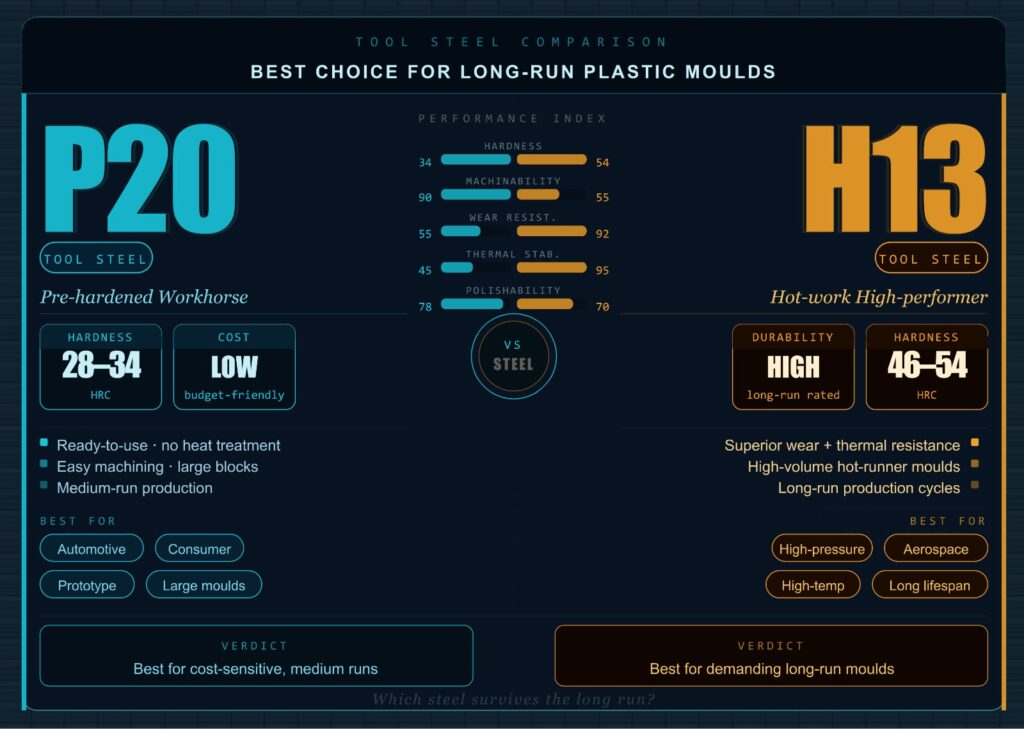
A practical, application-first guide for mould makers, tool rooms, and procurement teams choosing between two most popular plastic mould steel grades.
Choosing the wrong mould steel doesn’t just cost money — it costs production runs, surface finish quality, and mould life. Here’s how to pick the right one.
At a Glance: P20 vs H13
The table below gives a side-by-side view of both grades across the most critical properties mould buyers evaluate:
| P20 Steel Pre-hardened Mould Steel | H13 Steel Hot Work Tool Steel |
|---|---|
| Hardness 28–34 HRC (pre-hardened) | Hardness 44–52 HRC |
| Toughness High | Toughness Very High |
| Polishability Good | Polishability Excellent |
| Machinability Excellent | Machinability Moderate |
| Mould Life Up to 5,00,000 shots | Mould Life 10,00,000+ shots |
| Heat Treatment Not required | Heat Treatment Required (vacuum) |
| Tool Cost Lower | Tool Cost Higher |
| Lead Time Short | Lead Time Longer |
Detailed Property Comparison
| Property | P20 Steel | H13 Steel |
|---|---|---|
| Hardness after HT | 28–34 HRC (pre-hardened) | 44–52 HRC |
| Wear Resistance | Moderate | High |
| Toughness | High | Very High |
| Machinability | Excellent (no HT needed) | Moderate (HT required) |
| Thermal Fatigue Resistance | Low | Very High |
| Tool Cost | Lower | Higher |
| Lead Time | Short (ready to machine) | Longer (HT required) |
| Mould Life | Up to 5,00,000 shots | 10,00,000+ shots |
| Corrosion Resistance | Low | Moderate |
Which Steel is Best for Long-Run Moulds?
✅ Choose P20 if:
· Production volume is moderate
· Budget is limited
· Faster delivery is required
· Plastic material is non-abrasive
✅ Choose H13 if:
· Production volume is very high
· You need long mould life
· Material is abrasive or high temperature
· Dimensional stability is critical
| Which Grade Should You Pick? P20 for speed & cost · H13 for volume & finish |
If you need a mould quickly, at a lower cost, for regular plastics and medium production, go with P20.But if you’re producing in high volumes, using abrasive or glass-filled materials, or need a long-lasting, mirror-finish mould (over 10 lakh shots), choose H13.
Industry Applications in India
Both P20 and H13 are widely used across India’s plastics and automotive tooling industry. Here’s where each grade dominates:
| Industry | Recommended Grade | Reason |
| Automotive | H13 | High volume, tight tolerances, long mould life |
| Consumer Appliances | P20 | Medium run, cost-sensitive, faster delivery |
| Packaging (Caps & Closures) | H13 | Very high shot count, abrasion resistance |
| Electronics Housing | P20 / H13 | Depends on run volume and finish requirements |
| Medical Device Components | H13 (ESR Grade) | Mirror finish, cleanliness, long run |
| Soft Tooling | P20 | Quick machining, lower cost, short lead time |
Conclusion
Both P20 and H13 have their place in mould manufacturing—but the choice depends on your production goals:
· P20 = Cost-effective + faster production
· H13 = Long life + high performance
Sourcing P20 and H13 in India
Virat Special Steels stocks both P20 and H13 in ready inventory — supplied with full mill test certificates, hardness test reports, and chemical analysis. Available in round bars, flat bars, and pre-machined blocks across a wide size range.
| Need P20 or H13 for Your Next Mould? Get a fast quote — certified stock, ready to dispatch across India |
Contact our team to get more details about available sizes and technical specifications suitable for your applications.
https://www.viratsteels.com/products.html info@viratsteels.com
+91 98140-21775
Frequently Asked Questions
1. Which is better for long-run plastic moulds, P20 or H13?
H13 — higher hardness, wear resistance, and heat tolerance make it ideal for long runs.
2. What is the difference between P20 and H13?
P20: Pre-hardened, easier to machine, lower cost — best for short/medium runs. H13: Heat-treated, stronger, better for high-temp and high-volume applications.
3. Is H13 worth the higher cost?
Yes — for high-volume production, H13 delivers better ROI over time.
4. When should you choose P20 over H13?
When volume is low/medium, budget is tight, or faster machining/delivery is needed.
5. Which is better for high-temperature injection molding?
H13 — superior thermal fatigue resistance handles higher temps without deformation.
6. Can P20 be used for long-run moulds?
Yes, but it wears faster with abrasive materials and isn’t ideal for very long runs.
7. Which industries prefer H13?
Automotive, electronics, and high-volume packaging — anywhere durability matters.
8. What’s the cost difference?
P20: Lower upfront. H13: Higher initial cost, but better long-term value.
9. Best steel for 1 million cycle production?
H13 — built to withstand extended wear, heat, and stress over massive run counts.
How Virat Special Steels Delivers High-Quality Steel Across India
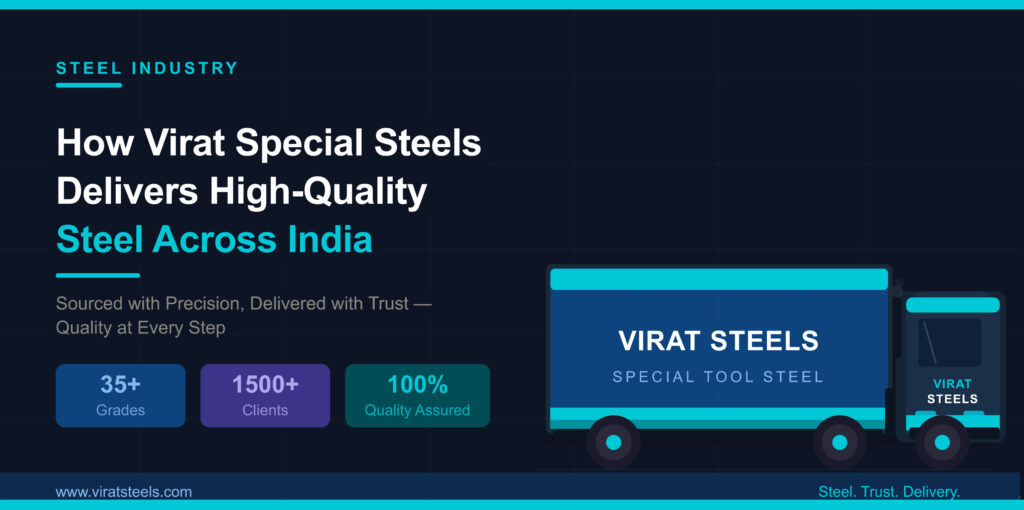
From raw material sourcing to pan-India distribution — a comprehensive look at India’s trusted special steel supplier and manufacturer.
In India where infrastructure is booming and industrial demand for precision tool & die steel is higher, Virat Special Steels has emerged as one of India’s most dependable names in high-quality steel supply and distribution.
| 1957 | 3500 tons | 35+ | 1.5K+ |
| Existence | Stock | Grades | Satisfied Clients |
Who Is Virat Special Steels?
Virat Special Steels is a leading stockist, supplier, and distributor of special and alloy steel products across India. With decades of domain expertise, the company serves industries ranging from automotive and aerospace to defence, tooling, and heavy engineering.
What sets Virat Special Steels apart in the crowded Indian steel market is its unwavering commitment to quality assurance, grade certification, and on-time delivery whether you are a small machine shop or a large-scale manufacturer.
Product Range: Every Grade, Every Need
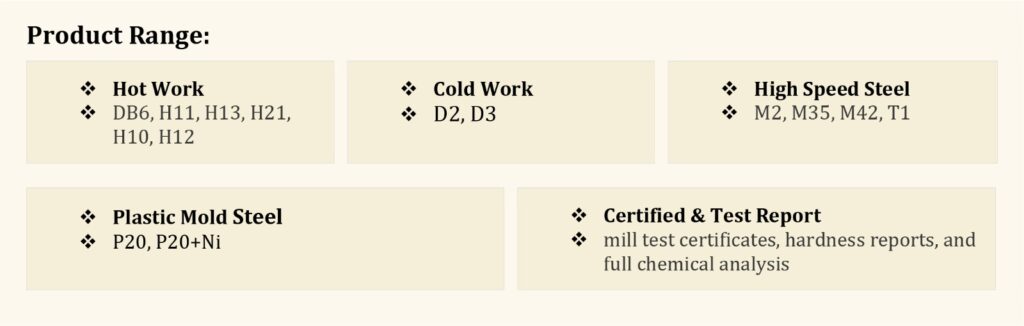
One of the key reasons Virat Special Steels commands trusts across sectors is its vast and diverse product portfolio The company stocks and supplies:
1. Hot Work Steel
DB6, H11, H13, H21, H10, H12—for dies, moulds, and tools that work with heated metals like forging dies, die casting dies, extrusion tools, and hot shearing blades operating at high temperatures (300–700°C).
2. Cold Work Steel
D2, D3– for cutting, punching, blanking, and forming tools that operate at room temperature on unheated workpieces.
3. High-Speed Steel (HSS)
M2, M35, M42, T1— engineered for extreme heat resistance and wear durability in high-speed machining operations.
3. Plastic Mold Steel
P20+Ni , P20 — for manufacturing injection moulds, blow moulds, and compression moulds that shape plastic products in mass production.
4. Certified & Test-Report Backed Steel
Every batch is supplied with original mill test certificates, hardness reports, and full chemical analysis — ensuring complete traceability.
The Supply Chain: How Quality Reaches You
Virat Special Steels operates a streamlined supply chain that ensures product integrity from steel mill to customer workshop. Here is how the process works:
- Sourcing from Certified Global & Domestic Mills — Raw steel is procured from ISO-certified mills in India, Europe, China, Japan, ensuring chemical composition and mechanical properties meet international standards like DIN, AISI, and IS.
- In-House Quality Inspection & Testing — Each incoming lot undergoes spectrometric testing, hardness verification, and dimensional checks before being added to inventory.
- Inventory Management — With large, well-organised warehouses, Virat Steels maintains ready stock of over 35+grades, enabling same-day dispatch for urgent industrial requirements.
- Custom Cutting— Steel is supplied in round bars, flat bars with cutting-to-size services to reduce waste and machining time for buyers.
- Pan-India Logistics & Timely Delivery — Our logistics partners ensure safe, on-time delivery across Pan India. With our offices at GURGAON, LUDHIANA, PUNE & CHENNAI to provide efficient business services to the Industrial undertaking at the location in India.
| Serving India’s Most Critical Industries — Where Failure Is Not an Option |
Why Industries Trust Virat Special Steels
Technical Expertise
Unlike generic steel traders, Virat’s team includes technical team who guide clients on grade selection — ensuring the right steel is used for the right application, reducing rejection rates and improving the productivity .
Consistent Quality with Traceability
Every supply comes with full traceability — heat numbers, TC, composition reports — making Virat’s steel compatible with ISO 9001 quality frameworks.
Competitive Pricing & Fast Quotes
Virat Steels offers market-competitive Quotes are processed quickly, supporting buyers’ procurement timelines without delay.
After-Sales Technical Support
Virat’s technical support team stays with you beyond the sale — helping with heat treatment parameters, machinability ratings, and surface hardness queries.
Frequently Asked Questions
Q1: What makes Virat Special Steels different from regular steel traders?
Virat Special Steels focuses exclusively on tool & die steels offering deep technical knowledge, certified inventory, and grade-specific expertise that other steel traders cannot match.
Q2: Do you supply steel to small businesses and individual buyers?
Yes. Virat serves a wide spectrum from large OEMs to small machine shops. Minimum order quantities are flexible, and enquiries are welcome for any quantity.
Q3: Is same-day or next-day dispatch available?
For grades available in ready stock which covers the majority of popular engineering and tool steel grades same-day dispatch is possible for orders placed before the cut-off time.
Q4: Are mill test certificates provided with every order?
Absolutely. Every supply from Virat Special Steels comes with original mill test certificates covering chemical composition ensuring full traceability.
Q5: Can Virat Steels supply cut to specific sizes?
Yes. Virat offers cutting-to-size and profiling services for round bars, flat bars reducing your raw material waste and machining effort significantly.
Conclusion
By combining advanced infrastructure, a wide product range, and a strong commitment to quality, Virat Special Steels continues to lead as a trusted Tool steel supplier across PAN India. Whether you need a plastic mould steel, tool & die steel, or high-speed steel, the brand delivers unmatched performance, durability, and trust.
| Ready to Source Smarter? Contact Virat Special Steels Today |
Fast quotes | Grade recommendations | Pan-India delivery
📧 info@viratsteels.com | 📱 +91 98140-21775
European Die Steels for Longer Tool Life – Backed by NLMK Verona (Italy) & Virat Steels (India)
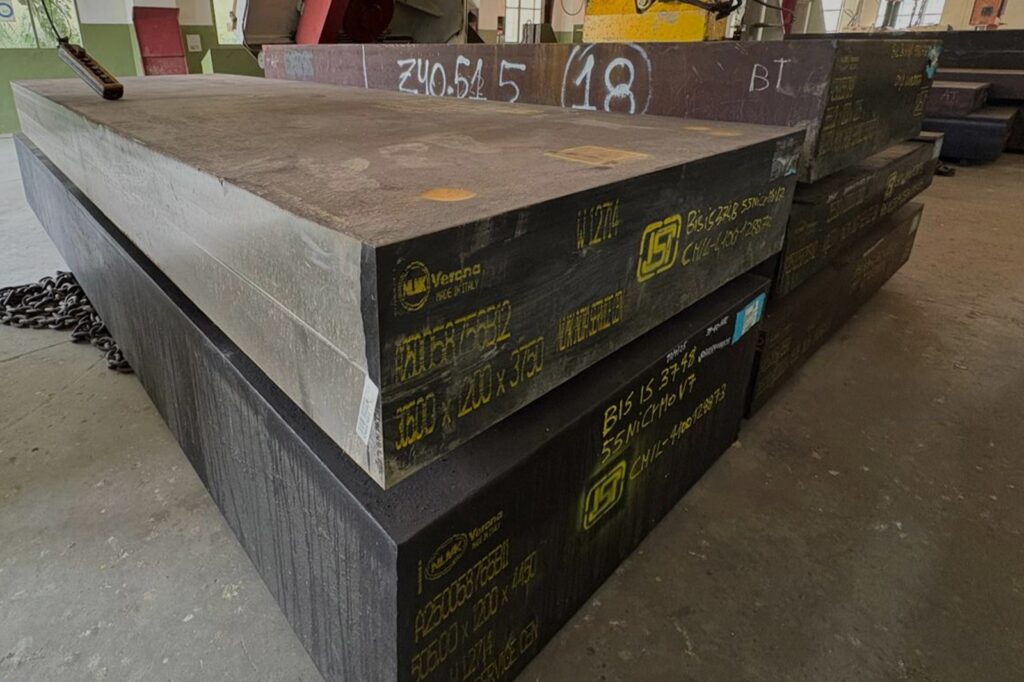
When it comes to tool and die steel, what it truly matters is –tool life, that truly considered as an important technical parameter for improved productivity. This is where European Tool & Die Steel continues to stand out as a proven solution.
Why European Tool Steel Stands Apart?
Globally, European tool steels are recognized for :
- Their advanced steel making technology,
- Strict quality control,
- Consistent performance.
NLMK Verona – European Excellence from Italy
NLMK Verona, based in Verona, Italy—an industrial hub known for metallurgical excellence—is a reputed European producer of high-performance tool and die steels engineered for:
- More tougher & crack-resistant
- Easier to machine
- More dimensionally stable.
When combined with a trusted Indian supply partner, they deliver excellence across tooling and die-making applications in India.
Bringing European Tool Steel to India: NLMK Verona × Virat Steels
Through partnership of NLMK Verona with Virat Steels, now Indian industries will have easier access to European-grade steel with reliable local stocking and service & technically supported solutions.
With over 70+ years of experience in the Indian metal industry, Virat Steels remains a trusted partner for toolmakers and manufacturers, supplying premium grades such as:
DIN 1.2714 | 1.2344 | 1.2738 | 1.2379 | HSS M2, M35 , T1 and more backed by the strong manufacturing expertise of NLMK Verona.
Looking for Genuine European Tool Steel with Assured Performance?
Manufacturers, toolmakers, and industry professionals are invited to connect with us at Mach Auto Expo 2026 to explore more premium European Tool & Die Steel solutions.
📍 Venue: LEC, Ludhiana (Punjab)
📅 Date: 20th Feb -23rdFeb 2026
Visit us to discuss tooling challenges, explore NLMK Verona steel grades, and understand how the right material choice can deliver longer tool life and consistent performance.
HCHCR D2 Steel in India for Your Cold Work Steel Industry
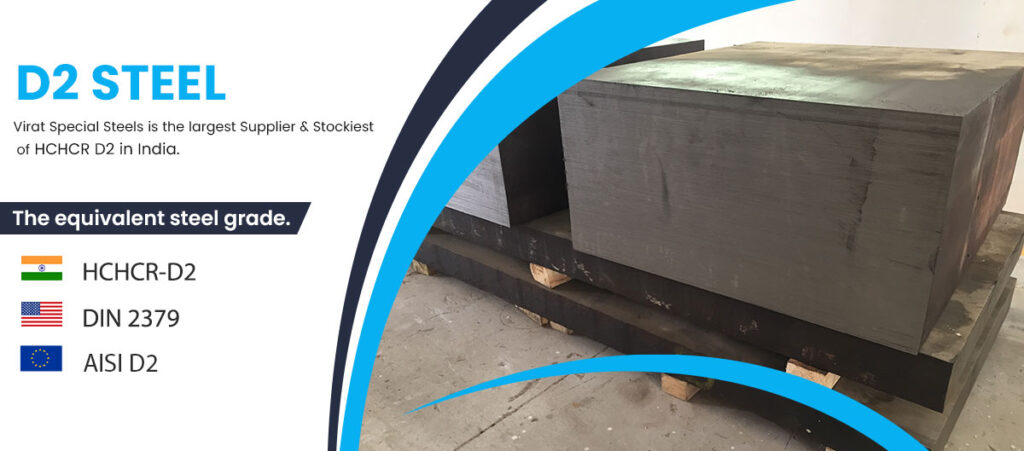
When it comes to cold work steel applications, selecting the right material is crucial for durability, precision, and long-term performance. One such outstanding choice is HCHCR D2 Steel—a high-carbon, high-chromium tool steel. In India, Virat Special Steels Pvt. Limited stands out as the leading supplier and stockiest of this versatile steel, catering to industries with a demand for superior-quality materials. This article dives deep into the significance of HCHCR D2 steel, its applications, and why Virat Special Steels should be your trusted partner.
What is HCHCR D2 Steel?
HCHCR D2, also known as DIN 2379 or AISI D2, is a high-carbon, high-chromium tool steel. It is particularly renowned for its exceptional hardness, wear resistance, and ability to retain its sharp edges. These qualities make it the go-to choice for a variety of cold work applications.
Key Characteristics:
- Hardness: Retains sharpness and withstands extreme wear conditions.
- Wear Resistance: Ideal for prolonged usage in abrasive environments.
- Dimensional Stability: Minimal deformation during heat treatment, ensuring precise applications.
- Corrosion Resistance: Its chromium content provides a level of resistance to rust and corrosion.
Applications of HCHCR D2 Steel
HCHCR D2 steel’s properties make it indispensable in industries that require robust materials for cold work processes. Below are the key applications:
- Cold Stamping and Forming Dies
- Used to create high-precision stamping dies for sheet metal processing.
- Cold Forming Rolls
- Essential for shaping metals under high pressure while maintaining dimensional accuracy.
- Chipper Knives
- Preferred for industrial wood chippers, ensuring longevity and precision cutting.
- Punches and Slitters
- Ideal for creating tools that deliver accurate cuts and punches repeatedly.
- Shear Blades
- Used for shearing and trimming metal sheets, offering excellent cutting performance.
- Tire Shredders
- Equipped to handle the rigors of recycling and tire shredding.
- Threading and Cutting Dies
- Provides high-quality threading solutions for industries needing fine details and uniformity.
- Stamping Tools
- Reliable for mass production, ensuring tools can handle repetitive tasks without wear.
Why Choose Virat Special Steels Pvt. Limited?
Virat Special Steels Pvt. Limited has established itself as India’s largest supplier and stockiest of HCHCR D2 steel. Here’s why you should partner with them:
1. Extensive Inventory
Virat Special Steels boasts a wide range of sizes and configurations to cater to varying industrial needs.
- Round Bars: 13mm Dia to 1500mm Dia
- Rectangular Bars: Thickness 13mm – 500mm, Width 13mm – 1500mm
2. Industry Expertise
With years of experience in the steel industry, the team at Virat Special Steels offers unmatched knowledge and guidance. Their technical expertise ensures you get the perfect material for your requirements.
3. Top-Quality Products
The company sources only the best-quality HCHCR D2 steel, ensuring products meet stringent international standards. Their steel is known for its:
- Superior machinability
- Excellent wear resistance
- Outstanding surface finish post-treatment
4. Customer-Centric Approach
At Virat Special Steels, customer satisfaction is paramount. From consultation to delivery, their dedicated team provides seamless service to meet your timelines and specifications.
5. Competitive Pricing
Despite being a leader in quality and service, the company offers competitive pricing, ensuring value for money.
Modes of Supply for HCHCR D2 Steel
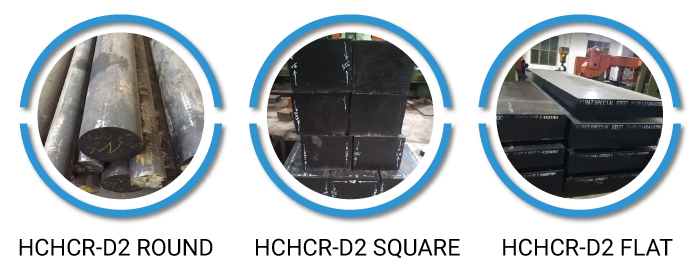
Virat Special Steels ensures you have access to the best materials for your specific application. Their HCHCR D2 steel is available in a variety of formats, including forged and rolled bars.
Available Options:
- Rounds and rectangular configurations
- Custom sizes for niche applications
- Bulk quantities for industrial operations
Benefits of Using HCHCR D2 Steel from Virat Special Steels
1. Durability in Harsh Conditions
HCHCR D2 steel offers unmatched toughness and is designed to handle the demands of cold work applications.
2. Enhanced Productivity
With its exceptional resistance to wear and deformation, industries can achieve higher efficiency and reduced downtime.
3. Cost-Effective Solution
Investing in high-quality HCHCR D2 steel translates to long-term savings due to its extended lifespan and reduced maintenance needs.
4. Eco-Friendly
Virat Special Steels is committed to sustainable practices, ensuring environmentally responsible sourcing and processing.
How to Place Your Order with Virat Special Steels
Ready to enhance your operations with the best HCHCR D2 steel in India? Here’s how you can get started:
- Consultation: Connect with their expert team to discuss your specific needs.
- Sizing: Select from their extensive range of sizes or request custom dimensions.
- Quotation: Receive a competitive price quote tailored to your order.
- Delivery: Experience fast, reliable shipping across India.
For more details, visit their dedicated HCHCR D2 page: Virat Special Steels HCHCR D2.
Conclusion
When it comes to cold work steel applications, HCHCR D2 steel is the top choice for industries seeking quality and durability. As India’s largest supplier and stockiest of this versatile material, Virat Special Steels Pvt. Limited ensures you get the best in terms of performance and value. From an extensive inventory to superior customer service, Virat Special Steels is the trusted partner you need to take your operations to the next level.
FAQs
1. What makes HCHCR D2 steel unique?
HCHCR D2 steel is unique due to its high carbon and chromium content, providing excellent hardness, wear resistance, and dimensional stability.
2. Which industries benefit the most from HCHCR D2 steel?
Industries like automotive, manufacturing, recycling, and sheet metal processing benefit significantly from HCHCR D2 steel.
3. Can Virat Special Steels provide custom sizes?
Yes, Virat Special Steels offers customized sizes and configurations to meet specific industrial requirements.
4. Is HCHCR D2 steel suitable for extreme conditions?
Absolutely! HCHCR D2 steel is designed to perform exceptionally well in harsh, abrasive environments.
5. How can I contact Virat Special Steels?
You can visit their website here or reach out to their expert team for assistance.
Any further queries feel free to contact us :
🌐https://www.viratsteels.com 📬 info@viratsteels.com ☎+91 98140-21775
Virat Special Steels an ISO 9001:2015 Certified Trading Company
Elevating Standards as an ISO 9001:2015 Certified Trading Company
Introduction: A Legacy of Excellence
Virat Special Steels is a name synonymous with trust, quality, and innovation in the steel trading industry. As an ISO 9001:2015 certified trading company, we are committed to setting benchmarks in quality and operational efficiency. Our dedication to upgrading infrastructure and maintaining world-class standards makes us the go-to partner for high-quality steel solutions. Whether you are constructing skyscrapers or manufacturing precision tools, Virat Special Steels ensures you get the finest products with expert guidance every step of the way.

What Makes ISO 9001:20215 Certification Significant?
Understanding ISO 9001:2015
ISO 9001:2015 certification is a globally recognized standard for quality management systems. It emphasizes:
- Meeting customer needs consistently.
- Adopting a process-driven approach for efficiency.
- Continuously improving systems for enhanced outcomes.
Virat Special Steels’ Certification
Being certified under ISO 9001:2015 highlights our commitment to:
- Ensuring superior quality standards.
- Streamlining processes to reduce delays.
- Delivering unparalleled customer satisfaction.
This certification reflects our dedication to staying ahead in the competitive steel trading market.
Our Commitment to Quality and Continuous Improvement
At Virat Special Steels, improvement isn’t a one-time effort—it’s a way of life. Our approach is grounded in:
- Upgrading Technology: Regular investments in cutting-edge machinery and tools ensure optimal efficiency and accuracy.
- Employee Training: Skilled professionals are empowered with continuous learning to excel in their roles.
- Customer-Centric Approach: Every product and service is designed with customer satisfaction in mind.
World-Class Infrastructure: Where Innovation Meets Precision
To deliver top-notch steel products, a robust infrastructure is essential. Virat Special Steels takes pride in its state-of-the-art facilities, designed for precision, speed, and reliability.
Machinery and Equipment
Our infrastructure is equipped with the latest tools and technologies, ensuring seamless operations:
- 27 Bimetal Horizontal & Vertical Bandsaw Machines: Cutting capacity up to 2500mm x 1100mm, catering to projects of any scale.
- 14 Overhead Lifting Cranes: Lifting capacity of up to 20 tons for effortless material handling.
- 20 Lifting Magnets: Each with a lifting capacity of up to 5 tons, ensuring safety and efficiency.
- 2 Fork Lifters: Designed to handle up to 3 tons, streamlining transportation within the plant.
Advanced Testing Facilities
Quality assurance is integral to our operations. Our in-house testing facilities include:
- Chemical & Spectro Lab: Ensures the composition meets industry standards.
- UT Testing Machine: Non-destructive testing for structural integrity.
- Hardness Tester: Measures the durability of our steel products, ensuring they stand the test of time.
Machining Plant
Our machining plant ensures precise customization to meet diverse project requirements, delivering products tailored to perfection.
Why Choose Virat Special Steels?
1. Superior Product Quality
Every product from Virat Special Steels meets rigorous quality checks. From raw materials to finished goods, quality is our top priority.
2. Expert Guidance
Our experienced team provides technical advice, ensuring you select the right product for your project. Whether it’s construction, machinery, or industrial manufacturing, our experts have you covered.
3. Comprehensive Range of Products
We offer a wide array of steel products, catering to diverse industries. Our inventory ensures you get exactly what you need, when you need it.
4. Commitment to Sustainability
Sustainability is at the heart of our operations. By using energy-efficient processes and reducing waste, we contribute to a greener planet.
Applications of Virat Special Steels’ Products
Virat Special Steels caters to a wide range of industries, ensuring our steel solutions meet specific needs:
- Construction: Reinforcing bars, structural steel, and beams for high-rise buildings and infrastructure.
- Automotive: High-grade steel for vehicle components, ensuring safety and durability.
- Industrial Machinery: Precision steel products for equipment that drives industrial growth.
- Tool Manufacturing: Specialized steel grades for making cutting tools and molds.
Dedicated to Customer Satisfaction
At Virat Special Steels, our customers are at the core of our mission. Here’s how we ensure satisfaction:
- Timely Deliveries: Robust logistics systems ensure products reach you on time, every time.
- Customization Options: Tailored solutions for unique project requirements.
- Reliable Support: A dedicated team to resolve queries and provide seamless after-sales service.
Looking Ahead: The Future of Virat Special Steels
As a forward-thinking company, Virat Special Steels is constantly innovating. Our goals for the future include:
- Expanding our product portfolio to cater to emerging markets.
- Investing in advanced automation for faster and more precise manufacturing.
- Strengthening our sustainability practices to contribute to a better tomorrow.
Conclusion: Building the Future with Virat Special Steels
When it comes to premium steel solutions, Virat Special Steels stands unmatched. With ISO 9001:2015 certification, cutting-edge infrastructure, and a commitment to excellence, we empower industries to achieve their goals. Trust Virat Special Steels for unmatched quality, expert guidance, and a partner dedicated to your success.
FAQs
1. What does ISO 9001:2015 certification mean for customers?
It ensures that customers receive products and services of the highest quality, backed by reliable processes and consistent improvements.
2. What industries does Virat Special Steels serve?
We serve industries such as forging, automotive, industrial machinery, and tool manufacturing.
3. What testing facilities are available at Virat Special Steels?
Our facilities include a chemical and spectro lab, UT testing machine, hardness tester, and more for comprehensive quality assurance.
4. Can I get customized steel products from Virat Special Steels?
Absolutely! We offer customized solutions to meet unique project needs.
5. How does Virat Special Steels ensure sustainability?
By adopting energy-efficient processes, minimizing waste, and prioritizing eco-friendly practices, we contribute to sustainable development.
Our products are specifically engineered to extend service life, save time, and provide optimal performance. Trust us for accurate and timely service to meet your needs.
Virat Special Steels, INDIA!
https://www.viratsteels.com/
📞 Contact us today to learn more about how we can support your business!
https://www.viratsteel.in/special-steel-supply-networks/
Watch now:
https://www.youtube.com/watch?v=c4h5KqyzVd0
Any further queries feel free to contact us :
🌐https://www.viratsteels.com/ 📬 info@viratsteels.com ☎+91 98140-21775
The Ultimate Guide to Tool Steel Selection with Virat Special Steels
Your Partner in Precision: Tool Steel Selection with Virat Special Steels
In the fast-paced world of manufacturing, tool steel plays a pivotal role in producing high-quality tools, dies, molds, and other critical components. However, selecting the right tool steel is no walk in the park. It’s a challenging task that, if done incorrectly, can lead to tool failure, subpar product quality, increased costs, and even safety risks.
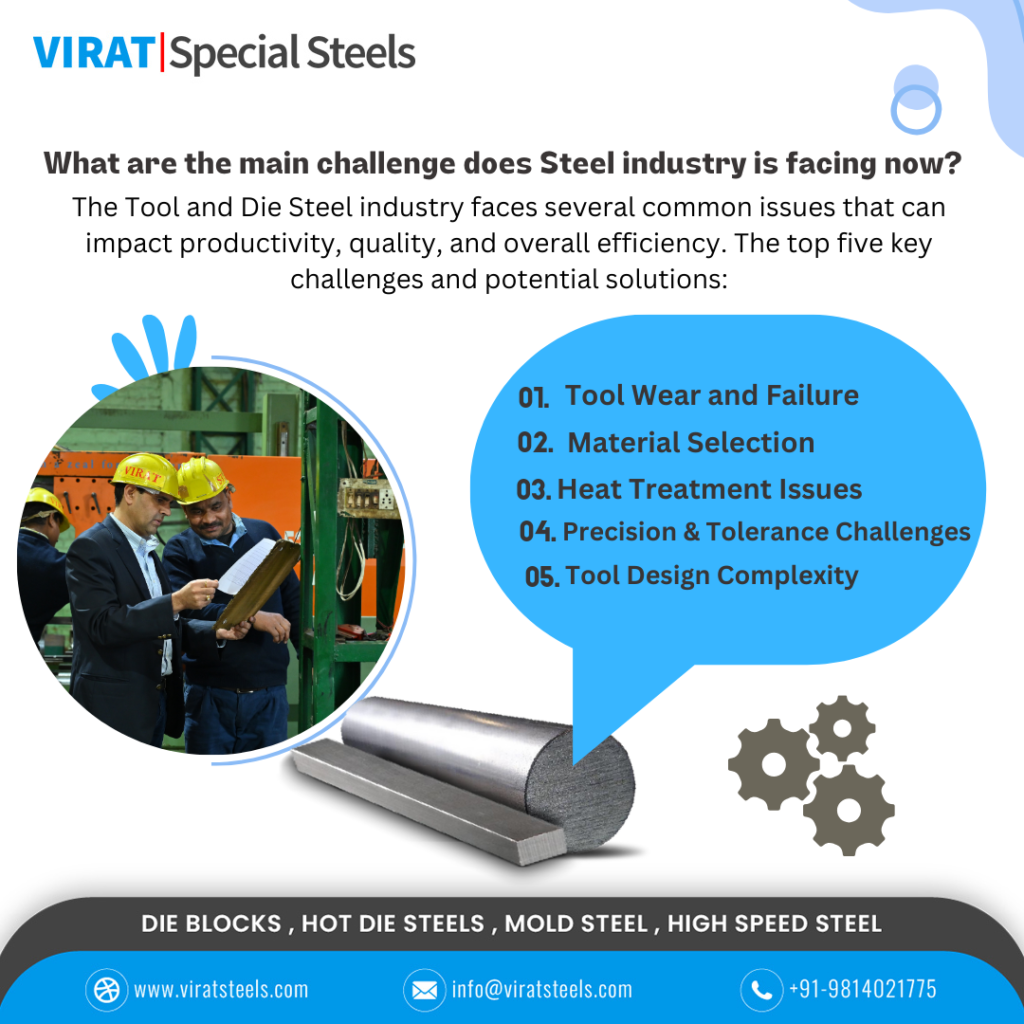
This is where Virat Special Steels steps in as a trusted partner, offering expert guidance to help manufacturers make informed decisions. With an impressive portfolio of products and an unwavering commitment to quality, Virat Special Steels is your go-to source for tool steel selection and supply.
Understanding Tool Steel: A Backbone of Manufacturing
Tool steel is a special category of alloyed steel designed for high-performance applications. It’s renowned for its durability, hardness, and resistance to wear and heat.
Applications of Tool Steel:
- Hand tools: Hammers, chisels, and screwdrivers.
- Machine dies: Used in metal stamping and forming.
- Plastic molds: Essential for injection molding.
- Hot extrusion tools: Withstand intense heat during metal shaping.
The unique characteristics of tool steel, such as thermal stability and toughness, make it indispensable in manufacturing industries.
The Challenges of Selecting the Right Tool Steel.
Tool steel selection isn’t just a technical decision—it’s a strategic one. Choosing the wrong material can lead to several issues, including:
- Premature tool failure: Shortening the lifespan of expensive tools.
- Higher costs: Increased maintenance and replacements.
- Safety risks: Equipment malfunction posing hazards to workers.
To make the right choice, manufacturers must carefully evaluate factors like stress resistance, hardness, and machinability—no small feat for most.
Our Extensive Product Portfolio
Virat Special Steels boasts a comprehensive inventory of over 35 grades of tool steel in various shapes and sizes, including:
- Flat bars: Ideal for heavy-duty industrial applications.
- Square bars: Versatile and durable.
- Round bars: Perfect for precision tooling.
- Each product is sourced from top global manufacturers, ensuring unmatched quality and performance.
Here’s why you can rely on Virat Special Steels:
- Wide Range of Grades: We have our own large steel yards in Gurgaon and Ludhiana, offering hot and cold work steels, high-speed steels, and die steels. With more than 35 grades available in flat, square, and round bar forms, we cater to diverse industrial needs.
- Distribution Network: Our strong distribution network across India ensures timely delivery of tool steels to various manufacturing facilities.
- Expertise: Our capable team of engineers understands the complexities of tool steel selection. We provide personalized guidance based on your specific requirements.
- Top Manufacturers: We import steel from top manufacturers such as Swiss Steels Gruop (Dew), NLMK Verona, Luchini, Vitkovice, Somers Forge, Nippon, Seah, and Hyundai Steel.
Today, Virat Special Steels stands as the world’s largest supplier to the forging and casting industry, offering die steels, tool steel, and die blocks. Feel free to contact us for any inquiries:
Web: https://www.viratsteels.com
Email: info@viratsteels.com
Phone: +91 98140-21775
Did you know about the Steel Facts?
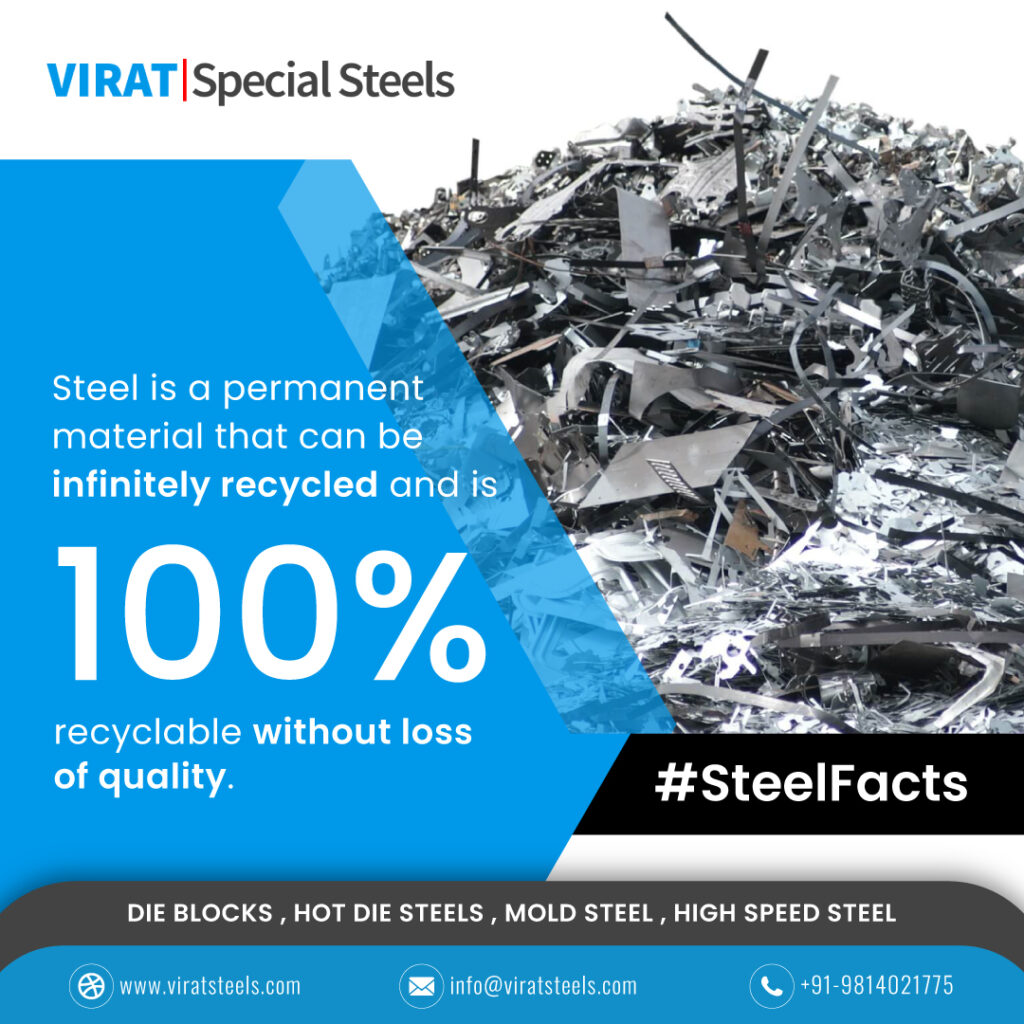
Steel is one of the most widely used materials in the world, found in everything from buildings and bridges to cars and household appliances. Steel is 100% recyclable without any loss of quality.
But what happens when steel products reach the end of their life cycle in all these applications?
Actually, it’s not the end. Indeed, for steel there is no end, as steel is 100% and infinitely recyclable without any loss of quality. The steel in end-of-life products can be melted down to be reused in the production of new steel.
This involves several stages:
- Collection: A significant amount of scrap currently used in steelmaking processes is acquired before it reaches the marketplace. Known as prompt scrap, these are residuals of large-scale industrial manufacturing processes
- Sorting: Scrap needs to be sorted and separated based on type and quality. As steel is made from a mix of various alloys and materials, such as carbon, chromium, manganese, nickel, and others, you need to match the steel grade you want to produce with scrap that matches its properties.
- Shredding: Once sorted, large scrap metal pieces are fed into industrial shredders, which break them into smaller pieces.
- Melting and refining: The shredded scrap steel is then placed into furnaces and melted down at temperatures that can exceed 1,600°C (2,900°F), turning the steel into molten metal.
- Casting and rolling: The refined steel is then poured into moulds, cooled, and rolled into new steel products, such as sheets, bars, or beams, ready to be used as they are or to be further processed into other products.
The study delves into the value of reestablishing compositional information for steel recycling and sheds light on the dynamic nature of steel grades.
VIRAT SPECIAL STEELS PVT. LIMITED , INDIA Your Trusted Partner in Special Steels. Explore a vast inventory of Die Blocks and Tool Steels sourced from renowned manufacturers worldwide…
Our Steel Yards boast a comprehensive inventory, including:
- DIE STEEL ( HH 370 – 410 BHN ) (DB6 / DIN-1.2714 / AISI L6 )
- HOT WORK STEELS (DIN 2343, 2344 / AISI H11, H13)
- PLASTIC MOULD STEELS (DIN 2738, 2311 , AISI P 20 )
- HIGH SPEED STEELS (DIN 3243 , 3343 / AISI M2 , M35)
- COLD WORK STEELS – HCHCr. (DIN 2379 , 2080 / AISI D2 , D3)
- ALLOY STEELS, EN-SERIES ETC.
Choose Virat Special Steels for your steel needs and experience the difference quality makes. Contact us today to learn more about our products and services!
Learn more :
https://www.viratsteels.com/
Any further queries feel free to contact us :
📩info@viratsteels.com 📲+91-98140-21775