



h13
now browsing by tag
Cut-to-Size Die Blocks: Machining Allowance Guide for DB6, H13, D2 & P20
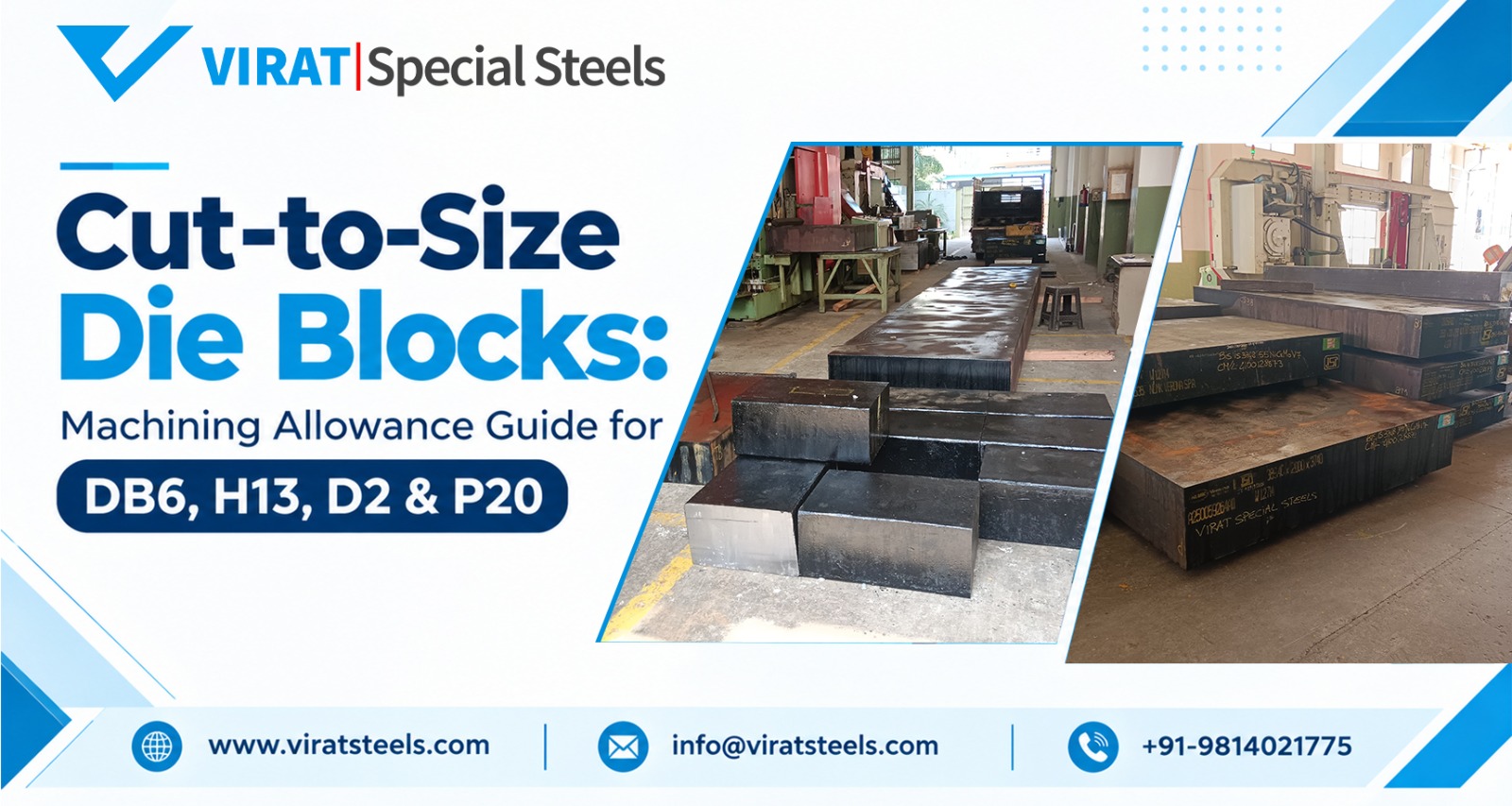
Technical guide by Virat Special Steels · Die and tool steel stockists since 1957
Order a Cut-to-Size Die Blocks with too little allowance and it can’t be cleaned up after heat treatment, so it ends up as scrap. Order too much and you pay for steel, sawing and machine time that turns into chips.
This manual provides us with a summary of the allowance for machining based on the requirements of the various categories from the Indian forging, die-casting, and toolroom industries including DB6 (DIN 1.2714), H13, H11, D2, D3, and P20.
Machining Allowance for Cut-to-Size Die Blocks
Plan these ranges per side (per face), then confirm with your supplier:
| Delivery condition | Allowance per side | What it has to cover |
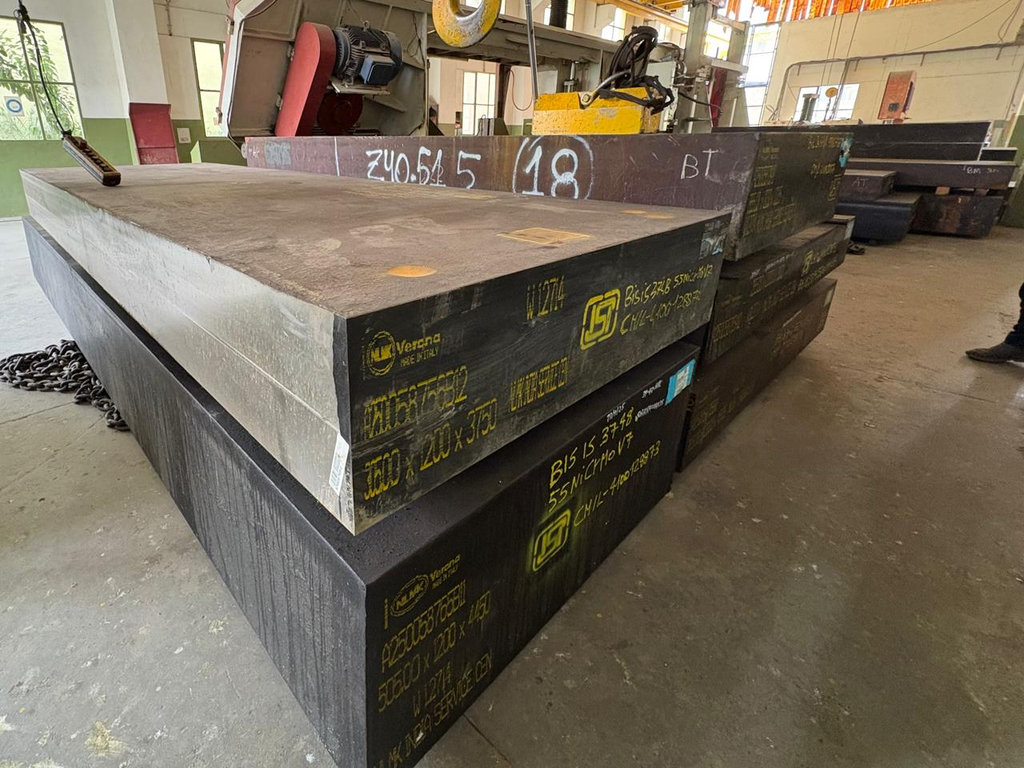
| Black (hot-rolled or forged) | 3–6 mm for most sizes; more on wide sections | Scale, seams, decarburized skin, bow |
| Saw-cut and rough-milled | 1–2 mm | Remaining geometry error, semi-finishing |
| Six-side milled | 0.2–0.4 mm | Final sizing; standard programmes ship +0.4 to +0.8 mm over nominal overall |
| Precision ground with allowance | 0.15–0.3 mm | Final sizing only |
If hardening is going to be done after machining the piece, allow for at least 0.15% of each dimension on each side for the final finishing of the piece. For instance, a 200 mm face would require about 0.3 mm to be kept.
These figures are based on available data from the mills and actual shop practice; they should not be considered standard values. The actual numbers may depend on the type of alloy, the shape of the section and the method you use. Therefore, make sure to send an engineering drawing before you finish up.
What Is Machining Allowance on a Die Block?
The machining allowance refers to the additional material requested to have the workpiece in its finished form. This is often defined by a number for each side, such as 3 mm per side for a 6 mm allowance in total. With cut-to-size die blocks, you would incorporate this allowance in your order specifications and make sure to mention it on the order.
Breakdown of Machining Allowance Layers
Total allowance is a stack of four layers, and each one exists for a reason.
| Layer | What it covers | Planning figure per side |
| 1. Surface | Scale, seams, laps and the decarburized skin left by hot working | 1.6% of the dimension, usually not under 2 mm |
| 2. Geometry | Bow, camber, out-of-flat and cutting tolerance | 0.3–0.5 mm |
| 3. Heat treatment | Hardening movement, residual scale or decarburization | 0.15% of the dimension, minimum about 0.3 mm |
| 4. Finishing | EDM recast removal, polishing | Small; set by the finishing process |
Layer 1: surface. Hot rolling and forging leave scale, seams and a skin where carbon has burned out. That soft skin won’t harden properly, so it must go. The AISI benchmark for hot-rolled flats and squares is removal of at least 1.6% of the dimension per side (2.4% for resulfurized steel). It was written for carbon and alloy bars, so treat it as a floor for tool steel. Decarburization depth is measured to ASTM E1077 or ISO 3887.
Layer 2: geometry. No bar is perfectly straight or flat, and long pieces bow more. Cutting adds tolerance, and length is the loosest dimension: +3/+8 mm on Uddeholm’s saw-cut stock, up to +35 mm in some precision flat programmes. Never rely on sawn length for a fit.
Layer 3: heat treatment. The sound workflow is rough machine, stress relieve, semi-finish, harden, grind. Uddeholm recommends 650°C for two hours after roughing H13; Virat’s DB6 guidance is 600–650°C. The Böhler-Uddeholm D2 data sheet sets a minimum of 0.15% per side, but only with stress relief, and Uddeholm’s oil-hardening Arne steel lists 0.25%. Movement can be small: on a 100 × 100 × 25 mm H13 sample, thickness changes 0 to +0.05% after air hardening and up to +0.30% after oil hardening. Scale and decarburization from hardening must also be ground off, so the allowance is never just the movement figure.
Layer 4: finishing. Wire EDM leaves a recast layer. Uddeholm advises removing it by grinding or stoning, then re-tempering about 25°C below the previous tempering temperature. Polishing needs little stock.
Formula and Worked Example
Per side: cleanup (the greater of 2 mm or 1.6% of the dimension) + geometry buffer (0.5 mm) + grinding stock (0.15% of the dimension, minimum 0.3 mm). Order size = finished size + 2 × that total.
For instance, a D2 block, which has a final measurement of 250 × 150 × 50 mm owing to the black flat finish, requires a thickness of 4.9, 3.2 and 2.8 mm on each side. This means that one should order something in the order of 260 × 157 × 56 mm with the understanding that this is merely an estimate rather than a guarantee.
Seven mistakes that cost money
- Writing “+5 mm” without saying per side or total.
- Using one allowance for every grade and condition.
- Ignoring bow on long flats.
- Skipping stress relief between roughing and finishing.
- Accepting a gas-cut block to save a few rupees.
- Expecting ESR to shrink the allowance. ESR cleans the inside of the steel. The surface still carries scale and decarb.
- Hoping allowance will fix internal defects. It won’t. For critical blocks, ask for ultrasonic testing.
What to send with your enquiry
- Grade and drawing, with finished size (L × W × T)
- Process route: use as supplied, or harden after machining
- Heat-treatment method: vacuum or atmosphere furnace
- Supply condition wanted: black, milled or ground
- Cutting method and tolerance (saw cut, plus-only or plus-minus)
- Documents needed: MTC, UT, spectro check
- Quantity and delivery location
Specific Scenarios and Add-Ons
Pre-hardened die blocks (DB6, H13, P20). Virat supplies DB6 annealed or hardened and tempered, typically at 38–44 HRC. If you machine the block as supplied, Layer 3 disappears. Keep Layers 1, 2 and 4, and confirm the condition at order stage.
Hardening after machining (D2, D3, soft H13). Use all four layers. Machine soft, stress relieve, harden, then grind.
Wire EDM. Blocks for eroding are often bought hardened and ground, sometimes with start holes. Allow for recast removal and agree finishing stock with your EDM shop.
Flame or plasma-cut blanks. Avoid them for alloy tool steel. Thermal cutting leaves a hardened heat-affected zone and cracking risk, and needs far more stock. Band-sawing is the safer route.
Large forged blocks. Allowance grows with size, so never reuse a 100 mm figure on a 400 mm block. For heavy die blocks, ask for ultrasonic testing. Virat supplies DB6 die blocks with extra forging reduction and double tempering for better UT quality.
Nitriding. Nitrided cases are shallow (about 0.12–0.20 mm in Uddeholm’s H13 examples), so finish the block first and treat nitriding as a surface step, not an allowance layer.
Add-ons to request on your enquiry:
- Bandsaw cut-to-size and surface machining
- Annealed or hardened-and-tempered supply; ESR or non-ESR
- Ultrasonic testing
- Mill Test Certificate (EN 10204 3.1 where applicable), spectro and hardness reports
- Ground reference faces with squareness and parallelism limits
- Batch-wise traceability
Common Material Grades for Cut-to-Size Die Blocks
Allowance logic changes with the grade and its supply condition:
| Grade (AISI / DIN) | Typical use | Allowance note |
| DB6 / 1.2714 (L6) | Hammer and press forging dies | Often supplied hardened and tempered, so no heat-treatment layer |
| H13 / 1.2344 | Die casting, extrusion, hot forging | Air or vacuum hardening keeps movement small; stress relief still applies |
| H11 / 1.2343 | Forging and aluminium extrusion dies | Plan like H13 |
| D2 (HCHCr) / 1.2379 | Blanking and forming dies, punches | Air hardening; keep at least 0.15% per side with stress relief |
| D3 (HCHCr) / 1.2080 | High-abrasion, long-run tooling | Oil hardening; leave more grinding stock than D2 |
| P20 / 1.2311 | Plastic mould blocks | Usually pre-hardened; no heat-treatment layer |
| P20+Ni / 1.2738 | Large mould blocks | Better through-hardening in thick sections |
Sourcing and Customization Options
Virat Special Steels has nearly 3,500 tons in over 35 grades available at its yards in Ludhiana and Gurugram, resulting in large amounts of cut-to-size die blocks shipped out from stock. The billets originate from mills such as Swiss Steel, NLMK Verona, Lucchini and ThyssenKrupp. Blocks reach you in four conditions, each trading price for convenience:
- Saw-cut black block: lowest cost per kg, most allowance to remove.
- Rough-milled: surface layer gone, flatter.
- Six-side milled: close to size, less machining time. Check the stock left if you will harden.
- Hardened and ground: ready for EDM or fitting, with no allowance for further heat treatment.
Include these on your enquiry:
- Grade and delivery condition
- Finished size and order size, stating per side or overall
- Faces to be ground, with tolerances
- Hardening plan and target hardness
- Testing and certificates needed
- Quantity and delivery date
Contact VIRAT for Drawing-Based Sizing and a Quotation
Let us know your engineering drawing, steel grade, dimensions after machining (L x W x T), desired supply condition, volume, and destination point for supply by Virat Special Steels. Our experts will assist you in estimating machining allowance and provide appropriate die blocks as per your needs.
You may get in touch with us at +91-98140 21775 or write to us at info@viratsteels.com to request for a quotation. We manufacture DB6, H13, H11, D2, D3, and P20 tool and die steels from our Gurugram and Ludhiana plants, supplied across India as per availability.
Frequently Asked Questions
1. How much machining allowance should I leave on a die block? Plan 3–6 mm per side on black stock, 1–2 mm on rough-milled and 0.2–0.4 mm on six-side milled blocks, plus grinding stock if you will harden afterwards.
2. Is machining allowance per side or total? Normally per side. A 3 mm allowance adds 6 mm to each dimension, so always state “per side” or “overall” on your enquiry.
3. How much allowance should I keep for grinding after heat treatment? At least 0.15% of the dimension per side for D2 after stress relief. Oil-hardening grades need more; Uddeholm lists 0.25% for its O1-type Arne steel.
4. Do pre-hardened DB6 (DIN 1.2714) die blocks need heat-treatment allowance? Not if you machine them as supplied, typically 38–44 HRC. Keep the surface, geometry and finishing allowances only.
5. What do black, rough-milled and six-side milled mean? Black keeps the as-forged or as-rolled skin. Rough-milled has the skin removed with stock left. Six-side milled is square and parallel, close to final size, so you can start machining straight away.
6. What do “hot die steel”, “HCHCr”, “OHNS” and “die block” mean? Hot die steel is hot-work steel such as H13, H11 and DB6. HCHCr is high-carbon, high-chromium cold-work steel (D2 and D3). OHNS is oil-hardening non-shrinking steel, usually O1. A die block is a large forged or rolled block used for forging and casting dies.
7. Can I flame-cut or plasma-cut a die block? Avoid it for alloy tool steel. These processes will create a hardened heat-affected area, with the possibility of fracture and wasted material. Instead, consider using a band saw.
8. How much stock should I leave for wire EDM? Enough to remove the recast layer by grinding or stoning, followed by re-tempering about 25°C below the last tempering temperature. Agree exact stock with your EDM shop.
9. What tolerance can I expect on cut length? Length is the loosest dimension. Published saw-cut tolerances run from +3/+8 mm to +35 mm, so ask your supplier for its tolerance and never rely on sawn length for a fit.
10. Db6 or H13 for forging die blocks? The typical material for hammering and press dies is DB6 (DIN 1.2714), while H13 (DIN 1.2344) is the preferred alloy for hot-working conditions like die casting, extrusion, and hot forging. This depends on temperature, impact loads, die configuration, and service life.
11. Does D2 or O1 (OHNS) need more allowance? O1, an oil-hardening grade, needs more grinding stock than air-hardening D2. “Non-shrinking” does not mean no movement.
12. Can I buy a small cut piece instead of a full bar? Yes. Virat Special Steels can provide steel that is cut to size depending on the grade, dimensions and availability of stock. Please inform us of your desired dimensions and quantities.
13. Is cut-to-size priced per kg or per piece? Most manufacturers charge according to the overall weight including the costs of cutting and machining. The extra allowance will be reflected in the weight, too, so you should size it accurately and ask them for your cutting estimate.
14. How can I check I received the grade I ordered? Ensure that the heat number on the material marking is the same as stated in the Mill Test Certificate (MTC). Another way would be to ask for an OES analysis to prove the steel grade. Spark testing cannot be considered a reliable way of verifying the alloy tool steel grade.
15. Can I get MTC and ultrasonic testing on cut-to-size blocks? Yes, request them at order stage. Virat supplies MTC (EN 10204 3.1 where applicable), UT-tested material and spectro verification, subject to grade and product.
16. How fast can I get a quotation and delivery? To receive a quotation from Virat Special Steels, share your steel grade, drawing or size, quantity, and the place where the delivery will take place. The lead time varies from time to time, based on availability of material, any cutting/machining work, testing, and transport.
17. How do I calculate die block weight? Length × width × thickness in mm ÷ 1,000,000 × 7.85 gives kg, using a typical tool steel density of 7.85 g/cm³. A 250 × 150 × 50 mm block weighs about 14.7 kg.
18. Where can I buy cut-to-size die blocks in India? Virat Special Steels supplies DB6, H13, H11, D2, D3 and P20 die blocks from ready stock at Ludhiana and Gurugram, with PAN India delivery, subject to grade and size.
Hot Work Tool Steel: Grades, Properties, Hardness, Heat Treatment & Applications
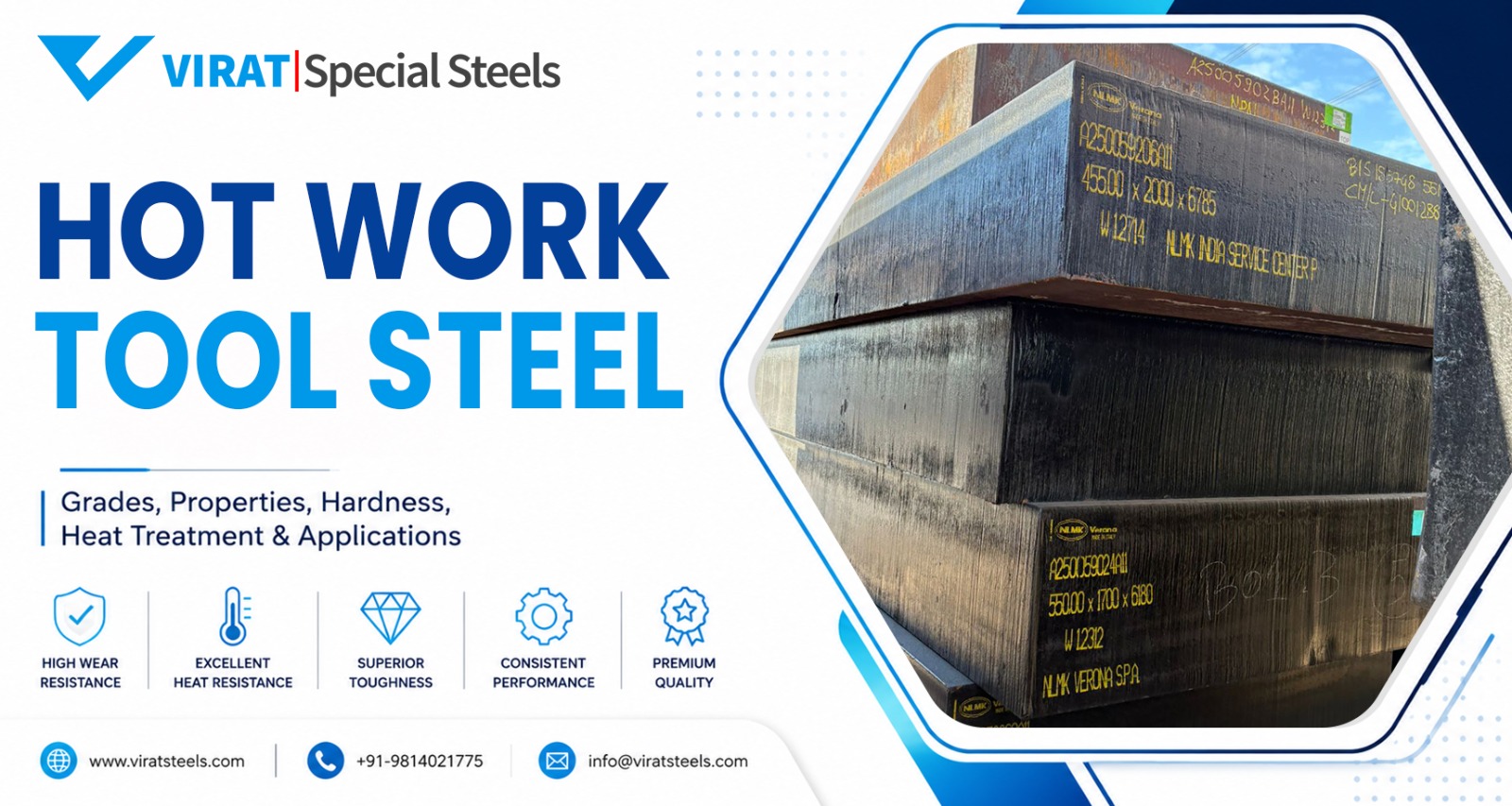
Hot work tool steel is designed for one purpose – to resist heat that would ruin common steel. It is the material behind the dies, molds, punches and blades that are hammered and squeezed and repeatedly heated and cooled – in die casting, forging, extrusion, hot stamping and hot shearing.
And what makes it different is easy to say and hard to engineer. It keeps its hardness, toughness, strength and dimensional stability, even when it’s hot. The most common grades you’ll come across are H13 (DIN 1.2344), H11 (DIN 1.2343) and DB6 (DIN 1.2714) — which one you need depends on your operating temperature, impact load, die size and how long you want the tool to last.
What Is Hot Work Tool Steel?
It’s an alloy tool steel for tools that get hot and cycle between hot and cold, again and again. It must be a combination of hot hardness, toughness, wear resistance, thermal-fatigue resistance and dimensional stability — all at the same time.
The Three Grades You Should Know:
- H13 / DIN 1.2344 – the go-to grade for die casting, aluminum extrusion and hot forging.
- H11 / DIN 1.2343 — good balance of toughness and hot strength, for forging and extrusion.
- DB6 / DIN 1.2714 – the choice for large forging dies, hammer dies and heavy-impact work where toughness is the most important property.
The final choice should always be based on the application and the steel maker’s datasheet, not on a general guide like this.
Hot work tool steel is a high-alloy steel for tooling operating at temperatures above about 200°C. Hot work grades are designed to resist the direct action of molten metal and hot workpieces, as opposed to cold-work steels, which are designed for cutting and forming at room temperature.
You will find it in aluminum and brass die-casting dies, forging dies, extrusion dies, hot shear blades, punches, mandrels, hot trimming dies, glass molds and copper alloy dies. It is their resistance to heat checking, deformation and softening that keeps these tools dimensionally stable and working reliably, cycle after cycle.
Popular Hot Work Tool Steel Grades
| Steel Grade | DIN Standard | Equivalent | Common Applications |
| H13 | 1.2344 | AISI H13 / JIS SKD61 | Die casting, forging, aluminium extrusion |
| H11 | 1.2343 | AISI H11 / JIS SKD6 | Forging dies, aluminium dies, extrusion |
| DB6 | 1.2714 | No exact AISI match; closest reference ~L6 | Hammer dies, press dies, forging dies |
| H21 | 1.2581 | AISI H21 | High-temperature tooling |
| H10 | 1.2365 | AISI H10 | Hot-work applications |
| H12 | 1.2606 | AISI H12 | Hot-work applications |
Mechanical Properties
| Property | H13 | DB6 |
| Density | 7.75–7.85 g/cm³ | 7.70–7.85 g/cm³ |
| Tensile Strength | 1550–2100 MPa | High |
| Hardness | 44–54 HRC | 38–42 HRC (working); refer to supplier datasheet |
| Toughness | Excellent | Excellent |
| Wear Resistance | Excellent | Excellent |
| Thermal Fatigue Resistance | Excellent | Excellent |
Chemical Composition
The alloying elements are what actually give hot work tool steel its personality — hardness, toughness, wear resistance and how it behaves under heat.
| Element | H13 (%) | DB6 (%) |
| Carbon (C) | 0.32–0.45 | 0.50–0.60 |
| Silicon (Si) | 0.80–1.25 | 0.10–0.40 |
| Manganese (Mn) | 0.20–0.60 | 0.65–0.95 |
| Chromium (Cr) | 4.75–5.50 | 1.00–1.20 |
| Molybdenum (Mo) | 1.10–1.75 | 0.45–0.55 |
| Vanadium (V) | 0.80–1.20 | 0.07–0.12 |
| Nickel (Ni) | — | 1.50–1.80 |
Hardness (HRC Scale)
Hardness is usually the first thing buyers ask about and it is really a trade-off push hardness up and you get wear resistance but you risk giving up toughness and a tool that is too hard cracks before it wears out.
| Grade | Typical Working Hardness |
| H13 | 44–54 HRC |
| H11 | 42–50 HRC |
| DB6 (1.2714) | 38–42 HRC |
DB6 is designed for lower working hardness than H13 tool steels – it is selected for hammer and large forging dies because it sacrifices some wear resistance for superior toughness, so it is tempered back further to prevent cracking under heavy impact.
Tip: The right hardness is not the hardest, it is the one that works for your application and duty cycle. Always verify the exact range with the datasheet of your supplier, as this may differ with section size and delivery condition.
How Hot Work Tool Steel Is Made
Good performance from hot work tool steel is not just a matter of choosing the right grade on paper – it is a matter of how well the steel was melted, forged, heat treated and inspected along the way.
1. Raw Material Selection
Everything starts with the alloying mix, and each element earns its place:
| Element | Main Function |
| Carbon | Hardness and strength |
| Chromium | Wear resistance and hardenability |
| Molybdenum | High-temperature strength |
| Vanadium | Grain refinement and wear resistance |
| Nickel | Toughness |
| Silicon | Strength and heat resistance |
| Manganese | Strength and hardenability |
2. Smelting & Refining
The steel is melted in an Electric Arc Furnace (EAF) and then further refined to the desired chemistry and cleanliness.
Ladle refining improves alloy composition, controls temperature and reduces contamination
Vacuum degassing removes dissolved gasses, mainly hydrogen, leading to better toughness, improved fatigue life, fewer internal defects and a more reliable material overall.
3. Electro-Slag Remelting (ESR)
ESR is a must when cleanliness and consistency counts. It provides a more homogeneous microstructure, better toughness and fatigue life, less segregation and a significantly improved polishability – which is why ESR grades are found in precision dies, high pressure die casting and plastic molds.
4. VAR (Vacuum Arc Remelting)
For the most demanding applications VAR takes purity one step further – lower inclusion levels, more uniform microstructure and better fatigue resistance.
5. Ingots casting
Molten steel is poured into ingots before forging, under controlled solidification conditions to minimize segregation and shrinkage.
6. Forging
Forging turns the cast ingot into dense blocks and bars by controlled heating and deformation. It increases the toughness, the grain structure, the internal flaws and gives more consistent mechanical properties to the material. Typical outputs are forged blocks, die blocks, round bars, flat bars and ESR blocks.
7. Annealing
Annealing is the process that softens the steel for machining and preparation for hardening — heat, soak evenly, then cool in a controlled fashion.
| Grade | Approx. Annealed Hardness |
| H13 | 190–230 HB |
| H11 | 180–230 HB |
| DB6 (1.2714) | 255 HB max |
Hardening is the method by which steel is given strength and wear resistance. It involves controlled pre-heating, austenitising, soaking and controlled cooling or quenching.
| Grade | Typical Austenitizing Range |
| H13 | 1,020–1,050°C |
| H11 | 1,000–1,030°C |
| DB6 (1.2714) | ~850–900°C (typical for this Ni-Cr-Mo grade; noticeably lower than the Cr-Mo-V H-series) |
DB6 is a lower alloy nickel chromium molybdenum steel and hardens at a substantially lower temperature than H13 or H11. Always stick to the manufacturer’s datasheet for the exact cycle – especially if you are working with large sections where getting this wrong is expensive.
9. Tempering
Tempering is done after hardening to reduce brittleness and to obtain the final balance between hardness and toughness. It relieves residual stress, increases toughness and helps dimensional stability. Depending on the grade, multiple cycles of tempering may be utilized.
Heat Treatment at a Glance
| Stage | Purpose |
| Annealing | Improve machinability |
| Stress Relieving | Reduce machining stresses |
| Hardening | Increase hardness and strength |
| Tempering | Improve toughness and stability |
| Final Inspection | Verify required properties |
10. Quality Inspection
The material is examined from every point of view before being shipped:
Ultrasonic Testing (UT) — identifies internal cracks, inclusions, laminations and shrinkage-related defects, especially important on large forged blocks.
Chemical composition testing – a spectrometer tests carbon, chromium, molybdenum, vanadium, nickel, silicon, manganese, sulfur and phosphorus against the specified grade.
Hardness and dimensional inspection: Rockwell or Brinell testing, checks of length, width, thickness, flatness, squareness, straightness and surface finish.
11. MTC (Material Test Certificate)
An MTC links grade, heat number, chemical composition, mechanical properties, hardness, heat-treatment condition, inspection results and manufacturer details. It provides buyers with a paper trail they can verify.
| Document / Test | Purpose |
| MTC / EN 10204 3.1 | Material traceability and test results |
| UT Report | Internal quality verification |
| Spectrometer Report | Chemical composition |
| Hardness Report | Hardness verification |
| Heat Number | Batch traceability |
| Dimensional Report | Size verification |
Where Hot Work Tool Steel Is Used
Aluminum diecast molds H13 tool steel is the material of choice here because it can be repeatedly heated and cooled without losing dimensional stability – think engine blocks, gear housings, transmission components, pump bodies, LED housings and other automotive parts.
Hot-forging dies They are pounded by impact loads and heat, which is why DB6 and H11—valued for toughness and resistance to thermal cracking—are the usual choices. Common on crankshafts, connecting rods, railroad components and heavy engineering components.
Extrusion Dies High hot strength and wear resistance is needed to keep profiles – used for aluminum profiles, window frames, heat sinks and electrical conductors.
Brass and copper die cast. These alloys run hotter than aluminum so H13 and H11 earn their keep with better hot hardness.
Hot shear blades, for cutting red-hot blooms, billets and bars in rolling mills;
Hot punches, made for hot piercing, making and punching where wear and impact resistance both count.
Glass molds on the basis of thermal stability and resistance to heat checking.
Plastic mold parts: ESR H13 material tool preferred for polishability and wear resistance.
Industries That Rely on It
| Industry | Applications |
| Automotive | Die casting, forging |
| Aerospace | Forging tools |
| Defence | Heavy-duty dies |
| Railways | Forged components |
| Aluminium | Extrusion dies |
| Plastic Moulding | Mould inserts |
| Steel Plants | Hot shear blades |
| Heavy Engineering | Forging tools |
| Energy | Turbine & valve tooling |
Hot Work vs. Cold Work vs. Plastic Mould Steel
| Feature | Hot Work Tool Steel | Cold Work Tool Steel | Plastic Mould Steel |
| Primary Use | High-temperature tooling | Room-temperature cutting/forming | Plastic injection & moulding |
| Operating Temperature | High | Low to moderate | Low to moderate |
| Key Property | Hot hardness & thermal fatigue resistance | Wear resistance & hardness | Toughness, polishability & machinability |
| Important Grades | H13, H11, DB6 | D2, D3, EN31 | P20, P20+Ni, 1.2083 |
| Common Applications | Die casting, forging, extrusion | Dies, punches, blanking, shear blades | Injection moulds, plastic moulds |
| Typical Hardness | 44–54 HRC | 55–62 HRC | 28–52 HRC |
| Main Advantage | Retains strength at elevated temperatures | Excellent wear & edge retention | Good machinability and surface finish |
| Typical Industries | Automotive, forging, die casting | Tool & die, automotive, engineering | Plastic, packaging, automotive |
| Parameter | H13 | DB6 |
| Type | Chromium hot work steel | Nickel-chromium-molybdenum tool steel |
| Hardness | 44–54 HRC | 38–42 HRC |
| Toughness | Excellent | Outstanding |
| Wear Resistance | Higher | Moderate |
| Thermal Fatigue | Excellent | Very good |
| Large Dies | Good | Excellent |
| Forging Applications | Very good | Excellent |
| Impact Resistance | Good | Superior |
| Aluminium Die Casting | Excellent | Good |
H13/DB6 comparison table in die casting and extrusion; go with DB6 for large forging dies, hammer dies and heavy-impact work.
Advantages & Limitations
| Advantages | Limitations |
| Excellent hot hardness | Higher material cost |
| High thermal fatigue resistance | Needs proper heat treatment |
| Excellent toughness | Harder to machine once hardened |
| Good wear resistance | Limited corrosion resistance |
| Good machinability when annealed | Large sections need controlled processing |
| Excellent dimensional stability | |
| Long tool life |
How to Choose the Right Grade
1. Match the grade to the application.
| Application | Recommended Grade |
| Aluminium die casting | H13 (1.2344) |
| Brass die casting | H13 |
| Hot forging dies | H11 (1.2343) |
| Hammer dies | DB6 (1.2714) |
| Extrusion dies | H13 |
| Plastic mould inserts | ESR H13 |
| Large forging blocks | DB6 |
Get the size right. Think about how long it’s how wide it is, how thick it is, Think about length, width, thickness, weight, machining allowance, and expected dimensional change during heat treatment.. Available forms include forged blocks, round bars, flat bars, ESR blocks and pieces that are already cut to size.
Settle on a delivery condition with your supplier — annealed, pre-hardened, hardened and tempered, soft annealed, or stress relieved. With your supplier.
Check the quality before you make a decision. Ask for testing results, spectrometer reports, material test certificates, heat-number traceability and confirmation of surface finish, straightness and mechanical properties.
Plan the amounts you need based on prototypes, regular production, yearly use, extra stock and any growth that is coming up.
Choose a supplier who can support you. One that has stock, imported materials, forged and ESR blocks, fast delivery, technical help, certificates and custom machining.
Certifications Worth Looking For
| Certification | Purpose |
| ISO 9001 | Quality management system |
| EN 10204 3.1 | Material test certificate |
| Ultrasonic Testing (UT) | Detects internal defects |
| Spectrometer Analysis | Verifies chemical composition |
| Hardness Test Report | Confirms HRC/HB values |
| Heat Number Traceability | Tracks production batch |
Why Manufacturing Quality Matters
How the steel is made has a direct line to how it performs on the shop floor. Controlled melting, refining, forging, annealing, hardening, tempering and inspection are what separate a die that lasts from one that fails early — particularly in die casting, hot forging, aluminium extrusion and heavy-duty tooling, where the cost of a bad batch shows up fast.
Key Takeaways
- Controlled melting and refining keep the chemistry consistent.
- Forging improves structural uniformity and toughness.
- Annealing gets the material ready for machining.
- Hardening builds the strength and hardness.
- Tempering balances hardness against toughness.
- UT, chemical analysis, hardness testing and dimensional inspection confirm quality before shipping.
- MTCs and heat-number traceability give buyers the documentation they need.
Why Choose Virat Special Steels?
Virat Special Steels Pvt. Ltd. has been supplying manufacturers with quality imported tool steels for over 70 years.
- Over 70 years of industry experience.
- 3,500+ tons of tool steel in stock, ready to use
- Sourced from established international mills.
- “Wide grade range: H13, H11, DB6, D2, D3, P20, M2, M35, and ESR grades“.
- “Every order comes with an EN 10204 3.1 MTC”
- “UT and spectrometer testing on all material”
- “Cut-to-size and custom machining available”
- “Fast delivery across India”
- “Trusted by automotive, forging, aerospace, plastic moulding, railway, and heavy engineering customers”.
Our Supply Network Across India
We supply H13, DB6, H11, H12, H10 and H21 across major industrial hubs — Delhi, Gurugram, Faridabad, Noida, Ghaziabad, Jaipur, agra, Ahmedabad, Vadodara, Surat, Rajkot, Mumbai, Pune, Nashik, Indore, Bhopal, Rudrapur , Chennai, Coimbatore, Hyderabad, Kolkata, Jamshedpur, Secunderabad and Nellore — with standard and custom sizes, cut-to-size material, annealed or heat-treated condition, and material test certificates as required.
Conclusion
H13 and DB6 remain the two most dependable choices for high-temperature tooling, offering a solid mix of hardness, toughness, wear resistance, hot strength and thermal-fatigue resistance. Get the grade selection, heat treatment, machining and maintenance right, and both can deliver excellent tool life. We supply H13, DB6 and other tool steel grades across major industrial cities in India for a wide range of manufacturing needs.
Get a Quote
Looking for reliable H13, DB6 or other hot work tool steel? Virat Special Steels supplies round & flat bars, forged & rolled blocks, ESR/non-ESR blocks and cut-to-size material — complete with MTC, UT testing, spectro testing, custom machining, ready stock and PAN India delivery.
Call: +91-98140 21775 Email: info@viratsteels.com Locations: Gurgaon (Haryana) | Ludhiana (Punjab)
Frequently Asked Questions
1. What is Hot Work Tool Steel?
Alloy steel for tools and dies exposed to high temperatures, thermal cycling, wear and mechanical stress.
2. What are the primary types?
Typical grades are H13, H11, H12, H10 and H21 – H13 tool is the most common.
3. H13 tool steel – what is it?
A hot work Cr-Mo-V grade that is known for its excellent hot strength, toughness, wear resistance and thermal-fatigue resistance.
4. What is the HRC of H13?
44-54 HRC depending on the application and heat treatment condition.
5. What is the maximum service temperature of H13?
Typically up to around 550–600°C, depending on load, thermal cycling and cooling conditions. Confirm the exact limit with your supplier’s datasheet.
6. Is H13 material good for high temperature applications?
Yes, it is used heavily where there is high heat and heating and cooling over and over again.
7. Can H13 be machined?
Yes, if annealed. It is much more difficult to machine once hardened.
8. How to Improve H13 Machinability?
Use proper cutting tools. Use appropriate speeds and feeds. Use adequate cooling. Machine in the annealed state where possible.
9. What is H13 used for?
Die casting dies, extrusion dies, forging dies, hot punches, mandrels and other similar hot work tooling.
10. H13 wear resistant?
Yes, if they are heat treated properly and matched to the proper operating conditions.
11. Is H13 hard enough?
Yes, gives a good balance of hardness and toughness which is what you need in demanding die work.
12. What is resistance to thermal fatigue?
It’s the ability of the steel to be heat cycled over and over again without heat checking or cracking.
13. Is H13 heat treatable?
Yes. Usually it is hardened and tempered so that it can obtain the desired hardness, toughness and hot strength.
14. Is H13 air hardenable?
Yes, which means it can achieve high hardness by means of appropriate heat treatment without a drastic quench.
15. Can H13 be used for nitriding?
Yes, nitriding can improve surface hardness, wear resistance and die life in suitable applications.
16. What is the chemical composition of H13?
Carbon, silicon, manganese, chromium, molybdenum and vanadium. Chromium, molybdenum and vanadium do most of the work.
17. What is the difference between H11 and H13?
Both are hot working grades but H13 tool steels gives generally a better combination of hot hardness, wear resistance, toughness and thermal-fatigue resistance.
18. What’s the difference between H13 and D2?
D2 is a cold-work grade built primarily for high wear resistance. H13 tool steel is a hot-work grade.
19. Is H13 tool steels appropriate for die casting dies?
Yes, it is widely used for aluminum, zinc and magnesium die casting because of its resistance to thermal fatigue and its hot strength.
20. Can H13 tool steels be used for hot extrusion die?
Yes, commonly used for extrusion dies, mandrels and related tooling.
H13 vs H11 Tool Steel – Complete Comparison (Properties, Hardness, Applications, Price & Selection Guide)
H13 vs H11 Tool Steel, Which One Should You Choose?
Walk into any tool room, forging shop, or die manufacturing unit in India, and you’ll hear the same debate.
“Should this die be made from H13 or H11?”
At first glance, both steels look nearly the same. They are both part of the Hot Work Tool Steel family, contain chromium and molybdenum, and are built to perform in extreme temperatures. However, choosing the wrong material can significantly decrease die life.
- Choose H13 where H11 should have been used, and the die may crack under repeated impact.
- Choose H11 where H13 belongs, and excessive wear can shorten production life.
This complete guide explains everything you need to know before selecting either grade.
You’ll learn about:
- H13 vs H11 Chemical Composition
- Hardness Comparison
- Mechanical Properties
- Heat Treatment
- Price Comparison
- Tool Life
- Equivalent Grades
- Applications
- Availability in India
- Supplier Selection Guide
- 25+ Frequently Asked Questions
H13 vs H11 Tool Steel – Quick Comparison
| Property | H13 (DIN 1.2344 / SKD61) | H11 (DIN 1.2343 / SKD6) |
| Main Strength | Excellent wear resistance and hot hardness | Great toughness and impact resistance |
| Wear Resistance | Excellent | Very Good |
| Toughness | Very Good | Excellent |
| Hot Hardness | Excellent | Very Good |
| Resistance to Thermal Fatigue | Excellent | Very Good |
| Shock/Impact resistance | Excellent | Good |
| Machinability (Annealed) | Better | Moderate |
| Maximum Working Hardness | Up to 54 HRC | Up to 52 HRC |
| Typical Working Hardness | 44–48 HRC | 42–46 HRC |
| Best Suited For | Die Casting, Extrusion Dies, Plastic Moulds | Forging Dies, Hammer Dies, Fastener Tooling |
| Relative Tool Life | Longer in wear-intensive applications | Longer in impact-intensive applications |
| Relative Cost | 10–20% Higher | More Economical |
| Best Choice When | Heat, wear and long production runs are the priority | High impact, shock loading and toughness are the priority |
What is H13 Tool Steel?
H13 Tool Steel (DIN 1.2344, SKD61) is one of the world’s most widely used chromium hot work tool steels.
Its high vanadium content forms extremely hard carbides that improve:
- Wear resistance
- Hot hardness
- Heat checking resistance
- Tool life
- Surface finish
This makes H13 the preferred steel for:
- Aluminium Die Casting Dies
- Zinc Die Casting
- Plastic Injection Moulds
- Extrusion Dies
- Hot Shear Blades
- Forging Punches
What is H11 Tool Steel?
H11 Tool Steel (DIN 1.2343, SKD6) is also a Hot Work Tool Steel, but with a lower vanadium content.
The lower carbide volume gives H11:
- Better toughness
- Better impact resistance
- Better crack resistance
- Easier machining
It is commonly selected for:
- Hammer Dies
- Forging Dies
- Fastener Tooling
- Hand Tool Dies
- Heavy Stamping
Comparison of Chemical Composition H13 vs H11 Tool Steel
| Element | H13 (DIN 1.2344) | H11 (DIN 1.2343) |
| Carbon | 0.32–0.45% | 0.33–0.43% |
| Chromium | 4.75–5.50% | 4.75–5.50% |
| Molybdenum | 1.10–1.75% | 1.10–1.60% |
| Vanadium | 0.80–1.20% | 0.30–0.50% |
| Silicon | 0.80–1.20% | 0.80–1.20% |
| Manganese | 0.20–0.50% | 0.20–0.50% |
Main Difference:
The H13 with higher vanadium content has much better wear resistance and longer tool life.
Mechanical Property Comparison
| Property | H13 | H11 |
| Wear Resistance | Excellent | Good |
| Toughness | Good | Excellent |
| Hot Hardness | Excellent | Good |
| Thermal Fatigue | Excellent | Very Good |
| Heat Checking Resistance | Excellent | Very Good |
| Impact Resistance | Good | Excellent |
| Machinability | Moderate | Better |
| Polishability | Excellent | Good |
Hardness Comparison
| Condition | H13 | H11 |
| Annealed | 180–220 HB | 180–220 HB |
| Working Hardness | 44–52 HRC | 42–50 HRC |
| Maximum Practical Hardness | 54 HRC | 52 HRC |
Heat Treatment Process
1. Preheating (650–750°C)
2. Austenitizing
o H13: 1010-1025 °C
3. Air, Oil, or Vacuum Quenching
4. Double or Triple Tempering (550-650 °C)
Vacuum heat treatment is recommended for precision dies to minimise distortion.
One of the most asked questions from buyers is:
“What’s the cheapest steel?
Generally,
Why?
- Higher Vanadium content
- Better wear resistance
- Longer production life
- Higher performance in die casting applications
Although the initial purchase price is higher, H13 often delivers a lower cost per component because of its longer service life.
Price depends on:
- ESR or Conventional Grade
- Forged or Rolled Material
- Imported or Domestic Mill
- Size
- Heat Treatment
- Quantity
No fixed market price exists, so always request a quotation based on current stock.
H13 vs H21
| Feature | H13 | H21 |
| Toughness | Better | Lower |
| Hot Hardness | Excellent | Outstanding |
| Wear Resistance | Excellent | Excellent |
| Typical Use | Die Casting | Hot Forging & Extreme Heat |
H13 vs DIN 1.2367
| Property | H13 | 1.2367 |
| Toughness | Excellent | Higher |
| Hot Strength | Excellent | Excellent |
| Large Forging Dies | Good | Better |
There is virtually no practical difference. SKD61 is the Japanese JIS designation equivalent to AISI H13 and DIN 1.2344. Selection should focus on material quality, cleanliness, ESR option, testing, and supplier reliability rather than the grade designation alone.
H13 vs DB6
| Feature | H13 | DB6 |
| Type | Hot Work | Hot Work |
| Toughness | Excellent | Very High |
| Nickel Content | No | Yes |
| Large Forging Dies | Good | Excellent |
| Heavy Impact | Good | Better |
Tool Life Comparison
| Application | Better Grade |
| Die Casting | H13 |
| Extrusion | H13 |
| Plastic Moulds | H13 |
| Hammer Dies | H11 |
| Forging Dies | H11 |
| Heavy Impact Tools | H11 |
H13 & H11 Equivalent Grades
H13 and H11 are common hot work tool steels, but they have different names depending on the international standard used. Use the table below to identify the equivalent grades used in different countries.
| Standard | H13 Equivalent | H11 Equivalent |
| AISI (USA) | H13 | H11 |
| DIN / EN (Germany) | 1.2344 / X40CrMoV5-1 | 1.2343 / X38CrMoV5-1 |
| JIS (Japan) | SKD61 | SKD6 |
Sizes Available
H13 (DIN 1.2344 / SKD61) and H11 (DIN 1.2343 / SKD6) tool steel are available in a wide range of sizes to suit different tooling applications.
| Product Form | Available Sizes |
| Round Bars | Ø13 mm to Ø500+ mm |
| Flat Bars | Thickness: 20–305 mm, Width: 50–600 mm |
| Cut-to-Size Blocks | As per customer drawing and specifications |
Custom sizes and large forged sections can also be supplied based on project requirements.
| Property | Conventional | ESR |
| Cleanliness | Good | Excellent |
| Inclusion Level | Higher | Lower |
| Polishability | Good | Excellent |
| Fatigue Life | Better | Best |
| Tool Life | Longer | Longest |
ESR H13 is recommended for premium die casting and mould applications requiring maximum reliability.
Industries Using H13
- Aluminium Die Casting
- Zinc Die Casting
- Plastic Injection Moulding
- Extrusion
- Aerospace
- Automotive
- Pressure Die Casting
- Hot Shear Blades
Industries Using H11
- Forging
- Hammer Dies
- Fastener Manufacturing
- Hand Tools
- Heavy Engineering
- Structural Components
Why Buy H13 or H11 from Virat Steels?
Virat Steels has been supplying premium tool steels to Indian manufacturers for 70+ years.
Why customers choose Virat Steels
- 70+ Years of Experience
- 2000+ Industrial Customers
- Supplier of material from reputed international mills
- Ready Stock Available
- Mill Test Certificate (MTC)
- UT Tested Material
- Spectro Tested Material
- PAN India Delivery
- Custom Cutting
- Fast Dispatch
- Technical Material Recommendation
Whether you’re looking to Buy H13 Steel, Buy H11 Steel, DIN 1.2344, DIN 1.2343, SKD61, SKD6, ESR H13, or Forged H13 Blocks, our team can recommend the right material based on your application
Our Supply Network Across India
Virat Steels is a trusted supplier of Hot Work Tool Steel to customers across the major industrial hubs of India including Ahmedabad, Rajkot, Pune, Nashik, Aurangabad, Kolhapur, Belgaum, Chennai, Coimbatore, Hosur, Bengaluru, Hyderabad, Faridabad, Manesar, Bhiwadi, Gurugram, Delhi NCR, Ludhiana, Chandigarh, Haryana, Punjab, Jamshedpur.
Our strong logistic network and efficient distribution system enable us to ensure timely PAN India dispatch to meet the requirement of tool rooms, die manufacturers, forging industries and engineering companies across the country.
- H13 Tool Steel
- H11 Tool Steel
- DIN 1.2344 Tool Steel
- DIN 1.2343 Tool Steel
- ESR Tool Steel
- Plastic Mould Steel
- Hot Work Tool Steel
- Forged Tool Steel Blocks
Download Free PDF:
H13 vs H11 Tool Steel Comparison Guide
https://www.viratsteels.com/downloads/h13-vs-h11-comparison.pdf
Request a Quote
Searching for the right Hot Work Tool Steel?
Our technical team can suggest the correct grade for your application whether you require H13, H11, DIN 1.2344, DIN 1.2343, SKD61, SKD6, ESR H13 or Forged H13 Blocks.
Request a Quote Today
✔ Material Recommendation
✔ Ready Stock
✔ MTC Available
✔ UT Tested
✔ Spectro Tested
✔ PAN India Delivery
Call us or send your drawing to receive a customised material recommendation.
Call us: +91-98140 21775 Email: info@viratsteels.com Visit us: Gurgaon (Haryana) | Ludhiana (Punjab)
FAQs (Frequently Asked Questions)
1. What is the difference between H11 and H13 tool steel?
H11 is tougher and more impact resistant while H13 has more wear resistance, hot hardness and resistance to thermal fatigue.
2. Which steel is best for aluminum die casting dies?
H13 is generally preferred as it has a longer die life and is more resistant to heat checking.
3. What grade is recommended for hot forging dies?
H11 is often chosen for heavy-impact forging work and H13 is appropriate for moderate-impact forging applications.
4. What are the common industries that use H11 and H13 tool steel?
These grades are widely used in die casting, forging, extrusion, automobile, aerospace, plastic molding and general engineering industry.
5. What is the working temperature range of H13 tool steel?
H13 has good strength and hardness up to about 600°C and is used for hot working.
6. Is H11 impact strength better than H13?
Yes. H11 has a lower vanadium content which makes it tougher and more resistant to impact loading.
7. Which tool steel has better dimensional stability in heat treatment?
H13 generally has better dimensional stability when properly heat treated.
8. Is it possible to nitride H11 and H13?
Yes. Both grades can be nitrided to increase surface hardness and wear resistance.
9. What is the best grade for extrusion tooling?
H13 is most often recommended for aluminum extrusion dies as it has the best hot strength and wear resistance.
10. Are H11 and H13 available on forged blocks?
Yes. Both grades are available as forged blocks, rounds, flats and in customer specific sizes.
11. What inspections are performed before dispatch?
Material usually comes with Spectro Test Reports, Ultrasonic Testing (UT), Material Test Certificates (MTC), and hardness testing if requested.
12. Can H11 and H13 be supplied in pre-hardened condition?
Yes. Based on customer needs, both grades can be offered annealed, pre-hardened, or heat-treated.
13. Which grade is easier to polish?
H13 generally provides an excellent polished finish, making it good for high-quality tooling applications.
14. Are H11 and H13 suitable for plastic mould applications?
Yes. H13 is commonly used for plastic moulds that work at high temperatures or need great wear resistance.
15. What shapes are available in H11 and H13 tool steel?
These grades come in round bars, flat bars, square bars, forged blocks, plates, and custom-cut sizes.
16. How do I choose between H11 and H13?
The choice depends on the application. Use H11 for maximum toughness, and H13 for better wear resistance and a longer service life.
17. What surface finish options are available?
Materials are available in black, peeled, rough machined, bright, or fully machined condition based on customer needs.
18. Can custom sizes be supplied?
Yes. Custom dimensions and cut-to-size materials are available to reduce machining time and material waste.
19. What certifications are available with the material?
Materials can come with Mill Test Certificates (MTC), chemical composition reports, mechanical property reports, and UT inspection certificates.
20. Does Virat Steels offer technical support in selecting tool steel?
Yes. Our technical team helps customers choose the right grade based on the application, operating temperature, and service conditions.
21. Does Virat Steels deliver across India?
Yes. We provide fast and dependable delivery across India to major industrial cities and manufacturing hubs.
22. How can I place an order with Virat Steels?
Just share your required grade, dimensions, quantity, or technical drawing with our sales team. We will recommend the right material, offer technical guidance, and provide a competitive quote.
Virat Steels-Trusted Tool & Die Steel Supplier in India
In the tool and die steel industry, quality material and reliable service are very essential for consistent production performance. Manufacturers today need more than just steel. Hence, they need a trusted supply partner.
That’s why industries across India choose Virat Special Steels for premium tool steel solutions.
With decades of domain expertise, the company serves high-quality tool & die steels industries ranging from automotive and aerospace to defence, tooling, and heavy engineering.
Premium Quality Steel
Virat Steels provide genuine and reliable tool steel with:
- Consistent hardness
- Better machinability
- Improved tool life
- Genuine quality
Available in:
✔ Rounds
✔ Flats
✔ Blocks
Ready Stock Availability
Ready stock available for major grades including:
ensuring quick dispatch and reduced downtime.
Ultrasonic Tested Material
Virat Steels supplies UT Tested Tool Steel
Ultrasonic testing helps detect:
- Internal defects
- Cracks
ensuring better reliability and performance.
Precision Cutting Facility
We offer precision cutting services for:
- Accurate dimensions
- Reduced machining allowance
- Faster processing
Helping customers save time and improve productivity.
Strong Logistics Support
We deliver across India with:
- Fast dispatch
- Safe handling
- Timely delivery
Supplying to major industrial regions across India .
Technical Support
Our team helps customers choose:
- Suitable steel grade
- Recommended Hardness
- ESR vs standard grades
- Application-based solutions
Certified & Test Report
- Material Test Certification (MTC)
Looking for a reliable tool and die steel supplier in India?
Contact Virat Special Steels:
📞 +91 98140-21775
🌐 www.viratsteels.com
✉ info@viratsteels.com
Frequently Asked Questions (FAQs)
1. What products does Virat Steels supply?
Virat Steels supplies premium tool and die steels including Hot work steels, cold work steels, High Speed steels, Alloy steel grades etc.
2. Which industries use tool and die steel?
Tool and die steels are widely used in Forging, Extrusion, Plastic moulds, Automotive components, Pressure Die casting .
3. Does Virat Steels provide ultrasonic tested material?
Yes, Virat Steels supplies UT tested material to ensure better reliability, reduced internal defects, and improved tooling performance.
4. Does Virat Steels maintain ready stock?
Yes, Virat Steels maintains ready stock of major tool steel grades for quick dispatch and faster delivery across India.
5. Why choose Virat Steels as a tool steel supplier?
Manufacturers choose Virat Steels because of Genuine quality, UT tested steel, Precision cutting facility, ready stock, fast delivery, technical support
6. Does Virat Steels deliver across India?
Yes, Virat Steels supplies tool and die steel across major industrial regions in India with reliable logistics and timely delivery support.
7. How can I contact Virat Steels for tool steel requirements?
You can contact Virat Steels on 📞 +91 98140-21775 for grade recommendations, stock availability, and pricing.
Hot Work vs Cold Work Tool Steel | H13 vs D2 | Virat Steels
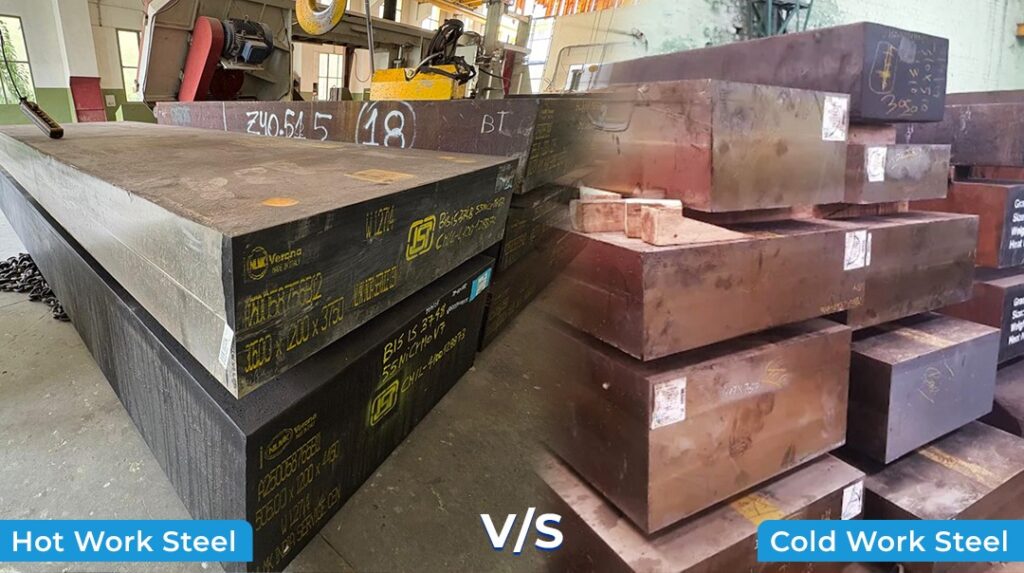
In tooling, one decision quietly determines tool life, rejection rate, and production cost: choosing the right tool steel.
Yet many failures on the shop floor come down to one mistake—using hot work steel where cold work is needed, or vice versa.
This guide will give you a clear, practical comparison between hot work and cold work tool steels—so you can make the right decision the first time.
Hot Work Tool Steel (For High Temperature Applications)
The most widely used grade: H13 tool steel
Best For:
- Aluminium die casting
- Forging dies
- Extrusion tools
- High-temperature moulds
Key Benefits:
✔ Handles extreme heat (200–700°C)
✔ Resists thermal cracking
✔ High toughness under load
Cold Work Tool Steel (For Wear Resistance)
A leading grade: D2 tool steel
Best For:
- Blanking & punching dies
- Shear blades
- Cold forming tools
- Sheet metal industry
Key Benefits:
✔ Very high hardness (up to 60+ HRC)
✔ Excellent wear resistance
✔ Long life in cutting operations
Hot Work vs Cold Work Steel — Quick Comparison
| Feature | Hot Work Steel (H13) | Cold Work Steel (D2) |
| Temperature | High | Low |
| Hardness | Medium | Very High |
| Toughness | High | Moderate |
| Wear Resistance | Medium | Very High |
| Heat Resistance | Excellent | Poor |
| Best Use | Die casting, forging | Cutting, punching |
Using the Wrong Steel? Here’s What Happens
- Cold work steel in hot application → Cracks & failure
- Hot work steel in wear application → Rapid wear & loss of accuracy
Result: Downtime, rejection, and higher cost per component
How to Choose the Right Tool Steel
Choose Hot Work Steel if:
- Temperature > 200°C
- Thermal cycling is involved
- Impact load is high
Choose Cold Work Steel if:
- Application is at room temperature
- Wear resistance is critical
- Cutting or shearing is involved
Industry-Wise Recommendation
| Industry | Recommended Steel |
| Die Casting | H13 |
| Forging | H13 / H11 |
| Sheet Metal | D2 |
| Blanking | D2 / D3 |
| Plastic Mould (High Temp) | H13 |
Increase Tool Life — Proven Methods
For Hot Work Steels:
- Use ESR quality material
- Apply nitriding
- Ensure proper preheating
- Control cooling cycles
For Cold Work Steels:
- Maintain correct hardness
- Use coatings (PVD)
- Avoid shock loading
- Ensure lubrication
Virat Steels — Your Tool Steel Partner
At Virat Steels, we help manufacturers reduce failure and increase tool life with the right material selection.
What You Get:
✔ Ready stock (rounds, flats, blocks)
✔ Ultrasonic tested material
✔ Fast delivery across India
✔ Technical guidance (not just supply)
FAQs?
1-Which is better: H13 or D2?
It depends on application.
- High temperature → H13
- High wear → D2
2-Can D2 be used for hot work?
No. D2 tool steel becomes brittle at high temperatures and may crack.
3-Does higher hardness mean better tool life?
Not always. Excess hardness reduces toughness and increases cracking risk.
4-What is the best steel for die casting?
H13 tool steel is the industry standard.
5. How does heat treatment differ between the two?
Hot work steels are heat-treated to maintain strength at high temperatures
Cold work steels are treated to achieve maximum hardness and wear resistance
6. Which is more expensive: hot work or cold work steel?
Hot work steels are often more expensive due to alloying elements and processing required for high-temperature performance.
7. What industries rely heavily on hot work steel?
Automotive forging, Aluminium die casting, Aerospace component manufacturing
8. What industries rely on cold work steel?
Sheet metal fabrication, Tool and die making, Packaging and appliance manufacturing
9. Which steel has longer tool life?
It depends on the application:
- Hot work steel lasts longer in high-temperature application.
- Cold work steel lasts longer in abrasive, low-temperature operations.
Get Expert Recommendation (Free Consultation)
Choosing the right steel can double your tool life.
- Stop tool failures before they happen.
- Choose the right steel with expert guidance from Virat Steels.
Share your application—we’ll recommend:
- Best grade with quality
- Ideal hardness
- Heat treatment process
Talk to our experts today:
🌐 viratsteels.com 📞 +91 98140-21775 ✉info@viratsteels.com
H13 vs D2 Steel – Which is Better for Hot Work vs Cold Work Dies?
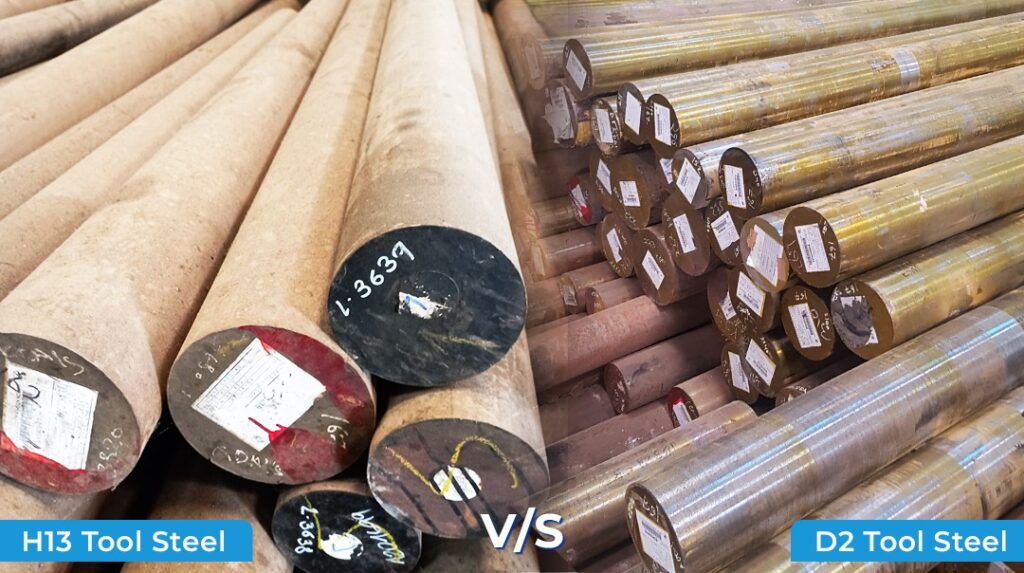
[The definitive guide to selecting the right die steel for forging, extrusion, stamping, and forming applications.]
In the tool and die manufacturing industry, selecting the right tool steel grade directly impacts die life, productivity, and cost efficiency. Among the most widely used grades, H13 tool steel and D2 tool steel are industry standards. but they’re specialists in different temperature.
At Virat Steels, we help manufacturers choose the right steel based on application, performance, and long-term value.
Understanding Tool Steel Categories
Tool steels are broadly classified into:
- Hot Work Tool Steel – Designed for high-temperature operations
- Cold Work Tool Steel – Used at room temperature for cutting and forming
What is H13 Steel? (Hot Work Tool Steel)
H13 steel (DIN 1.2344 / SKD61) is a chromium-molybdenum hot work tool steel known for its ability to withstand extreme heat and thermal cycling.
Key Properties:
- Excellent hot hardness & thermal fatigue resistance
- High toughness and crack resistance
- Strong performance under repeated heating & cooling cycles
H13 retains hardness even above 500°C, making it ideal for high-temperature applications.
Applications:
- Die casting dies
- Hot forging dies
- Extrusion tooling
- Injection mould cores
H13 is the best choice for hot work dies where heat resistance and durability are required.
What is D2 Steel? (Cold Work Tool Steel)
D2 steel is a high carbon, high chromium cold work tool steel designed for maximum wear resistance and hardness.
Key Properties:
- Very high wear resistance
- High hardness (up to 62 HRC)
- Excellent edge retention
- Good dimensional stability
Applications:
- Cold stamping dies
- Blanking and punching tools
- Shear blades
- Cutting tools
D2 performs best in low-temperature, high-wear environments.
H13 vs D2 Steel — Detailed Comparison
| Property | H13 Tool Steel (Hot Work) | D2 Tool Steel (Cold Work) |
| Type | Hot work steel | Cold work steel |
| Hardness | Medium (48–52 HRC) | Very high (58–62 HRC) |
| Heat Resistance | Excellent | Poor at high temperature |
| Wear Resistance | Good | Excellent |
| Toughness | High | Moderate |
| Thermal Fatigue | Excellent | Low |
| Best Use | Hot dies & high-temp tools | Cutting, stamping & cold dies |
Key difference:
- H13 = Heat resistance + toughness
- D2 = Wear resistance + hardness
When to Choose H13 Steel?
Choose H13 tool steel when your application involves:
- High operating temperatures
- Continuous heating & cooling cycles
- Risk of thermal cracking
Typical industries:
- Automotive die casting
- Aluminium extrusion
- Forging industries
H13 provides longer die life and reduced downtime in hot work applications.
When to Choose D2 Steel?
Choose D2 steel when your requirement is:
- High wear resistance
- Sharp cutting edges
- Dimensional stability
Typical industries:
- Sheet metal stamping
- Tool manufacturing
- Cold forming operations
D2 provides superior wear life in cold work applications.
H13 vs D2: Which One is Better?
The H13 vs D2 decision comes down to one primary question: Will your die contact hot workpieces above 200°C?
If the answer is yes: if you’re doing die casting, hot forging, or extrusion, then H13 is your steel. Its thermal fatigue resistance is unmatched in the tool steel sector, and using D2 in these applications will result in catastrophic heat checking and premature failure.
If the answer is no: if your application is stamping, blanking, forming, or precision cold work, then D2 is almost always the superior choice. Its wear resistance, dimensional stability during hardening, and edge-holding capability far exceed what H13 can deliver at ambient temperatures.
In simple terms:
- Heat present? → Go with H13
- Only wear & cutting? → Go with D2
Why Choose Virat Steels for Tool Steel?
At Virat Steels, we supply premium quality:
- H13 tool steel (hot work applications)
- D2 tool steel (cold work applications)
- Custom-cut tool steel blocks
- Ultrasonic tested materials for reliability
What sets us apart:
- Consistent quality & certified grades
- Fast delivery across industrial hubs
- Technical guidance for grade selection
We don’t just supply steel—we help you choose the right steel for maximum performance.
Frequently Asked Questions –
1. Can D2 steel be used for hot work applications?
No. D2 is not suitable for hot work. It becomes brittle at high temperatures and cracks under thermal cycling. For applications above 200–250°C, use H13 or other H-series steels.
2. Is D2 or H13 harder?
D2 is harder (up to 62 HRC) than H13 (up to ~54 HRC). However, H13 performs better in high-temperature conditions due to its toughness.
3. What is the difference between H13 and H11?
H13 has higher wear resistance and hot strength, while H11 offers slightly better toughness. H13 is more commonly used for die casting and forging.
4. Is D2 the same as Cr12MoV?
Almost. Cr12MoV is the Chinese equivalent of D2 with very similar composition and performance, and they are generally interchangeable.
5. How do I weld H13 steel die inserts?
Preheat to 300–400°C, use matching filler wire, maintain temperature, and cool slowly. Post-weld tempering is essential. Welding D2 is not recommended due to crack risk.
Final Thoughts
Choosing between H13 vs D2 steel depends entirely on your application:
- H13 dominates in heat-intensive operations
- D2 leads in wear-intensive, cold conditions
Making the right choice can significantly improve: Tool life , Production efficiency, Overall cost savings.
Need D2 or H13 for Your Next tool steels project?
Get a fast quote — certified stock, ready to dispatch across India:
www.viratsteels.com | 📧 info@viratsteels.com | 📱 +91 98140-21775
P20 vs H13 — Best Choice for Long-Run Plastic Moulds Plastic Mould Steel · Grade Comparison · Virat Special Steels
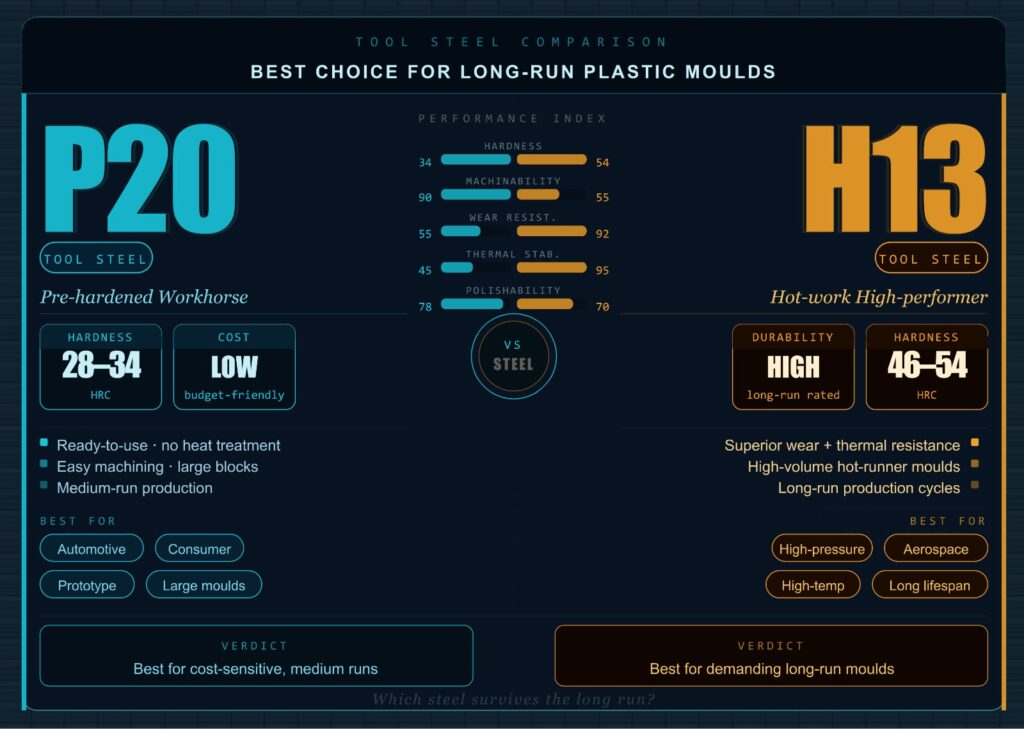
A practical, application-first guide for mould makers, tool rooms, and procurement teams choosing between two most popular plastic mould steel grades.
Choosing the wrong mould steel doesn’t just cost money — it costs production runs, surface finish quality, and mould life. Here’s how to pick the right one.
At a Glance: P20 vs H13
The table below gives a side-by-side view of both grades across the most critical properties mould buyers evaluate:
| P20 Steel Pre-hardened Mould Steel | H13 Steel Hot Work Tool Steel |
|---|---|
| Hardness 28–34 HRC (pre-hardened) | Hardness 44–52 HRC |
| Toughness High | Toughness Very High |
| Polishability Good | Polishability Excellent |
| Machinability Excellent | Machinability Moderate |
| Mould Life Up to 5,00,000 shots | Mould Life 10,00,000+ shots |
| Heat Treatment Not required | Heat Treatment Required (vacuum) |
| Tool Cost Lower | Tool Cost Higher |
| Lead Time Short | Lead Time Longer |
Detailed Property Comparison
| Property | P20 Steel | H13 Steel |
|---|---|---|
| Hardness after HT | 28–34 HRC (pre-hardened) | 44–52 HRC |
| Wear Resistance | Moderate | High |
| Toughness | High | Very High |
| Machinability | Excellent (no HT needed) | Moderate (HT required) |
| Thermal Fatigue Resistance | Low | Very High |
| Tool Cost | Lower | Higher |
| Lead Time | Short (ready to machine) | Longer (HT required) |
| Mould Life | Up to 5,00,000 shots | 10,00,000+ shots |
| Corrosion Resistance | Low | Moderate |
Which Steel is Best for Long-Run Moulds?
✅ Choose P20 if:
· Production volume is moderate
· Budget is limited
· Faster delivery is required
· Plastic material is non-abrasive
✅ Choose H13 if:
· Production volume is very high
· You need long mould life
· Material is abrasive or high temperature
· Dimensional stability is critical
| Which Grade Should You Pick? P20 for speed & cost · H13 for volume & finish |
If you need a mould quickly, at a lower cost, for regular plastics and medium production, go with P20.But if you’re producing in high volumes, using abrasive or glass-filled materials, or need a long-lasting, mirror-finish mould (over 10 lakh shots), choose H13.
Industry Applications in India
Both P20 and H13 are widely used across India’s plastics and automotive tooling industry. Here’s where each grade dominates:
| Industry | Recommended Grade | Reason |
| Automotive | H13 | High volume, tight tolerances, long mould life |
| Consumer Appliances | P20 | Medium run, cost-sensitive, faster delivery |
| Packaging (Caps & Closures) | H13 | Very high shot count, abrasion resistance |
| Electronics Housing | P20 / H13 | Depends on run volume and finish requirements |
| Medical Device Components | H13 (ESR Grade) | Mirror finish, cleanliness, long run |
| Soft Tooling | P20 | Quick machining, lower cost, short lead time |
Conclusion
Both P20 and H13 have their place in mould manufacturing—but the choice depends on your production goals:
· P20 = Cost-effective + faster production
· H13 = Long life + high performance
Sourcing P20 and H13 in India
Virat Special Steels stocks both P20 and H13 in ready inventory — supplied with full mill test certificates, hardness test reports, and chemical analysis. Available in round bars, flat bars, and pre-machined blocks across a wide size range.
| Need P20 or H13 for Your Next Mould? Get a fast quote — certified stock, ready to dispatch across India |
Contact our team to get more details about available sizes and technical specifications suitable for your applications.
https://www.viratsteels.com/products.html info@viratsteels.com
+91 98140-21775
Frequently Asked Questions
1. Which is better for long-run plastic moulds, P20 or H13?
H13 — higher hardness, wear resistance, and heat tolerance make it ideal for long runs.
2. What is the difference between P20 and H13?
P20: Pre-hardened, easier to machine, lower cost — best for short/medium runs. H13: Heat-treated, stronger, better for high-temp and high-volume applications.
3. Is H13 worth the higher cost?
Yes — for high-volume production, H13 delivers better ROI over time.
4. When should you choose P20 over H13?
When volume is low/medium, budget is tight, or faster machining/delivery is needed.
5. Which is better for high-temperature injection molding?
H13 — superior thermal fatigue resistance handles higher temps without deformation.
6. Can P20 be used for long-run moulds?
Yes, but it wears faster with abrasive materials and isn’t ideal for very long runs.
7. Which industries prefer H13?
Automotive, electronics, and high-volume packaging — anywhere durability matters.
8. What’s the cost difference?
P20: Lower upfront. H13: Higher initial cost, but better long-term value.
9. Best steel for 1 million cycle production?
H13 — built to withstand extended wear, heat, and stress over massive run counts.
Top 5 Tool Steel Grades for Die Makers-Complete Comparison
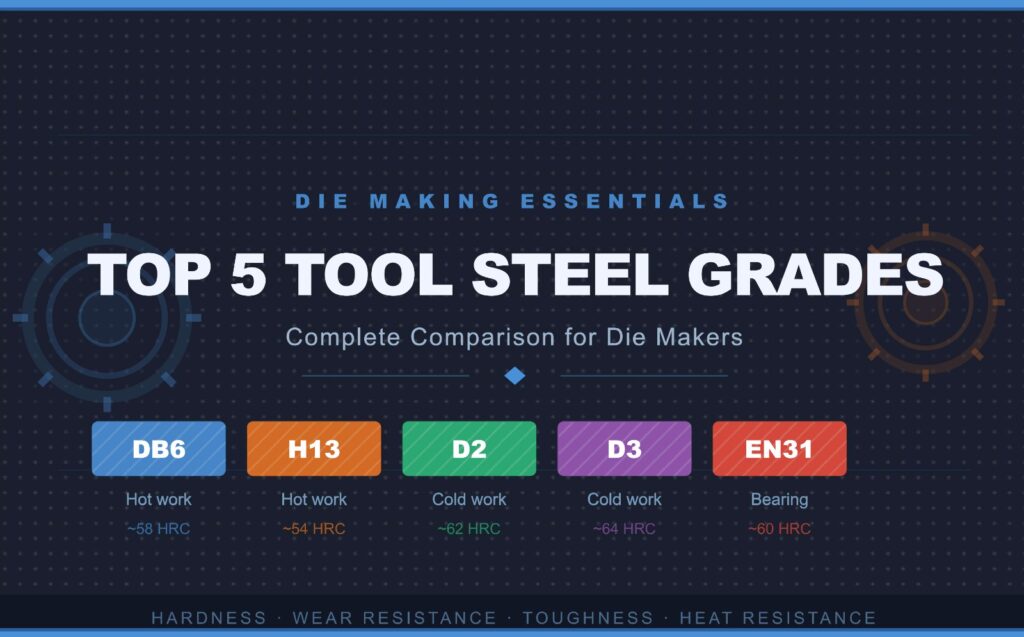
In the tool and die manufacturing industry, the successful production line often begins with one important decision that is choosing the right tool steel grade. When the correct steel is selected, dies last longer, machines run smoothly, and production targets are achieved with consistent quality.
Every manufacturing process has its own demands. A forging die must withstand intense heat and pressure, while stamping dies and cutting tools require exceptional wear resistance and hardness. Similarly, molds need the right balance of toughness and durability to perform reliably over thousands of production cycles.
Over time, die makers have learned that not all tool steels perform the same. Through years of experience and industrial use, certain grades have earned the trust of manufacturers because they consistently deliver strength, durability, and excellent performance on the shop floor. These trusted grades have become the preferred choice for die makers looking to achieve efficiency, reliability, and long die life.
1. DB6 Tool Steel – Advanced Steel for Longer Die Life
DB6 tool steel is gaining popularity among die manufacturers due to its exceptional toughness and wear resistance.
Key Properties
- Superior toughness
- Excellent wear resistance
- High fatigue resistance
- Longer die life
Common Applications
- Forging dies
- Heavy duty stamping dies
- High impact tooling
- Automotive die manufacturing
Why DB6 is Becoming Popular
Compared to conventional tool steels, DB6 offers longer tool life and better performance under heavy loads, which helps reduce downtime and tooling costs.
2. H13 Tool Steel – Best Hot Work Tool Steel
H13 tool steel is one of the most popular hot work tool steels used for applications involving high temperatures.
Key Properties
- Excellent heat resistance
- Good toughness
- High thermal fatigue resistance
- Good strength at elevated temperatures
Common Applications
- Forging dies
- Extrusion dies
- Die casting tools
- Hot stamping dies
Why H13 is Popular
H13 maintains its hardness even at high operating temperatures, making it ideal for hot forging and die casting industries.
3. D2 Tool Steel – High Wear Resistance Grade
D2 tool steel is one of the most widely used cold work tool steels in die manufacturing. It contains a high percentage of chromium, which provides excellent wear resistance and hardness.
Key Properties
- High wear resistance
- Good dimensional stability
- High compressive strength
- Moderate toughness
Common Applications
- Blanking dies
- Punches
- Shear blades
- Cold forming tools
- Stamping dies
Why Die Makers Prefer D2
D2 steel is ideal for applications where abrasion resistance is more important than impact resistance. It helps increase die life in high-production environments.
4. D3 Tool Steel – Maximum Hardness for Cutting Applications
D3 tool steel is another high carbon high chromium cold work steel known for its extremely high hardness and wear resistance.
Key Properties
- Very high hardness
- Excellent wear resistance
- High compressive strength
- Lower toughness compared to D2
Common Applications
- Cutting dies
- Thread rolling dies
- Knives and blades
- Cold extrusion tools
Why Die Makers Use D3
D3 is widely used where cutting performance and wear resistance are critical, especially in heavy duty cutting operations.
5. EN31 Steel – High Hardness Bearing Steel
EN31 steel is a high carbon alloy steel commonly used in tools requiring high hardness and wear resistance.
Key Properties
- High hardness after heat treatment
- Good wear resistance
- Excellent surface finish
Common Applications
- Dies and punches
- Bearing components
- Gauges
- Rollers
Why Die Makers Use EN31
EN31 is often selected for applications requiring fine finish and precision tooling.
Grade Comparison Table
| DB6 Hot work Cr-Mo-V | H13 Hot work Cr-Mo-V | D2 Cold work Hi-Cr | D3 Cold work Hi-Cr | EN31 Bearing Hi-C Cr |
| Standard: DIN 1.2714 | Standard: AISI H13 | Standard: AISI D2 | Standard: AISI D3 | Standard: BS EN31 |
| C content: 0.35% | C content: 0.38% | C content: 1.55% | C content: 2.25% | C content: 1.00% |
| Hardness: 54–58 HRC | Hardness: 48–54 HRC | Hardness: 58–62 HRC | Hardness: 60–64 HRC | Hardness: 58–62 HRC |
| Toughness & durability | Heat resistance | High wear resistance | Maximum hardness | High hardness |
How to Choose the Right Tool Steel Grade
Selecting the right tool steel depends on several factors:
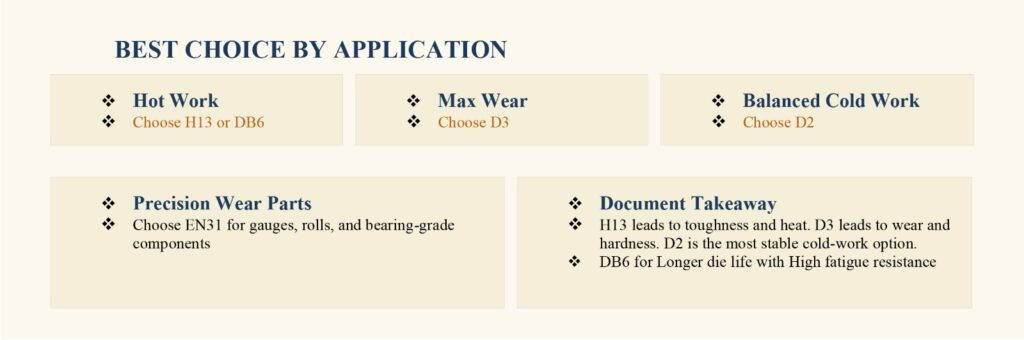
1. Application Type
Cold work operations require D2 or D3, while hot work processes prefer H13.
2. Wear Resistance Requirement
For high wear conditions, D2 or D3 are excellent choices.
3. Impact Resistance
Applications with heavy loads benefit from DB6 tool steel.
4. Temperature Conditions
Hot forming applications require steels like H13 that can withstand high
temperatures.
Why Die Makers Trust Virat Steels
At Virat Special Steels, we supply premium quality tool and die steels for industries such as:
- Automotive manufacturing
- Forging industry
- Die making
- Precision engineering
Our wide range of tool steels ensures that die makers get the right material for maximum performance and durability.
Frequently Asked Questions (FAQs)
1. What is tool steel used for in die making?
Tool steel is used to manufacture dies, punches, moulds, and cutting tools because of its high hardness, wear resistance, and toughness.
2. Which tool steel grade is best for die making?
D2, D3, H13, EN31, and DB6. The best grade depends on the application, such as cold work, hot work, or high-wear operations.
3. What is the difference between D2 and D3 tool steel?
Both D2 and D3 are cold work tool steels with high wear resistance.
- D2 steel offers better toughness and dimensional stability.
- D3 steel provides higher hardness but lower toughness.
4. Why is H13 tool steel used for forging dies?
H13 tool steel is widely used in forging dies because it has excellent heat resistance, toughness, and thermal fatigue strength, allowing it to perform well at high temperatures.
5. Which tool steel provides the longest die life?
Tool steels with a balance of toughness and wear resistance, such as DB6 and H13, are known to provide longer die life in demanding industrial applications.
6. What industries use tool and die steel?
Tool and die steels are widely used in industries such as:
- Automotive manufacturing
- Forging and casting
- Metal stamping
- Plastic moulding
- Engineering and heavy machinery
7. How does the right tool steel improve production efficiency?
Using the right tool steel grade improves die life, reduces maintenance, minimizes downtime, and ensures consistent product quality, which ultimately increases manufacturing productivity.
Conclusion
By understanding the properties and applications of each grade, manufacturers can select the best tool steel for their specificrequirements for increasing production capacity.
Virat Special Steels has built a reputation as one of India’s most trusted suppliers, known for expertise, premium quality, and unmatched stock capabilities of various grades of Tool & Die steels.
📞 Curious about the right size, grades or technical specifications for your application? Our team is ready to guide you.
👉 Explore more: www.viratsteels.com | 📧 info@viratsteels.com | 📱 +91 98140-21775
DB6 vs H13 Tool Steel: Which is Better for Forging Applications?
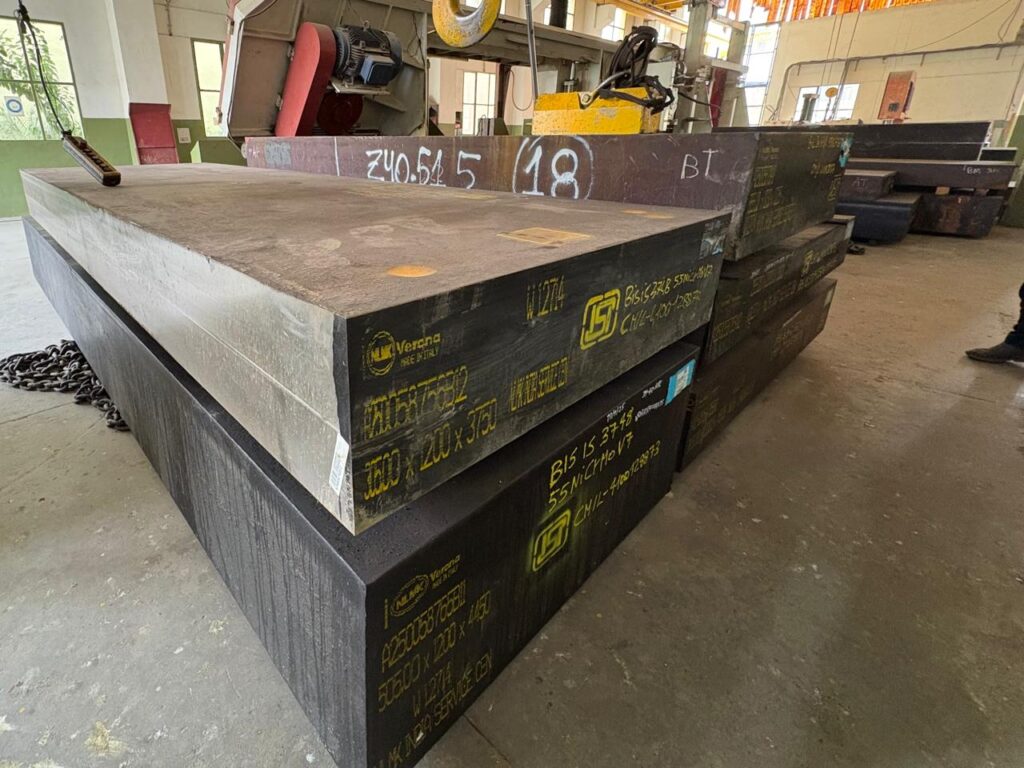
In forging, every die tells a story. Its steel grade decides how long it lasts, how smooth production runs, and how good the final product looks. Some last longer, some deliver sharper precision, and some balance cost with performance. Behind each of these outcomes lies one major choice is the steel grade used to craft the die.
Two steels often step into this role: DB6 and H13. Both are strong, both resist wear, but they shine in different ways. DB6 is the tough fighter, built to handle shock loads in heavy-duty forging. H13 is the precision player, balancing hardness and heat resistance for high-performance dies.
Choosing between them isn’t just technical, it’s about selecting the right steel need for your operations. Whether you’re in automotive forging, heavy engineering, or industrial equipment manufacturing, understanding the differences between DB6 and H13 can help you decide which steel will carry your production forward.
Overview of DB6 Tool Steel
DB6 is a high-toughness hot work tool steel commonly used for hammer forging dies and heavy-duty tooling. It is generally considered equivalent to DIN 1.2714.
Key features of DB6 steel:
- Very high toughness
- Excellent resistance to impact loads
- Good wear resistance
- Ideal for hammer forging operations
Because of its toughness, DB6 is preferred where tools face repeated mechanical shock.
Overview of H13 Tool Steel
H13 is one of the most widely used hot work tool steels due to its strong heat resistance and hardness stability at high temperatures.
Key features of H13 steel:
- Excellent heat resistance
- Good wear resistance
- High hardness retention at elevated temperatures
- Suitable for hot work tooling
H13 is commonly used in die casting, extrusion, and hot forging applications.
Chemical Composition Comparison
The chemical composition of these steels influences their mechanical properties and performance.
| Element | DB6 Steel | H13 Steel |
| Carbon | 0.50 – 0.60% | 0.35 – 0.42% |
| Chromium | 1.00 – 1.30% | 4.75 – 5.50% |
| Nickel | 1.50 – 1.80% | — |
| Molybdenum | 0.40 – 0.50% | 1.10 – 1.75% |
| Vanadium | — | 0.80 – 1.20% |
Nickel in DB6 increases toughness, while chromium and vanadium in H13 improve heat resistance.
Hardness Comparison
Hardness plays an important role in determining the wear resistance and durability of tool steels.
| Condition | DB6 Steel | H13 Steel |
| Annealed Condition | 200 – 240 HB | 190 – 220 HB |
| Hardened & tempered | 50 – 54 HRC | 48 – 52 HRC |
Both steels achieve similar hardness, but their performance differs due to toughness and heat resistance.
Applications of DB6 Steel
DB6 steel is widely used in industries requiring tools that can withstand high impact forces includes.
- Hammer forging dies
- Heavy duty forging tools
- Shear blades
- Industrial punches
- Large forming dies
These tools often experience repeated mechanical shock, making DB6 steel an ideal choice.
Applications of H13 Steel
H13 steel is commonly used in hot work tooling where high temperatures are involved includes.
- Die casting dies
- Hot extrusion tools
- Aluminum die casting molds
- Plastic injection molds
- Hot forging dies
Its excellent thermal stability makes it suitable for processes involving molten metals or continuous heating.
Key Differences Between DB6 and H13 Steel
| Toughness | Very high | High |
| Heat resistance | Good | Excellent |
| Wear resistance | Good | Very good |
| Impact resistance | Excellent | Moderate |
| Typical use | Hammer forging dies | Hot work dies |
This comparison highlights that both steels serve different purposes in industrial tooling.
Which Steel Should You Choose?
The choice between DB6 and H13 steel depends on the operating conditions of the tooling.
| Choose DB6 Steel for | Choose H13 Steel for |
| Heavy hammer forging | High temp applications |
| High impact loads | Die Casting |
| Large forging dies | Hot Extrusion process |
Understanding the working conditions helps engineers select the most suitable tool steel.
Tips for Improving Die Life
when selecting high-quality die steel, manufacturers must follow several practices to improve die performance:
- Ensure Proper heat treatment
- Maintain Correct die design
- Use appropriate lubrication during forging
- Control operating temperatures
These practices help reduce tool wear and prevent premature failure.
Frequently Asked Questions (FAQs)
1.Is DB6 better than H13 steel?
DB6 steel is better for applications requiring high toughness and impact resistance excels in heavy forging applications, while H13 steel is better for high-temperature hot work processes.
2.What is DB6 steel equivalent to?
DB6 steel is commonly considered equivalent to DIN 1.2714 tool steel.
3.What is the hardness of DB6 steel?
After heat treatment, DB6 steel typically reaches a hardness of approximately 50 to 54 HRC.
4.Which steel is better for hammer forging dies?
DB6 steel is generally preferred due to its superior toughness and impact resistance.
5.Which steel offers better value for money in the long term?
H13 offers superior durability in extreme conditions, while DB6 provides cost-efficiency for general use.
6.Is DB6 steel suitable for hot work applications?
Yes, DB6 steel performs well in hot work applications due to its strength and resistance to elevated temperatures.
7.Where can I source premium DB6 and H13 steels?
Virat Special Steels provides premium quality DB6 and H13 steel for forging and industrial tooling applications across India.
8.Is Virat Steels a reliable supplier for DB6 tool steel?
Yes, Virat Steels is known as a major importer, exporter, and stockiest of tools and die steels including DB6 / DIN 1.2714.
9.Do suppliers in India stock European grades?
Yes. Virat Special Steels is one of the best stockiest and suppliers of European grades such as DIN 1.2714, DIN 1.2344 etc.
10. Can DB6 be welded or re‑hardened?
Yes, DB6 tool steel can be welded and re-hardened, but it must be done carefully to maintain its mechanical properties and avoid cracking.
Looking for high-quality DB6 or H13 tool steel?
Virat Steels supplies premium tool and die steel grades for industries across India. Contact our team to get more details about available sizes and technical specifications suitable for your applications.
https://www.viratsteels.com/db6.html info@viratsteels.com +91 98140-21775
European Die Steels for Longer Tool Life – Backed by NLMK Verona (Italy) & Virat Steels (India)
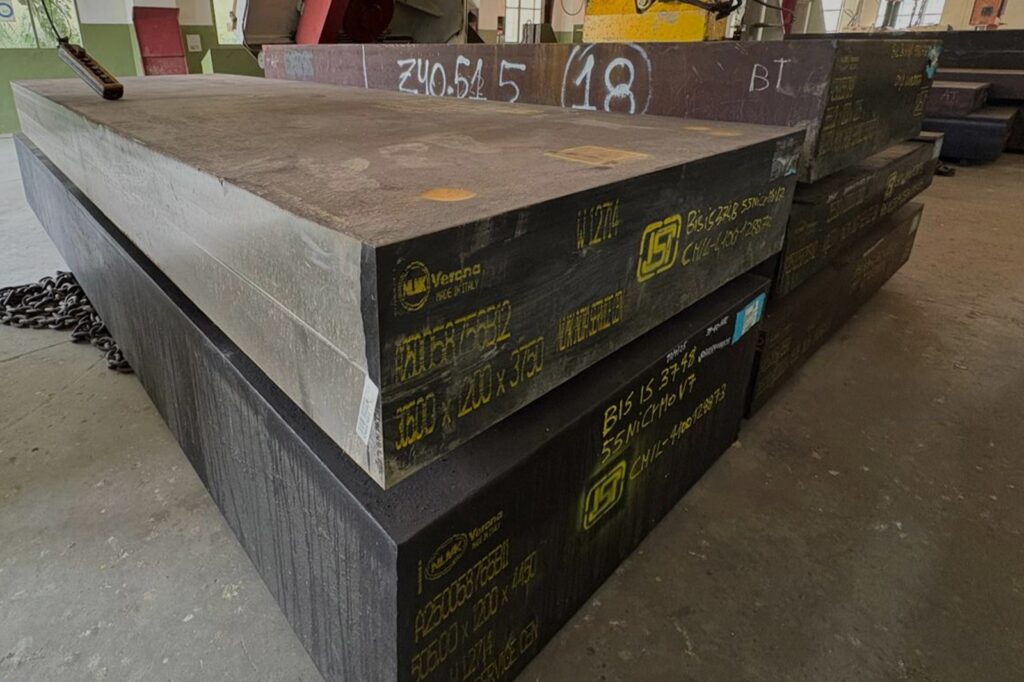
When it comes to tool and die steel, what it truly matters is –tool life, that truly considered as an important technical parameter for improved productivity. This is where European Tool & Die Steel continues to stand out as a proven solution.
Why European Tool Steel Stands Apart?
Globally, European tool steels are recognized for :
- Their advanced steel making technology,
- Strict quality control,
- Consistent performance.
NLMK Verona – European Excellence from Italy
NLMK Verona, based in Verona, Italy—an industrial hub known for metallurgical excellence—is a reputed European producer of high-performance tool and die steels engineered for:
- More tougher & crack-resistant
- Easier to machine
- More dimensionally stable.
When combined with a trusted Indian supply partner, they deliver excellence across tooling and die-making applications in India.
Bringing European Tool Steel to India: NLMK Verona × Virat Steels
Through partnership of NLMK Verona with Virat Steels, now Indian industries will have easier access to European-grade steel with reliable local stocking and service & technically supported solutions.
With over 70+ years of experience in the Indian metal industry, Virat Steels remains a trusted partner for toolmakers and manufacturers, supplying premium grades such as:
DIN 1.2714 | 1.2344 | 1.2738 | 1.2379 | HSS M2, M35 , T1 and more backed by the strong manufacturing expertise of NLMK Verona.
Looking for Genuine European Tool Steel with Assured Performance?
Manufacturers, toolmakers, and industry professionals are invited to connect with us at Mach Auto Expo 2026 to explore more premium European Tool & Die Steel solutions.
📍 Venue: LEC, Ludhiana (Punjab)
📅 Date: 20th Feb -23rdFeb 2026
Visit us to discuss tooling challenges, explore NLMK Verona steel grades, and understand how the right material choice can deliver longer tool life and consistent performance.