



High Carbon Steel Supplier in India
now browsing by category
D2 vs D3 Material: Composition, Hardness, Properties & Selection Guide
If you manufacture dies, punches, molds or precision tooling, you may need to choose between D2 vs D3 material. Both are high-carbon, high-chromium cold-work tool steels, but their chemical composition, carbide structure, heat-treatment response, toughness, machinability and wear resistance differ.
D2 material contains molybdenum and vanadium and provides a good balance of wear resistance, toughness and dimensional stability. D3 material has higher carbon and carbide content and is generally considered for applications where high abrasion resistance is required and impact loading is relatively low.
In this guide, we compare D2 vs D3 material in terms of chemical composition, hardness, properties, machinability, applications, cost considerations and grade equivalents to help you understand the factors involved in selecting between the two grades.
What Is D2 Material?
D2 material is a type of air-hardening cold work tool steel that has a high carbon content and high chromium content. It is used in making die and punch tools. It has good dimensional stability in heat treatment and excellent wear resistance. It is sometimes called a “semi-stainless” steel because of its relatively high chromium content.
D2 Steel is popular in many industries, from metal stamping and forming to knife making. It offers a good balance of hardness, edge retention and reasonable toughness.
D2 Chemical Composition
Based on Virat Steels’ own AISI D2 technical data, the typical D2 steel chemical composition is:
| Element | Typical % (D2 material composition) |
| Carbon (C) | 1.40 – 1.60% |
| Chromium (Cr) | 11.00 – 13.00% |
| Molybdenum (Mo) | 0.70 – 1.20% |
| Vanadium (V) | 0.50 – 1.10% |
| Manganese (Mn) | 0.10 – 0.60% |
| Silicon (Si) | 0.10 – 0.60% |
| Iron (Fe) | Balance |
D2 has high carbon and chromium content, which results in large volumes of hard carbides being formed, contributing to its excellent abrasion resistance. Vanadium refines the primary grain structure and forms strong carbides which increase wear resistance, edge holding and high temperature strength. Molybdenum increases the hardenability in conjunction with other alloying elements. This Mo + V combo is the big metallurgy difference from D3, and why D2 generally holds a sharper edge longer.
D2 Material Hardness in HRC
This is one of the most searched questions about the grade, so let’s separate the two conditions clearly:
- D2 material hardness in HRC before heat treatment (annealed/as-supplied condition): D2 comes in a soft condition for ease of machining. D2 in the annealed condition is normally 217-255 HB (Brinell) – which is approximately equivalent to low to mid 20’s on the HRC scale, but Brinell is the standard way this soft condition is actually measured and reported.
- D2 hardness after heat treatment (hardened & tempered): D2 hardness after hardening is 58-62 HRC with a tensile strength of approximately 1,900 MPa and a compressive strength of more than 2,700 MPa. Some suppliers quote a maximum hardness closer to 62 HRC.
Thus, if one asks for “d2 hrc” or “d2 hardness in hrc” without mentioning the state of the material, then the correct response would be that “it depends on whether you are referring to the ‘as supplied’ state (which is soft and machinable) or ‘post heat treatment’ state (which is hard).”
D2 Properties & Applications
D2 grade steel is known for:
- High abrasion and wear resistance
- Good dimensional stability during hardening (it’s air-hardening, so distortion is minimal).
- Mo/V carbides offer good edge retention
- Semi-stainless behavior in dry environment (mild corrosion resistance)
- Toughness is relatively lower than shock-resisting grades such as S7
Typical applications:blanking and piercing dies, forming dies, thread rolling dies, punches, shear blades, slitter knives, cold extrusion tooling and wear-critical mold components such as guide pins, wear plates and cavity inserts where abrasion – not impact – is the dominant failure mode.
What Is D3 Material?
D3 grade material (AISI/ASTM D3) is another form of high-carbon and high-chromium cold-work tool steel, but it has completely distinct characteristics when it comes to its quenching process. One of the differences of D3 material from other D-series steels lies in the fact that it does not contain 1% of molybdenum. D3 is oil-quenched instead of air-hardened, but small sections can be vacuum/gas-quenched. This oil-hardening route makes tools made from D3 more susceptible to brittleness during the hardening. Internationally, D3 is equivalent to DIN/Werkstoff 1.2080 (X210Cr12) – also known as SKD1 in Japan and Cr12 in China.
D3 Chemical Composition
| Element | Typical % (D3 material composition) |
| Carbon (C) | ~1.90 – 2.20%* |
| Chromium (Cr) | ~11.00 – 13.50%* |
| Manganese (Mn) | ≤ 0.60% |
| Silicon (Si) | ≤ 0.60% |
| Molybdenum / Vanadium | Not a defining addition (unlike D2) |
| Iron (Fe) | Balance |
D3 has a higher carbon content and about the same chromium content as D2, but without the Mo/V additions . This results in a larger volume of primary chromium carbides . That’s the main reason, D3 usually beats D2 on raw abrasion resistance at the expense of toughness.
D3 Material Hardness in HRC
D3 can be heat treated to 58-64 HRC hardness. This is supported by many independent technical data sources for the grade. Like D2, the material hardness of D3 in HRC is highly dependent on the tempering temperature chosen and the section thickness being hardened — for a given tool, verify the target hardness with your heat treatment partner before nailing down the process route.
In the annealed/as supplied condition D3 is also kept soft for machining, generally in line with the rest of the D-series family, but exact annealed hardness should be verified on the supplier’s certificate rather than assumed.
D3 Properties & Applications
- Superior wear and abrasion resistance – Usually rated better than D2 because of increased carbide volume
- Excellent dimensional stability in heat treatment, size retention almost as good as air hardening types such as D2
- High compression strength
- It is less tough than D2 and more prone to chip when subjected to shock or impact loading
- Due to its abrasion resistance, machining should generally be restricted to finish grinding after hardening
Typical applications: forming rolls, drawing dies, powder compaction tooling and lamination dies as well as blanking dies, punches, shear blades, gages and thread rolling dies. Basically high volume, low shock, high abrasion tooling.
D2 vs D3 Material: Key Differences
| Parameter | D2 Material | D3 Material |
| Standard / Equivalent | AISI D2, DIN 1.2379 | AISI D3, DIN 1.2080 |
| Hardening method | Air-hardening | Oil-hardening (air/vacuum for small sections) |
| Carbon content | 1.40–1.60% | ~1.90–2.20%* |
| Chromium content | 11.00–13.00% | ~11.00–13.50%* |
| Mo / V alloying | Present (0.7–1.2% Mo, 0.5–1.1% V) | Not a defining addition |
| Annealed hardness | ~217–255 HB | Similar soft range (verify per MTC) |
| Hardened hardness | 58–62 HRC | 58–64 HRC |
| Wear resistance | Very good | Excellent (typically higher than D2) |
| Toughness | Better of the two | Lower — more brittle |
| Dimensional stability | Excellent | Good, slightly more distortion risk |
| Machinability | Low | Lower than D2 |
| Corrosion resistance | Mild (semi-stainless behaviour) | Similar chromium level, comparable behaviour |
| Best suited for | Long-run dies, punches, wear parts needing edge retention | High-abrasion, low-impact forming/drawing tooling |
| Relative cost | Generally carries an alloy premium (Mo + V) | Often positioned as the more economical D-series option |
*See composition notes above — verify exact figures with your supplier’s mill certificate.
Machinability: D2 vs D3
Both grades have their reputation as “difficult but worth it” in machinability. D2 has a machinability of about 27% of AISI 1112 steel. This is poor compared to general engineering steels, but typical for high performance tool steels of this class.
D3 is generally considered more difficult to machine than D2, because of its higher carbon content and greater volume of carbides. In practice many fabricators machine D3 in the annealed condition and then rely mainly on grinding to bring it to the hardened state, rather than attempting conventional cutting once the hardness is achieved.
Practical takeaway: D2 is the more forgiving option if you have a lot of machining to do after heat treat. If the bulk of the shaping is done before hardening (with finish grinding done after), the lower machinability of D3 is less of a concern.
Which Industries Use D2 and D3?
The two grades cater to different, though similar, parts of the tool and die market segment:
- Tool & die manufacturing: Blanker, piercer and former dies ( grades D2 and D3)
- Mould manufacturing / injection moulding: Wear plates, guide pins, ejector parts and mold cavities exposed to abrasive plastic or filler material (grade D2 where toughness and machinability are important in addition to wear resistance)
- Metal stamping & press tooling: Long run punches and dies (grade D2 for edge wear; grade D3 for abrasion resistance only)
- Wire and thread rolling: thread rolling dies (both grades)
- Sheet metal forming: forming rolls and drawing dies (D3’s strength)
- Powder metallurgy & compaction tooling: compaction dies (D3)
D2 vs D3: Price Considerations
Pricing is specific to section size, quantity, prevailing raw material and alloy surcharge rates, and finishing requirements (rolled, forged, ground, ESR, etc.). We will not give a fixed figure here as this would quickly become outdated and is order dependent.
For example, in general terms: The inclusion of molybdenum and vanadium in D2 usually makes it a slightly more expensive alloy choice than the D3 alloy, which mostly uses carbon and chromium for its composition. For that reason, the D3 alloy can be marketed as the relatively cheaper high-chromium cold work alloy, while D2 comes at a higher cost due to its superior toughness and machinability properties. A quotation request can be made from the manufacturer regarding your required quantity.
How to Choose Between D2 vs D3 Material?
Use these questions to guide the decision:
- Is toughness or pure wear resistance more critical? If your tool sees any shock loading, impact, or lateral force, lean toward D2 (or reconsider A2/S7 for high-shock jobs). If it’s a steady, high-volume abrasive wear situation with minimal impact, D3’s extra hardness pays off.
- How much post-hardening machining is required? If your design needs precision machining after heat treatment, D2’s better machinability makes it the safer choice.
- What’s your quenching setup? D2’s air-hardening gives more forgiving dimensional control for complex geometries; D3’s oil-hardening needs more careful process control, especially on larger sections.
- What’s the production volume and expected tool life target? For very long die life with less concern about impact, D3’s superior abrasion resistance can extend service intervals.
- What’s the budget? If cost-per-kg is a tight constraint and the application doesn’t demand D2’s toughness, D3 is usually the more economical route.
- Does the component need any corrosion resistance in service? Both offer mild, comparable resistance — neither is a substitute for stainless grades in wet/corrosive environments.
If you’re unsure after weighing these factors, share your drawing and application details with Virat Steels’ technical team — grade selection is easier with a specific load case in front of you rather than generic comparisons.
FAQs: D2 vs D3 Material
- What is the difference between D2 and D3 material? D2 and D3 differ in composition and hardening method: D2 contains added molybdenum and vanadium and is air-hardened, while D3 has higher carbon content, no defining Mo/V addition, and is oil-hardened.
- What is D2 material? D2 Steel is an air hardening tool steel that consists of high carbon and chromium content (AISI D2 / DIN 1.2379).
- What is D2 material’s chemical composition? composition is 1.40–1.60% carbon, 11.00–13.00% chromium, 0.70–1.20% molybdenum, 0.50–1.10% vanadium, plus manganese and silicon in the 0.10–0.60% range.
- What is D2 material hardness in HRC? The D2 material usually attains 58-62 HRC after heat treatment. When it is annealed (or before heat treatment), it is provided in the softer form, which is around 217-255 HB.
- What is D2 material hardness in HRC before heat treatment? D2 material is provided in the soft or annealed state before heat treatment, and hence it is not provided in HRC but is provided in Brinell hardness scale (i.e., roughly 217-255 HB).
- What is D3 material’s hardness in HRC? The hardness of the D3 material in HRC ranges from 58-64 HRC after heat treatment.
- Is D2 or D3 harder? D3 has a slightly higher maximum hardness, up to about 64 HRC, compared to D2’s maximum of around 62 HRC, due to its higher carbon content and carbide volume.
- Which is tougher, D2 or D3? D2 is tougher due to fine, balanced carbide formation, while D3’s higher carbon content makes it less tough.
- Can D2 and D3 be used interchangeably? No. Although D2 and D3 have similar properties, there are differences that make D3 inadequate in certain applications where D2 works fine and vice versa.
- Which is better for injection moulds — D2 or D3? D2 can be used for wear-resistant mould components such as guide parts, wear plates and selected inserts, where good wear resistance, dimensional stability and machinability are required. D3 is generally more suitable for applications where very high abrasion resistance is the primary requirement and impact loading is low. The appropriate grade depends on the mould material, filler content, loading conditions, required hardness and manufacturing process. .
- What is D2 material grade used for? D2 grade is suitable for blanking and piercing dies, forming dies, thread rolling dies, punches, shear blades, and wear-related mold inserts..
- Is D2 a stainless steel? No, it is not stainless steel as it contains sufficient chromium content to resist corrosion in dry environments (also known as “semi-stainless”).
- Why is D3 harder to machine than D2? The carbon content in D3 is higher, and the volume of primary chromium carbides in D3 is higher than that of D2, making it more abrasive but at the same time leading to faster wear of the cutting tools during machining.
- What is the price difference between D2 and D3? The price of D2 is slightly higher than that of D3 since D2 contains molybdenum and vanadium. However, the actual price is dependent on the section size, volume and market prices.
- What are the DIN/international equivalents of D2 and D3? D2 is equivalent to DIN/Werkstoff 1.2379 (X153CrMoV12). D3 is equivalent to DIN/Werkstoff 1.2080 (X210Cr12), known as SKD1 (Japan) and Cr12 (China).
Conclusion
While both D2 and D3 have been confirmed as having high carbon and high chromium content cold work tool steel, it does not mean that they are one and the same only branded differently. The addition of molybdenum and vanadium in D2 makes it tougher and easier to machine, hence it is better used in dies, punches, and die elements. The increased carbon in D3 increases its wear resistance and hardness; however, it reduces toughness.
The right grade depends on your specific load conditions, production volume, and machining process — not a generic “which is better” answer.
Need help selecting between D2 and D3 for your next tooling project? Virat Steels supplies both grades with full mill test certification and technical support to match the right steel to your application. Get in touch with our team for a quote or a grade recommendation based on your drawing.
Our technical team will confirm grade equivalence, available sizes and delivery timeline within 24 hours.
Prefer to talk directly?
Gurugram, Haryana | Ludhiana, PunjabPhone: +91-98140-21775
Email: info@viratsteels.com
Best Cold Work Tool Steel Supplier in India- D2, D3, DIN 1.2379, DIN 2080 Steel | Virat Steels
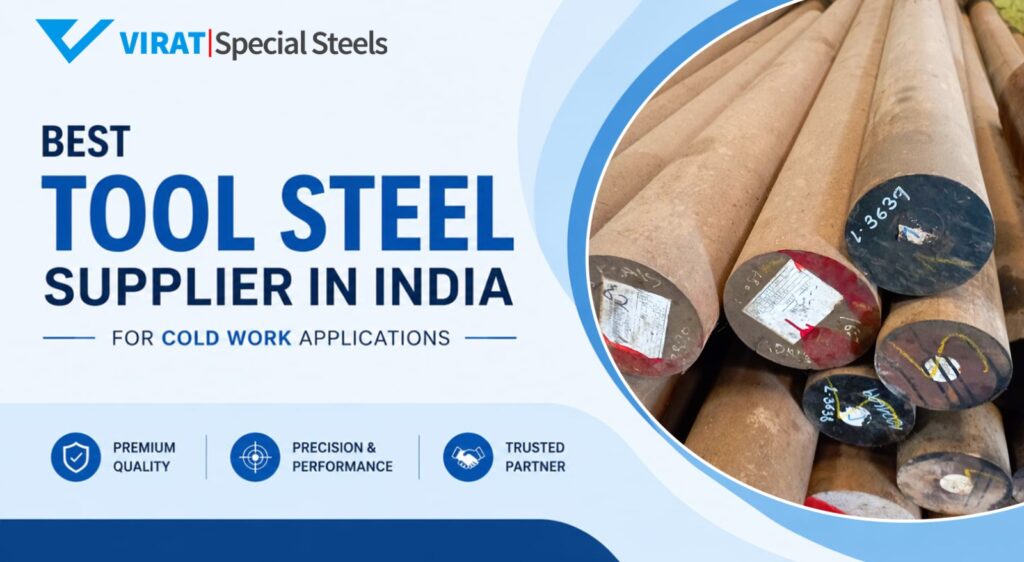
Premium Cold Work Tool Steel Supplier in India
India’s manufacturing sector is on the rise and the quality of tool steel has a direct impact on productivity, precision and tool life. Premium cold work tool steels are used extensively in automotive, forging, sheet metal and heavy engineering industries, and offer consistent performance and reduced downtime.
With increasing demand for premium grade tool steels across India, Virat Special Steels continues to be a preferred choice for industries looking for reliable quality, imported steel grades, extensive inventory and fast nationwide delivery support.
What is Cold Work Tool Steel?
Cold work tool steel is a group of tool steel that is designed specifically for uses carried out at room temperature. These steels provide a great combination of hardness, wear resistance, toughness and dimensional stability, which makes them suitable for high precision tooling applications.
Key Properties of Cold Work Tool Steel
- High hardness
- Excellent wear resistance
- Superior edge retention
- High compressive strength
- Good dimensional stability
- Enhanced toughness
Applications of Cold Work Tool Steel
Cold work tool steels are extensively used in:
- Punches and dies
- Blanking dies
- Forming tools
- Shearing blades
- Precision cutting tools
- Industrial knives
- Stamping tools
- Thread rolling dies
- Extrusion Dies
- Burnishing Tools
- Heading Tools
- Coining Dies
Why Cold Work Tool Steel is Important in Manufacturing
Modern manufacturing industries require tooling materials that provide precision, durability and reliable performance. These are the benefits of cold work tool steels, which also bring lower maintenance costs and less production downtime.
| Benefit | Industrial Advantage |
| High Wear Resistance | Longer tool life |
| High Hardness | Better cutting and forming performance |
| Dimensional Stability | Improved manufacturing accuracy |
| Superior Toughness | Reduced cracking and chipping |
| Good Machinability | Easier processing and fabrication |
| Cost Efficiency | Lower maintenance and replacement costs |
Why Choosing the Right Tool Steel Supplier Matters
Choosing the right tool steel supplier is as important as choosing the right steel grades. A dependable supplier provides material consistency, quality assurance and technical support that directly impact tooling performance.
Key Factors to Consider
| Factor | Importance |
| Genuine Steel Grades | Prevents premature tool failure |
| Ready Stock Availability | Ensures uninterrupted production |
| Technical Expertise | Helps select the correct steel grade |
| Fast Delivery Support | Minimizes downtime |
| Quality Assurance | Guarantees certified material quality |
| Competitive Pricing | Improves overall project economics |
Popular Cold Work Tool Steel Grades Available at Virat Special Steels
Virat Special Steels supplies a wide range of imported and premium cold work tool steels, including:
D2 Tool Steel
One of the most widely used cold work tool steels known for excellent wear resistance, hardness, and dimensional stability.
D3 Tool Steel
Suitable for applications requiring maximum wear resistance and excellent edge retention.
DIN 1.2379 Steel
A premium chromium-rich cold work tool steel widely used for precision dies, blanking tools, and cutting applications.
Heat Treatment
The heat treatment process involves carefully controlled parameters such as heating temperature, heating and cooling rates, soaking time, furnace type, quenching medium, and workpiece transfer facilities. These factors are critical for achieving the desired metallurgical properties, including high hardness, excellent wear resistance, and dimensional stability, making the material suitable for demanding tooling applications such as dies, punches, shear blades, and molds.
- Preheating – Heat gradually to about 650–850°C temperature to reduce thermal shock.
- Austenitizing (Hardening) – Heat to the recommended hardening temperature typically 950–1050°C, depending on the grade and hold until the structure becomes austenitic.
- Quenching – Cool rapidly in air, oil, or salt bath (depending on the steel grade) to obtain high hardness.
- Tempering – Reheat to 150–550°C temperature and hold for a specified time, then cool which reduces brittleness and improves toughness while maintaining hardness.
- Stress Relieving – For machined parts, stress relief may be performed before hardening to minimize distortion.
How to Select the Right Cold Work Tool Steel
Choosing the correct cold work tool steel depends on multiple factors:
Consider the Application
Different applications require different combinations of hardness, toughness, and wear resistance.
Evaluate Wear Resistance Requirements
High-production environments often require steel such as D2 or DIN 1.2379 for longer tool life.
Assess Toughness Requirements
Applications prone to impact loading may require tougher grades such as DC53.
Review Machinability
The selected steel should support efficient machining and heat treatment processes.
Seek Expert Technical Guidance
Working with experienced suppliers such as Virat Special Steels ensures optimal material selection based on specific manufacturing requirements.
Conclusion
Cold work tool steels are the backbone of precision, durability and efficiency in modern manufacturing operations. The selection of steel grade and supplier directly impacts tool life, productivity and operational cost savings.
Virat Special Steels is one of the trusted suppliers of tool steels in India offering premium quality high-performance cold work tool steels like D2, D3, DIN 1.2379, DIN 2080, DC53 and other grades. With wide range of inventory, technical expertise, quality assurance and Pan India delivery support, Virat Special Steels continues to be the choice of manufacturers across different industries.
Looking for reliable cold work steel solutions?
Contact Virat Special Steels today for expert guidance and premium tool steel supply.
+91 98140-21775 info@viratsteels.com
For more details about our cold work tool steel grades and applications, please click on the link below to explore our product range and technical specifications.
https://www.viratsteels.com/cold-work-steel.html
https://www.viratsteels.com/hchcr-d2.html
https://www.viratsteels.com/hchcr-d3.html
Frequently Asked Questions (FAQs)
1-What is cold work tool steel?
Cold work tool steel is a type of tool steel used for applications performed at room temperature. It offers excellent hardness, wear resistance, and durability.
2-Which industries use cold work tool steel?
Automotive, forging, sheet metal, aerospace, railway, defence, hand tools, and precision engineering industries commonly use cold work tool steels.
3-Which is the most popular cold work tool steel grade?
D2 tool steel is one of the most widely used grades because of its excellent wear resistance and long service life.
4-What is DIN 1.2379 steel used for?
DIN 1.2379 steel is commonly used for blanking dies, punches, industrial knives, cutting tools, and precision tooling applications.
5-Why are imported tool steels preferred?
Imported tool steels often provide superior quality consistency, improved toughness, better wear resistance, and extended tool life.
6-Which supplier in India is best for cold work steels?
Virat Special Steels offers genuine imported steel grades, ready stock availability, technical support, quality assurance, and fast delivery across India.
7-Why choose Virat Special Steels for cold work tool steel?
Virat Special Steels offers genuine imported steel grades, ready stock availability, technical support, quality assurance, and fast delivery across India.
8-How do I select the right cold work tool steel grade?
Selection depends on application requirements, hardness, toughness, wear resistance, production volume, and expected tool life.
Virat Steels-Trusted Tool & Die Steel Supplier in India
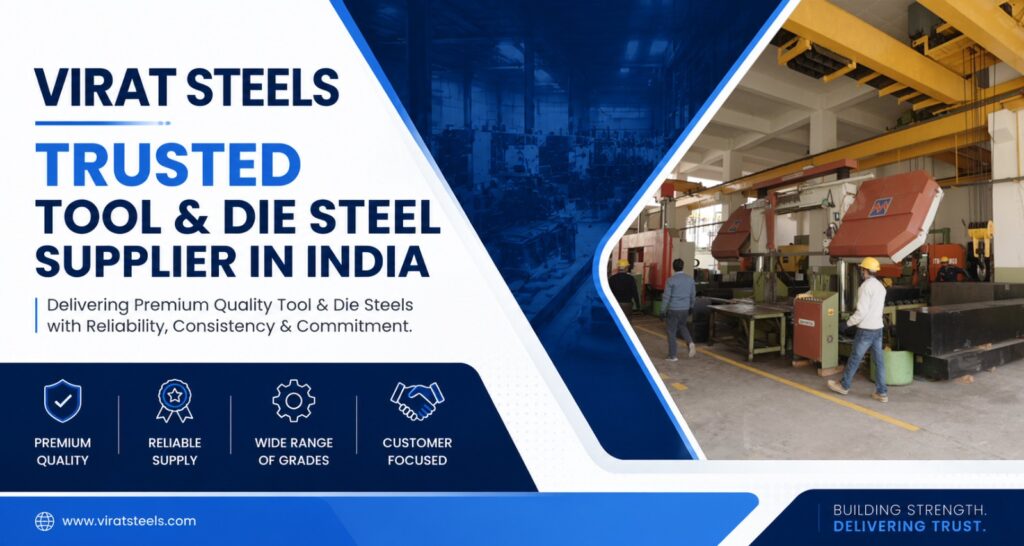
In the tool and die steel industry, quality material and reliable service are very essential for consistent production performance. Manufacturers today need more than just steel. Hence, they need a trusted supply partner.
That’s why industries across India choose Virat Special Steels for premium tool steel solutions.
With decades of domain expertise, the company serves high-quality tool & die steels industries ranging from automotive and aerospace to defence, tooling, and heavy engineering.
Premium Quality Steel
Virat Steels provide genuine and reliable tool steel with:
- Consistent hardness
- Better machinability
- Improved tool life
- Genuine quality
Available in:
✔ Rounds
✔ Flats
✔ Blocks
Ready Stock Availability
Ready stock available for major grades including:
ensuring quick dispatch and reduced downtime.
Ultrasonic Tested Material
Virat Steels supplies UT Tested Tool Steel
Ultrasonic testing helps detect:
- Internal defects
- Cracks
ensuring better reliability and performance.
Precision Cutting Facility
We offer precision cutting services for:
- Accurate dimensions
- Reduced machining allowance
- Faster processing
Helping customers save time and improve productivity.
Strong Logistics Support
We deliver across India with:
- Fast dispatch
- Safe handling
- Timely delivery
Supplying to major industrial regions across India .
Technical Support
Our team helps customers choose:
- Suitable steel grade
- Recommended Hardness
- ESR vs standard grades
- Application-based solutions
Certified & Test Report
- Material Test Certification (MTC)
Looking for a reliable tool and die steel supplier in India?
Contact Virat Special Steels:
📞 +91 98140-21775
🌐 www.viratsteels.com
✉ info@viratsteels.com
Frequently Asked Questions (FAQs)
1. What products does Virat Steels supply?
Virat Steels supplies premium tool and die steels including Hot work steels, cold work steels, High Speed steels, Alloy steel grades etc.
2. Which industries use tool and die steel?
Tool and die steels are widely used in Forging, Extrusion, Plastic moulds, Automotive components, Pressure Die casting .
3. Does Virat Steels provide ultrasonic tested material?
Yes, Virat Steels supplies UT tested material to ensure better reliability, reduced internal defects, and improved tooling performance.
4. Does Virat Steels maintain ready stock?
Yes, Virat Steels maintains ready stock of major tool steel grades for quick dispatch and faster delivery across India.
5. Why choose Virat Steels as a tool steel supplier?
Manufacturers choose Virat Steels because of Genuine quality, UT tested steel, Precision cutting facility, ready stock, fast delivery, technical support
6. Does Virat Steels deliver across India?
Yes, Virat Steels supplies tool and die steel across major industrial regions in India with reliable logistics and timely delivery support.
7. How can I contact Virat Steels for tool steel requirements?
You can contact Virat Steels on 📞 +91 98140-21775 for grade recommendations, stock availability, and pricing.
H13 vs D2 Steel – Which is Better for Hot Work vs Cold Work Dies?
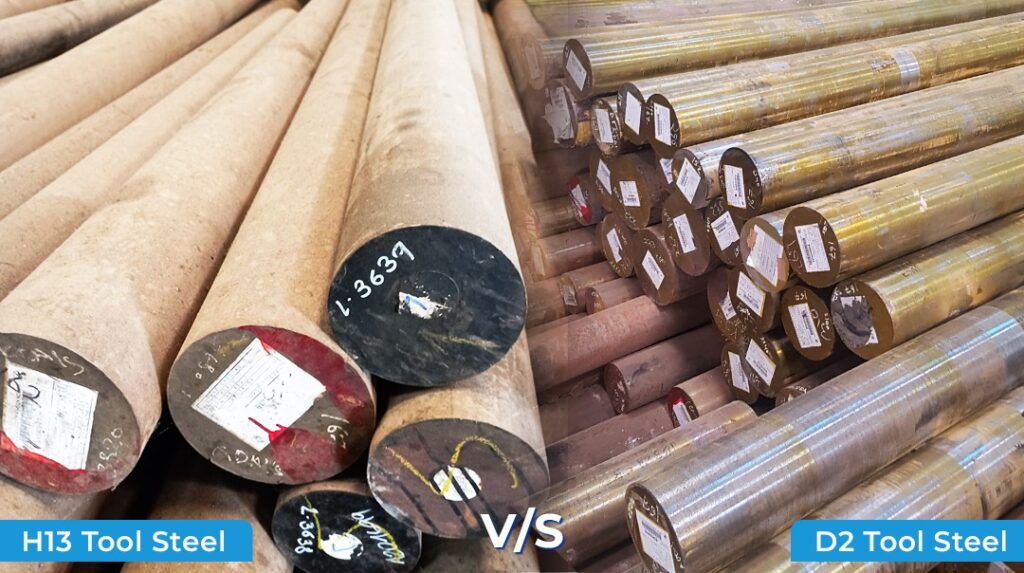
[The definitive guide to selecting the right die steel for forging, extrusion, stamping, and forming applications.]
In the tool and die manufacturing industry, selecting the right tool steel grade directly impacts die life, productivity, and cost efficiency. Among the most widely used grades, H13 tool steel and D2 tool steel are industry standards. but they’re specialists in different temperature.
At Virat Steels, we help manufacturers choose the right steel based on application, performance, and long-term value.
Understanding Tool Steel Categories
Tool steels are broadly classified into:
- Hot Work Tool Steel – Designed for high-temperature operations
- Cold Work Tool Steel – Used at room temperature for cutting and forming
What is H13 Steel? (Hot Work Tool Steel)
H13 steel (DIN 1.2344 / SKD61) is a chromium-molybdenum hot work tool steel known for its ability to withstand extreme heat and thermal cycling.
Key Properties:
- Excellent hot hardness & thermal fatigue resistance
- High toughness and crack resistance
- Strong performance under repeated heating & cooling cycles
H13 retains hardness even above 500°C, making it ideal for high-temperature applications.
Applications:
- Die casting dies
- Hot forging dies
- Extrusion tooling
- Injection mould cores
H13 is the best choice for hot work dies where heat resistance and durability are required.
What is D2 Steel? (Cold Work Tool Steel)
D2 steel is a high carbon, high chromium cold work tool steel designed for maximum wear resistance and hardness.
Key Properties:
- Very high wear resistance
- High hardness (up to 62 HRC)
- Excellent edge retention
- Good dimensional stability
Applications:
- Cold stamping dies
- Blanking and punching tools
- Shear blades
- Cutting tools
D2 performs best in low-temperature, high-wear environments.
H13 vs D2 Steel — Detailed Comparison
| Property | H13 Tool Steel (Hot Work) | D2 Tool Steel (Cold Work) |
| Type | Hot work steel | Cold work steel |
| Hardness | Medium (48–52 HRC) | Very high (58–62 HRC) |
| Heat Resistance | Excellent | Poor at high temperature |
| Wear Resistance | Good | Excellent |
| Toughness | High | Moderate |
| Thermal Fatigue | Excellent | Low |
| Best Use | Hot dies & high-temp tools | Cutting, stamping & cold dies |
Key difference:
- H13 = Heat resistance + toughness
- D2 = Wear resistance + hardness
When to Choose H13 Steel?
Choose H13 tool steel when your application involves:
- High operating temperatures
- Continuous heating & cooling cycles
- Risk of thermal cracking
Typical industries:
- Automotive die casting
- Aluminium extrusion
- Forging industries
H13 provides longer die life and reduced downtime in hot work applications.
When to Choose D2 Steel?
Choose D2 steel when your requirement is:
- High wear resistance
- Sharp cutting edges
- Dimensional stability
Typical industries:
- Sheet metal stamping
- Tool manufacturing
- Cold forming operations
D2 provides superior wear life in cold work applications.
H13 vs D2: Which One is Better?
The H13 vs D2 decision comes down to one primary question: Will your die contact hot workpieces above 200°C?
If the answer is yes: if you’re doing die casting, hot forging, or extrusion, then H13 is your steel. Its thermal fatigue resistance is unmatched in the tool steel sector, and using D2 in these applications will result in catastrophic heat checking and premature failure.
If the answer is no: if your application is stamping, blanking, forming, or precision cold work, then D2 is almost always the superior choice. Its wear resistance, dimensional stability during hardening, and edge-holding capability far exceed what H13 can deliver at ambient temperatures.
In simple terms:
- Heat present? → Go with H13
- Only wear & cutting? → Go with D2
Why Choose Virat Steels for Tool Steel?
At Virat Steels, we supply premium quality:
- H13 tool steel (hot work applications)
- D2 tool steel (cold work applications)
- Custom-cut tool steel blocks
- Ultrasonic tested materials for reliability
What sets us apart:
- Consistent quality & certified grades
- Fast delivery across industrial hubs
- Technical guidance for grade selection
We don’t just supply steel—we help you choose the right steel for maximum performance.
Frequently Asked Questions –
1. Can D2 steel be used for hot work applications?
No. D2 is not suitable for hot work. It becomes brittle at high temperatures and cracks under thermal cycling. For applications above 200–250°C, use H13 or other H-series steels.
2. Is D2 or H13 harder?
D2 is harder (up to 62 HRC) than H13 (up to ~54 HRC). However, H13 performs better in high-temperature conditions due to its toughness.
3. What is the difference between H13 and H11?
H13 has higher wear resistance and hot strength, while H11 offers slightly better toughness. H13 is more commonly used for die casting and forging.
4. Is D2 the same as Cr12MoV?
Almost. Cr12MoV is the Chinese equivalent of D2 with very similar composition and performance, and they are generally interchangeable.
5. How do I weld H13 steel die inserts?
Preheat to 300–400°C, use matching filler wire, maintain temperature, and cool slowly. Post-weld tempering is essential. Welding D2 is not recommended due to crack risk.
Final Thoughts
Choosing between H13 vs D2 steel depends entirely on your application:
- H13 dominates in heat-intensive operations
- D2 leads in wear-intensive, cold conditions
Making the right choice can significantly improve: Tool life , Production efficiency, Overall cost savings.
Need D2 or H13 for Your Next tool steels project?
Get a fast quote — certified stock, ready to dispatch across India:
www.viratsteels.com | 📧 info@viratsteels.com | 📱 +91 98140-21775
Understanding the Mechanical Properties of High Carbon Steel!
High carbon steel is renowned for its exceptional mechanical properties, making it a vital material in various industrial applications. At Virat Special Steels, we recognize the significance of these properties and ensure the highest quality standards in our high carbon steel offerings.
High-carbon steel has approximately 0.6 to 1.0% carbon content. It is very strong, used for springs, edged tools, and high-strength wires. Discover Quality Die Steel with Virat Special Steels Pvt. Limited. As the leading die steel supplier in India, Virat Special Steels Pvt. Limited takes pride in delivering exceptional quality and reliability.
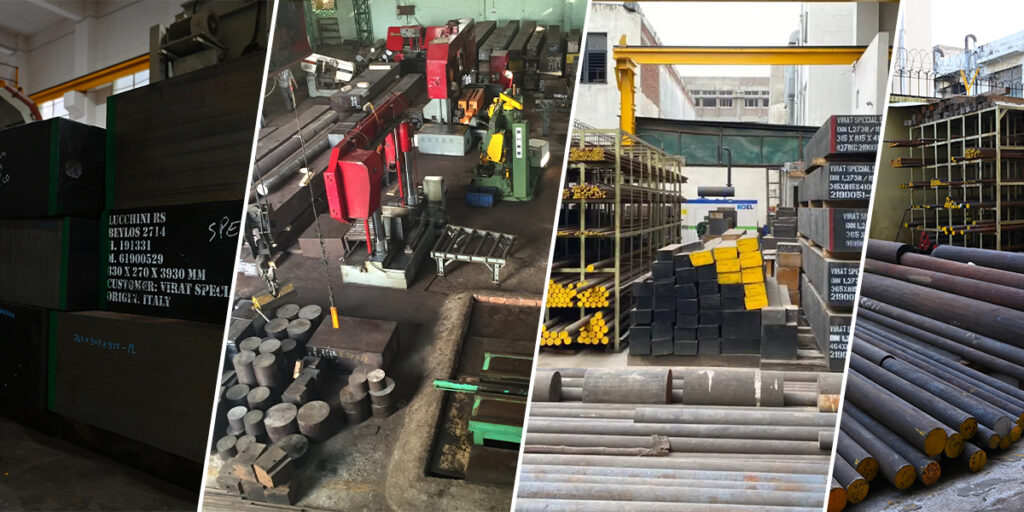
Let’s delve into the key mechanical properties that make high carbon steel an indispensable material in manufacturing and engineering.
- High Strength : One of the most notable properties of high carbon steel is its high strength. This material has a high tensile strength, which means it can withstand significant stress and strain without deforming. This makes it ideal for applications requiring robust and durable materials, such as cutting tools, blades, and springs.
- Hardness: High carbon steel is known for its superior hardness compared to low or medium carbon steel. This hardness is achieved through heat treatment processes such as quenching and tempering. The increased hardness makes high carbon steel resistant to wear and abrasion, making it suitable for high-stress applications like industrial machinery and cutting tools.
- Wear Resistance: The wear resistance of high carbon steel is another critical property that makes it suitable for demanding applications. The high carbon content enhances the steel’s ability to resist surface wear and tear, extending the lifespan of components made from this material. This is particularly important in the manufacturing of tools and machinery that are subjected to repetitive use and friction.
- Ductility and Toughness: While high carbon steel is less ductile than low carbon steel, it still maintains a degree of toughness. The right heat treatment process can enhance the steel’s toughness, making it capable of absorbing energy and resisting impact. This balance of hardness and toughness is crucial for applications where both strength and resistance to fracture are needed.
- Elasticity and Modulus of Elasticity: High carbon steel exhibits good elasticity, which is the ability to return to its original shape after deformation. The modulus of elasticity, a measure of the material’s stiffness, is also relatively high in high carbon steel. These properties are essential for applications like springs and suspension components, where the material must withstand repeated loading and unloading cycles without permanent deformation.
- Thermal Conductivity: The thermal conductivity of high carbon steel is another important property, especially in applications involving heat transfer. High carbon steel can conduct heat efficiently, making it suitable for use in heat exchangers, radiators, and other thermal management systems.
- Corrosion Resistance: Although high carbon steel is not as corrosion-resistant as stainless steel, it can be treated to improve its resistance to rust and corrosion. Protective coatings, such as galvanization or the application of corrosion-resistant alloys, can enhance the durability of high carbon steel in corrosive environments.
Conclusion
High carbon steel’s mechanical properties make it a versatile and indispensable material in various industrial applications. At Virat Special Steels, we are committed to providing high-quality high carbon steel that meets the rigorous demands of our customers. Whether you need steel for cutting tools, machinery, or structural components, our high carbon steel offerings deliver the strength, hardness, and durability required for optimal performance.
Explore our range of high carbon steel products and discover how Virat Special Steels can meet your specific needs with precision and excellence. HCHCr. (DIN 2379, 2080 / AISI D2, D3)
Size Range in Forged / Rolled Bars:
Rounds: 13mm Dia to 1500mm Dia
Rectangular: Thickness 13mm – 500mm / Width 13mm to 1500mm
Choose Virat Special Steels for unparalleled quality and service. Experience the difference that cutting-edge infrastructure and top-notch materials make.
Any further queries feel free to contact us :
🌐https://www.viratsteels.com 📬 info@viratsteels.com ☎+91 98140-21775