



DIN 2344 Steel Supplier in India
now browsing by category
Hot Work Tool Steel: Grades, Properties, Hardness, Heat Treatment & Applications
Hot work tool steel is designed for one purpose – to resist heat that would ruin common steel. It is the material behind the dies, molds, punches and blades that are hammered and squeezed and repeatedly heated and cooled – in die casting, forging, extrusion, hot stamping and hot shearing.
And what makes it different is easy to say and hard to engineer. It keeps its hardness, toughness, strength and dimensional stability, even when it’s hot. The most common grades you’ll come across are H13 (DIN 1.2344), H11 (DIN 1.2343) and DB6 (DIN 1.2714) — which one you need depends on your operating temperature, impact load, die size and how long you want the tool to last.
What Is Hot Work Tool Steel?
It’s an alloy tool steel for tools that get hot and cycle between hot and cold, again and again. It must be a combination of hot hardness, toughness, wear resistance, thermal-fatigue resistance and dimensional stability — all at the same time.
The Three Grades You Should Know:
- H13 / DIN 1.2344 – the go-to grade for die casting, aluminum extrusion and hot forging.
- H11 / DIN 1.2343 — good balance of toughness and hot strength, for forging and extrusion.
- DB6 / DIN 1.2714 – the choice for large forging dies, hammer dies and heavy-impact work where toughness is the most important property.
The final choice should always be based on the application and the steel maker’s datasheet, not on a general guide like this.
Hot work tool steel is a high-alloy steel for tooling operating at temperatures above about 200°C. Hot work grades are designed to resist the direct action of molten metal and hot workpieces, as opposed to cold-work steels, which are designed for cutting and forming at room temperature.
You will find it in aluminum and brass die-casting dies, forging dies, extrusion dies, hot shear blades, punches, mandrels, hot trimming dies, glass molds and copper alloy dies. It is their resistance to heat checking, deformation and softening that keeps these tools dimensionally stable and working reliably, cycle after cycle.
Popular Hot Work Tool Steel Grades
| Steel Grade | DIN Standard | Equivalent | Common Applications |
| H13 | 1.2344 | AISI H13 / JIS SKD61 | Die casting, forging, aluminium extrusion |
| H11 | 1.2343 | AISI H11 / JIS SKD6 | Forging dies, aluminium dies, extrusion |
| DB6 | 1.2714 | No exact AISI match; closest reference ~L6 | Hammer dies, press dies, forging dies |
| H21 | 1.2581 | AISI H21 | High-temperature tooling |
| H10 | 1.2365 | AISI H10 | Hot-work applications |
| H12 | 1.2606 | AISI H12 | Hot-work applications |
Mechanical Properties
| Property | H13 | DB6 |
| Density | 7.75–7.85 g/cm³ | 7.70–7.85 g/cm³ |
| Tensile Strength | 1550–2100 MPa | High |
| Hardness | 44–54 HRC | 38–42 HRC (working); refer to supplier datasheet |
| Toughness | Excellent | Excellent |
| Wear Resistance | Excellent | Excellent |
| Thermal Fatigue Resistance | Excellent | Excellent |
Chemical Composition
The alloying elements are what actually give hot work tool steel its personality — hardness, toughness, wear resistance and how it behaves under heat.
| Element | H13 (%) | DB6 (%) |
| Carbon (C) | 0.32–0.45 | 0.50–0.60 |
| Silicon (Si) | 0.80–1.25 | 0.10–0.40 |
| Manganese (Mn) | 0.20–0.60 | 0.65–0.95 |
| Chromium (Cr) | 4.75–5.50 | 1.00–1.20 |
| Molybdenum (Mo) | 1.10–1.75 | 0.45–0.55 |
| Vanadium (V) | 0.80–1.20 | 0.07–0.12 |
| Nickel (Ni) | — | 1.50–1.80 |
Hardness (HRC Scale)
Hardness is usually the first thing buyers ask about and it is really a trade-off push hardness up and you get wear resistance but you risk giving up toughness and a tool that is too hard cracks before it wears out.
| Grade | Typical Working Hardness |
| H13 | 44–54 HRC |
| H11 | 42–50 HRC |
| DB6 (1.2714) | 38–42 HRC |
DB6 is designed for lower working hardness than H13 tool steels – it is selected for hammer and large forging dies because it sacrifices some wear resistance for superior toughness, so it is tempered back further to prevent cracking under heavy impact.
Tip: The right hardness is not the hardest, it is the one that works for your application and duty cycle. Always verify the exact range with the datasheet of your supplier, as this may differ with section size and delivery condition.
How Hot Work Tool Steel Is Made
Good performance from hot work tool steel is not just a matter of choosing the right grade on paper – it is a matter of how well the steel was melted, forged, heat treated and inspected along the way.
1. Raw Material Selection
Everything starts with the alloying mix, and each element earns its place:
| Element | Main Function |
| Carbon | Hardness and strength |
| Chromium | Wear resistance and hardenability |
| Molybdenum | High-temperature strength |
| Vanadium | Grain refinement and wear resistance |
| Nickel | Toughness |
| Silicon | Strength and heat resistance |
| Manganese | Strength and hardenability |
2. Smelting & Refining
The steel is melted in an Electric Arc Furnace (EAF) and then further refined to the desired chemistry and cleanliness.
Ladle refining improves alloy composition, controls temperature and reduces contamination
Vacuum degassing removes dissolved gasses, mainly hydrogen, leading to better toughness, improved fatigue life, fewer internal defects and a more reliable material overall.
3. Electro-Slag Remelting (ESR)
ESR is a must when cleanliness and consistency counts. It provides a more homogeneous microstructure, better toughness and fatigue life, less segregation and a significantly improved polishability – which is why ESR grades are found in precision dies, high pressure die casting and plastic molds.
4. VAR (Vacuum Arc Remelting)
For the most demanding applications VAR takes purity one step further – lower inclusion levels, more uniform microstructure and better fatigue resistance.
5. Ingots casting
Molten steel is poured into ingots before forging, under controlled solidification conditions to minimize segregation and shrinkage.
6. Forging
Forging turns the cast ingot into dense blocks and bars by controlled heating and deformation. It increases the toughness, the grain structure, the internal flaws and gives more consistent mechanical properties to the material. Typical outputs are forged blocks, die blocks, round bars, flat bars and ESR blocks.
7. Annealing
Annealing is the process that softens the steel for machining and preparation for hardening — heat, soak evenly, then cool in a controlled fashion.
| Grade | Approx. Annealed Hardness |
| H13 | 190–230 HB |
| H11 | 180–230 HB |
| DB6 (1.2714) | 255 HB max |
Hardening is the method by which steel is given strength and wear resistance. It involves controlled pre-heating, austenitising, soaking and controlled cooling or quenching.
| Grade | Typical Austenitizing Range |
| H13 | 1,020–1,050°C |
| H11 | 1,000–1,030°C |
| DB6 (1.2714) | ~850–900°C (typical for this Ni-Cr-Mo grade; noticeably lower than the Cr-Mo-V H-series) |
DB6 is a lower alloy nickel chromium molybdenum steel and hardens at a substantially lower temperature than H13 or H11. Always stick to the manufacturer’s datasheet for the exact cycle – especially if you are working with large sections where getting this wrong is expensive.
9. Tempering
Tempering is done after hardening to reduce brittleness and to obtain the final balance between hardness and toughness. It relieves residual stress, increases toughness and helps dimensional stability. Depending on the grade, multiple cycles of tempering may be utilized.
Heat Treatment at a Glance
| Stage | Purpose |
| Annealing | Improve machinability |
| Stress Relieving | Reduce machining stresses |
| Hardening | Increase hardness and strength |
| Tempering | Improve toughness and stability |
| Final Inspection | Verify required properties |
10. Quality Inspection
The material is examined from every point of view before being shipped:
Ultrasonic Testing (UT) — identifies internal cracks, inclusions, laminations and shrinkage-related defects, especially important on large forged blocks.
Chemical composition testing – a spectrometer tests carbon, chromium, molybdenum, vanadium, nickel, silicon, manganese, sulfur and phosphorus against the specified grade.
Hardness and dimensional inspection: Rockwell or Brinell testing, checks of length, width, thickness, flatness, squareness, straightness and surface finish.
11. MTC (Material Test Certificate)
An MTC links grade, heat number, chemical composition, mechanical properties, hardness, heat-treatment condition, inspection results and manufacturer details. It provides buyers with a paper trail they can verify.
| Document / Test | Purpose |
| MTC / EN 10204 3.1 | Material traceability and test results |
| UT Report | Internal quality verification |
| Spectrometer Report | Chemical composition |
| Hardness Report | Hardness verification |
| Heat Number | Batch traceability |
| Dimensional Report | Size verification |
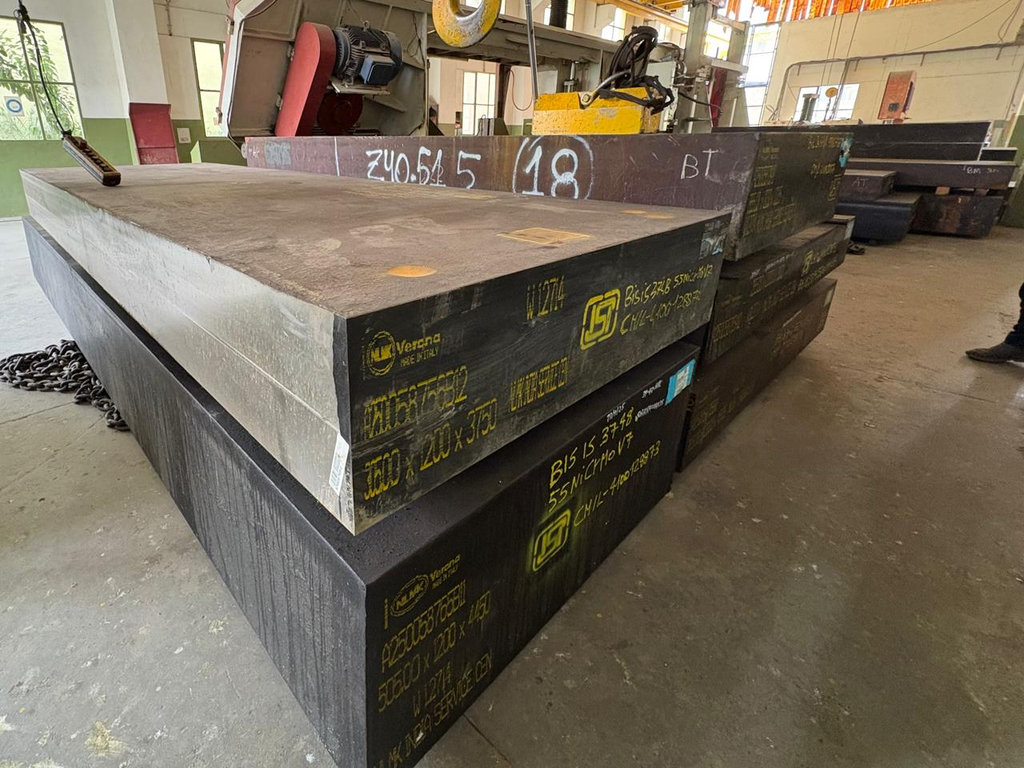
Where Hot Work Tool Steel Is Used
Aluminum diecast molds H13 tool steel is the material of choice here because it can be repeatedly heated and cooled without losing dimensional stability – think engine blocks, gear housings, transmission components, pump bodies, LED housings and other automotive parts.
Hot-forging dies They are pounded by impact loads and heat, which is why DB6 and H11—valued for toughness and resistance to thermal cracking—are the usual choices. Common on crankshafts, connecting rods, railroad components and heavy engineering components.
Extrusion Dies High hot strength and wear resistance is needed to keep profiles – used for aluminum profiles, window frames, heat sinks and electrical conductors.
Brass and copper die cast. These alloys run hotter than aluminum so H13 and H11 earn their keep with better hot hardness.
Hot shear blades, for cutting red-hot blooms, billets and bars in rolling mills;
Hot punches, made for hot piercing, making and punching where wear and impact resistance both count.
Glass molds on the basis of thermal stability and resistance to heat checking.
Plastic mold parts: ESR H13 material tool preferred for polishability and wear resistance.
Industries That Rely on It
| Industry | Applications |
| Automotive | Die casting, forging |
| Aerospace | Forging tools |
| Defence | Heavy-duty dies |
| Railways | Forged components |
| Aluminium | Extrusion dies |
| Plastic Moulding | Mould inserts |
| Steel Plants | Hot shear blades |
| Heavy Engineering | Forging tools |
| Energy | Turbine & valve tooling |
Hot Work vs. Cold Work vs. Plastic Mould Steel
| Feature | Hot Work Tool Steel | Cold Work Tool Steel | Plastic Mould Steel |
| Primary Use | High-temperature tooling | Room-temperature cutting/forming | Plastic injection & moulding |
| Operating Temperature | High | Low to moderate | Low to moderate |
| Key Property | Hot hardness & thermal fatigue resistance | Wear resistance & hardness | Toughness, polishability & machinability |
| Important Grades | H13, H11, DB6 | D2, D3, EN31 | P20, P20+Ni, 1.2083 |
| Common Applications | Die casting, forging, extrusion | Dies, punches, blanking, shear blades | Injection moulds, plastic moulds |
| Typical Hardness | 44–54 HRC | 55–62 HRC | 28–52 HRC |
| Main Advantage | Retains strength at elevated temperatures | Excellent wear & edge retention | Good machinability and surface finish |
| Typical Industries | Automotive, forging, die casting | Tool & die, automotive, engineering | Plastic, packaging, automotive |
| Parameter | H13 | DB6 |
| Type | Chromium hot work steel | Nickel-chromium-molybdenum tool steel |
| Hardness | 44–54 HRC | 38–42 HRC |
| Toughness | Excellent | Outstanding |
| Wear Resistance | Higher | Moderate |
| Thermal Fatigue | Excellent | Very good |
| Large Dies | Good | Excellent |
| Forging Applications | Very good | Excellent |
| Impact Resistance | Good | Superior |
| Aluminium Die Casting | Excellent | Good |
H13/DB6 comparison table in die casting and extrusion; go with DB6 for large forging dies, hammer dies and heavy-impact work.
Advantages & Limitations
| Advantages | Limitations |
| Excellent hot hardness | Higher material cost |
| High thermal fatigue resistance | Needs proper heat treatment |
| Excellent toughness | Harder to machine once hardened |
| Good wear resistance | Limited corrosion resistance |
| Good machinability when annealed | Large sections need controlled processing |
| Excellent dimensional stability | |
| Long tool life |
How to Choose the Right Grade
1. Match the grade to the application.
| Application | Recommended Grade |
| Aluminium die casting | H13 (1.2344) |
| Brass die casting | H13 |
| Hot forging dies | H11 (1.2343) |
| Hammer dies | DB6 (1.2714) |
| Extrusion dies | H13 |
| Plastic mould inserts | ESR H13 |
| Large forging blocks | DB6 |
Get the size right. Think about how long it’s how wide it is, how thick it is, Think about length, width, thickness, weight, machining allowance, and expected dimensional change during heat treatment.. Available forms include forged blocks, round bars, flat bars, ESR blocks and pieces that are already cut to size.
Settle on a delivery condition with your supplier — annealed, pre-hardened, hardened and tempered, soft annealed, or stress relieved. With your supplier.
Check the quality before you make a decision. Ask for testing results, spectrometer reports, material test certificates, heat-number traceability and confirmation of surface finish, straightness and mechanical properties.
Plan the amounts you need based on prototypes, regular production, yearly use, extra stock and any growth that is coming up.
Choose a supplier who can support you. One that has stock, imported materials, forged and ESR blocks, fast delivery, technical help, certificates and custom machining.
Certifications Worth Looking For
| Certification | Purpose |
| ISO 9001 | Quality management system |
| EN 10204 3.1 | Material test certificate |
| Ultrasonic Testing (UT) | Detects internal defects |
| Spectrometer Analysis | Verifies chemical composition |
| Hardness Test Report | Confirms HRC/HB values |
| Heat Number Traceability | Tracks production batch |
Why Manufacturing Quality Matters
How the steel is made has a direct line to how it performs on the shop floor. Controlled melting, refining, forging, annealing, hardening, tempering and inspection are what separate a die that lasts from one that fails early — particularly in die casting, hot forging, aluminium extrusion and heavy-duty tooling, where the cost of a bad batch shows up fast.
Key Takeaways
- Controlled melting and refining keep the chemistry consistent.
- Forging improves structural uniformity and toughness.
- Annealing gets the material ready for machining.
- Hardening builds the strength and hardness.
- Tempering balances hardness against toughness.
- UT, chemical analysis, hardness testing and dimensional inspection confirm quality before shipping.
- MTCs and heat-number traceability give buyers the documentation they need.
Why Choose Virat Special Steels?
Virat Special Steels Pvt. Ltd. has been supplying manufacturers with quality imported tool steels for over 70 years.
- Over 70 years of industry experience.
- 3,500+ tons of tool steel in stock, ready to use
- Sourced from established international mills.
- “Wide grade range: H13, H11, DB6, D2, D3, P20, M2, M35, and ESR grades“.
- “Every order comes with an EN 10204 3.1 MTC”
- “UT and spectrometer testing on all material”
- “Cut-to-size and custom machining available”
- “Fast delivery across India”
- “Trusted by automotive, forging, aerospace, plastic moulding, railway, and heavy engineering customers”.
Our Supply Network Across India
We supply H13, DB6, H11, H12, H10 and H21 across major industrial hubs — Delhi, Gurugram, Faridabad, Noida, Ghaziabad, Jaipur, agra, Ahmedabad, Vadodara, Surat, Rajkot, Mumbai, Pune, Nashik, Indore, Bhopal, Rudrapur , Chennai, Coimbatore, Hyderabad, Kolkata, Jamshedpur, Secunderabad and Nellore — with standard and custom sizes, cut-to-size material, annealed or heat-treated condition, and material test certificates as required.
Conclusion
H13 and DB6 remain the two most dependable choices for high-temperature tooling, offering a solid mix of hardness, toughness, wear resistance, hot strength and thermal-fatigue resistance. Get the grade selection, heat treatment, machining and maintenance right, and both can deliver excellent tool life. We supply H13, DB6 and other tool steel grades across major industrial cities in India for a wide range of manufacturing needs.
Get a Quote
Looking for reliable H13, DB6 or other hot work tool steel? Virat Special Steels supplies round & flat bars, forged & rolled blocks, ESR/non-ESR blocks and cut-to-size material — complete with MTC, UT testing, spectro testing, custom machining, ready stock and PAN India delivery.
Call: +91-98140 21775 Email: info@viratsteels.com Locations: Gurgaon (Haryana) | Ludhiana (Punjab)
Frequently Asked Questions
1. What is Hot Work Tool Steel?
Alloy steel for tools and dies exposed to high temperatures, thermal cycling, wear and mechanical stress.
2. What are the primary types?
Typical grades are H13, H11, H12, H10 and H21 – H13 tool is the most common.
3. H13 tool steel – what is it?
A hot work Cr-Mo-V grade that is known for its excellent hot strength, toughness, wear resistance and thermal-fatigue resistance.
4. What is the HRC of H13?
44-54 HRC depending on the application and heat treatment condition.
5. What is the maximum service temperature of H13?
Typically up to around 550–600°C, depending on load, thermal cycling and cooling conditions. Confirm the exact limit with your supplier’s datasheet.
6. Is H13 material good for high temperature applications?
Yes, it is used heavily where there is high heat and heating and cooling over and over again.
7. Can H13 be machined?
Yes, if annealed. It is much more difficult to machine once hardened.
8. How to Improve H13 Machinability?
Use proper cutting tools. Use appropriate speeds and feeds. Use adequate cooling. Machine in the annealed state where possible.
9. What is H13 used for?
Die casting dies, extrusion dies, forging dies, hot punches, mandrels and other similar hot work tooling.
10. H13 wear resistant?
Yes, if they are heat treated properly and matched to the proper operating conditions.
11. Is H13 hard enough?
Yes, gives a good balance of hardness and toughness which is what you need in demanding die work.
12. What is resistance to thermal fatigue?
It’s the ability of the steel to be heat cycled over and over again without heat checking or cracking.
13. Is H13 heat treatable?
Yes. Usually it is hardened and tempered so that it can obtain the desired hardness, toughness and hot strength.
14. Is H13 air hardenable?
Yes, which means it can achieve high hardness by means of appropriate heat treatment without a drastic quench.
15. Can H13 be used for nitriding?
Yes, nitriding can improve surface hardness, wear resistance and die life in suitable applications.
16. What is the chemical composition of H13?
Carbon, silicon, manganese, chromium, molybdenum and vanadium. Chromium, molybdenum and vanadium do most of the work.
17. What is the difference between H11 and H13?
Both are hot working grades but H13 tool steels gives generally a better combination of hot hardness, wear resistance, toughness and thermal-fatigue resistance.
18. What’s the difference between H13 and D2?
D2 is a cold-work grade built primarily for high wear resistance. H13 tool steel is a hot-work grade.
19. Is H13 tool steels appropriate for die casting dies?
Yes, it is widely used for aluminum, zinc and magnesium die casting because of its resistance to thermal fatigue and its hot strength.
20. Can H13 tool steels be used for hot extrusion die?
Yes, commonly used for extrusion dies, mandrels and related tooling.
H13 vs H11 Tool Steel – Complete Comparison (Properties, Hardness, Applications, Price & Selection Guide)
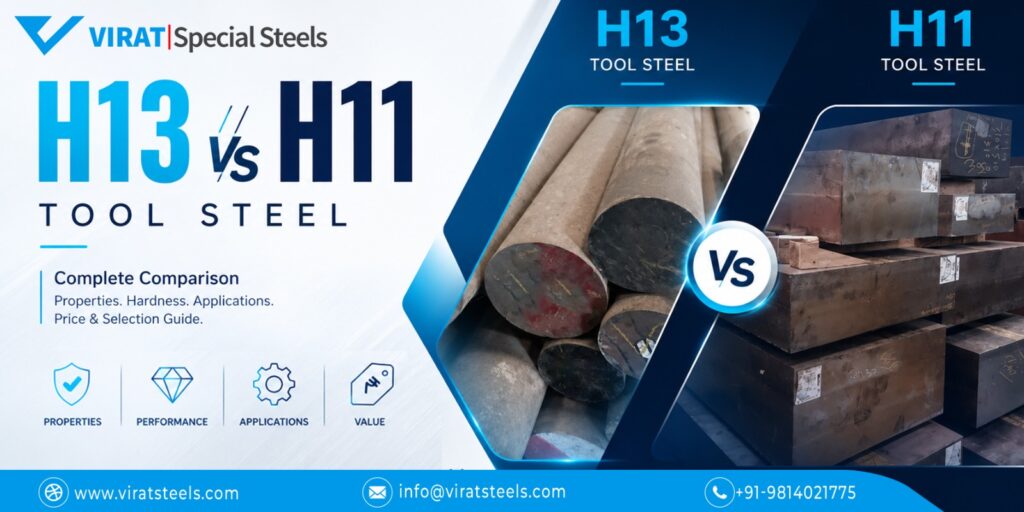
H13 vs H11 Tool Steel, Which One Should You Choose?
Walk into any tool room, forging shop, or die manufacturing unit in India, and you’ll hear the same debate.
“Should this die be made from H13 or H11?”
At first glance, both steels look nearly the same. They are both part of the Hot Work Tool Steel family, contain chromium and molybdenum, and are built to perform in extreme temperatures. However, choosing the wrong material can significantly decrease die life.
- Choose H13 where H11 should have been used, and the die may crack under repeated impact.
- Choose H11 where H13 belongs, and excessive wear can shorten production life.
This complete guide explains everything you need to know before selecting either grade.
You’ll learn about:
- H13 vs H11 Chemical Composition
- Hardness Comparison
- Mechanical Properties
- Heat Treatment
- Price Comparison
- Tool Life
- Equivalent Grades
- Applications
- Availability in India
- Supplier Selection Guide
- 25+ Frequently Asked Questions
H13 vs H11 Tool Steel – Quick Comparison
| Property | H13 (DIN 1.2344 / SKD61) | H11 (DIN 1.2343 / SKD6) |
| Main Strength | Excellent wear resistance and hot hardness | Great toughness and impact resistance |
| Wear Resistance | Excellent | Very Good |
| Toughness | Very Good | Excellent |
| Hot Hardness | Excellent | Very Good |
| Resistance to Thermal Fatigue | Excellent | Very Good |
| Shock/Impact resistance | Excellent | Good |
| Machinability (Annealed) | Better | Moderate |
| Maximum Working Hardness | Up to 54 HRC | Up to 52 HRC |
| Typical Working Hardness | 44–48 HRC | 42–46 HRC |
| Best Suited For | Die Casting, Extrusion Dies, Plastic Moulds | Forging Dies, Hammer Dies, Fastener Tooling |
| Relative Tool Life | Longer in wear-intensive applications | Longer in impact-intensive applications |
| Relative Cost | 10–20% Higher | More Economical |
| Best Choice When | Heat, wear and long production runs are the priority | High impact, shock loading and toughness are the priority |
What is H13 Tool Steel?
H13 Tool Steel (DIN 1.2344, SKD61) is one of the world’s most widely used chromium hot work tool steels.
Its high vanadium content forms extremely hard carbides that improve:
- Wear resistance
- Hot hardness
- Heat checking resistance
- Tool life
- Surface finish
This makes H13 the preferred steel for:
- Aluminium Die Casting Dies
- Zinc Die Casting
- Plastic Injection Moulds
- Extrusion Dies
- Hot Shear Blades
- Forging Punches
What is H11 Tool Steel?
H11 Tool Steel (DIN 1.2343, SKD6) is also a Hot Work Tool Steel, but with a lower vanadium content.
The lower carbide volume gives H11:
- Better toughness
- Better impact resistance
- Better crack resistance
- Easier machining
It is commonly selected for:
- Hammer Dies
- Forging Dies
- Fastener Tooling
- Hand Tool Dies
- Heavy Stamping
Comparison of Chemical Composition H13 vs H11 Tool Steel
| Element | H13 (DIN 1.2344) | H11 (DIN 1.2343) |
| Carbon | 0.32–0.45% | 0.33–0.43% |
| Chromium | 4.75–5.50% | 4.75–5.50% |
| Molybdenum | 1.10–1.75% | 1.10–1.60% |
| Vanadium | 0.80–1.20% | 0.30–0.50% |
| Silicon | 0.80–1.20% | 0.80–1.20% |
| Manganese | 0.20–0.50% | 0.20–0.50% |
Main Difference:
The H13 with higher vanadium content has much better wear resistance and longer tool life.
Mechanical Property Comparison
| Property | H13 | H11 |
| Wear Resistance | Excellent | Good |
| Toughness | Good | Excellent |
| Hot Hardness | Excellent | Good |
| Thermal Fatigue | Excellent | Very Good |
| Heat Checking Resistance | Excellent | Very Good |
| Impact Resistance | Good | Excellent |
| Machinability | Moderate | Better |
| Polishability | Excellent | Good |
Hardness Comparison
| Condition | H13 | H11 |
| Annealed | 180–220 HB | 180–220 HB |
| Working Hardness | 44–52 HRC | 42–50 HRC |
| Maximum Practical Hardness | 54 HRC | 52 HRC |
Heat Treatment Process
1. Preheating (650–750°C)
2. Austenitizing
o H13: 1010-1025 °C
3. Air, Oil, or Vacuum Quenching
4. Double or Triple Tempering (550-650 °C)
Vacuum heat treatment is recommended for precision dies to minimise distortion.
One of the most asked questions from buyers is:
“What’s the cheapest steel?
Generally,
Why?
- Higher Vanadium content
- Better wear resistance
- Longer production life
- Higher performance in die casting applications
Although the initial purchase price is higher, H13 often delivers a lower cost per component because of its longer service life.
Price depends on:
- ESR or Conventional Grade
- Forged or Rolled Material
- Imported or Domestic Mill
- Size
- Heat Treatment
- Quantity
No fixed market price exists, so always request a quotation based on current stock.
H13 vs H21
| Feature | H13 | H21 |
| Toughness | Better | Lower |
| Hot Hardness | Excellent | Outstanding |
| Wear Resistance | Excellent | Excellent |
| Typical Use | Die Casting | Hot Forging & Extreme Heat |
H13 vs DIN 1.2367
| Property | H13 | 1.2367 |
| Toughness | Excellent | Higher |
| Hot Strength | Excellent | Excellent |
| Large Forging Dies | Good | Better |
There is virtually no practical difference. SKD61 is the Japanese JIS designation equivalent to AISI H13 and DIN 1.2344. Selection should focus on material quality, cleanliness, ESR option, testing, and supplier reliability rather than the grade designation alone.
H13 vs DB6
| Feature | H13 | DB6 |
| Type | Hot Work | Hot Work |
| Toughness | Excellent | Very High |
| Nickel Content | No | Yes |
| Large Forging Dies | Good | Excellent |
| Heavy Impact | Good | Better |
Tool Life Comparison
| Application | Better Grade |
| Die Casting | H13 |
| Extrusion | H13 |
| Plastic Moulds | H13 |
| Hammer Dies | H11 |
| Forging Dies | H11 |
| Heavy Impact Tools | H11 |
H13 & H11 Equivalent Grades
H13 and H11 are common hot work tool steels, but they have different names depending on the international standard used. Use the table below to identify the equivalent grades used in different countries.
| Standard | H13 Equivalent | H11 Equivalent |
| AISI (USA) | H13 | H11 |
| DIN / EN (Germany) | 1.2344 / X40CrMoV5-1 | 1.2343 / X38CrMoV5-1 |
| JIS (Japan) | SKD61 | SKD6 |
Sizes Available
H13 (DIN 1.2344 / SKD61) and H11 (DIN 1.2343 / SKD6) tool steel are available in a wide range of sizes to suit different tooling applications.
| Product Form | Available Sizes |
| Round Bars | Ø13 mm to Ø500+ mm |
| Flat Bars | Thickness: 20–305 mm, Width: 50–600 mm |
| Cut-to-Size Blocks | As per customer drawing and specifications |
Custom sizes and large forged sections can also be supplied based on project requirements.
| Property | Conventional | ESR |
| Cleanliness | Good | Excellent |
| Inclusion Level | Higher | Lower |
| Polishability | Good | Excellent |
| Fatigue Life | Better | Best |
| Tool Life | Longer | Longest |
ESR H13 is recommended for premium die casting and mould applications requiring maximum reliability.
Industries Using H13
- Aluminium Die Casting
- Zinc Die Casting
- Plastic Injection Moulding
- Extrusion
- Aerospace
- Automotive
- Pressure Die Casting
- Hot Shear Blades
Industries Using H11
- Forging
- Hammer Dies
- Fastener Manufacturing
- Hand Tools
- Heavy Engineering
- Structural Components
Why Buy H13 or H11 from Virat Steels?
Virat Steels has been supplying premium tool steels to Indian manufacturers for 70+ years.
Why customers choose Virat Steels
- 70+ Years of Experience
- 2000+ Industrial Customers
- Supplier of material from reputed international mills
- Ready Stock Available
- Mill Test Certificate (MTC)
- UT Tested Material
- Spectro Tested Material
- PAN India Delivery
- Custom Cutting
- Fast Dispatch
- Technical Material Recommendation
Whether you’re looking to Buy H13 Steel, Buy H11 Steel, DIN 1.2344, DIN 1.2343, SKD61, SKD6, ESR H13, or Forged H13 Blocks, our team can recommend the right material based on your application
Our Supply Network Across India
Virat Steels is a trusted supplier of Hot Work Tool Steel to customers across the major industrial hubs of India including Ahmedabad, Rajkot, Pune, Nashik, Aurangabad, Kolhapur, Belgaum, Chennai, Coimbatore, Hosur, Bengaluru, Hyderabad, Faridabad, Manesar, Bhiwadi, Gurugram, Delhi NCR, Ludhiana, Chandigarh, Haryana, Punjab, Jamshedpur.
Our strong logistic network and efficient distribution system enable us to ensure timely PAN India dispatch to meet the requirement of tool rooms, die manufacturers, forging industries and engineering companies across the country.
- H13 Tool Steel
- H11 Tool Steel
- DIN 1.2344 Tool Steel
- DIN 1.2343 Tool Steel
- ESR Tool Steel
- Plastic Mould Steel
- Hot Work Tool Steel
- Forged Tool Steel Blocks
Download Free PDF:
H13 vs H11 Tool Steel Comparison Guide
https://www.viratsteels.com/downloads/h13-vs-h11-comparison.pdf
Request a Quote
Searching for the right Hot Work Tool Steel?
Our technical team can suggest the correct grade for your application whether you require H13, H11, DIN 1.2344, DIN 1.2343, SKD61, SKD6, ESR H13 or Forged H13 Blocks.
Request a Quote Today
✔ Material Recommendation
✔ Ready Stock
✔ MTC Available
✔ UT Tested
✔ Spectro Tested
✔ PAN India Delivery
Call us or send your drawing to receive a customised material recommendation.
Call us: +91-98140 21775 Email: info@viratsteels.com Visit us: Gurgaon (Haryana) | Ludhiana (Punjab)
FAQs (Frequently Asked Questions)
1. What is the difference between H11 and H13 tool steel?
H11 is tougher and more impact resistant while H13 has more wear resistance, hot hardness and resistance to thermal fatigue.
2. Which steel is best for aluminum die casting dies?
H13 is generally preferred as it has a longer die life and is more resistant to heat checking.
3. What grade is recommended for hot forging dies?
H11 is often chosen for heavy-impact forging work and H13 is appropriate for moderate-impact forging applications.
4. What are the common industries that use H11 and H13 tool steel?
These grades are widely used in die casting, forging, extrusion, automobile, aerospace, plastic molding and general engineering industry.
5. What is the working temperature range of H13 tool steel?
H13 has good strength and hardness up to about 600°C and is used for hot working.
6. Is H11 impact strength better than H13?
Yes. H11 has a lower vanadium content which makes it tougher and more resistant to impact loading.
7. Which tool steel has better dimensional stability in heat treatment?
H13 generally has better dimensional stability when properly heat treated.
8. Is it possible to nitride H11 and H13?
Yes. Both grades can be nitrided to increase surface hardness and wear resistance.
9. What is the best grade for extrusion tooling?
H13 is most often recommended for aluminum extrusion dies as it has the best hot strength and wear resistance.
10. Are H11 and H13 available on forged blocks?
Yes. Both grades are available as forged blocks, rounds, flats and in customer specific sizes.
11. What inspections are performed before dispatch?
Material usually comes with Spectro Test Reports, Ultrasonic Testing (UT), Material Test Certificates (MTC), and hardness testing if requested.
12. Can H11 and H13 be supplied in pre-hardened condition?
Yes. Based on customer needs, both grades can be offered annealed, pre-hardened, or heat-treated.
13. Which grade is easier to polish?
H13 generally provides an excellent polished finish, making it good for high-quality tooling applications.
14. Are H11 and H13 suitable for plastic mould applications?
Yes. H13 is commonly used for plastic moulds that work at high temperatures or need great wear resistance.
15. What shapes are available in H11 and H13 tool steel?
These grades come in round bars, flat bars, square bars, forged blocks, plates, and custom-cut sizes.
16. How do I choose between H11 and H13?
The choice depends on the application. Use H11 for maximum toughness, and H13 for better wear resistance and a longer service life.
17. What surface finish options are available?
Materials are available in black, peeled, rough machined, bright, or fully machined condition based on customer needs.
18. Can custom sizes be supplied?
Yes. Custom dimensions and cut-to-size materials are available to reduce machining time and material waste.
19. What certifications are available with the material?
Materials can come with Mill Test Certificates (MTC), chemical composition reports, mechanical property reports, and UT inspection certificates.
20. Does Virat Steels offer technical support in selecting tool steel?
Yes. Our technical team helps customers choose the right grade based on the application, operating temperature, and service conditions.
21. Does Virat Steels deliver across India?
Yes. We provide fast and dependable delivery across India to major industrial cities and manufacturing hubs.
22. How can I place an order with Virat Steels?
Just share your required grade, dimensions, quantity, or technical drawing with our sales team. We will recommend the right material, offer technical guidance, and provide a competitive quote.
Virat Steels-Trusted Tool & Die Steel Supplier in India
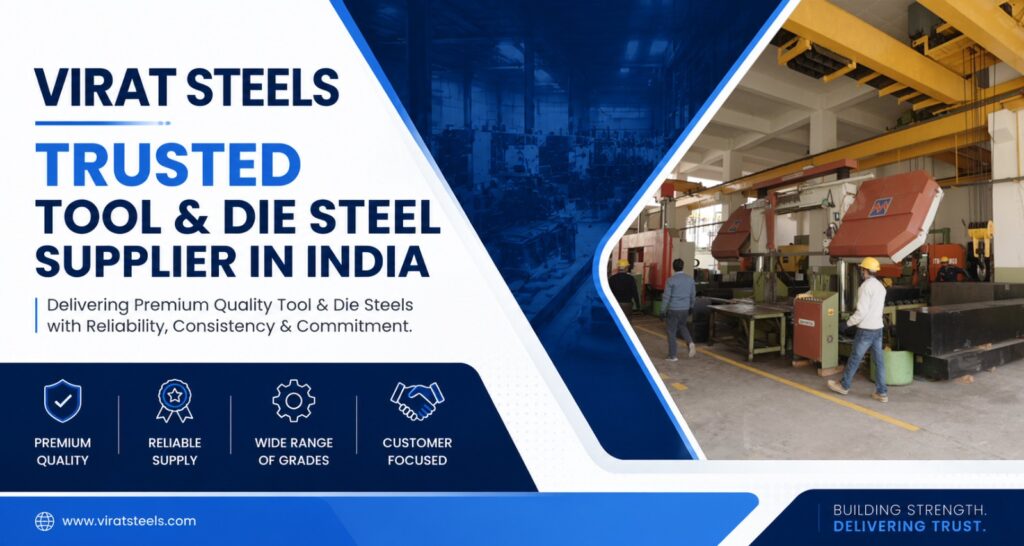
In the tool and die steel industry, quality material and reliable service are very essential for consistent production performance. Manufacturers today need more than just steel. Hence, they need a trusted supply partner.
That’s why industries across India choose Virat Special Steels for premium tool steel solutions.
With decades of domain expertise, the company serves high-quality tool & die steels industries ranging from automotive and aerospace to defence, tooling, and heavy engineering.
Premium Quality Steel
Virat Steels provide genuine and reliable tool steel with:
- Consistent hardness
- Better machinability
- Improved tool life
- Genuine quality
Available in:
✔ Rounds
✔ Flats
✔ Blocks
Ready Stock Availability
Ready stock available for major grades including:
ensuring quick dispatch and reduced downtime.
Ultrasonic Tested Material
Virat Steels supplies UT Tested Tool Steel
Ultrasonic testing helps detect:
- Internal defects
- Cracks
ensuring better reliability and performance.
Precision Cutting Facility
We offer precision cutting services for:
- Accurate dimensions
- Reduced machining allowance
- Faster processing
Helping customers save time and improve productivity.
Strong Logistics Support
We deliver across India with:
- Fast dispatch
- Safe handling
- Timely delivery
Supplying to major industrial regions across India .
Technical Support
Our team helps customers choose:
- Suitable steel grade
- Recommended Hardness
- ESR vs standard grades
- Application-based solutions
Certified & Test Report
- Material Test Certification (MTC)
Looking for a reliable tool and die steel supplier in India?
Contact Virat Special Steels:
📞 +91 98140-21775
🌐 www.viratsteels.com
✉ info@viratsteels.com
Frequently Asked Questions (FAQs)
1. What products does Virat Steels supply?
Virat Steels supplies premium tool and die steels including Hot work steels, cold work steels, High Speed steels, Alloy steel grades etc.
2. Which industries use tool and die steel?
Tool and die steels are widely used in Forging, Extrusion, Plastic moulds, Automotive components, Pressure Die casting .
3. Does Virat Steels provide ultrasonic tested material?
Yes, Virat Steels supplies UT tested material to ensure better reliability, reduced internal defects, and improved tooling performance.
4. Does Virat Steels maintain ready stock?
Yes, Virat Steels maintains ready stock of major tool steel grades for quick dispatch and faster delivery across India.
5. Why choose Virat Steels as a tool steel supplier?
Manufacturers choose Virat Steels because of Genuine quality, UT tested steel, Precision cutting facility, ready stock, fast delivery, technical support
6. Does Virat Steels deliver across India?
Yes, Virat Steels supplies tool and die steel across major industrial regions in India with reliable logistics and timely delivery support.
7. How can I contact Virat Steels for tool steel requirements?
You can contact Virat Steels on 📞 +91 98140-21775 for grade recommendations, stock availability, and pricing.
Why H13 Dies Fail Prematurely — And How to Prevent It
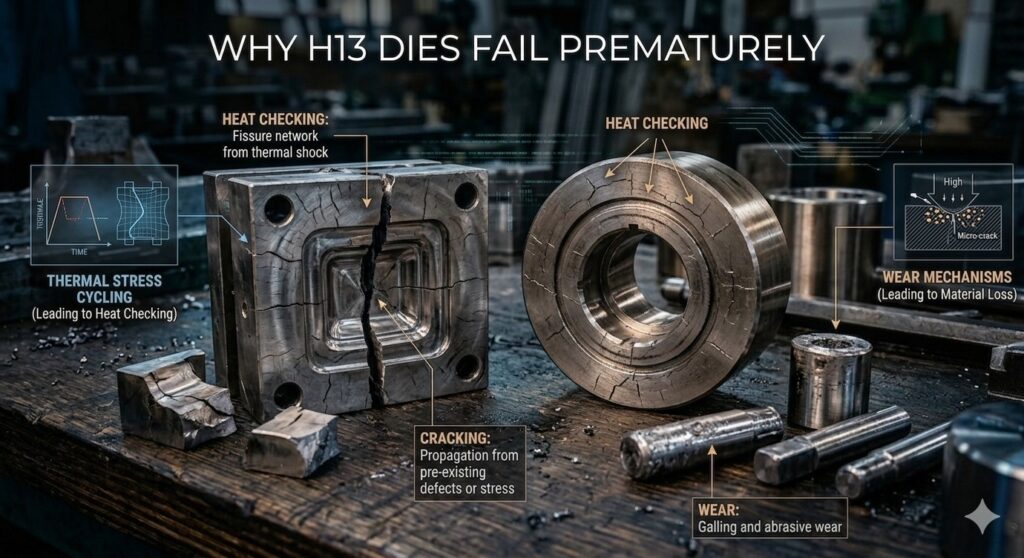
H13 tool steel is the backbone of hot work tooling—widely used in die casting, forging, extrusion, and moulding. When processed correctly, it delivers long life and consistent performance.
Yet many H13 dies fail far earlier than expected.
That’s not a material problem—it’s a process problem.
What is Premature Failure?
Premature failure means a die cracks, wears out, or loses accuracy well before its expected production life—leading to downtime, rejection, and high tooling costs.
Top Reasons H13 Dies Fail Early
1. Heat Checking (Thermal Fatigue)
Repeated heating and cooling creates fine surface cracks (like dry mud). Over time, these cracks grow and damage the die surface.
Why it happens faster:
- Excessive cooling (thermal shock)
- Over-hardening (brittleness)
- No preheating before production
Prevention: Controlled cooling, correct hardness, nitriding, ESR-grade steel.
2. Gross Cracking & Fracture
Deep cracks or sudden die breakage.
Causes:
- Over-hardening
- Poor tempering (retained austenite)
- Sharp corners (stress concentration)
- Thermal shock
Prevention: Proper heat treatment, multiple tempering cycles, better die design.
3. Abrasive Wear & Erosion
Gradual loss of dimension and surface finish.
Causes:
- Low hardness
- High temperatures
- Poor lubrication
- High metal flow (in die casting)
Prevention: Correct hardness, lubrication, nitriding/PVD coatings.
4. Poor Heat Treatment
Even premium H13 fails if heat treatment is wrong.
Common mistakes:
- Incorrect hardening temperature
- Uneven quenching
- Single tempering
- Surface decarburisation
Prevention: Vacuum heat treatment + double/triple tempering.
5. Low Steel Quality
Not all H13 is equal.
Standard grades may contain inclusions and segregation—leading to early cracks.
Better choice:
ESR process H13 — cleaner, tougher, longer life.
6. Design & Machining Errors
Even perfect steel fails with poor design.
Common issues:
- Sharp corners
- Thin sections
- Poor cooling line placement
- EDM layer without re-tempering
Prevention: Smooth radii, balanced design, proper finishing.
7. Poor Lubrication & Cooling
Operational mistakes accelerate failure.
- Uneven cooling → thermal stress
- Poor lubrication → wear & soldering
- Hard water scaling → overheating
8. No Preheating
A cold die entering production faces instant thermal shock.
Recommended:
- Die casting: 180–250°C
- Forging: 150–200°C
How to Extend H13 Die Life
- Use ESR-quality H13 steel
- Maintain correct hardness (not “harder is better”)
- Ensure proper heat treatment (multi-temper)
- Apply nitriding or coatings
- Design with proper radii & cooling layout
- Always preheat before production
Conclusion
H13 failure is rarely random—it’s almost always preventable.
The biggest difference between short life and long life?
Material quality + process control.
Start with the right steel. Execute the process right.
And H13 will deliver the performance it’s known for.
Frequently Asked Questions
Q1: Why is H13 preferred for hot work dies?
Excellent hot strength
Good thermal fatigue resistance
High toughness
Q2: What is the main cause of heat checking in H13?
Repeated thermal cycling (heating + cooling)
Q3: How can heat checking be reduced?
Proper die preheating (150–300°C typically)
Controlled cooling (avoid sudden quenching)
Use of thermal barrier coatings
Q4: What hardness is ideal for H13 dies?
Typically 44–52 HRC depending on application
Too hard → cracking
Too soft → wear
Q5: How does nitriding help H13 dies?
Increases surface hardness
Improves wear resistance
Delays crack initiation
Q6: What is the role of cooling channels?
Maintain uniform temperature
Reduce thermal gradients
Prevent hot spots → reduce cracking
Q7: Can coatings completely prevent wear?
No, but they significantly delay it
Coatings improve life, not eliminate failure
Q8: Why do dies soften over time?
Overexposure to high temperatures beyond tempering limit
Q9: What industries commonly face H13 die failure?
Die casting (aluminum, zinc)
Forging
Extrusion
| Ready to Source H13 Smarter? Contact Virat Special Steels Today |
Fast quotes | Grade recommendations | Pan-India delivery
https://www.viratsteels.com/h13.html📧 info@viratsteels.com | 📱 +91 98140-21775
Understanding Tool & Die Steel Hardness and Toughness for Manufacturing
Introduction
In every industry from forging shops to automotive plants, tool & die steels are the silent heroes at work. They shape, cut, and press with relentless precision. But behind every tool lies a choice: the steel it’s made from.
If a tool steel is too hard, it risks cracking under impact. If it’s too tough, it wears down too quickly. The secret to industrial success isn’t choosing one over the other. it’s finding the perfect balance.
The topic is hence clear that neither hardness nor toughness alone could carry the weight of modern industry. Progress demanded a balance that is -hard enough to resist wear & tough enough to withstand impact. With this harmony, dies lasted longer, automotive components are forged with precision, and heavy engineering tools are made without interruption.
That’s why manufacturers don’t just pick any steel grade. They choose carefully, knowing that the right steel is the difference between downtime and success.
What Is Tool & Die Steel Hardness?
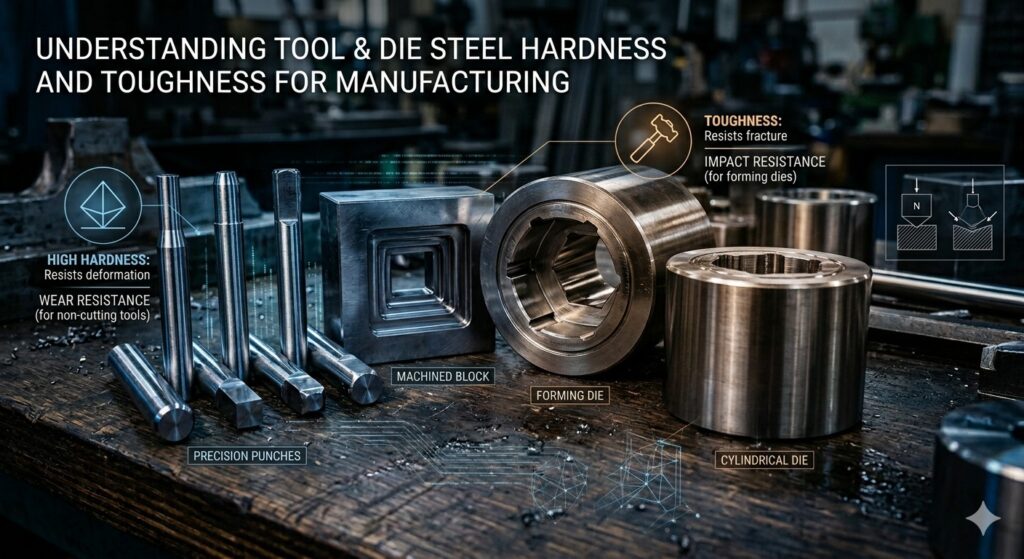
Hardness means the ability of steel to resist surface wear, indentation, or deformation. In industrial tooling applications, higher hardness usually means better resistance to abrasion and longer tool life.
Hardness is typically measured using the Rockwell hardness scale(HRC). Tool steels used in industrial applications often fall within a hardness range of 45 HRC to 62 HRC, depending on the specific grade and application.
Why Hardness Matters ?
Hardness is especially important in applications where tools are exposed to continuous friction and high pressure. Examples include:
- Forging dies
- Cutting tools
- Punches and Molds
- Industrial forming tools
A higher hardness level helps tools maintain their shape and resist wear during repeated manufacturing cycles.
What Is Tool & Die Steel Toughness?
Toughness refers to the ability of steel to absorb impact and resist cracking or breaking under stress. It is particularly important for tooling applications where tools are exposed to heavy mechanical loads or sudden shocks.
In forging operations, dies often experience repeated impact forces. Tool steels with good toughness can withstand these forces without developing cracks or fractures.
Why toughness Matters ?
High toughness is critical in applications such as:
- Hammer forging dies
- Press forging tools
- Heavy-duty industrial dies
- Impact tools
Without adequate toughness, even a very hard steel may fail prematurely.
The Balance Between Hardness and Toughness
One of the biggest challenges in tool steel selection is achieving the right balance between hardness and toughness. Increasing hardness often reduces toughness, while increasing toughness may lower hardness.
Therefore, tool steel manufacturers carefully design steel grades and heat treatment processes to achieve an optimal combination of these properties.
For example:
- Cold work tool steels often emphasize high hardness and wear resistance
- Hot work tool steels are designed with higher toughness to withstand thermal and mechanical stress
Selecting the correct steel grade depends on the specific operating conditions of the tool.
How Heat Treatment Affects Hardness and Toughness
Heat treatment plays a critical role in controlling the mechanical properties of tool steel. Processes such as hardening and tempering help achieve the desired balance of hardness and toughness.
Typical heat treatment stages include:
- Heating the steel to a specific temperature
- Rapid cooling (quenching) to increase hardness
- Tempering to improve toughness and reduce brittleness
Proper heat treatment ensures that tool steel can perform reliably in demanding industrial environments.
Tool Steel Applications Requiring the Right Balance
Different industrial applications require different combinations of hardness and toughness.
1.Forging Dies
Forging dies require high toughness to withstand repeated impact and sufficient hardness to resist wear.
2.Cutting Tools
Cutting tools need very high hardness to maintain sharp edges during machining operations.
3.Plastic Moulds
Mould steels require moderate hardness and good toughness for durability and dimensional stability.
Choosing the right tool steel for each application helps manufacturers reduce tool failures and improve productivity.
Why Tool & Die Steel Quality Matters
Even with the correct hardness and toughness levels, the quality of the steel itself plays an important role. Factors such as metallurgical cleanliness, grain structure, and manufacturing processes influence the final performance of tool steel.
Reliable suppliers such as Virat Special Steels help industries access high-quality tool steel with proper certification and consistent properties.
This ensures better reliability in applications such as forging dies, industrial tooling, and heavy engineering components.
FAQs (Frequent Asked Questions)
1-What is tool & die steel?
Tool & Die Steel is a high-strength, wear-resistant steel specially designed for making tools, dies, and molds used in manufacturing and shaping materials like metal or plastic.
2-What is hardness in tool steel?
Hardness is the ability of tool steel to resist wear, indentation, and deformation during industrial use.
3-Why is toughness important in tool steel?
Toughness allows tool steel to absorb impact and resist cracking under heavy loads.
4-Can tool steel have both high hardness and toughness?
Yes, modern tool steels are designed to balance hardness and toughness through alloy composition and proper heat treatment.
5-What affects the hardness of tool steel?
Hardness is influenced by chemical composition, heat treatment processes, and steel manufacturing quality.
6-Which supplier provides best quality tool & die steels?
Virat Special Steels, a most trusted Indian Supplier provide a wide range of high-performance steel grades for manufacturing industries.
Conclusion
Hardness and toughness are two of the most important properties that determine the performance of tool steel.
By selecting the right tool steel grade and sourcing it from reliable suppliers, manufacturers can significantly improve the performance and durability of their industrial tools.
At VIRAT SPECIAL STEELS, we provide a complete range of premium hot work and cold work tool steels to support every industrial requirement. Whether you are into forging, stamping, cutting, die casting, or extrusion, we deliver the right steel grade with consistent quality and reliable performance. Contact us today.
https://www.viratsteels.com info@viratsteels.com +91 98140-21775
European Tool Steel vs Indian Tool Steel: A Quality Comparison for Industrial Applications
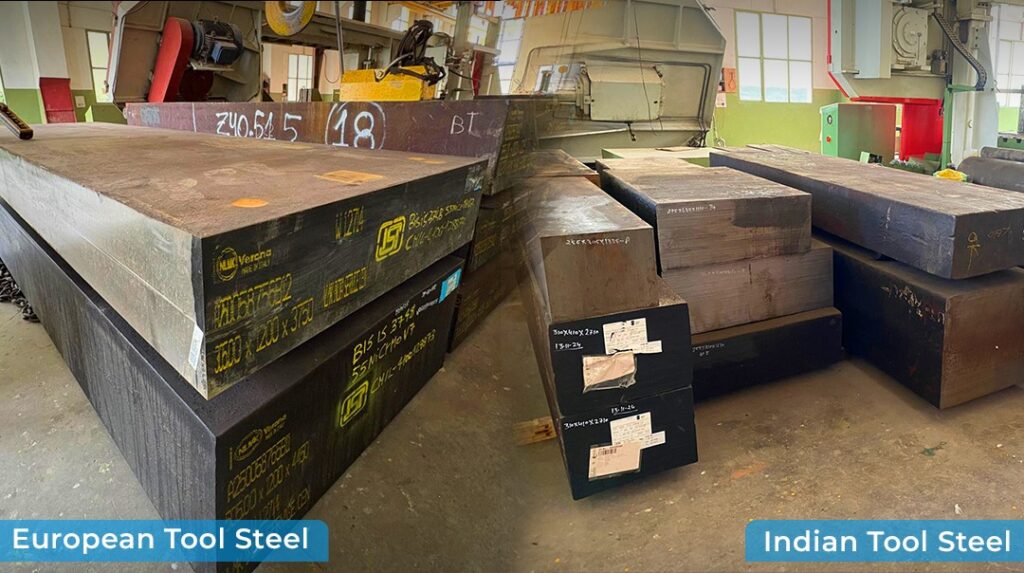
Tool steel isn’t just another material. It’s the foundation of modern manufacturing. From forging and die-making to automotive parts and heavy engineering, tool steel is everywhere. Every hammer strike, every die cut, every moulded part relies on its strength.
But what really defines good tool steel?
- Durability – how long it lasts under pressure
- Productivity – how much it improves output
- Cost impact – how it affects overall manufacturing expenses
That’s why industrial buyers don’t just buy they compare.
Henceone of the hottest discussions in the market today is:
- European tool steel – known for performance under extreme conditions
- Indian tool steel – often praised for balancing durability with cost efficiency
Which one is better? The answer isn’t always obvious. Each has strengths, and the choice depends on what industries value most—maximum reliability or cost-effective scale.
Thus, understanding the differences between these two sources European tool steel & Indian tool steel helps manufacturers choose the right tool steel for durability, cost efficiency, and reliable performance.
4 major Factors Determines Tool & Die Steel Quality?
The most essential factors together measure how effectively tool steel performs in applications like forging dies, cutting tools, and industrial moulds etc are:
1-Chemical Composition
Tool steel contains alloying elements such as chromium, molybdenum, vanadium, and nickel. The correct balance of these elements determines hardness, toughness, and wear resistance.
2-Metallurgical Structure
Uniform grain structure and low levels of impurities improve strength and reduce the risk of cracking during heavy industrial use.
3-Heat Treatment Capability
Proper hardening and tempering processes ensure the steel achieves the required mechanical properties.
4-Quality Testing and Certification
Inspection methods such as ultrasonic testing help ensure the steel is free from internal defects.
European Tool Steel Manufacturing Standards
European tool steel is produced under strict industrial standards established by organizations such as DIN and European Committee for Standardization. These standards define the chemical composition, mechanical properties, and testing requirements for various tool steel grades.
European steel manufacturers typically focus on:
- Precise alloy composition control
- Advanced refining technologies
- High internal cleanliness of steel
- Consistent mechanical properties
Many widely used tool steel grades originate from European standards, including:
- DIN 1.2344
- DIN 1.2714
- DIN 2379
These steels are commonly used in forging dies, die casting tools, and high-performance industrial tooling.
Development of Indian Tool Steel Manufacturing
India has become one of the leading steel-producing countries in the world. Today, many Indian steel plants use advanced technologies including:
- Electric arc furnaces
- Vacuum degassing
- Continuous casting
- Rolling and forging processes
These technologies help produce high-quality alloy steels and tool steels suitable for industrial applications. Hence, Indian tool steel quality has improved a lot in recent years.
Main Differences Between European and Indian Tool Steel
1-Manufacturing Consistency
European tool steel is recognized for its high level of consistency due to strict production standards and long experience in tool steel metallurgy whereas Indian tool steel also delivers good performance, but the level of consistency may vary depending on the manufacturer and production facility.
2-Metallurgical Cleanliness
European mills generally focus on internal steel cleanliness, which is especially important for tool steels used in forging dies.
Modern Indian steel plants have improved significantly in this area, though buyers should ensure they source from reputable producers or suppliers.
3-Availability of Tool Steel Grades
European mills offer a wide range of specialized tool steel grades developed for specific applications.
and many European grades are now stocked and supplied locally by distributors like Virat Special Steels, allowing manufacturers to access them without importing directly.
4-Cost Considerations
Cost is another important factor when comparing European and Indian tool steel.
European tool steel often comes with a premium price due to its advanced production processes with the costs of international transportation. On the other hand, Indian tool steel positions itself as a cost-competitive contender, offering a practical solution for industries that need performance without stretching budgets.
Which Should You Choose the right supplier?
Whether steel comes from Europe or India, one factor matters most that is –supplier reliability. Consistent quality depends on working with a trusted partner.
A supplier like Virat Steels ensures:
- Verified mill test certificates
- Proper material traceability
- Ready stock across tool steel grades
- Expert technical guidance
For manufacturers, the best choice depends on application requirements, budget considerations, and supplier trust.
European and Indian steel both shine in unique ways—Europe for innovation and sustainability, India for affordability and scale. Assess your project’s requirements to strike the perfect balance.
Frequently Asked Questions (FAQs)
1. Is European tool steel better than Indian tool steel?
European tool steel is known for strict manufacturing standards and consistent metallurgy whereas modern Indian tool steels can also deliver reliable performance when sourced from trusted manufacturers.
2. Why do forging industries prefer European tool steel grades?
European grades follow standards such as DIN, ensuring consistent chemical composition and performance in high-temperature forging applications.
3. What are common European tool steel grades used in forging?
Popular European grades include DIN 1.2344, DIN 1.2714, and DIN 2379.
4. Is Indian tool steel suitable for industrial applications?
Yes. With modern steelmaking technology, Indian tool steel is widely used in forging, automotive, and engineering industries.
5. What factors determine tool steel quality?
Tool steel quality depends on chemical composition, metallurgical cleanliness, heat treatment, and quality testing.
6. How can manufacturers ensure good tool steel quality?
Manufacturers should check mill test certificates, inspection reports, and source materials from trusted suppliers like Virat Steels.
Looking for high-quality tool & die steel?
Virat Special Steels has built a reputation as one of India’s most trusted suppliers, known for expertise, premium quality, and unmatched stock capabilities.
From DB6, H13, P20, D2 and more, we supply tool and die steel grades across India. Whether it’s forging, die-making, or automotive tooling, our steels are engineered to deliver reliability and performance.
📞 Curious about the right size or technical specifications for your application? Our team is ready to guide you.
👉 Explore more: www.viratsteels.com | 📧 info@viratsteels.com | 📱 +91 98140-21775
Virat Special Steels -India’s Premium Tool Steel Stockiest
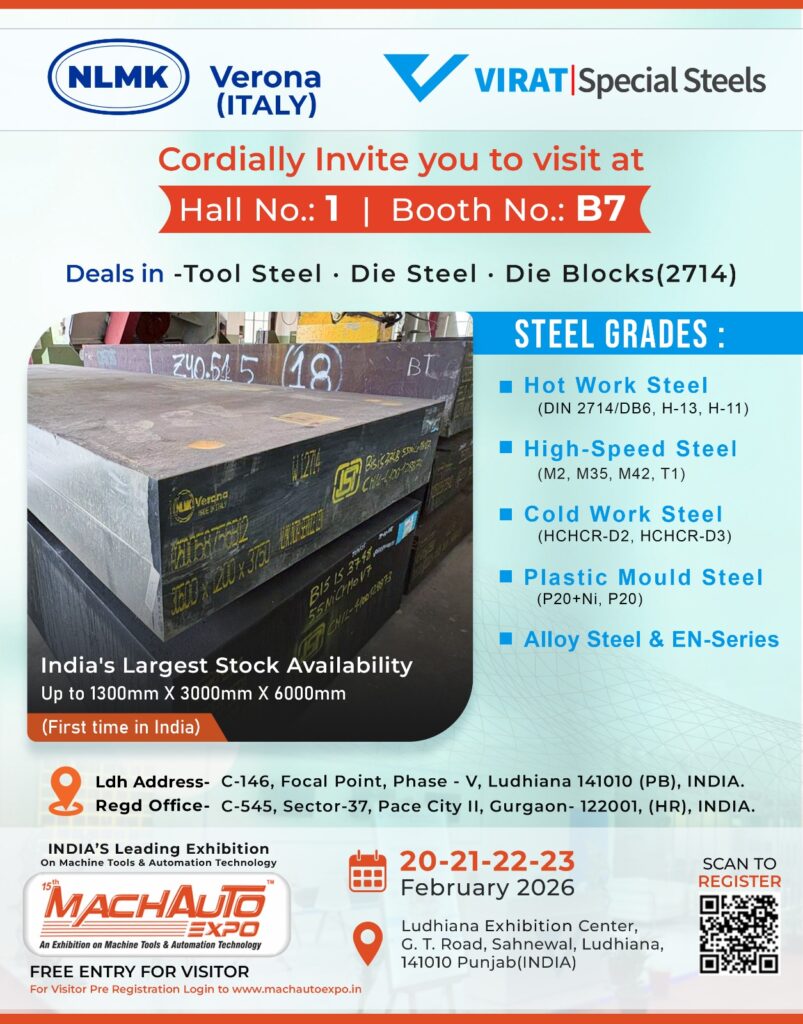
An Authorized Partner Of NLMK Verona, Italy
With 7 decades of experience in metal domain, Virat Special Steels is a trusted & successful pan-India supplier of tool and die steels backed by 3 regional stocking yards, 2,000+ tons of inventory, offering more than 35 specialized grades , advanced cutting facilities, ensuring fast and reliable deliveries, strengthened by a growing base of 1800+ satisfied customers across India, making us one of the Best reliable and preferred tool steel suppliers..
By combining European manufacturing excellence (the authorized stockist of NLMK Verona, Italy) with strong local service and technical expertise, the company enables Indian toolmakers to compete confidently on a global level now easily accessible with:
- consistent quality with premium metallurgical properties
- reliable supply, even during market shortages
- proven performance material in critical applications
- complete documentation and traceability
India’s Largest Steel Stock Availability –
For the first time in India, we offer extra-large steel blocks up to 1300mm x 3000mm x 6000mm ensuring that industries requiring precision steel, heavy-duty moulds, and large-scale production can rely on us for consistent supply and superior quality.
We provide a wide range of premium steel grades to meet diverse industrial needs ensuring availability even during periods of market volatility and steel shortages.
- Hot Work Steel: DB6, H-13, H-11
- High-Speed Steel: M2, M35, T1
- Cold Work Steel: D2, D3
- Plastic Mould Steel: P20, P20+Ni
Whether you are in automotive, manufacturing, tooling, or mould-making, our steel solutions are designed to deliver performance, durability, and efficiency.
Looking Ahead –
Our reputation as a leading steel importer, exporter, and stockist in India is built on reliability, trust and global partnerships.
Meet Us at Mach Auto Expo – Steel Solutions for Every Industry
Join us at the Mach Auto Expo to explore our premium steel offerings: 📍 Hall No. 1 | Booth No. B7
Explore how Virat Special Steels can empower your projects with world-class steel solutions.
Connect With Us Today –
📧 Email: info@viratsteels.com 🌐 Website: www.viratsteels.com 📞 Phone: +91-9814021775
Virat Special Steels Recognized as Authorised Distributor by NLMK Verona
[Strengthening India’s Access to Genuine European Tool Steel]
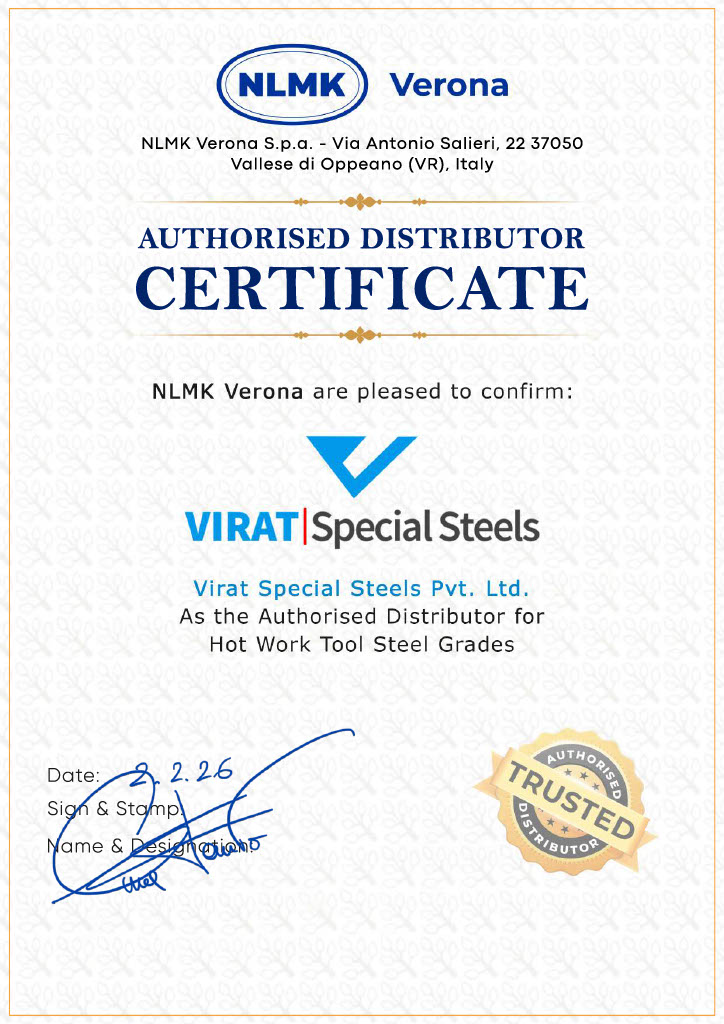
Virat Special Steels Pvt. Ltd. is proud to announce a significant milestone in our journey—official recognition as the Authorised Distributor for Hot Work Tool Steel Grades by NLMK Verona S.p.a., Italy. This milestone, dated 2nd February 2026, marks a new chapter in our commitment to delivering excellence in the steel industry.
Virat Special Steels Pvt. Ltd. has been recognized as one of the largest Importers, Exporters, and Stockists of premium steel products of :
- Die Blocks (DIN 1.2714, DB6, H13, H11)
- Tool Steels & Die Steels
- Special Steels & Alloy Steels in multiple grades
Backed by decades of expertise, the company maintains the largest steel yards, ensuring consistent availability, unmatched quality, and timely delivery to domestic industries.
NLMK Verona, a renowned name in the global steel sector, has entrusted Virat Special Steels with the responsibility of distributing their Hot Work Tool Steel Grades in India. This partnership reflects not only our technical expertise but also the trust we have built over the years with our customers and partners.
What This Means for Our Customers
Being an Authorised & Trusted Distributor ensures that our customers benefit from:
- Authentic NLMK Verona products with guaranteed quality
- Reliable supply chain solutions met to industry needs
- Global standards of excellence delivered locally
- On-ground technical support and grade selection support
Whether you are manufacturing dies, Molds, or critical tooling components, Virat Steels ensures your tools are built on proven European steel excellence drive productivity.
Looking Ahead
This achievement is not just a certificate— It’s a promise of authentic material, consistent quality, and strong technical partnership for the Indian tooling industry.
European tool steel excellence is now officially within reach.
Connect with Virat Special Steels to explore NLMK Verona’s authorised tool and die steel range and elevate your tooling performance.
Web: www.viratsteels.com
Email Us: info@viratsteels.com.
Ph: 98140-21775, 9999124971-80 , 9216321771-79.
The Future of Tool Steel: Innovations with DIN 2344 and H13
In the evolving world of manufacturing, the materials used to shape, mold, and cut have a direct impact on productivity and quality. Tool steels play a critical role in this landscape, with DIN 2344 and H13 standing out as industry leaders. Known for their exceptional thermal resistance, hardness, and strength, these grades are the backbone of tools, molds, and dies in industries such as automotive, aerospace, and die-casting. In this article, we’ll explore the significance of these materials, examine ongoing innovations, and understand how companies like Virat Special Steels contribute to shaping the future of tool steel.
The Role of Tool Steel in Manufacturing and Industry
Tool steels are indispensable for industries that demand precision and durability. Used extensively in the production of cutting tools, molds, and dies, these alloys must endure extreme conditions, from high temperatures to heavy wear. Without them, high-quality manufacturing would simply not be possible. Automotive industries rely on tool steels for die-casting, while aerospace engineering depends on these materials for components exposed to high temperatures and stresses. In short, tool steels are the unsung heroes enabling modern engineering feats.
What Makes DIN 2344 and H13 Stand Out?
Composition and Properties of DIN 2344
DIN 2344 is a chromium-molybdenum-vanadium alloyed steel prized for its high thermal resistance and toughness. It maintains hardness even at elevated temperatures, making it a preferred choice for hot-working tools like forging dies and extrusion presses. Key properties include:
- Exceptional wear resistance.
- High tensile strength.
- Excellent machinability.
Characteristics and Features of H13
H13 steel, part of the H-series family, is well-known for its versatility and toughness. It’s often chosen for die-casting and plastic mold tooling, thanks to its outstanding thermal fatigue resistance and ease of fabrication. Its main properties are:
- Superior thermal conductivity.
- Resistance to cracking under repeated heating and cooling cycles.
- High flexibility for complex shaping.
Innovations Driving the Future of Tool Steel
The tool steel industry has seen several groundbreaking advancements. Let’s delve into some of the most significant ones:
- Advanced Alloying Techniques
Researchers are experimenting with alloying elements like cobalt and niobium to improve the thermal and wear resistance of tool steels. Such innovations push the limits of performance. - Additive Manufacturing and 3D Printing
3D printing is revolutionizing tool steel production by enabling intricate designs and reducing material waste. Industries are now combining traditional methods with 3D technologies for optimal results. - Improved Heat Treatment Processes
Heat treatment plays a pivotal role in enhancing tool steel properties. Modern techniques such as vacuum hardening ensure precision in achieving desired hardness and toughness.
Advantages of Modern Tool Steel Innovations
New innovations in DIN 2344 and H13 steels offer several benefits:
- Durability: These steels withstand high temperatures and extreme pressures without significant wear.
- Longevity: Enhanced resistance to thermal fatigue and cracking translates into longer tool lifespans, reducing downtime and maintenance costs.
- Efficiency: Advanced manufacturing techniques improve energy usage and reduce material waste.
Comparing DIN 2344 and H13 Tool Steels
Below is a snapshot of their key differences:
| Property | DIN 2344 | H13 |
| Composition | Cr, Mo, V | Cr, Mo, Si, V |
| Thermal Resistance | High | Very High |
| Applications | Forging, extrusion | Die-casting, molds |
Applications of DIN 2344 and H13
Both steels are tailored to specific needs:
- DIN 2344: Ideal for extrusion tooling and hot forging, thanks to its resistance to thermal shock.
- H13: Perfect for plastic injection molding, die-casting, and high-temperature aerospace components.
Environmental Sustainability and Tool Steels
Modern practices focus on sustainability. From reducing energy-intensive processes to emphasizing recycling, the industry is working toward a smaller environmental footprint. The longevity of DIN 2344 and H13 further minimizes the need for replacements, aligning with eco-friendly goals.
Future Prospects of DIN 2344 and H13
As industries move toward automation and more advanced technologies, the demand for high-performing materials like DIN 2344 and H13 is set to rise. Innovations in metallurgy and 3D printing will only increase their applications.
Challenges in the Tool Steel Industry
Despite advancements, challenges persist. Manufacturers face supply chain disruptions, the rising cost of raw materials, and the need to balance quality with affordability. Addressing these challenges requires collective efforts from stakeholders, including suppliers like Virat Special Steels.
The Role of Companies Like Virat Special Steels
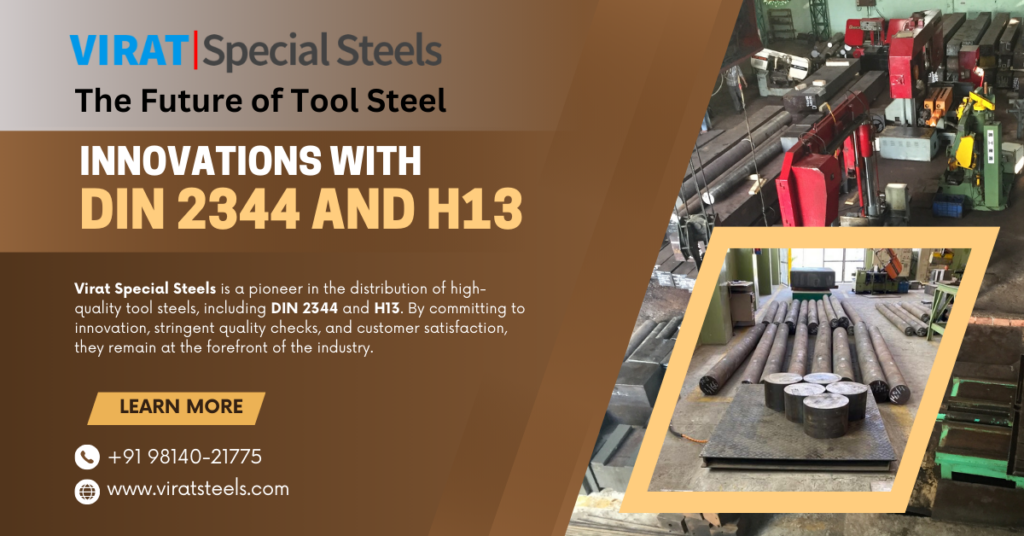
Virat Special Steels is a pioneer in the distribution of high-quality tool steels, including DIN 2344 and H13. By committing to innovation, stringent quality checks, and customer satisfaction, they remain at the forefront of the industry.
Key Takeaways
- Tool steels like DIN 2344 and H13 are integral to modern manufacturing.
- Innovations are enhancing their performance and extending their applications.
- Companies like Virat Special Steels are instrumental in meeting the growing demands of the industry.
FAQs About Tool Steel
- What makes DIN 2344 unique compared to other tool steels?
Its ability to maintain hardness at high temperatures and resist wear sets it apart. - Why is H13 preferred in certain industries?
H13 combines versatility and thermal fatigue resistance, making it ideal for die-casting and molds. - How does Virat Special Steels ensure the quality of its products?
Rigorous testing, advanced manufacturing techniques, and expert handling ensure top-notch quality. - Can DIN 2344 and H13 be recycled efficiently?
Yes, their high-grade compositions make them suitable for recycling without significant loss of quality. - What industries are likely to adopt future innovations in tool steels?
Automotive, aerospace, and renewable energy sectors will likely benefit the most.
Virat Special Steels is the largest Supplier & Stockiest of H13 Steel in India. Consult our team who will assist you for H-13/ DIN 2344 / AISI H13 steel query. https://www.viratsteels.com/h13.html
Size Range in Forged / Rolled Bars:
Rounds: 13mm Dia to 1500mm Dia
Rectangular: Thickness 13mm – 500mm / Width 13mm to 1500mm
For more information or to discuss your steel needs, Virat Special Steels invites you to reach out through their contact details provided, ensuring a professional and informative experience.
Any further queries feel free to contact us :
🌐https://www.viratsteel.in 📬 info@viratsteels.com ☎+91 98140-21775
Critical Applications of DIN 2344 Steel in the Automotive Industry!
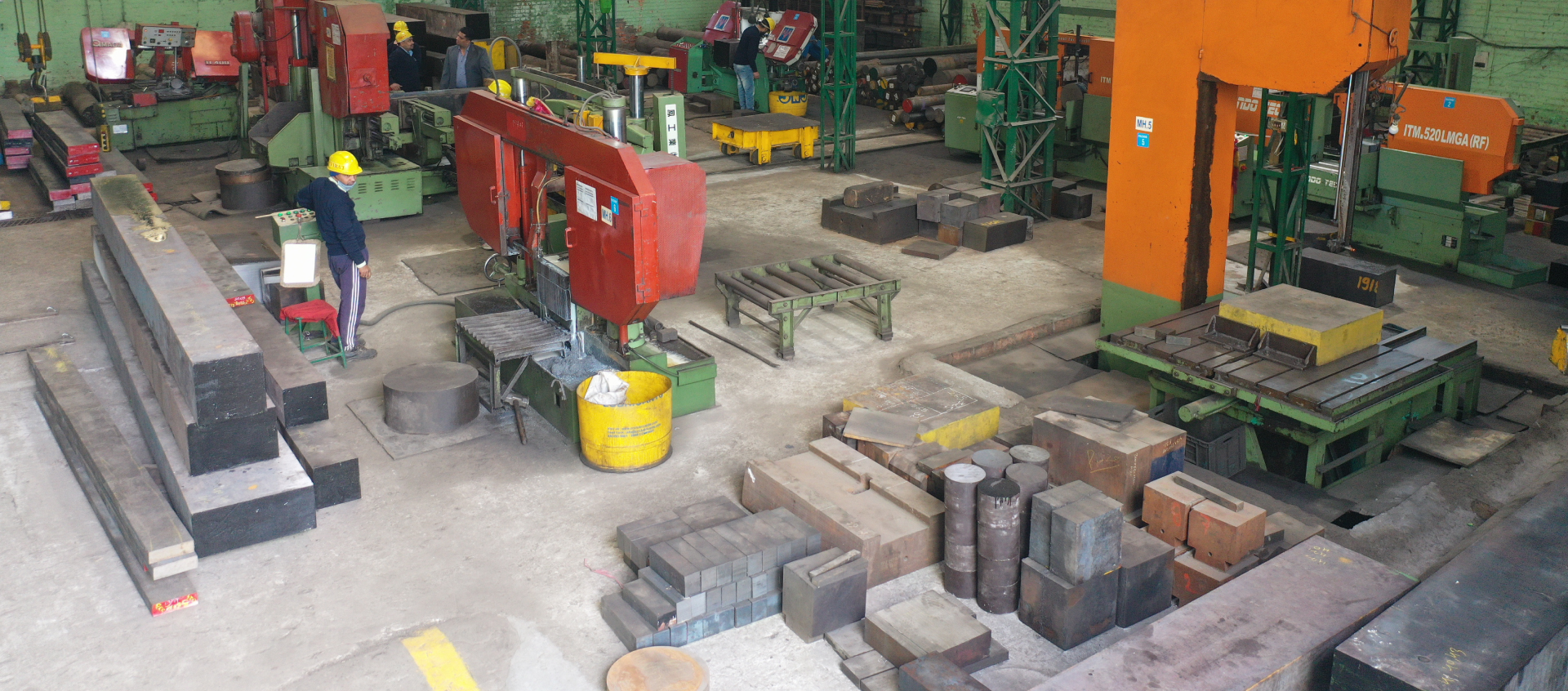
Steel remains the backbone of the automotive industry, providing the strength and resilience required for modern vehicles. Among the various grades of steel used, DIN 2344 steel holds a prominent place due to its exceptional performance under challenging conditions. This article explores the critical applications of DIN 2344 steel in the automotive industry, showcasing why it is a preferred material for manufacturers globally.
What is DIN 2344 Steel?
DIN 2344 steel, also known as H13 tool steel, is a versatile, high-performance material widely utilized in hot work applications. Classified as a chromium-molybdenum steel alloy, it is specially engineered for superior heat resistance, toughness, and wear properties.
Key Properties of DIN 2344 Steel
- Thermal Resistance: With its ability to retain strength and hardness at elevated temperatures, DIN 2344 is perfect for high-heat environments.
- Toughness and Durability: Its superior toughness makes it resistant to cracking and deformation.
- Corrosion Resistance: With strong resistance against oxidizing environments, it outperforms many other alloys.
- Machinability: While challenging to machine, advanced processes have streamlined its incorporation in various automotive applications.
Importance of DIN 2344 Steel in Modern Industry
The global shift toward lightweight yet robust materials has spotlighted DIN 2344 steel, particularly in automotive manufacturing. With its combination of toughness and flexibility, it meets the demands of advanced production lines.
Relevance of DIN 2344 Steel in Automotive Manufacturing
1. Historical Context of Material Usage in Automotive Engineering
Steel has evolved over decades as the material of choice in automotive engineering. From basic carbon steels to high-alloy steels like DIN 2344, each advancement reflects a need to address emerging challenges, including efficiency, safety, and sustainability.
2. Why DIN 2344 is Perfect for the Automotive Sector?
The automotive industry faces constant pressure to produce durable, efficient, and lightweight vehicles. DIN 2344 steel meets these demands with its remarkable properties, offering enhanced strength for components that endure high-stress conditions.
Applications of DIN 2344 Steel in Automotive Components
- Use in Die Casting Tools: Die casting forms a vital part of automotive manufacturing, especially for producing lightweight engine and body components.
- Significance in Aluminum and Magnesium Alloy Casting. DIN 2344 steel excels in die-casting tools used for aluminum and magnesium alloys, offering superior wear resistance and prolonging tool life in high-temperature operations.
- Molds for Plastic Injection: As plastics gain traction in automotive design, durable molds made from DIN 2344 steel ensure precise shaping of components, contributing to reduced production defects and downtime.
- Hot Forming and Forging Applications: DIN 2344 steel is indispensable in hot forming and forging operations due to its ability to maintain hardness and strength even at elevated temperatures.
- Applications in Exhaust Systems and Engine Components:
- Enhanced Durability in High-Temperature Environments: From turbochargers to exhaust manifolds, DIN 2344 steel ensures resistance to thermal fatigue, ensuring reliability in extreme engine environments.
Benefits of Using DIN 2344 Steel
- High Wear Resistance: The wear resistance of DIN 2344 enhances the lifespan of tools and components, reducing frequent replacements and minimizing downtime.
- Excellent Thermal Stability: DIN 2344 steel maintains its structural integrity under high-temperature operations, a critical advantage for heat-intensive automotive processes.
- Corrosion Resistance: Superior resistance to oxidation and other corrosive agents ensures long-term durability, even under severe operating conditions.
- Cost-Effectiveness in Automotive Production: Reduced downtime, longer tool life, and enhanced product performance result in significant cost savings for manufacturers.
Challenges and Considerations
- Machining and Heat Treatment Challenges: While offering unmatched performance, DIN 2344 steel poses challenges in machining and heat treatment. Manufacturers must employ specialized techniques to overcome these hurdles.
- Alternatives to DIN 2344 Steel: In scenarios where DIN 2344 isn’t suitable, alternatives such as D2 or P20 steels might be considered based on specific application requirements.
Innovations and Future Applications
- Emerging Automotive Trends Impacting Material Choice: Electric vehicles and lightweight design trends are shaping the use of advanced steels, with DIN 2344 continuing to play a pivotal role.
- Future-Ready Technologies Enabled by DIN 2344 Steel: From 3D-printed automotive parts to precision components for EVs, the versatility of DIN 2344 opens pathways for innovative designs.
Sustainability and Environmental Impact
- How DIN 2344 Supports Energy Efficiency: The durability of DIN 2344 reduces waste in production, while its energy-efficient processing ensures environmentally friendly manufacturing practices.
- Recycling and Reusability in the Automotive Supply Chain: DIN 2344 steel components can be recycled and reused, supporting circular economy principles and reducing the industry’s carbon footprint.
Conclusion:
DIN 2344 steel stands as a cornerstone in the automotive industry, enabling the creation of high-performance vehicles and components. With its unique properties and adaptability, it continues to shape the future of manufacturing.
Mode of Supply
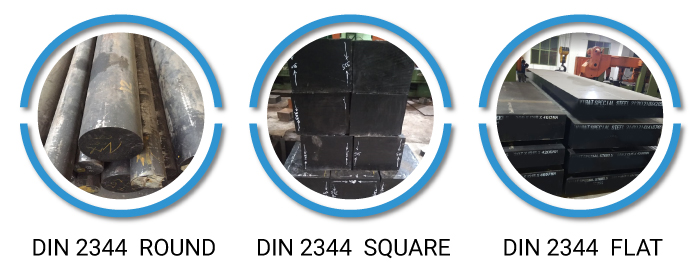
Virat Special Steels is the largest stockiest and supplier of DIN 2344 tool steel in flat, square and round bar. We provide steel in all sizes as your requirements. DIN 2344 die steel is available in flat, square and round shape. Consult our team who will assist you for DIN 2344 steel query.
FAQs
- What makes DIN 2344 steel ideal for the automotive industry?
Its exceptional heat resistance, wear resistance, and durability make it indispensable for high-stress applications like die-casting and forging tools. - Can DIN 2344 steel withstand extreme temperatures in engine systems?
Yes, DIN 2344 offers excellent thermal stability and is ideal for components in high-temperature environments, such as exhaust systems. - How does DIN 2344 steel contribute to cost-efficiency in manufacturing?
Its durability and wear resistance minimize tool replacement costs, reducing downtime and production expenses. - Are there eco-friendly aspects to using DIN 2344 steel in automotive production?
Yes, its recyclability and reduced waste in the production process support sustainable manufacturing practices. - What are the alternatives if DIN 2344 steel isn’t viable?
D2 or P20 steels are viable alternatives, depending on application needs and operating conditions.