




Hot Work Tool Steel Supplier
now browsing by category
How to Weld H13 (1.2344) & DB6 (1.2714) Steel: Welding Procedure and Repair Guide
Short answer: Yes, H13 and DB6 (1.2714) die steel can both be welded, but there are no shortcuts. Here is how to weld H13 & DB6 die steel in short: preheat the die (300–500°C for H13, roughly 300–400°C for DB6), use a dry filler suited to the job, keep the die hot during welding, cool it slowly and temper it right away. Skip any step and the weld is at serious risk of cracking.
Nobody wants to deal with a cracked die. A deformed forging impression or a cavity full of heat checks is just as unwelcome. The question is the same as usual: scrap or weld? If you decide to weld, this guide shows how to weld H13 & DB6 1.2714 welding die steel so the repair last.
Welding could save the tool. It could also destroy it in just one afternoon, hence why all the people in the tool room have an opinion about it. We offer H13 & DB6 1.2714 welding die steel, which means we approach this issue from the angle of steel. We take into consideration the data sheets offered by the producers of the steel, as well as the welding organizations such as TWI, and questions posed to us by the tool room.
This guide to H13 & DB6 1.2714 welding is general information. Always follow the welding sheet from your steelmaker and filler manufacturer, and a qualified welding procedure for your die.
H13 and DB6 1.2714 welding at a glance
Let us start off with the names, as there seems to be some confusion there. H13 1.2344 welding is the name from the AISI nomenclature. The same steel has the following designations H13 1.2344 welding or X40CrMoV5-1 in the German/EN system, and SKD61 in Japan. DB6 1.2714 welding is the market name for 1.2714 (56NiCrMoV7) in India. This is not an official designation; therefore, insist that it be written 1.2714 on the mill test certificate. Böhler sells roughly the same steel as W500, which is approximately equivalent to AISI L6 and JIS SKT4.
| H13 (1.2344 / SKD61) | DB6 (1.2714 / 56NiCrMoV7) | |
| Steel type | 5% Cr-Mo-V hot work steel | Ni-Cr-Mo-V die block steel |
| Strongest at | Hot strength and heat-checking resistance | Toughness and deep hardening in large sections |
| Typical uses | Aluminium die casting dies, extrusion tooling, forging inserts | Hammer and forging dies, die holders, large blocks |
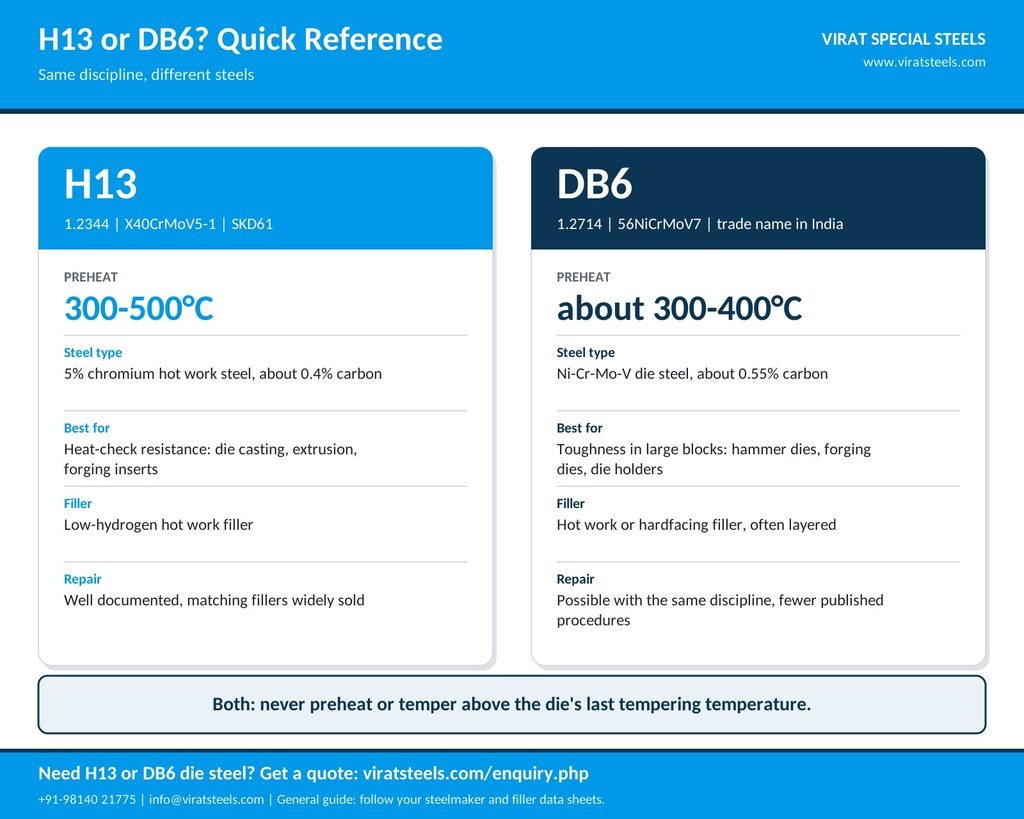
| Typical preheat | 300–500°C (Uddeholm’s QRO 90 Supreme sheet: 330°C ±25°C) | Roughly 300–400°C |
| Hardened die limit | Never above the last tempering temperature | Same rule |
| After welding | Cool slowly, then temper (Uddeholm: about 25°C below the last temper) | Same logic; confirm with the block maker |
| Typical filler | Low-hydrogen hot work filler | Hot work or hardfacing filler suited to the duty, often layered |
| Weld repair | Well documented, matching fillers widely sold | Possible, with the same discipline as H13; fewer published procedures |
H13 1.2344 welding is suitable when the problems are those of cycling and heat checking just like in case of die casting and extrusion operations. On the other hand, DB6 1.2714 welding is preferred when dealing with impact and large cross sections such as when using hammer dies and die holders. In case of uncertainty on which to choose, give more information to the supplier about the die size and temperature.
Should you weld the die or scrap it?
There is no fixed rule, but these questions help a great deal:
How bad is the damage, and where is it? Surface damage, wear and localized cracks that are superficial can be repaired. However, cracks extending into the block or throughout its entire section or starting from a sharp internal corner or other load-bearing areas are more difficult to repair.
What is the die worth? It should be considered how much money was spent on making it, i.e. the costs of the block itself, the cavity and heat treatment plus waiting time for it. A large block with a cavity can be economically repaired while a small one may not be worth it.
How many repairs has it had? There is no fixed limit, but every repair adds stress and another heat-affected zone. A die that has been welded several times in the same spot deserves scrutiny.
Do you know what the die is? Grade, hardness and heat treatment decide the procedure. If there are no records, test the die before you start welding.
Do you know why it cracked? If the cause is still there, it is not likely that the repair will hold. Look into the design, cooling, heating, and steel quality first.
Can you heat treat it properly? A good repair needs a way to preheat the whole die and to temper the die afterwards. If you cannot do that, hand the job to a specialist or replace the die.
In short: weld where there is localized damage, the cause is known, the grade is known and heat can be controlled. Replace the die when the damage is extensive, the same spot keeps failing, or proper heat treatment is not possible
What kind of damage are you repairing?
Cracks, wear and heat checks are all called “repair”. Each is a different job.
Cracks. Cut out the crack completely. TWI advises machining out the defect and leaving a smooth groove with no sharp corners. Check the groove with dye penetrant or magnetic particle testing until it is clean, then clean and dry it. Welding over a crack only hides it.
Worn or deformed impressions. Treat these as layered build-ups. On working surfaces, TWI says the deposit should have the same hardness as the parent metal. In forging impressions some shops cover only the parts most likely to fail rather than filling the entire gap.
Heat checks. Machine out the fine surface networks down to clean metal before welding. If the network is deep and covers most of the cavity, ask whether a new die is needed, and check cooling and warm-up before blaming the steel.
H13 1.2344 welding and repair
H13 steel has 5% chromium and around 0.4% carbon. H13 1.2344 welding steel is the material from which aluminium die casting dies, extrusion tooling and forging inserts are made. This is due to the fact that it retains its mechanical properties in a heated state and is resistant to heat checking.
H13 1.2344 welding is also crack-prone when welded. As per TWI, the carbon equivalent of tool and die steels makes them highly susceptible to cracking. Welded areas cool off quickly, resulting in hard and brittle martensite. Residual stress or presence of any hydrogen content can result in cracking.
Annealed or hardened?
Weld the H13 1.2344 welding in the annealed state wherever possible before hardening and tempering the die. This is what TWI suggests. Welding can also be done on a hardened and tempered die, but preheating or tempering should not be carried out at temperatures higher than the prior tempering temperature.
What preheat should you use?
There is quite a variance among the published numbers regarding this issue. According to West Yorkshire Steel, 300-500°C is the proper preheat temperature for H13 1.2344 welding. The recommended welding temperature of QRO 90 Supreme, provided by Uddeholm, is 330°C ±25°C. However, do remember that QRO 90 Supreme is just another high-alloyed hot work steel. Uddeholm’s welding recommendation for Orvar Supreme (their grade H13) in the company’s general welding brochure provides a minimum preheat of 300°C for TIG welding. A Castolin recommendation provides 200°C for TIG welding.
This range is not a mistake. It is a reflection of die size, condition and filler metal. Follow the recommendations of the welding sheet.
The repair, step by step
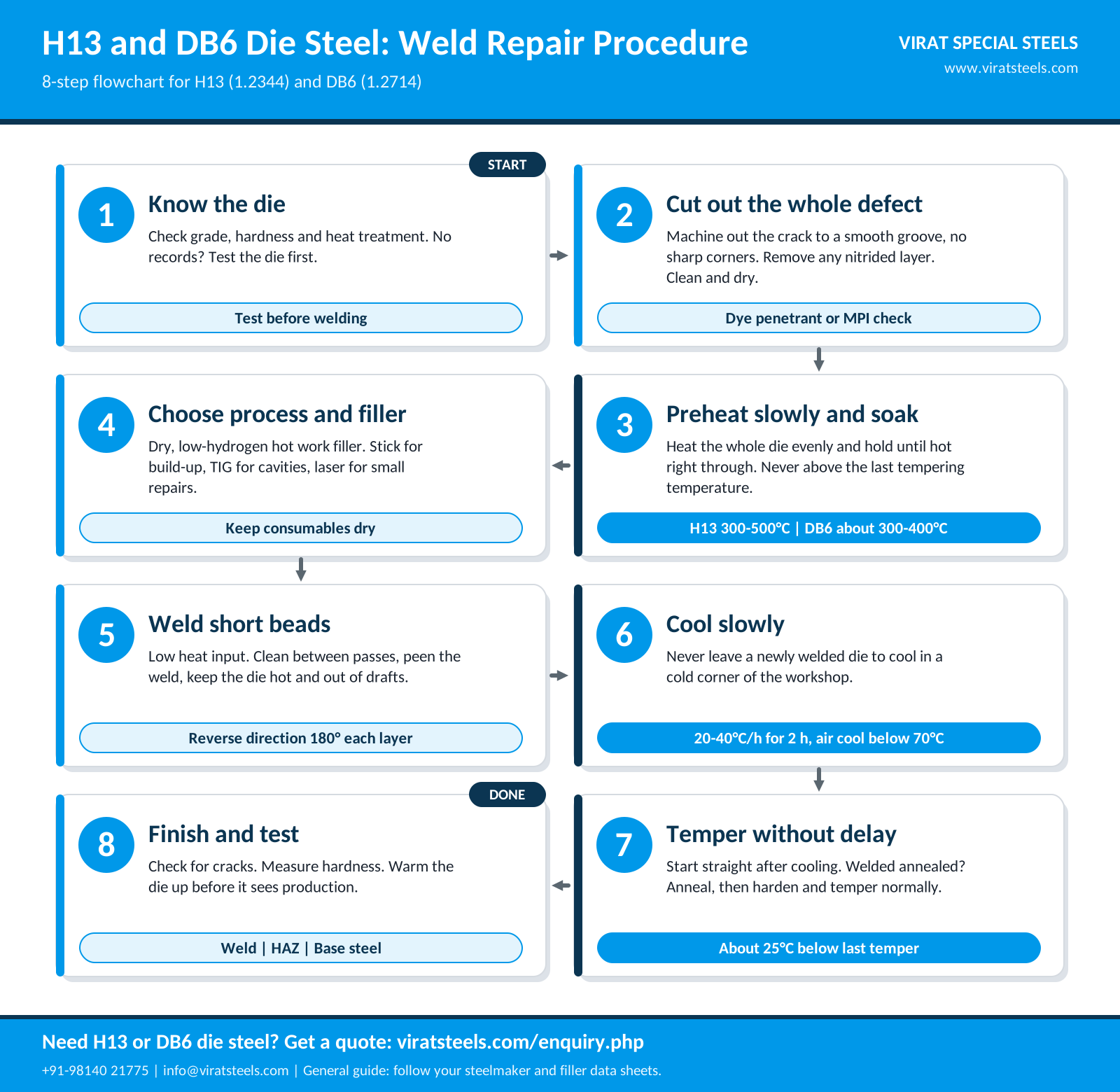
- Know the die. Verify the grade, hardness, and heat treatment. In case someone did not document these, perform tests prior to welding.
- Cut out the whole defect. Remove any nitrided layer first. Leave a smooth contour with no sharp edges, confirm it is defect-free with dye penetrant or magnetic particle testing, then clean and dry the groove.
- Preheat slowly and keep it there. Heat the whole die evenly and hold the temperature through the job. See the heating section below for how.
- Choose the process and filler. Use dried, low-hydrogen consumables with a hot work filler. For a cavity that will be polished or photo-etched, Uddeholm wants a filler that matches the base composition.
- Weld short beads. Keep heat input low, clean between passes and leave a few minutes between layers. Where possible, peen the weld and reverse the welding direction by 180° between layers.
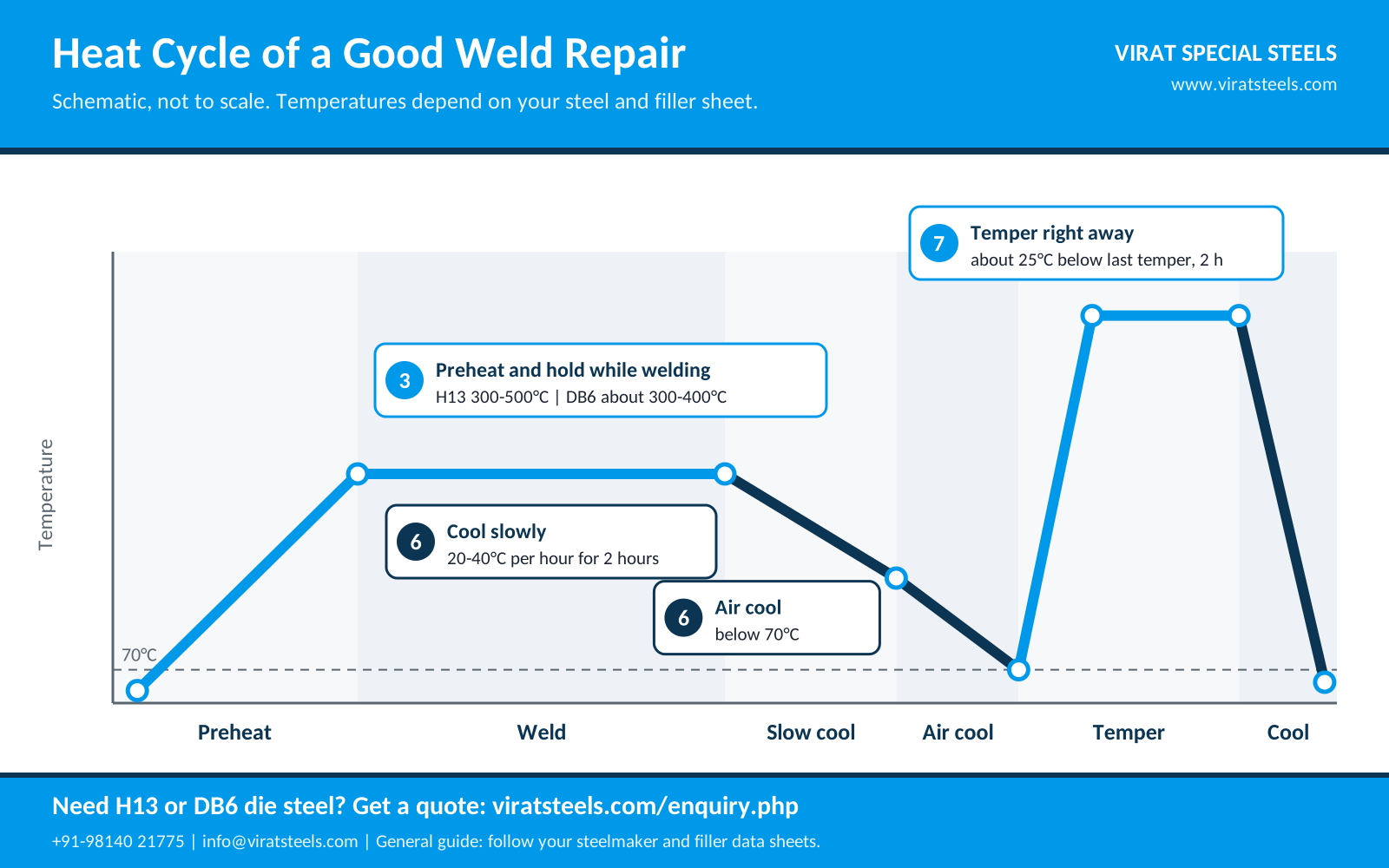
- Cool slowly, then temper without delay. Cool at 20–40°C per hour for the first two hours, air cool to below 70°C, then temper for two hours. Where the weld metal tempers the same way as the base metal, Uddeholm tempers at about 25°C below the die’s previous tempering temperature, so the base steel does not soften. TWI likewise says post-weld heat treatment should start immediately after welding. A newly welded die should never spend the night in a cold corner of the workshop. If the die was welded in the annealed state, anneal it, then harden and temper it normally.
- Finish and test. Finish the repair work, test for cracks and check hardness in the weld area, heat affected area and base steel. Heat the die up correctly before putting it back into use.
Welding without pulling the die from the machine
It is done in some shops. Uddeholm does not recommend it. If there is truly no alternative, its welding sheets describe a last-resort procedure that includes a second heating step after welding. Follow the sheet for your exact steel, and expect a less reliable repair than a full furnace cycle.
Expect a slightly weaker repair
According to a Daido Steel report on die casting repair, the weld material is somewhat weaker and more susceptible to heat-checks than the original steel, but good post-welding heat treatment can restore some of its properties. Be ready for the welded area to show up first during the next inspection.
DB6 (1.2714) welding and repair
The designation used for 1.2714 steel in India is DB6. It corresponds to 56NiCrMoV7 steel in the DIN and EN system. The composition is entirely different from H13; 0.55% carbon, 1.1% chromium, 1.7% nickel and small amount of molybdenum and vanadium. The carbon gives DB6 high hardness and strength, while the nickel supports toughness. Together they handle heavy impact well, which means that it can withstand a lot of impact. This property makes it suitable for hammer dies, forging dies, die holders and large blocks.
At that carbon level, the weld and heat-affected zone form very hard, brittle martensite if they cool too fast. Slow cooling and prompt tempering matter as much here as with H13 1.2344 welding. There are two varieties of DB6 1.2714 welding: soft annealed (hardness up to 248 HB according to EN ISO 4957 standard) and quenched and tempered (about 370–415 HB, approximately 39–43 HRC).
With many blocks arriving already hardened, many DB6 1.2714 welding repairs involve welding hard steel, so standard procedure is to preheat to a temperature below the last tempering process, and then retemper following the welding. Ask your supplier for the final tempering temperature of the block prior to preheating.
Preheat and filler for DB6 1.2714 welding
Guidance and experience range between 300-400°C in relation to DB6 1.2714 Welding. Don’t heat above the previous tempering temperature of the die and maintain the temperature throughout the procedure.
When selecting filler metals, forging-die repairs can be done using multi-pass buildup and the selection of appropriate metal will depend on whether the application is one of impact resistance or abrasion or a combination of the two. Check with your steel/filler manufacturer for the best metal to use with your particular die. Some companies don’t even build up the entire impression and instead build up the areas where failures are likely to occur using hard facing rods (iron or cobalt alloy).
Cooling, tempering and warm-up
Cooling and tempering schedules for DB6 1.2714 Welding depend on block size, delivery condition and filler, so take them from the block maker’s welding sheet. The principles match H13 1.2344 welding: cool slowly, temper promptly and stay below the last tempering temperature. Because DB6 carries more carbon, do not simply copy an H13 schedule onto it. Large blocks need an experienced heat treater and a furnace. If you are unsure, send us the block size, condition and job details and we will help.
Forging dies too should be properly warmed before re-introduction into production. The repaired die should never encounter its first hot billet in a cold state. Warm up to your normal preheat temperature for the die, and find the appropriate temperature from the forging process engineer or steel supplier.
Heating and temperature control
A lot of failed repairs trace back to heat control rather than the welding itself.
How to heat. The furnace offers the best way of heating the entire block uniformly. Gas burners, electric heating blankets, and ceramic pad heaters are options for large blocks. However, heating should be as uniform as possible. Heating using a torch on one end of the block will build up stress and not eliminate it.
How to check temperature. Thermocouples attached to the die, pyrometers, or temperature-indicating crayons are methods used. Infrared temperature guns give incorrect results when working with smooth or scaled steel. It is important to use several different areas, even some on the opposite side of where the heating occurs.
Soak. Hold the die until the whole section, not just the surface, has reached the preheat temperature. Ask the block maker or your heat treater for the soak time for your block size.
Interpass. The data sheet for Uddeholm’s welding sheets specifies that the temperature around the weld must not exceed 150°C beyond the preheat temperature; otherwise, the base material might soften or crack. Fillers also have their own maximum interpass temperature, which can be seen on the electrode/rod data sheet.
Keep it warm, don’t let drafts get to it. Protect the die from the elements and keep the shop door closed when doing the work so that it could be done in one operation. Otherwise consult your welding engineer about stop procedures.
Stick, TIG or laser: which process?
| Process | Best for | Heat input | Watch out for |
| Stick (MMA/SMAW) | Build-ups and larger repairs. TWI notes it is popular because equipment and consumables are easy to find. | Higher than TIG or laser | Electrodes must be dried and kept dry. More heat means tighter interpass control. |
| TIG (GTAW) | Cavities, edges and fine detail. It gives the most control. Rods made for H11, H12 or H13-type repair are a common choice. | Lower than stick | Needs a skilled welder. Slow for big build-ups. |
| Laser | Small, precise repairs. TWI says it uses low heat input. | Very low | Usually a specialist service. Uddeholm’s brochure lists its laser filler with no preheat and a two-hour temper at 250°C, but follow your repair provider’s procedure. |
Whatever the process, the basics do not change: clean the area, dry the consumables, control the temperature and temper afterwards.
Choosing the filler
Filler material according to application. Regarding working surfaces, TWI recommends filler material to have hardness similar to the base material. There are other types of filler materials which are used in non-critical areas.
Composition matching for polished cavities. In case the cavity has to undergo polishing or photo-etching process, Uddeholm suggests filler material that has same composition as the base material.
Low-hydrogen and dry. Store electrodes either in their packs or in a desiccator until you start to weld them and ensure that they are clean and dry prior to welding since wet electrodes cause hydrogen to get into the joint.
Example. Uddeholm’s QRO 90 Weld is a basic coated electrode and QRO 90 TIG-Weld is a TIG rod. They are recommended by Uddeholm for its hot work steels such as Orvar Supreme. Check the datasheet for as-welded hardness and tempering. Filler manufacturers produce their own equivalents. Always choose the filler for your specific steel.
Buffer layers and hardfacing. There are a number of techniques used where the soft buffer layer is deposited below the hard layer so as to minimize the chance of cracking while some particular regions are hardfaced with the use of certain hardfacing alloys. Please inform your filler manufacturer in case you require this treatment for your steel application.
Describe your application to the filler manufacturer. The casting, extruding, or forging of the part will affect your repair differently. Inform your filler manufacturer what you are doing.
Hardness after welding
In fact, the hardness of hot work filler weld deposits is usually quite high as deposited, which means it is often around 50-55 HRC depending on the filler, while tempering decreases the hardness of those deposits to the required working hardness. For aluminium die casting dies, the working hardness is typically in the mid-40s to low-50s HRC, depending on the steel and application; check your steelmaker’s datasheet. Blocks DB6 1.2714 welding can be ordered in hardness 39-43 HRC. 1.2714 welding
Measure hardness at three places: the weld metal, the heat-affected zone and the base steel. A portable hardness tester works on the repaired die. A heat-affected zone softer than the base steel suggests the die was heated above its last tempering temperature. A weld much harder than the base steel may point to under-tempering. Measure rather than assume.
Troubleshooting weld problems
| What you see | Likely causes | What to try |
| Crack in or beside the weld soon after welding | Preheat too low or lost, cooling too fast, damp consumables, defect not fully removed | Check temperature records, dry the consumables, cut out the crack completely and re-weld to a proper schedule |
| Cracks that show up hours or days later | Hydrogen and residual stress, too long a gap before tempering | Dry consumables, cool slowly, temper promptly |
| Porosity or gas pores | Damp electrodes, grease, coolant or nitrided case left in the groove, poor gas cover in TIG | Clean, dry and re-grind the area; check shielding gas |
| Soft spot beside the weld | Base steel went above its last tempering temperature, interpass too high | Check temperatures; the area may need re-heat treatment |
| Weld lifts or spalls in service | Poor fusion, damaged metal left behind, filler too hard or too brittle for the duty, cold start | Re-check the groove preparation and the filler; warm the die up before production |
| Same spot keeps cracking | The root cause is still there | Look at die design, sharp corners, cooling, warm-up and steel quality before welding again |
| Dimensions drift after repair | Uneven heating, heavy heat input, re-hardening | Leave machining allowance, balance the heat, and finish machining after the final heat treatment |
Best practices and safety
- Clean first. Grease, scale, coolant, and nitrided surface can cause porosity and cracks. Never weld through a nitrided surface; grind out the nitrided layer at the area of repair and re-nitride after repair if the process requires it.
- Dry your consumables. Wet electrodes and rods will introduce hydrogen into the weld metal.
- Preheat all the way. Preheat uniformly; maintain constant interpass temperature; avoid draft cooling during welding operation.
- Write it down. Document the values of preheat, filler, temper and hardness. Then you can start the next repair with the information rather than relying on memory.
- Find out the root cause. In case of a recurrent problem, investigate die design, cooling, heating up and steel grade before you start welding.
- Treat the heat with respect. At 300-500°C the die can look cool enough to touch and still burn severely. Use adequate PPE, mark hot dies with appropriate signs, use adequate hoisting devices, and have a fire watch.
- Breathe clean air. Fumes from alloy filler and tool steel, in particular chromium and nickel, should not be inhaled. Maintain fume exhaust, and read the SDS for the filler you are using.
Buying the right steel before you weld
Good repairs start with good steel. DB6 1.2714 welding a trade name, not a formal standard, so buy on the mill test certificate, not on a listing title. Ask for:
- Grade and standard. 1.2344 or 1.2714 on the certificate, not only the trade name. If 1.2714 – compare the certificate’s chemical analysis with EN ISO 4957 specifications. The allowed limits for H13 steel are slightly different from one standard to another, compare the certificate to the standard indicated on the drawing.
- Delivery condition and hardness. For DB6 1.2714 Welding, soft annealed means a maximum of 248 HB per EN ISO 4957. Quenched and tempered is a supplier range, commonly around 370-415 HB near the surface. State the exact hardness range and your block size on the order.
- Grade of steel for die casting. NADCA #207 establishes Grade A (Premium, conventional melting H13 steel) and Grade B (Superior, re-melting H13, e.g. ESR). If your die will be used for aluminium die casting – specify which grade you need and make sure that the certificate mentions it. Also make sure what edition of NADCA #207 your customer specifies.
- Testing and Traceability. Ask for batch traceability, ultrasonic test reports for blocks, and a named contact who can answer your welding and heat-treatment questions.
- Annealed or pre-hardened steel. You should choose annealed steel when you want to perform welding, stress relieving, and hardening of material as you need significant repair and build-up work. Prehardened steel saves the step of heat treatment and limits preheat temperature.
Why buy from Virat Special Steels
H13 & DB6 1.2714 welding Die Steel is available from Virat Special Steels in form of sheet, round, square and blocks. The mill test certificate, batch traceability and ultrasonic test certificate for blocks are provided along with block cutting service. Please inform us regarding application of the job, die size and temperature of job and our metallurgist will help in selecting correct grade.
Frequently asked questions
Can H13 steel be welded? Yes. H13 1.2344 welding can be done both in an annealed state and a hardened one, but the material cracks without appropriate precautions. Preheat the steel, select an adequate low hydrogen filler, maintain a constant inter pass temperature, cool slowly and temper the steel immediately. Make sure you adhere to your steelmaker’s welding sheet.
What preheat temperature should I use for H13? Published guidance is commonly 300-500°C, and some filler makers allow lower for TIG. Hold the temperature during the whole welding process. Uddeholm gives a minimum of 300°C for TIG welding Orvar Supreme. If the material is a hardened die, do not exceed its tempering temperature. Verify this value according to the data sheets for the specific steel and filler used.
Can I weld H13 without preheating? Not with arc welding. Preheat slows cooling and reduces the risk of brittle martensite and hydrogen cracking in the weld zone. Laser repair is different: Uddeholm lists a laser filler with no preheat, but with a tempering treatment afterwards.
Can DB6 (1.2714) be welded? Yes. DB6 1.2714 welding carries about 0.55% carbon, so it hardens easily and can crack if it cools too fast. Preheat to roughly 300–400°C, keep the temperature steady, cool slowly and temper promptly, following the steel maker’s welding sheet.
What is the equivalent of DB6 steel? DB6 steel is 1.2714 (56NiCrMoV7). The Böhler equivalent for this steel is W500, which is said to be equivalent to about AISI L6 and JIS SKT4. Because DB6 is not a standardised name, always order it as 1.2714.
What is DB6 used for? Hammer dies, forging dies, die holders and die blocks.
Is H13 the same as 1.2344 and SKD61? Yes, all are equivalent designations. H13 is AISI designation, while 1.2344 and X40CrMoV5-1 are German and EN designations respectively, and SKD61 is Japanese designation. Compositional tolerances vary somewhat from system to system, so if your drawing specifies one of these grade names, please refer to the certificate for its exact content.
What is the difference between H13 and DB6? H13 is a 5% chromium hot work steel developed for good hot strength and resistance to heat checking. DB6 1.2714 welding is a nickel-chromium-molybdenum-vanadium steel, developed for toughness and good hardenability in thick sections.
Which filler rod should I use for H13 repair? Select a low-hydrogen hot work tool steel filler rod depending on your requirement. For polished or photo-etched cavities, select a filler rod that is compatible with the base material. Welding rods used for repairing H11, H12 or H13 are commonly used. Inform the manufacturer of the filler rod regarding the type of die (casting, extrusion or forging) so they may suggest the suitable filler rod.
Is TIG, stick or laser welding better for die repair? The most preferred is TIG for cavity welds and details. Manual metal arc welding or stick welding is appropriate for build-up welds. As per TWI, laser welding is suitable for precise welding with low heat input.
Can I weld a hardened die without annealing it? Yes, but the guidelines are different. Make sure that the preheat and post-weld temper are lower than the final tempering temperature of the die so that the base steel is not softened. Still, TWI recommends annealing for welding whenever possible, especially for larger repairs which will be subsequently hardened.
Do I have to temper after welding? Yes. The weld metal and the heat affected zone will remain in the hardened state and thus become brittle and retain high levels of residual stresses. After welding a hardened die, cool slowly and then temper immediately at about 25°C below its final tempering temperature (based on Uddeholm guidelines where the weld metal has tempering properties equal to those of the base). After welding an annealed die, anneal, harden and temper it normally like in a heat treatment cycle.
What hardness should a repaired die have? Hot work filler deposits are very hard as welded, often around 50-55 HRC depending on the filler. Tempering brings the repair down to working hardness. For aluminium die casting dies this is typically in the mid-40s to low-50s HRC, depending on the steel and application, so check your steelmaker’s datasheet. Measure hardness in the weld metal, the heat-affected zone and the base steel.
Can I weld a nitrided die? It cannot be done in the nitrided zone. First, remove it by grinding. This is necessary to avoid cracks and porosity when welding through the case. Re-nitride if required afterwards.
How many times can a die be repaired? It depends. The number of repairs that you undertake will add up the stresses and heat affected zones in each case. If you find that there is repeated cracking in the same area of the die, then consider looking into the design of the die, the cooling process, preheating and the quality of the steel.
Should I choose H13 or DB6 for my die? Select H13 when thermal cycling and heat checking become the major concern, like aluminium die casting and extrusion dies. Select DB6 when impact and cross-sectional size become the major concern, like hammer dies and die holder dies.
Conclusion
A welded die can give a long service life, or it can fail on its first run. The difference is rarely luck. It comes from knowing the steel grade, preheating the whole die, choosing the right filler, and controlling cooling and tempering. Start with known steel and the whole job becomes much simpler.
Require H13 or DB6 die steel for your dies and repair projects? Request a quote from Virat Special Steels and expert advice on how best to meet your needs. Get in touch with us at our metallurgical division for certificates, ultrasonic testing data or even cut-to-size blocks of steel.
Virat Special Steels Pvt. Ltd. Locations: Gurugram (Haryana) | Ludhiana (Punjab) Call: +91-98140 21775 Email: info@viratsteels.com Web: www.viratsteels.com
Hot Work Tool Steel: Grades, Properties, Hardness, Heat Treatment & Applications
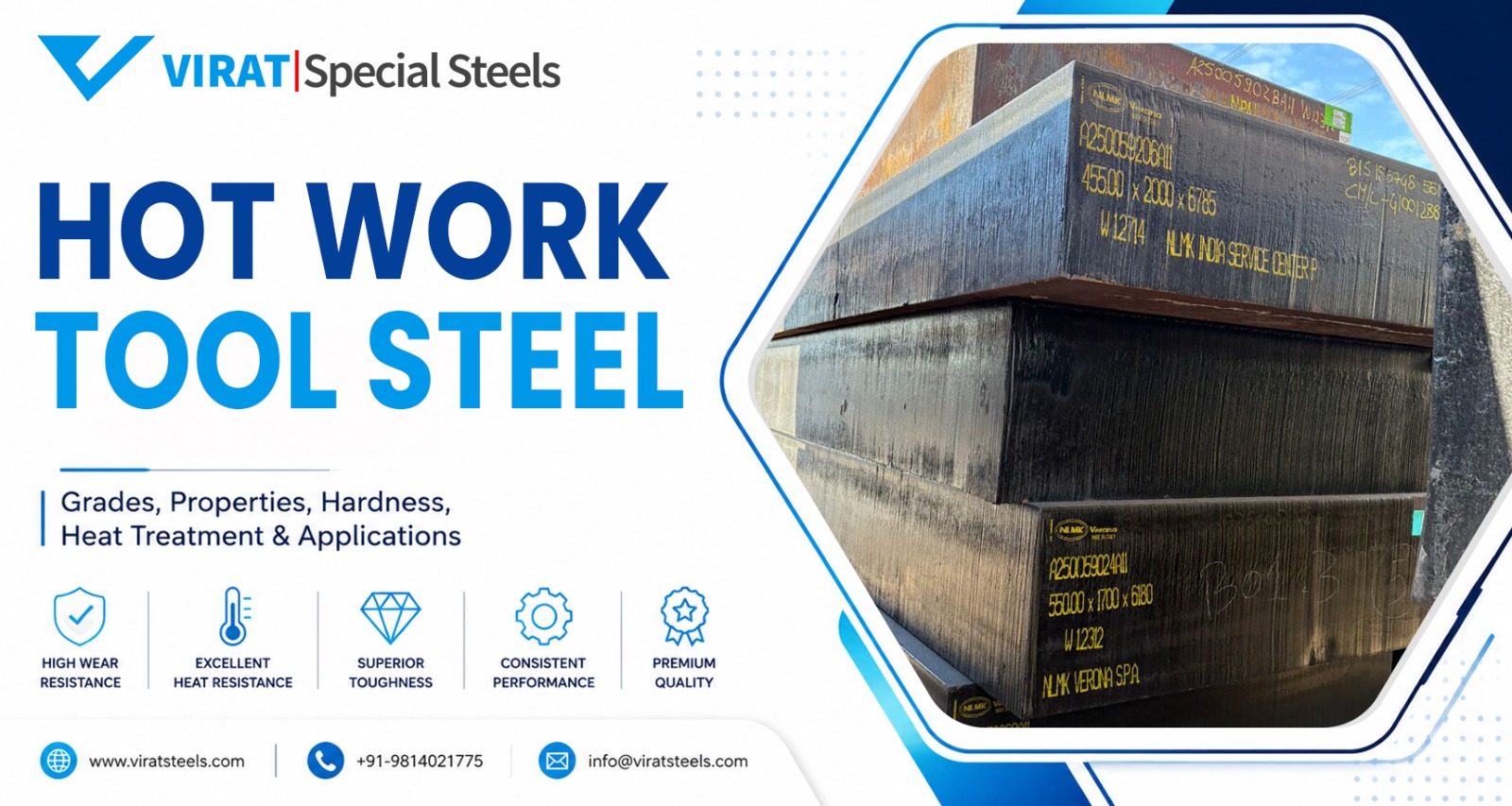
Hot work tool steel is designed for one purpose – to resist heat that would ruin common steel. It is the material behind the dies, molds, punches and blades that are hammered and squeezed and repeatedly heated and cooled – in die casting, forging, extrusion, hot stamping and hot shearing.
And what makes it different is easy to say and hard to engineer. It keeps its hardness, toughness, strength and dimensional stability, even when it’s hot. The most common grades you’ll come across are H13 (DIN 1.2344), H11 (DIN 1.2343) and DB6 (DIN 1.2714) — which one you need depends on your operating temperature, impact load, die size and how long you want the tool to last.
What Is Hot Work Tool Steel?
It’s an alloy tool steel for tools that get hot and cycle between hot and cold, again and again. It must be a combination of hot hardness, toughness, wear resistance, thermal-fatigue resistance and dimensional stability — all at the same time.
The Three Grades You Should Know:
- H13 / DIN 1.2344 – the go-to grade for die casting, aluminum extrusion and hot forging.
- H11 / DIN 1.2343 — good balance of toughness and hot strength, for forging and extrusion.
- DB6 / DIN 1.2714 – the choice for large forging dies, hammer dies and heavy-impact work where toughness is the most important property.
The final choice should always be based on the application and the steel maker’s datasheet, not on a general guide like this.
Hot work tool steel is a high-alloy steel for tooling operating at temperatures above about 200°C. Hot work grades are designed to resist the direct action of molten metal and hot workpieces, as opposed to cold-work steels, which are designed for cutting and forming at room temperature.
You will find it in aluminum and brass die-casting dies, forging dies, extrusion dies, hot shear blades, punches, mandrels, hot trimming dies, glass molds and copper alloy dies. It is their resistance to heat checking, deformation and softening that keeps these tools dimensionally stable and working reliably, cycle after cycle.
Popular Hot Work Tool Steel Grades
| Steel Grade | DIN Standard | Equivalent | Common Applications |
| H13 | 1.2344 | AISI H13 / JIS SKD61 | Die casting, forging, aluminium extrusion |
| H11 | 1.2343 | AISI H11 / JIS SKD6 | Forging dies, aluminium dies, extrusion |
| DB6 | 1.2714 | No exact AISI match; closest reference ~L6 | Hammer dies, press dies, forging dies |
| H21 | 1.2581 | AISI H21 | High-temperature tooling |
| H10 | 1.2365 | AISI H10 | Hot-work applications |
| H12 | 1.2606 | AISI H12 | Hot-work applications |
Mechanical Properties
| Property | H13 | DB6 |
| Density | 7.75–7.85 g/cm³ | 7.70–7.85 g/cm³ |
| Tensile Strength | 1550–2100 MPa | High |
| Hardness | 44–54 HRC | 38–42 HRC (working); refer to supplier datasheet |
| Toughness | Excellent | Excellent |
| Wear Resistance | Excellent | Excellent |
| Thermal Fatigue Resistance | Excellent | Excellent |
Chemical Composition
The alloying elements are what actually give hot work tool steel its personality — hardness, toughness, wear resistance and how it behaves under heat.
| Element | H13 (%) | DB6 (%) |
| Carbon (C) | 0.32–0.45 | 0.50–0.60 |
| Silicon (Si) | 0.80–1.25 | 0.10–0.40 |
| Manganese (Mn) | 0.20–0.60 | 0.65–0.95 |
| Chromium (Cr) | 4.75–5.50 | 1.00–1.20 |
| Molybdenum (Mo) | 1.10–1.75 | 0.45–0.55 |
| Vanadium (V) | 0.80–1.20 | 0.07–0.12 |
| Nickel (Ni) | — | 1.50–1.80 |
Hardness (HRC Scale)
Hardness is usually the first thing buyers ask about and it is really a trade-off push hardness up and you get wear resistance but you risk giving up toughness and a tool that is too hard cracks before it wears out.
| Grade | Typical Working Hardness |
| H13 | 44–54 HRC |
| H11 | 42–50 HRC |
| DB6 (1.2714) | 38–42 HRC |
DB6 is designed for lower working hardness than H13 tool steels – it is selected for hammer and large forging dies because it sacrifices some wear resistance for superior toughness, so it is tempered back further to prevent cracking under heavy impact.
Tip: The right hardness is not the hardest, it is the one that works for your application and duty cycle. Always verify the exact range with the datasheet of your supplier, as this may differ with section size and delivery condition.
How Hot Work Tool Steel Is Made
Good performance from hot work tool steel is not just a matter of choosing the right grade on paper – it is a matter of how well the steel was melted, forged, heat treated and inspected along the way.
1. Raw Material Selection
Everything starts with the alloying mix, and each element earns its place:
| Element | Main Function |
| Carbon | Hardness and strength |
| Chromium | Wear resistance and hardenability |
| Molybdenum | High-temperature strength |
| Vanadium | Grain refinement and wear resistance |
| Nickel | Toughness |
| Silicon | Strength and heat resistance |
| Manganese | Strength and hardenability |
2. Smelting & Refining
The steel is melted in an Electric Arc Furnace (EAF) and then further refined to the desired chemistry and cleanliness.
Ladle refining improves alloy composition, controls temperature and reduces contamination
Vacuum degassing removes dissolved gasses, mainly hydrogen, leading to better toughness, improved fatigue life, fewer internal defects and a more reliable material overall.
3. Electro-Slag Remelting (ESR)
ESR is a must when cleanliness and consistency counts. It provides a more homogeneous microstructure, better toughness and fatigue life, less segregation and a significantly improved polishability – which is why ESR grades are found in precision dies, high pressure die casting and plastic molds.
4. VAR (Vacuum Arc Remelting)
For the most demanding applications VAR takes purity one step further – lower inclusion levels, more uniform microstructure and better fatigue resistance.
5. Ingots casting
Molten steel is poured into ingots before forging, under controlled solidification conditions to minimize segregation and shrinkage.
6. Forging
Forging turns the cast ingot into dense blocks and bars by controlled heating and deformation. It increases the toughness, the grain structure, the internal flaws and gives more consistent mechanical properties to the material. Typical outputs are forged blocks, die blocks, round bars, flat bars and ESR blocks.
7. Annealing
Annealing is the process that softens the steel for machining and preparation for hardening — heat, soak evenly, then cool in a controlled fashion.
| Grade | Approx. Annealed Hardness |
| H13 | 190–230 HB |
| H11 | 180–230 HB |
| DB6 (1.2714) | 255 HB max |
Hardening is the method by which steel is given strength and wear resistance. It involves controlled pre-heating, austenitising, soaking and controlled cooling or quenching.
| Grade | Typical Austenitizing Range |
| H13 | 1,020–1,050°C |
| H11 | 1,000–1,030°C |
| DB6 (1.2714) | ~850–900°C (typical for this Ni-Cr-Mo grade; noticeably lower than the Cr-Mo-V H-series) |
DB6 is a lower alloy nickel chromium molybdenum steel and hardens at a substantially lower temperature than H13 or H11. Always stick to the manufacturer’s datasheet for the exact cycle – especially if you are working with large sections where getting this wrong is expensive.
9. Tempering
Tempering is done after hardening to reduce brittleness and to obtain the final balance between hardness and toughness. It relieves residual stress, increases toughness and helps dimensional stability. Depending on the grade, multiple cycles of tempering may be utilized.
Heat Treatment at a Glance
| Stage | Purpose |
| Annealing | Improve machinability |
| Stress Relieving | Reduce machining stresses |
| Hardening | Increase hardness and strength |
| Tempering | Improve toughness and stability |
| Final Inspection | Verify required properties |
10. Quality Inspection
The material is examined from every point of view before being shipped:
Ultrasonic Testing (UT) — identifies internal cracks, inclusions, laminations and shrinkage-related defects, especially important on large forged blocks.
Chemical composition testing – a spectrometer tests carbon, chromium, molybdenum, vanadium, nickel, silicon, manganese, sulfur and phosphorus against the specified grade.
Hardness and dimensional inspection: Rockwell or Brinell testing, checks of length, width, thickness, flatness, squareness, straightness and surface finish.
11. MTC (Material Test Certificate)
An MTC links grade, heat number, chemical composition, mechanical properties, hardness, heat-treatment condition, inspection results and manufacturer details. It provides buyers with a paper trail they can verify.
| Document / Test | Purpose |
| MTC / EN 10204 3.1 | Material traceability and test results |
| UT Report | Internal quality verification |
| Spectrometer Report | Chemical composition |
| Hardness Report | Hardness verification |
| Heat Number | Batch traceability |
| Dimensional Report | Size verification |
Where Hot Work Tool Steel Is Used
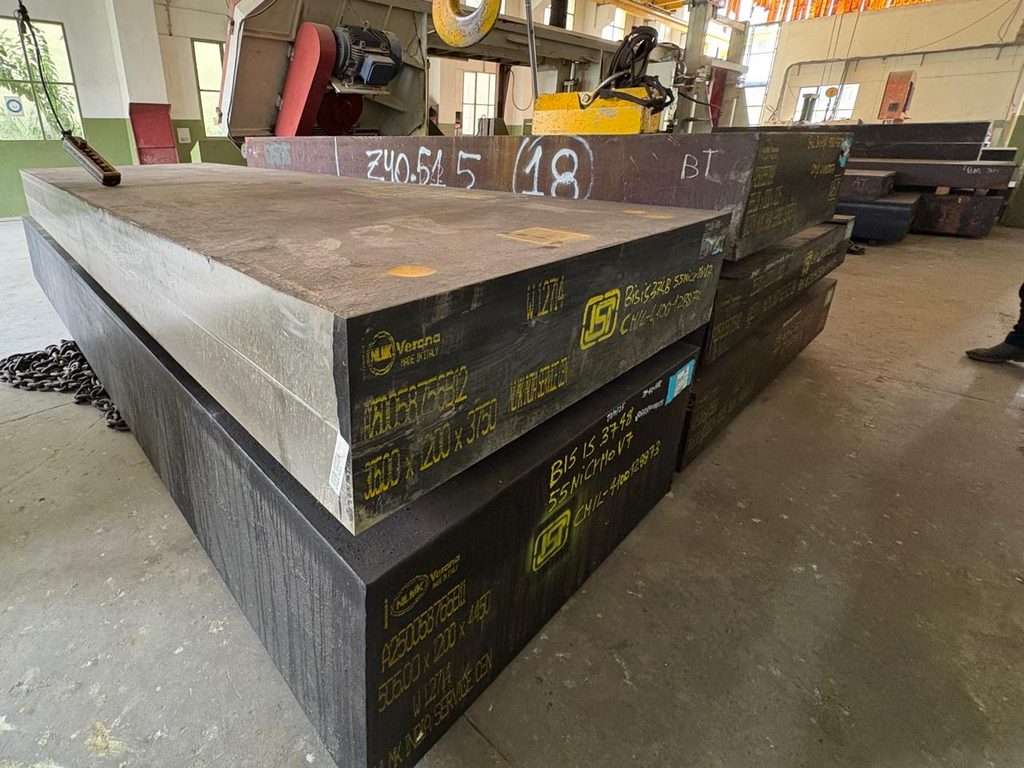
Aluminum diecast molds H13 tool steel is the material of choice here because it can be repeatedly heated and cooled without losing dimensional stability – think engine blocks, gear housings, transmission components, pump bodies, LED housings and other automotive parts.
Hot-forging dies They are pounded by impact loads and heat, which is why DB6 and H11—valued for toughness and resistance to thermal cracking—are the usual choices. Common on crankshafts, connecting rods, railroad components and heavy engineering components.
Extrusion Dies High hot strength and wear resistance is needed to keep profiles – used for aluminum profiles, window frames, heat sinks and electrical conductors.
Brass and copper die cast. These alloys run hotter than aluminum so H13 and H11 earn their keep with better hot hardness.
Hot shear blades, for cutting red-hot blooms, billets and bars in rolling mills;
Hot punches, made for hot piercing, making and punching where wear and impact resistance both count.
Glass molds on the basis of thermal stability and resistance to heat checking.
Plastic mold parts: ESR H13 material tool preferred for polishability and wear resistance.
Industries That Rely on It
| Industry | Applications |
| Automotive | Die casting, forging |
| Aerospace | Forging tools |
| Defence | Heavy-duty dies |
| Railways | Forged components |
| Aluminium | Extrusion dies |
| Plastic Moulding | Mould inserts |
| Steel Plants | Hot shear blades |
| Heavy Engineering | Forging tools |
| Energy | Turbine & valve tooling |
Hot Work vs. Cold Work vs. Plastic Mould Steel
| Feature | Hot Work Tool Steel | Cold Work Tool Steel | Plastic Mould Steel |
| Primary Use | High-temperature tooling | Room-temperature cutting/forming | Plastic injection & moulding |
| Operating Temperature | High | Low to moderate | Low to moderate |
| Key Property | Hot hardness & thermal fatigue resistance | Wear resistance & hardness | Toughness, polishability & machinability |
| Important Grades | H13, H11, DB6 | D2, D3, EN31 | P20, P20+Ni, 1.2083 |
| Common Applications | Die casting, forging, extrusion | Dies, punches, blanking, shear blades | Injection moulds, plastic moulds |
| Typical Hardness | 44–54 HRC | 55–62 HRC | 28–52 HRC |
| Main Advantage | Retains strength at elevated temperatures | Excellent wear & edge retention | Good machinability and surface finish |
| Typical Industries | Automotive, forging, die casting | Tool & die, automotive, engineering | Plastic, packaging, automotive |
| Parameter | H13 | DB6 |
| Type | Chromium hot work steel | Nickel-chromium-molybdenum tool steel |
| Hardness | 44–54 HRC | 38–42 HRC |
| Toughness | Excellent | Outstanding |
| Wear Resistance | Higher | Moderate |
| Thermal Fatigue | Excellent | Very good |
| Large Dies | Good | Excellent |
| Forging Applications | Very good | Excellent |
| Impact Resistance | Good | Superior |
| Aluminium Die Casting | Excellent | Good |
H13/DB6 comparison table in die casting and extrusion; go with DB6 for large forging dies, hammer dies and heavy-impact work.
Advantages & Limitations
| Advantages | Limitations |
| Excellent hot hardness | Higher material cost |
| High thermal fatigue resistance | Needs proper heat treatment |
| Excellent toughness | Harder to machine once hardened |
| Good wear resistance | Limited corrosion resistance |
| Good machinability when annealed | Large sections need controlled processing |
| Excellent dimensional stability | |
| Long tool life |
How to Choose the Right Grade
1. Match the grade to the application.
| Application | Recommended Grade |
| Aluminium die casting | H13 (1.2344) |
| Brass die casting | H13 |
| Hot forging dies | H11 (1.2343) |
| Hammer dies | DB6 (1.2714) |
| Extrusion dies | H13 |
| Plastic mould inserts | ESR H13 |
| Large forging blocks | DB6 |
Get the size right. Think about how long it’s how wide it is, how thick it is, Think about length, width, thickness, weight, machining allowance, and expected dimensional change during heat treatment.. Available forms include forged blocks, round bars, flat bars, ESR blocks and pieces that are already cut to size.
Settle on a delivery condition with your supplier — annealed, pre-hardened, hardened and tempered, soft annealed, or stress relieved. With your supplier.
Check the quality before you make a decision. Ask for testing results, spectrometer reports, material test certificates, heat-number traceability and confirmation of surface finish, straightness and mechanical properties.
Plan the amounts you need based on prototypes, regular production, yearly use, extra stock and any growth that is coming up.
Choose a supplier who can support you. One that has stock, imported materials, forged and ESR blocks, fast delivery, technical help, certificates and custom machining.
Certifications Worth Looking For
| Certification | Purpose |
| ISO 9001 | Quality management system |
| EN 10204 3.1 | Material test certificate |
| Ultrasonic Testing (UT) | Detects internal defects |
| Spectrometer Analysis | Verifies chemical composition |
| Hardness Test Report | Confirms HRC/HB values |
| Heat Number Traceability | Tracks production batch |
Why Manufacturing Quality Matters
How the steel is made has a direct line to how it performs on the shop floor. Controlled melting, refining, forging, annealing, hardening, tempering and inspection are what separate a die that lasts from one that fails early — particularly in die casting, hot forging, aluminium extrusion and heavy-duty tooling, where the cost of a bad batch shows up fast.
Key Takeaways
- Controlled melting and refining keep the chemistry consistent.
- Forging improves structural uniformity and toughness.
- Annealing gets the material ready for machining.
- Hardening builds the strength and hardness.
- Tempering balances hardness against toughness.
- UT, chemical analysis, hardness testing and dimensional inspection confirm quality before shipping.
- MTCs and heat-number traceability give buyers the documentation they need.
Why Choose Virat Special Steels?
Virat Special Steels Pvt. Ltd. has been supplying manufacturers with quality imported tool steels for over 70 years.
- Over 70 years of industry experience.
- 3,500+ tons of tool steel in stock, ready to use
- Sourced from established international mills.
- “Wide grade range: H13, H11, DB6, D2, D3, P20, M2, M35, and ESR grades“.
- “Every order comes with an EN 10204 3.1 MTC”
- “UT and spectrometer testing on all material”
- “Cut-to-size and custom machining available”
- “Fast delivery across India”
- “Trusted by automotive, forging, aerospace, plastic moulding, railway, and heavy engineering customers”.
Our Supply Network Across India
We supply H13, DB6, H11, H12, H10 and H21 across major industrial hubs — Delhi, Gurugram, Faridabad, Noida, Ghaziabad, Jaipur, agra, Ahmedabad, Vadodara, Surat, Rajkot, Mumbai, Pune, Nashik, Indore, Bhopal, Rudrapur , Chennai, Coimbatore, Hyderabad, Kolkata, Jamshedpur, Secunderabad and Nellore — with standard and custom sizes, cut-to-size material, annealed or heat-treated condition, and material test certificates as required.
Conclusion
H13 and DB6 remain the two most dependable choices for high-temperature tooling, offering a solid mix of hardness, toughness, wear resistance, hot strength and thermal-fatigue resistance. Get the grade selection, heat treatment, machining and maintenance right, and both can deliver excellent tool life. We supply H13, DB6 and other tool steel grades across major industrial cities in India for a wide range of manufacturing needs.
Get a Quote
Looking for reliable H13, DB6 or other hot work tool steel? Virat Special Steels supplies round & flat bars, forged & rolled blocks, ESR/non-ESR blocks and cut-to-size material — complete with MTC, UT testing, spectro testing, custom machining, ready stock and PAN India delivery.
Call: +91-98140 21775 Email: info@viratsteels.com Locations: Gurgaon (Haryana) | Ludhiana (Punjab)
Frequently Asked Questions
1. What is Hot Work Tool Steel?
Alloy steel for tools and dies exposed to high temperatures, thermal cycling, wear and mechanical stress.
2. What are the primary types?
Typical grades are H13, H11, H12, H10 and H21 – H13 tool is the most common.
3. H13 tool steel – what is it?
A hot work Cr-Mo-V grade that is known for its excellent hot strength, toughness, wear resistance and thermal-fatigue resistance.
4. What is the HRC of H13?
44-54 HRC depending on the application and heat treatment condition.
5. What is the maximum service temperature of H13?
Typically up to around 550–600°C, depending on load, thermal cycling and cooling conditions. Confirm the exact limit with your supplier’s datasheet.
6. Is H13 material good for high temperature applications?
Yes, it is used heavily where there is high heat and heating and cooling over and over again.
7. Can H13 be machined?
Yes, if annealed. It is much more difficult to machine once hardened.
8. How to Improve H13 Machinability?
Use proper cutting tools. Use appropriate speeds and feeds. Use adequate cooling. Machine in the annealed state where possible.
9. What is H13 used for?
Die casting dies, extrusion dies, forging dies, hot punches, mandrels and other similar hot work tooling.
10. H13 wear resistant?
Yes, if they are heat treated properly and matched to the proper operating conditions.
11. Is H13 hard enough?
Yes, gives a good balance of hardness and toughness which is what you need in demanding die work.
12. What is resistance to thermal fatigue?
It’s the ability of the steel to be heat cycled over and over again without heat checking or cracking.
13. Is H13 heat treatable?
Yes. Usually it is hardened and tempered so that it can obtain the desired hardness, toughness and hot strength.
14. Is H13 air hardenable?
Yes, which means it can achieve high hardness by means of appropriate heat treatment without a drastic quench.
15. Can H13 be used for nitriding?
Yes, nitriding can improve surface hardness, wear resistance and die life in suitable applications.
16. What is the chemical composition of H13?
Carbon, silicon, manganese, chromium, molybdenum and vanadium. Chromium, molybdenum and vanadium do most of the work.
17. What is the difference between H11 and H13?
Both are hot working grades but H13 tool steels gives generally a better combination of hot hardness, wear resistance, toughness and thermal-fatigue resistance.
18. What’s the difference between H13 and D2?
D2 is a cold-work grade built primarily for high wear resistance. H13 tool steel is a hot-work grade.
19. Is H13 tool steels appropriate for die casting dies?
Yes, it is widely used for aluminum, zinc and magnesium die casting because of its resistance to thermal fatigue and its hot strength.
20. Can H13 tool steels be used for hot extrusion die?
Yes, commonly used for extrusion dies, mandrels and related tooling.
Why Manufacturers Across India Choose Virat Steels as Their Trusted Tool Steel Supplier
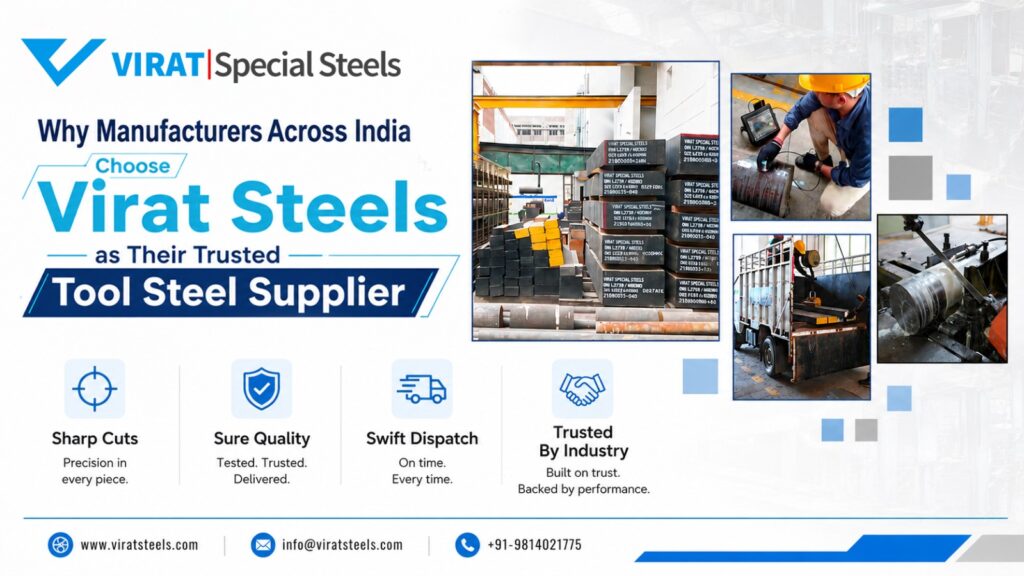
Importance of the Right Tool Steel Supplier
In the current competitive environment, the quality of Tool Steel Supplier plays an important role when it comes to efficiency in production, quality of the product, and cost of the operations. It really does not matter if you are working with cars or airplanes or making parts or doing precise engineering work. What is important is that you have a company that supplies the right kind of steel tools.
Virat Special Steels Pvt Ltd has been doing this work for over 68 years. We have been supplying quality steel tools to people who make cars, airplanes and other things. We know the problems that people face when they are trying to choose the kind of steel tool, for their work. We are a company that people trust to supply steel tools in India. We give our customers quality materials and also help them with technical problems. We have steel tools to be delivered and we can also cut them to the size that our customers need. We deliver our tools over the country on time. This helps our customers to work waste less time and get good results.
1. Extensive Portfolio of PremiumTool Steel Supplier Grades
There is an extensive portfolio of different grades of tool steel Supplier available at Virat Steels, appropriate for varied industrial uses.
The list includes the following:
2. Premium Quality Tool Steel Supplier You Can Rely On
Quality forms the basis of all products manufactured by Virat Steels.
Every steel alloy is selected, tested, and inspected for the following qualities:
• Hardness
• Wear Resistance
• Toughness
• Tolerance
• Machinability
Manufacturers get products which perform reliably in difficult conditions of manufacture.
3. Ready Stocks Available for Quicker Deliveries
Production delays usually happen when there is a lack of raw materials.
Having ready stocks means that Virat Steels will be able to supply its clients with the necessary tool steel Supplier grades without any delay.
Advantages include:
• Downtime reduction
• Project completion
• Better stock control
• Better scheduling
4. Custom Cutting & Sizing
Each manufacturing company has its own material needs. The Virat Steels offer:
• Custom-cutting services
• Sizes as per the requirement
• Machine-ready sizes
• Bulk availability
This minimizes wastage on the machine and saves time for customers.
5. Technical Competence and Materials Information
Choosing the right grade of tool steel Supplier may not be an easy task always.
The skilled and knowledgeable professionals from Virat Steels assist clients by advising on the most appropriate material considering the following factors:
• Application
• Heat-treating needs
• Wear resistance
• Toughness
• Machinability requirements
• Economic considerations
6. Price Competitiveness without Sacrificing Quality
Producers are always trying to find that delicate balance between the two.
Virat Steels delivers:
• Market competitive rates
• High value products
• Value-for-money materials
Customers get high-end steel within their procurement budget.
7. Industries That Trust Virat Steels
Virat Steels provides services to various industrial sectors such as:
• Automobile Manufacturing
• Plastic Injection Moulding
• Forging Sector
• Manufacturing of Dies and Moulds
• Engineering Workshops
• Aerospace Parts
• Machine Tools Manufacturing
• Precision Engineering
• Industrial Machinery Manufacturing
The capability of serving different sectors highlights their level of professionalism.
8. Fast Tool Steel Supplier Delivery Across India
Indian manufacturers need timely deliveries to keep their operations running smoothly and efficiently.
Virat Steels have an effective supply chain system in place which allows quick deliveries in industrial towns and manufacturing centres. They offer a reliable logistics system that guarantees on-time material delivery.
9. Building Strong Customer Relationships
Virat Steels does not concentrate only on transactions; rather, it builds strong relationships.
Customer needs include:
• Quick communication
• Professional assistance
• Readily available products
• Post sales support
• Long term relationship
This customer first approach has helped create a loyal clientele across India.
10. Commitment to Continuous Improvement
Technology in manufacturing continues to develop, while material demands increase.
Virat Steels keeps abreast of changes in industry through:
• Evolving product line
• Quality assurance
• Better inventory control
• Exceptional customer service
• Efficient supply chain
How Premium Tool Steel Supplier Benefits Manufacturers?
| Manufacturing Challenge | How Virat Steels Helps |
| Production delays | Ready stock and reliable dispatch |
| Incorrect material selection | Technical guidance for grade selection |
| Excess machining | Custom-cut and machine-ready sizes |
| Frequent tool replacement | Premium-quality tool steel designed for demanding applications |
| Procurement delays | Reliable pan-India supply network |
Why Manufacturers Choose Virat Steels
Manufacturers across India choose Virat Steels because we combine high-quality tool steel Supplier with dependable service and technical expertise. Our customers benefit from:
• Premium-quality tool steel
• Wide range of steel grades
• Competitive pricing
• Fast delivery across India
• Custom cutting services
• Expert technical guidance
• Reliable stock availability
• Trusted industry experience
• Excellent customer support
• Long-term supply partnership
| Feature | Virat Steels | Typical Supplier |
| Tool Steel Supplier Grades | Wide range of premium grades | Limited availability |
| Stock Availability | Ready stock for quick dispatch | May require longer lead times |
| Custom Cutting | ✓ Available | Not always available |
| Technical Guidance | Expert material selection support | Limited technical assistance |
| Delivery | Reliable pan-India delivery | Varies by supplier |
| Industries Served | Automotive, Aerospace, Die & Mould, Forging, Precision Engineering | May focus on fewer industries |
| Customer Support | Dedicated and responsive | Varies |
Conclusion
Looking for a trusted Tool Steel Supplier in India ?
No matter where your business is located—North, South, East, or West—Virat Special Steels is here to support your manufacturing needs with premium-quality tool steel Supplier .
From dies and moulds to cutting tools and precision engineering applications, we supply high-performance tool steel Supplier that delivers strength, durability, and consistent results. With expert technical guidance, reliable quality, and timely delivery across India, we help manufacturers keep production running smoothly and efficiently.
Choose Virat Special Steels—your dependable partner for quality tool steel Supplier and long-term manufacturing success.
Contact Virat Special Steels today for expert guidance and premium tool steel Supplier supply.
Need help choosing between DIN 1.2714 Steel , DB6, and H13 for your next die?
Talk to our technical sales team before you place the order — it’s a five-minute call that can save you a failed die six months from now.
Call us: +91-98140 21775 Email: info@viratsteels.com Visit us: Gurgaon (Haryana) | Ludhiana (Punjab)
Frequently Asked Questions (FAQs)
1. What types of tool steel Supplier does Virat Steels supply?
Virat Steels supplies Cold Work Tool Steel, Hot Work Tool Steel Supplier and Plastic Mold Steel. They also provide High-Speed Steel, Alloy Steel, Die Steel and Engineering Steel. Additionally they offer special steel grades.
2. Why should manufacturers choose Virat Steels?
Manufacturers choose Virat Steels because they provide high-quality materials. They have an inventory and offer competitive pricing. Virat Steels also provides expertise and custom cutting services. They ensure delivery across the nation.
3. Does Virat Steels provide sized tool steel Supplier ?
Yes Virat Steels offers custom cutting services. They supply tool steel Supplier in sizes that match customer requirements. This helps reduce machining time and material waste.
4. Which industries use Virat Steels products?
Virat Steels serves industries. These include automotive, aerospace and plastic moulding. They also serve die and mould manufacturing, forging and precision engineering. Machine tools and general engineering are also among their clients.
5. Does Virat Steels maintain stock?
Yes Virat Steels maintains an inventory. They stock used tool steel grades. This ensures dispatch and minimizes production delays.
6. Can Virat Steels help select the tool steel Supplier grade?
Yes Virat Steels has a technical team. They assist customers in choosing the suitable steel grade. The team considers application, hardness wear resistance, toughness and machining requirements.
7. Does Virat Steels deliver across India?
Yes Virat Steels delivers tool steel across India. They have a logistics and distribution network.
8. How does quality tool steel improve manufacturing?
High-quality tool steel offers better wear resistance. It also provides tool life and improved machining performance. Additionally it reduces downtime. Lowers maintenance costs. This leads to productivity and cost savings.
9. Does Virat Steels supply materials for die and mould manufacturing?
Yes Virat Steels offers specialized die steel and mould steel grades. These are suitable, for stamping dies, injection moulds, forging dies and precision tooling applications.
10. How can I contact Virat Steels for a quotation?
You can contact Virat Steels through their website. You can also email them. Reach out to their customer support team. They will discuss your tool steel requirements. Provide a customized quotation.
11. How do I pick the right tool steel for my needs?
The right tool steel depends on what you’re using it for, temperature, wear and tear how hard it needs to be and how easy it is to work with. For example hot work tool steels are good for forging and die-casting while cold work tool steels are often used for cutting tools. If you’re not sure Virat Special Steels technical team can help you choose the tool steel for your project.
12. Why is it important to buy tool steel from a supplier who knows what they’re doing?
A supplier who knows what they’re doing doesn’t just provide tool steel they also help you pick the right one make sure they always have it in stock and deliver it on time. This means you won’t have to delay production your tools will last longer and you’ll spend money making things.
13. What are the benefits of using high-quality tool steel?
High-quality tool steel lasts is stronger keeps its shape and makes your tools last longer. It also means you don’t have to replace tools often you can work without stopping and you get consistent results even when you’re making things in large quantities.
14. What kinds of businesses use tool steel from Virat Special Steels?
Tool steel, from Virat Special Steels is used in industries including making cars, airplanes, molds and dies, forging, making plastic parts, machine tools, precision engineering, and making general equipment.
15. Can Virat Special Steels cut tool steel to the sizes I need?
Yes Virat Special Steels can cut tool steel to the sizes you need. Getting tool steel that’s already the size helps you make things faster use less material and work more efficiently.
Why Hot Work Tool Steel matters in Indian Manufacturing Industries
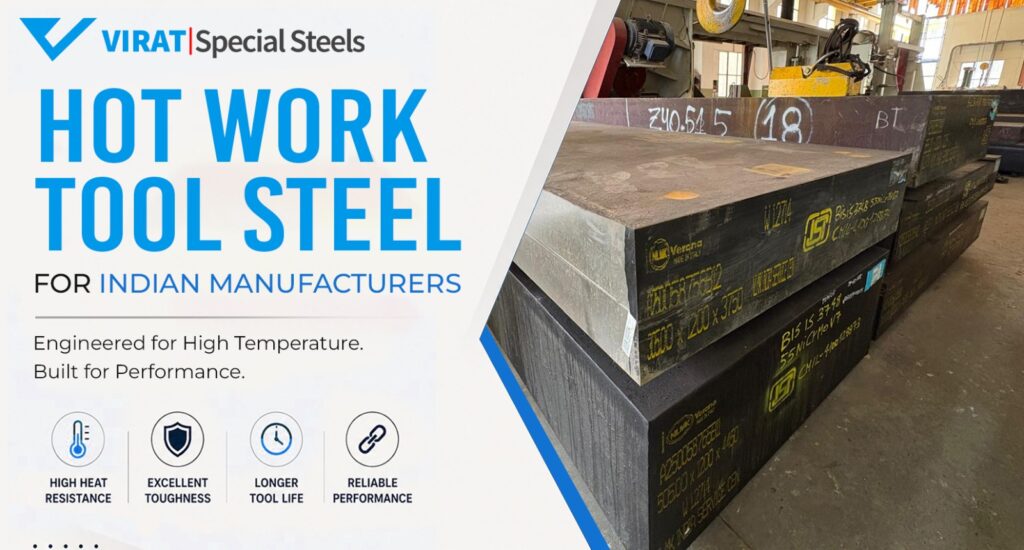
India’s manufacturing sector is expanding rapidly across industries such as automotive, die casting, forging, aluminium extrusion, plastic moulding, and heavy engineering demanding higher productivity, better precision, and longer tool life than ever before. Hence In such high-temperature and high-pressure applications, the quality of tool steel directly impacts production performance, die life, and operational efficiency.
So, industries increasingly rely on premium hot work tool steels such as H13 tool steel, H11, and DB6 grades known for their excellent heat resistance, toughness, wear resistance, and durability under demanding working conditions.
To support these growing industrial requirements, Virat Special Steels Pvt. Limited with ready stock, precision cutting, UT tested material, and technical support supplies high-quality hot work tool steels engineered for reliable performance across modern manufacturing applications.
Hot Work Tool Steel
Hot work tool steel is a category of alloy steel specifically designed for applications involving elevated temperatures. These steels are used to manufacture tools, dies, and molds that shape.
Hot work tool steels can withstand:
- High thermal stress
- Repeated heating and cooling cycles
- Mechanical shock
- Abrasion and wear
- Surface cracking
This makes them ideal for industrial applications where reliability and long tool life are essential.
Common Types of Hot Work Tool Steel
H13 is one of the most widely used hot work tool steels because of its excellent heat resistance, toughness, and wear resistance. It is commonly used in aluminum extrusion, die casting, and forging applications.
H11 tool steel offers high toughness and strong thermal fatigue resistance, making it suitable for applications involving heavy impact and thermal cycling.
DB6 hot work tool steel is known for its superior hot strength and durability in demanding industrial applications such as heavy-duty tooling and forging dies.
Importance of Hot Work Tool Steel in Indian Manufacturing
India’s industrial growth has significantly increased the demand for durable and high-performance tooling materials. Hot work tool steels help industries achieve:
1. Higher Production Efficiency
Premium hot work steels reduce downtime and improve continuous production performance.
2. Longer Tool and Die Life
These steels provide excellent resistance to thermal fatigue and wear, resulting in extended die life and lower replacement costs.
3. Improved Product Quality
Dimensional stability and resistance to deformation ensure consistent product quality in extrusion, forging, and die casting operations.
Applications of H13, H11 & DB6 Hot Work Tool Steel
| Grade | Industry Use | Main Applications | Key Benefit |
| H13 | Aluminum Extrusion | Extrusion Dies | High heat resistance |
| H13 | Plastic Molding | Injection Molds | Excellent wear resistance |
| H11 | Forging Industry | Forging Dies & Punches | High toughness |
| H11 | Heavy Engineering | Hot Work Tooling | Better shock resistance |
| DB6 | Die Casting | Die Casting Tools | Superior hot strength |
| DB6 | Heavy Forging | Heavy-Duty Dies | Long tool life |
Why are H13, H11 & DB6 Tool Steels Popular in Indian Industries?
H13, H11, and DB6 tool steels are widely used in Indian industries because of their excellent heat resistance, toughness, durability, and long tool life in demanding hot work applications.
Key Advantages of H13, H11 & DB6 Tool Steel
| Grade | Key Property | Industrial Advantage |
| H13 | High Heat Resistance | Performs reliably at elevated temperatures |
| H13 | Excellent Wear Resistance | Reduces tooling wear and maintenance |
| H11 | High Toughness | Prevents cracking and premature tool failure |
| H11 | Thermal Fatigue Resistance | Handles repeated heating and cooling cycles |
| DB6 | Superior Hot Strength | Performs well in heavy-duty hot work applications |
| DB6 | Long Tool Life | Improves productivity and reduces operating costs |
Choosing the Right Hot Work Tool Steel Supplier
The quality of hot work tool steel directly affects tool life, productivity, and manufacturing performance. When selecting suppliers for tool steels like H13, H11, and DB6 tool steel and many more, manufacturers should look for:
- Consistent material quality
- Proper testing and certification
- Technical support and application guidance
- Reliable stock availability and timely delivery
Conclusion
High-performance hot work tool steels are very essential in improving die life, production efficiency, and overall manufacturing performance. Hence choosing the right grade and the right supplier can enhance tooling reliability in demanding industrial applications.
Virat Special Steels Pvt. Limited is committed to supplying premium-quality hot work tool steels like DB6, H13, H11 etc backed by ready stock availability, UT tested material, precision cutting, and technical support to your industry requirements.
Whether for die casting, forging, extrusion, or heavy engineering applications, Virat Steels helps manufacturers achieve better productivity, durability, and long-term performance.
Looking for reliable hot work tool steel solutions?
Contact Virat Special Steels Pvt. Limited today for expert guidance and premium tool steel supply.
📞 +91 98140-21775 ✉ info@viratsteels.com
For more details about our hot work tool steel grades and applications, please click on the link below to explore our product range and technical specifications.
https://www.viratsteels.com/h13.html
https://www.viratsteels.com/h11.html
https://www.viratsteels.com/db6.html
FAQs – Hot Work Tool Steel
1. What is Hot Work Tool Steel?
Hot work tool steel is specially designed for applications involving high temperatures, pressure, and wear.
2. Which are the common hot work tool steel grades?
H13, H11, and DB6 are among the most widely used hot work tool steel grades in industries.
3. Why is H13 tool steel popular?
H13 offers excellent heat resistance, wear resistance, and long tool life.
4. What is H11 tool steel used for?
H11 is mainly used in forging and heavy-duty applications requiring high toughness and crack resistance.
5. What are the advantages of DB6 tool steel?
DB6 provides superior hot strength, durability, and reliable performance in extreme working conditions.
6. Which industries use H13, H11, and DB6 steel?
These grades are widely used in aluminum extrusion, die casting, forging, plastic molding, and heavy engineering industries.
7. What is the hardness range of H13 steel?
H13 tool steel generally ranges between 44–52 HRC depending on heat treatment and application.
8. Where can I buy quality H13, H11, and DB6 tool steel in India?
Premium-quality H13, H11, and DB6 hot work tool steels are available from Virat Special Steels for industrial applications.
How Virat Special Steels Delivers High-Quality Steel Across India
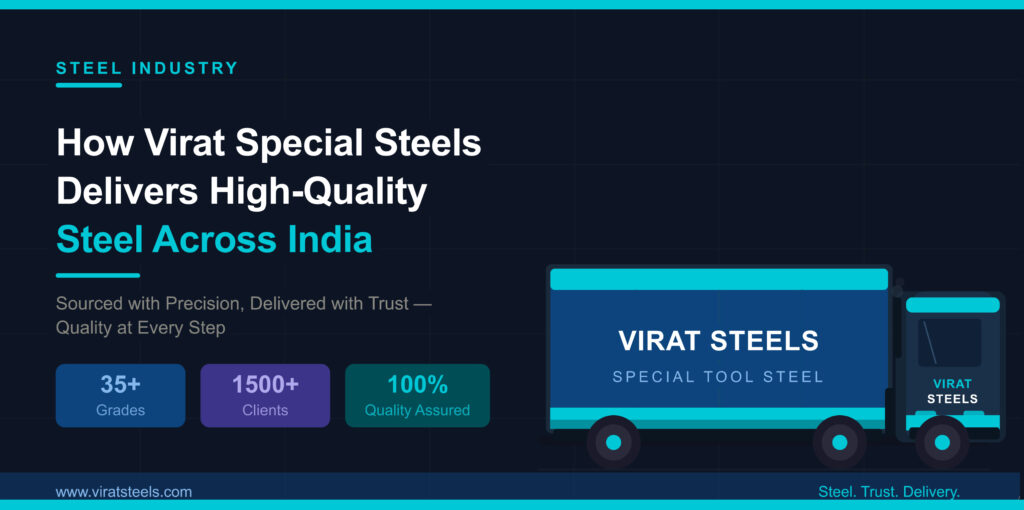
From raw material sourcing to pan-India distribution — a comprehensive look at India’s trusted special steel supplier and manufacturer.
In India where infrastructure is booming and industrial demand for precision tool & die steel is higher, Virat Special Steels has emerged as one of India’s most dependable names in high-quality steel supply and distribution.
| 1957 | 3500 tons | 35+ | 1.5K+ |
| Existence | Stock | Grades | Satisfied Clients |
Who Is Virat Special Steels?
Virat Special Steels is a leading stockist, supplier, and distributor of special and alloy steel products across India. With decades of domain expertise, the company serves industries ranging from automotive and aerospace to defence, tooling, and heavy engineering.
What sets Virat Special Steels apart in the crowded Indian steel market is its unwavering commitment to quality assurance, grade certification, and on-time delivery whether you are a small machine shop or a large-scale manufacturer.
Product Range: Every Grade, Every Need
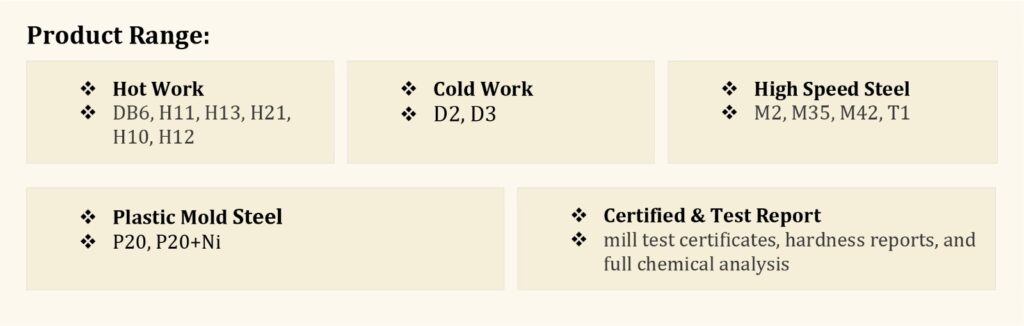
One of the key reasons Virat Special Steels commands trusts across sectors is its vast and diverse product portfolio The company stocks and supplies:
1. Hot Work Steel
DB6, H11, H13, H21, H10, H12—for dies, moulds, and tools that work with heated metals like forging dies, die casting dies, extrusion tools, and hot shearing blades operating at high temperatures (300–700°C).
2. Cold Work Steel
D2, D3– for cutting, punching, blanking, and forming tools that operate at room temperature on unheated workpieces.
3. High-Speed Steel (HSS)
M2, M35, M42, T1— engineered for extreme heat resistance and wear durability in high-speed machining operations.
3. Plastic Mold Steel
P20+Ni , P20 — for manufacturing injection moulds, blow moulds, and compression moulds that shape plastic products in mass production.
4. Certified & Test-Report Backed Steel
Every batch is supplied with original mill test certificates, hardness reports, and full chemical analysis — ensuring complete traceability.
The Supply Chain: How Quality Reaches You
Virat Special Steels operates a streamlined supply chain that ensures product integrity from steel mill to customer workshop. Here is how the process works:
- Sourcing from Certified Global & Domestic Mills — Raw steel is procured from ISO-certified mills in India, Europe, China, Japan, ensuring chemical composition and mechanical properties meet international standards like DIN, AISI, and IS.
- In-House Quality Inspection & Testing — Each incoming lot undergoes spectrometric testing, hardness verification, and dimensional checks before being added to inventory.
- Inventory Management — With large, well-organised warehouses, Virat Steels maintains ready stock of over 35+grades, enabling same-day dispatch for urgent industrial requirements.
- Custom Cutting— Steel is supplied in round bars, flat bars with cutting-to-size services to reduce waste and machining time for buyers.
- Pan-India Logistics & Timely Delivery — Our logistics partners ensure safe, on-time delivery across Pan India. With our offices at GURGAON, LUDHIANA, PUNE & CHENNAI to provide efficient business services to the Industrial undertaking at the location in India.
| Serving India’s Most Critical Industries — Where Failure Is Not an Option |
Why Industries Trust Virat Special Steels
Technical Expertise
Unlike generic steel traders, Virat’s team includes technical team who guide clients on grade selection — ensuring the right steel is used for the right application, reducing rejection rates and improving the productivity .
Consistent Quality with Traceability
Every supply comes with full traceability — heat numbers, TC, composition reports — making Virat’s steel compatible with ISO 9001 quality frameworks.
Competitive Pricing & Fast Quotes
Virat Steels offers market-competitive Quotes are processed quickly, supporting buyers’ procurement timelines without delay.
After-Sales Technical Support
Virat’s technical support team stays with you beyond the sale — helping with heat treatment parameters, machinability ratings, and surface hardness queries.
Frequently Asked Questions
Q1: What makes Virat Special Steels different from regular steel traders?
Virat Special Steels focuses exclusively on tool & die steels offering deep technical knowledge, certified inventory, and grade-specific expertise that other steel traders cannot match.
Q2: Do you supply steel to small businesses and individual buyers?
Yes. Virat serves a wide spectrum from large OEMs to small machine shops. Minimum order quantities are flexible, and enquiries are welcome for any quantity.
Q3: Is same-day or next-day dispatch available?
For grades available in ready stock which covers the majority of popular engineering and tool steel grades same-day dispatch is possible for orders placed before the cut-off time.
Q4: Are mill test certificates provided with every order?
Absolutely. Every supply from Virat Special Steels comes with original mill test certificates covering chemical composition ensuring full traceability.
Q5: Can Virat Steels supply cut to specific sizes?
Yes. Virat offers cutting-to-size and profiling services for round bars, flat bars reducing your raw material waste and machining effort significantly.
Conclusion
By combining advanced infrastructure, a wide product range, and a strong commitment to quality, Virat Special Steels continues to lead as a trusted Tool steel supplier across PAN India. Whether you need a plastic mould steel, tool & die steel, or high-speed steel, the brand delivers unmatched performance, durability, and trust.
| Ready to Source Smarter? Contact Virat Special Steels Today |
Fast quotes | Grade recommendations | Pan-India delivery
📧 info@viratsteels.com | 📱 +91 98140-21775
Selecting the Right Hot Work Tool Steel: A Guide for Manufacturers
In the manufacturing industry, the choice of material can significantly impact the quality and efficiency of production. Hot work tool steels are a critical component in this process, especially when it comes to high-temperature applications. These steels are designed to withstand the rigors of processes such as forging, die casting, and extrusion.
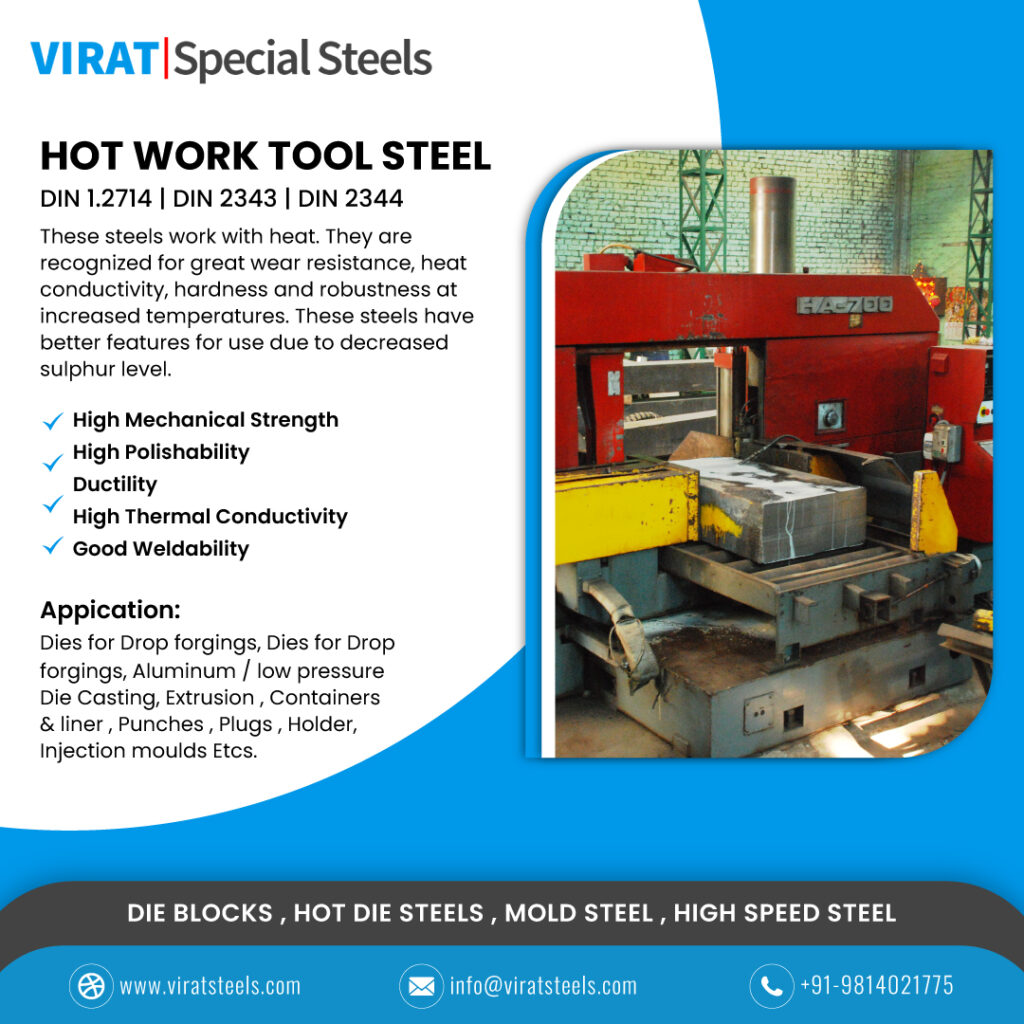
Among the various options available, grades like DB6, H13, H11, and H21 stand out for their exceptional properties. H13, for instance, is renowned for its excellent heat resistance, toughness, and wear resistance, making it an ideal choice for die casting dies and extrusion tools.
VIRAT SPECIAL STEELS PVT. LIMITED, based in India, has established itself as a leading supplier in this niche market. With a vast inventory of DB6, H13, and H11 tool and die steels, they cater to a diverse range of industrial requirements. Their expertise not only lies in the supply of these materials but also in providing valuable guidance to manufacturers in selecting the appropriate steel for their specific needs.
The mode of supply is another aspect where VIRAT SPECIAL STEELS excels. They offer these high-grade steels in various forms, including flat, square, and round bars, ensuring that clients have access to the right shape and size for their manufacturing processes.
For those in the manufacturing sector looking to enhance their production capabilities with hot work tool steels, consulting with a knowledgeable supplier like VIRAT SPECIAL STEELS can make all the difference. Their team is equipped to handle queries related to hot work steels, ensuring that manufacturers are empowered to make informed decisions that will shape the future of their production lines.
In conclusion, the selection of hot work tool steel is a pivotal decision for any manufacturer. With the right guidance and quality materials, the path to efficient and high-quality production is well within reach.
Learn more :
https://www.viratsteels.com/hot-work-steel.html
https://www.viratsteel.in/materials/hot-work-steel-supplier-in-india/
Any queries feel free to contact us: info@viratsteels.com or
Call on mobile number +91-9814021775
Choosing the best Tool and Die Steels for your Pressure Die Casting needs?
Pressure die casting is a metal casting process that is characterized by forcing molten metal under high pressure into a mold cavity. The mold cavity is created using two hardened tool steel dies which have been machined into shape and work similarly to an injection mold during the process.
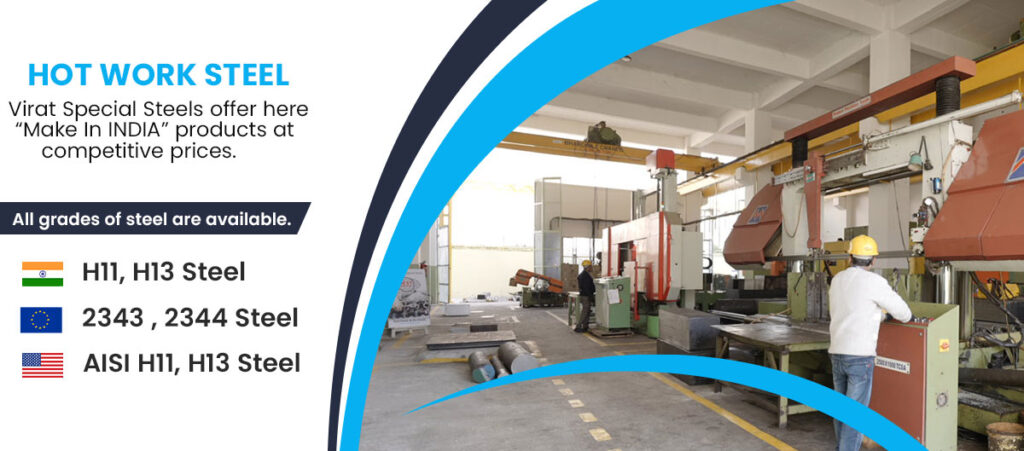
- H13 Steels: DIN 1.2344 (H13) is a hot work tool steel that has excellent machinability and polishability, good high toughness and plasticity, high wear resistance at high and low temperatures and overall hardening performance. It is widely used for aluminum, magnesium and zinc die casting, as well as metal extrusion tools, shear knives, and hot forging dies.
- H11 Steels: DIN 1.2343 (H11) is also a hot work tool steel that has similar properties to DIN 1.2344 (H13), but with less vanadium content, which gives it higher toughness and lower wear resistance. It is suitable for die casting molds for light metal processing, cylinders and pistons on cold chamber machines, and hot forming tools.
- H21 Steels: DIN 1.2581 (H21) is a tungsten-chrome-vanadium steel for hardening in oil and possibly in air with very good hardenability, very high firmness during the heat and resistance to the tempering, high resistance to the hot tempering and good toughness. It is mainly used for hot-working dies and tooling, such as extrusion, die casting and hot-forming of parts.
Virat Special Steels is one of the largest importer, exporter and stockist of die blocks, tool steels, die steels, special steels and alloy steels in various grades in India. The company maintains a high level of inventory of special steels from the world’s leading manufacturers and provides technical advice and support to its customers.
Choose VIRAT SPECIAL STEELS for a seamless blend of quality, variety, and reliability in every steel grade.
Learn more :
https://www.viratsteels.com/hot-work-steel.html
https://www.viratsteel.in/materials/hot-work-steel-supplier-in-india/
Industry’s Guide to Selecting the Right Hot Work Tool Steel!
In the dynamic world of manufacturing, selecting the right materials is crucial for success. Hot work tool steels are a critical component in this process, especially for industries that shape metals under high temperatures. These steels are designed to withstand the rigorous conditions of cutting and molding heated metals, making them indispensable for manufacturers.
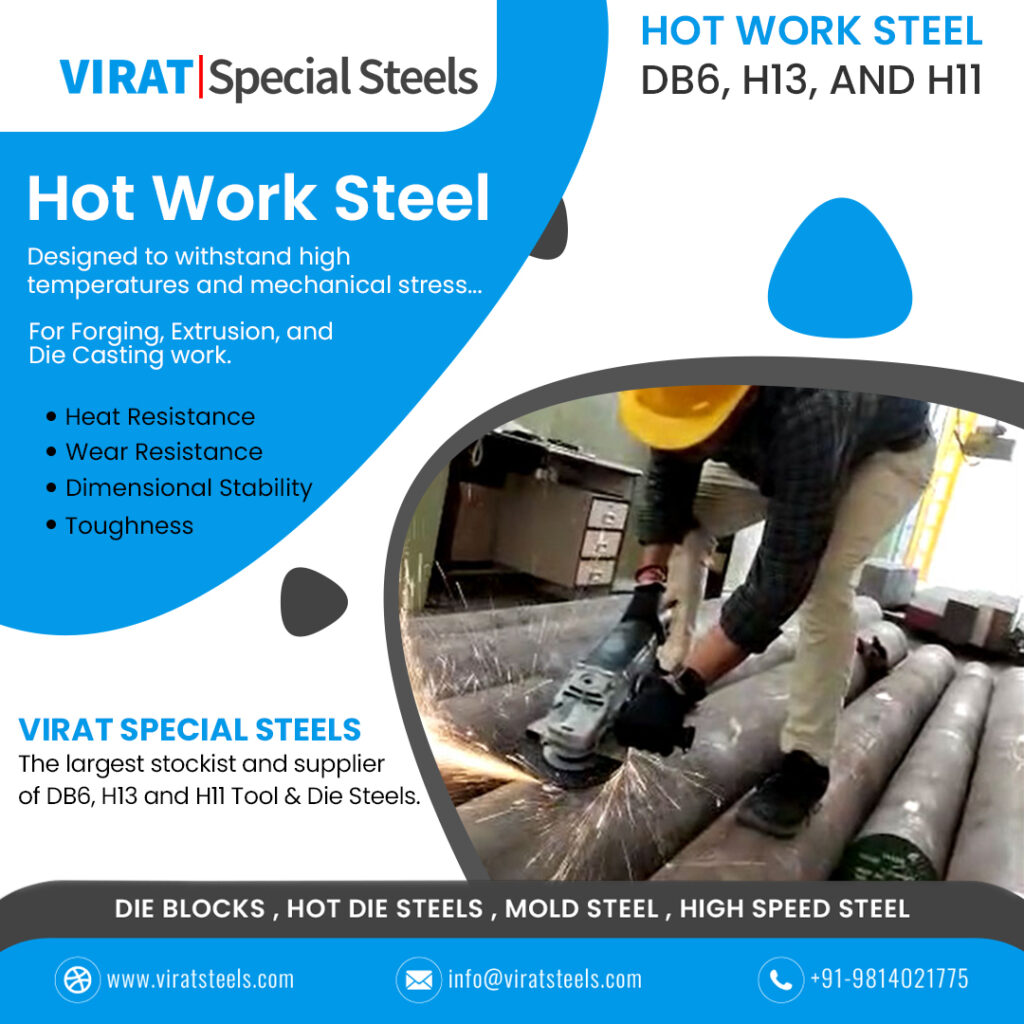
Virat Special Steels stands out as a beacon in the supply of hot work tool steels, such as DB6, H13, and H11. Their extensive inventory and expertise make them a go-to for industries in need of high-quality materials that can endure the heat, beat, and repeat cycle of manufacturing processes.
Understanding the unique properties of hot work tool steels like DB6, H13, H11, and H21 is essential. For instance, H13 is renowned for its exceptional heat resistance, toughness, and wear resistance, making it ideal for die casting dies and extrusion tools. These characteristics are vital for maintaining the integrity of tools and ensuring the consistency of manufactured products.
Virat Special Steels offers these materials in various forms, including flat, square, and round bars, catering to diverse manufacturing needs. Their mode of supply ensures that manufacturers have access to the right type of steel in the required shape, enhancing the efficiency of production lines.
For manufacturers looking to push the boundaries of what’s possible, partnering with knowledgeable suppliers like Virat Special Steels is a step towards achieving superior results. With the right hot work tool steel, the future of manufacturing looks bright, shaped by the principles of heat, beat, and repeat.
For detailed guidance and assistance in selecting the perfect hot work tool steel for your manufacturing needs, consulting with the experts at Virat Special Steels is highly recommended. Their team is equipped to handle queries and provide solutions that propel manufacturing operations to new heights.
Embrace the future of manufacturing with the right materials and expertise, and watch your operations transform with the power of hot work tool steel.
Contact us today to learn more!
https://www.viratsteel.in/materials/hot-work-steel-supplier-in-india/
Any further queries feel free to contact us :
🌐https://www.viratsteels.com 📬 info@viratsteels.com ☎+91 98140-21775