



Die Steels Supplier in India
now browsing by category
NLMK Verona Tool Steel DB6 (DIN 1.2714): Properties, Applications & Supply in India
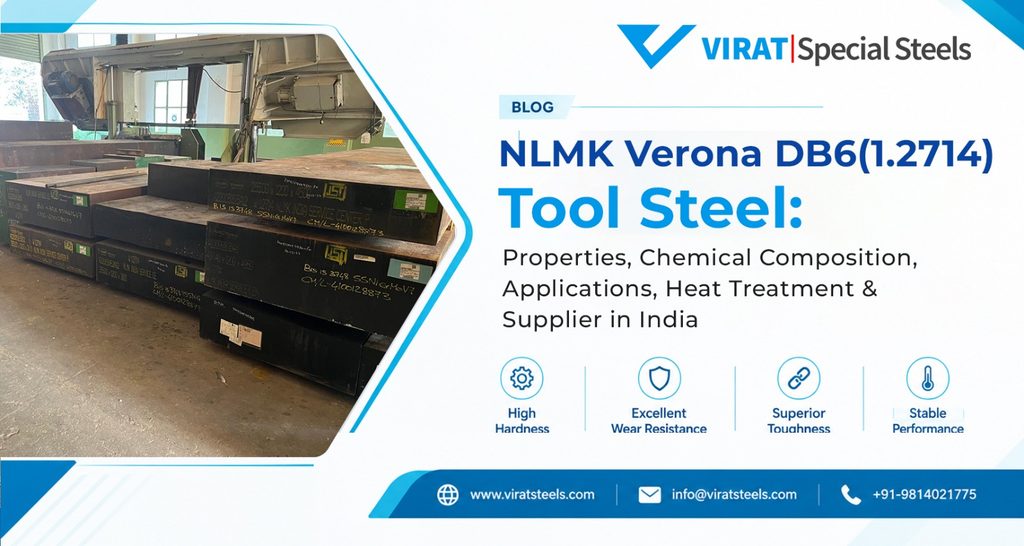
If you own a forging shop, die-making unit or heavy tooling operation, you know that the difference between a die that lasts one production run and one that lasts hundreds comes down to the steel underneath it. NLMK Verona Tool Steel DB6 is one of the European grades that is increasingly being specified by Indian manufacturers for close die forging, hammer dies and heavy-impact tooling – and with good reason.
This guide will explain what NLMK Verona DB6 really is, its real composition and mechanical properties, how it machines and heat-treats, where it is used and how to decide if it is the right grade for your application – all from verified technical data.
What Is NLMK Verona Tool Steel DB6?
NLMK Verona Tool Steel DB6 is a specialty tool steel plant of the NLMK Group, located in the north of Italy, close to Verona. The plant produces forged blocks, plates, and ingots for tool and die applications, and currently supplies its hot-work die steel to the Indian market under the DB6 designation — the specific grade Virat Steels stocks and distributes from this mill.
DB6 is not a proprietary or obscure code. It corresponds to well-established international standards:
| Designation | Standard |
| DB6 | Commercial/trade name |
| DIN 1.2714 | German (Werkstoff) standard |
| AISI L6 | American standard |
| AFNOR 55NCDVV7 | French standard |
| Standard family | 55NiCrMoV (Cr-Ni-Mo-V alloyed hot-work steel) |
To summarize, a buyer searching for “NLMK Verona DB6”, “db6 nmlk verona” or “nmlk verona die steel” is looking for this specific chromium-nickel-molybdenum-vanadium alloyed hot-work die steel, a popular grade in the European and Indian tooling supply chains, now available from NLMK Verona’s Italian production.
Chemical Composition of NLMK Verona Tool Steel DB6 / DIN 1.2714
DB6 is a Cr-Ni-Mo-V alloy system which provides a balance of toughness and hardness:
| Element | C | Si | Mn | P | S | Cr | Ni | Mo | V |
| % Range | 0.50–0.60 | 0.10–0.40 | 0.65–0.95 | ≤0.03 | ≤0.03 | 1.00–1.20 | 1.50–1.80 | 0.45–0.55 | 0.07–0.12 |
DB6 has high toughness and impact resistance (compared to more common hot-work grades such as H13) and high nickel content (compared to more common hot-work grades such as H13) for exceptional toughness and impact resistance rather than pure high-temperature hardness retention.
Mechanical Properties
| Property | Value |
| Tensile Strength | 1000–1400 MPa |
| Yield Strength | 1045 MPa |
| Elongation | 15%–20% |
| Impact Toughness | 20–25 J/cm² |
| Hardness (working) | 50–55 HRC |
| Compressive Strength | 2500 MPa |
| Modulus of Elasticity | 205 GPa |
Typical supply hardness ranges (depending on treatment condition):
- Annealed condition: 255 BHN max
- Hardened & tempered: 38–42 HRC (die-ready condition), with tools further hardened up to 50–55 HRC for service
- Hardness variation, surface to core: 20–25 BHN
Physical Properties
| Coefficient of Thermal Expansion (10⁻⁶ m/m·K) | 20–100°C | 20–200°C | 20–300°C | 20–400°C | 20–500°C | 20–600°C |
| Value | 12.1 | 13.1 | 13.2 | 13.5 | 14.1 | 14.3 |
| Thermal Conductivity (W/m·K) | 20°C | 350°C | 700°C |
| Value | 35.0 | 39.0 | 36.0 |
Note: Exact physical values can vary slightly with heat treatment and section size — always cross-check against the mill test certificate for critical applications.
Machinability of NLMK Verona DB6
DB6 is easy to work and the machinability can be rated at about 90 % relative to W-group water-hardening low-alloy steels taken as the 100 % reference. This makes it much easier to machine than many high-alloy cold-work or high-speed steel grades, and still retains the toughness needed for heavy forging dies.
Practical machining notes:
- Best machined in the annealed condition (≤255 BHN) before final hardening
- Finish machining should ideally be completed before final hardening and tempering, with only grinding/polishing done after
- Stress-relief before hardening reduces distortion risk in large die blocks
Heat Treatment Guide
| Process | Parameters |
| Annealing | Soak at 740–760°C, furnace-cool at max 10°C/hr down to 600°C, then air cool |
| Hardening | Preheat to 650°C, raise quickly to 900–950°C, quench in oil |
| Hardening (mill data) | 840–880°C oil quench → 57 HRC; 860–900°C air quench → 55 HRC |
| Tempering | Multiple tempers; hardness drops from ~56 HRC (100°C temper) to ~34 HRC (650°C temper) |
| Stress Relieving | Heat to 600–650°C, soak 2 hrs per 25mm section, slow cool |
| Forging | Warm to 700°C, raise to 1050°C, keep forging above 800°C, cool slowly in furnace/vermiculite |
| Nitriding | Possible after hardening + tempering; done ~50°C above nitriding temperature |
| Normalizing | Not recommended — DB6 is air-hardening |
Applications of NLMK Verona DB6 Tool Steel
DB6’s high toughness and impact resistance make it especially suited to heavy-impact forging applications rather than pure high-temperature die casting:
- Dies for drop forging hammers & mechanical presses
- Die holders, cassettes, and shoe blocks
- Hot shear blades
- Piston rods, cranks, and boosters
- Punches and blanking/forming dies
- Trimmer dies
- Clutch parts, pawls, shafts, knuckle pins
- Forming rolls, spindles, and rollers
Industries: Automotive component manufacturing, heavy forging, aerospace tooling, general engineering, and metalworking.
Advantages of NLMK Verona DB6 Tool Steel
- Superior toughness and impact resistance compared to many hot-work alternatives — ideal where shock loading, not just heat, is the main stress
- Good hardenability through thick sections, suited to large forging die blocks
- European mill origin (NLMK Verona, Italy) with documented alloy composition
- Good machinability (~90% relative rating) compared to many alloy tool steels
- Nitriding-compatible for surface wear resistance without sacrificing core toughness
- Supplied by Virat Steels with extra forging reduction, upsetting, and double tempering for improved ultrasonic quality in die blocks
DB6 vs H13 vs D2 — Comparison Table
| Factor | DB6 (DIN 1.2714) | H13 (DIN 1.2344) | D2 (Cold Work) |
| Category | Hot-work, high-toughness | Hot-work, high-temp hardness | Cold-work, high wear resistance |
| Key strength | Toughness & impact resistance | Thermal fatigue resistance | Abrasion/wear resistance |
| Typical hardness | 50–55 HRC | ~50 HRC | 58–62 HRC |
| Best suited to | Hammer/press forging dies, shock loading | Die casting, extrusion dies | Blanking, punching, cold forming |
| Machinability | Good (~90% rating) | Good | Moderate (high alloy content) |
| Nickel content | High (1.5–1.8%) | None | None |
How to Choose Between NLMK Verona Tool Steel DB6 (and Other Grades)?
- Is your tooling exposed to repeated impact/shock loading? DB6 is specifically strong here — hammer forging and heavy press dies benefit most from its toughness.
- Is your process purely high-temperature (die casting, hot extrusion) with less shock? H13 (DIN 1.2344) may be a better fit than DB6 due to superior thermal fatigue resistance.
- What supply condition do you need? DB6 is available annealed or hardened & tempered — confirm this at order stage based on your in-house heat treatment capability.
- What section size does your die need? Large forged blocks require good through-thickness hardenability — DB6’s alloy design supports this.
- Do you need surface hardening? DB6 can be nitrided after hardening/tempering for improved wear resistance while keeping core toughness.
- Do you need ultrasonic-tested quality die blocks? Ask specifically for extra forging reduction and double-tempered blocks — Virat Steels supplies DB6 this way for critical forging applications.
Why Source NLMK Verona DB6 Through Virat Steels?
- NLMK Verona origin DB6/DIN 1.2714 Steel – Official stockist and supplier
- PAN-India supply network covering major forging & auto hubs (Ahmedabad, Pune, Chennai, Bengaluru, Delhi NCR, Ludhiana etc.)
- Flat, square, and round bar available in project-based quantities
- Extra forging reduction and double tempering for improved ultrasonic quality on die blocks
- Technical support to confirm the right grade — DB6 vs H13 vs other die steels — for your specific application
Frequently Asked Questions
1. What is NLMK Verona Tool Steel DB6?
It is a Cr-Ni-Mo-V alloyed hot-work die steel (DIN 1.2714 / AISI L6) produced by NLMK Verona, Italy and supplied in India by Virat Steels.
2. What is DB6 steel equivalent to?
DB6 is commonly equivalent to DIN 1.2714, AISI L6, and AFNOR 55NCDVV7.
3. What is the hardness of DB6 steel?
Working hardness is typically 50–55 HRC after hardening and tempering; annealed condition is supplied at 255 BHN max.
4. Is DB6 better than H13 steel?
DB6 provides higher toughness and impact resistance, hence better suited for heavy forging, whereas H13 is more suitable for high temperature hot-work processes such as die casting.
5. Which steel is better for hammer forging dies?
DB6 is generally preferred for hammer forging dies due to its superior toughness and shock resistance.
6. What is the chemical composition of DB6?
Approximately 0.50–0.60% C, 1.00–1.20% Cr, 1.50–1.80% Ni, 0.45–0.55% Mo, and 0.07–0.12% V.
7. Can DB6 steel be welded or re-hardened?
Yes, but it must be done carefully — with stress tempering for pre-hardened condition — to avoid cracking.
8. Is DB6 steel suitable for hot work applications?
Yes, DB6 performs well in hot-work applications due to its strength and toughness at elevated stress conditions.
9. What is the machinability of DB6 steel?
DB6 rates roughly 90% machinability relative to W-group water-hardening steels (100% baseline) — considered good.
10. Should DB6 be normalized?
No — DB6 is air-hardening and should not be normalized.
11. Can DB6 be nitrided?
Yes, after hardening and tempering, at approximately 50°C above the intended nitriding temperature.
12. What shapes is NLMK Verona DB6 available in?
Flat, square, and round bar, supplied by Virat Steels across India.
13. Does Virat Steels supply NLMK Verona DB6 in India?
Yes, Virat Steels is a stockist and supplier of NLMK Verona-origin DB6/DIN 1.2714 tool steel.
14. What industries use DB6 tool steel?
Automotive components, heavy forging, aerospace tooling and general engineering.
15. What is the forging temperature range for DB6?
Heat to 700°C and then raise rapidly to 1050°C. Keep forging temperature above 800°C.
16. What’s the distinction between DB6 and DIN 2713?
The DIN 2713 is improved for better die performance and is called DIN 2714 (DB6).
17. What tensile and yield strength does DB6 offer?
Tensile strength 1000–1400 MPa, yield strength ~1045 MPa.
18. Does DB6 require oil or air quenching?
Both are used. Oil quenching at 840-880 °C gives ~57 HRC. Air quenching at 860-900 °C gives ~55 HRC.
19. What documentation should I request when ordering NLMK Verona DB6?
Always request a mill test certificate (MTC) confirming the heat/batch chemical composition and mechanical test results.
20. Where can I buy NLMK Verona DB6 tool steel in India?
Virat Steels supplies and stocks NLMK Verona DB6/DIN 1.2714 steel PAN-India, including to Gurugram, Delhi NCR, Pune, Chennai, and other major industrial hubs.
Conclusion
NLMK Verona Tool Steel DB6 (DIN 1.2714 / AISI L6) is the best solution for one simple reason: toughness where it counts – in heavy forging dies subject to repeated shock loading. Its Cr-Ni-Mo-V alloy design, excellent machinability and good hardenability make it a preferred choice for forging shops and die makers across India.
Need NLMK Verona DB6 die blocks, flats, squares, or round bars for your next forging project? Get in touch with Virat Steels — share your drawing and section size requirement, and our team will confirm grade, stock availability, and delivery timelines.
+91-98140 21775 | info@viratsteels.com
D2 vs D3 Material: Composition, Hardness, Properties & Selection Guide
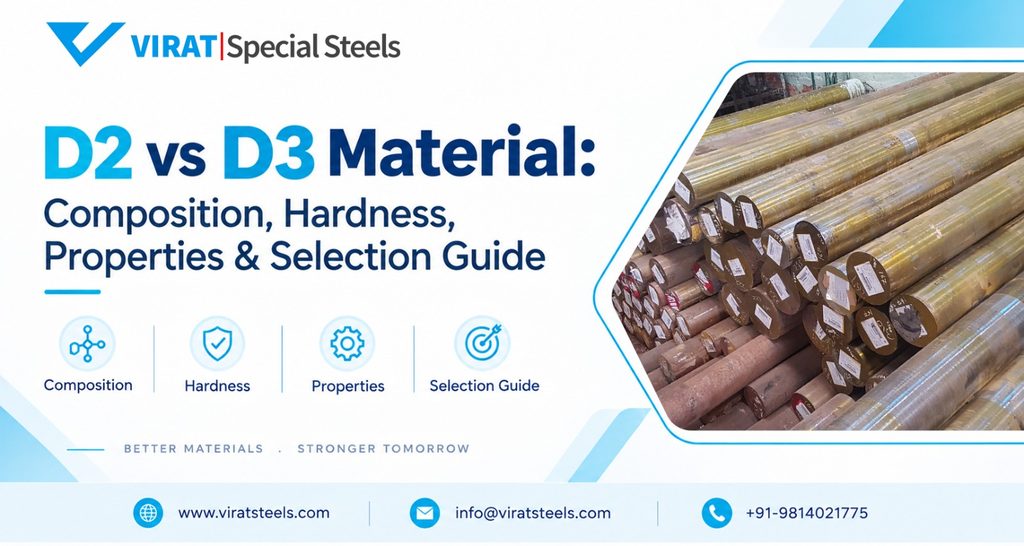
If you manufacture dies, punches, molds or precision tooling, you may need to choose between D2 vs D3 material. Both are high-carbon, high-chromium cold-work tool steels, but their chemical composition, carbide structure, heat-treatment response, toughness, machinability and wear resistance differ.
D2 material contains molybdenum and vanadium and provides a good balance of wear resistance, toughness and dimensional stability. D3 material has higher carbon and carbide content and is generally considered for applications where high abrasion resistance is required and impact loading is relatively low.
In this guide, we compare D2 vs D3 material in terms of chemical composition, hardness, properties, machinability, applications, cost considerations and grade equivalents to help you understand the factors involved in selecting between the two grades.
What Is D2 Material?
D2 material is a type of air-hardening cold work tool steel that has a high carbon content and high chromium content. It is used in making die and punch tools. It has good dimensional stability in heat treatment and excellent wear resistance. It is sometimes called a “semi-stainless” steel because of its relatively high chromium content.
D2 Steel is popular in many industries, from metal stamping and forming to knife making. It offers a good balance of hardness, edge retention and reasonable toughness.
D2 Chemical Composition
Based on Virat Steels’ own AISI D2 technical data, the typical D2 steel chemical composition is:
| Element | Typical % (D2 material composition) |
| Carbon (C) | 1.40 – 1.60% |
| Chromium (Cr) | 11.00 – 13.00% |
| Molybdenum (Mo) | 0.70 – 1.20% |
| Vanadium (V) | 0.50 – 1.10% |
| Manganese (Mn) | 0.10 – 0.60% |
| Silicon (Si) | 0.10 – 0.60% |
| Iron (Fe) | Balance |
D2 has high carbon and chromium content, which results in large volumes of hard carbides being formed, contributing to its excellent abrasion resistance. Vanadium refines the primary grain structure and forms strong carbides which increase wear resistance, edge holding and high temperature strength. Molybdenum increases the hardenability in conjunction with other alloying elements. This Mo + V combo is the big metallurgy difference from D3, and why D2 generally holds a sharper edge longer.
D2 Material Hardness in HRC
This is one of the most searched questions about the grade, so let’s separate the two conditions clearly:
- D2 material hardness in HRC before heat treatment (annealed/as-supplied condition): D2 comes in a soft condition for ease of machining. D2 in the annealed condition is normally 217-255 HB (Brinell) – which is approximately equivalent to low to mid 20’s on the HRC scale, but Brinell is the standard way this soft condition is actually measured and reported.
- D2 hardness after heat treatment (hardened & tempered): D2 hardness after hardening is 58-62 HRC with a tensile strength of approximately 1,900 MPa and a compressive strength of more than 2,700 MPa. Some suppliers quote a maximum hardness closer to 62 HRC.
Thus, if one asks for “d2 hrc” or “d2 hardness in hrc” without mentioning the state of the material, then the correct response would be that “it depends on whether you are referring to the ‘as supplied’ state (which is soft and machinable) or ‘post heat treatment’ state (which is hard).”
D2 Properties & Applications
D2 grade steel is known for:
- High abrasion and wear resistance
- Good dimensional stability during hardening (it’s air-hardening, so distortion is minimal).
- Mo/V carbides offer good edge retention
- Semi-stainless behavior in dry environment (mild corrosion resistance)
- Toughness is relatively lower than shock-resisting grades such as S7
Typical applications:blanking and piercing dies, forming dies, thread rolling dies, punches, shear blades, slitter knives, cold extrusion tooling and wear-critical mold components such as guide pins, wear plates and cavity inserts where abrasion – not impact – is the dominant failure mode.
What Is D3 Material?
D3 grade material (AISI/ASTM D3) is another form of high-carbon and high-chromium cold-work tool steel, but it has completely distinct characteristics when it comes to its quenching process. One of the differences of D3 material from other D-series steels lies in the fact that it does not contain 1% of molybdenum. D3 is oil-quenched instead of air-hardened, but small sections can be vacuum/gas-quenched. This oil-hardening route makes tools made from D3 more susceptible to brittleness during the hardening. Internationally, D3 is equivalent to DIN/Werkstoff 1.2080 (X210Cr12) – also known as SKD1 in Japan and Cr12 in China.
D3 Chemical Composition
| Element | Typical % (D3 material composition) |
| Carbon (C) | ~1.90 – 2.20%* |
| Chromium (Cr) | ~11.00 – 13.50%* |
| Manganese (Mn) | ≤ 0.60% |
| Silicon (Si) | ≤ 0.60% |
| Molybdenum / Vanadium | Not a defining addition (unlike D2) |
| Iron (Fe) | Balance |
D3 has a higher carbon content and about the same chromium content as D2, but without the Mo/V additions . This results in a larger volume of primary chromium carbides . That’s the main reason, D3 usually beats D2 on raw abrasion resistance at the expense of toughness.
D3 Material Hardness in HRC
D3 can be heat treated to 58-64 HRC hardness. This is supported by many independent technical data sources for the grade. Like D2, the material hardness of D3 in HRC is highly dependent on the tempering temperature chosen and the section thickness being hardened — for a given tool, verify the target hardness with your heat treatment partner before nailing down the process route.
In the annealed/as supplied condition D3 is also kept soft for machining, generally in line with the rest of the D-series family, but exact annealed hardness should be verified on the supplier’s certificate rather than assumed.
D3 Properties & Applications
- Superior wear and abrasion resistance – Usually rated better than D2 because of increased carbide volume
- Excellent dimensional stability in heat treatment, size retention almost as good as air hardening types such as D2
- High compression strength
- It is less tough than D2 and more prone to chip when subjected to shock or impact loading
- Due to its abrasion resistance, machining should generally be restricted to finish grinding after hardening
Typical applications: forming rolls, drawing dies, powder compaction tooling and lamination dies as well as blanking dies, punches, shear blades, gages and thread rolling dies. Basically high volume, low shock, high abrasion tooling.
D2 vs D3 Material: Key Differences
| Parameter | D2 Material | D3 Material |
| Standard / Equivalent | AISI D2, DIN 1.2379 | AISI D3, DIN 1.2080 |
| Hardening method | Air-hardening | Oil-hardening (air/vacuum for small sections) |
| Carbon content | 1.40–1.60% | ~1.90–2.20%* |
| Chromium content | 11.00–13.00% | ~11.00–13.50%* |
| Mo / V alloying | Present (0.7–1.2% Mo, 0.5–1.1% V) | Not a defining addition |
| Annealed hardness | ~217–255 HB | Similar soft range (verify per MTC) |
| Hardened hardness | 58–62 HRC | 58–64 HRC |
| Wear resistance | Very good | Excellent (typically higher than D2) |
| Toughness | Better of the two | Lower — more brittle |
| Dimensional stability | Excellent | Good, slightly more distortion risk |
| Machinability | Low | Lower than D2 |
| Corrosion resistance | Mild (semi-stainless behaviour) | Similar chromium level, comparable behaviour |
| Best suited for | Long-run dies, punches, wear parts needing edge retention | High-abrasion, low-impact forming/drawing tooling |
| Relative cost | Generally carries an alloy premium (Mo + V) | Often positioned as the more economical D-series option |
*See composition notes above — verify exact figures with your supplier’s mill certificate.
Machinability: D2 vs D3
Both grades have their reputation as “difficult but worth it” in machinability. D2 has a machinability of about 27% of AISI 1112 steel. This is poor compared to general engineering steels, but typical for high performance tool steels of this class.
D3 is generally considered more difficult to machine than D2, because of its higher carbon content and greater volume of carbides. In practice many fabricators machine D3 in the annealed condition and then rely mainly on grinding to bring it to the hardened state, rather than attempting conventional cutting once the hardness is achieved.
Practical takeaway: D2 is the more forgiving option if you have a lot of machining to do after heat treat. If the bulk of the shaping is done before hardening (with finish grinding done after), the lower machinability of D3 is less of a concern.
Which Industries Use D2 and D3?
The two grades cater to different, though similar, parts of the tool and die market segment:
- Tool & die manufacturing: Blanker, piercer and former dies ( grades D2 and D3)
- Mould manufacturing / injection moulding: Wear plates, guide pins, ejector parts and mold cavities exposed to abrasive plastic or filler material (grade D2 where toughness and machinability are important in addition to wear resistance)
- Metal stamping & press tooling: Long run punches and dies (grade D2 for edge wear; grade D3 for abrasion resistance only)
- Wire and thread rolling: thread rolling dies (both grades)
- Sheet metal forming: forming rolls and drawing dies (D3’s strength)
- Powder metallurgy & compaction tooling: compaction dies (D3)
D2 vs D3: Price Considerations
Pricing is specific to section size, quantity, prevailing raw material and alloy surcharge rates, and finishing requirements (rolled, forged, ground, ESR, etc.). We will not give a fixed figure here as this would quickly become outdated and is order dependent.
For example, in general terms: The inclusion of molybdenum and vanadium in D2 usually makes it a slightly more expensive alloy choice than the D3 alloy, which mostly uses carbon and chromium for its composition. For that reason, the D3 alloy can be marketed as the relatively cheaper high-chromium cold work alloy, while D2 comes at a higher cost due to its superior toughness and machinability properties. A quotation request can be made from the manufacturer regarding your required quantity.
How to Choose Between D2 vs D3 Material?
Use these questions to guide the decision:
- Is toughness or pure wear resistance more critical? If your tool sees any shock loading, impact, or lateral force, lean toward D2 (or reconsider A2/S7 for high-shock jobs). If it’s a steady, high-volume abrasive wear situation with minimal impact, D3’s extra hardness pays off.
- How much post-hardening machining is required? If your design needs precision machining after heat treatment, D2’s better machinability makes it the safer choice.
- What’s your quenching setup? D2’s air-hardening gives more forgiving dimensional control for complex geometries; D3’s oil-hardening needs more careful process control, especially on larger sections.
- What’s the production volume and expected tool life target? For very long die life with less concern about impact, D3’s superior abrasion resistance can extend service intervals.
- What’s the budget? If cost-per-kg is a tight constraint and the application doesn’t demand D2’s toughness, D3 is usually the more economical route.
- Does the component need any corrosion resistance in service? Both offer mild, comparable resistance — neither is a substitute for stainless grades in wet/corrosive environments.
If you’re unsure after weighing these factors, share your drawing and application details with Virat Steels’ technical team — grade selection is easier with a specific load case in front of you rather than generic comparisons.
FAQs: D2 vs D3 Material
- What is the difference between D2 and D3 material? D2 and D3 differ in composition and hardening method: D2 contains added molybdenum and vanadium and is air-hardened, while D3 has higher carbon content, no defining Mo/V addition, and is oil-hardened.
- What is D2 material? D2 Steel is an air hardening tool steel that consists of high carbon and chromium content (AISI D2 / DIN 1.2379).
- What is D2 material’s chemical composition? composition is 1.40–1.60% carbon, 11.00–13.00% chromium, 0.70–1.20% molybdenum, 0.50–1.10% vanadium, plus manganese and silicon in the 0.10–0.60% range.
- What is D2 material hardness in HRC? The D2 material usually attains 58-62 HRC after heat treatment. When it is annealed (or before heat treatment), it is provided in the softer form, which is around 217-255 HB.
- What is D2 material hardness in HRC before heat treatment? D2 material is provided in the soft or annealed state before heat treatment, and hence it is not provided in HRC but is provided in Brinell hardness scale (i.e., roughly 217-255 HB).
- What is D3 material’s hardness in HRC? The hardness of the D3 material in HRC ranges from 58-64 HRC after heat treatment.
- Is D2 or D3 harder? D3 has a slightly higher maximum hardness, up to about 64 HRC, compared to D2’s maximum of around 62 HRC, due to its higher carbon content and carbide volume.
- Which is tougher, D2 or D3? D2 is tougher due to fine, balanced carbide formation, while D3’s higher carbon content makes it less tough.
- Can D2 and D3 be used interchangeably? No. Although D2 and D3 have similar properties, there are differences that make D3 inadequate in certain applications where D2 works fine and vice versa.
- Which is better for injection moulds — D2 or D3? D2 can be used for wear-resistant mould components such as guide parts, wear plates and selected inserts, where good wear resistance, dimensional stability and machinability are required. D3 is generally more suitable for applications where very high abrasion resistance is the primary requirement and impact loading is low. The appropriate grade depends on the mould material, filler content, loading conditions, required hardness and manufacturing process. .
- What is D2 material grade used for? D2 grade is suitable for blanking and piercing dies, forming dies, thread rolling dies, punches, shear blades, and wear-related mold inserts..
- Is D2 a stainless steel? No, it is not stainless steel as it contains sufficient chromium content to resist corrosion in dry environments (also known as “semi-stainless”).
- Why is D3 harder to machine than D2? The carbon content in D3 is higher, and the volume of primary chromium carbides in D3 is higher than that of D2, making it more abrasive but at the same time leading to faster wear of the cutting tools during machining.
- What is the price difference between D2 and D3? The price of D2 is slightly higher than that of D3 since D2 contains molybdenum and vanadium. However, the actual price is dependent on the section size, volume and market prices.
- What are the DIN/international equivalents of D2 and D3? D2 is equivalent to DIN/Werkstoff 1.2379 (X153CrMoV12). D3 is equivalent to DIN/Werkstoff 1.2080 (X210Cr12), known as SKD1 (Japan) and Cr12 (China).
Conclusion
While both D2 and D3 have been confirmed as having high carbon and high chromium content cold work tool steel, it does not mean that they are one and the same only branded differently. The addition of molybdenum and vanadium in D2 makes it tougher and easier to machine, hence it is better used in dies, punches, and die elements. The increased carbon in D3 increases its wear resistance and hardness; however, it reduces toughness.
The right grade depends on your specific load conditions, production volume, and machining process — not a generic “which is better” answer.
Need help selecting between D2 and D3 for your next tooling project? Virat Steels supplies both grades with full mill test certification and technical support to match the right steel to your application. Get in touch with our team for a quote or a grade recommendation based on your drawing.
Our technical team will confirm grade equivalence, available sizes and delivery timeline within 24 hours.
Prefer to talk directly?
Gurugram, Haryana | Ludhiana, PunjabPhone: +91-98140-21775
Email: info@viratsteels.com
European Tool Steel vs Indian Tool Steel: A Quality Comparison for Industrial Applications
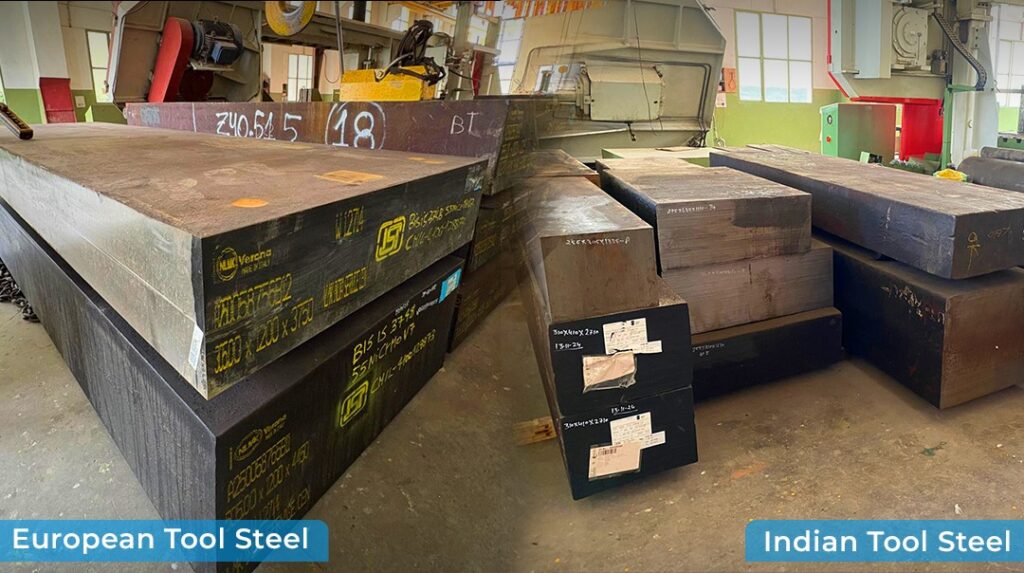
Tool steel isn’t just another material. It’s the foundation of modern manufacturing. From forging and die-making to automotive parts and heavy engineering, tool steel is everywhere. Every hammer strike, every die cut, every moulded part relies on its strength.
But what really defines good tool steel?
- Durability – how long it lasts under pressure
- Productivity – how much it improves output
- Cost impact – how it affects overall manufacturing expenses
That’s why industrial buyers don’t just buy they compare.
Henceone of the hottest discussions in the market today is:
- European tool steel – known for performance under extreme conditions
- Indian tool steel – often praised for balancing durability with cost efficiency
Which one is better? The answer isn’t always obvious. Each has strengths, and the choice depends on what industries value most—maximum reliability or cost-effective scale.
Thus, understanding the differences between these two sources European tool steel & Indian tool steel helps manufacturers choose the right tool steel for durability, cost efficiency, and reliable performance.
4 major Factors Determines Tool & Die Steel Quality?
The most essential factors together measure how effectively tool steel performs in applications like forging dies, cutting tools, and industrial moulds etc are:
1-Chemical Composition
Tool steel contains alloying elements such as chromium, molybdenum, vanadium, and nickel. The correct balance of these elements determines hardness, toughness, and wear resistance.
2-Metallurgical Structure
Uniform grain structure and low levels of impurities improve strength and reduce the risk of cracking during heavy industrial use.
3-Heat Treatment Capability
Proper hardening and tempering processes ensure the steel achieves the required mechanical properties.
4-Quality Testing and Certification
Inspection methods such as ultrasonic testing help ensure the steel is free from internal defects.
European Tool Steel Manufacturing Standards
European tool steel is produced under strict industrial standards established by organizations such as DIN and European Committee for Standardization. These standards define the chemical composition, mechanical properties, and testing requirements for various tool steel grades.
European steel manufacturers typically focus on:
- Precise alloy composition control
- Advanced refining technologies
- High internal cleanliness of steel
- Consistent mechanical properties
Many widely used tool steel grades originate from European standards, including:
- DIN 1.2344
- DIN 1.2714
- DIN 2379
These steels are commonly used in forging dies, die casting tools, and high-performance industrial tooling.
Development of Indian Tool Steel Manufacturing
India has become one of the leading steel-producing countries in the world. Today, many Indian steel plants use advanced technologies including:
- Electric arc furnaces
- Vacuum degassing
- Continuous casting
- Rolling and forging processes
These technologies help produce high-quality alloy steels and tool steels suitable for industrial applications. Hence, Indian tool steel quality has improved a lot in recent years.
Main Differences Between European and Indian Tool Steel
1-Manufacturing Consistency
European tool steel is recognized for its high level of consistency due to strict production standards and long experience in tool steel metallurgy whereas Indian tool steel also delivers good performance, but the level of consistency may vary depending on the manufacturer and production facility.
2-Metallurgical Cleanliness
European mills generally focus on internal steel cleanliness, which is especially important for tool steels used in forging dies.
Modern Indian steel plants have improved significantly in this area, though buyers should ensure they source from reputable producers or suppliers.
3-Availability of Tool Steel Grades
European mills offer a wide range of specialized tool steel grades developed for specific applications.
and many European grades are now stocked and supplied locally by distributors like Virat Special Steels, allowing manufacturers to access them without importing directly.
4-Cost Considerations
Cost is another important factor when comparing European and Indian tool steel.
European tool steel often comes with a premium price due to its advanced production processes with the costs of international transportation. On the other hand, Indian tool steel positions itself as a cost-competitive contender, offering a practical solution for industries that need performance without stretching budgets.
Which Should You Choose the right supplier?
Whether steel comes from Europe or India, one factor matters most that is –supplier reliability. Consistent quality depends on working with a trusted partner.
A supplier like Virat Steels ensures:
- Verified mill test certificates
- Proper material traceability
- Ready stock across tool steel grades
- Expert technical guidance
For manufacturers, the best choice depends on application requirements, budget considerations, and supplier trust.
European and Indian steel both shine in unique ways—Europe for innovation and sustainability, India for affordability and scale. Assess your project’s requirements to strike the perfect balance.
Frequently Asked Questions (FAQs)
1. Is European tool steel better than Indian tool steel?
European tool steel is known for strict manufacturing standards and consistent metallurgy whereas modern Indian tool steels can also deliver reliable performance when sourced from trusted manufacturers.
2. Why do forging industries prefer European tool steel grades?
European grades follow standards such as DIN, ensuring consistent chemical composition and performance in high-temperature forging applications.
3. What are common European tool steel grades used in forging?
Popular European grades include DIN 1.2344, DIN 1.2714, and DIN 2379.
4. Is Indian tool steel suitable for industrial applications?
Yes. With modern steelmaking technology, Indian tool steel is widely used in forging, automotive, and engineering industries.
5. What factors determine tool steel quality?
Tool steel quality depends on chemical composition, metallurgical cleanliness, heat treatment, and quality testing.
6. How can manufacturers ensure good tool steel quality?
Manufacturers should check mill test certificates, inspection reports, and source materials from trusted suppliers like Virat Steels.
Looking for high-quality tool & die steel?
Virat Special Steels has built a reputation as one of India’s most trusted suppliers, known for expertise, premium quality, and unmatched stock capabilities.
From DB6, H13, P20, D2 and more, we supply tool and die steel grades across India. Whether it’s forging, die-making, or automotive tooling, our steels are engineered to deliver reliability and performance.
📞 Curious about the right size or technical specifications for your application? Our team is ready to guide you.
👉 Explore more: www.viratsteels.com | 📧 info@viratsteels.com | 📱 +91 98140-21775
Choosing the Right Tools & Die Steel Supplier in India!
A Closer Look at Virat Special Steels …
VIRAT SPECIAL STEELS PVT. LIMITED , INDIA stands out as a beacon of excellence in the steel industry. With its headquarters nestled in the industrial hubs of Gurgaon, Haryana, and Ludhiana, Punjab, Virat Special Steels has carved a niche for itself as a premier supplier of high-grade steel products.
What sets Virat Special Steels apart is not just its extensive product range, which includes everything from Die Steel to High-Speed Steels, but also its unwavering commitment to quality. By importing Tools & Die Steels from globally renowned manufacturers.
The company’s dedication to excellence is evident in its meticulous sourcing of raw materials from trusted vendors, ensuring that each product, whether it be Flats, Squares, or Bars, is of superior quality. This attention to detail is what makes Virat Special Steels a preferred dealer, wholesaler, and supplier for forging companies spread across various Indian cities.
Virat Special Steels‘ mission goes beyond mere supply; it aims to support and enhance the tool and steel products industry by empowering businesses with high-quality materials that are crucial for their success.
The company’s product list is a testament to its diverse offerings:
- Die Steel (HH 370 – 410 BHN) (DIN-1.2714 / AISI L6)
- Hot Die Steels (DIN 2343, 2344 / AISI H11, H13)
- Plastic Mould Steels (DIN 2738, 2311, AISI P 20)
- High Speed Steels (DIN 3243, 3343 / AISI M2, M35)
- HCHCr (DIN 2379, 2080 / AISI D2, D3)
- Alloy Steels, EN-Series, etc.
For more information or to discuss your steel needs, Virat Special Steels invites you to reach out through their contact details provided, ensuring a professional and informative experience.
Any further queries feel free to contact us :
🌐https://www.viratsteels.com 📬 info@viratsteels.com ☎+91 98140-21775