



DIN 2714 Steel in Forging Industries
now browsing by category
Understanding Tool & Die Steel Hardness and Toughness for Manufacturing
Introduction
In every industry from forging shops to automotive plants, tool & die steels are the silent heroes at work. They shape, cut, and press with relentless precision. But behind every tool lies a choice: the steel it’s made from.
If a tool steel is too hard, it risks cracking under impact. If it’s too tough, it wears down too quickly. The secret to industrial success isn’t choosing one over the other. it’s finding the perfect balance.
The topic is hence clear that neither hardness nor toughness alone could carry the weight of modern industry. Progress demanded a balance that is -hard enough to resist wear & tough enough to withstand impact. With this harmony, dies lasted longer, automotive components are forged with precision, and heavy engineering tools are made without interruption.
That’s why manufacturers don’t just pick any steel grade. They choose carefully, knowing that the right steel is the difference between downtime and success.
What Is Tool & Die Steel Hardness?
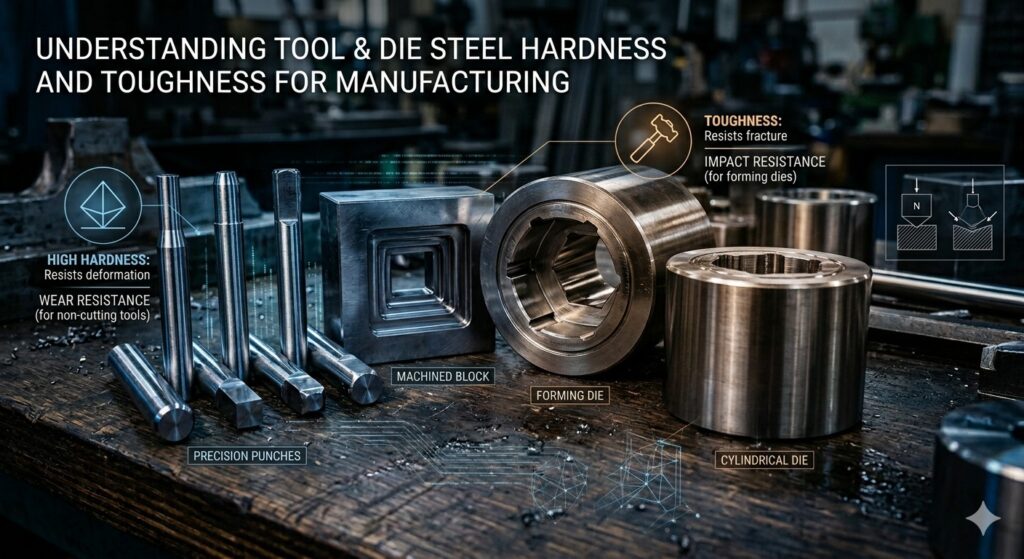
Hardness means the ability of steel to resist surface wear, indentation, or deformation. In industrial tooling applications, higher hardness usually means better resistance to abrasion and longer tool life.
Hardness is typically measured using the Rockwell hardness scale(HRC). Tool steels used in industrial applications often fall within a hardness range of 45 HRC to 62 HRC, depending on the specific grade and application.
Why Hardness Matters ?
Hardness is especially important in applications where tools are exposed to continuous friction and high pressure. Examples include:
- Forging dies
- Cutting tools
- Punches and Molds
- Industrial forming tools
A higher hardness level helps tools maintain their shape and resist wear during repeated manufacturing cycles.
What Is Tool & Die Steel Toughness?
Toughness refers to the ability of steel to absorb impact and resist cracking or breaking under stress. It is particularly important for tooling applications where tools are exposed to heavy mechanical loads or sudden shocks.
In forging operations, dies often experience repeated impact forces. Tool steels with good toughness can withstand these forces without developing cracks or fractures.
Why toughness Matters ?
High toughness is critical in applications such as:
- Hammer forging dies
- Press forging tools
- Heavy-duty industrial dies
- Impact tools
Without adequate toughness, even a very hard steel may fail prematurely.
The Balance Between Hardness and Toughness
One of the biggest challenges in tool steel selection is achieving the right balance between hardness and toughness. Increasing hardness often reduces toughness, while increasing toughness may lower hardness.
Therefore, tool steel manufacturers carefully design steel grades and heat treatment processes to achieve an optimal combination of these properties.
For example:
- Cold work tool steels often emphasize high hardness and wear resistance
- Hot work tool steels are designed with higher toughness to withstand thermal and mechanical stress
Selecting the correct steel grade depends on the specific operating conditions of the tool.
How Heat Treatment Affects Hardness and Toughness
Heat treatment plays a critical role in controlling the mechanical properties of tool steel. Processes such as hardening and tempering help achieve the desired balance of hardness and toughness.
Typical heat treatment stages include:
- Heating the steel to a specific temperature
- Rapid cooling (quenching) to increase hardness
- Tempering to improve toughness and reduce brittleness
Proper heat treatment ensures that tool steel can perform reliably in demanding industrial environments.
Tool Steel Applications Requiring the Right Balance
Different industrial applications require different combinations of hardness and toughness.
1.Forging Dies
Forging dies require high toughness to withstand repeated impact and sufficient hardness to resist wear.
2.Cutting Tools
Cutting tools need very high hardness to maintain sharp edges during machining operations.
3.Plastic Moulds
Mould steels require moderate hardness and good toughness for durability and dimensional stability.
Choosing the right tool steel for each application helps manufacturers reduce tool failures and improve productivity.
Why Tool & Die Steel Quality Matters
Even with the correct hardness and toughness levels, the quality of the steel itself plays an important role. Factors such as metallurgical cleanliness, grain structure, and manufacturing processes influence the final performance of tool steel.
Reliable suppliers such as Virat Special Steels help industries access high-quality tool steel with proper certification and consistent properties.
This ensures better reliability in applications such as forging dies, industrial tooling, and heavy engineering components.
FAQs (Frequent Asked Questions)
1-What is tool & die steel?
Tool & Die Steel is a high-strength, wear-resistant steel specially designed for making tools, dies, and molds used in manufacturing and shaping materials like metal or plastic.
2-What is hardness in tool steel?
Hardness is the ability of tool steel to resist wear, indentation, and deformation during industrial use.
3-Why is toughness important in tool steel?
Toughness allows tool steel to absorb impact and resist cracking under heavy loads.
4-Can tool steel have both high hardness and toughness?
Yes, modern tool steels are designed to balance hardness and toughness through alloy composition and proper heat treatment.
5-What affects the hardness of tool steel?
Hardness is influenced by chemical composition, heat treatment processes, and steel manufacturing quality.
6-Which supplier provides best quality tool & die steels?
Virat Special Steels, a most trusted Indian Supplier provide a wide range of high-performance steel grades for manufacturing industries.
Conclusion
Hardness and toughness are two of the most important properties that determine the performance of tool steel.
By selecting the right tool steel grade and sourcing it from reliable suppliers, manufacturers can significantly improve the performance and durability of their industrial tools.
At VIRAT SPECIAL STEELS, we provide a complete range of premium hot work and cold work tool steels to support every industrial requirement. Whether you are into forging, stamping, cutting, die casting, or extrusion, we deliver the right steel grade with consistent quality and reliable performance. Contact us today.
https://www.viratsteels.com info@viratsteels.com +91 98140-21775
European Tool Steel vs Indian Tool Steel: A Quality Comparison for Industrial Applications
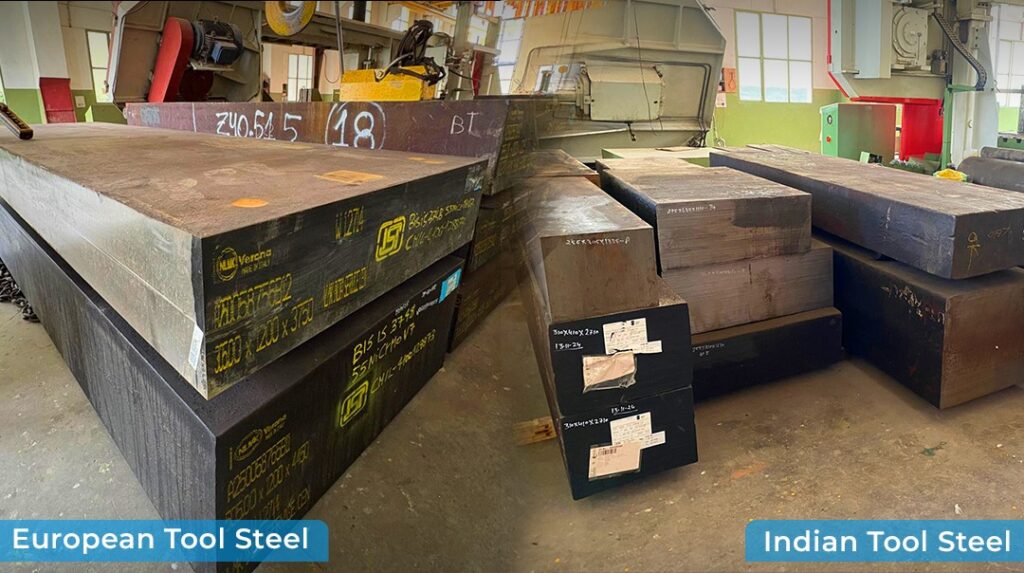
Tool steel isn’t just another material. It’s the foundation of modern manufacturing. From forging and die-making to automotive parts and heavy engineering, tool steel is everywhere. Every hammer strike, every die cut, every moulded part relies on its strength.
But what really defines good tool steel?
- Durability – how long it lasts under pressure
- Productivity – how much it improves output
- Cost impact – how it affects overall manufacturing expenses
That’s why industrial buyers don’t just buy they compare.
Henceone of the hottest discussions in the market today is:
- European tool steel – known for performance under extreme conditions
- Indian tool steel – often praised for balancing durability with cost efficiency
Which one is better? The answer isn’t always obvious. Each has strengths, and the choice depends on what industries value most—maximum reliability or cost-effective scale.
Thus, understanding the differences between these two sources European tool steel & Indian tool steel helps manufacturers choose the right tool steel for durability, cost efficiency, and reliable performance.
4 major Factors Determines Tool & Die Steel Quality?
The most essential factors together measure how effectively tool steel performs in applications like forging dies, cutting tools, and industrial moulds etc are:
1-Chemical Composition
Tool steel contains alloying elements such as chromium, molybdenum, vanadium, and nickel. The correct balance of these elements determines hardness, toughness, and wear resistance.
2-Metallurgical Structure
Uniform grain structure and low levels of impurities improve strength and reduce the risk of cracking during heavy industrial use.
3-Heat Treatment Capability
Proper hardening and tempering processes ensure the steel achieves the required mechanical properties.
4-Quality Testing and Certification
Inspection methods such as ultrasonic testing help ensure the steel is free from internal defects.
European Tool Steel Manufacturing Standards
European tool steel is produced under strict industrial standards established by organizations such as DIN and European Committee for Standardization. These standards define the chemical composition, mechanical properties, and testing requirements for various tool steel grades.
European steel manufacturers typically focus on:
- Precise alloy composition control
- Advanced refining technologies
- High internal cleanliness of steel
- Consistent mechanical properties
Many widely used tool steel grades originate from European standards, including:
- DIN 1.2344
- DIN 1.2714
- DIN 2379
These steels are commonly used in forging dies, die casting tools, and high-performance industrial tooling.
Development of Indian Tool Steel Manufacturing
India has become one of the leading steel-producing countries in the world. Today, many Indian steel plants use advanced technologies including:
- Electric arc furnaces
- Vacuum degassing
- Continuous casting
- Rolling and forging processes
These technologies help produce high-quality alloy steels and tool steels suitable for industrial applications. Hence, Indian tool steel quality has improved a lot in recent years.
Main Differences Between European and Indian Tool Steel
1-Manufacturing Consistency
European tool steel is recognized for its high level of consistency due to strict production standards and long experience in tool steel metallurgy whereas Indian tool steel also delivers good performance, but the level of consistency may vary depending on the manufacturer and production facility.
2-Metallurgical Cleanliness
European mills generally focus on internal steel cleanliness, which is especially important for tool steels used in forging dies.
Modern Indian steel plants have improved significantly in this area, though buyers should ensure they source from reputable producers or suppliers.
3-Availability of Tool Steel Grades
European mills offer a wide range of specialized tool steel grades developed for specific applications.
and many European grades are now stocked and supplied locally by distributors like Virat Special Steels, allowing manufacturers to access them without importing directly.
4-Cost Considerations
Cost is another important factor when comparing European and Indian tool steel.
European tool steel often comes with a premium price due to its advanced production processes with the costs of international transportation. On the other hand, Indian tool steel positions itself as a cost-competitive contender, offering a practical solution for industries that need performance without stretching budgets.
Which Should You Choose the right supplier?
Whether steel comes from Europe or India, one factor matters most that is –supplier reliability. Consistent quality depends on working with a trusted partner.
A supplier like Virat Steels ensures:
- Verified mill test certificates
- Proper material traceability
- Ready stock across tool steel grades
- Expert technical guidance
For manufacturers, the best choice depends on application requirements, budget considerations, and supplier trust.
European and Indian steel both shine in unique ways—Europe for innovation and sustainability, India for affordability and scale. Assess your project’s requirements to strike the perfect balance.
Frequently Asked Questions (FAQs)
1. Is European tool steel better than Indian tool steel?
European tool steel is known for strict manufacturing standards and consistent metallurgy whereas modern Indian tool steels can also deliver reliable performance when sourced from trusted manufacturers.
2. Why do forging industries prefer European tool steel grades?
European grades follow standards such as DIN, ensuring consistent chemical composition and performance in high-temperature forging applications.
3. What are common European tool steel grades used in forging?
Popular European grades include DIN 1.2344, DIN 1.2714, and DIN 2379.
4. Is Indian tool steel suitable for industrial applications?
Yes. With modern steelmaking technology, Indian tool steel is widely used in forging, automotive, and engineering industries.
5. What factors determine tool steel quality?
Tool steel quality depends on chemical composition, metallurgical cleanliness, heat treatment, and quality testing.
6. How can manufacturers ensure good tool steel quality?
Manufacturers should check mill test certificates, inspection reports, and source materials from trusted suppliers like Virat Steels.
Looking for high-quality tool & die steel?
Virat Special Steels has built a reputation as one of India’s most trusted suppliers, known for expertise, premium quality, and unmatched stock capabilities.
From DB6, H13, P20, D2 and more, we supply tool and die steel grades across India. Whether it’s forging, die-making, or automotive tooling, our steels are engineered to deliver reliability and performance.
📞 Curious about the right size or technical specifications for your application? Our team is ready to guide you.
👉 Explore more: www.viratsteels.com | 📧 info@viratsteels.com | 📱 +91 98140-21775
Common Forging Die Failures and How DB6 Tool Steel Prevents Them | Virat Steels
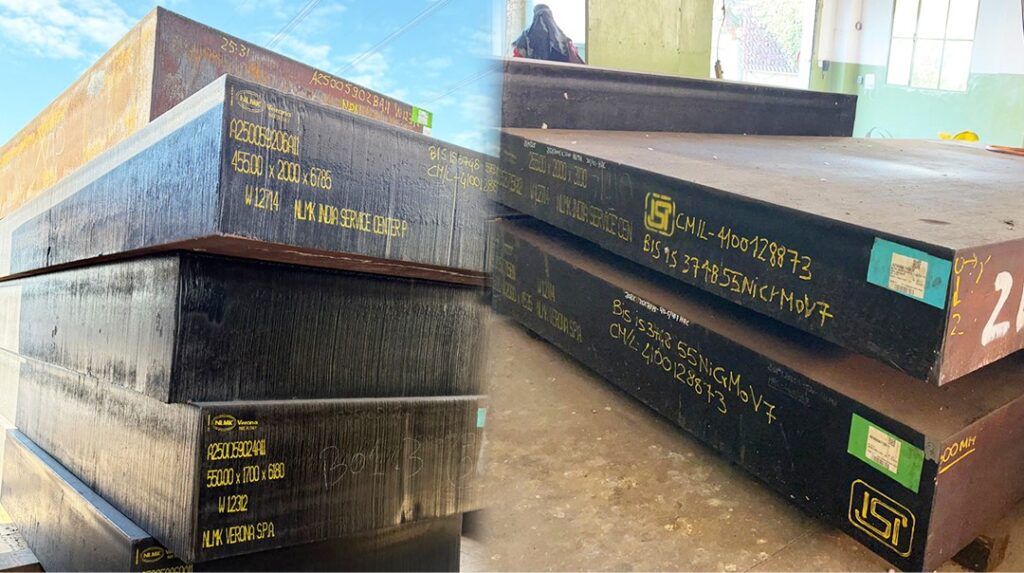
Every forging die lives a tough life. Imagine being struck by immense pressure, temperature, and repetitive impact —all day, every day. It’s no surprise that dies eventually wear out, crack, or lose their shape.
For the forging industry, It means a lot that is -halted production, rising tooling costs, and frustrated timelines.
But here’s where the story changes. When DB6 tool steel comes into the picture–a material designed to withstand the battlefield of forging. With its unique balance of toughness, wear resistance, and thermal stability, DB6 helps dies fight longer, harder, and smarter.
The result? Extended die life, reduced downtime, and significant savings for manufacturers.
👉 Choosing the right die steel is essential. DB6 steel turns challenges into durability and gives you a strong competitive edge.
Common Forging Die Failures
Forging dies can fail in several ways during production. Understanding these failures helps manufacturers select better die materials and improve tooling performance.
1. Excessive Die Wear
Cause
In forging operations, hot metal continuously flows across the die surface under high pressure. This causes abrasive wear, gradually removing material from the die surface.
Over time, this leads to:
- Loss of dimensional accuracy
- Poor part finish
- Frequent die replacement
How DB6 Helps
DB6 tool steel offers high hardness and wear resistance, which helps maintain its original shape for a longer period and reduces frequent die replacement.
2. Die Cracking
Cause
During hot forging, dies are repeatedly heated by hot metal and then cooled by air or lubricants, and this continuous heating and cooling cycle create thermal stress and then leads to surface cracks. And these Cracks often start at stress concentration points and gradually grow during repeated forging cycles.
How DB6 Helps
DB6 steel has excellent thermal stability and toughness, hence absorb repeated hammer blows without developing cracks. This is especially suitable for hammer forging dies and heavy-duty tooling.
3. Plastic Deformation
Cause
Forging dies operate under extremely high loads. If the die material does not have sufficient strength, it can permanently deform, causing an inaccurate part shape.
How DB6 Helps
DB6 steel has high compressive strength to resist deformation and maintain precise die geometry during heavy forging operations.
4. Premature Die Failure
Cause
When dies fail earlier than expected, it results in increased production cost and lower the manufacturing efficiency
How DB6 Helps
DB6 offers a balanced combination of toughness, strength, and wear resistance, which significantly improves die durability and overall productivity.
5. Surface Galling
Cause
Sometimes the forged metal sticks to the die surface. This is known as galling, damages the die surface and affects product finish also.
How DB6 Helps
The wear-resistant microstructure of DB6 tool steel reduces metal adhesion and improves the surface performance of forging dies.
Industry Insights
In many forging industry discussions, engineers highlight that die cracking and die failure are common challenges in hammer forging operations where dies experience repeated shock loads. Technical discussions in communities such as Practical Machinist often mention that high-toughness steels like DIN 1.2714 (DB6) help improve die life in heavy impact applications.
Such real-world discussions clarify the importance of selecting appropriate die steels for improving forging productivity.
Tips to Improve Forging Die Life
when selecting high-quality die steel, manufacturers must follow several practices to improve die performance:
- To ensure proper heat treatment of the die material
- To maintain correct die design to reduce stress concentration
- To use appropriate lubrication during forging operations
- To control operating temperatures during production
These measures help to reduce the die failures and improve productivity.
FAQs
What is DB6 tool steel used for?
DB6 steel is widely used for forging dies, hammer dies, shear blades, and heavy-duty industrial tooling because of its high toughness and impact resistance.
Is DB6 the same as DIN 2714?
DB6 steel is commonly considered equivalent or modified version of DIN 1.2714 tool steel.
What causes forging die failure?
Forging die failure is mainly caused by wear, thermal cracking, deformation, and repeated impact during forging operations.
How can forging die life be improved?
Die life can be improved by selecting the right tool steel, applying proper heat treatment, and maintaining optimal forging conditions.
Do suppliers in India stock DB6 steel?
Yes, many specialized tool steel suppliers in India maintain stock of DB6 steel and other European grades for forging and tooling applications.
References
- Tool steel classification standards from DIN
- Materials engineering research from ASM International
- Industry discussions from Practical Machinist
Looking for DB6 for your industrial tooling needs?
Virat Steels supplies premium-quality DB6 tool steel for forging dies and industrial tooling applications. Manufacturers can rely on our high quality tool steel materials to get consistent performance in demanding forging operations.
Contact our team to get more details about available sizes and technical specifications suitable for your applications.
https://www.viratsteels.com/db6.html info@viratsteels.com +91 98140-21775
DB6 vs H13 Tool Steel: Which is Better for Forging Applications?
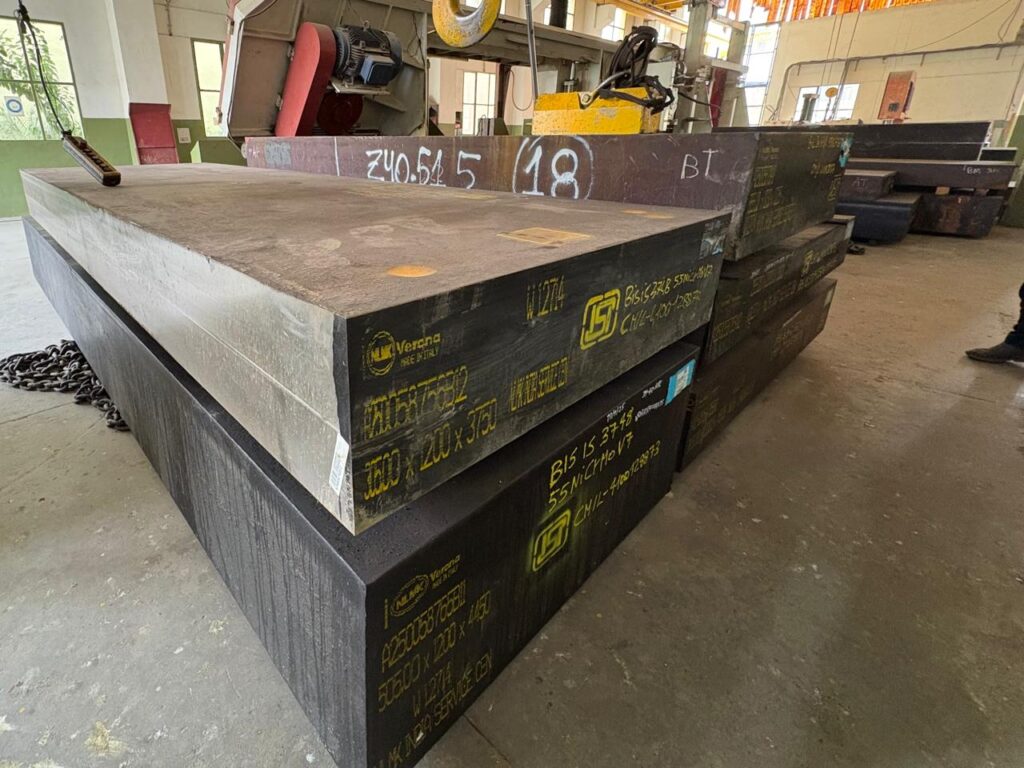
In forging, every die tells a story. Its steel grade decides how long it lasts, how smooth production runs, and how good the final product looks. Some last longer, some deliver sharper precision, and some balance cost with performance. Behind each of these outcomes lies one major choice is the steel grade used to craft the die.
Two steels often step into this role: DB6 and H13. Both are strong, both resist wear, but they shine in different ways. DB6 is the tough fighter, built to handle shock loads in heavy-duty forging. H13 is the precision player, balancing hardness and heat resistance for high-performance dies.
Choosing between them isn’t just technical, it’s about selecting the right steel need for your operations. Whether you’re in automotive forging, heavy engineering, or industrial equipment manufacturing, understanding the differences between DB6 and H13 can help you decide which steel will carry your production forward.
Overview of DB6 Tool Steel
DB6 is a high-toughness hot work tool steel commonly used for hammer forging dies and heavy-duty tooling. It is generally considered equivalent to DIN 1.2714.
Key features of DB6 steel:
- Very high toughness
- Excellent resistance to impact loads
- Good wear resistance
- Ideal for hammer forging operations
Because of its toughness, DB6 is preferred where tools face repeated mechanical shock.
Overview of H13 Tool Steel
H13 is one of the most widely used hot work tool steels due to its strong heat resistance and hardness stability at high temperatures.
Key features of H13 steel:
- Excellent heat resistance
- Good wear resistance
- High hardness retention at elevated temperatures
- Suitable for hot work tooling
H13 is commonly used in die casting, extrusion, and hot forging applications.
Chemical Composition Comparison
The chemical composition of these steels influences their mechanical properties and performance.
| Element | DB6 Steel | H13 Steel |
| Carbon | 0.50 – 0.60% | 0.35 – 0.42% |
| Chromium | 1.00 – 1.30% | 4.75 – 5.50% |
| Nickel | 1.50 – 1.80% | — |
| Molybdenum | 0.40 – 0.50% | 1.10 – 1.75% |
| Vanadium | — | 0.80 – 1.20% |
Nickel in DB6 increases toughness, while chromium and vanadium in H13 improve heat resistance.
Hardness Comparison
Hardness plays an important role in determining the wear resistance and durability of tool steels.
| Condition | DB6 Steel | H13 Steel |
| Annealed Condition | 200 – 240 HB | 190 – 220 HB |
| Hardened & tempered | 50 – 54 HRC | 48 – 52 HRC |
Both steels achieve similar hardness, but their performance differs due to toughness and heat resistance.
Applications of DB6 Steel
DB6 steel is widely used in industries requiring tools that can withstand high impact forces includes.
- Hammer forging dies
- Heavy duty forging tools
- Shear blades
- Industrial punches
- Large forming dies
These tools often experience repeated mechanical shock, making DB6 steel an ideal choice.
Applications of H13 Steel
H13 steel is commonly used in hot work tooling where high temperatures are involved includes.
- Die casting dies
- Hot extrusion tools
- Aluminum die casting molds
- Plastic injection molds
- Hot forging dies
Its excellent thermal stability makes it suitable for processes involving molten metals or continuous heating.
Key Differences Between DB6 and H13 Steel
| Toughness | Very high | High |
| Heat resistance | Good | Excellent |
| Wear resistance | Good | Very good |
| Impact resistance | Excellent | Moderate |
| Typical use | Hammer forging dies | Hot work dies |
This comparison highlights that both steels serve different purposes in industrial tooling.
Which Steel Should You Choose?
The choice between DB6 and H13 steel depends on the operating conditions of the tooling.
| Choose DB6 Steel for | Choose H13 Steel for |
| Heavy hammer forging | High temp applications |
| High impact loads | Die Casting |
| Large forging dies | Hot Extrusion process |
Understanding the working conditions helps engineers select the most suitable tool steel.
Tips for Improving Die Life
when selecting high-quality die steel, manufacturers must follow several practices to improve die performance:
- Ensure Proper heat treatment
- Maintain Correct die design
- Use appropriate lubrication during forging
- Control operating temperatures
These practices help reduce tool wear and prevent premature failure.
Frequently Asked Questions (FAQs)
1.Is DB6 better than H13 steel?
DB6 steel is better for applications requiring high toughness and impact resistance excels in heavy forging applications, while H13 steel is better for high-temperature hot work processes.
2.What is DB6 steel equivalent to?
DB6 steel is commonly considered equivalent to DIN 1.2714 tool steel.
3.What is the hardness of DB6 steel?
After heat treatment, DB6 steel typically reaches a hardness of approximately 50 to 54 HRC.
4.Which steel is better for hammer forging dies?
DB6 steel is generally preferred due to its superior toughness and impact resistance.
5.Which steel offers better value for money in the long term?
H13 offers superior durability in extreme conditions, while DB6 provides cost-efficiency for general use.
6.Is DB6 steel suitable for hot work applications?
Yes, DB6 steel performs well in hot work applications due to its strength and resistance to elevated temperatures.
7.Where can I source premium DB6 and H13 steels?
Virat Special Steels provides premium quality DB6 and H13 steel for forging and industrial tooling applications across India.
8.Is Virat Steels a reliable supplier for DB6 tool steel?
Yes, Virat Steels is known as a major importer, exporter, and stockiest of tools and die steels including DB6 / DIN 1.2714.
9.Do suppliers in India stock European grades?
Yes. Virat Special Steels is one of the best stockiest and suppliers of European grades such as DIN 1.2714, DIN 1.2344 etc.
10. Can DB6 be welded or re‑hardened?
Yes, DB6 tool steel can be welded and re-hardened, but it must be done carefully to maintain its mechanical properties and avoid cracking.
Looking for high-quality DB6 or H13 tool steel?
Virat Steels supplies premium tool and die steel grades for industries across India. Contact our team to get more details about available sizes and technical specifications suitable for your applications.
https://www.viratsteels.com/db6.html info@viratsteels.com +91 98140-21775
Virat Steels & NLMK Verona at Mach Auto Expo 2026 | European Tool Steel Excellence
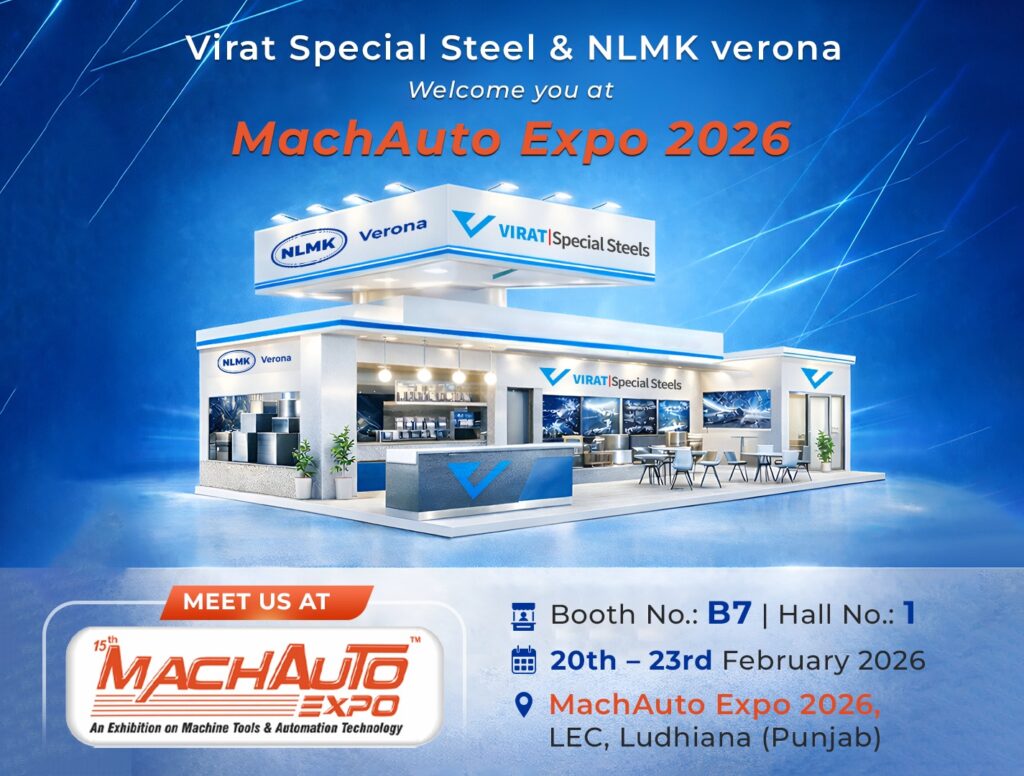
Virat Steels & NLMK Verona at Mach Auto Expo 2026 | European Tool Steel Excellence
The countdown has begun for Mach Auto Expo 2026, India’s premier exhibition for industrial innovation, and this year promises something truly special. Virat Special Steels Pvt. Ltd., a trusted name in premium steel solutions, is proud to partner with NLMK Verona, Europe’s renowned tool steel manufacturer, to display the cutting-edge products and global expertise under one roof.
A Partnership Forged in Strength
Virat Special Steels Pvt. Ltd. has always been committed to delivering world-class steel solutions. By joining hands with NLMK Verona, we bring the best of European tool steel technology directly to Indian manufacturers. This collaboration ensures:
- Superior quality standards backed by European precision.
- Wide product range for automotive, engineering, and heavy machinery sectors.
- Global expertise with local support, combining NLMK’s innovation with Virat’s trusted service.
Why Visit us at Mach Auto Expo 2026?
At our booth, visitors will experience:
- Live product showcases of premium tool steels designed for durability and performance.
- Technical insights from experts on applications, machining, and heat treatment.
- Networking opportunities with industry leaders and decision-makers.
- Exclusive offers for expo attendees, reinforcing our commitment to customer success.
India’s manufacturing sector is evolving rapidly, and the demand for high-performance tool steel is greater than ever.
Join Us at Mach Auto Expo 2026
📍 Hall No. 1 | Booth No. B7 , LEC Ludhiana, Punjab
📅 Date: February 20th ,21st, 22nd,23rd 2026
Whether you are an OEM, supplier, or industry enthusiast, this is your chance to explore European tool steel excellence—right here in India.
Connect With Us Today –
📧 Email: info@viratsteels.com 🌐 Website: www.viratsteels.com 📞 Phone: +91-9814021775 ,9216321774 ,9216321778
Virat Steels & NLMK Verona – Building Strength, Shaping the Future.
Virat Special Steels -India’s Premium Tool Steel Stockiest
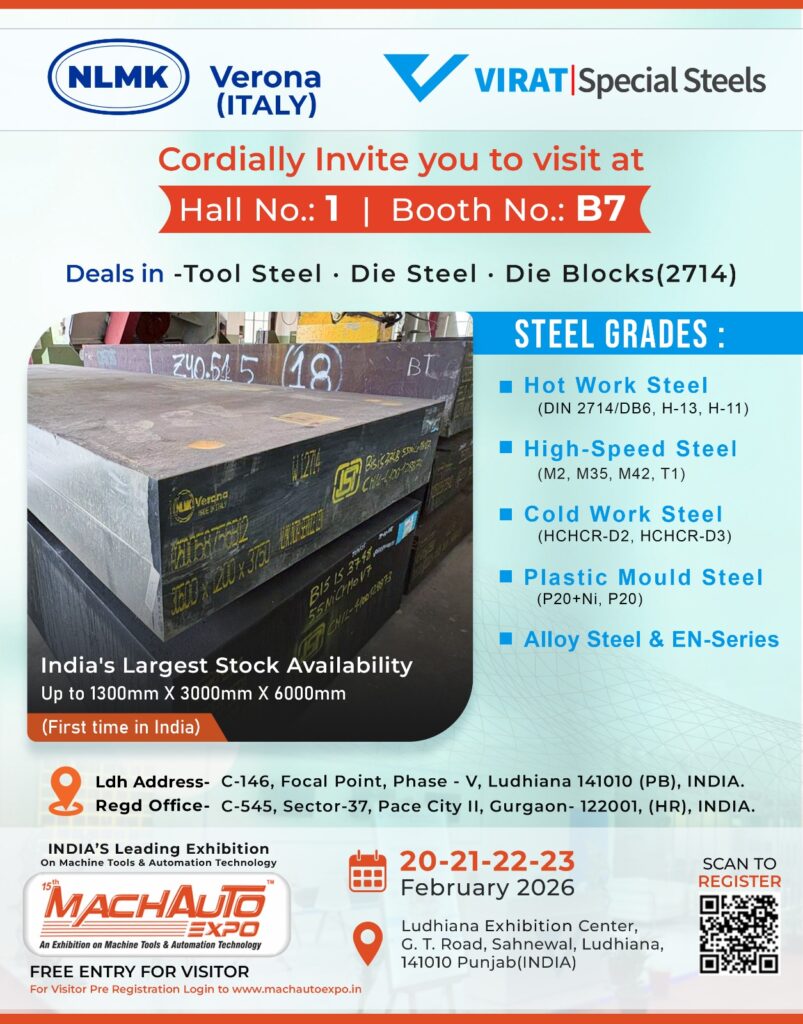
An Authorized Partner Of NLMK Verona, Italy
With 7 decades of experience in metal domain, Virat Special Steels is a trusted & successful pan-India supplier of tool and die steels backed by 3 regional stocking yards, 2,000+ tons of inventory, offering more than 35 specialized grades , advanced cutting facilities, ensuring fast and reliable deliveries, strengthened by a growing base of 1800+ satisfied customers across India, making us one of the Best reliable and preferred tool steel suppliers..
By combining European manufacturing excellence (the authorized stockist of NLMK Verona, Italy) with strong local service and technical expertise, the company enables Indian toolmakers to compete confidently on a global level now easily accessible with:
- consistent quality with premium metallurgical properties
- reliable supply, even during market shortages
- proven performance material in critical applications
- complete documentation and traceability
India’s Largest Steel Stock Availability –
For the first time in India, we offer extra-large steel blocks up to 1300mm x 3000mm x 6000mm ensuring that industries requiring precision steel, heavy-duty moulds, and large-scale production can rely on us for consistent supply and superior quality.
We provide a wide range of premium steel grades to meet diverse industrial needs ensuring availability even during periods of market volatility and steel shortages.
- Hot Work Steel: DB6, H-13, H-11
- High-Speed Steel: M2, M35, T1
- Cold Work Steel: D2, D3
- Plastic Mould Steel: P20, P20+Ni
Whether you are in automotive, manufacturing, tooling, or mould-making, our steel solutions are designed to deliver performance, durability, and efficiency.
Looking Ahead –
Our reputation as a leading steel importer, exporter, and stockist in India is built on reliability, trust and global partnerships.
Meet Us at Mach Auto Expo – Steel Solutions for Every Industry
Join us at the Mach Auto Expo to explore our premium steel offerings: 📍 Hall No. 1 | Booth No. B7
Explore how Virat Special Steels can empower your projects with world-class steel solutions.
Connect With Us Today –
📧 Email: info@viratsteels.com 🌐 Website: www.viratsteels.com 📞 Phone: +91-9814021775
Virat Special Steels Recognized as Authorised Distributor by NLMK Verona
[Strengthening India’s Access to Genuine European Tool Steel]
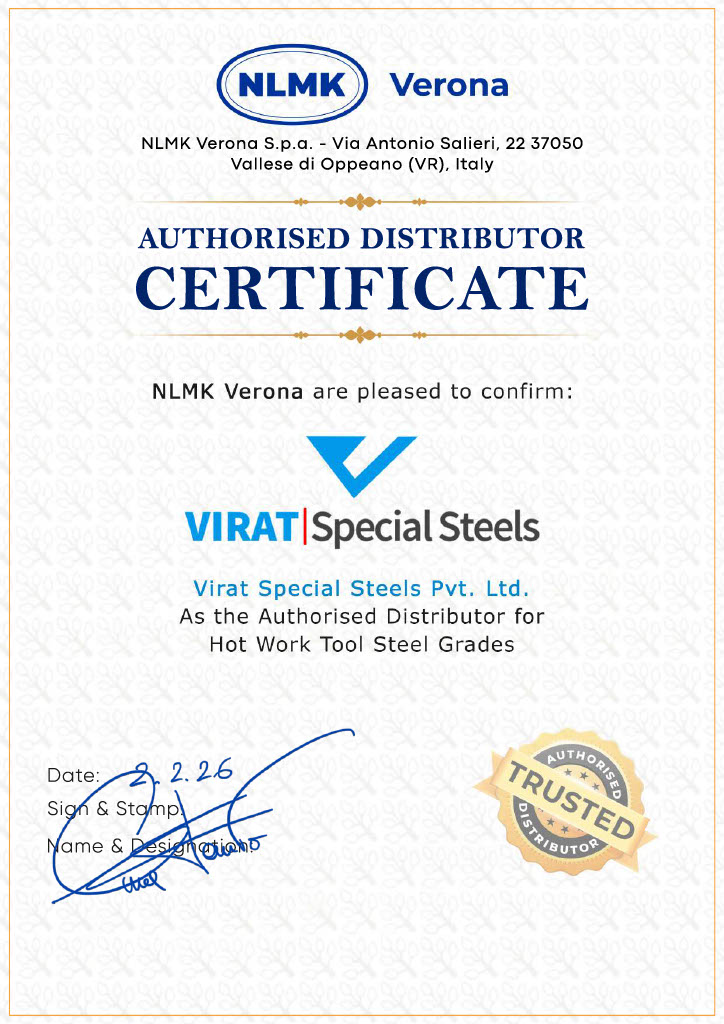
Virat Special Steels Pvt. Ltd. is proud to announce a significant milestone in our journey—official recognition as the Authorised Distributor for Hot Work Tool Steel Grades by NLMK Verona S.p.a., Italy. This milestone, dated 2nd February 2026, marks a new chapter in our commitment to delivering excellence in the steel industry.
Virat Special Steels Pvt. Ltd. has been recognized as one of the largest Importers, Exporters, and Stockists of premium steel products of :
- Die Blocks (DIN 1.2714, DB6, H13, H11)
- Tool Steels & Die Steels
- Special Steels & Alloy Steels in multiple grades
Backed by decades of expertise, the company maintains the largest steel yards, ensuring consistent availability, unmatched quality, and timely delivery to domestic industries.
NLMK Verona, a renowned name in the global steel sector, has entrusted Virat Special Steels with the responsibility of distributing their Hot Work Tool Steel Grades in India. This partnership reflects not only our technical expertise but also the trust we have built over the years with our customers and partners.
What This Means for Our Customers
Being an Authorised & Trusted Distributor ensures that our customers benefit from:
- Authentic NLMK Verona products with guaranteed quality
- Reliable supply chain solutions met to industry needs
- Global standards of excellence delivered locally
- On-ground technical support and grade selection support
Whether you are manufacturing dies, Molds, or critical tooling components, Virat Steels ensures your tools are built on proven European steel excellence drive productivity.
Looking Ahead
This achievement is not just a certificate— It’s a promise of authentic material, consistent quality, and strong technical partnership for the Indian tooling industry.
European tool steel excellence is now officially within reach.
Connect with Virat Special Steels to explore NLMK Verona’s authorised tool and die steel range and elevate your tooling performance.
Web: www.viratsteels.com
Email Us: info@viratsteels.com.
Ph: 98140-21775, 9999124971-80 , 9216321771-79.
NLMK Verona Tool Steel: Tough & Stable
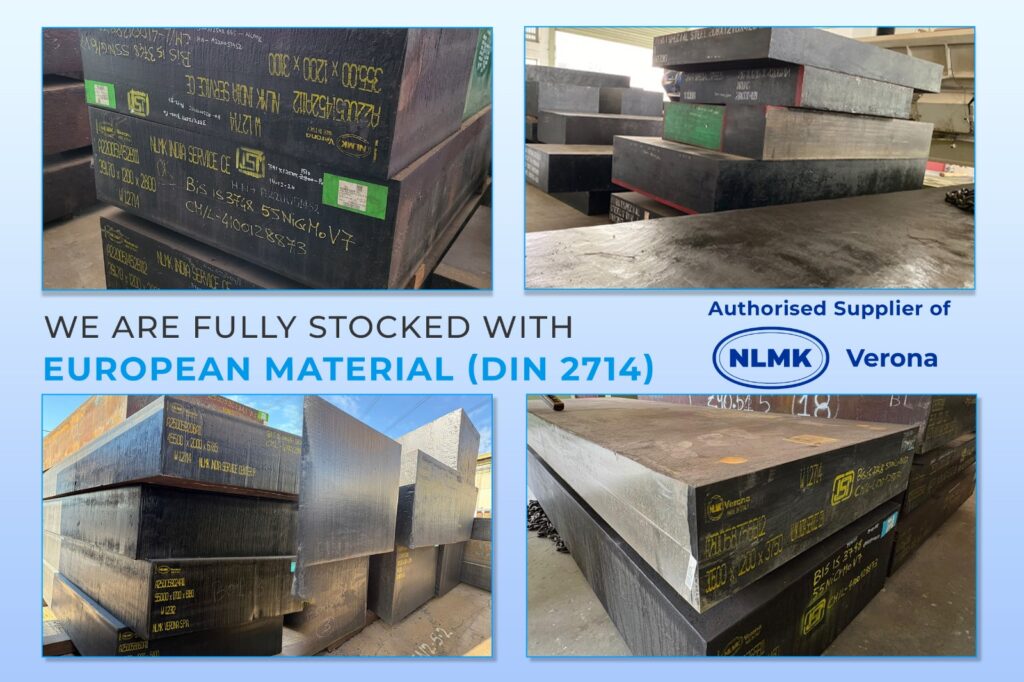
When it comes to tool steel suppliers in India, industries demand materials of high strength, precision, and durability. Virat Steels having great experience consistently in metal domain for 7 decades bringing you the finest in European engineering—NLMK Verona Tool Steel. Known worldwide for its toughness, stability, and performance, this steel is trusted across sectors where reliability is non-negotiable.
What Makes NLMK Verona Tool Steel Exceptional?
NLMK Verona, part of the globally respected NLMK Group, is a leader in European tool steel manufacturing. Their products are engineered to hold extreme industrial conditions, ensuring longer service life and superior efficiency.
- Unmatched Toughness
- Dimensional Stability
- High Performance
Optimized for demanding applications like die-making, forging, and cutting tools.
Applications Across Industries
NLMK Verona’s tool steels are trusted in sectors where precision and durability are non-negotiable:
- Automotive Manufacturing: For molds, dies, and wear-resistant components.
- Aerospace Engineering: Ensuring stability in parts exposed to extreme conditions.
- Heavy Engineering: Industrial machinery, specialized tools.
- General Manufacturing: From injection Molds to stamping dies, performance is guaranteed.
Virat Steels: Your Trusted Tool Steel Supplier in India
Virat Steels don’t just supply steel—We deliver solutions engineered for success. By offering NLMK Verona European Tool Steel, we empower our clients with materials that defines with excellent cutting-edge metallurgy technology.
When you choose Virat Steels, you are choosing:
- Global quality with local expertise
- Quick Service
- Technical guidance to your needs
NLMK Verona’s European Tool Steel is more than just a material—it’s truly a commitment to performance. At Virat Steels, we are proud to bring this world-class steel to industries across India, ensuring that our customers stay ahead in quality and productivity.
Looking for the best tool steel suppliers in India?
Choose Virat Steels—your gateway to Italian Tool steel excellence & Discover authentic European quality with full assurance.
Meanwhile for more details explore on- https://www.viratsteels.com/
Email Us: info@viratsteels.com.
Ph: 98140 – 21775, 99991 – 24971 to 80 , 92163-21771 to 79.
Global Quality With NLMK . Local Reliability With Virat Steels.
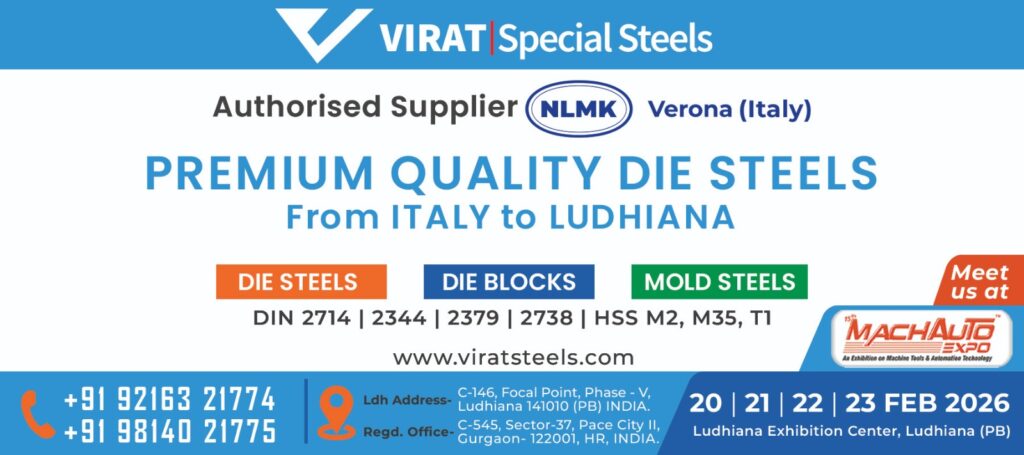
In today’s competitive manufacturing sector, material quality is truly a important parameter. For toolmakers, die manufacturers, and OEM suppliers, the difference between consistent output and recurring failure often begins with the quality of tool steel.
For decades, European tool and die steels have been set global benchmarks for their performance, reliability, and longevity. Today, that same European steel excellence is no longer distant or difficult to access—it is now locally available in Virat Steels – India, backed by trusted partnerships and reliable supply chains.
European Tool Steel: A Proven Benchmark –
European tool steel manufacturers—particularly NLMK Verona—are globally recognized for their strict quality control, advanced refining processes, and consistent heat-treatment performance.
These superior metallurgical standards deliver:
- longer die and mould life
- Excellent toughness and hardness balance
- Superior surface finish after machining
- Lower rejection rate
The result is predictable performance, higher productivity, and long-term cost efficiency for demanding tooling applications.
Now Local Availability with Trusted Indian Support –
With 70+ years of experience in metal domain, Virat Steels is a trusted & successful pan-India supplier of tool and die steels backed by 3 regional stocking yards, 3,500+ tons of inventory, and advanced cutting facilities, ensuring fast and reliable deliveries.
The company remains committed to delivering premium grades such as: DIN 1.2714 | 1.2344 | 1.2738 | 1.2379 | HSS M2, M35 , T1 and more ensuring availability even during periods of market volatility and steel shortages.
By combining European manufacturing excellence with strong local service and technical expertise, Virat Steels enables Indian toolmakers to compete confidently on a global level now easily accessible with:
- consistent quality with premium metallurgical properties
- reliable supply, even during market shortages
- proven performance material in critical applications
- complete documentation and traceability
If you are looking to upgrade your tooling materials and align with global level, now is the time to experience European tool steel—locally supported, reliably supplied, and technically assured by Virat Steels.
Please Consult our office for further assistance.
Meanwhile for more on Virat Special Steels;
Email Us: info@viratsteels.com.
Ph: 98140 – 21775, 99991 – 24971 to 80 , 92163-21771 to 79.
The Role of DIN 2714 Steel in Forging Industries
The forging industry plays a pivotal role in manufacturing, producing components that form the backbone of various sectors such as automotive, aerospace, construction, and heavy machinery. One material that has emerged as a cornerstone of the forging process is DIN 2714 steel. Renowned for its exceptional properties, DIN 2714 is a hot work tool steel that meets the rigorous demands of forging operations. This blog delves into the characteristics, applications, and benefits of DIN 2714 steel, highlighting its indispensability in the forging industry.
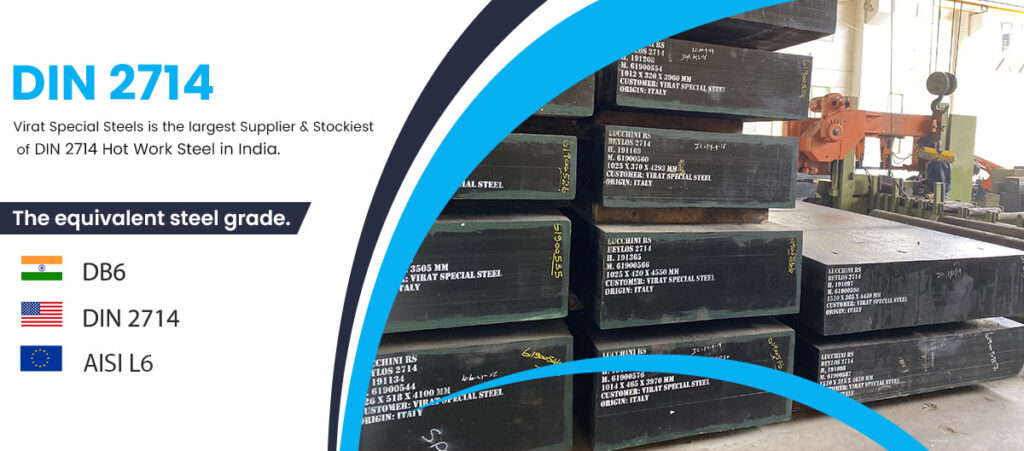
Understanding DIN 2714 Steel
DIN 2714 is a German-standard steel, widely recognized for its high wear resistance, toughness, and thermal stability. It belongs to the family of alloyed steels that exhibit excellent mechanical properties, making it ideal for use in hot forging tools. The composition of DIN 2714 typically includes:
Carbon (C): Contributing to hardness and strength.
Silicon (Si): Enhancing heat resistance.
Manganese (Mn): Improving toughness and hardenability.
Chromium (Cr): Providing corrosion resistance and strength.
Molybdenum (Mo): Increasing high-temperature strength and creep resistance.
This combination of elements gives DIN 2714 its unique ability to withstand extreme operating conditions while maintaining dimensional stability.
Key Properties of DIN 2714 Steel
- High Toughness: With its exceptional toughness, DIN 2714 resists cracking and – chipping, even under heavy loads.
- Excellent Thermal Stability: The steel maintains its mechanical properties at elevated temperatures, making it perfect for hot work applications.
- Wear Resistance: The material can endure prolonged exposure to abrasion, increasing the longevity of forging dies and tools.
- Hardenability: DIN 2714 can achieve a consistent hardness profile, ensuring uniform performance across the material.
Applications in the Forging Industry
DIN 2714 steel’s properties make it indispensable in several forging processes. Some of its primary applications include:
- Forging Dies: The wear resistance and toughness of DIN 2714 make it an excellent choice for dies used in drop forging and upset forging.
- Hot Shear Blades: The steel’s ability to maintain hardness at high temperatures is ideal for cutting hot metal billets.
- Extrusion Tools: DIN 2714’s thermal stability and wear resistance are advantageous in metal extrusion processes.
- Press Tools: These tools require materials that can withstand repeated stress and high impact, making DIN 2714 a preferred choice.
Benefits of Using DIN 2714 Steel
- Increased Tool Life: The superior wear resistance and toughness reduce the frequency of tool replacement, cutting down costs and downtime.
- Improved Efficiency: The steel’s thermal stability allows tools to operate efficiently under high temperatures, enhancing production rates.
- Cost-Effectiveness: Although the initial investment may be higher, the extended tool life and reduced maintenance offset the costs, delivering long-term savings.
- Enhanced Performance: Tools made from DIN 2714 ensure precise and high-quality forging results, meeting stringent industrial requirements.
Conclusion
The forging industry demands materials that can withstand extreme conditions while delivering consistent performance. DIN 2714 steel checks all these boxes, making it a preferred material for manufacturing critical forging tools. By choosing DIN 2714, industries can achieve enhanced productivity, reduced operational costs, and superior product quality.
At Virat Special Steels, we are committed to delivering the highest quality DIN 2714 steel tailored to meet the diverse needs of the forging industry. Partner with us to unlock the potential of this exceptional material and elevate your forging operations to new heights.
FAQ: The Role of DIN 2714 Steel in Forging Industries
1. What is DIN 2714 steel?
DIN 2714 is a German-standard hot work tool steel known for its excellent toughness, wear resistance, and thermal stability. It is widely used in the forging industry for its ability to withstand high temperatures and heavy mechanical loads.
2. What are the key components of DIN 2714 steel?
The primary components of DIN 2714 steel include:
- Carbon (C) for hardness and strength.
- Silicon (Si) for heat resistance.
- Manganese (Mn) for toughness and hardenability.
- Chromium (Cr) for corrosion resistance and strength.
- Molybdenum (Mo) for high-temperature strength.
3. Why is DIN 2714 steel preferred in the forging industry?
DIN 2714 steel is preferred due to its combination of high toughness, wear resistance, thermal stability, and hardenability. These properties make it ideal for manufacturing forging dies, hot shear blades, extrusion tools, and press tools.
4. What applications is DIN 2714 steel suitable for?
DIN 2714 steel is commonly used in:
- Forging dies
- Hot shear blades
- Metal extrusion tools
- Press tools for hot work applications
5. What are the benefits of using DIN 2714 steel in forging?
The key benefits include:
- Prolonged tool life due to high wear resistance
- Improved efficiency in high-temperature operations
- Cost-effectiveness through reduced maintenance and downtime
- Consistent and precise forging results
6. How does DIN 2714 compare with other hot work tool steels?
DIN 2714 stands out for its balanced properties, such as toughness, wear resistance, and heat resistance. It offers an optimal combination of durability and performance, making it a reliable choice for heavy-duty forging tools.
7. Can DIN 2714 steel be customized for specific applications?
Yes, DIN 2714 steel can be heat-treated and machined to meet specific requirements of different forging applications. Working with a trusted supplier ensures customization tailored to your operational needs.
8. What is the typical service life of tools made from DIN 2714 steel?
The service life varies based on the application, maintenance practices, and operating conditions. However, DIN 2714’s durability ensures longer tool life compared to many other materials.
9. How should DIN 2714 steel be maintained to maximize its performance?
Proper maintenance includes regular inspection for wear, timely heat treatment, and ensuring that tools operate within their recommended temperature range. This helps in prolonging the tool’s service life.
10. Where can I source high-quality DIN 2714 steel?
Virat Special Steels is a trusted supplier of premium DIN 2714 steel, offering products tailored to the needs of the forging industry. Contact us to learn more about our offerings and how we can support your business.
Mode of Supply:
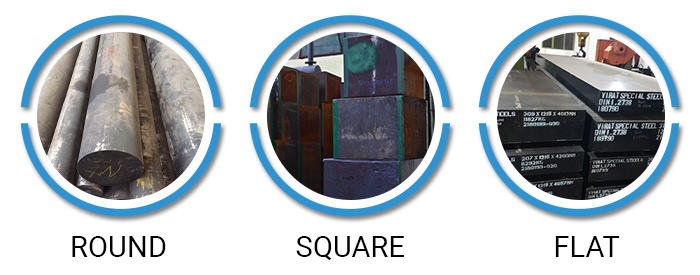
Virat Special Steels is the largest stockiest and supplier of DIN 2714 tool steel in flat, square and round bar. We provide steel in all sizes as your requirements. DIN 2714 die steel is available in flat, square and round shape.
Consult our team who will assist you for DIN 2714 steel query.
https://www.viratsteels.com/din-2714.html
🌐https://www.viratsteels.com 📩info@viratsteels.com 📲+91-98140-21775