



April, 2026
now browsing by month
P20 vs P20+Ni Tool Steel: Which is Better for Plastic Mould Applications?
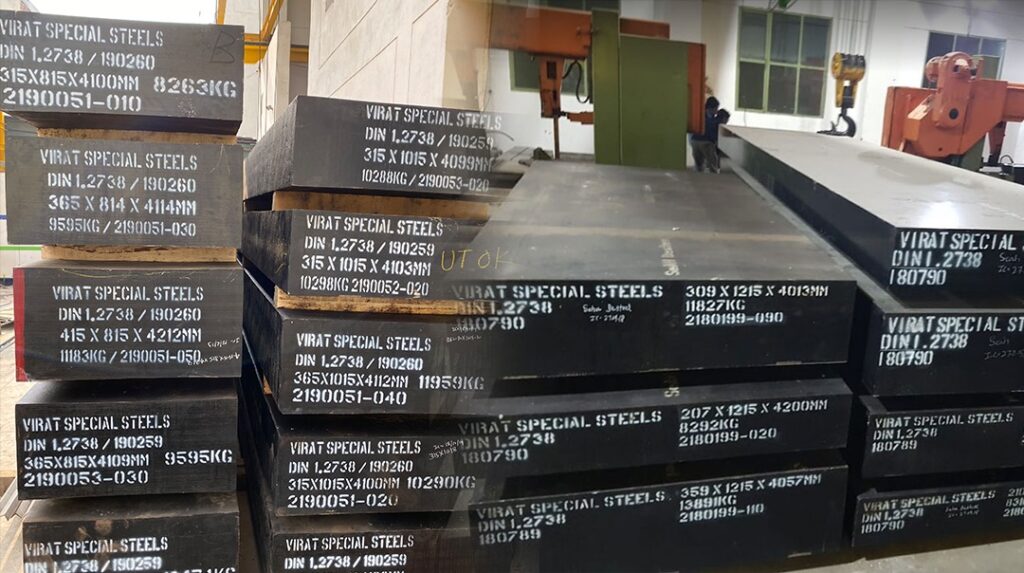
In the plastic mould industry, selecting the right material plays a crucial role in determining tool life, surface finish, and production efficiency. Two of the most used mould steels are P20 and P20+Ni tool steel (Nickel Alloyed P20 Steel).
But which one is better for your application?
In this blog, we compare P20 vs P20+Ni tool steel to help manufacturers make the right decision.
What is P20 Tool Steel?
P20 is a pre-hardened plastic mould steel widely used in the manufacturing of:
- Plastic injection moulds
- Die casting dies
- Automotive components
- Mold bases
Key Properties of P20 Steel
- Hardness: 280–320 BHN
- Good machinability
- Moderate toughness
- Cost-effective solution
- Suitable for medium production runs
What is P20+Ni Tool Steel?
P20+Ni is an enhanced version of P20 steel with Nickel (Ni) added, improving its performance significantly.
Key Properties of P20+Ni Steel
- Improved toughness
- Better hardness uniformity
- Superior polishability
- Enhanced core strength
- Ideal for high-quality moulds
P20 vs P20+Ni: Key Differences
| Property | P20 Steel | P20+Ni Steel |
| Toughness | Moderate | High |
| Hardness Uniformity | Standard | Excellent |
| Polishability | Good | Superior (Mirror Finish) |
| Core Strength | Average | Strong |
| Cost | Lower | Slightly Higher |
| Best Use | General moulds | High precision & glossy moulds |
Why Choose P20+Ni for Plastic Moulds?
If your application requires:
✔ High surface finish (mirror polish)
✔ Large mould sizes
✔ Better durability and longer tool life
✔ Uniform hardness across thick sections
Then P20+Ni steel is the better choice.
Applications of P20 & P20+Ni Steel
Both grades are widely used in:
- Plastic injection moulds
- Blow moulds
- Die casting dies
- Automotive plastic components
- Consumer product moulds
Result:
- Choose P20 → for general-purpose moulds
- Choose P20+Ni → for high-end, precision moulds
Why Choose Virat Special Steels?
At Virat Special Steels, we provide premium quality P20 and P20+Ni tool steel with:
- Large ready stock
- Assured material quality
- Custom sizes available
- Competitive pricing
- Fast delivery across India
We are a trusted tool and die steel supplier in India, serving Pan India industries including key industrial hubs such as Pune, Nashik, Ahmedabad, Rajkot, Ludhiana, Faridabad, Ghaziabad, Gurgaon, and the entire South India region.
Conclusion
Both P20 and P20+Ni tool steels have their own advantages, but the right choice depends on your application.
If you’re looking for a reliable P20 / P20+Ni steel supplier in India, Virat Special Steels is your trusted partner.
Contact our team to get more details about available sizes and technical specifications suitable for your applications.
https://www.viratsteels.com/p20ni.htmlinfo@viratsteels.com
+91 98140-21775
FAQs
1. What is the difference between P20 and P20+Ni steel?
P20+Ni contains nickel, which improves toughness, polishability, and hardness uniformity compared to standard P20.
2. What is the hardness of P20 steel?
Typically 280–320 BHN in pre-hardened condition.
3. Which steel is better for mirror finish moulds?
P20+Ni steel is preferred due to its superior polishability.
4. Where can I buy P20+Ni tool steel in India?
You can source high-quality P20 and P20+Ni steel from Virat Special Steels.
Reasons to Choose DIN 1.2714 Steel for Heavy-Duty Projects
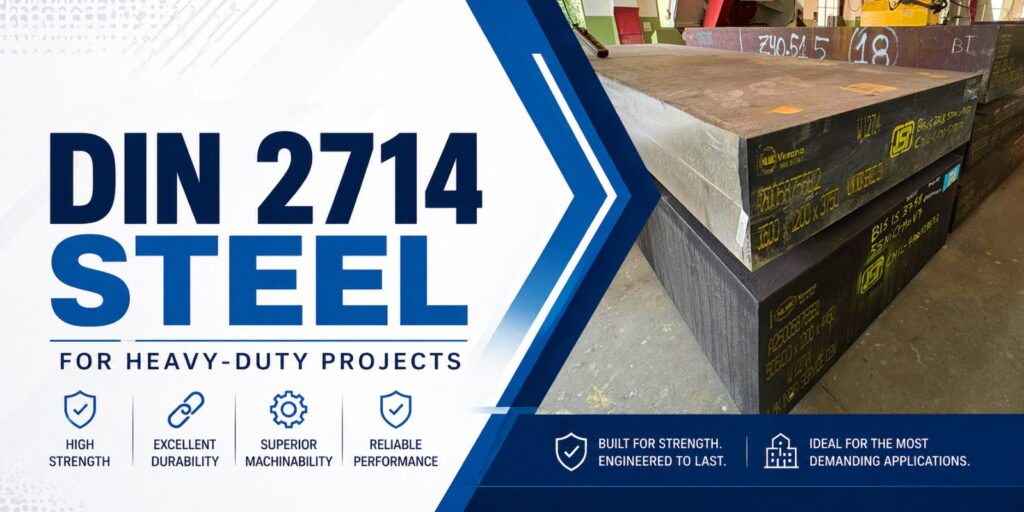
When it comes to heavy-duty industrial applications, choosing the right tool steel can significantly impact performance, durability, and cost-effectiveness. DIN 1.2714 steel, also known as DB6 tool steel, is one of the most trusted materials for industries requiring high toughness, excellent wear resistance, and superior strength.
From forging dies to plastic molds and heavy engineering tools, DIN 1.2714 has become the preferred choice for manufacturers worldwide.
What is DIN 1.2714 Steel?
DIN 1.2714 is a nickel-chromium-molybdenum hot work tool steel popularly known for its:
- High toughness
- Good wear resistance
- Excellent hardenability
- High impact strength
- Resistance to heat and pressure
It is widely used in industries like:
- Automotive
- Aerospace
- Forging
- Die casting
- Plastic molding
- Heavy machinery manufacturing
Top Reasons to Choose DIN 1.2714 Steel
1. Exceptional Toughness for Heavy Loads
One of the biggest advantages of DIN 1.2714 steel is its excellent toughness, making it ideal for applications involving:
- Repeated impact
- Heavy pressure
- Shock loading
This makes it a perfect material for forging dies, hammer dies, and press tools.
2. Superior Wear Resistance
DIN 1.2714 offers excellent abrasion resistance, which helps tools last longer under harsh working conditions.
This reduces:
- Frequent replacements
- Downtime
- Maintenance costs
3. High Strength at Elevated Temperatures
For industries dealing with hot work applications, DIN 1.2714 performs exceptionally well even at higher temperatures.
It is widely used in:
- Hot forging dies
- Extrusion tools
- Die holders
4. Excellent Hardenability
DIN 1.2714 can achieve a uniform hardness throughout the section, making it suitable for large-size blocks and dies.
Typical hardness range:
360–430 BHN (Pre-Hardened)
This ensures:
- Better machinability
- Reduced heat treatment distortion
- Consistent performance
5. High Impact Strength
This steel grade withstands heavy impact without cracking easily.
That’s why it is preferred for:
- Hammer dies
- Heavy forging tools
- Industrial cutters
6. Longer Tool Life
Because of its balance of strength + toughness + wear resistance, DIN 1.2714 increases tool life significantly.
Benefits include:
- Lower production costs
- Higher productivity
7. Excellent Machinability
Despite being pre-hardened, DIN 1.2714 offers good machinability compared to many other heavy-duty steels.
This makes manufacturing faster and more economical.
8. Suitable for Large Forged Blocks
DIN 1.2714 is commonly available in large, forged rounds, flats, and blocks, making it suitable for:
- Large dies
- Mold bases
- Heavy industrial tools
At Virat Special Steels, we offer extra forging reduction for enhanced grain structure and better performance.
Common Applications of DIN 1.2714 Steel
DIN 1.2714 is widely used in:
- Forging dies
- Die holders
- Hammer dies
- Press tools
- Plastic Molds
- Shear blades
- Heavy-duty machine parts
Why Buy DIN 1.2714 Steel from Virat Special Steels?
At Virat Special Steels, we provide:
- Premium quality DIN 1.2714 / DB6 steel
- Large stock availability
- Ready sizes & custom cutting
- Competitive prices
- Fast delivery across India
- Expert technical support
We are among the leading suppliers of DIN 1.2714 steel in India.
FAQs
Q1. What is DIN 1.2714 steel used for?
DIN 1.2714 is used for forging dies, hammer dies, plastic Molds, and heavy-duty tools.
Q2. Is DIN 1.2714 a hot work tool steel?
Yes, it is widely used in hot work and impact applications.
Q3. What is the hardness of DIN 1.2714 steel?
The standard pre-hardened hardness is around 360–430 BHN.
Q4. Where can I buy DIN 1.2714 steel in India?
You can buy premium quality DIN 1.2714 steel from Virat Special Steels.
Conclusion
If your project requires high toughness, wear resistance, and long-lasting performance, DIN 1.2714 steel is one of the best choices for heavy-duty industrial applications.
Ready to Source DIN 1.2714 / DB6 steel Smarter? Contact Virat Special Steels Today.
📞 Curious about the right size, grades or technical specifications for your application? Our team is ready to guide you.
Explore more: https://www.viratsteels.com/db6.html | 📧info@viratsteels.com | 📱+91 98140-21775
H13 Tool Steel Supplier in India | Buying Guide for Manufacturers
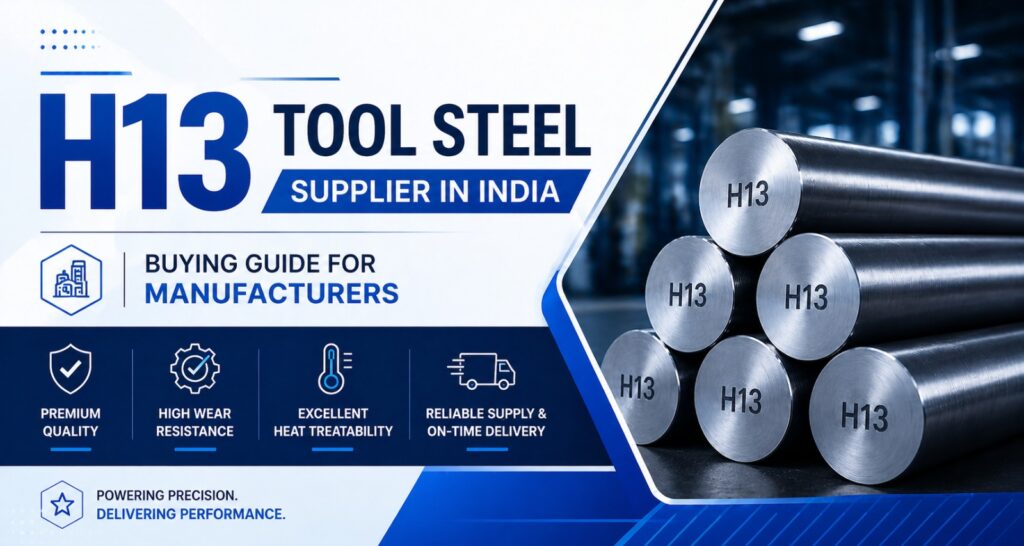
If you are searching for a reliable H13 tool steel supplier in India, you are likely looking for more than just price.
You need genuine material, ready stock, technical support, test certificates, and fast delivery—especially when your production depends on high-performance tooling.
Whether you are in die casting, forging, extrusion, or plastic moulding, choosing the right supplier for H13 tool steel can directly impact tool life, production quality, and downtime.
What is H13 Tool Steel?
H13 tool steel is one of the most widely used hot work tool steels known for:
- High toughness
- Excellent thermal fatigue resistance
- Good wear resistance
- Heat checking resistance
- Strength at elevated temperatures
This makes it ideal for high-temperature tooling.
Equivalent grades include:
- DIN 1.2344
- SKD61
- X40CrMoV5-1
H13 is commonly used for:
- Aluminium die casting dies
- Forging dies
- Extrusion dies
- Plastic injection moulds
- Hot shear blades
Where to Buy H13 Tool Steel in India?
India has many steel traders, but not all are specialists in tool and die steels.
For consistent quality and reliable service, manufacturers prefer experienced suppliers like Virat Special Steels Pvt Ltd.
Virat Steels is one of the leading H13 steel stockists in India, supplying across major industrial hubs.
Why Virat Steels is a Trusted H13 Steel Supplier in India
1. Ready Stock Available
Virat Steels maintains stock in:
- Round bars
- Flats
- Blocks
This ensures quick dispatch and reduced waiting time.
2. Standard & ESR Grade H13 Available
Virat Steels offers:
- Standard H13
- ESR H13 (Electro Slag Remelted)
ESR H13 provides:
- Better cleanliness
- Longer die life
- Improved toughness
3. Ultrasonic Tested & Certified Material
Each batch can be supplied with:
- Test Certificate
- Hardness report
- Ultrasonic testing report
- Chemical composition details
4. Technical Guidance
Virat Steels helps customers choose:
- Correct grade
- Correct HRC hardness
- Correct size and dimensions
5. Fast Delivery Across India
Virat Steels supplies H13 tool steels in all states and cities in India .
What to Check Before Buying H13 Tool Steel
Before purchasing, always confirm:
1-Material Grade
Ask whether it is genuine H13 tool steel / DIN 1.2344 / SKD61.
2-Steel Quality
Check if the steel is ESR or standard.
3-Testing
Ask for:
- Ultrasonic testing
- Test certificate
- Hardness report
4-Size Availability
Check whether the supplier has ready stock.
5-Technical Support
A knowledgeable supplier helps avoid wrong selection.
Industries Using H13 Steel in India
Virat Steels supplies H13 to:
- Die casting manufacturers
- Forging units
- Extrusion companies
- Plastic mould makers
- Automotive component manufacturers
Frequently Asked Questions (?)
1. What is the equivalent grade of H13 tool steel?
Common equivalent grades of H13 tool steel include DIN 1.2344, SKD61, and X40CrMoV5-1.
2. Where can I buy genuine H13 tool steel in India?
You can buy genuine H13 tool steel from trusted suppliers like Virat Steels, which offers ready stock, ESR grades, test certificates, and fast delivery across India.
3. What is the difference between standard H13 and ESR H13?
ESR (Electro-Slag Remelted) H13 has a cleaner microstructure, fewer inclusions, better toughness, and longer die life compared to standard H13.
4. Is H13 tool steel suitable for plastic moulds?
Yes, H13 tool steel is widely used in high-temperature or long-run plastic injection mould applications due to its wear resistance and toughness.
5. Does Virat Steels provide ultrasonic tested H13 steel?
Yes, Virat Steels can provide ultrasonic-tested H13 steel along with mill test certificates and hardness reports.
6. Which industries use H13 tool steel in India?
Industries such as die casting, forging, extrusion, plastic moulding, and automotive component manufacturing commonly use H13 tool steel.
7. How do I choose the right H13 steel supplier in India?
Choose a supplier that offers genuine material, ready stock, test certificates, technical guidance, and reliable delivery—such as Virat Steels.
8. What sizes are available in H13 tool steel?
Virat Steels supplies H13 steel in rounds, flats, plates, and blocks in various sizes.
Looking to buy genuine H13 tool steel in India?
Contact Virat Steels today:
📞 +91 98140-21775
🌐 https://www.viratsteels.com/h13.html
✉ info@viratsteels.com
& Quickly get expert help with:
- Price
- Size
- Availability Grade
- Delivery timeline
Virat Steels-Trusted H13 Tool Steel Supplier in India.
Hardness Ratings (HRC) in Tool and Die Steel
Virat Steels | India’s Leading Tool and Die Steel Supplier
Virat Steels | India’s Leading Tool and Die Steel Supplier
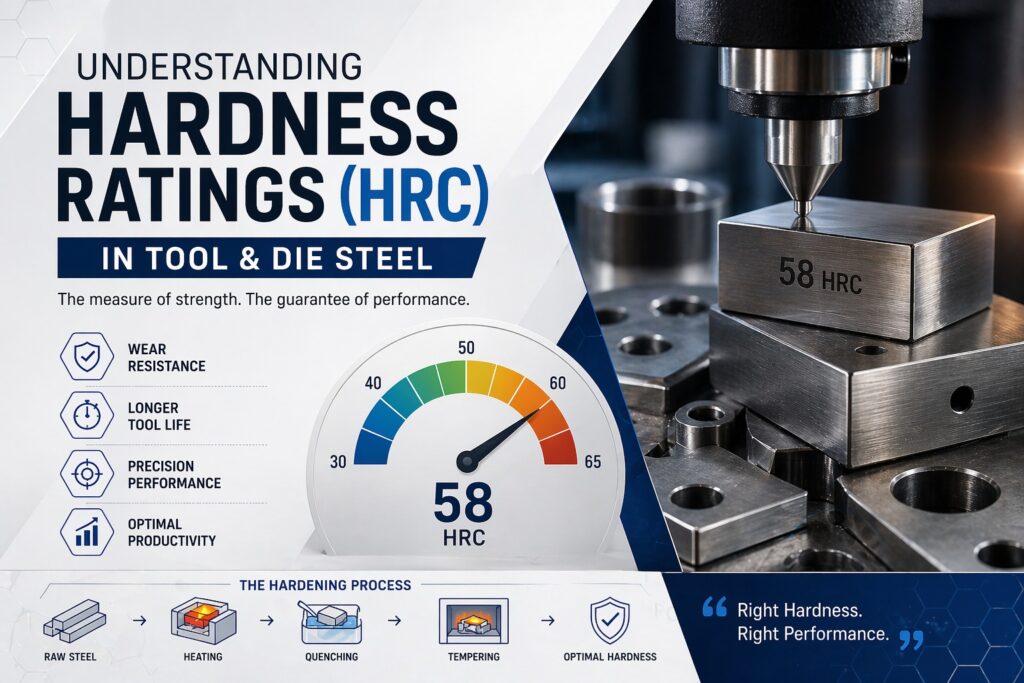
If you’ve ever looked at a tool steel datasheet and wondered what “58 HRC” means and why it matters for your die or mould. Hardness is one of the most critical properties in tool and die steel selection. Get it right, and your tooling performs reliably for thousands of production cycles. Get it wrong, and you’re facing premature wear, unexpected cracking, or both. This complete blog explains what is the Rockwell C scale means, maps HRC ranges to every major tool steel grade, and shows you exactly how to choose the right hardness for your application.
What is Hardness in Steel and Why Does It Matter?
In simple terms, hardness is a material’s ability to resist dents, scratches, or permanent deformation under pressure.
For tool and die steel, hardness is one of the most important properties because it affects:
- Wear resistance – resists abrasion and surface wear
- Edge retention – keeps cutting tools sharper for longer
- Compressive strength – withstands heavy forming pressure
- Dimensional stability – maintains shape and accuracy during production
However, hardness always comes with a trade-off: toughness.
As hardness increases, the steel can become more brittle and prone to cracking under impact.
So, the right steel grade and hardness level should provide the best balance of wear resistance and toughness for the application.
What is the Rockwell Hardness Test?
The Rockwell hardness test is the most widely used hardness measurement method in the tool steel industry.
The Rockwell hardness test checks how hard a material is by measuring how deep a diamond cone goes into its surface.
It works in 3 simple steps:
- Minor load applied – A small force (10 kgf) is applied first to set the starting point and remove surface unevenness.
- Major load applied – A bigger force (150 kgf for HRC) pushes the diamond into the material.
- Load removed – The big force is removed, and the machine measures how deep the mark remains.
Result:
- Less depth = harder material = higher HRC
- More depth = softer material = lower HRC
Understanding HRC -The Rockwell C Scale
HRC stands for Hardness Rockwell C -meaning the result was obtained using the Rockwell C scale. It is the standard unit used to express the hardness of virtually all tool and die steels.
The HRC scale for tool steels runs approximately from 20 HRC(soft, annealed or pre-hardened low-alloy steel) to 68 HRC (the upper limit of conventional hardened tool steel). Here is how the HRC range maps to practical tool steel conditions:
| HRC Range | Condition / Category | In Practice |
| 20-35HRC | Soft / pre-hardened | Easily machined; P20 mould steel supply condition |
| 36-44 HRC | Medium Hardness | Good toughness; forging dies for heavy impact |
| 45-52 HRC | Hard | Balanced wear resistance and toughness; H13 die casting dies |
| 53-60 HRC | Very Hard | High wear resistance; D2 cold work dies, punches |
| 61-66 HRC | Extremely Hard | Maximum wear resistance; M2, M42 high-speed steel cutting tools |
| Above 66 HRC | Ultra Hard | Extremely brittle; not typical for standard die steels |
HRC vs HRB vs HRA — Which Scale Applies to Tool Steel and Die steels?
| HRC | HRB | HRA |
| Indenter: Diamond cone | Indenter: 1/16″ steel ball | Indenter: Diamond cone |
| Major load: 150 kgf | Major load: 100 kgf | Major load: 60 kgf |
| Range: Approx 20–70 HRC | Range: Approx 0–100 HRB | Range: for very hard materials |
| Used For: All hardened and heat-treated tool steels, die steels, high-speed steels, and hardened alloy steels | Used For: Softer steels (mild steel, annealed low-alloy steel), copper alloys, aluminium alloys | Used For: Cemented carbides, case-hardened surfaces, thin hardened layers |
You cannot directly compare numbers from different Rockwell scales. 60 HRC and 60 HRB are not equivalent, they refer to completely different hardness levels. Always confirm which scale a hardness value is expressed in before comparing materials.
HRC vs Brinell (HB) vs Vickers (HV): Approximate conversion table for tool steel
While HRC is the standard for tool steel, you will also encounter Brinell (HB or HBW) and Vickers (HV) hardness values — particularly on material certificates from European suppliers who use DIN specifications.
| HRC | HB (Brinell) | HV (Vickers) | Approx. Tensile Strength |
| 20 | 226 | 238 | ~780 MPa |
| 25 | 253 | 266 | ~870 MPa |
| 30 | 286 | 302 | ~995 MPa |
| 35 | 327 | 345 | ~1140 MPa |
| 40 | 371 | 392 | ~1310 MPa |
| 45 | 421 | 446 | ~1500 MPa |
| 48 | 455 | 481 | ~1630 MPa |
| 50 | 481 | 509 | ~1720 MPa |
| 52 | 512 | 544 | ~1820 MPa |
| 55 | 560 | 595 | ~1980 MPa |
| 58 | 615 | 655 | ~2160 MPa |
| 60 | 654 | 697 | ~2280 MPa |
| 62 | 746 | 746 | ~2400 MPa |
*Note: These are approximate conversions. For precise engineering calculations, always use the original test method. Conversion between hardness scales involves empirical estimates, not exact equivalences. *
HRC Ranges for Common Applications — Quick Reference
If you are selecting tool steel hardness based on the application & the grade, here is a practical quick-reference guide:
| Application | Recommended HRC | Recommended Grade |
| Aluminium die inserts | 44–48 HRC | H13 tool steel / DIN 1.2344 ESR |
| Aluminium extrusion dies | 48–52 HRC | H13 tool steel / DIN 1.2344 |
| Hot forging dies (heavy hammers) | 40–45 HRC | H13 or H11 |
| Hot forging dies (mechanical press) | 46–50 HRC | H13 |
| Cold stamping and blanking dies | 58–62 HRC | D2 tool steel / DIN 1.2379 |
| Cold forming and bending dies | 56–60 HRC | D2 or A2 |
| Plastic injection mould cavities | 48–54 HRC | H13 or P20+Ni |
| Plastic injection mould bases | 28–32 HRC | P20 / DIN 1.2311 |
| Drill bits and taps | 62–65 HRC | M2 / DIN 3343 |
| Cutting and slitting knives | 58–62 HRC | D2 or M2 |
| Punches (light impact) | 58–62 HRC | D2 |
| Punches (heavy impact) | 52–58 HRC | H13 |
| Gauges and measuring tools | 58–64 HRC | D2 or EN31 |
What Happens if HRC is Too High or Too Low?
1. If HRC is too high
The die becomes too hard and brittle.
- More chances of cracking or breaking under impact or stress
- In hot work, heat checking (small surface cracks) starts earlier
- Sharp corners and weak areas may fracture suddenly
- Failure can happen without warning
2. If HRC is too low
The die becomes too soft.
- Surface wears out quickly
- Shape and size accuracy reduce over time
- Can deform permanently under heavy pressure
- In die casting, molten metal may stick to the die (soldering)
- In cutting/stamping, edges become dull or chip fast
- Failure is gradual, but die life becomes much shorter
So, the correct HRC should balance hardness and toughness for the application.
What to check on the MTC
1. Verify the hardness is within the specification for the supply condition. H13 in annealed supply should not exceed 229 HBW. Higher values may indicate the material was not properly annealed.
2. Check for uniformity. If multiple hardness readings are reported from different locations in the bar, they should be consistent. Large variation in hardness across a section is a warning sign of segregation or poor annealing.
3. Confirm the test method. Brinell (HBW) and Vickers (HV) hardness values on the certificate are not directly comparable to HRC values you may see on a datasheet — use the conversion table above if comparison is needed.
4. For pre-hardened grades (P20): Verify the HRC range corresponds to 28–32 HRC. Values outside this range may indicate the steel will machine differently than expected or may not meet the performance requirements of the mould design.
Frequently Asked Questions
1. What HRC stands for in steel?
HRC stands for Hardness Rockwell C, a standard hardness scale for hardened tool steels. Higher HRC means harder and more wear-resistant steel.
2. What HRC is H13 tool steel?
H13 is typically hardened to 40–52 HRC depending on use:
- Die casting: 44–48 HRC
- Extrusion/plastic moulds: 48–52 HRC
- Forging dies: 40–44 HRC
3. What is the HRC of D2 steel?
D2 is usually hardened to 55–62 HRC for stamping and blanking applications.
4. What is the difference between HRC and HB hardness?
HRC uses a diamond cone and measures depth; HB (Brinell) uses a ball indenter and measures impression size.
5. Is higher HRC always better for dies?
No. Higher HRC improves wear resistance but reduces toughness, increasing crack risk.
6. What HRC should I specify for a plastic injection mould?
- P20: 28–32 HRC
- H13: 48–52 HRC for longer runs or abrasive materials
7. Can I check tool steel hardness without a lab?
Yes. Use portable Rockwell or Leeb hardness testers for quick on-site checking.
8. What hardness should I specify when ordering H13?
H13 is usually supplied soft-annealed (max 229 HBW) for machining or can be supplied pre-hardened (30–36 HRC) / fully hardened as required.
9. Why do two steels with the same HRC perform differently?
HRC alone doesn’t tell the full story & performance also depends on:
- Chemical composition
- Heat treatment quality
- Grain structure
- Alloying elements
10. What is the HRC of DB6 steel for forging dies?
For forging dies, DB6 is commonly used around 38–42 HRC to balance toughness and wear resistance. It is known for better toughness than H13 in heavy-impact applications.
- Pre-hardened condition: 360–430 BHN (approx. 38–45 HRC)
- Fully hardened / heat-treated: up to 50–55 HRC
- Annealed condition: max 240–255 BHN
Conclusion
At Virat Steels, we help customers across India choose the right tool steel grade, correct HRC, and suitable size/form for die casting, forging, extrusion, and plastic moulding applications backed by stock availability, test certificates, and ultrasonic-tested material.
📞+91 98140-21775 | 🌐 www.viratsteels.com | ✉ info@viratsteels.com
Hot Work vs Cold Work Tool Steel | H13 vs D2 | Virat Steels
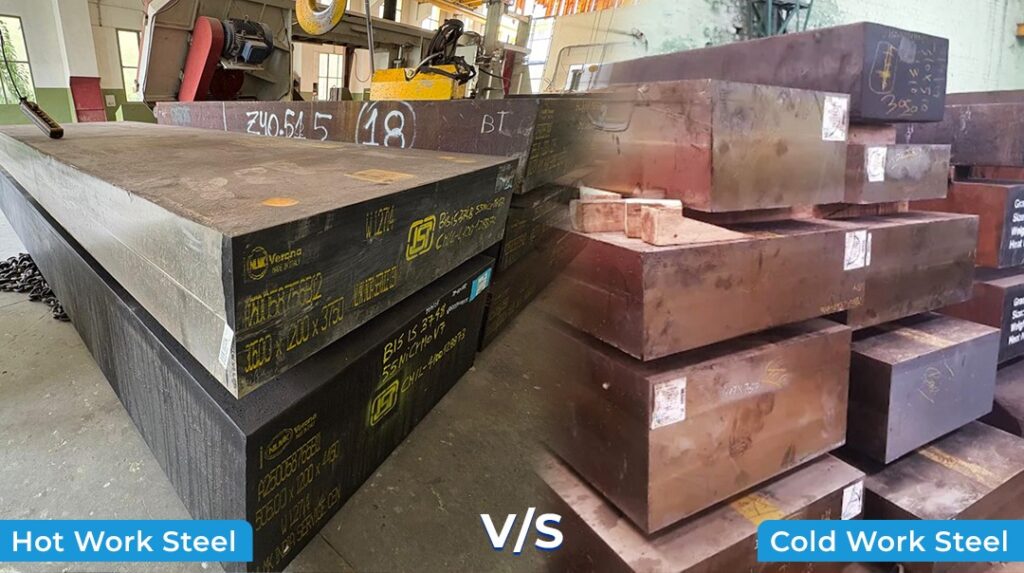
In tooling, one decision quietly determines tool life, rejection rate, and production cost: choosing the right tool steel.
Yet many failures on the shop floor come down to one mistake—using hot work steel where cold work is needed, or vice versa.
This guide will give you a clear, practical comparison between hot work and cold work tool steels—so you can make the right decision the first time.
Hot Work Tool Steel (For High Temperature Applications)
The most widely used grade: H13 tool steel
Best For:
- Aluminium die casting
- Forging dies
- Extrusion tools
- High-temperature moulds
Key Benefits:
✔ Handles extreme heat (200–700°C)
✔ Resists thermal cracking
✔ High toughness under load
Cold Work Tool Steel (For Wear Resistance)
A leading grade: D2 tool steel
Best For:
- Blanking & punching dies
- Shear blades
- Cold forming tools
- Sheet metal industry
Key Benefits:
✔ Very high hardness (up to 60+ HRC)
✔ Excellent wear resistance
✔ Long life in cutting operations
Hot Work vs Cold Work Steel — Quick Comparison
| Feature | Hot Work Steel (H13) | Cold Work Steel (D2) |
| Temperature | High | Low |
| Hardness | Medium | Very High |
| Toughness | High | Moderate |
| Wear Resistance | Medium | Very High |
| Heat Resistance | Excellent | Poor |
| Best Use | Die casting, forging | Cutting, punching |
Using the Wrong Steel? Here’s What Happens
- Cold work steel in hot application → Cracks & failure
- Hot work steel in wear application → Rapid wear & loss of accuracy
Result: Downtime, rejection, and higher cost per component
How to Choose the Right Tool Steel
Choose Hot Work Steel if:
- Temperature > 200°C
- Thermal cycling is involved
- Impact load is high
Choose Cold Work Steel if:
- Application is at room temperature
- Wear resistance is critical
- Cutting or shearing is involved
Industry-Wise Recommendation
| Industry | Recommended Steel |
| Die Casting | H13 |
| Forging | H13 / H11 |
| Sheet Metal | D2 |
| Blanking | D2 / D3 |
| Plastic Mould (High Temp) | H13 |
Increase Tool Life — Proven Methods
For Hot Work Steels:
- Use ESR quality material
- Apply nitriding
- Ensure proper preheating
- Control cooling cycles
For Cold Work Steels:
- Maintain correct hardness
- Use coatings (PVD)
- Avoid shock loading
- Ensure lubrication
Virat Steels — Your Tool Steel Partner
At Virat Steels, we help manufacturers reduce failure and increase tool life with the right material selection.
What You Get:
✔ Ready stock (rounds, flats, blocks)
✔ Ultrasonic tested material
✔ Fast delivery across India
✔ Technical guidance (not just supply)
FAQs?
1-Which is better: H13 or D2?
It depends on application.
- High temperature → H13
- High wear → D2
2-Can D2 be used for hot work?
No. D2 tool steel becomes brittle at high temperatures and may crack.
3-Does higher hardness mean better tool life?
Not always. Excess hardness reduces toughness and increases cracking risk.
4-What is the best steel for die casting?
H13 tool steel is the industry standard.
5. How does heat treatment differ between the two?
Hot work steels are heat-treated to maintain strength at high temperatures
Cold work steels are treated to achieve maximum hardness and wear resistance
6. Which is more expensive: hot work or cold work steel?
Hot work steels are often more expensive due to alloying elements and processing required for high-temperature performance.
7. What industries rely heavily on hot work steel?
Automotive forging, Aluminium die casting, Aerospace component manufacturing
8. What industries rely on cold work steel?
Sheet metal fabrication, Tool and die making, Packaging and appliance manufacturing
9. Which steel has longer tool life?
It depends on the application:
- Hot work steel lasts longer in high-temperature application.
- Cold work steel lasts longer in abrasive, low-temperature operations.
Get Expert Recommendation (Free Consultation)
Choosing the right steel can double your tool life.
- Stop tool failures before they happen.
- Choose the right steel with expert guidance from Virat Steels.
Share your application—we’ll recommend:
- Best grade with quality
- Ideal hardness
- Heat treatment process
Talk to our experts today:
🌐 viratsteels.com 📞 +91 98140-21775 ✉info@viratsteels.com
Why H13 Dies Fail Prematurely — And How to Prevent It
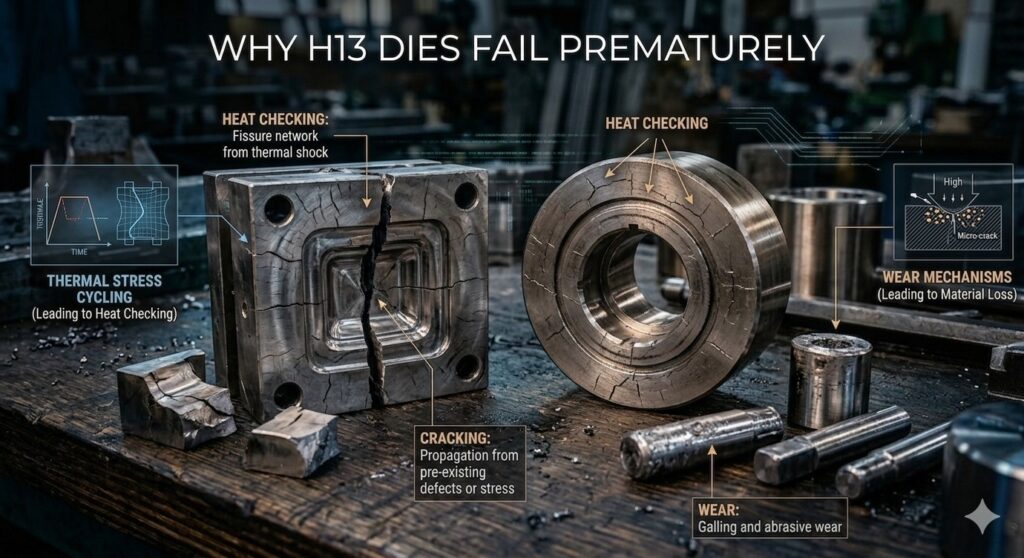
H13 tool steel is the backbone of hot work tooling—widely used in die casting, forging, extrusion, and moulding. When processed correctly, it delivers long life and consistent performance.
Yet many H13 dies fail far earlier than expected.
That’s not a material problem—it’s a process problem.
What is Premature Failure?
Premature failure means a die cracks, wears out, or loses accuracy well before its expected production life—leading to downtime, rejection, and high tooling costs.
Top Reasons H13 Dies Fail Early
1. Heat Checking (Thermal Fatigue)
Repeated heating and cooling creates fine surface cracks (like dry mud). Over time, these cracks grow and damage the die surface.
Why it happens faster:
- Excessive cooling (thermal shock)
- Over-hardening (brittleness)
- No preheating before production
Prevention: Controlled cooling, correct hardness, nitriding, ESR-grade steel.
2. Gross Cracking & Fracture
Deep cracks or sudden die breakage.
Causes:
- Over-hardening
- Poor tempering (retained austenite)
- Sharp corners (stress concentration)
- Thermal shock
Prevention: Proper heat treatment, multiple tempering cycles, better die design.
3. Abrasive Wear & Erosion
Gradual loss of dimension and surface finish.
Causes:
- Low hardness
- High temperatures
- Poor lubrication
- High metal flow (in die casting)
Prevention: Correct hardness, lubrication, nitriding/PVD coatings.
4. Poor Heat Treatment
Even premium H13 fails if heat treatment is wrong.
Common mistakes:
- Incorrect hardening temperature
- Uneven quenching
- Single tempering
- Surface decarburisation
Prevention: Vacuum heat treatment + double/triple tempering.
5. Low Steel Quality
Not all H13 is equal.
Standard grades may contain inclusions and segregation—leading to early cracks.
Better choice:
ESR process H13 — cleaner, tougher, longer life.
6. Design & Machining Errors
Even perfect steel fails with poor design.
Common issues:
- Sharp corners
- Thin sections
- Poor cooling line placement
- EDM layer without re-tempering
Prevention: Smooth radii, balanced design, proper finishing.
7. Poor Lubrication & Cooling
Operational mistakes accelerate failure.
- Uneven cooling → thermal stress
- Poor lubrication → wear & soldering
- Hard water scaling → overheating
8. No Preheating
A cold die entering production faces instant thermal shock.
Recommended:
- Die casting: 180–250°C
- Forging: 150–200°C
How to Extend H13 Die Life
- Use ESR-quality H13 steel
- Maintain correct hardness (not “harder is better”)
- Ensure proper heat treatment (multi-temper)
- Apply nitriding or coatings
- Design with proper radii & cooling layout
- Always preheat before production
Conclusion
H13 failure is rarely random—it’s almost always preventable.
The biggest difference between short life and long life?
Material quality + process control.
Start with the right steel. Execute the process right.
And H13 will deliver the performance it’s known for.
Frequently Asked Questions
Q1: Why is H13 preferred for hot work dies?
Excellent hot strength
Good thermal fatigue resistance
High toughness
Q2: What is the main cause of heat checking in H13?
Repeated thermal cycling (heating + cooling)
Q3: How can heat checking be reduced?
Proper die preheating (150–300°C typically)
Controlled cooling (avoid sudden quenching)
Use of thermal barrier coatings
Q4: What hardness is ideal for H13 dies?
Typically 44–52 HRC depending on application
Too hard → cracking
Too soft → wear
Q5: How does nitriding help H13 dies?
Increases surface hardness
Improves wear resistance
Delays crack initiation
Q6: What is the role of cooling channels?
Maintain uniform temperature
Reduce thermal gradients
Prevent hot spots → reduce cracking
Q7: Can coatings completely prevent wear?
No, but they significantly delay it
Coatings improve life, not eliminate failure
Q8: Why do dies soften over time?
Overexposure to high temperatures beyond tempering limit
Q9: What industries commonly face H13 die failure?
Die casting (aluminum, zinc)
Forging
Extrusion
| Ready to Source H13 Smarter? Contact Virat Special Steels Today |
Fast quotes | Grade recommendations | Pan-India delivery
https://www.viratsteels.com/h13.html📧 info@viratsteels.com | 📱 +91 98140-21775
H13 vs D2 Steel – Which is Better for Hot Work vs Cold Work Dies?
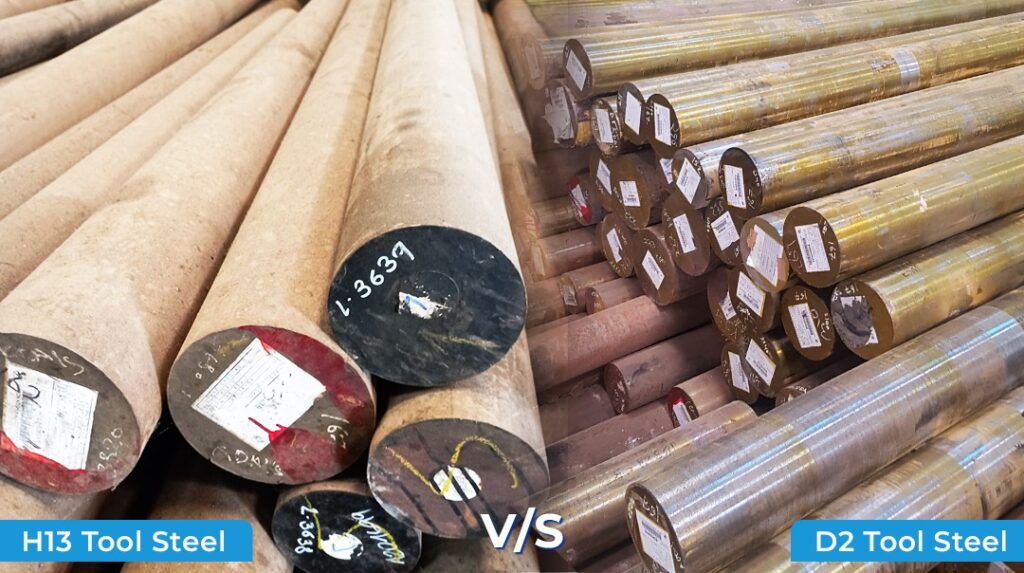
[The definitive guide to selecting the right die steel for forging, extrusion, stamping, and forming applications.]
In the tool and die manufacturing industry, selecting the right tool steel grade directly impacts die life, productivity, and cost efficiency. Among the most widely used grades, H13 tool steel and D2 tool steel are industry standards. but they’re specialists in different temperature.
At Virat Steels, we help manufacturers choose the right steel based on application, performance, and long-term value.
Understanding Tool Steel Categories
Tool steels are broadly classified into:
- Hot Work Tool Steel – Designed for high-temperature operations
- Cold Work Tool Steel – Used at room temperature for cutting and forming
What is H13 Steel? (Hot Work Tool Steel)
H13 steel (DIN 1.2344 / SKD61) is a chromium-molybdenum hot work tool steel known for its ability to withstand extreme heat and thermal cycling.
Key Properties:
- Excellent hot hardness & thermal fatigue resistance
- High toughness and crack resistance
- Strong performance under repeated heating & cooling cycles
H13 retains hardness even above 500°C, making it ideal for high-temperature applications.
Applications:
- Die casting dies
- Hot forging dies
- Extrusion tooling
- Injection mould cores
H13 is the best choice for hot work dies where heat resistance and durability are required.
What is D2 Steel? (Cold Work Tool Steel)
D2 steel is a high carbon, high chromium cold work tool steel designed for maximum wear resistance and hardness.
Key Properties:
- Very high wear resistance
- High hardness (up to 62 HRC)
- Excellent edge retention
- Good dimensional stability
Applications:
- Cold stamping dies
- Blanking and punching tools
- Shear blades
- Cutting tools
D2 performs best in low-temperature, high-wear environments.
H13 vs D2 Steel — Detailed Comparison
| Property | H13 Tool Steel (Hot Work) | D2 Tool Steel (Cold Work) |
| Type | Hot work steel | Cold work steel |
| Hardness | Medium (48–52 HRC) | Very high (58–62 HRC) |
| Heat Resistance | Excellent | Poor at high temperature |
| Wear Resistance | Good | Excellent |
| Toughness | High | Moderate |
| Thermal Fatigue | Excellent | Low |
| Best Use | Hot dies & high-temp tools | Cutting, stamping & cold dies |
Key difference:
- H13 = Heat resistance + toughness
- D2 = Wear resistance + hardness
When to Choose H13 Steel?
Choose H13 tool steel when your application involves:
- High operating temperatures
- Continuous heating & cooling cycles
- Risk of thermal cracking
Typical industries:
- Automotive die casting
- Aluminium extrusion
- Forging industries
H13 provides longer die life and reduced downtime in hot work applications.
When to Choose D2 Steel?
Choose D2 steel when your requirement is:
- High wear resistance
- Sharp cutting edges
- Dimensional stability
Typical industries:
- Sheet metal stamping
- Tool manufacturing
- Cold forming operations
D2 provides superior wear life in cold work applications.
H13 vs D2: Which One is Better?
The H13 vs D2 decision comes down to one primary question: Will your die contact hot workpieces above 200°C?
If the answer is yes: if you’re doing die casting, hot forging, or extrusion, then H13 is your steel. Its thermal fatigue resistance is unmatched in the tool steel sector, and using D2 in these applications will result in catastrophic heat checking and premature failure.
If the answer is no: if your application is stamping, blanking, forming, or precision cold work, then D2 is almost always the superior choice. Its wear resistance, dimensional stability during hardening, and edge-holding capability far exceed what H13 can deliver at ambient temperatures.
In simple terms:
- Heat present? → Go with H13
- Only wear & cutting? → Go with D2
Why Choose Virat Steels for Tool Steel?
At Virat Steels, we supply premium quality:
- H13 tool steel (hot work applications)
- D2 tool steel (cold work applications)
- Custom-cut tool steel blocks
- Ultrasonic tested materials for reliability
What sets us apart:
- Consistent quality & certified grades
- Fast delivery across industrial hubs
- Technical guidance for grade selection
We don’t just supply steel—we help you choose the right steel for maximum performance.
Frequently Asked Questions –
1. Can D2 steel be used for hot work applications?
No. D2 is not suitable for hot work. It becomes brittle at high temperatures and cracks under thermal cycling. For applications above 200–250°C, use H13 or other H-series steels.
2. Is D2 or H13 harder?
D2 is harder (up to 62 HRC) than H13 (up to ~54 HRC). However, H13 performs better in high-temperature conditions due to its toughness.
3. What is the difference between H13 and H11?
H13 has higher wear resistance and hot strength, while H11 offers slightly better toughness. H13 is more commonly used for die casting and forging.
4. Is D2 the same as Cr12MoV?
Almost. Cr12MoV is the Chinese equivalent of D2 with very similar composition and performance, and they are generally interchangeable.
5. How do I weld H13 steel die inserts?
Preheat to 300–400°C, use matching filler wire, maintain temperature, and cool slowly. Post-weld tempering is essential. Welding D2 is not recommended due to crack risk.
Final Thoughts
Choosing between H13 vs D2 steel depends entirely on your application:
- H13 dominates in heat-intensive operations
- D2 leads in wear-intensive, cold conditions
Making the right choice can significantly improve: Tool life , Production efficiency, Overall cost savings.
Need D2 or H13 for Your Next tool steels project?
Get a fast quote — certified stock, ready to dispatch across India:
www.viratsteels.com | 📧 info@viratsteels.com | 📱 +91 98140-21775
P20 vs H13 — Best Choice for Long-Run Plastic Moulds Plastic Mould Steel · Grade Comparison · Virat Special Steels
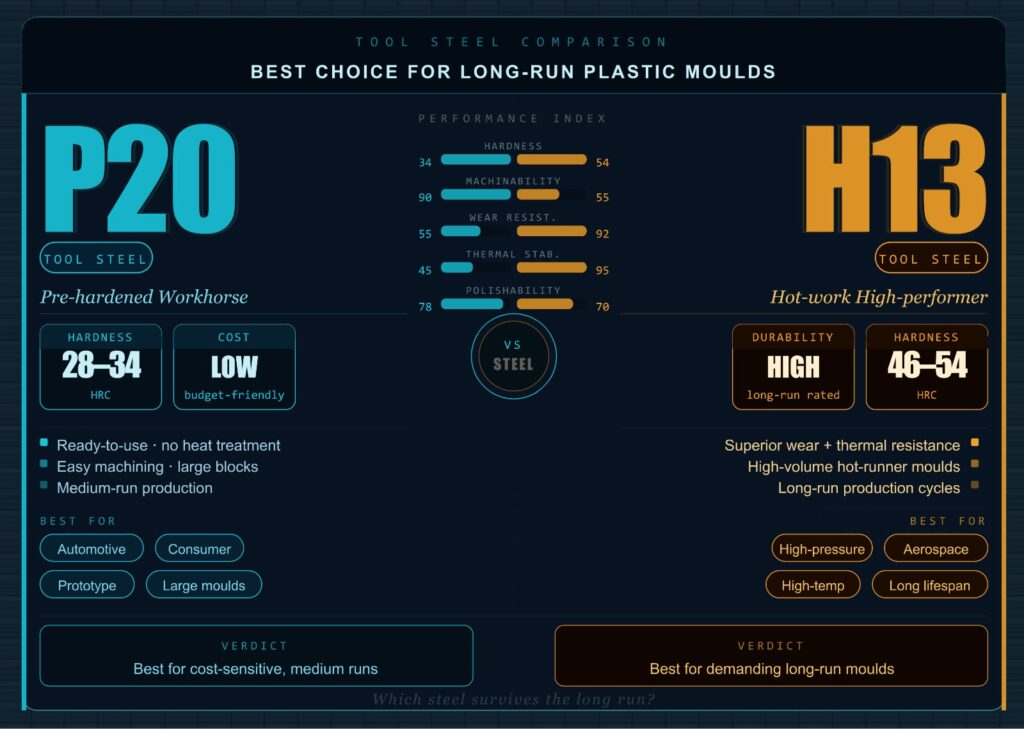
A practical, application-first guide for mould makers, tool rooms, and procurement teams choosing between two most popular plastic mould steel grades.
Choosing the wrong mould steel doesn’t just cost money — it costs production runs, surface finish quality, and mould life. Here’s how to pick the right one.
At a Glance: P20 vs H13
The table below gives a side-by-side view of both grades across the most critical properties mould buyers evaluate:
| P20 Steel Pre-hardened Mould Steel | H13 Steel Hot Work Tool Steel |
|---|---|
| Hardness 28–34 HRC (pre-hardened) | Hardness 44–52 HRC |
| Toughness High | Toughness Very High |
| Polishability Good | Polishability Excellent |
| Machinability Excellent | Machinability Moderate |
| Mould Life Up to 5,00,000 shots | Mould Life 10,00,000+ shots |
| Heat Treatment Not required | Heat Treatment Required (vacuum) |
| Tool Cost Lower | Tool Cost Higher |
| Lead Time Short | Lead Time Longer |
Detailed Property Comparison
| Property | P20 Steel | H13 Steel |
|---|---|---|
| Hardness after HT | 28–34 HRC (pre-hardened) | 44–52 HRC |
| Wear Resistance | Moderate | High |
| Toughness | High | Very High |
| Machinability | Excellent (no HT needed) | Moderate (HT required) |
| Thermal Fatigue Resistance | Low | Very High |
| Tool Cost | Lower | Higher |
| Lead Time | Short (ready to machine) | Longer (HT required) |
| Mould Life | Up to 5,00,000 shots | 10,00,000+ shots |
| Corrosion Resistance | Low | Moderate |
Which Steel is Best for Long-Run Moulds?
✅ Choose P20 if:
· Production volume is moderate
· Budget is limited
· Faster delivery is required
· Plastic material is non-abrasive
✅ Choose H13 if:
· Production volume is very high
· You need long mould life
· Material is abrasive or high temperature
· Dimensional stability is critical
| Which Grade Should You Pick? P20 for speed & cost · H13 for volume & finish |
If you need a mould quickly, at a lower cost, for regular plastics and medium production, go with P20.But if you’re producing in high volumes, using abrasive or glass-filled materials, or need a long-lasting, mirror-finish mould (over 10 lakh shots), choose H13.
Industry Applications in India
Both P20 and H13 are widely used across India’s plastics and automotive tooling industry. Here’s where each grade dominates:
| Industry | Recommended Grade | Reason |
| Automotive | H13 | High volume, tight tolerances, long mould life |
| Consumer Appliances | P20 | Medium run, cost-sensitive, faster delivery |
| Packaging (Caps & Closures) | H13 | Very high shot count, abrasion resistance |
| Electronics Housing | P20 / H13 | Depends on run volume and finish requirements |
| Medical Device Components | H13 (ESR Grade) | Mirror finish, cleanliness, long run |
| Soft Tooling | P20 | Quick machining, lower cost, short lead time |
Conclusion
Both P20 and H13 have their place in mould manufacturing—but the choice depends on your production goals:
· P20 = Cost-effective + faster production
· H13 = Long life + high performance
Sourcing P20 and H13 in India
Virat Special Steels stocks both P20 and H13 in ready inventory — supplied with full mill test certificates, hardness test reports, and chemical analysis. Available in round bars, flat bars, and pre-machined blocks across a wide size range.
| Need P20 or H13 for Your Next Mould? Get a fast quote — certified stock, ready to dispatch across India |
Contact our team to get more details about available sizes and technical specifications suitable for your applications.
https://www.viratsteels.com/products.html info@viratsteels.com
+91 98140-21775
Frequently Asked Questions
1. Which is better for long-run plastic moulds, P20 or H13?
H13 — higher hardness, wear resistance, and heat tolerance make it ideal for long runs.
2. What is the difference between P20 and H13?
P20: Pre-hardened, easier to machine, lower cost — best for short/medium runs. H13: Heat-treated, stronger, better for high-temp and high-volume applications.
3. Is H13 worth the higher cost?
Yes — for high-volume production, H13 delivers better ROI over time.
4. When should you choose P20 over H13?
When volume is low/medium, budget is tight, or faster machining/delivery is needed.
5. Which is better for high-temperature injection molding?
H13 — superior thermal fatigue resistance handles higher temps without deformation.
6. Can P20 be used for long-run moulds?
Yes, but it wears faster with abrasive materials and isn’t ideal for very long runs.
7. Which industries prefer H13?
Automotive, electronics, and high-volume packaging — anywhere durability matters.
8. What’s the cost difference?
P20: Lower upfront. H13: Higher initial cost, but better long-term value.
9. Best steel for 1 million cycle production?
H13 — built to withstand extended wear, heat, and stress over massive run counts.
How Virat Special Steels Delivers High-Quality Steel Across India
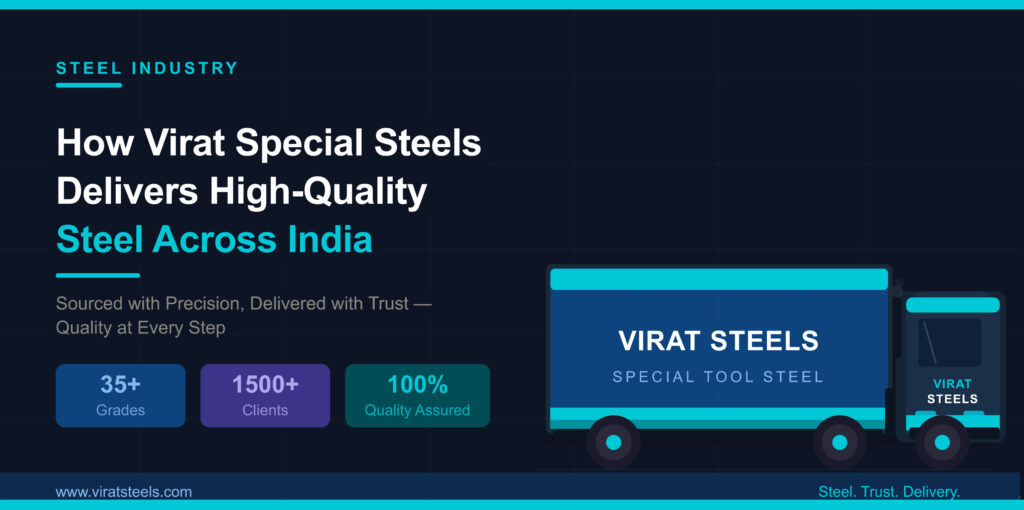
From raw material sourcing to pan-India distribution — a comprehensive look at India’s trusted special steel supplier and manufacturer.
In India where infrastructure is booming and industrial demand for precision tool & die steel is higher, Virat Special Steels has emerged as one of India’s most dependable names in high-quality steel supply and distribution.
| 1957 | 3500 tons | 35+ | 1.5K+ |
| Existence | Stock | Grades | Satisfied Clients |
Who Is Virat Special Steels?
Virat Special Steels is a leading stockist, supplier, and distributor of special and alloy steel products across India. With decades of domain expertise, the company serves industries ranging from automotive and aerospace to defence, tooling, and heavy engineering.
What sets Virat Special Steels apart in the crowded Indian steel market is its unwavering commitment to quality assurance, grade certification, and on-time delivery whether you are a small machine shop or a large-scale manufacturer.
Product Range: Every Grade, Every Need
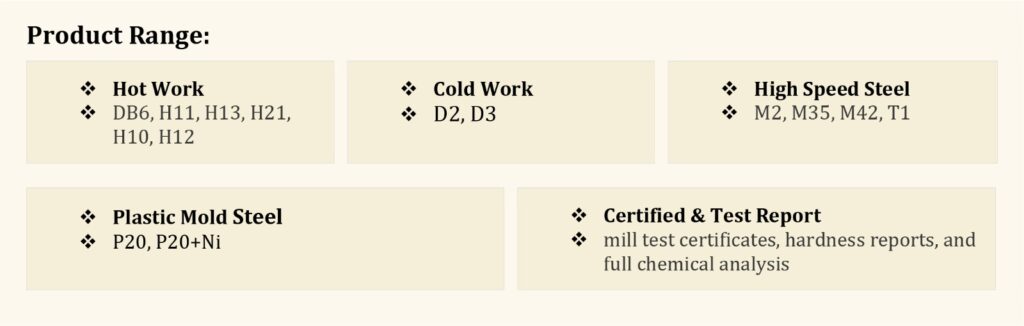
One of the key reasons Virat Special Steels commands trusts across sectors is its vast and diverse product portfolio The company stocks and supplies:
1. Hot Work Steel
DB6, H11, H13, H21, H10, H12—for dies, moulds, and tools that work with heated metals like forging dies, die casting dies, extrusion tools, and hot shearing blades operating at high temperatures (300–700°C).
2. Cold Work Steel
D2, D3– for cutting, punching, blanking, and forming tools that operate at room temperature on unheated workpieces.
3. High-Speed Steel (HSS)
M2, M35, M42, T1— engineered for extreme heat resistance and wear durability in high-speed machining operations.
3. Plastic Mold Steel
P20+Ni , P20 — for manufacturing injection moulds, blow moulds, and compression moulds that shape plastic products in mass production.
4. Certified & Test-Report Backed Steel
Every batch is supplied with original mill test certificates, hardness reports, and full chemical analysis — ensuring complete traceability.
The Supply Chain: How Quality Reaches You
Virat Special Steels operates a streamlined supply chain that ensures product integrity from steel mill to customer workshop. Here is how the process works:
- Sourcing from Certified Global & Domestic Mills — Raw steel is procured from ISO-certified mills in India, Europe, China, Japan, ensuring chemical composition and mechanical properties meet international standards like DIN, AISI, and IS.
- In-House Quality Inspection & Testing — Each incoming lot undergoes spectrometric testing, hardness verification, and dimensional checks before being added to inventory.
- Inventory Management — With large, well-organised warehouses, Virat Steels maintains ready stock of over 35+grades, enabling same-day dispatch for urgent industrial requirements.
- Custom Cutting— Steel is supplied in round bars, flat bars with cutting-to-size services to reduce waste and machining time for buyers.
- Pan-India Logistics & Timely Delivery — Our logistics partners ensure safe, on-time delivery across Pan India. With our offices at GURGAON, LUDHIANA, PUNE & CHENNAI to provide efficient business services to the Industrial undertaking at the location in India.
| Serving India’s Most Critical Industries — Where Failure Is Not an Option |
Why Industries Trust Virat Special Steels
Technical Expertise
Unlike generic steel traders, Virat’s team includes technical team who guide clients on grade selection — ensuring the right steel is used for the right application, reducing rejection rates and improving the productivity .
Consistent Quality with Traceability
Every supply comes with full traceability — heat numbers, TC, composition reports — making Virat’s steel compatible with ISO 9001 quality frameworks.
Competitive Pricing & Fast Quotes
Virat Steels offers market-competitive Quotes are processed quickly, supporting buyers’ procurement timelines without delay.
After-Sales Technical Support
Virat’s technical support team stays with you beyond the sale — helping with heat treatment parameters, machinability ratings, and surface hardness queries.
Frequently Asked Questions
Q1: What makes Virat Special Steels different from regular steel traders?
Virat Special Steels focuses exclusively on tool & die steels offering deep technical knowledge, certified inventory, and grade-specific expertise that other steel traders cannot match.
Q2: Do you supply steel to small businesses and individual buyers?
Yes. Virat serves a wide spectrum from large OEMs to small machine shops. Minimum order quantities are flexible, and enquiries are welcome for any quantity.
Q3: Is same-day or next-day dispatch available?
For grades available in ready stock which covers the majority of popular engineering and tool steel grades same-day dispatch is possible for orders placed before the cut-off time.
Q4: Are mill test certificates provided with every order?
Absolutely. Every supply from Virat Special Steels comes with original mill test certificates covering chemical composition ensuring full traceability.
Q5: Can Virat Steels supply cut to specific sizes?
Yes. Virat offers cutting-to-size and profiling services for round bars, flat bars reducing your raw material waste and machining effort significantly.
Conclusion
By combining advanced infrastructure, a wide product range, and a strong commitment to quality, Virat Special Steels continues to lead as a trusted Tool steel supplier across PAN India. Whether you need a plastic mould steel, tool & die steel, or high-speed steel, the brand delivers unmatched performance, durability, and trust.
| Ready to Source Smarter? Contact Virat Special Steels Today |
Fast quotes | Grade recommendations | Pan-India delivery
📧 info@viratsteels.com | 📱 +91 98140-21775
Top 5 Tool Steel Grades for Die Makers-Complete Comparison
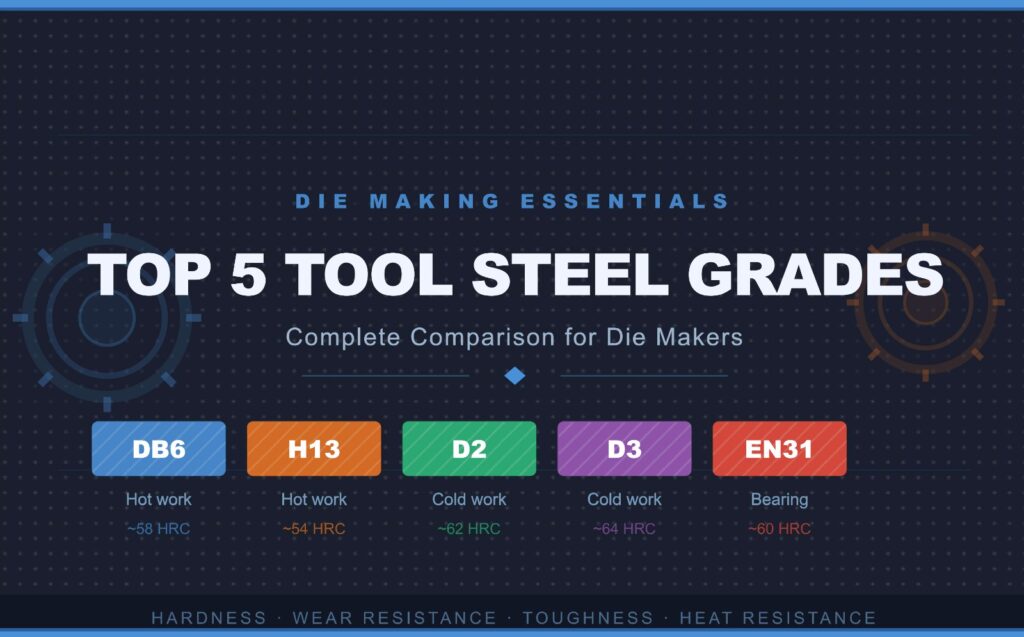
In the tool and die manufacturing industry, the successful production line often begins with one important decision that is choosing the right tool steel grade. When the correct steel is selected, dies last longer, machines run smoothly, and production targets are achieved with consistent quality.
Every manufacturing process has its own demands. A forging die must withstand intense heat and pressure, while stamping dies and cutting tools require exceptional wear resistance and hardness. Similarly, molds need the right balance of toughness and durability to perform reliably over thousands of production cycles.
Over time, die makers have learned that not all tool steels perform the same. Through years of experience and industrial use, certain grades have earned the trust of manufacturers because they consistently deliver strength, durability, and excellent performance on the shop floor. These trusted grades have become the preferred choice for die makers looking to achieve efficiency, reliability, and long die life.
1. DB6 Tool Steel – Advanced Steel for Longer Die Life
DB6 tool steel is gaining popularity among die manufacturers due to its exceptional toughness and wear resistance.
Key Properties
- Superior toughness
- Excellent wear resistance
- High fatigue resistance
- Longer die life
Common Applications
- Forging dies
- Heavy duty stamping dies
- High impact tooling
- Automotive die manufacturing
Why DB6 is Becoming Popular
Compared to conventional tool steels, DB6 offers longer tool life and better performance under heavy loads, which helps reduce downtime and tooling costs.
2. H13 Tool Steel – Best Hot Work Tool Steel
H13 tool steel is one of the most popular hot work tool steels used for applications involving high temperatures.
Key Properties
- Excellent heat resistance
- Good toughness
- High thermal fatigue resistance
- Good strength at elevated temperatures
Common Applications
- Forging dies
- Extrusion dies
- Die casting tools
- Hot stamping dies
Why H13 is Popular
H13 maintains its hardness even at high operating temperatures, making it ideal for hot forging and die casting industries.
3. D2 Tool Steel – High Wear Resistance Grade
D2 tool steel is one of the most widely used cold work tool steels in die manufacturing. It contains a high percentage of chromium, which provides excellent wear resistance and hardness.
Key Properties
- High wear resistance
- Good dimensional stability
- High compressive strength
- Moderate toughness
Common Applications
- Blanking dies
- Punches
- Shear blades
- Cold forming tools
- Stamping dies
Why Die Makers Prefer D2
D2 steel is ideal for applications where abrasion resistance is more important than impact resistance. It helps increase die life in high-production environments.
4. D3 Tool Steel – Maximum Hardness for Cutting Applications
D3 tool steel is another high carbon high chromium cold work steel known for its extremely high hardness and wear resistance.
Key Properties
- Very high hardness
- Excellent wear resistance
- High compressive strength
- Lower toughness compared to D2
Common Applications
- Cutting dies
- Thread rolling dies
- Knives and blades
- Cold extrusion tools
Why Die Makers Use D3
D3 is widely used where cutting performance and wear resistance are critical, especially in heavy duty cutting operations.
5. EN31 Steel – High Hardness Bearing Steel
EN31 steel is a high carbon alloy steel commonly used in tools requiring high hardness and wear resistance.
Key Properties
- High hardness after heat treatment
- Good wear resistance
- Excellent surface finish
Common Applications
- Dies and punches
- Bearing components
- Gauges
- Rollers
Why Die Makers Use EN31
EN31 is often selected for applications requiring fine finish and precision tooling.
Grade Comparison Table
| DB6 Hot work Cr-Mo-V | H13 Hot work Cr-Mo-V | D2 Cold work Hi-Cr | D3 Cold work Hi-Cr | EN31 Bearing Hi-C Cr |
| Standard: DIN 1.2714 | Standard: AISI H13 | Standard: AISI D2 | Standard: AISI D3 | Standard: BS EN31 |
| C content: 0.35% | C content: 0.38% | C content: 1.55% | C content: 2.25% | C content: 1.00% |
| Hardness: 54–58 HRC | Hardness: 48–54 HRC | Hardness: 58–62 HRC | Hardness: 60–64 HRC | Hardness: 58–62 HRC |
| Toughness & durability | Heat resistance | High wear resistance | Maximum hardness | High hardness |
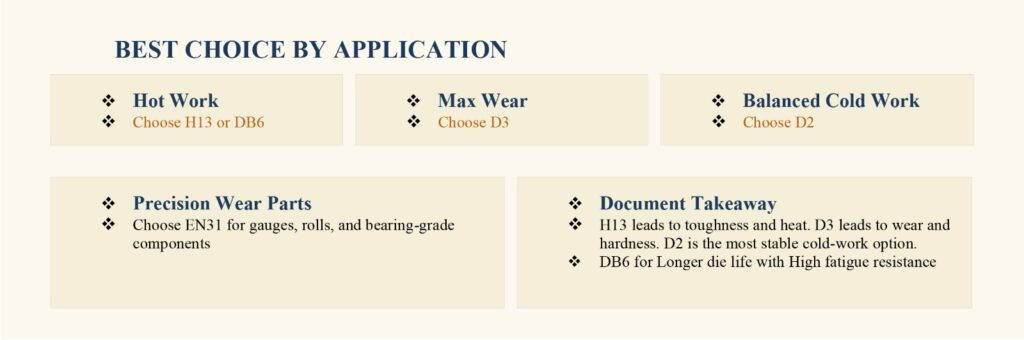
How to Choose the Right Tool Steel Grade
Selecting the right tool steel depends on several factors:
1. Application Type
Cold work operations require D2 or D3, while hot work processes prefer H13.
2. Wear Resistance Requirement
For high wear conditions, D2 or D3 are excellent choices.
3. Impact Resistance
Applications with heavy loads benefit from DB6 tool steel.
4. Temperature Conditions
Hot forming applications require steels like H13 that can withstand high
temperatures.
Why Die Makers Trust Virat Steels
At Virat Special Steels, we supply premium quality tool and die steels for industries such as:
- Automotive manufacturing
- Forging industry
- Die making
- Precision engineering
Our wide range of tool steels ensures that die makers get the right material for maximum performance and durability.
Frequently Asked Questions (FAQs)
1. What is tool steel used for in die making?
Tool steel is used to manufacture dies, punches, moulds, and cutting tools because of its high hardness, wear resistance, and toughness.
2. Which tool steel grade is best for die making?
D2, D3, H13, EN31, and DB6. The best grade depends on the application, such as cold work, hot work, or high-wear operations.
3. What is the difference between D2 and D3 tool steel?
Both D2 and D3 are cold work tool steels with high wear resistance.
- D2 steel offers better toughness and dimensional stability.
- D3 steel provides higher hardness but lower toughness.
4. Why is H13 tool steel used for forging dies?
H13 tool steel is widely used in forging dies because it has excellent heat resistance, toughness, and thermal fatigue strength, allowing it to perform well at high temperatures.
5. Which tool steel provides the longest die life?
Tool steels with a balance of toughness and wear resistance, such as DB6 and H13, are known to provide longer die life in demanding industrial applications.
6. What industries use tool and die steel?
Tool and die steels are widely used in industries such as:
- Automotive manufacturing
- Forging and casting
- Metal stamping
- Plastic moulding
- Engineering and heavy machinery
7. How does the right tool steel improve production efficiency?
Using the right tool steel grade improves die life, reduces maintenance, minimizes downtime, and ensures consistent product quality, which ultimately increases manufacturing productivity.
Conclusion
By understanding the properties and applications of each grade, manufacturers can select the best tool steel for their specificrequirements for increasing production capacity.
Virat Special Steels has built a reputation as one of India’s most trusted suppliers, known for expertise, premium quality, and unmatched stock capabilities of various grades of Tool & Die steels.
📞 Curious about the right size, grades or technical specifications for your application? Our team is ready to guide you.
👉 Explore more: www.viratsteels.com | 📧 info@viratsteels.com | 📱 +91 98140-21775