



DB6 Steel from Virat steels
now browsing by category
NLMK Verona Tool Steel DB6 (DIN 1.2714): Properties, Applications & Supply in India
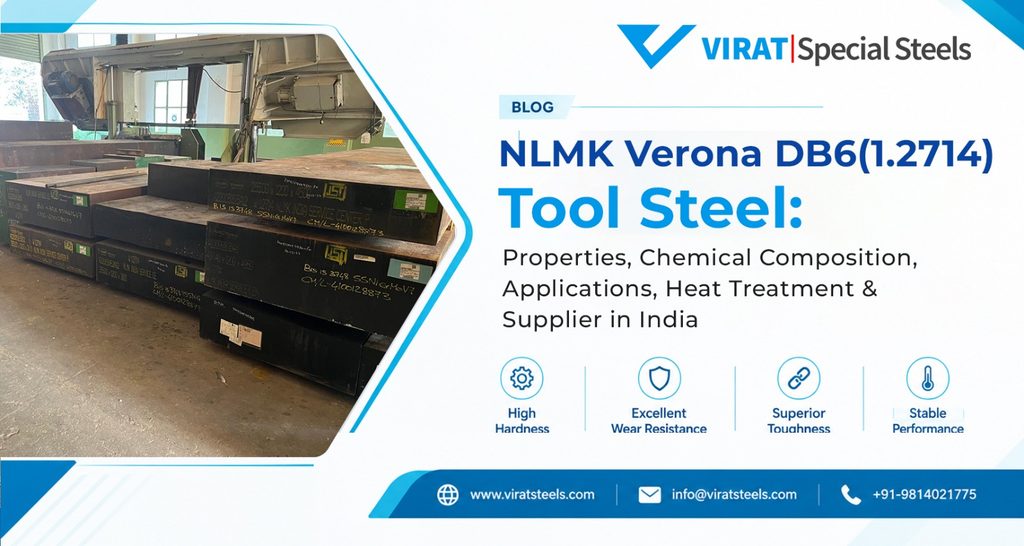
If you own a forging shop, die-making unit or heavy tooling operation, you know that the difference between a die that lasts one production run and one that lasts hundreds comes down to the steel underneath it. NLMK Verona Tool Steel DB6 is one of the European grades that is increasingly being specified by Indian manufacturers for close die forging, hammer dies and heavy-impact tooling – and with good reason.
This guide will explain what NLMK Verona DB6 really is, its real composition and mechanical properties, how it machines and heat-treats, where it is used and how to decide if it is the right grade for your application – all from verified technical data.
What Is NLMK Verona Tool Steel DB6?
NLMK Verona Tool Steel DB6 is a specialty tool steel plant of the NLMK Group, located in the north of Italy, close to Verona. The plant produces forged blocks, plates, and ingots for tool and die applications, and currently supplies its hot-work die steel to the Indian market under the DB6 designation — the specific grade Virat Steels stocks and distributes from this mill.
DB6 is not a proprietary or obscure code. It corresponds to well-established international standards:
| Designation | Standard |
| DB6 | Commercial/trade name |
| DIN 1.2714 | German (Werkstoff) standard |
| AISI L6 | American standard |
| AFNOR 55NCDVV7 | French standard |
| Standard family | 55NiCrMoV (Cr-Ni-Mo-V alloyed hot-work steel) |
To summarize, a buyer searching for “NLMK Verona DB6”, “db6 nmlk verona” or “nmlk verona die steel” is looking for this specific chromium-nickel-molybdenum-vanadium alloyed hot-work die steel, a popular grade in the European and Indian tooling supply chains, now available from NLMK Verona’s Italian production.
Chemical Composition of NLMK Verona Tool Steel DB6 / DIN 1.2714
DB6 is a Cr-Ni-Mo-V alloy system which provides a balance of toughness and hardness:
| Element | C | Si | Mn | P | S | Cr | Ni | Mo | V |
| % Range | 0.50–0.60 | 0.10–0.40 | 0.65–0.95 | ≤0.03 | ≤0.03 | 1.00–1.20 | 1.50–1.80 | 0.45–0.55 | 0.07–0.12 |
DB6 has high toughness and impact resistance (compared to more common hot-work grades such as H13) and high nickel content (compared to more common hot-work grades such as H13) for exceptional toughness and impact resistance rather than pure high-temperature hardness retention.
Mechanical Properties
| Property | Value |
| Tensile Strength | 1000–1400 MPa |
| Yield Strength | 1045 MPa |
| Elongation | 15%–20% |
| Impact Toughness | 20–25 J/cm² |
| Hardness (working) | 50–55 HRC |
| Compressive Strength | 2500 MPa |
| Modulus of Elasticity | 205 GPa |
Typical supply hardness ranges (depending on treatment condition):
- Annealed condition: 255 BHN max
- Hardened & tempered: 38–42 HRC (die-ready condition), with tools further hardened up to 50–55 HRC for service
- Hardness variation, surface to core: 20–25 BHN
Physical Properties
| Coefficient of Thermal Expansion (10⁻⁶ m/m·K) | 20–100°C | 20–200°C | 20–300°C | 20–400°C | 20–500°C | 20–600°C |
| Value | 12.1 | 13.1 | 13.2 | 13.5 | 14.1 | 14.3 |
| Thermal Conductivity (W/m·K) | 20°C | 350°C | 700°C |
| Value | 35.0 | 39.0 | 36.0 |
Note: Exact physical values can vary slightly with heat treatment and section size — always cross-check against the mill test certificate for critical applications.
Machinability of NLMK Verona DB6
DB6 is easy to work and the machinability can be rated at about 90 % relative to W-group water-hardening low-alloy steels taken as the 100 % reference. This makes it much easier to machine than many high-alloy cold-work or high-speed steel grades, and still retains the toughness needed for heavy forging dies.
Practical machining notes:
- Best machined in the annealed condition (≤255 BHN) before final hardening
- Finish machining should ideally be completed before final hardening and tempering, with only grinding/polishing done after
- Stress-relief before hardening reduces distortion risk in large die blocks
Heat Treatment Guide
| Process | Parameters |
| Annealing | Soak at 740–760°C, furnace-cool at max 10°C/hr down to 600°C, then air cool |
| Hardening | Preheat to 650°C, raise quickly to 900–950°C, quench in oil |
| Hardening (mill data) | 840–880°C oil quench → 57 HRC; 860–900°C air quench → 55 HRC |
| Tempering | Multiple tempers; hardness drops from ~56 HRC (100°C temper) to ~34 HRC (650°C temper) |
| Stress Relieving | Heat to 600–650°C, soak 2 hrs per 25mm section, slow cool |
| Forging | Warm to 700°C, raise to 1050°C, keep forging above 800°C, cool slowly in furnace/vermiculite |
| Nitriding | Possible after hardening + tempering; done ~50°C above nitriding temperature |
| Normalizing | Not recommended — DB6 is air-hardening |
Applications of NLMK Verona DB6 Tool Steel
DB6’s high toughness and impact resistance make it especially suited to heavy-impact forging applications rather than pure high-temperature die casting:
- Dies for drop forging hammers & mechanical presses
- Die holders, cassettes, and shoe blocks
- Hot shear blades
- Piston rods, cranks, and boosters
- Punches and blanking/forming dies
- Trimmer dies
- Clutch parts, pawls, shafts, knuckle pins
- Forming rolls, spindles, and rollers
Industries: Automotive component manufacturing, heavy forging, aerospace tooling, general engineering, and metalworking.
Advantages of NLMK Verona DB6 Tool Steel
- Superior toughness and impact resistance compared to many hot-work alternatives — ideal where shock loading, not just heat, is the main stress
- Good hardenability through thick sections, suited to large forging die blocks
- European mill origin (NLMK Verona, Italy) with documented alloy composition
- Good machinability (~90% relative rating) compared to many alloy tool steels
- Nitriding-compatible for surface wear resistance without sacrificing core toughness
- Supplied by Virat Steels with extra forging reduction, upsetting, and double tempering for improved ultrasonic quality in die blocks
DB6 vs H13 vs D2 — Comparison Table
| Factor | DB6 (DIN 1.2714) | H13 (DIN 1.2344) | D2 (Cold Work) |
| Category | Hot-work, high-toughness | Hot-work, high-temp hardness | Cold-work, high wear resistance |
| Key strength | Toughness & impact resistance | Thermal fatigue resistance | Abrasion/wear resistance |
| Typical hardness | 50–55 HRC | ~50 HRC | 58–62 HRC |
| Best suited to | Hammer/press forging dies, shock loading | Die casting, extrusion dies | Blanking, punching, cold forming |
| Machinability | Good (~90% rating) | Good | Moderate (high alloy content) |
| Nickel content | High (1.5–1.8%) | None | None |
How to Choose Between NLMK Verona Tool Steel DB6 (and Other Grades)?
- Is your tooling exposed to repeated impact/shock loading? DB6 is specifically strong here — hammer forging and heavy press dies benefit most from its toughness.
- Is your process purely high-temperature (die casting, hot extrusion) with less shock? H13 (DIN 1.2344) may be a better fit than DB6 due to superior thermal fatigue resistance.
- What supply condition do you need? DB6 is available annealed or hardened & tempered — confirm this at order stage based on your in-house heat treatment capability.
- What section size does your die need? Large forged blocks require good through-thickness hardenability — DB6’s alloy design supports this.
- Do you need surface hardening? DB6 can be nitrided after hardening/tempering for improved wear resistance while keeping core toughness.
- Do you need ultrasonic-tested quality die blocks? Ask specifically for extra forging reduction and double-tempered blocks — Virat Steels supplies DB6 this way for critical forging applications.
Why Source NLMK Verona DB6 Through Virat Steels?
- NLMK Verona origin DB6/DIN 1.2714 Steel – Official stockist and supplier
- PAN-India supply network covering major forging & auto hubs (Ahmedabad, Pune, Chennai, Bengaluru, Delhi NCR, Ludhiana etc.)
- Flat, square, and round bar available in project-based quantities
- Extra forging reduction and double tempering for improved ultrasonic quality on die blocks
- Technical support to confirm the right grade — DB6 vs H13 vs other die steels — for your specific application
Frequently Asked Questions
1. What is NLMK Verona Tool Steel DB6?
It is a Cr-Ni-Mo-V alloyed hot-work die steel (DIN 1.2714 / AISI L6) produced by NLMK Verona, Italy and supplied in India by Virat Steels.
2. What is DB6 steel equivalent to?
DB6 is commonly equivalent to DIN 1.2714, AISI L6, and AFNOR 55NCDVV7.
3. What is the hardness of DB6 steel?
Working hardness is typically 50–55 HRC after hardening and tempering; annealed condition is supplied at 255 BHN max.
4. Is DB6 better than H13 steel?
DB6 provides higher toughness and impact resistance, hence better suited for heavy forging, whereas H13 is more suitable for high temperature hot-work processes such as die casting.
5. Which steel is better for hammer forging dies?
DB6 is generally preferred for hammer forging dies due to its superior toughness and shock resistance.
6. What is the chemical composition of DB6?
Approximately 0.50–0.60% C, 1.00–1.20% Cr, 1.50–1.80% Ni, 0.45–0.55% Mo, and 0.07–0.12% V.
7. Can DB6 steel be welded or re-hardened?
Yes, but it must be done carefully — with stress tempering for pre-hardened condition — to avoid cracking.
8. Is DB6 steel suitable for hot work applications?
Yes, DB6 performs well in hot-work applications due to its strength and toughness at elevated stress conditions.
9. What is the machinability of DB6 steel?
DB6 rates roughly 90% machinability relative to W-group water-hardening steels (100% baseline) — considered good.
10. Should DB6 be normalized?
No — DB6 is air-hardening and should not be normalized.
11. Can DB6 be nitrided?
Yes, after hardening and tempering, at approximately 50°C above the intended nitriding temperature.
12. What shapes is NLMK Verona DB6 available in?
Flat, square, and round bar, supplied by Virat Steels across India.
13. Does Virat Steels supply NLMK Verona DB6 in India?
Yes, Virat Steels is a stockist and supplier of NLMK Verona-origin DB6/DIN 1.2714 tool steel.
14. What industries use DB6 tool steel?
Automotive components, heavy forging, aerospace tooling and general engineering.
15. What is the forging temperature range for DB6?
Heat to 700°C and then raise rapidly to 1050°C. Keep forging temperature above 800°C.
16. What’s the distinction between DB6 and DIN 2713?
The DIN 2713 is improved for better die performance and is called DIN 2714 (DB6).
17. What tensile and yield strength does DB6 offer?
Tensile strength 1000–1400 MPa, yield strength ~1045 MPa.
18. Does DB6 require oil or air quenching?
Both are used. Oil quenching at 840-880 °C gives ~57 HRC. Air quenching at 860-900 °C gives ~55 HRC.
19. What documentation should I request when ordering NLMK Verona DB6?
Always request a mill test certificate (MTC) confirming the heat/batch chemical composition and mechanical test results.
20. Where can I buy NLMK Verona DB6 tool steel in India?
Virat Steels supplies and stocks NLMK Verona DB6/DIN 1.2714 steel PAN-India, including to Gurugram, Delhi NCR, Pune, Chennai, and other major industrial hubs.
Conclusion
NLMK Verona Tool Steel DB6 (DIN 1.2714 / AISI L6) is the best solution for one simple reason: toughness where it counts – in heavy forging dies subject to repeated shock loading. Its Cr-Ni-Mo-V alloy design, excellent machinability and good hardenability make it a preferred choice for forging shops and die makers across India.
Need NLMK Verona DB6 die blocks, flats, squares, or round bars for your next forging project? Get in touch with Virat Steels — share your drawing and section size requirement, and our team will confirm grade, stock availability, and delivery timelines.
+91-98140 21775 | info@viratsteels.com
Hot Work Tool Steel: Grades, Properties, Hardness, Heat Treatment & Applications
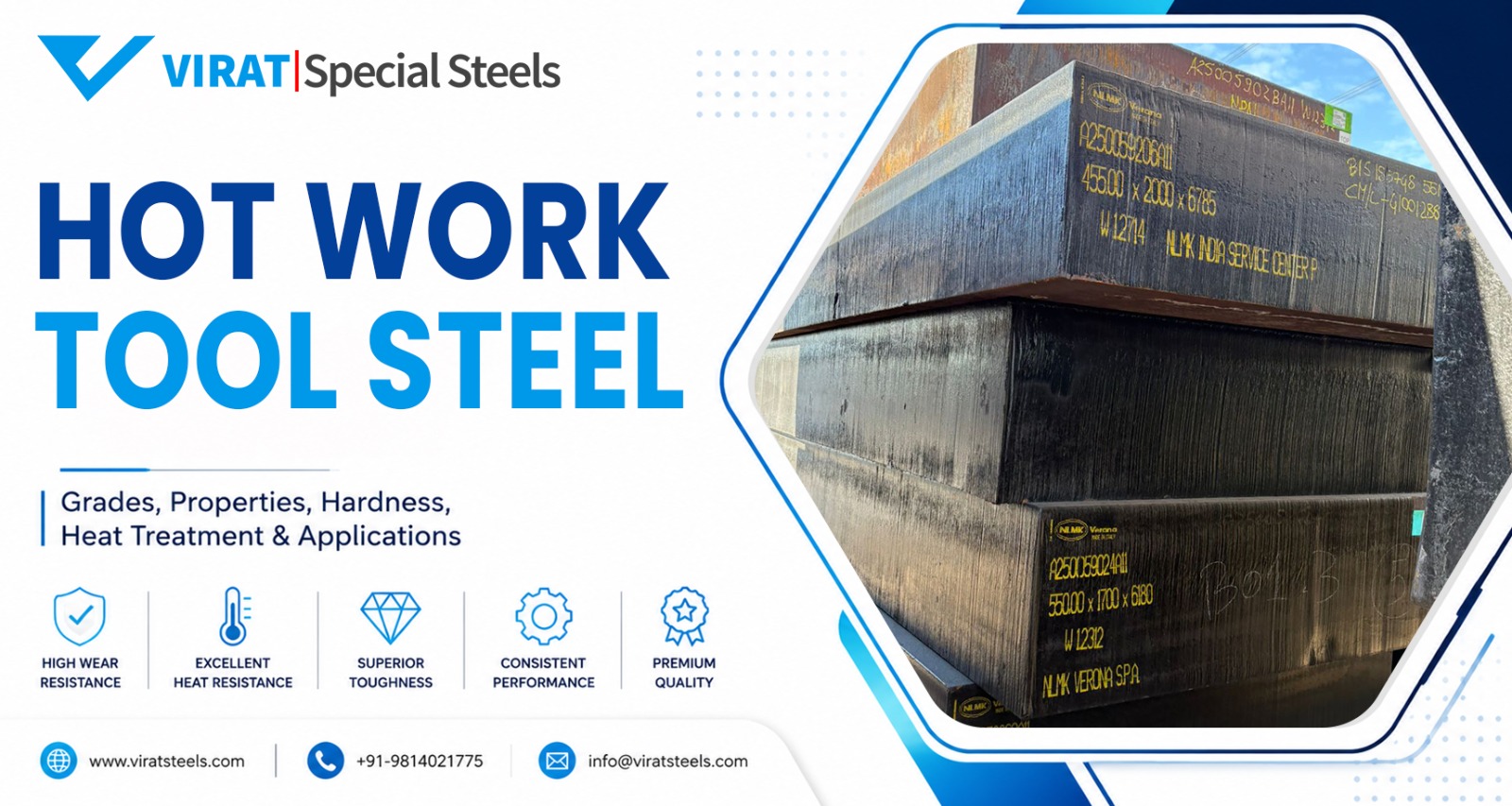
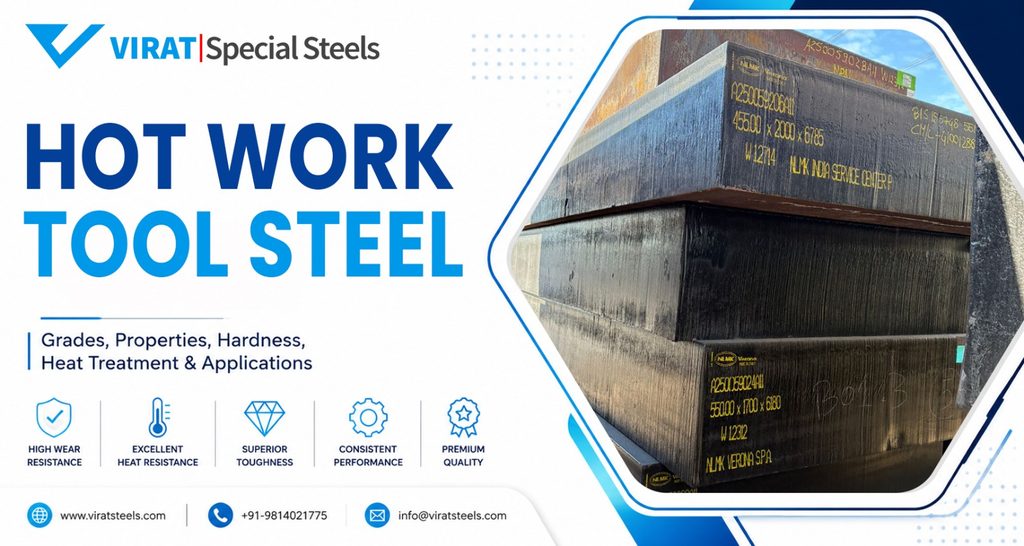
Hot work tool steel is designed for one purpose – to resist heat that would ruin common steel. It is the material behind the dies, molds, punches and blades that are hammered and squeezed and repeatedly heated and cooled – in die casting, forging, extrusion, hot stamping and hot shearing.
And what makes it different is easy to say and hard to engineer. It keeps its hardness, toughness, strength and dimensional stability, even when it’s hot. The most common grades you’ll come across are H13 (DIN 1.2344), H11 (DIN 1.2343) and DB6 (DIN 1.2714) — which one you need depends on your operating temperature, impact load, die size and how long you want the tool to last.
What Is Hot Work Tool Steel?
It’s an alloy tool steel for tools that get hot and cycle between hot and cold, again and again. It must be a combination of hot hardness, toughness, wear resistance, thermal-fatigue resistance and dimensional stability — all at the same time.
The Three Grades You Should Know:
- H13 / DIN 1.2344 – the go-to grade for die casting, aluminum extrusion and hot forging.
- H11 / DIN 1.2343 — good balance of toughness and hot strength, for forging and extrusion.
- DB6 / DIN 1.2714 – the choice for large forging dies, hammer dies and heavy-impact work where toughness is the most important property.
The final choice should always be based on the application and the steel maker’s datasheet, not on a general guide like this.
Hot work tool steel is a high-alloy steel for tooling operating at temperatures above about 200°C. Hot work grades are designed to resist the direct action of molten metal and hot workpieces, as opposed to cold-work steels, which are designed for cutting and forming at room temperature.
You will find it in aluminum and brass die-casting dies, forging dies, extrusion dies, hot shear blades, punches, mandrels, hot trimming dies, glass molds and copper alloy dies. It is their resistance to heat checking, deformation and softening that keeps these tools dimensionally stable and working reliably, cycle after cycle.
Popular Hot Work Tool Steel Grades
| Steel Grade | DIN Standard | Equivalent | Common Applications |
| H13 | 1.2344 | AISI H13 / JIS SKD61 | Die casting, forging, aluminium extrusion |
| H11 | 1.2343 | AISI H11 / JIS SKD6 | Forging dies, aluminium dies, extrusion |
| DB6 | 1.2714 | No exact AISI match; closest reference ~L6 | Hammer dies, press dies, forging dies |
| H21 | 1.2581 | AISI H21 | High-temperature tooling |
| H10 | 1.2365 | AISI H10 | Hot-work applications |
| H12 | 1.2606 | AISI H12 | Hot-work applications |
Mechanical Properties
| Property | H13 | DB6 |
| Density | 7.75–7.85 g/cm³ | 7.70–7.85 g/cm³ |
| Tensile Strength | 1550–2100 MPa | High |
| Hardness | 44–54 HRC | 38–42 HRC (working); refer to supplier datasheet |
| Toughness | Excellent | Excellent |
| Wear Resistance | Excellent | Excellent |
| Thermal Fatigue Resistance | Excellent | Excellent |
Chemical Composition
The alloying elements are what actually give hot work tool steel its personality — hardness, toughness, wear resistance and how it behaves under heat.
| Element | H13 (%) | DB6 (%) |
| Carbon (C) | 0.32–0.45 | 0.50–0.60 |
| Silicon (Si) | 0.80–1.25 | 0.10–0.40 |
| Manganese (Mn) | 0.20–0.60 | 0.65–0.95 |
| Chromium (Cr) | 4.75–5.50 | 1.00–1.20 |
| Molybdenum (Mo) | 1.10–1.75 | 0.45–0.55 |
| Vanadium (V) | 0.80–1.20 | 0.07–0.12 |
| Nickel (Ni) | — | 1.50–1.80 |
Hardness (HRC Scale)
Hardness is usually the first thing buyers ask about and it is really a trade-off push hardness up and you get wear resistance but you risk giving up toughness and a tool that is too hard cracks before it wears out.
| Grade | Typical Working Hardness |
| H13 | 44–54 HRC |
| H11 | 42–50 HRC |
| DB6 (1.2714) | 38–42 HRC |
DB6 is designed for lower working hardness than H13 tool steels – it is selected for hammer and large forging dies because it sacrifices some wear resistance for superior toughness, so it is tempered back further to prevent cracking under heavy impact.
Tip: The right hardness is not the hardest, it is the one that works for your application and duty cycle. Always verify the exact range with the datasheet of your supplier, as this may differ with section size and delivery condition.
How Hot Work Tool Steel Is Made
Good performance from hot work tool steel is not just a matter of choosing the right grade on paper – it is a matter of how well the steel was melted, forged, heat treated and inspected along the way.
1. Raw Material Selection
Everything starts with the alloying mix, and each element earns its place:
| Element | Main Function |
| Carbon | Hardness and strength |
| Chromium | Wear resistance and hardenability |
| Molybdenum | High-temperature strength |
| Vanadium | Grain refinement and wear resistance |
| Nickel | Toughness |
| Silicon | Strength and heat resistance |
| Manganese | Strength and hardenability |
2. Smelting & Refining
The steel is melted in an Electric Arc Furnace (EAF) and then further refined to the desired chemistry and cleanliness.
Ladle refining improves alloy composition, controls temperature and reduces contamination
Vacuum degassing removes dissolved gasses, mainly hydrogen, leading to better toughness, improved fatigue life, fewer internal defects and a more reliable material overall.
3. Electro-Slag Remelting (ESR)
ESR is a must when cleanliness and consistency counts. It provides a more homogeneous microstructure, better toughness and fatigue life, less segregation and a significantly improved polishability – which is why ESR grades are found in precision dies, high pressure die casting and plastic molds.
4. VAR (Vacuum Arc Remelting)
For the most demanding applications VAR takes purity one step further – lower inclusion levels, more uniform microstructure and better fatigue resistance.
5. Ingots casting
Molten steel is poured into ingots before forging, under controlled solidification conditions to minimize segregation and shrinkage.
6. Forging
Forging turns the cast ingot into dense blocks and bars by controlled heating and deformation. It increases the toughness, the grain structure, the internal flaws and gives more consistent mechanical properties to the material. Typical outputs are forged blocks, die blocks, round bars, flat bars and ESR blocks.
7. Annealing
Annealing is the process that softens the steel for machining and preparation for hardening — heat, soak evenly, then cool in a controlled fashion.
| Grade | Approx. Annealed Hardness |
| H13 | 190–230 HB |
| H11 | 180–230 HB |
| DB6 (1.2714) | 255 HB max |
Hardening is the method by which steel is given strength and wear resistance. It involves controlled pre-heating, austenitising, soaking and controlled cooling or quenching.
| Grade | Typical Austenitizing Range |
| H13 | 1,020–1,050°C |
| H11 | 1,000–1,030°C |
| DB6 (1.2714) | ~850–900°C (typical for this Ni-Cr-Mo grade; noticeably lower than the Cr-Mo-V H-series) |
DB6 is a lower alloy nickel chromium molybdenum steel and hardens at a substantially lower temperature than H13 or H11. Always stick to the manufacturer’s datasheet for the exact cycle – especially if you are working with large sections where getting this wrong is expensive.
9. Tempering
Tempering is done after hardening to reduce brittleness and to obtain the final balance between hardness and toughness. It relieves residual stress, increases toughness and helps dimensional stability. Depending on the grade, multiple cycles of tempering may be utilized.
Heat Treatment at a Glance
| Stage | Purpose |
| Annealing | Improve machinability |
| Stress Relieving | Reduce machining stresses |
| Hardening | Increase hardness and strength |
| Tempering | Improve toughness and stability |
| Final Inspection | Verify required properties |
10. Quality Inspection
The material is examined from every point of view before being shipped:
Ultrasonic Testing (UT) — identifies internal cracks, inclusions, laminations and shrinkage-related defects, especially important on large forged blocks.
Chemical composition testing – a spectrometer tests carbon, chromium, molybdenum, vanadium, nickel, silicon, manganese, sulfur and phosphorus against the specified grade.
Hardness and dimensional inspection: Rockwell or Brinell testing, checks of length, width, thickness, flatness, squareness, straightness and surface finish.
11. MTC (Material Test Certificate)
An MTC links grade, heat number, chemical composition, mechanical properties, hardness, heat-treatment condition, inspection results and manufacturer details. It provides buyers with a paper trail they can verify.
| Document / Test | Purpose |
| MTC / EN 10204 3.1 | Material traceability and test results |
| UT Report | Internal quality verification |
| Spectrometer Report | Chemical composition |
| Hardness Report | Hardness verification |
| Heat Number | Batch traceability |
| Dimensional Report | Size verification |
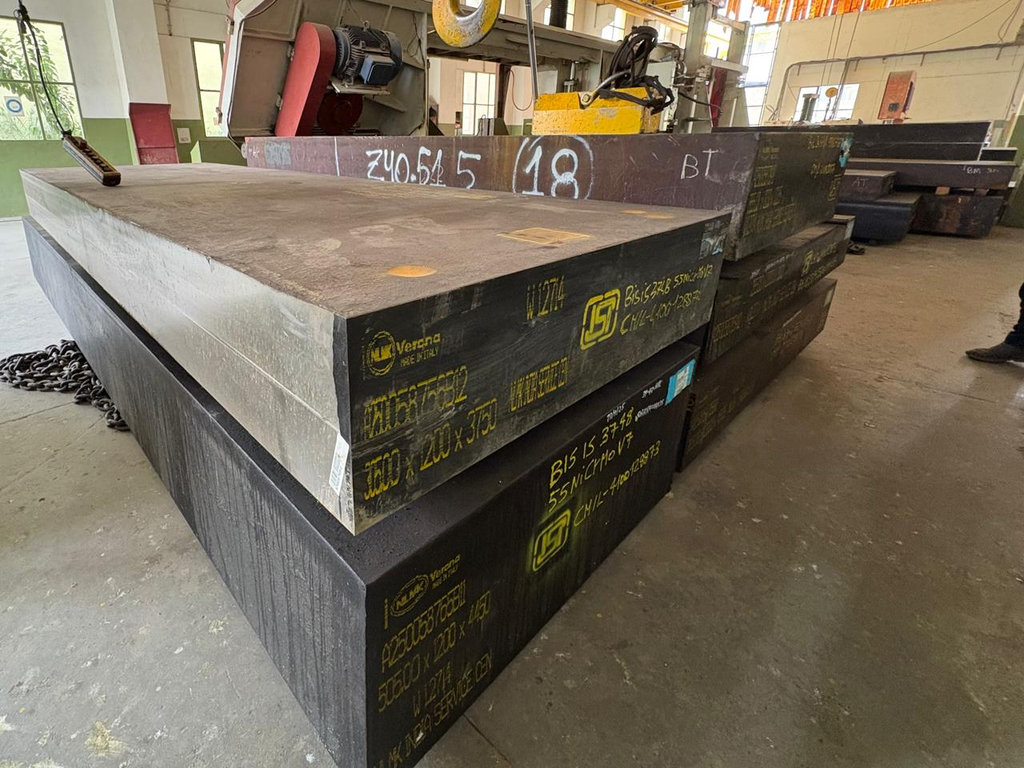
Where Hot Work Tool Steel Is Used
Aluminum diecast molds H13 tool steel is the material of choice here because it can be repeatedly heated and cooled without losing dimensional stability – think engine blocks, gear housings, transmission components, pump bodies, LED housings and other automotive parts.
Hot-forging dies They are pounded by impact loads and heat, which is why DB6 and H11—valued for toughness and resistance to thermal cracking—are the usual choices. Common on crankshafts, connecting rods, railroad components and heavy engineering components.
Extrusion Dies High hot strength and wear resistance is needed to keep profiles – used for aluminum profiles, window frames, heat sinks and electrical conductors.
Brass and copper die cast. These alloys run hotter than aluminum so H13 and H11 earn their keep with better hot hardness.
Hot shear blades, for cutting red-hot blooms, billets and bars in rolling mills;
Hot punches, made for hot piercing, making and punching where wear and impact resistance both count.
Glass molds on the basis of thermal stability and resistance to heat checking.
Plastic mold parts: ESR H13 material tool preferred for polishability and wear resistance.
Industries That Rely on It
| Industry | Applications |
| Automotive | Die casting, forging |
| Aerospace | Forging tools |
| Defence | Heavy-duty dies |
| Railways | Forged components |
| Aluminium | Extrusion dies |
| Plastic Moulding | Mould inserts |
| Steel Plants | Hot shear blades |
| Heavy Engineering | Forging tools |
| Energy | Turbine & valve tooling |
Hot Work vs. Cold Work vs. Plastic Mould Steel
| Feature | Hot Work Tool Steel | Cold Work Tool Steel | Plastic Mould Steel |
| Primary Use | High-temperature tooling | Room-temperature cutting/forming | Plastic injection & moulding |
| Operating Temperature | High | Low to moderate | Low to moderate |
| Key Property | Hot hardness & thermal fatigue resistance | Wear resistance & hardness | Toughness, polishability & machinability |
| Important Grades | H13, H11, DB6 | D2, D3, EN31 | P20, P20+Ni, 1.2083 |
| Common Applications | Die casting, forging, extrusion | Dies, punches, blanking, shear blades | Injection moulds, plastic moulds |
| Typical Hardness | 44–54 HRC | 55–62 HRC | 28–52 HRC |
| Main Advantage | Retains strength at elevated temperatures | Excellent wear & edge retention | Good machinability and surface finish |
| Typical Industries | Automotive, forging, die casting | Tool & die, automotive, engineering | Plastic, packaging, automotive |
| Parameter | H13 | DB6 |
| Type | Chromium hot work steel | Nickel-chromium-molybdenum tool steel |
| Hardness | 44–54 HRC | 38–42 HRC |
| Toughness | Excellent | Outstanding |
| Wear Resistance | Higher | Moderate |
| Thermal Fatigue | Excellent | Very good |
| Large Dies | Good | Excellent |
| Forging Applications | Very good | Excellent |
| Impact Resistance | Good | Superior |
| Aluminium Die Casting | Excellent | Good |
H13/DB6 comparison table in die casting and extrusion; go with DB6 for large forging dies, hammer dies and heavy-impact work.
Advantages & Limitations
| Advantages | Limitations |
| Excellent hot hardness | Higher material cost |
| High thermal fatigue resistance | Needs proper heat treatment |
| Excellent toughness | Harder to machine once hardened |
| Good wear resistance | Limited corrosion resistance |
| Good machinability when annealed | Large sections need controlled processing |
| Excellent dimensional stability | |
| Long tool life |
How to Choose the Right Grade
1. Match the grade to the application.
| Application | Recommended Grade |
| Aluminium die casting | H13 (1.2344) |
| Brass die casting | H13 |
| Hot forging dies | H11 (1.2343) |
| Hammer dies | DB6 (1.2714) |
| Extrusion dies | H13 |
| Plastic mould inserts | ESR H13 |
| Large forging blocks | DB6 |
Get the size right. Think about how long it’s how wide it is, how thick it is, Think about length, width, thickness, weight, machining allowance, and expected dimensional change during heat treatment.. Available forms include forged blocks, round bars, flat bars, ESR blocks and pieces that are already cut to size.
Settle on a delivery condition with your supplier — annealed, pre-hardened, hardened and tempered, soft annealed, or stress relieved. With your supplier.
Check the quality before you make a decision. Ask for testing results, spectrometer reports, material test certificates, heat-number traceability and confirmation of surface finish, straightness and mechanical properties.
Plan the amounts you need based on prototypes, regular production, yearly use, extra stock and any growth that is coming up.
Choose a supplier who can support you. One that has stock, imported materials, forged and ESR blocks, fast delivery, technical help, certificates and custom machining.
Certifications Worth Looking For
| Certification | Purpose |
| ISO 9001 | Quality management system |
| EN 10204 3.1 | Material test certificate |
| Ultrasonic Testing (UT) | Detects internal defects |
| Spectrometer Analysis | Verifies chemical composition |
| Hardness Test Report | Confirms HRC/HB values |
| Heat Number Traceability | Tracks production batch |
Why Manufacturing Quality Matters
How the steel is made has a direct line to how it performs on the shop floor. Controlled melting, refining, forging, annealing, hardening, tempering and inspection are what separate a die that lasts from one that fails early — particularly in die casting, hot forging, aluminium extrusion and heavy-duty tooling, where the cost of a bad batch shows up fast.
Key Takeaways
- Controlled melting and refining keep the chemistry consistent.
- Forging improves structural uniformity and toughness.
- Annealing gets the material ready for machining.
- Hardening builds the strength and hardness.
- Tempering balances hardness against toughness.
- UT, chemical analysis, hardness testing and dimensional inspection confirm quality before shipping.
- MTCs and heat-number traceability give buyers the documentation they need.
Why Choose Virat Special Steels?
Virat Special Steels Pvt. Ltd. has been supplying manufacturers with quality imported tool steels for over 70 years.
- Over 70 years of industry experience.
- 3,500+ tons of tool steel in stock, ready to use
- Sourced from established international mills.
- “Wide grade range: H13, H11, DB6, D2, D3, P20, M2, M35, and ESR grades“.
- “Every order comes with an EN 10204 3.1 MTC”
- “UT and spectrometer testing on all material”
- “Cut-to-size and custom machining available”
- “Fast delivery across India”
- “Trusted by automotive, forging, aerospace, plastic moulding, railway, and heavy engineering customers”.
Our Supply Network Across India
We supply H13, DB6, H11, H12, H10 and H21 across major industrial hubs — Delhi, Gurugram, Faridabad, Noida, Ghaziabad, Jaipur, agra, Ahmedabad, Vadodara, Surat, Rajkot, Mumbai, Pune, Nashik, Indore, Bhopal, Rudrapur , Chennai, Coimbatore, Hyderabad, Kolkata, Jamshedpur, Secunderabad and Nellore — with standard and custom sizes, cut-to-size material, annealed or heat-treated condition, and material test certificates as required.
Conclusion
H13 and DB6 remain the two most dependable choices for high-temperature tooling, offering a solid mix of hardness, toughness, wear resistance, hot strength and thermal-fatigue resistance. Get the grade selection, heat treatment, machining and maintenance right, and both can deliver excellent tool life. We supply H13, DB6 and other tool steel grades across major industrial cities in India for a wide range of manufacturing needs.
Get a Quote
Looking for reliable H13, DB6 or other hot work tool steel? Virat Special Steels supplies round & flat bars, forged & rolled blocks, ESR/non-ESR blocks and cut-to-size material — complete with MTC, UT testing, spectro testing, custom machining, ready stock and PAN India delivery.
Call: +91-98140 21775 Email: info@viratsteels.com Locations: Gurgaon (Haryana) | Ludhiana (Punjab)
Frequently Asked Questions
1. What is Hot Work Tool Steel?
Alloy steel for tools and dies exposed to high temperatures, thermal cycling, wear and mechanical stress.
2. What are the primary types?
Typical grades are H13, H11, H12, H10 and H21 – H13 tool is the most common.
3. H13 tool steel – what is it?
A hot work Cr-Mo-V grade that is known for its excellent hot strength, toughness, wear resistance and thermal-fatigue resistance.
4. What is the HRC of H13?
44-54 HRC depending on the application and heat treatment condition.
5. What is the maximum service temperature of H13?
Typically up to around 550–600°C, depending on load, thermal cycling and cooling conditions. Confirm the exact limit with your supplier’s datasheet.
6. Is H13 material good for high temperature applications?
Yes, it is used heavily where there is high heat and heating and cooling over and over again.
7. Can H13 be machined?
Yes, if annealed. It is much more difficult to machine once hardened.
8. How to Improve H13 Machinability?
Use proper cutting tools. Use appropriate speeds and feeds. Use adequate cooling. Machine in the annealed state where possible.
9. What is H13 used for?
Die casting dies, extrusion dies, forging dies, hot punches, mandrels and other similar hot work tooling.
10. H13 wear resistant?
Yes, if they are heat treated properly and matched to the proper operating conditions.
11. Is H13 hard enough?
Yes, gives a good balance of hardness and toughness which is what you need in demanding die work.
12. What is resistance to thermal fatigue?
It’s the ability of the steel to be heat cycled over and over again without heat checking or cracking.
13. Is H13 heat treatable?
Yes. Usually it is hardened and tempered so that it can obtain the desired hardness, toughness and hot strength.
14. Is H13 air hardenable?
Yes, which means it can achieve high hardness by means of appropriate heat treatment without a drastic quench.
15. Can H13 be used for nitriding?
Yes, nitriding can improve surface hardness, wear resistance and die life in suitable applications.
16. What is the chemical composition of H13?
Carbon, silicon, manganese, chromium, molybdenum and vanadium. Chromium, molybdenum and vanadium do most of the work.
17. What is the difference between H11 and H13?
Both are hot working grades but H13 tool steels gives generally a better combination of hot hardness, wear resistance, toughness and thermal-fatigue resistance.
18. What’s the difference between H13 and D2?
D2 is a cold-work grade built primarily for high wear resistance. H13 tool steel is a hot-work grade.
19. Is H13 tool steels appropriate for die casting dies?
Yes, it is widely used for aluminum, zinc and magnesium die casting because of its resistance to thermal fatigue and its hot strength.
20. Can H13 tool steels be used for hot extrusion die?
Yes, commonly used for extrusion dies, mandrels and related tooling.
Why Hot Work Tool Steel matters in Indian Manufacturing Industries
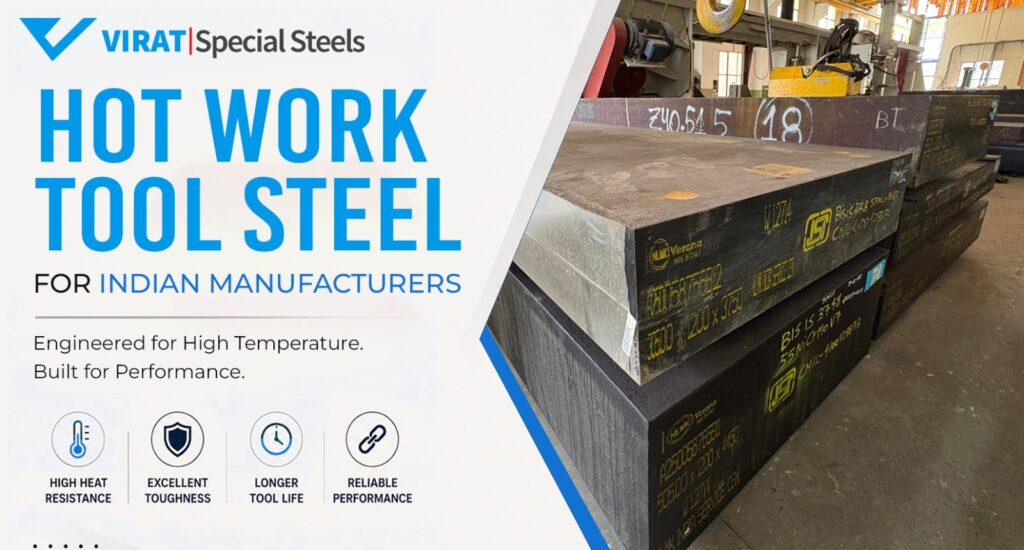
India’s manufacturing sector is expanding rapidly across industries such as automotive, die casting, forging, aluminium extrusion, plastic moulding, and heavy engineering demanding higher productivity, better precision, and longer tool life than ever before. Hence In such high-temperature and high-pressure applications, the quality of tool steel directly impacts production performance, die life, and operational efficiency.
So, industries increasingly rely on premium hot work tool steels such as H13 tool steel, H11, and DB6 grades known for their excellent heat resistance, toughness, wear resistance, and durability under demanding working conditions.
To support these growing industrial requirements, Virat Special Steels Pvt. Limited with ready stock, precision cutting, UT tested material, and technical support supplies high-quality hot work tool steels engineered for reliable performance across modern manufacturing applications.
Hot Work Tool Steel
Hot work tool steel is a category of alloy steel specifically designed for applications involving elevated temperatures. These steels are used to manufacture tools, dies, and molds that shape.
Hot work tool steels can withstand:
- High thermal stress
- Repeated heating and cooling cycles
- Mechanical shock
- Abrasion and wear
- Surface cracking
This makes them ideal for industrial applications where reliability and long tool life are essential.
Common Types of Hot Work Tool Steel
H13 is one of the most widely used hot work tool steels because of its excellent heat resistance, toughness, and wear resistance. It is commonly used in aluminum extrusion, die casting, and forging applications.
H11 tool steel offers high toughness and strong thermal fatigue resistance, making it suitable for applications involving heavy impact and thermal cycling.
DB6 hot work tool steel is known for its superior hot strength and durability in demanding industrial applications such as heavy-duty tooling and forging dies.
Importance of Hot Work Tool Steel in Indian Manufacturing
India’s industrial growth has significantly increased the demand for durable and high-performance tooling materials. Hot work tool steels help industries achieve:
1. Higher Production Efficiency
Premium hot work steels reduce downtime and improve continuous production performance.
2. Longer Tool and Die Life
These steels provide excellent resistance to thermal fatigue and wear, resulting in extended die life and lower replacement costs.
3. Improved Product Quality
Dimensional stability and resistance to deformation ensure consistent product quality in extrusion, forging, and die casting operations.
Applications of H13, H11 & DB6 Hot Work Tool Steel
| Grade | Industry Use | Main Applications | Key Benefit |
| H13 | Aluminum Extrusion | Extrusion Dies | High heat resistance |
| H13 | Plastic Molding | Injection Molds | Excellent wear resistance |
| H11 | Forging Industry | Forging Dies & Punches | High toughness |
| H11 | Heavy Engineering | Hot Work Tooling | Better shock resistance |
| DB6 | Die Casting | Die Casting Tools | Superior hot strength |
| DB6 | Heavy Forging | Heavy-Duty Dies | Long tool life |
Why are H13, H11 & DB6 Tool Steels Popular in Indian Industries?
H13, H11, and DB6 tool steels are widely used in Indian industries because of their excellent heat resistance, toughness, durability, and long tool life in demanding hot work applications.
Key Advantages of H13, H11 & DB6 Tool Steel
| Grade | Key Property | Industrial Advantage |
| H13 | High Heat Resistance | Performs reliably at elevated temperatures |
| H13 | Excellent Wear Resistance | Reduces tooling wear and maintenance |
| H11 | High Toughness | Prevents cracking and premature tool failure |
| H11 | Thermal Fatigue Resistance | Handles repeated heating and cooling cycles |
| DB6 | Superior Hot Strength | Performs well in heavy-duty hot work applications |
| DB6 | Long Tool Life | Improves productivity and reduces operating costs |
Choosing the Right Hot Work Tool Steel Supplier
The quality of hot work tool steel directly affects tool life, productivity, and manufacturing performance. When selecting suppliers for tool steels like H13, H11, and DB6 tool steel and many more, manufacturers should look for:
- Consistent material quality
- Proper testing and certification
- Technical support and application guidance
- Reliable stock availability and timely delivery
Conclusion
High-performance hot work tool steels are very essential in improving die life, production efficiency, and overall manufacturing performance. Hence choosing the right grade and the right supplier can enhance tooling reliability in demanding industrial applications.
Virat Special Steels Pvt. Limited is committed to supplying premium-quality hot work tool steels like DB6, H13, H11 etc backed by ready stock availability, UT tested material, precision cutting, and technical support to your industry requirements.
Whether for die casting, forging, extrusion, or heavy engineering applications, Virat Steels helps manufacturers achieve better productivity, durability, and long-term performance.
Looking for reliable hot work tool steel solutions?
Contact Virat Special Steels Pvt. Limited today for expert guidance and premium tool steel supply.
📞 +91 98140-21775 ✉ info@viratsteels.com
For more details about our hot work tool steel grades and applications, please click on the link below to explore our product range and technical specifications.
https://www.viratsteels.com/h13.html
https://www.viratsteels.com/h11.html
https://www.viratsteels.com/db6.html
FAQs – Hot Work Tool Steel
1. What is Hot Work Tool Steel?
Hot work tool steel is specially designed for applications involving high temperatures, pressure, and wear.
2. Which are the common hot work tool steel grades?
H13, H11, and DB6 are among the most widely used hot work tool steel grades in industries.
3. Why is H13 tool steel popular?
H13 offers excellent heat resistance, wear resistance, and long tool life.
4. What is H11 tool steel used for?
H11 is mainly used in forging and heavy-duty applications requiring high toughness and crack resistance.
5. What are the advantages of DB6 tool steel?
DB6 provides superior hot strength, durability, and reliable performance in extreme working conditions.
6. Which industries use H13, H11, and DB6 steel?
These grades are widely used in aluminum extrusion, die casting, forging, plastic molding, and heavy engineering industries.
7. What is the hardness range of H13 steel?
H13 tool steel generally ranges between 44–52 HRC depending on heat treatment and application.
8. Where can I buy quality H13, H11, and DB6 tool steel in India?
Premium-quality H13, H11, and DB6 hot work tool steels are available from Virat Special Steels for industrial applications.
Why Manufacturers Are Choosing DB6 / DIN2714 Steel for Industrial Tooling Applications
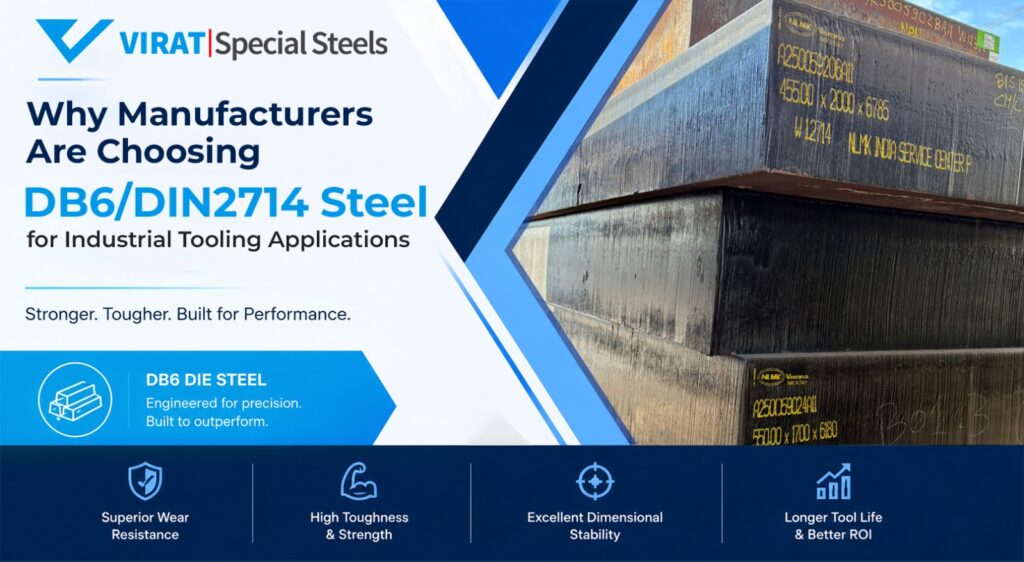
DB6 / DIN 1.2714 steel is a preferred choice for heavy-duty industrial applications because of its toughness, strength, wear resistance, and heat resistance. It is widely used in tooling, forging, die manufacturing, and engineering, delivering reliable performance under demanding conditions.
VIRAT Special Steels supplies high-quality DB6 / DIN 1.2714 steel that meets strict industrial standards and delivers consistent performance across various applications.
Industries today require materials that can withstand high pressure, repeated impact, elevated temperatures, and continuous wear. DB6 steel fulfills these requirements efficiently, making it a trusted choice for manufacturers looking to improve productivity, reduce downtime, and increase tool life.
1. Exceptional Wear Resistance
One of the biggest advantages of DB6 steel is its excellent wear resistance. In high-friction and heavy-duty industrial operations, components are constantly exposed to abrasion and mechanical stress. DB6 steel maintains its performance and dimensional stability even under continuous use.
Common applications include:
- Forging dies
- Cutting tools
- Punches and molds
- Shear blades
- Heavy-duty machine components
Its superior wear resistance helps reduce frequent replacement of tools and components, resulting in lower maintenance costs and improved operational efficiency.
2. High Toughness and Strength
DIN 1.2714 steel is specially designed to provide high toughness along with excellent mechanical strength. Unlike many conventional tool steels, DB6 steel can withstand repeated impact loading without cracking or deformation.
Key benefits include:
- High impact resistance
- Better load-bearing capacity
- Resistance to deformation
- Improved structural stability
- Reliable performance under heavy stress
These properties make DB6 steel highly suitable for demanding forging and tooling applications.
3. Excellent Heat Resistance
DB6 / DIN 1.2714 steel offers excellent resistance to heat and thermal fatigue. It retains its hardness and strength even at elevated operating temperatures, making it ideal for hot work applications.
This property is especially beneficial in:
- Hot forging dies
- Press tools
- High-temperature tooling
- Heavy industrial processing
- Hot working operations
Its ability to perform consistently at high temperatures improves productivity and extends tool life.
4. Longer Tool Life
The balanced combination of toughness, strength, and wear resistance significantly increases the service life of tools manufactured from DB6 steel.
Advantages include:
- Reduced tool failure
- Lower downtime
- Reduced replacement frequency
- Higher production efficiency
- Lower overall production cost
Longer tool life directly contributes to improved manufacturing efficiency and cost savings.
5. Good Machinability
Despite its high strength and hardness, DB6 steel offers good machinability when processed under proper conditions. Manufacturers prefer this grade because it allows accurate machining with excellent surface finish quality.
Benefits include:
- Cleaner machining results
- Better dimensional accuracy
- Improved surface finish
- Reduced machining errors
- Consistent production quality
This makes DB6 steel suitable for precision engineering applications.
6. Reliable Performance in Harsh Industrial Conditions
Modern industries require materials that can consistently perform under extreme operating conditions involving pressure, heat, shock, and continuous usage. DB6 steel is widely appreciated for its reliability and durability.
Industries value DB6 steel for:
- Dimensional stability
- Resistance to cracking
- High toughness
- Thermal stability
- Long-term operational reliability
These characteristics make it one of the most dependable tool steel grades available today.
Industries Using DB6 / DIN 1.2714 Steel
DB6 steel is widely used across multiple industries due to its versatility and superior mechanical properties.
Major industries include:
- Automotive industry
- Forging industry
- Tool and die manufacturing
- Aerospace engineering
- Industrial machinery
- Metal fabrication
- Precision engineering
Common Applications of DB6 Steel
Typical applications of DIN 1.2714 / DB6 steel include:
- Forging dies
- Hammer dies
- Press tools
- Die holders
- Shear blades
- Extrusion tools
- Heavy-duty tooling components
FAQs
Is DB6 steel suitable for heavy-duty industrial applications?
Yes. DB6 / DIN 1.2714 steel is highly suitable for heavy-duty industrial applications because of its excellent toughness, strength, wear resistance, and heat resistance.
Can DB6 steel improve production efficiency?
Yes. Its longer tool life and reliable performance help reduce downtime, maintenance, and replacement costs, leading to higher productivity.
Is DB6 steel cost-effective?
Yes. Although it is a premium-grade tool steel, its durability and extended service life make it highly cost-effective over the long term.
Which industries commonly use DB6 steel?
Automotive, forging, tooling, aerospace, metal fabrication, and heavy engineering industries commonly use DB6 steel.
Why choose DB6 steel from VIRAT Special Steels?
VIRAT Special Steels offers premium-quality DB6 / DIN 1.2714 steel with reliable quality, accurate sizes, and dependable industrial performance.
Conclusion
DB6 / DIN 1.2714 steel is an excellent choice for manufacturers seeking high performance, durability, toughness, and long service life in demanding industrial applications. Its superior mechanical properties make it ideal for forging dies, tooling applications, and heavy engineering industries.
By choosing premium-quality DB6 steel, industries can improve productivity, reduce operational costs, and achieve reliable long-term performance.
For high-quality DB6 / DIN 1.2714 steel solutions, connect with:
Email: info@viratsteels.com
Phone: +91 98140-21775
Virat Steels-Trusted Tool & Die Steel Supplier in India
In the tool and die steel industry, quality material and reliable service are very essential for consistent production performance. Manufacturers today need more than just steel. Hence, they need a trusted supply partner.
That’s why industries across India choose Virat Special Steels for premium tool steel solutions.
With decades of domain expertise, the company serves high-quality tool & die steels industries ranging from automotive and aerospace to defence, tooling, and heavy engineering.
Premium Quality Steel
Virat Steels provide genuine and reliable tool steel with:
- Consistent hardness
- Better machinability
- Improved tool life
- Genuine quality
Available in:
✔ Rounds
✔ Flats
✔ Blocks
Ready Stock Availability
Ready stock available for major grades including:
ensuring quick dispatch and reduced downtime.
Ultrasonic Tested Material
Virat Steels supplies UT Tested Tool Steel
Ultrasonic testing helps detect:
- Internal defects
- Cracks
ensuring better reliability and performance.
Precision Cutting Facility
We offer precision cutting services for:
- Accurate dimensions
- Reduced machining allowance
- Faster processing
Helping customers save time and improve productivity.
Strong Logistics Support
We deliver across India with:
- Fast dispatch
- Safe handling
- Timely delivery
Supplying to major industrial regions across India .
Technical Support
Our team helps customers choose:
- Suitable steel grade
- Recommended Hardness
- ESR vs standard grades
- Application-based solutions
Certified & Test Report
- Material Test Certification (MTC)
Looking for a reliable tool and die steel supplier in India?
Contact Virat Special Steels:
📞 +91 98140-21775
🌐 www.viratsteels.com
✉ info@viratsteels.com
Frequently Asked Questions (FAQs)
1. What products does Virat Steels supply?
Virat Steels supplies premium tool and die steels including Hot work steels, cold work steels, High Speed steels, Alloy steel grades etc.
2. Which industries use tool and die steel?
Tool and die steels are widely used in Forging, Extrusion, Plastic moulds, Automotive components, Pressure Die casting .
3. Does Virat Steels provide ultrasonic tested material?
Yes, Virat Steels supplies UT tested material to ensure better reliability, reduced internal defects, and improved tooling performance.
4. Does Virat Steels maintain ready stock?
Yes, Virat Steels maintains ready stock of major tool steel grades for quick dispatch and faster delivery across India.
5. Why choose Virat Steels as a tool steel supplier?
Manufacturers choose Virat Steels because of Genuine quality, UT tested steel, Precision cutting facility, ready stock, fast delivery, technical support
6. Does Virat Steels deliver across India?
Yes, Virat Steels supplies tool and die steel across major industrial regions in India with reliable logistics and timely delivery support.
7. How can I contact Virat Steels for tool steel requirements?
You can contact Virat Steels on 📞 +91 98140-21775 for grade recommendations, stock availability, and pricing.
DIN 2714 Hot Work Tool Steel: Properties, Uses & Supplier in India | Virat Steels
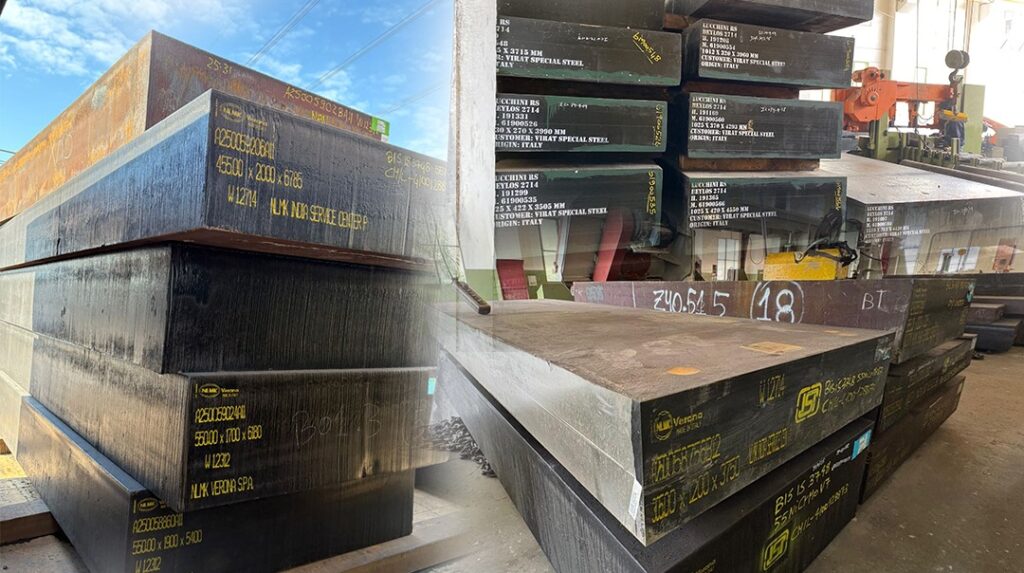
In the demanding application of forging, die casting, and heavy engineering, selecting the right tool steel is essential for performance and durability. Among the most reliable grades for high-temperature and high-impact applications, DIN 1.2714 tool steel stands out for its exceptional toughness and strength.
If you are searching for reliable supplier in India, Virat Steels offers Din 2714 tool steel with large stock, fast delivery & consistent quality across India.
What is DIN 1.2714 Tool Steel?
DIN 1.2714 is a nickel-chromium-molybdenum hot work tool steel, specifically designed for applications involving high temperature, heavy loads, and shock resistance.
It is widely known by its EN/DIN designation:
- 55NiCrMoV7
- DB6
- AISI L6
This grade offers a perfect balance of:
- Strength
- Toughness
- Heat resistance
making it ideal for forging and heavy-duty tooling applications.
Key Properties of DIN 1.2714 Tool Steel
Understanding the properties of 1.2714 helps manufacturers choose the right material for demanding work environments:
- Exceptional Toughness
- Good Hot Strength
- Thermal Fatigue Resistance
- Moderate Wear Resistance
- Good Hardenability
Allows uniform hardness even in large sections.
Chemical Composition of DIN 1.2714
The superior performance of this grade is due to its alloying elements:
| Element | Values (%) | Feature |
| Carbon (C): | 0.50-0.60 | Provides hardness |
| Nickel (Ni): | 1.50-1.80 | Improves toughness |
| Chromium (Cr): | 1.00-1.30 | Meant for strength and wear resistance |
| Molybdenum (Mo): | 0.45-0.60 | Boosts high-temperature strength |
| Vanadium (V): | 0.07-0.12 | Improves grain structure |
This composition gives a strong balance of hardness & toughness, ensures long tool life and resistance to heavy impact loads.
Heat Treatment of DIN 1.2714 Tool Steel
Proper heat treatment is essential to achieve maximum performance:
- Preheating: 600–700°C
- Hardening: 830–870°C followed by oil or air quenching
- Tempering: 400–650°C depending on required hardness
- Typical hardness range: 45–52 HRC
A controlled heat treatment process improves:
- Strength
- Toughness
- Resistance to thermal cracking
Applications of DIN 1.2714 Tool Steel
DIN 1.2714 is widely used in industries requiring high strength and shock resistance:
| Forging Industry | Heavy Engineering | Automotive Sector | Manufacturing Industry |
| Hammer dies Press dies Anvils | Die holders Support tools Structural components | Forging tools for automotive parts Heavy-duty shafts | Hot forming tools Extrusion tools |
Its ability to withstand extreme stress and temperature variations makes it capable in industrial applications.
DIN 1.2714 vs H13 Tool Steel – Which is Better?
A common comparison in the industry is between DIN 1.2714 and H13.
| Feature | DIN 1.2714 | H13 Tool Steel |
| Toughness | Very High | High |
| Heat Resistance | Good | Excellent |
| Wear Resistance | Moderate | High |
| Application | Heavy duty application | Die casting, extrusion |
Why Choose Virat Steels?
When sourcing high-quality tool steel, selecting a reliable supplier is crucial for operational efficiency.
Virat Steels is a leading supplier of hot work tool steels, offering premium-quality DIN 1.2714 / DB6 material across India.
✔ Wide Range of Sizes
Available in:
- Round bars
- Flats
✔ Pan India Supply Network
We cater to major industrial hubs across India, including Pune, Nashik, Ahmedabad, Rajkot, Ludhiana, Jalandhar, Faridabad, Gurgaon & Delhi NCR, Bangalore, Tamil Nadu, Hyderabad, and many more regions nationwide.
✔ Assured Quality
All materials are tested and certified to meet industry standards.
✔ Competitive Pricing
We offer cost-effective solutions for bulk and customized requirements.
✔ Technical Expertise
Our team helps you select the right grade based on your application.
DIN 1.2714 Tool Steel Price in India
The price of DIN 1.2714 tool steel depends on:
- Size and dimensions
- Quantity
- Heat treatment condition
- Market trends
Choosing a trusted partner like Virat Steels ensures consistent quality, timely delivery, and long-term reliability.
Frequently Asked Questions (FAQs)
1. What is DIN 1.2714 tool steel used for?
It is used in forging dies, hammer tools, and heavy-duty applications requiring high toughness.
2. Is DIN 1.2714 a hot work tool steel?
Yes, it is a hot work tool steel designed for high-temperature applications.
3. What is the hardness of DIN 1.2714?
Typically ranges between 45–52 HRC after heat treatment.
4. What is the equivalent of DIN 1.2714?
Its common equivalent is 55NiCrMoV7 / DB6.
5. Where can I buy DIN 1.2714 tool steel in India?
You can source high-quality material from Virat Steels, a trusted supplier across India.
Get in Touch with Virat Steels
Looking for premium DIN 1.2714 tool steel?
Contact Virat Steels today for expert guidance and the best pricing tailored to your requirements.
For the best price and bulk supply, Call now Virat Steels for a customized quotation.
https://www.viratsteels.com/db6.html | 📧info@viratsteels.com | 📱+91 98140-21775
Reasons to Choose DIN 1.2714 Steel for Heavy-Duty Projects
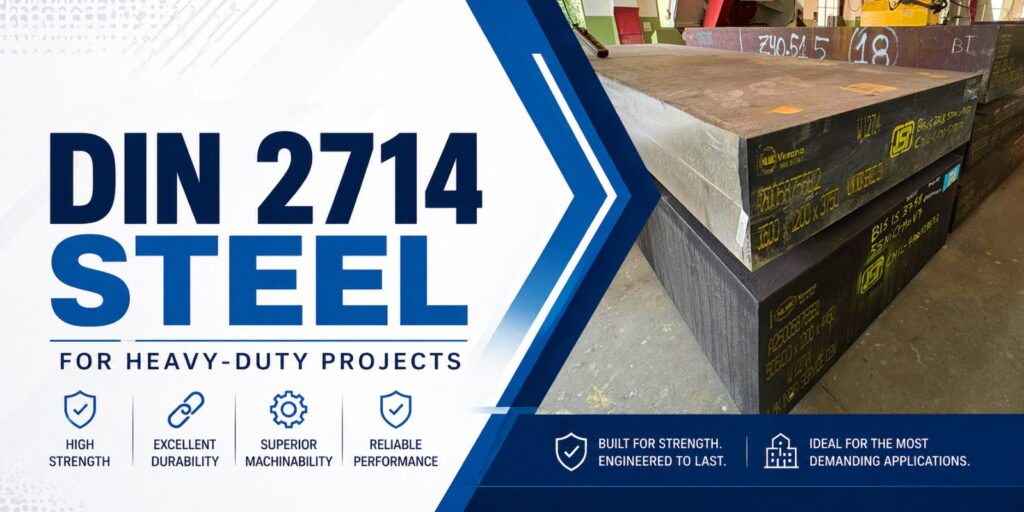
When it comes to heavy-duty industrial applications, choosing the right tool steel can significantly impact performance, durability, and cost-effectiveness. DIN 1.2714 steel, also known as DB6 tool steel, is one of the most trusted materials for industries requiring high toughness, excellent wear resistance, and superior strength.
From forging dies to plastic molds and heavy engineering tools, DIN 1.2714 has become the preferred choice for manufacturers worldwide.
What is DIN 1.2714 Steel?
DIN 1.2714 is a nickel-chromium-molybdenum hot work tool steel popularly known for its:
- High toughness
- Good wear resistance
- Excellent hardenability
- High impact strength
- Resistance to heat and pressure
It is widely used in industries like:
- Automotive
- Aerospace
- Forging
- Die casting
- Plastic molding
- Heavy machinery manufacturing
Top Reasons to Choose DIN 1.2714 Steel
1. Exceptional Toughness for Heavy Loads
One of the biggest advantages of DIN 1.2714 steel is its excellent toughness, making it ideal for applications involving:
- Repeated impact
- Heavy pressure
- Shock loading
This makes it a perfect material for forging dies, hammer dies, and press tools.
2. Superior Wear Resistance
DIN 1.2714 offers excellent abrasion resistance, which helps tools last longer under harsh working conditions.
This reduces:
- Frequent replacements
- Downtime
- Maintenance costs
3. High Strength at Elevated Temperatures
For industries dealing with hot work applications, DIN 1.2714 performs exceptionally well even at higher temperatures.
It is widely used in:
- Hot forging dies
- Extrusion tools
- Die holders
4. Excellent Hardenability
DIN 1.2714 can achieve a uniform hardness throughout the section, making it suitable for large-size blocks and dies.
Typical hardness range:
360–430 BHN (Pre-Hardened)
This ensures:
- Better machinability
- Reduced heat treatment distortion
- Consistent performance
5. High Impact Strength
This steel grade withstands heavy impact without cracking easily.
That’s why it is preferred for:
- Hammer dies
- Heavy forging tools
- Industrial cutters
6. Longer Tool Life
Because of its balance of strength + toughness + wear resistance, DIN 1.2714 increases tool life significantly.
Benefits include:
- Lower production costs
- Higher productivity
7. Excellent Machinability
Despite being pre-hardened, DIN 1.2714 offers good machinability compared to many other heavy-duty steels.
This makes manufacturing faster and more economical.
8. Suitable for Large Forged Blocks
DIN 1.2714 is commonly available in large, forged rounds, flats, and blocks, making it suitable for:
- Large dies
- Mold bases
- Heavy industrial tools
At Virat Special Steels, we offer extra forging reduction for enhanced grain structure and better performance.
Common Applications of DIN 1.2714 Steel
DIN 1.2714 is widely used in:
- Forging dies
- Die holders
- Hammer dies
- Press tools
- Plastic Molds
- Shear blades
- Heavy-duty machine parts
Why Buy DIN 1.2714 Steel from Virat Special Steels?
At Virat Special Steels, we provide:
- Premium quality DIN 1.2714 / DB6 steel
- Large stock availability
- Ready sizes & custom cutting
- Competitive prices
- Fast delivery across India
- Expert technical support
We are among the leading suppliers of DIN 1.2714 steel in India.
FAQs
Q1. What is DIN 1.2714 steel used for?
DIN 1.2714 is used for forging dies, hammer dies, plastic Molds, and heavy-duty tools.
Q2. Is DIN 1.2714 a hot work tool steel?
Yes, it is widely used in hot work and impact applications.
Q3. What is the hardness of DIN 1.2714 steel?
The standard pre-hardened hardness is around 360–430 BHN.
Q4. Where can I buy DIN 1.2714 steel in India?
You can buy premium quality DIN 1.2714 steel from Virat Special Steels.
Conclusion
If your project requires high toughness, wear resistance, and long-lasting performance, DIN 1.2714 steel is one of the best choices for heavy-duty industrial applications.
Ready to Source DIN 1.2714 / DB6 steel Smarter? Contact Virat Special Steels Today.
📞 Curious about the right size, grades or technical specifications for your application? Our team is ready to guide you.
Explore more: https://www.viratsteels.com/db6.html | 📧info@viratsteels.com | 📱+91 98140-21775
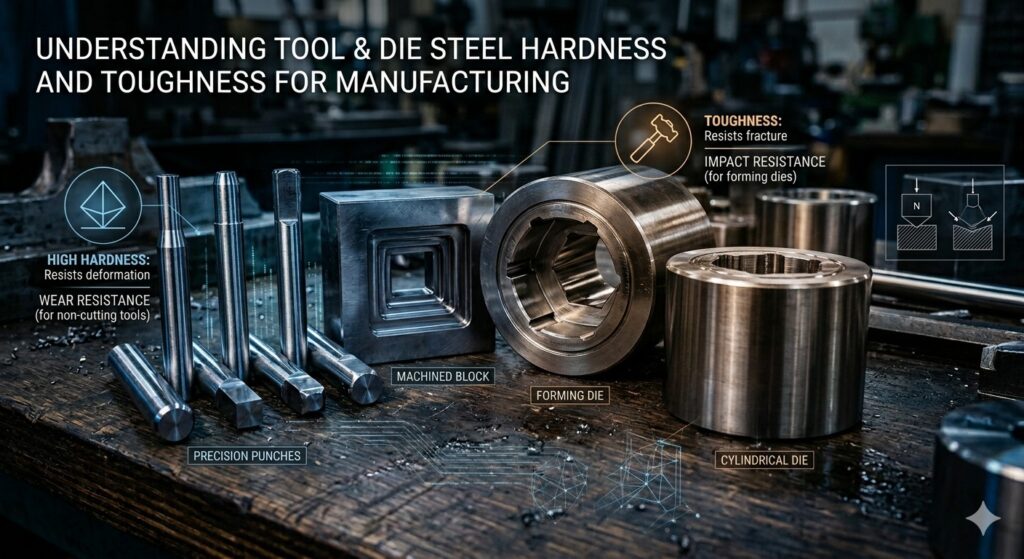
Understanding Tool & Die Steel Hardness and Toughness for Manufacturing
Introduction
In every industry from forging shops to automotive plants, tool & die steels are the silent heroes at work. They shape, cut, and press with relentless precision. But behind every tool lies a choice: the steel it’s made from.
If a tool steel is too hard, it risks cracking under impact. If it’s too tough, it wears down too quickly. The secret to industrial success isn’t choosing one over the other. it’s finding the perfect balance.
The topic is hence clear that neither hardness nor toughness alone could carry the weight of modern industry. Progress demanded a balance that is -hard enough to resist wear & tough enough to withstand impact. With this harmony, dies lasted longer, automotive components are forged with precision, and heavy engineering tools are made without interruption.
That’s why manufacturers don’t just pick any steel grade. They choose carefully, knowing that the right steel is the difference between downtime and success.
What Is Tool & Die Steel Hardness?
Hardness means the ability of steel to resist surface wear, indentation, or deformation. In industrial tooling applications, higher hardness usually means better resistance to abrasion and longer tool life.
Hardness is typically measured using the Rockwell hardness scale(HRC). Tool steels used in industrial applications often fall within a hardness range of 45 HRC to 62 HRC, depending on the specific grade and application.
Why Hardness Matters ?
Hardness is especially important in applications where tools are exposed to continuous friction and high pressure. Examples include:
- Forging dies
- Cutting tools
- Punches and Molds
- Industrial forming tools
A higher hardness level helps tools maintain their shape and resist wear during repeated manufacturing cycles.
What Is Tool & Die Steel Toughness?
Toughness refers to the ability of steel to absorb impact and resist cracking or breaking under stress. It is particularly important for tooling applications where tools are exposed to heavy mechanical loads or sudden shocks.
In forging operations, dies often experience repeated impact forces. Tool steels with good toughness can withstand these forces without developing cracks or fractures.
Why toughness Matters ?
High toughness is critical in applications such as:
- Hammer forging dies
- Press forging tools
- Heavy-duty industrial dies
- Impact tools
Without adequate toughness, even a very hard steel may fail prematurely.
The Balance Between Hardness and Toughness
One of the biggest challenges in tool steel selection is achieving the right balance between hardness and toughness. Increasing hardness often reduces toughness, while increasing toughness may lower hardness.
Therefore, tool steel manufacturers carefully design steel grades and heat treatment processes to achieve an optimal combination of these properties.
For example:
- Cold work tool steels often emphasize high hardness and wear resistance
- Hot work tool steels are designed with higher toughness to withstand thermal and mechanical stress
Selecting the correct steel grade depends on the specific operating conditions of the tool.
How Heat Treatment Affects Hardness and Toughness
Heat treatment plays a critical role in controlling the mechanical properties of tool steel. Processes such as hardening and tempering help achieve the desired balance of hardness and toughness.
Typical heat treatment stages include:
- Heating the steel to a specific temperature
- Rapid cooling (quenching) to increase hardness
- Tempering to improve toughness and reduce brittleness
Proper heat treatment ensures that tool steel can perform reliably in demanding industrial environments.
Tool Steel Applications Requiring the Right Balance
Different industrial applications require different combinations of hardness and toughness.
1.Forging Dies
Forging dies require high toughness to withstand repeated impact and sufficient hardness to resist wear.
2.Cutting Tools
Cutting tools need very high hardness to maintain sharp edges during machining operations.
3.Plastic Moulds
Mould steels require moderate hardness and good toughness for durability and dimensional stability.
Choosing the right tool steel for each application helps manufacturers reduce tool failures and improve productivity.
Why Tool & Die Steel Quality Matters
Even with the correct hardness and toughness levels, the quality of the steel itself plays an important role. Factors such as metallurgical cleanliness, grain structure, and manufacturing processes influence the final performance of tool steel.
Reliable suppliers such as Virat Special Steels help industries access high-quality tool steel with proper certification and consistent properties.
This ensures better reliability in applications such as forging dies, industrial tooling, and heavy engineering components.
FAQs (Frequent Asked Questions)
1-What is tool & die steel?
Tool & Die Steel is a high-strength, wear-resistant steel specially designed for making tools, dies, and molds used in manufacturing and shaping materials like metal or plastic.
2-What is hardness in tool steel?
Hardness is the ability of tool steel to resist wear, indentation, and deformation during industrial use.
3-Why is toughness important in tool steel?
Toughness allows tool steel to absorb impact and resist cracking under heavy loads.
4-Can tool steel have both high hardness and toughness?
Yes, modern tool steels are designed to balance hardness and toughness through alloy composition and proper heat treatment.
5-What affects the hardness of tool steel?
Hardness is influenced by chemical composition, heat treatment processes, and steel manufacturing quality.
6-Which supplier provides best quality tool & die steels?
Virat Special Steels, a most trusted Indian Supplier provide a wide range of high-performance steel grades for manufacturing industries.
Conclusion
Hardness and toughness are two of the most important properties that determine the performance of tool steel.
By selecting the right tool steel grade and sourcing it from reliable suppliers, manufacturers can significantly improve the performance and durability of their industrial tools.
At VIRAT SPECIAL STEELS, we provide a complete range of premium hot work and cold work tool steels to support every industrial requirement. Whether you are into forging, stamping, cutting, die casting, or extrusion, we deliver the right steel grade with consistent quality and reliable performance. Contact us today.
https://www.viratsteels.com info@viratsteels.com +91 98140-21775
European Tool Steel vs Indian Tool Steel: A Quality Comparison for Industrial Applications
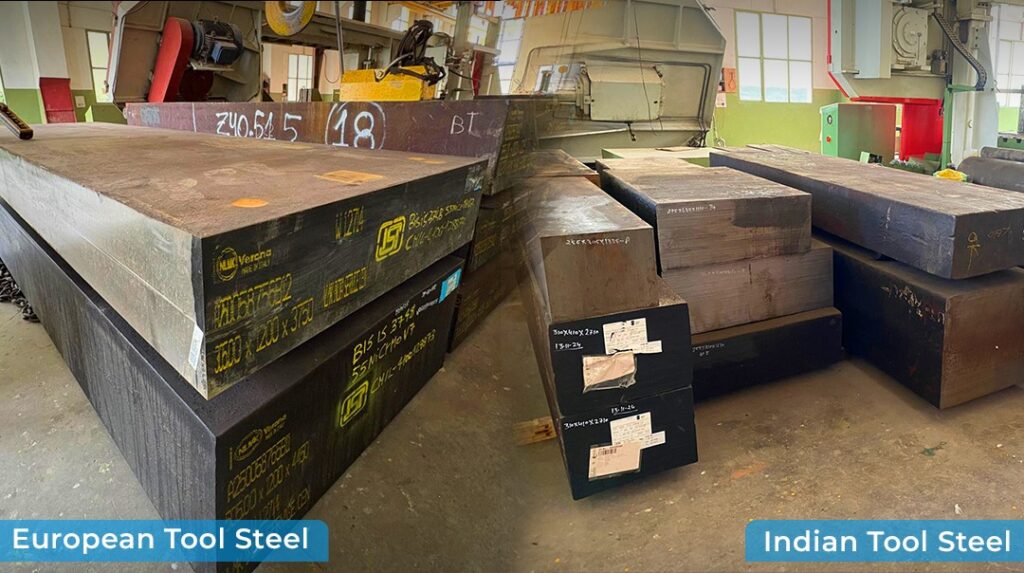
Tool steel isn’t just another material. It’s the foundation of modern manufacturing. From forging and die-making to automotive parts and heavy engineering, tool steel is everywhere. Every hammer strike, every die cut, every moulded part relies on its strength.
But what really defines good tool steel?
- Durability – how long it lasts under pressure
- Productivity – how much it improves output
- Cost impact – how it affects overall manufacturing expenses
That’s why industrial buyers don’t just buy they compare.
Henceone of the hottest discussions in the market today is:
- European tool steel – known for performance under extreme conditions
- Indian tool steel – often praised for balancing durability with cost efficiency
Which one is better? The answer isn’t always obvious. Each has strengths, and the choice depends on what industries value most—maximum reliability or cost-effective scale.
Thus, understanding the differences between these two sources European tool steel & Indian tool steel helps manufacturers choose the right tool steel for durability, cost efficiency, and reliable performance.
4 major Factors Determines Tool & Die Steel Quality?
The most essential factors together measure how effectively tool steel performs in applications like forging dies, cutting tools, and industrial moulds etc are:
1-Chemical Composition
Tool steel contains alloying elements such as chromium, molybdenum, vanadium, and nickel. The correct balance of these elements determines hardness, toughness, and wear resistance.
2-Metallurgical Structure
Uniform grain structure and low levels of impurities improve strength and reduce the risk of cracking during heavy industrial use.
3-Heat Treatment Capability
Proper hardening and tempering processes ensure the steel achieves the required mechanical properties.
4-Quality Testing and Certification
Inspection methods such as ultrasonic testing help ensure the steel is free from internal defects.
European Tool Steel Manufacturing Standards
European tool steel is produced under strict industrial standards established by organizations such as DIN and European Committee for Standardization. These standards define the chemical composition, mechanical properties, and testing requirements for various tool steel grades.
European steel manufacturers typically focus on:
- Precise alloy composition control
- Advanced refining technologies
- High internal cleanliness of steel
- Consistent mechanical properties
Many widely used tool steel grades originate from European standards, including:
- DIN 1.2344
- DIN 1.2714
- DIN 2379
These steels are commonly used in forging dies, die casting tools, and high-performance industrial tooling.
Development of Indian Tool Steel Manufacturing
India has become one of the leading steel-producing countries in the world. Today, many Indian steel plants use advanced technologies including:
- Electric arc furnaces
- Vacuum degassing
- Continuous casting
- Rolling and forging processes
These technologies help produce high-quality alloy steels and tool steels suitable for industrial applications. Hence, Indian tool steel quality has improved a lot in recent years.
Main Differences Between European and Indian Tool Steel
1-Manufacturing Consistency
European tool steel is recognized for its high level of consistency due to strict production standards and long experience in tool steel metallurgy whereas Indian tool steel also delivers good performance, but the level of consistency may vary depending on the manufacturer and production facility.
2-Metallurgical Cleanliness
European mills generally focus on internal steel cleanliness, which is especially important for tool steels used in forging dies.
Modern Indian steel plants have improved significantly in this area, though buyers should ensure they source from reputable producers or suppliers.
3-Availability of Tool Steel Grades
European mills offer a wide range of specialized tool steel grades developed for specific applications.
and many European grades are now stocked and supplied locally by distributors like Virat Special Steels, allowing manufacturers to access them without importing directly.
4-Cost Considerations
Cost is another important factor when comparing European and Indian tool steel.
European tool steel often comes with a premium price due to its advanced production processes with the costs of international transportation. On the other hand, Indian tool steel positions itself as a cost-competitive contender, offering a practical solution for industries that need performance without stretching budgets.
Which Should You Choose the right supplier?
Whether steel comes from Europe or India, one factor matters most that is –supplier reliability. Consistent quality depends on working with a trusted partner.
A supplier like Virat Steels ensures:
- Verified mill test certificates
- Proper material traceability
- Ready stock across tool steel grades
- Expert technical guidance
For manufacturers, the best choice depends on application requirements, budget considerations, and supplier trust.
European and Indian steel both shine in unique ways—Europe for innovation and sustainability, India for affordability and scale. Assess your project’s requirements to strike the perfect balance.
Frequently Asked Questions (FAQs)
1. Is European tool steel better than Indian tool steel?
European tool steel is known for strict manufacturing standards and consistent metallurgy whereas modern Indian tool steels can also deliver reliable performance when sourced from trusted manufacturers.
2. Why do forging industries prefer European tool steel grades?
European grades follow standards such as DIN, ensuring consistent chemical composition and performance in high-temperature forging applications.
3. What are common European tool steel grades used in forging?
Popular European grades include DIN 1.2344, DIN 1.2714, and DIN 2379.
4. Is Indian tool steel suitable for industrial applications?
Yes. With modern steelmaking technology, Indian tool steel is widely used in forging, automotive, and engineering industries.
5. What factors determine tool steel quality?
Tool steel quality depends on chemical composition, metallurgical cleanliness, heat treatment, and quality testing.
6. How can manufacturers ensure good tool steel quality?
Manufacturers should check mill test certificates, inspection reports, and source materials from trusted suppliers like Virat Steels.
Looking for high-quality tool & die steel?
Virat Special Steels has built a reputation as one of India’s most trusted suppliers, known for expertise, premium quality, and unmatched stock capabilities.
From DB6, H13, P20, D2 and more, we supply tool and die steel grades across India. Whether it’s forging, die-making, or automotive tooling, our steels are engineered to deliver reliability and performance.
📞 Curious about the right size or technical specifications for your application? Our team is ready to guide you.
👉 Explore more: www.viratsteels.com | 📧 info@viratsteels.com | 📱 +91 98140-21775
Common Forging Die Failures and How DB6 Tool Steel Prevents Them | Virat Steels
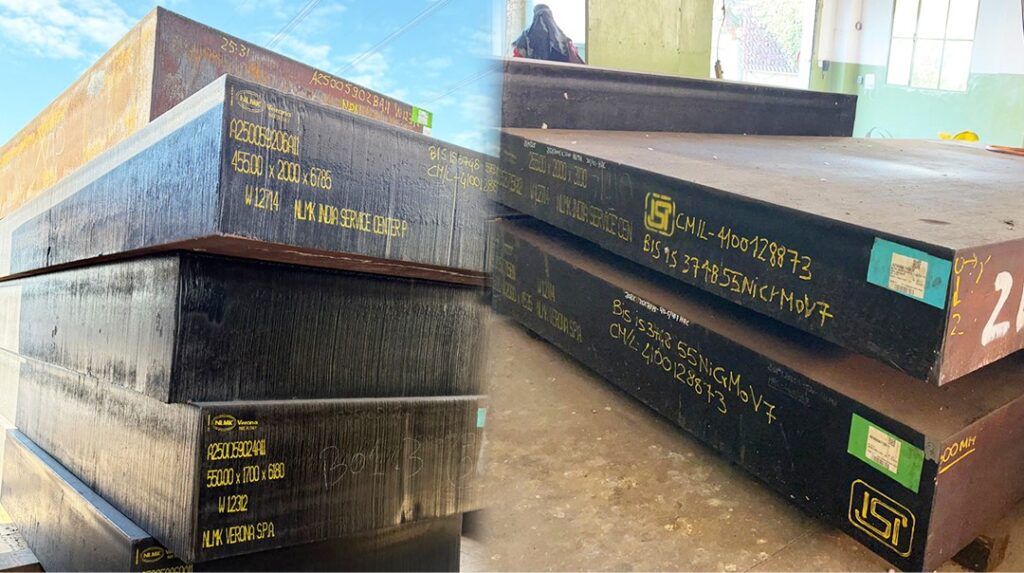
Every forging die lives a tough life. Imagine being struck by immense pressure, temperature, and repetitive impact —all day, every day. It’s no surprise that dies eventually wear out, crack, or lose their shape.
For the forging industry, It means a lot that is -halted production, rising tooling costs, and frustrated timelines.
But here’s where the story changes. When DB6 tool steel comes into the picture–a material designed to withstand the battlefield of forging. With its unique balance of toughness, wear resistance, and thermal stability, DB6 helps dies fight longer, harder, and smarter.
The result? Extended die life, reduced downtime, and significant savings for manufacturers.
👉 Choosing the right die steel is essential. DB6 steel turns challenges into durability and gives you a strong competitive edge.
Common Forging Die Failures
Forging dies can fail in several ways during production. Understanding these failures helps manufacturers select better die materials and improve tooling performance.
1. Excessive Die Wear
Cause
In forging operations, hot metal continuously flows across the die surface under high pressure. This causes abrasive wear, gradually removing material from the die surface.
Over time, this leads to:
- Loss of dimensional accuracy
- Poor part finish
- Frequent die replacement
How DB6 Helps
DB6 tool steel offers high hardness and wear resistance, which helps maintain its original shape for a longer period and reduces frequent die replacement.
2. Die Cracking
Cause
During hot forging, dies are repeatedly heated by hot metal and then cooled by air or lubricants, and this continuous heating and cooling cycle create thermal stress and then leads to surface cracks. And these Cracks often start at stress concentration points and gradually grow during repeated forging cycles.
How DB6 Helps
DB6 steel has excellent thermal stability and toughness, hence absorb repeated hammer blows without developing cracks. This is especially suitable for hammer forging dies and heavy-duty tooling.
3. Plastic Deformation
Cause
Forging dies operate under extremely high loads. If the die material does not have sufficient strength, it can permanently deform, causing an inaccurate part shape.
How DB6 Helps
DB6 steel has high compressive strength to resist deformation and maintain precise die geometry during heavy forging operations.
4. Premature Die Failure
Cause
When dies fail earlier than expected, it results in increased production cost and lower the manufacturing efficiency
How DB6 Helps
DB6 offers a balanced combination of toughness, strength, and wear resistance, which significantly improves die durability and overall productivity.
5. Surface Galling
Cause
Sometimes the forged metal sticks to the die surface. This is known as galling, damages the die surface and affects product finish also.
How DB6 Helps
The wear-resistant microstructure of DB6 tool steel reduces metal adhesion and improves the surface performance of forging dies.
Industry Insights
In many forging industry discussions, engineers highlight that die cracking and die failure are common challenges in hammer forging operations where dies experience repeated shock loads. Technical discussions in communities such as Practical Machinist often mention that high-toughness steels like DIN 1.2714 (DB6) help improve die life in heavy impact applications.
Such real-world discussions clarify the importance of selecting appropriate die steels for improving forging productivity.
Tips to Improve Forging Die Life
when selecting high-quality die steel, manufacturers must follow several practices to improve die performance:
- To ensure proper heat treatment of the die material
- To maintain correct die design to reduce stress concentration
- To use appropriate lubrication during forging operations
- To control operating temperatures during production
These measures help to reduce the die failures and improve productivity.
FAQs
What is DB6 tool steel used for?
DB6 steel is widely used for forging dies, hammer dies, shear blades, and heavy-duty industrial tooling because of its high toughness and impact resistance.
Is DB6 the same as DIN 2714?
DB6 steel is commonly considered equivalent or modified version of DIN 1.2714 tool steel.
What causes forging die failure?
Forging die failure is mainly caused by wear, thermal cracking, deformation, and repeated impact during forging operations.
How can forging die life be improved?
Die life can be improved by selecting the right tool steel, applying proper heat treatment, and maintaining optimal forging conditions.
Do suppliers in India stock DB6 steel?
Yes, many specialized tool steel suppliers in India maintain stock of DB6 steel and other European grades for forging and tooling applications.
References
- Tool steel classification standards from DIN
- Materials engineering research from ASM International
- Industry discussions from Practical Machinist
Looking for DB6 for your industrial tooling needs?
Virat Steels supplies premium-quality DB6 tool steel for forging dies and industrial tooling applications. Manufacturers can rely on our high quality tool steel materials to get consistent performance in demanding forging operations.
Contact our team to get more details about available sizes and technical specifications suitable for your applications.
https://www.viratsteels.com/db6.html info@viratsteels.com +91 98140-21775