



din 1.2714 steel stockist india
now browsing by category
NLMK Verona Tool Steel DB6 (DIN 1.2714): Properties, Applications & Supply in India
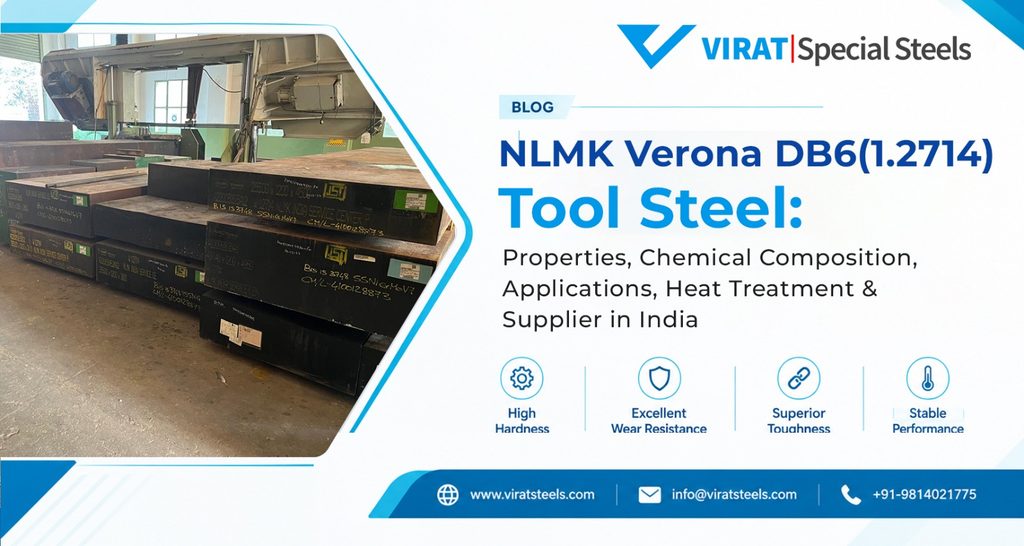
If you own a forging shop, die-making unit or heavy tooling operation, you know that the difference between a die that lasts one production run and one that lasts hundreds comes down to the steel underneath it. NLMK Verona Tool Steel DB6 is one of the European grades that is increasingly being specified by Indian manufacturers for close die forging, hammer dies and heavy-impact tooling – and with good reason.
This guide will explain what NLMK Verona DB6 really is, its real composition and mechanical properties, how it machines and heat-treats, where it is used and how to decide if it is the right grade for your application – all from verified technical data.
What Is NLMK Verona Tool Steel DB6?
NLMK Verona Tool Steel DB6 is a specialty tool steel plant of the NLMK Group, located in the north of Italy, close to Verona. The plant produces forged blocks, plates, and ingots for tool and die applications, and currently supplies its hot-work die steel to the Indian market under the DB6 designation — the specific grade Virat Steels stocks and distributes from this mill.
DB6 is not a proprietary or obscure code. It corresponds to well-established international standards:
| Designation | Standard |
| DB6 | Commercial/trade name |
| DIN 1.2714 | German (Werkstoff) standard |
| AISI L6 | American standard |
| AFNOR 55NCDVV7 | French standard |
| Standard family | 55NiCrMoV (Cr-Ni-Mo-V alloyed hot-work steel) |
To summarize, a buyer searching for “NLMK Verona DB6”, “db6 nmlk verona” or “nmlk verona die steel” is looking for this specific chromium-nickel-molybdenum-vanadium alloyed hot-work die steel, a popular grade in the European and Indian tooling supply chains, now available from NLMK Verona’s Italian production.
Chemical Composition of NLMK Verona Tool Steel DB6 / DIN 1.2714
DB6 is a Cr-Ni-Mo-V alloy system which provides a balance of toughness and hardness:
| Element | C | Si | Mn | P | S | Cr | Ni | Mo | V |
| % Range | 0.50–0.60 | 0.10–0.40 | 0.65–0.95 | ≤0.03 | ≤0.03 | 1.00–1.20 | 1.50–1.80 | 0.45–0.55 | 0.07–0.12 |
DB6 has high toughness and impact resistance (compared to more common hot-work grades such as H13) and high nickel content (compared to more common hot-work grades such as H13) for exceptional toughness and impact resistance rather than pure high-temperature hardness retention.
Mechanical Properties
| Property | Value |
| Tensile Strength | 1000–1400 MPa |
| Yield Strength | 1045 MPa |
| Elongation | 15%–20% |
| Impact Toughness | 20–25 J/cm² |
| Hardness (working) | 50–55 HRC |
| Compressive Strength | 2500 MPa |
| Modulus of Elasticity | 205 GPa |
Typical supply hardness ranges (depending on treatment condition):
- Annealed condition: 255 BHN max
- Hardened & tempered: 38–42 HRC (die-ready condition), with tools further hardened up to 50–55 HRC for service
- Hardness variation, surface to core: 20–25 BHN
Physical Properties
| Coefficient of Thermal Expansion (10⁻⁶ m/m·K) | 20–100°C | 20–200°C | 20–300°C | 20–400°C | 20–500°C | 20–600°C |
| Value | 12.1 | 13.1 | 13.2 | 13.5 | 14.1 | 14.3 |
| Thermal Conductivity (W/m·K) | 20°C | 350°C | 700°C |
| Value | 35.0 | 39.0 | 36.0 |
Note: Exact physical values can vary slightly with heat treatment and section size — always cross-check against the mill test certificate for critical applications.
Machinability of NLMK Verona DB6
DB6 is easy to work and the machinability can be rated at about 90 % relative to W-group water-hardening low-alloy steels taken as the 100 % reference. This makes it much easier to machine than many high-alloy cold-work or high-speed steel grades, and still retains the toughness needed for heavy forging dies.
Practical machining notes:
- Best machined in the annealed condition (≤255 BHN) before final hardening
- Finish machining should ideally be completed before final hardening and tempering, with only grinding/polishing done after
- Stress-relief before hardening reduces distortion risk in large die blocks
Heat Treatment Guide
| Process | Parameters |
| Annealing | Soak at 740–760°C, furnace-cool at max 10°C/hr down to 600°C, then air cool |
| Hardening | Preheat to 650°C, raise quickly to 900–950°C, quench in oil |
| Hardening (mill data) | 840–880°C oil quench → 57 HRC; 860–900°C air quench → 55 HRC |
| Tempering | Multiple tempers; hardness drops from ~56 HRC (100°C temper) to ~34 HRC (650°C temper) |
| Stress Relieving | Heat to 600–650°C, soak 2 hrs per 25mm section, slow cool |
| Forging | Warm to 700°C, raise to 1050°C, keep forging above 800°C, cool slowly in furnace/vermiculite |
| Nitriding | Possible after hardening + tempering; done ~50°C above nitriding temperature |
| Normalizing | Not recommended — DB6 is air-hardening |
Applications of NLMK Verona DB6 Tool Steel
DB6’s high toughness and impact resistance make it especially suited to heavy-impact forging applications rather than pure high-temperature die casting:
- Dies for drop forging hammers & mechanical presses
- Die holders, cassettes, and shoe blocks
- Hot shear blades
- Piston rods, cranks, and boosters
- Punches and blanking/forming dies
- Trimmer dies
- Clutch parts, pawls, shafts, knuckle pins
- Forming rolls, spindles, and rollers
Industries: Automotive component manufacturing, heavy forging, aerospace tooling, general engineering, and metalworking.
Advantages of NLMK Verona DB6 Tool Steel
- Superior toughness and impact resistance compared to many hot-work alternatives — ideal where shock loading, not just heat, is the main stress
- Good hardenability through thick sections, suited to large forging die blocks
- European mill origin (NLMK Verona, Italy) with documented alloy composition
- Good machinability (~90% relative rating) compared to many alloy tool steels
- Nitriding-compatible for surface wear resistance without sacrificing core toughness
- Supplied by Virat Steels with extra forging reduction, upsetting, and double tempering for improved ultrasonic quality in die blocks
DB6 vs H13 vs D2 — Comparison Table
| Factor | DB6 (DIN 1.2714) | H13 (DIN 1.2344) | D2 (Cold Work) |
| Category | Hot-work, high-toughness | Hot-work, high-temp hardness | Cold-work, high wear resistance |
| Key strength | Toughness & impact resistance | Thermal fatigue resistance | Abrasion/wear resistance |
| Typical hardness | 50–55 HRC | ~50 HRC | 58–62 HRC |
| Best suited to | Hammer/press forging dies, shock loading | Die casting, extrusion dies | Blanking, punching, cold forming |
| Machinability | Good (~90% rating) | Good | Moderate (high alloy content) |
| Nickel content | High (1.5–1.8%) | None | None |
How to Choose Between NLMK Verona Tool Steel DB6 (and Other Grades)?
- Is your tooling exposed to repeated impact/shock loading? DB6 is specifically strong here — hammer forging and heavy press dies benefit most from its toughness.
- Is your process purely high-temperature (die casting, hot extrusion) with less shock? H13 (DIN 1.2344) may be a better fit than DB6 due to superior thermal fatigue resistance.
- What supply condition do you need? DB6 is available annealed or hardened & tempered — confirm this at order stage based on your in-house heat treatment capability.
- What section size does your die need? Large forged blocks require good through-thickness hardenability — DB6’s alloy design supports this.
- Do you need surface hardening? DB6 can be nitrided after hardening/tempering for improved wear resistance while keeping core toughness.
- Do you need ultrasonic-tested quality die blocks? Ask specifically for extra forging reduction and double-tempered blocks — Virat Steels supplies DB6 this way for critical forging applications.
Why Source NLMK Verona DB6 Through Virat Steels?
- NLMK Verona origin DB6/DIN 1.2714 Steel – Official stockist and supplier
- PAN-India supply network covering major forging & auto hubs (Ahmedabad, Pune, Chennai, Bengaluru, Delhi NCR, Ludhiana etc.)
- Flat, square, and round bar available in project-based quantities
- Extra forging reduction and double tempering for improved ultrasonic quality on die blocks
- Technical support to confirm the right grade — DB6 vs H13 vs other die steels — for your specific application
Frequently Asked Questions
1. What is NLMK Verona Tool Steel DB6?
It is a Cr-Ni-Mo-V alloyed hot-work die steel (DIN 1.2714 / AISI L6) produced by NLMK Verona, Italy and supplied in India by Virat Steels.
2. What is DB6 steel equivalent to?
DB6 is commonly equivalent to DIN 1.2714, AISI L6, and AFNOR 55NCDVV7.
3. What is the hardness of DB6 steel?
Working hardness is typically 50–55 HRC after hardening and tempering; annealed condition is supplied at 255 BHN max.
4. Is DB6 better than H13 steel?
DB6 provides higher toughness and impact resistance, hence better suited for heavy forging, whereas H13 is more suitable for high temperature hot-work processes such as die casting.
5. Which steel is better for hammer forging dies?
DB6 is generally preferred for hammer forging dies due to its superior toughness and shock resistance.
6. What is the chemical composition of DB6?
Approximately 0.50–0.60% C, 1.00–1.20% Cr, 1.50–1.80% Ni, 0.45–0.55% Mo, and 0.07–0.12% V.
7. Can DB6 steel be welded or re-hardened?
Yes, but it must be done carefully — with stress tempering for pre-hardened condition — to avoid cracking.
8. Is DB6 steel suitable for hot work applications?
Yes, DB6 performs well in hot-work applications due to its strength and toughness at elevated stress conditions.
9. What is the machinability of DB6 steel?
DB6 rates roughly 90% machinability relative to W-group water-hardening steels (100% baseline) — considered good.
10. Should DB6 be normalized?
No — DB6 is air-hardening and should not be normalized.
11. Can DB6 be nitrided?
Yes, after hardening and tempering, at approximately 50°C above the intended nitriding temperature.
12. What shapes is NLMK Verona DB6 available in?
Flat, square, and round bar, supplied by Virat Steels across India.
13. Does Virat Steels supply NLMK Verona DB6 in India?
Yes, Virat Steels is a stockist and supplier of NLMK Verona-origin DB6/DIN 1.2714 tool steel.
14. What industries use DB6 tool steel?
Automotive components, heavy forging, aerospace tooling and general engineering.
15. What is the forging temperature range for DB6?
Heat to 700°C and then raise rapidly to 1050°C. Keep forging temperature above 800°C.
16. What’s the distinction between DB6 and DIN 2713?
The DIN 2713 is improved for better die performance and is called DIN 2714 (DB6).
17. What tensile and yield strength does DB6 offer?
Tensile strength 1000–1400 MPa, yield strength ~1045 MPa.
18. Does DB6 require oil or air quenching?
Both are used. Oil quenching at 840-880 °C gives ~57 HRC. Air quenching at 860-900 °C gives ~55 HRC.
19. What documentation should I request when ordering NLMK Verona DB6?
Always request a mill test certificate (MTC) confirming the heat/batch chemical composition and mechanical test results.
20. Where can I buy NLMK Verona DB6 tool steel in India?
Virat Steels supplies and stocks NLMK Verona DB6/DIN 1.2714 steel PAN-India, including to Gurugram, Delhi NCR, Pune, Chennai, and other major industrial hubs.
Conclusion
NLMK Verona Tool Steel DB6 (DIN 1.2714 / AISI L6) is the best solution for one simple reason: toughness where it counts – in heavy forging dies subject to repeated shock loading. Its Cr-Ni-Mo-V alloy design, excellent machinability and good hardenability make it a preferred choice for forging shops and die makers across India.
Need NLMK Verona DB6 die blocks, flats, squares, or round bars for your next forging project? Get in touch with Virat Steels — share your drawing and section size requirement, and our team will confirm grade, stock availability, and delivery timelines.
+91-98140 21775 | info@viratsteels.com
Lucchini Italy Tool Steel Supplier in India | DIN 1.2714 & Hot Work Tool Steels
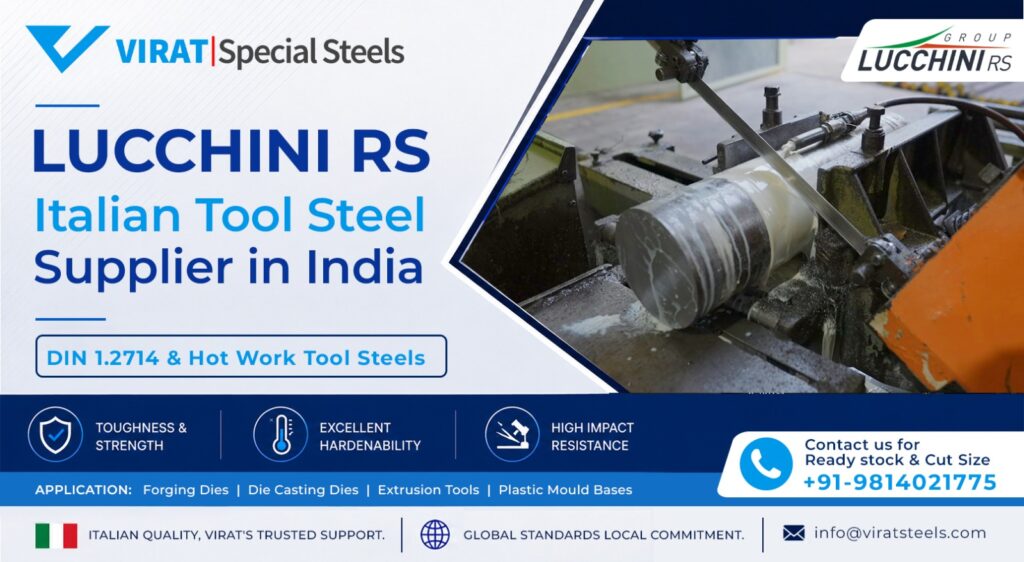
DIN 1.2714, H13, H11 & Hot Work Tool Steels | Pan India Delivery
In precision manufacturing, the right tool steel is not just a material choice — it is a productivity decision. Tool life, dimensional stability, surface finish, and downtime all depend heavily on the steel used in dies, moulds, punches, cutters, and hot-work tooling.
For manufacturers sourcing imported, high-performance tool steel across India — Lucchini Italy Tool Steel is the benchmark for consistent quality and advanced metallurgy. As an authorised Tool Steel Supplier in India, Virat Special Steels stocks and supplies premium Lucchini grades for automotive, aerospace, forging, die casting, plastic moulding, and precision engineering industries.
What Makes Lucchini Italy Tool Steel Special?
Lucchini, headquartered in Italy, has decades of experience manufacturing specialised tool steels to the most demanding international standards. As a trusted Imported Tool Steel supplier in India, Virat Steels sources directly from Lucchini to ensure authenticity and traceability.
- Exceptional hardness and wear resistance
- Superior toughness under impact and shock loading
- Excellent dimensional stability after heat treatment
- Batch-to-batch consistency for repeatable manufacturing results
- Lower inclusion levels through advanced melting and refining
Why Choose Italian Tool Steel?
Italian tool steel from Lucchini consistently outperforms standard grades due to superior steel-making practices. Here is why engineers and toolmakers prefer it:
| Advantage | What It Means for Your Tools |
| Cleaner Metallurgy | Lower sulphur, phosphorus and inclusion content; fewer micro-cracks in service |
| Better Toughness | Tools resist chipping and cracking even under heavy impact loads |
| Lower Rejection Rates | Uniform chemistry and microstructure reduce scrap during heat treatment and machining |
| Longer Tool Life | Customers consistently report 20–35% longer die life compared to standard grades |
| Consistent Heat Treatment | Predictable hardness response reduces rework; saves time and cost in toolrooms |
Lucchini Italy Tool Steel Grades Available in India
Virat Special Steels, a leading Special Steel Supplier and Industrial Tool Steel distributor, stocks the following Lucchini grades for immediate supply across India:
DIN 1.2714 — Hot Work Die Steel (L6 / BH 224 Equivalent)
DIN 1.2714 is the most widely used forging die steel in India. Its combination of high toughness, good wear resistance, and thermal shock resistance makes it the preferred choice for hot forging dies, hammer dies, and press tools.
- Applications: Forging Dies, Hot Stamping Tools, Hammer Dies, Press Tools
- Typical Hardness: 38–42 HRC depending on application
- Keywords: Forging Die Steel, Hot Work Tool Steel, Die Steel Supplier India
Hot Work Tool Steel — Full Range
Complete range of Lucchini hot work grades for forging, extrusion, die casting, and high-temperature tooling applications across Indian industry.
- Applications: Hot Work Dies, Extrusion Containers, Pressure Casting Dies
- Keywords: Hot Work Tool Steel India, Imported Tool Steel Supplier
Technical Data — Key Lucchini Tool Steel Grades
All values are typical and may vary with specific heat treatment parameters. Request mill test certificates for exact batch data.
| Grade | C % | Cr % | Mo % | V % | Hardness (HRC) | Key Property |
| DIN 1.2714 | 0.54–0.60 | 0.90–1.20 | 0.45–0.55 | 0.08–0.15 | 38–52 | Toughness |
| H13 / 1.2344 | 0.37–0.42 | 4.80–5.50 | 1.20–1.50 | 0.90–1.10 | 44–52 | Heat Resistance |
| H11 / 1.2343 | 0.37–0.41 | 4.80–5.50 | 1.10–1.40 | 0.30–0.50 | 44–50 | Impact Toughness |
| Plastic Mould | 0.28–0.40 | 1.60–2.00 | 0.15–0.25 | — | 28–34 (Pre-H) | Polishability |
Lucchini 1.2714 vs Standard 1.2714 — Performance Comparison
This comparison is based on customer feedback and industry data from Indian forging, die casting, and automotive tooling operations.
| Property | Lucchini 1.2714 | Standard 1.2714 | Advantage |
| Toughness | Higher | Medium | ✔ Lucchini — fewer cracks |
| Wear Resistance | High | Moderate | ✔ Lucchini — less edge wear |
| Tool Life | Longer (+20–25%) | Standard | ✔ Lucchini — lower tooling cost |
| Heat Treatment Response | Consistent | Variable | ✔ Lucchini — fewer rejects |
| Inclusion Level | Very Low | Moderate | ✔ Lucchini — cleaner steel |
| Surface Finish | Superior | Standard | ✔ Lucchini — better mould finish |
Customer Success Story — Real Results from Indian Industry
25% Longer Die Life for a Leading Forging Manufacturer
Challenge: A mid-size forging unit in Ludhiana was experiencing frequent die failure and inconsistent heat treatment results using domestically available DIN 1.2714.
Solution: Virat Special Steels recommended switching to Lucchini DIN 1.2714, supported by a full material certificate and application consultation.
Result: The customer achieved 25% longer die life, reduced rejection during heat treatment by over 30%, and lowered overall tooling cost per component — all within 3 production cycles.
Applications Across Indian Industries
| Industry | Common Tooling Application | Recommended Grade |
| Automotive | Stamping dies, forging dies, press tools | DIN 1.2714, H13 / 1.2344 |
| Die Casting | Aluminium, zinc & magnesium casting dies | H13 / 1.2344, H11 / 1.2343 |
| Forging & Extrusion | Hot-work dies, containers, mandrels | DIN 1.2714, H11 / 1.2343 |
| Plastic Processing | Injection moulds, blow moulds, inserts | Plastic Mould Steel |
| General Engineering | Punches, shear blades, wear parts, fixtures | DIN 1.2714, Cold Work Grades |
| Aerospace | Precision tooling, jigs & fixtures | H13 / 1.2344, High-Speed Steel |
Why Choose Virat Special Steels ?
Virat Special Steels is one of India’s most trusted Special Steel Suppliers and Tool Steel Distributors — backed by proven performance and a deep technical knowledge of tool steel applications.
| Credential | What It Means for You |
| Years in Business | Over 3 decades supplying special steels to Indian industry — deep market knowledge and trusted supplier relationships |
| Industries Served | Automotive, aerospace, forging, die casting, defence, railways, oil & gas, plastic processing — 20+ sectors |
| Stock Availability | Ready stock of popular Lucchini grades; no waiting for imports — immediate dispatch possible |
| Custom Cutting Facility | Cut-to-length, rough machined blanks, and custom sizes available — reduce waste and machining time |
| Pan India Supply | Delivering to Ludhiana, Delhi NCR, Mumbai, Pune, Chennai, Coimbatore, Rajkot, Hyderabad and all major industrial centres |
| Certified Material | Every batch supplied with Lucchini mill test certificates, chemical composition reports and hardness verification |
| Technical Consultation | Application-specific grade selection, heat treatment guidance, and after-sales technical support |
Tool Steel Supplier — Pan India Delivery
Virat Special Steels supplies Lucchini tool steel across India. Whether you need material in Punjab, Maharashtra, Tamil Nadu, Telangana, Gujarat, or anywhere else in India — we deliver fast with full traceability.
- Tool Steel Supplier in Ludhiana — Same-day dispatch from our warehouse
- Tool Steel Supplier in Delhi NCR — Serving Faridabad, Gurgaon, Manesar, Noida, Ghaziabad
- Tool Steel Distributor India — Mumbai, Chennai, Pune, bangalore, Karnataka
- Pan India Delivery — Special packaging for long-distance shipments, tracking on request
Explore Our Product Range
Browse our full range of Lucchini tool steel and special steel products:
DIN 1.2714 Tool Steel — Product Page
H13 Tool Steel (DIN 1.2344) — Product Page
H11 Tool Steel (DIN 1.2343) — Product Page
Hot Work Tool Steel — Full Range
Plastic Mould Steel — Product Page
Why Manufacturers Choose Lucchini Tool Steel
Greater Resistance to Wear
Designed for hard working conditions and repeated production cycles, Lucchini grades minimise edge wear and reduce the frequency of maintenance shutdowns — keeping production lines running longer.
High Toughness
Good for tooling subjected to shock, impact and heavy mechanical loads where brittle fracture is costly. Lucchini’s controlled microstructure delivers consistent toughness that standard grades cannot match.
Thermal Fatigue Strength
Critical for die casting, forging, and extrusion where tools are repeatedly heated and cooled. Lucchini hot work grades resist thermal cracking even in high-cycle aluminium die casting operations.
Dimensional Stability
Maintains tolerances after heat treatment and in production — essential for precision tooling where dimensional drift causes part rejection.
Steady Production Performance
Cleaner steel and uniform properties allow for repeatable machining, heat treatment, and shop floor results batch to batch — reducing uncertainty in your toolroom.
Frequently Asked Questions — Lucchini Tool Steel in India
1. What is DIN 1.2714 used for?
DIN 1.2714 is primarily used for hot forging dies, hammer dies, press tools, and hot stamping applications. Its combination of toughness and wear resistance at elevated temperatures makes it the most widely used forging die steel in India.
2. Is Lucchini better than Chinese tool steel?
Yes, for most demanding industrial applications. Lucchini steel offers cleaner metallurgy, lower inclusion levels, consistent chemical composition, and reliable batch-to-batch quality. While Chinese tool steel may have a lower initial cost, Lucchini grades often provide longer tool life, improved heat treatment results, reduced rejection rates, and more predictable performance, resulting in better long-term value.
3. What is the hardness of DIN 1.2714 steel?
Typical hardness for DIN 1.2714 in service is 38–52 HRC depending on the application. Forging dies for heavy hammers are typically hardened to 38–44 HRC for maximum toughness, while press tools and inserts may be taken to 48–52 HRC for better wear resistance.
4. What is the equivalent grade of DIN 1.2714?
DIN 1.2714 is equivalent to AISI L6 (USA), BH 224 (UK), 55NiCrMoV7 (EN), and is comparable to several Indian standard grades. Always verify exact chemistry before substituting, as minor differences in nickel or vanadium content can affect toughness and heat treatment response.
5. What is H13 tool steel used for?
H13 (DIN 1.2344) is the global standard for aluminium die casting dies, hot extrusion tooling, hot forging dies, and high-polish plastic injection moulds. Its high chromium and vanadium content provides excellent thermal fatigue resistance and hot hardness.
6. What is the difference between H13 and H11 tool steel?
H13 (1.2344) contains more vanadium (0.90–1.10%) than H11 (1.2343, 0.30–0.50%), giving it higher wear resistance and hot hardness. H11 has slightly better toughness due to lower carbon and vanadium. H13 is preferred for die casting; H11 for extrusion liners and applications requiring maximum impact resistance.
7. Where can I buy Lucchini tool steel in India?
Virat Special Steels stocks popular Lucchini Italy grades, including DIN 1.2714, H13, H11, and plastic mould steels, with supply across major industrial hubs in India.
8. Is Lucchini tool steel available with mill test certificates?
Yes. Lucchini tool steel is supplied with original mill test certificates, providing details of chemical composition, mechanical properties, and full traceability for quality assurance..
9. Can you supply custom sizes and cut-to-length pieces?
Yes. Virat Special Steels offers custom cutting and rough machining services. We can supply tool steel in cut-to-length bars, rough turned rounds, and custom blanks to reduce material waste and machining time in your toolroom.
10. What industries benefit most from Lucchini Tool Steel?
Premium Italian tool steel is trusted across automotive, forging, die casting, extrusion, plastic moulding, aerospace, railways, defence, and precision engineering industries for reliable performance and longer tool life.
11. What is the minimum order quantity for Lucchini tool steel?
Virat Special Steels can supply from small quantities (single piece) for toolroom requirements up to bulk tonnage for production facilities. There is no minimum order restriction on stocked grades.
12. Do you supply Lucchini steel outside Ludhiana?
Yes. We supply Lucchini tool steel Pan India — including Maharashtra, Gujarat, Tamil Nadu, Telangana, Karnataka, Rajasthan, Uttar Pradesh, and all major industrial regions. Courier, truck, and train transport options available.
Get in Touch — Request a Quote Today
For grade selection, pricing, stock availability, and technical support for Lucchini Italy Tool Steel — contact Virat Special Steels today.
📞 +91 98140-21775 ✉ info@viratsteels.com
DIN 2714 Hot Work Tool Steel: Properties, Uses & Supplier in India | Virat Steels
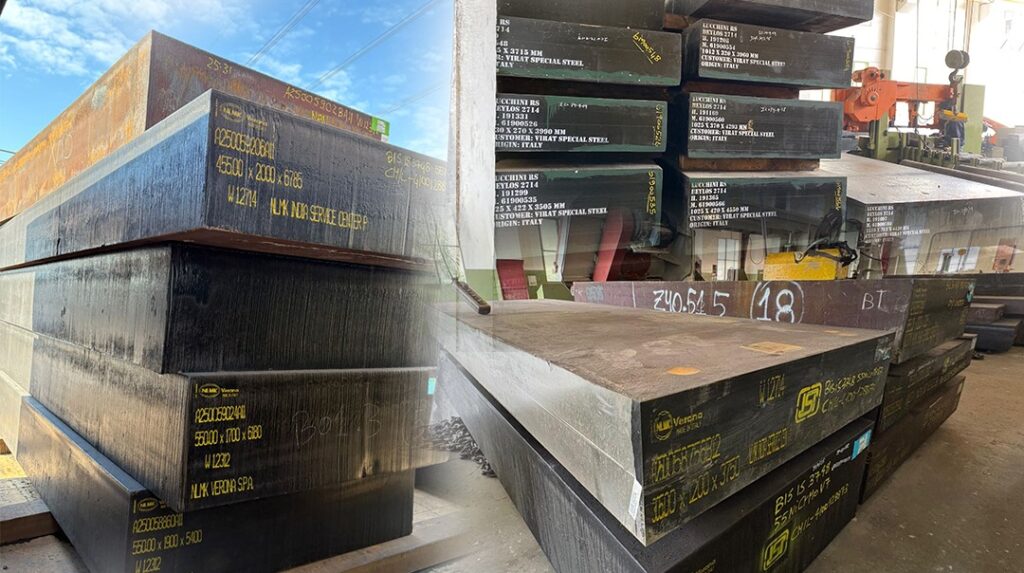
In the demanding application of forging, die casting, and heavy engineering, selecting the right tool steel is essential for performance and durability. Among the most reliable grades for high-temperature and high-impact applications, DIN 1.2714 tool steel stands out for its exceptional toughness and strength.
If you are searching for reliable supplier in India, Virat Steels offers Din 2714 tool steel with large stock, fast delivery & consistent quality across India.
What is DIN 1.2714 Tool Steel?
DIN 1.2714 is a nickel-chromium-molybdenum hot work tool steel, specifically designed for applications involving high temperature, heavy loads, and shock resistance.
It is widely known by its EN/DIN designation:
- 55NiCrMoV7
- DB6
- AISI L6
This grade offers a perfect balance of:
- Strength
- Toughness
- Heat resistance
making it ideal for forging and heavy-duty tooling applications.
Key Properties of DIN 1.2714 Tool Steel
Understanding the properties of 1.2714 helps manufacturers choose the right material for demanding work environments:
- Exceptional Toughness
- Good Hot Strength
- Thermal Fatigue Resistance
- Moderate Wear Resistance
- Good Hardenability
Allows uniform hardness even in large sections.
Chemical Composition of DIN 1.2714
The superior performance of this grade is due to its alloying elements:
| Element | Values (%) | Feature |
| Carbon (C): | 0.50-0.60 | Provides hardness |
| Nickel (Ni): | 1.50-1.80 | Improves toughness |
| Chromium (Cr): | 1.00-1.30 | Meant for strength and wear resistance |
| Molybdenum (Mo): | 0.45-0.60 | Boosts high-temperature strength |
| Vanadium (V): | 0.07-0.12 | Improves grain structure |
This composition gives a strong balance of hardness & toughness, ensures long tool life and resistance to heavy impact loads.
Heat Treatment of DIN 1.2714 Tool Steel
Proper heat treatment is essential to achieve maximum performance:
- Preheating: 600–700°C
- Hardening: 830–870°C followed by oil or air quenching
- Tempering: 400–650°C depending on required hardness
- Typical hardness range: 45–52 HRC
A controlled heat treatment process improves:
- Strength
- Toughness
- Resistance to thermal cracking
Applications of DIN 1.2714 Tool Steel
DIN 1.2714 is widely used in industries requiring high strength and shock resistance:
| Forging Industry | Heavy Engineering | Automotive Sector | Manufacturing Industry |
| Hammer dies Press dies Anvils | Die holders Support tools Structural components | Forging tools for automotive parts Heavy-duty shafts | Hot forming tools Extrusion tools |
Its ability to withstand extreme stress and temperature variations makes it capable in industrial applications.
DIN 1.2714 vs H13 Tool Steel – Which is Better?
A common comparison in the industry is between DIN 1.2714 and H13.
| Feature | DIN 1.2714 | H13 Tool Steel |
| Toughness | Very High | High |
| Heat Resistance | Good | Excellent |
| Wear Resistance | Moderate | High |
| Application | Heavy duty application | Die casting, extrusion |
Why Choose Virat Steels?
When sourcing high-quality tool steel, selecting a reliable supplier is crucial for operational efficiency.
Virat Steels is a leading supplier of hot work tool steels, offering premium-quality DIN 1.2714 / DB6 material across India.
✔ Wide Range of Sizes
Available in:
- Round bars
- Flats
✔ Pan India Supply Network
We cater to major industrial hubs across India, including Pune, Nashik, Ahmedabad, Rajkot, Ludhiana, Jalandhar, Faridabad, Gurgaon & Delhi NCR, Bangalore, Tamil Nadu, Hyderabad, and many more regions nationwide.
✔ Assured Quality
All materials are tested and certified to meet industry standards.
✔ Competitive Pricing
We offer cost-effective solutions for bulk and customized requirements.
✔ Technical Expertise
Our team helps you select the right grade based on your application.
DIN 1.2714 Tool Steel Price in India
The price of DIN 1.2714 tool steel depends on:
- Size and dimensions
- Quantity
- Heat treatment condition
- Market trends
Choosing a trusted partner like Virat Steels ensures consistent quality, timely delivery, and long-term reliability.
Frequently Asked Questions (FAQs)
1. What is DIN 1.2714 tool steel used for?
It is used in forging dies, hammer tools, and heavy-duty applications requiring high toughness.
2. Is DIN 1.2714 a hot work tool steel?
Yes, it is a hot work tool steel designed for high-temperature applications.
3. What is the hardness of DIN 1.2714?
Typically ranges between 45–52 HRC after heat treatment.
4. What is the equivalent of DIN 1.2714?
Its common equivalent is 55NiCrMoV7 / DB6.
5. Where can I buy DIN 1.2714 tool steel in India?
You can source high-quality material from Virat Steels, a trusted supplier across India.
Get in Touch with Virat Steels
Looking for premium DIN 1.2714 tool steel?
Contact Virat Steels today for expert guidance and the best pricing tailored to your requirements.
For the best price and bulk supply, Call now Virat Steels for a customized quotation.
https://www.viratsteels.com/db6.html | 📧info@viratsteels.com | 📱+91 98140-21775