



Special Steel Supplier in India
now browsing by category
Why Hot Work Tool Steel matters in Indian Manufacturing Industries
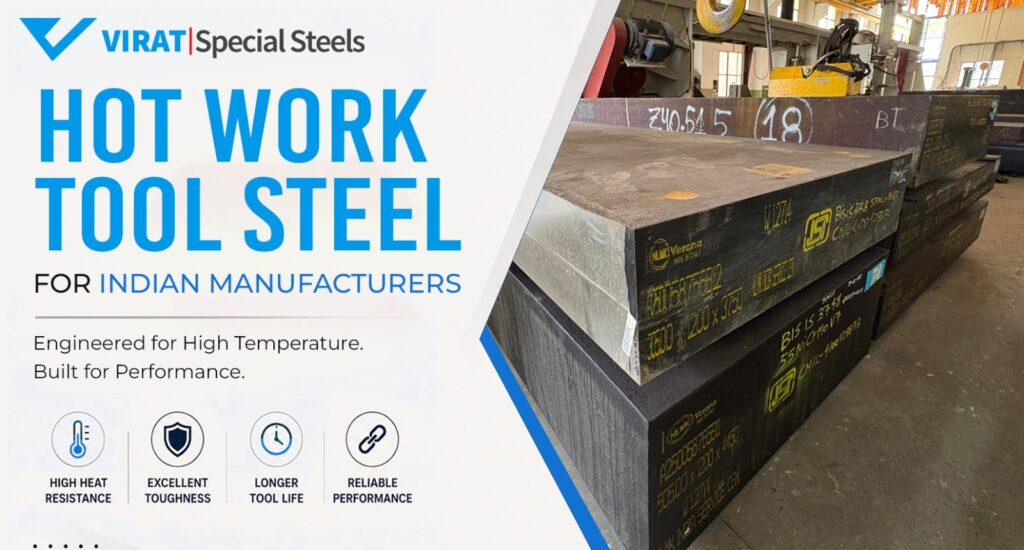
India’s manufacturing sector is expanding rapidly across industries such as automotive, die casting, forging, aluminium extrusion, plastic moulding, and heavy engineering demanding higher productivity, better precision, and longer tool life than ever before. Hence In such high-temperature and high-pressure applications, the quality of tool steel directly impacts production performance, die life, and operational efficiency.
So, industries increasingly rely on premium hot work tool steels such as H13 tool steel, H11, and DB6 grades known for their excellent heat resistance, toughness, wear resistance, and durability under demanding working conditions.
To support these growing industrial requirements, Virat Special Steels Pvt. Limited with ready stock, precision cutting, UT tested material, and technical support supplies high-quality hot work tool steels engineered for reliable performance across modern manufacturing applications.
Hot Work Tool Steel
Hot work tool steel is a category of alloy steel specifically designed for applications involving elevated temperatures. These steels are used to manufacture tools, dies, and molds that shape.
Hot work tool steels can withstand:
- High thermal stress
- Repeated heating and cooling cycles
- Mechanical shock
- Abrasion and wear
- Surface cracking
This makes them ideal for industrial applications where reliability and long tool life are essential.
Common Types of Hot Work Tool Steel
H13 is one of the most widely used hot work tool steels because of its excellent heat resistance, toughness, and wear resistance. It is commonly used in aluminum extrusion, die casting, and forging applications.
H11 tool steel offers high toughness and strong thermal fatigue resistance, making it suitable for applications involving heavy impact and thermal cycling.
DB6 hot work tool steel is known for its superior hot strength and durability in demanding industrial applications such as heavy-duty tooling and forging dies.
Importance of Hot Work Tool Steel in Indian Manufacturing
India’s industrial growth has significantly increased the demand for durable and high-performance tooling materials. Hot work tool steels help industries achieve:
1. Higher Production Efficiency
Premium hot work steels reduce downtime and improve continuous production performance.
2. Longer Tool and Die Life
These steels provide excellent resistance to thermal fatigue and wear, resulting in extended die life and lower replacement costs.
3. Improved Product Quality
Dimensional stability and resistance to deformation ensure consistent product quality in extrusion, forging, and die casting operations.
Applications of H13, H11 & DB6 Hot Work Tool Steel
| Grade | Industry Use | Main Applications | Key Benefit |
| H13 | Aluminum Extrusion | Extrusion Dies | High heat resistance |
| H13 | Plastic Molding | Injection Molds | Excellent wear resistance |
| H11 | Forging Industry | Forging Dies & Punches | High toughness |
| H11 | Heavy Engineering | Hot Work Tooling | Better shock resistance |
| DB6 | Die Casting | Die Casting Tools | Superior hot strength |
| DB6 | Heavy Forging | Heavy-Duty Dies | Long tool life |
Why are H13, H11 & DB6 Tool Steels Popular in Indian Industries?
H13, H11, and DB6 tool steels are widely used in Indian industries because of their excellent heat resistance, toughness, durability, and long tool life in demanding hot work applications.
Key Advantages of H13, H11 & DB6 Tool Steel
| Grade | Key Property | Industrial Advantage |
| H13 | High Heat Resistance | Performs reliably at elevated temperatures |
| H13 | Excellent Wear Resistance | Reduces tooling wear and maintenance |
| H11 | High Toughness | Prevents cracking and premature tool failure |
| H11 | Thermal Fatigue Resistance | Handles repeated heating and cooling cycles |
| DB6 | Superior Hot Strength | Performs well in heavy-duty hot work applications |
| DB6 | Long Tool Life | Improves productivity and reduces operating costs |
Choosing the Right Hot Work Tool Steel Supplier
The quality of hot work tool steel directly affects tool life, productivity, and manufacturing performance. When selecting suppliers for tool steels like H13, H11, and DB6 tool steel and many more, manufacturers should look for:
- Consistent material quality
- Proper testing and certification
- Technical support and application guidance
- Reliable stock availability and timely delivery
Conclusion
High-performance hot work tool steels are very essential in improving die life, production efficiency, and overall manufacturing performance. Hence choosing the right grade and the right supplier can enhance tooling reliability in demanding industrial applications.
Virat Special Steels Pvt. Limited is committed to supplying premium-quality hot work tool steels like DB6, H13, H11 etc backed by ready stock availability, UT tested material, precision cutting, and technical support to your industry requirements.
Whether for die casting, forging, extrusion, or heavy engineering applications, Virat Steels helps manufacturers achieve better productivity, durability, and long-term performance.
Looking for reliable hot work tool steel solutions?
Contact Virat Special Steels Pvt. Limited today for expert guidance and premium tool steel supply.
📞 +91 98140-21775 ✉ info@viratsteels.com
For more details about our hot work tool steel grades and applications, please click on the link below to explore our product range and technical specifications.
https://www.viratsteels.com/h13.html
https://www.viratsteels.com/h11.html
https://www.viratsteels.com/db6.html
FAQs – Hot Work Tool Steel
1. What is Hot Work Tool Steel?
Hot work tool steel is specially designed for applications involving high temperatures, pressure, and wear.
2. Which are the common hot work tool steel grades?
H13, H11, and DB6 are among the most widely used hot work tool steel grades in industries.
3. Why is H13 tool steel popular?
H13 offers excellent heat resistance, wear resistance, and long tool life.
4. What is H11 tool steel used for?
H11 is mainly used in forging and heavy-duty applications requiring high toughness and crack resistance.
5. What are the advantages of DB6 tool steel?
DB6 provides superior hot strength, durability, and reliable performance in extreme working conditions.
6. Which industries use H13, H11, and DB6 steel?
These grades are widely used in aluminum extrusion, die casting, forging, plastic molding, and heavy engineering industries.
7. What is the hardness range of H13 steel?
H13 tool steel generally ranges between 44–52 HRC depending on heat treatment and application.
8. Where can I buy quality H13, H11, and DB6 tool steel in India?
Premium-quality H13, H11, and DB6 hot work tool steels are available from Virat Special Steels for industrial applications.
Why Manufacturers Are Choosing DB6 / DIN2714 Steel for Industrial Tooling Applications
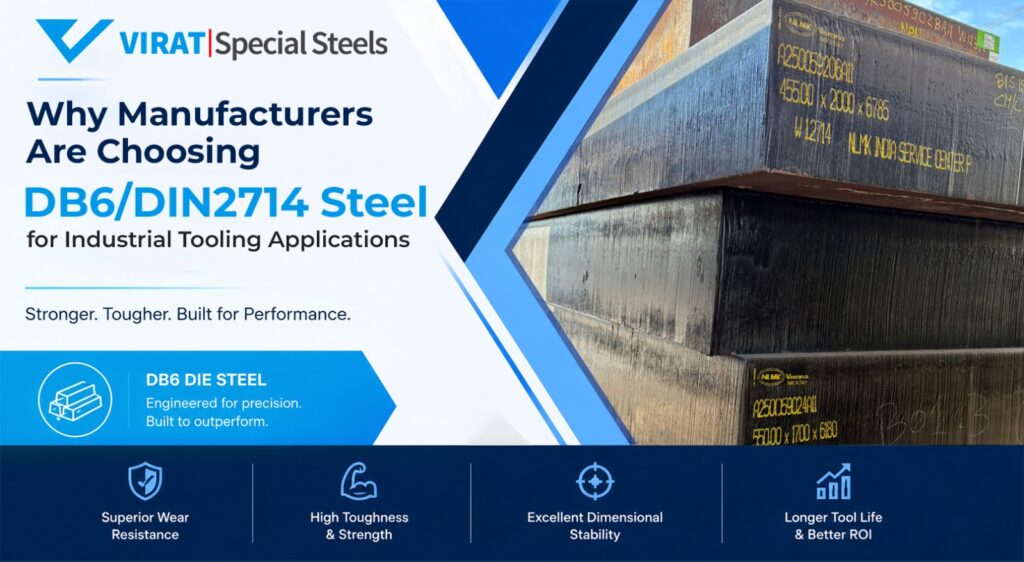
DB6 / DIN 1.2714 steel is a preferred choice for heavy-duty industrial applications because of its toughness, strength, wear resistance, and heat resistance. It is widely used in tooling, forging, die manufacturing, and engineering, delivering reliable performance under demanding conditions.
VIRAT Special Steels supplies high-quality DB6 / DIN 1.2714 steel that meets strict industrial standards and delivers consistent performance across various applications.
Industries today require materials that can withstand high pressure, repeated impact, elevated temperatures, and continuous wear. DB6 steel fulfills these requirements efficiently, making it a trusted choice for manufacturers looking to improve productivity, reduce downtime, and increase tool life.
1. Exceptional Wear Resistance
One of the biggest advantages of DB6 steel is its excellent wear resistance. In high-friction and heavy-duty industrial operations, components are constantly exposed to abrasion and mechanical stress. DB6 steel maintains its performance and dimensional stability even under continuous use.
Common applications include:
- Forging dies
- Cutting tools
- Punches and molds
- Shear blades
- Heavy-duty machine components
Its superior wear resistance helps reduce frequent replacement of tools and components, resulting in lower maintenance costs and improved operational efficiency.
2. High Toughness and Strength
DIN 1.2714 steel is specially designed to provide high toughness along with excellent mechanical strength. Unlike many conventional tool steels, DB6 steel can withstand repeated impact loading without cracking or deformation.
Key benefits include:
- High impact resistance
- Better load-bearing capacity
- Resistance to deformation
- Improved structural stability
- Reliable performance under heavy stress
These properties make DB6 steel highly suitable for demanding forging and tooling applications.
3. Excellent Heat Resistance
DB6 / DIN 1.2714 steel offers excellent resistance to heat and thermal fatigue. It retains its hardness and strength even at elevated operating temperatures, making it ideal for hot work applications.
This property is especially beneficial in:
- Hot forging dies
- Press tools
- High-temperature tooling
- Heavy industrial processing
- Hot working operations
Its ability to perform consistently at high temperatures improves productivity and extends tool life.
4. Longer Tool Life
The balanced combination of toughness, strength, and wear resistance significantly increases the service life of tools manufactured from DB6 steel.
Advantages include:
- Reduced tool failure
- Lower downtime
- Reduced replacement frequency
- Higher production efficiency
- Lower overall production cost
Longer tool life directly contributes to improved manufacturing efficiency and cost savings.
5. Good Machinability
Despite its high strength and hardness, DB6 steel offers good machinability when processed under proper conditions. Manufacturers prefer this grade because it allows accurate machining with excellent surface finish quality.
Benefits include:
- Cleaner machining results
- Better dimensional accuracy
- Improved surface finish
- Reduced machining errors
- Consistent production quality
This makes DB6 steel suitable for precision engineering applications.
6. Reliable Performance in Harsh Industrial Conditions
Modern industries require materials that can consistently perform under extreme operating conditions involving pressure, heat, shock, and continuous usage. DB6 steel is widely appreciated for its reliability and durability.
Industries value DB6 steel for:
- Dimensional stability
- Resistance to cracking
- High toughness
- Thermal stability
- Long-term operational reliability
These characteristics make it one of the most dependable tool steel grades available today.
Industries Using DB6 / DIN 1.2714 Steel
DB6 steel is widely used across multiple industries due to its versatility and superior mechanical properties.
Major industries include:
- Automotive industry
- Forging industry
- Tool and die manufacturing
- Aerospace engineering
- Industrial machinery
- Metal fabrication
- Precision engineering
Common Applications of DB6 Steel
Typical applications of DIN 1.2714 / DB6 steel include:
- Forging dies
- Hammer dies
- Press tools
- Die holders
- Shear blades
- Extrusion tools
- Heavy-duty tooling components
FAQs
Is DB6 steel suitable for heavy-duty industrial applications?
Yes. DB6 / DIN 1.2714 steel is highly suitable for heavy-duty industrial applications because of its excellent toughness, strength, wear resistance, and heat resistance.
Can DB6 steel improve production efficiency?
Yes. Its longer tool life and reliable performance help reduce downtime, maintenance, and replacement costs, leading to higher productivity.
Is DB6 steel cost-effective?
Yes. Although it is a premium-grade tool steel, its durability and extended service life make it highly cost-effective over the long term.
Which industries commonly use DB6 steel?
Automotive, forging, tooling, aerospace, metal fabrication, and heavy engineering industries commonly use DB6 steel.
Why choose DB6 steel from VIRAT Special Steels?
VIRAT Special Steels offers premium-quality DB6 / DIN 1.2714 steel with reliable quality, accurate sizes, and dependable industrial performance.
Conclusion
DB6 / DIN 1.2714 steel is an excellent choice for manufacturers seeking high performance, durability, toughness, and long service life in demanding industrial applications. Its superior mechanical properties make it ideal for forging dies, tooling applications, and heavy engineering industries.
By choosing premium-quality DB6 steel, industries can improve productivity, reduce operational costs, and achieve reliable long-term performance.
For high-quality DB6 / DIN 1.2714 steel solutions, connect with:
Email: info@viratsteels.com
Phone: +91 98140-21775
Virat Steels-Trusted Tool & Die Steel Supplier in India
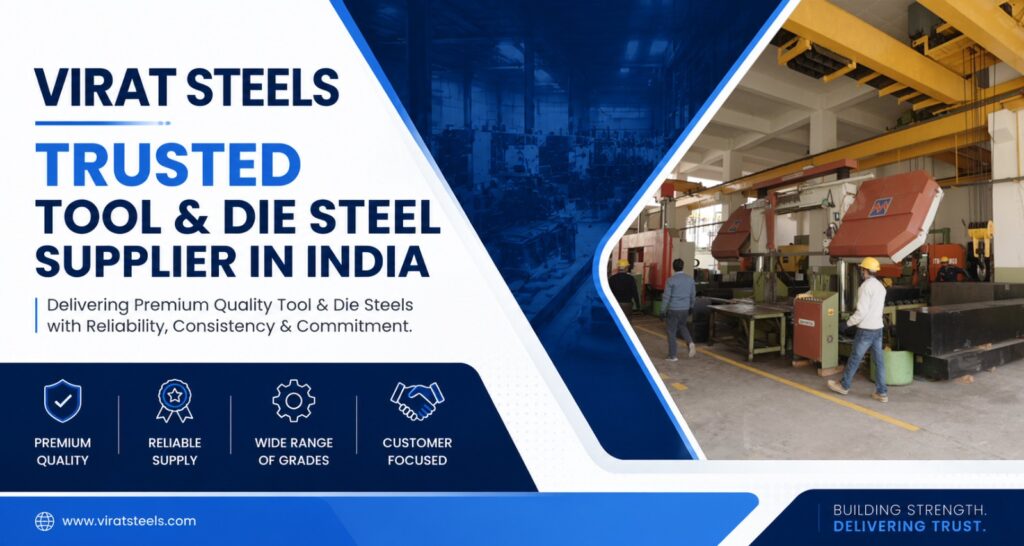
In the tool and die steel industry, quality material and reliable service are very essential for consistent production performance. Manufacturers today need more than just steel. Hence, they need a trusted supply partner.
That’s why industries across India choose Virat Special Steels for premium tool steel solutions.
With decades of domain expertise, the company serves high-quality tool & die steels industries ranging from automotive and aerospace to defence, tooling, and heavy engineering.
Premium Quality Steel
Virat Steels provide genuine and reliable tool steel with:
- Consistent hardness
- Better machinability
- Improved tool life
- Genuine quality
Available in:
✔ Rounds
✔ Flats
✔ Blocks
Ready Stock Availability
Ready stock available for major grades including:
ensuring quick dispatch and reduced downtime.
Ultrasonic Tested Material
Virat Steels supplies UT Tested Tool Steel
Ultrasonic testing helps detect:
- Internal defects
- Cracks
ensuring better reliability and performance.
Precision Cutting Facility
We offer precision cutting services for:
- Accurate dimensions
- Reduced machining allowance
- Faster processing
Helping customers save time and improve productivity.
Strong Logistics Support
We deliver across India with:
- Fast dispatch
- Safe handling
- Timely delivery
Supplying to major industrial regions across India .
Technical Support
Our team helps customers choose:
- Suitable steel grade
- Recommended Hardness
- ESR vs standard grades
- Application-based solutions
Certified & Test Report
- Material Test Certification (MTC)
Looking for a reliable tool and die steel supplier in India?
Contact Virat Special Steels:
📞 +91 98140-21775
🌐 www.viratsteels.com
✉ info@viratsteels.com
Frequently Asked Questions (FAQs)
1. What products does Virat Steels supply?
Virat Steels supplies premium tool and die steels including Hot work steels, cold work steels, High Speed steels, Alloy steel grades etc.
2. Which industries use tool and die steel?
Tool and die steels are widely used in Forging, Extrusion, Plastic moulds, Automotive components, Pressure Die casting .
3. Does Virat Steels provide ultrasonic tested material?
Yes, Virat Steels supplies UT tested material to ensure better reliability, reduced internal defects, and improved tooling performance.
4. Does Virat Steels maintain ready stock?
Yes, Virat Steels maintains ready stock of major tool steel grades for quick dispatch and faster delivery across India.
5. Why choose Virat Steels as a tool steel supplier?
Manufacturers choose Virat Steels because of Genuine quality, UT tested steel, Precision cutting facility, ready stock, fast delivery, technical support
6. Does Virat Steels deliver across India?
Yes, Virat Steels supplies tool and die steel across major industrial regions in India with reliable logistics and timely delivery support.
7. How can I contact Virat Steels for tool steel requirements?
You can contact Virat Steels on 📞 +91 98140-21775 for grade recommendations, stock availability, and pricing.
Why H13 tool steel Is Widely Used for Aluminium Extrusion Dies
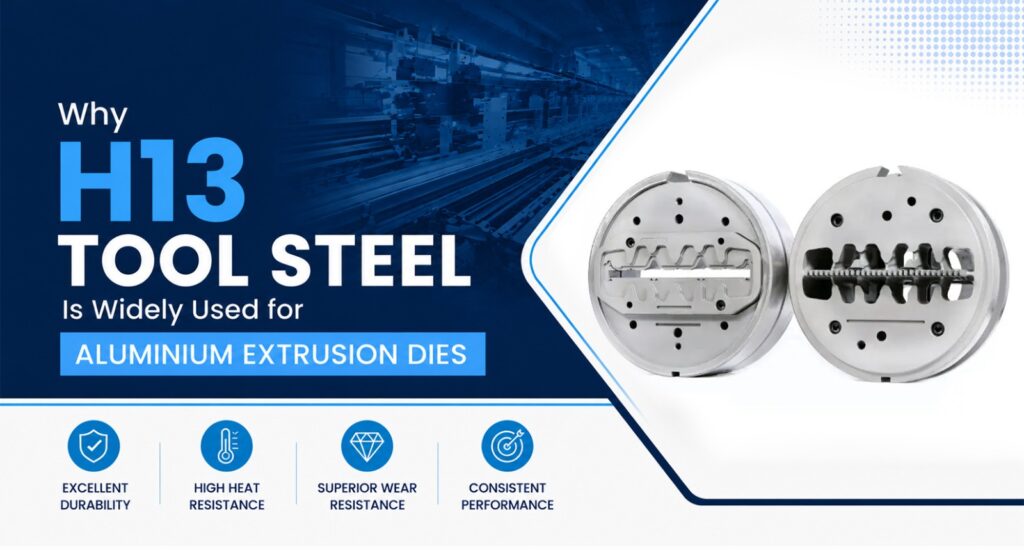
The aluminium extrusion industry demands tooling that can withstand extreme heat, pressure, wear, and continuous production cycles. Choosing the wrong die steel can lead to premature cracking, dimensional loss, downtime, and high replacement costs.
That is why H13 tool steel has become the industry’s preferred choice for aluminium extrusion dies.
Known for its excellent combination of hot strength, toughness, thermal fatigue resistance, and wear resistance, H13 steel delivers reliable performance in demanding extrusion applications.
What is H13 Tool Steel?
H13 tool steel is a chromium-molybdenum-vanadium hot work tool steel designed for high-temperature tooling applications.
Equivalent grades include:
- DIN 1.2344
- SKD61
- X40CrMoV5-1
H13 is widely used in:
- Aluminium extrusion dies
- Die casting dies
- Forging dies
- Plastic injection moulds
Why Aluminium Extrusion Dies Need Special Tool Steel
During extrusion, aluminium billets are heated to high temperatures and forced through the die under massive pressure.
This creates:
- High thermal stress
- Severe wear
- Continuous friction
- Cyclic heating and cooling
Ordinary steels cannot withstand these conditions for long. The die material must maintain:
- Hardness at high temperatures
- Toughness against cracking
- Wear resistance under pressure
This is where H13 tool steel performs exceptionally well.
ESR H13 vs Standard H13 for Extrusion Dies
What is ESR H13?
ESR stands for:
Electro Slag Remelting
This secondary refining process produces cleaner steel with:
✔ Lower inclusions
✔ Better toughness
✔ Improved fatigue resistance
✔ More uniform carbide distribution
For demanding extrusion applications, many manufacturers prefer:
👉 ESR-grade H13 tool steel
How to Increase H13 Extrusion Die Life
Manufacturers can significantly improve die life by:
✔ Using ESR-grade H13
Cleaner steel improves fatigue resistance.
✔ Maintaining Correct Hardness
Recommended:48–52 HRC
✔ Proper Preheating
Reduces thermal shock during startup.
✔ Nitriding Surface Treatment
Improves:
- Wear resistance
- Oxidation resistance
- Surface hardness
✔ Correct Cooling Practices
Avoid aggressive cooling that causes thermal stress.
Why Manufacturers Prefer Virat Steels for H13 Tool Steel
Virat Steels is a trusted supplier of:
- H13 / DIN 1.2344
- ESR H13
- SKD61 tool steel
We supply:
✔ Rounds
✔ Flats
✔ Blocks
✔ Ultrasonic tested material
✔ Mill test certificates
Industries served:
- Aluminium extrusion
- Die casting
- Forging
- Plastic moulding
Why Choose Virat Steels?
✔ Ready Stock Available
Fast dispatch across India.
✔ ESR & Standard Grades
Application-based recommendations.
✔ Technical Support
We help customers choose:
- Correct grade
- Correct HRC
- Correct size
✔ Trusted by Manufacturers Across India
We are supplying to major industrial regions across Pan India .
Contact Virat Steels for H13 Tool Steel
Looking for a reliable supplier of H13 tool steel for aluminium extrusion dies?
Contact Virat Steels today:
📞 +91 98140-21775
https://www.viratsteels.com/h13.html
✉ info@viratsteels.com
Get expert guidance on:
✔ Grade selection
✔ ESR vs standard
✔ Hardness recommendations
✔ Size availability
Frequently Asked Questions (FAQs)
1. Why is H13 tool steel widely used for aluminium extrusion dies?
H13 steel is widely used because of its excellent hot strength, thermal fatigue resistance, toughness, and wear resistance. These properties help extrusion dies perform reliably under high temperature and pressure.
2. What hardness is recommended for H13 extrusion dies?
The recommended hardness for aluminium extrusion dies is typically: 48–52 HRC
3. What is the equivalent grade of H13 steel?
Equivalent grades of H13 tool steel include:
- DIN 1.2344
- SKD61
- X40CrMoV5-1
4. What are the common failures in aluminium extrusion dies?
Common extrusion die failures include:
- Heat checking
- Thermal fatigue cracking
- Surface wear
- Gross cracking
- Dimensional loss
These failures are often caused by improper heat treatment, poor cooling, or low-quality steel.
5. What is ESR H13 steel?
ESR stands for Electro Slag Remelting.
ESR-grade H13 tool steel offers:
✔ Cleaner microstructure
✔ Better toughness
✔ Improved fatigue resistance
✔ Longer die life
6. How can extrusion die life be increased?
Extrusion die life can be improved by:
- Using ESR-quality H13 steel
- Maintaining proper hardness
- Applying nitriding
- Using correct cooling practices
- Proper die preheating
7. Is H13 steel suitable for high-pressure applications?
Yes. H13 tool steel performs very well in high-pressure applications because of its excellent toughness and heat resistance.
8. What industries use H13 steel in India?
H13 steel is widely used in:
- Aluminium extrusion industry
- Die casting industry
- Forging industry
- Plastic mould manufacturing
- Automotive tooling applications
9. Where can I buy genuine H13 steel in India?
You can buy genuine H13 tool steel from trusted suppliers like Virat Steels, offering ESR and standard grades with test certificates and ultrasonic-tested material.
Hot Work vs Cold Work Tool Steel | H13 vs D2 | Virat Steels
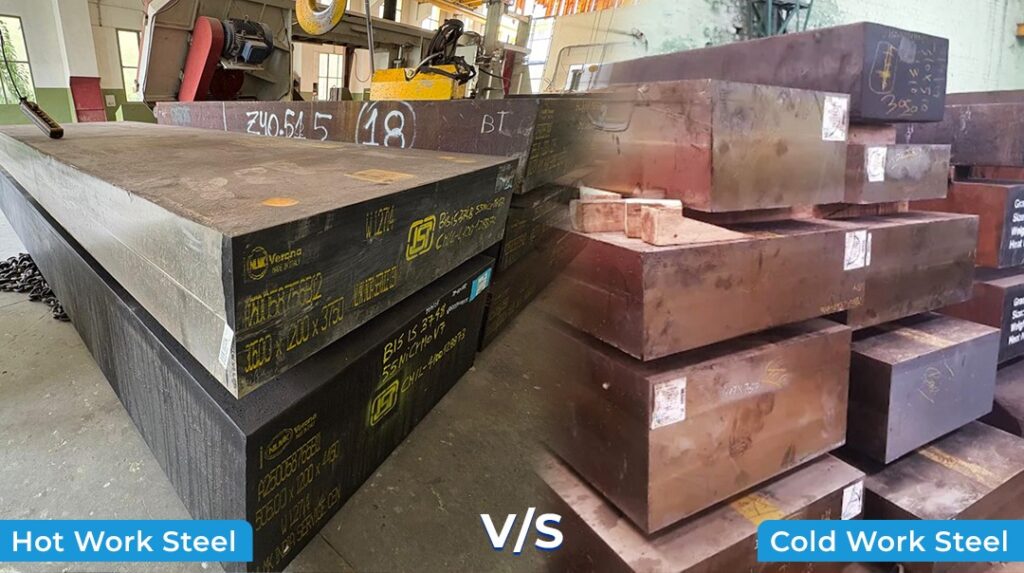
In tooling, one decision quietly determines tool life, rejection rate, and production cost: choosing the right tool steel.
Yet many failures on the shop floor come down to one mistake—using hot work steel where cold work is needed, or vice versa.
This guide will give you a clear, practical comparison between hot work and cold work tool steels—so you can make the right decision the first time.
Hot Work Tool Steel (For High Temperature Applications)
The most widely used grade: H13 tool steel
Best For:
- Aluminium die casting
- Forging dies
- Extrusion tools
- High-temperature moulds
Key Benefits:
✔ Handles extreme heat (200–700°C)
✔ Resists thermal cracking
✔ High toughness under load
Cold Work Tool Steel (For Wear Resistance)
A leading grade: D2 tool steel
Best For:
- Blanking & punching dies
- Shear blades
- Cold forming tools
- Sheet metal industry
Key Benefits:
✔ Very high hardness (up to 60+ HRC)
✔ Excellent wear resistance
✔ Long life in cutting operations
Hot Work vs Cold Work Steel — Quick Comparison
| Feature | Hot Work Steel (H13) | Cold Work Steel (D2) |
| Temperature | High | Low |
| Hardness | Medium | Very High |
| Toughness | High | Moderate |
| Wear Resistance | Medium | Very High |
| Heat Resistance | Excellent | Poor |
| Best Use | Die casting, forging | Cutting, punching |
Using the Wrong Steel? Here’s What Happens
- Cold work steel in hot application → Cracks & failure
- Hot work steel in wear application → Rapid wear & loss of accuracy
Result: Downtime, rejection, and higher cost per component
How to Choose the Right Tool Steel
Choose Hot Work Steel if:
- Temperature > 200°C
- Thermal cycling is involved
- Impact load is high
Choose Cold Work Steel if:
- Application is at room temperature
- Wear resistance is critical
- Cutting or shearing is involved
Industry-Wise Recommendation
| Industry | Recommended Steel |
| Die Casting | H13 |
| Forging | H13 / H11 |
| Sheet Metal | D2 |
| Blanking | D2 / D3 |
| Plastic Mould (High Temp) | H13 |
Increase Tool Life — Proven Methods
For Hot Work Steels:
- Use ESR quality material
- Apply nitriding
- Ensure proper preheating
- Control cooling cycles
For Cold Work Steels:
- Maintain correct hardness
- Use coatings (PVD)
- Avoid shock loading
- Ensure lubrication
Virat Steels — Your Tool Steel Partner
At Virat Steels, we help manufacturers reduce failure and increase tool life with the right material selection.
What You Get:
✔ Ready stock (rounds, flats, blocks)
✔ Ultrasonic tested material
✔ Fast delivery across India
✔ Technical guidance (not just supply)
FAQs?
1-Which is better: H13 or D2?
It depends on application.
- High temperature → H13
- High wear → D2
2-Can D2 be used for hot work?
No. D2 tool steel becomes brittle at high temperatures and may crack.
3-Does higher hardness mean better tool life?
Not always. Excess hardness reduces toughness and increases cracking risk.
4-What is the best steel for die casting?
H13 tool steel is the industry standard.
5. How does heat treatment differ between the two?
Hot work steels are heat-treated to maintain strength at high temperatures
Cold work steels are treated to achieve maximum hardness and wear resistance
6. Which is more expensive: hot work or cold work steel?
Hot work steels are often more expensive due to alloying elements and processing required for high-temperature performance.
7. What industries rely heavily on hot work steel?
Automotive forging, Aluminium die casting, Aerospace component manufacturing
8. What industries rely on cold work steel?
Sheet metal fabrication, Tool and die making, Packaging and appliance manufacturing
9. Which steel has longer tool life?
It depends on the application:
- Hot work steel lasts longer in high-temperature application.
- Cold work steel lasts longer in abrasive, low-temperature operations.
Get Expert Recommendation (Free Consultation)
Choosing the right steel can double your tool life.
- Stop tool failures before they happen.
- Choose the right steel with expert guidance from Virat Steels.
Share your application—we’ll recommend:
- Best grade with quality
- Ideal hardness
- Heat treatment process
Talk to our experts today:
🌐 viratsteels.com 📞 +91 98140-21775 ✉info@viratsteels.com
P20 vs H13 — Best Choice for Long-Run Plastic Moulds Plastic Mould Steel · Grade Comparison · Virat Special Steels
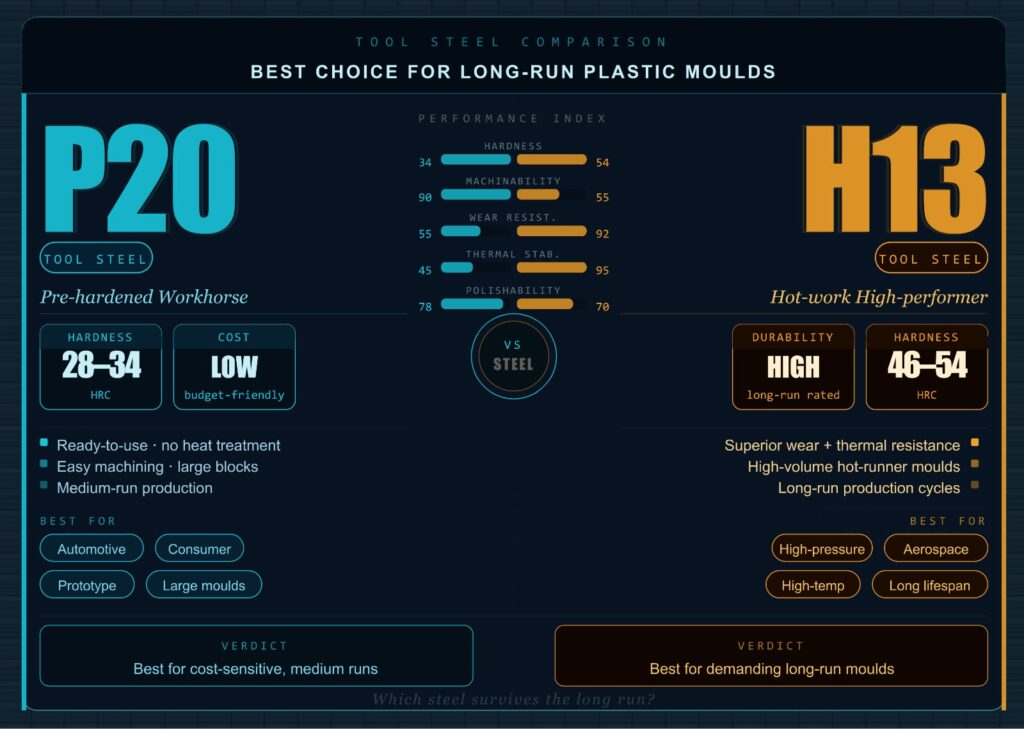
A practical, application-first guide for mould makers, tool rooms, and procurement teams choosing between two most popular plastic mould steel grades.
Choosing the wrong mould steel doesn’t just cost money — it costs production runs, surface finish quality, and mould life. Here’s how to pick the right one.
At a Glance: P20 vs H13
The table below gives a side-by-side view of both grades across the most critical properties mould buyers evaluate:
| P20 Steel Pre-hardened Mould Steel | H13 Steel Hot Work Tool Steel |
|---|---|
| Hardness 28–34 HRC (pre-hardened) | Hardness 44–52 HRC |
| Toughness High | Toughness Very High |
| Polishability Good | Polishability Excellent |
| Machinability Excellent | Machinability Moderate |
| Mould Life Up to 5,00,000 shots | Mould Life 10,00,000+ shots |
| Heat Treatment Not required | Heat Treatment Required (vacuum) |
| Tool Cost Lower | Tool Cost Higher |
| Lead Time Short | Lead Time Longer |
Detailed Property Comparison
| Property | P20 Steel | H13 Steel |
|---|---|---|
| Hardness after HT | 28–34 HRC (pre-hardened) | 44–52 HRC |
| Wear Resistance | Moderate | High |
| Toughness | High | Very High |
| Machinability | Excellent (no HT needed) | Moderate (HT required) |
| Thermal Fatigue Resistance | Low | Very High |
| Tool Cost | Lower | Higher |
| Lead Time | Short (ready to machine) | Longer (HT required) |
| Mould Life | Up to 5,00,000 shots | 10,00,000+ shots |
| Corrosion Resistance | Low | Moderate |
Which Steel is Best for Long-Run Moulds?
✅ Choose P20 if:
· Production volume is moderate
· Budget is limited
· Faster delivery is required
· Plastic material is non-abrasive
✅ Choose H13 if:
· Production volume is very high
· You need long mould life
· Material is abrasive or high temperature
· Dimensional stability is critical
| Which Grade Should You Pick? P20 for speed & cost · H13 for volume & finish |
If you need a mould quickly, at a lower cost, for regular plastics and medium production, go with P20.But if you’re producing in high volumes, using abrasive or glass-filled materials, or need a long-lasting, mirror-finish mould (over 10 lakh shots), choose H13.
Industry Applications in India
Both P20 and H13 are widely used across India’s plastics and automotive tooling industry. Here’s where each grade dominates:
| Industry | Recommended Grade | Reason |
| Automotive | H13 | High volume, tight tolerances, long mould life |
| Consumer Appliances | P20 | Medium run, cost-sensitive, faster delivery |
| Packaging (Caps & Closures) | H13 | Very high shot count, abrasion resistance |
| Electronics Housing | P20 / H13 | Depends on run volume and finish requirements |
| Medical Device Components | H13 (ESR Grade) | Mirror finish, cleanliness, long run |
| Soft Tooling | P20 | Quick machining, lower cost, short lead time |
Conclusion
Both P20 and H13 have their place in mould manufacturing—but the choice depends on your production goals:
· P20 = Cost-effective + faster production
· H13 = Long life + high performance
Sourcing P20 and H13 in India
Virat Special Steels stocks both P20 and H13 in ready inventory — supplied with full mill test certificates, hardness test reports, and chemical analysis. Available in round bars, flat bars, and pre-machined blocks across a wide size range.
| Need P20 or H13 for Your Next Mould? Get a fast quote — certified stock, ready to dispatch across India |
Contact our team to get more details about available sizes and technical specifications suitable for your applications.
https://www.viratsteels.com/products.html info@viratsteels.com
+91 98140-21775
Frequently Asked Questions
1. Which is better for long-run plastic moulds, P20 or H13?
H13 — higher hardness, wear resistance, and heat tolerance make it ideal for long runs.
2. What is the difference between P20 and H13?
P20: Pre-hardened, easier to machine, lower cost — best for short/medium runs. H13: Heat-treated, stronger, better for high-temp and high-volume applications.
3. Is H13 worth the higher cost?
Yes — for high-volume production, H13 delivers better ROI over time.
4. When should you choose P20 over H13?
When volume is low/medium, budget is tight, or faster machining/delivery is needed.
5. Which is better for high-temperature injection molding?
H13 — superior thermal fatigue resistance handles higher temps without deformation.
6. Can P20 be used for long-run moulds?
Yes, but it wears faster with abrasive materials and isn’t ideal for very long runs.
7. Which industries prefer H13?
Automotive, electronics, and high-volume packaging — anywhere durability matters.
8. What’s the cost difference?
P20: Lower upfront. H13: Higher initial cost, but better long-term value.
9. Best steel for 1 million cycle production?
H13 — built to withstand extended wear, heat, and stress over massive run counts.
Top 5 Tool Steel Grades for Die Makers-Complete Comparison
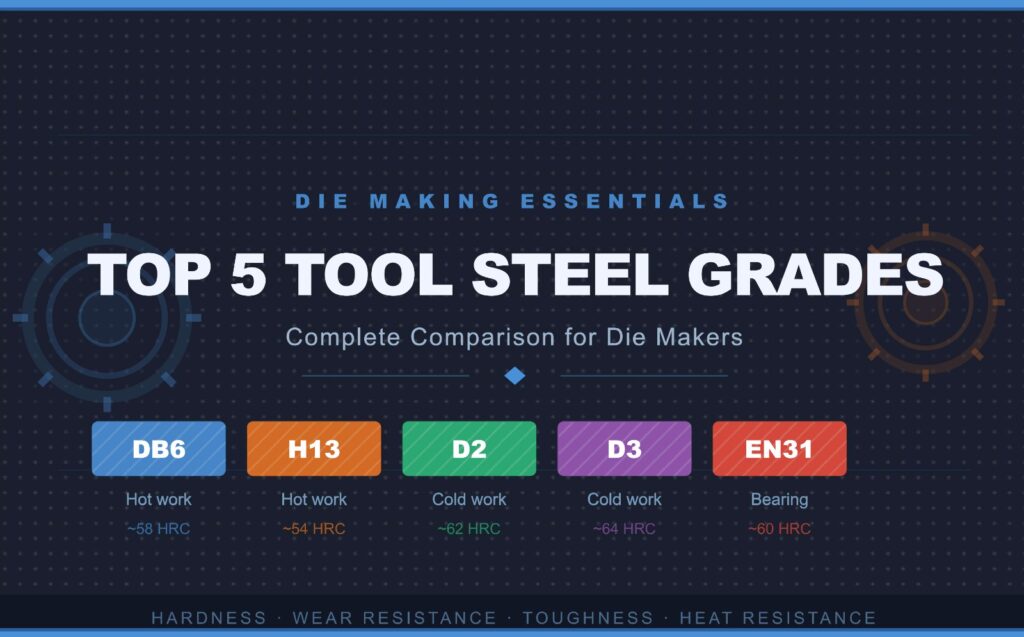
In the tool and die manufacturing industry, the successful production line often begins with one important decision that is choosing the right tool steel grade. When the correct steel is selected, dies last longer, machines run smoothly, and production targets are achieved with consistent quality.
Every manufacturing process has its own demands. A forging die must withstand intense heat and pressure, while stamping dies and cutting tools require exceptional wear resistance and hardness. Similarly, molds need the right balance of toughness and durability to perform reliably over thousands of production cycles.
Over time, die makers have learned that not all tool steels perform the same. Through years of experience and industrial use, certain grades have earned the trust of manufacturers because they consistently deliver strength, durability, and excellent performance on the shop floor. These trusted grades have become the preferred choice for die makers looking to achieve efficiency, reliability, and long die life.
1. DB6 Tool Steel – Advanced Steel for Longer Die Life
DB6 tool steel is gaining popularity among die manufacturers due to its exceptional toughness and wear resistance.
Key Properties
- Superior toughness
- Excellent wear resistance
- High fatigue resistance
- Longer die life
Common Applications
- Forging dies
- Heavy duty stamping dies
- High impact tooling
- Automotive die manufacturing
Why DB6 is Becoming Popular
Compared to conventional tool steels, DB6 offers longer tool life and better performance under heavy loads, which helps reduce downtime and tooling costs.
2. H13 Tool Steel – Best Hot Work Tool Steel
H13 tool steel is one of the most popular hot work tool steels used for applications involving high temperatures.
Key Properties
- Excellent heat resistance
- Good toughness
- High thermal fatigue resistance
- Good strength at elevated temperatures
Common Applications
- Forging dies
- Extrusion dies
- Die casting tools
- Hot stamping dies
Why H13 is Popular
H13 maintains its hardness even at high operating temperatures, making it ideal for hot forging and die casting industries.
3. D2 Tool Steel – High Wear Resistance Grade
D2 tool steel is one of the most widely used cold work tool steels in die manufacturing. It contains a high percentage of chromium, which provides excellent wear resistance and hardness.
Key Properties
- High wear resistance
- Good dimensional stability
- High compressive strength
- Moderate toughness
Common Applications
- Blanking dies
- Punches
- Shear blades
- Cold forming tools
- Stamping dies
Why Die Makers Prefer D2
D2 steel is ideal for applications where abrasion resistance is more important than impact resistance. It helps increase die life in high-production environments.
4. D3 Tool Steel – Maximum Hardness for Cutting Applications
D3 tool steel is another high carbon high chromium cold work steel known for its extremely high hardness and wear resistance.
Key Properties
- Very high hardness
- Excellent wear resistance
- High compressive strength
- Lower toughness compared to D2
Common Applications
- Cutting dies
- Thread rolling dies
- Knives and blades
- Cold extrusion tools
Why Die Makers Use D3
D3 is widely used where cutting performance and wear resistance are critical, especially in heavy duty cutting operations.
5. EN31 Steel – High Hardness Bearing Steel
EN31 steel is a high carbon alloy steel commonly used in tools requiring high hardness and wear resistance.
Key Properties
- High hardness after heat treatment
- Good wear resistance
- Excellent surface finish
Common Applications
- Dies and punches
- Bearing components
- Gauges
- Rollers
Why Die Makers Use EN31
EN31 is often selected for applications requiring fine finish and precision tooling.
Grade Comparison Table
| DB6 Hot work Cr-Mo-V | H13 Hot work Cr-Mo-V | D2 Cold work Hi-Cr | D3 Cold work Hi-Cr | EN31 Bearing Hi-C Cr |
| Standard: DIN 1.2714 | Standard: AISI H13 | Standard: AISI D2 | Standard: AISI D3 | Standard: BS EN31 |
| C content: 0.35% | C content: 0.38% | C content: 1.55% | C content: 2.25% | C content: 1.00% |
| Hardness: 54–58 HRC | Hardness: 48–54 HRC | Hardness: 58–62 HRC | Hardness: 60–64 HRC | Hardness: 58–62 HRC |
| Toughness & durability | Heat resistance | High wear resistance | Maximum hardness | High hardness |
How to Choose the Right Tool Steel Grade
Selecting the right tool steel depends on several factors:
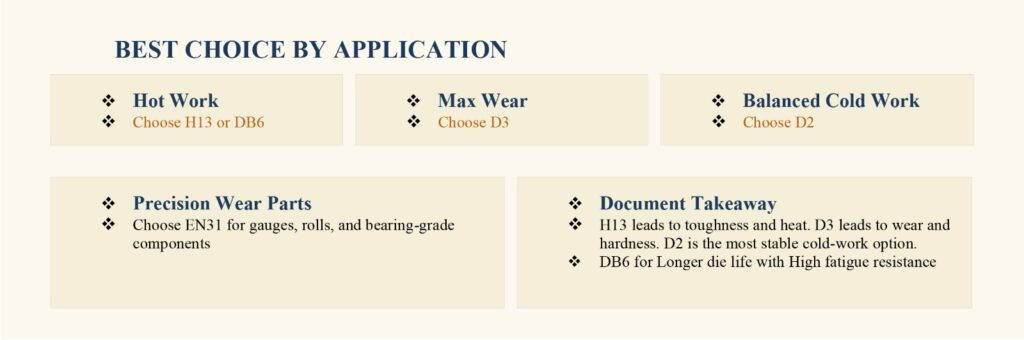
1. Application Type
Cold work operations require D2 or D3, while hot work processes prefer H13.
2. Wear Resistance Requirement
For high wear conditions, D2 or D3 are excellent choices.
3. Impact Resistance
Applications with heavy loads benefit from DB6 tool steel.
4. Temperature Conditions
Hot forming applications require steels like H13 that can withstand high
temperatures.
Why Die Makers Trust Virat Steels
At Virat Special Steels, we supply premium quality tool and die steels for industries such as:
- Automotive manufacturing
- Forging industry
- Die making
- Precision engineering
Our wide range of tool steels ensures that die makers get the right material for maximum performance and durability.
Frequently Asked Questions (FAQs)
1. What is tool steel used for in die making?
Tool steel is used to manufacture dies, punches, moulds, and cutting tools because of its high hardness, wear resistance, and toughness.
2. Which tool steel grade is best for die making?
D2, D3, H13, EN31, and DB6. The best grade depends on the application, such as cold work, hot work, or high-wear operations.
3. What is the difference between D2 and D3 tool steel?
Both D2 and D3 are cold work tool steels with high wear resistance.
- D2 steel offers better toughness and dimensional stability.
- D3 steel provides higher hardness but lower toughness.
4. Why is H13 tool steel used for forging dies?
H13 tool steel is widely used in forging dies because it has excellent heat resistance, toughness, and thermal fatigue strength, allowing it to perform well at high temperatures.
5. Which tool steel provides the longest die life?
Tool steels with a balance of toughness and wear resistance, such as DB6 and H13, are known to provide longer die life in demanding industrial applications.
6. What industries use tool and die steel?
Tool and die steels are widely used in industries such as:
- Automotive manufacturing
- Forging and casting
- Metal stamping
- Plastic moulding
- Engineering and heavy machinery
7. How does the right tool steel improve production efficiency?
Using the right tool steel grade improves die life, reduces maintenance, minimizes downtime, and ensures consistent product quality, which ultimately increases manufacturing productivity.
Conclusion
By understanding the properties and applications of each grade, manufacturers can select the best tool steel for their specificrequirements for increasing production capacity.
Virat Special Steels has built a reputation as one of India’s most trusted suppliers, known for expertise, premium quality, and unmatched stock capabilities of various grades of Tool & Die steels.
📞 Curious about the right size, grades or technical specifications for your application? Our team is ready to guide you.
👉 Explore more: www.viratsteels.com | 📧 info@viratsteels.com | 📱 +91 98140-21775
Exploring the Prime Tool and Die Steel Supplier in India!
Tool and die steels are a group of high-carbon steels used primarily in the manufacturing of tools and dies used in metal forming and metal cutting processes. These steels are designed to have high hardness, wear resistance, and toughness, making them suitable for withstanding the severe conditions encountered during the shaping and cutting of metals.
Key characteristics of tool and die steels include:
- Hardness: Tool and die steels are heat-treated to achieve high hardness, enabling them to resist wear and abrasion.
- Toughness: Despite their hardness, these steels also exhibit toughness, which is crucial for withstanding the impact and shock loads associated with metalworking processes.
- Wear Resistance: Tool and die steels should have excellent wear resistance to maintain their cutting and shaping abilities over an extended period.
- Heat Resistance: Some applications may involve elevated temperatures, so heat resistance is another important property for tool and die steels.
In terms of the future of tool and die steel industry in India, it is dependent on various factors, including the growth of the manufacturing sector, advancements in technology, and the overall economic development of the country.
Here are some potential trends and considerations, as India continues to develop its manufacturing sector, there will likely be an increased demand for tool and die steels to support the production of various goods. Innovations in manufacturing processes and technologies may lead to the development of new and more specialized tool and die steels with enhanced properties, contributing to increased efficiency and precision in metalworking.
The competitiveness of the Indian tool and die steel industry will be influenced by global market trends and competition. Adapting to international standards and quality benchmarks will be essential. Government policies and initiatives that promote the growth of the manufacturing sector, technological innovation, and skill development can positively impact the tool and die steel industry.
One of the best Tool & Die Steel Supplier in India is:
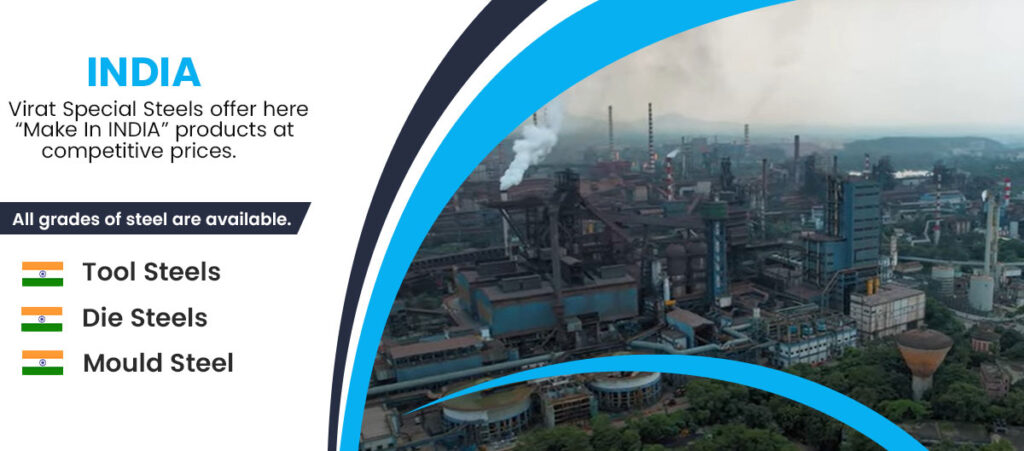
Virat Special Steels Pvt. Limited : This is a company that deals in all kinds of tool steel, die steel, plastic mold steel, high speed steel, and alloy steel. They provide value added services, such as material machining, cut pieces, and tailor-made material. They also offer metallurgical advice and quality assurance. They have a state-of-the-art plant in Gurugram and Ludhiana. They also have a strong distribution network across India.
Virat Special Steels Provides Special Steels in All Major Cities India.
Agra, Alwar,Ambala, Anand, Bhiwadi, Dehradun, Ghaziabad, Haridwar, Rudrapur, Delhi, Faridabad, Kanpur, Noida, Gurgaon, Manesar, Kundali , Chandigarh, Waluj , Vadodara, Pimpri – Chinchwad, Rajkot, Jaipur, Ahmedabad, Pithampur, Surat, Amravati, Vadodara, Indore, Bhopal, Ranchi, Jamshedpur, Howrah, Kolkata, Pune, Thane, Nashik, Mumbai, Navi Mumbai, Nagpur, Ambattur, Bangalore, Belgaum, Chittoor, Dindigul, Hyderabad, Ernakulam, Chennai, Secunderabad, Visakhapatnam, Coimbatore, Mysore, Nellore, Kochi, Thiruvananthapuram, Trivandrum, Vijayawada, Guntur, Tirupati, Nazarathpet, Kakinada, Kurnool and many more..
You can visit their website: https://www.viratsteels.com/