




stress relieving tool steel
now browsing by tag
Why Tool Steels Distortion During Heat Treatment — and How Stress Relieving Prevents It
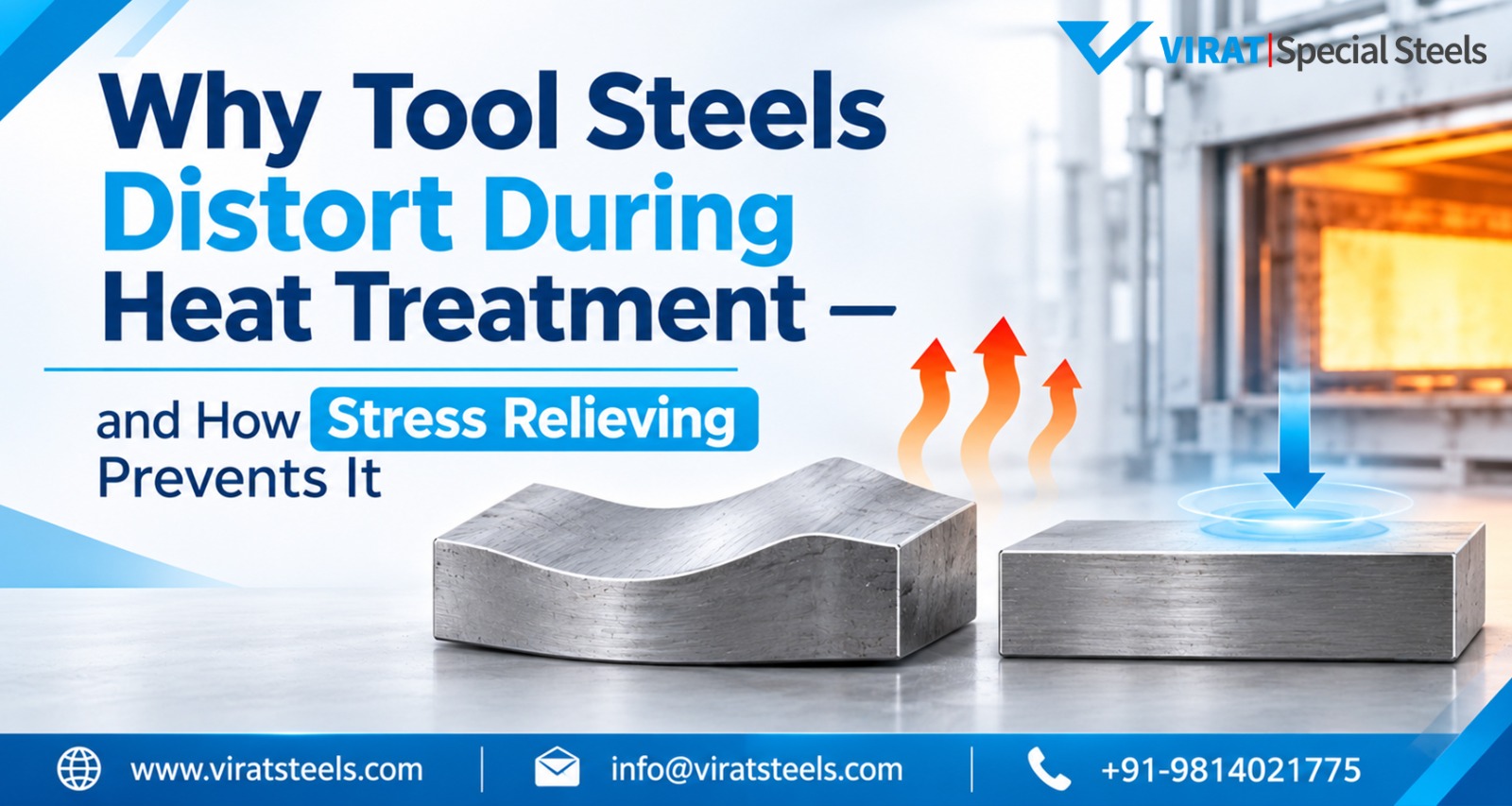
Short answer: The following are the three main factors that cause Tool Steels Distortion during heat treatment: (1) Stress in machining and shaping operations is relieved during heating of the metal, (2) Thicker and thinner areas of the metal have different rates of heating and cooling, and (3) The metal expands when austenite is transformed to martensite during quenching.
Key takeaways
- Dimensional changes are relatively predictable for every grade. However, warping, twisting, and ovalness are not predictable, so you manage them during processing.
- Relieve stress after rough machining and before semi-finish machining and hardening.
- Air, gas, and vacuum-gas cooling generally distort less than oil does, but the quench still has to provide the required hardness for your section.
- None of the grades is Tool Steels Distortion free. Pre-hardened grades such as P20 don’t undergo the hardening cycle, and this decreases the chance of Tool Steels distortion.
- Get temperature and time information for your grade from the manufacturer’s datasheet.
What is Tool Steels Distortion?
Tool Steels Distortion shows up in two ways:
- Size change (dimensional change): the whole part grows or shrinks. For a given grade and process, it follows a fairly predictable pattern.
- Shape distortion: bowing, warping, twisting or oval (out-of-round) parts. This one is hard to predict, and it comes mainly from processing and design.
Precision dies, punches and moulds have tight tolerances, so shape distortion is the one to control. It shares its root causes with quench cracking: when stress exceeds what the steel can take, the part cracks instead of moving.
Key terms in plain English
| Term | What it means |
| Austenite | The structure steel takes at hardening temperature, before the quench |
| Martensite | The hard structure formed when austenite is cooled fast enough. It takes up more volume than austenite |
| Retained austenite | Austenite that didn’t transform in the quench. It can change later and alter the size of the part |
| Lower critical temperature | The temperature where steel starts changing to austenite on heating. Stress relieving Tool Steel and tempering stay below it |
| Stress relieving | A below-critical heat cycle that relaxes machining and forming stress |
| Tempering | Reheating after the quench to set hardness and toughness |
| Pre-hardened steel | Supplied already hardened and tempered, so there is no hardening cycle after machining |
| HCHCR | Common Indian trade term for high-carbon, high-chromium steels such as D2 and D3 |
Why do Tool Steels Distortion during heat treatment?
Six factors cause most Tool Steels Distortio problems.
1. Stress due to previous manufacturing operations. Operations such as rolling, forging, rough machining, grinding, EDM, welding and cold straightening will induce stress within the steel. When the tool is heated and the steel softened, the stress will be released and thus the Tool Steels Distortion will occur. Stress relief prior to heat treatment of tool steel will cause the distortion earlier, when stock is still present.
2. Thermal stress due to uneven heating and cooling. The surface will heat and cool faster than the core, while thinner sections will proceed ahead of thicker sections. The larger the temperature gradient, the higher will be the thermal stress; therefore rapid heating and drastic quenching will increase the distortion.
3. Structural change during hardening. There is an expansion of steel upon the transformation from austenite to martensite. This change being non-uniform in time for different areas may result in deformation of the workpiece. Deformation will occur due to subsequent transformation of retained austenite. Deformation also occurs due to tempering, as in high alloyed steels, secondary hardening leads to additional expansion.
4. Shape and mass. The presence of non-uniform cross-sections, abrupt changes in sections, blind holes and flat surfaces results in non-uniform cooling and stress concentration.
5. Furnace practice. non-uniform heating, overheating, non-uniform support (deformation under the weight of the part at high temperature) and quench orientation have effect on the shape.
6. Material condition. The non-uniformity of the structure, the non-uniformity of stock removal, or the grade that is not compatible with the section size and the quench will make it difficult to anticipate the results. The dimensional change may also vary depending on whether the rolling direction is transverse or longitudinal in high-carbide grades like D2.
Common distortion symptoms and what to check
| Symptom | Likely cause | What to check |
| Bowed or banana-shaped bar or plate | Stress released unevenly after heavy or one-sided stock removal | Machine symmetrically, stress relieve after rough machining, support the part evenly in the furnace |
| Oval (out-of-round) rings or bushes | Uneven cooling or poor quench orientation | Quench orientation, gas or vacuum quench, fixture or press quench |
| Long, thin part sags | Poor support at hardening temperature, or overheating | Support points, furnace loading, temperature control |
| Size grows after tempering or in service | Retained austenite transforming; secondary hardening | Multiple tempers; sub-zero treatment where the grade allows |
| Length and width change by different amounts | Rolling direction and carbide distribution | Note the grain direction, leave stock to suit, ask the mill for data |
| Cracks at corners or holes | Stress concentration plus a severe quench | Add radii, use a gentler quench, temper promptly |
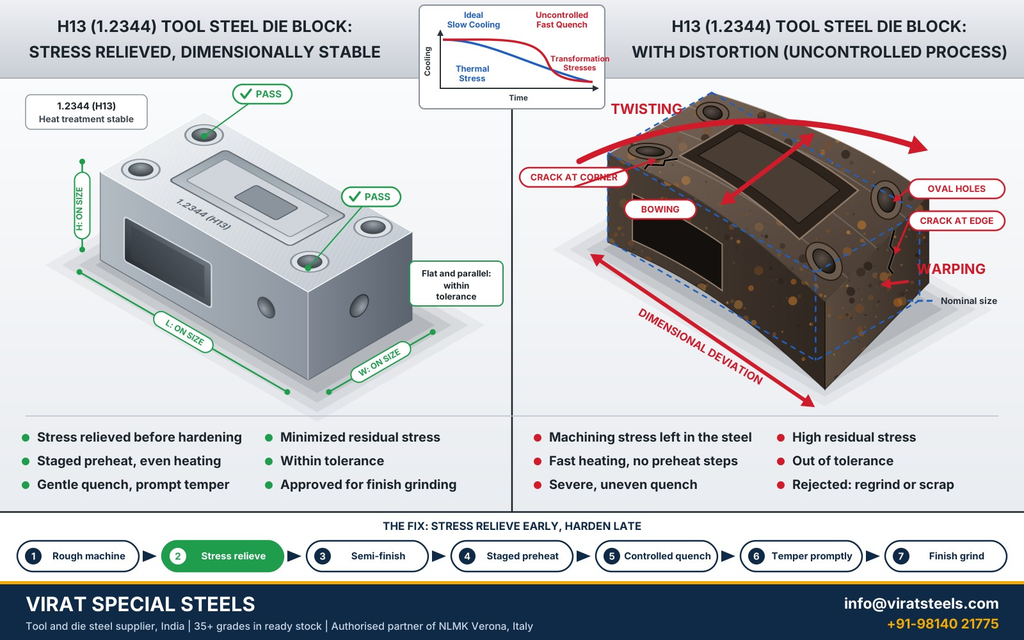
How does stress relieving prevent Tool Steels Distortion?
stress relieving tool steel means heating the tool below the steel’s lower critical temperature, holding until it is heated through evenly, then cooling slowly. At this temperature the steel’s yield strength drops, so machining stress relaxes. Any movement happens now, not in the hardening furnace, and it is cheaper to correct at the semi-finish stage than on a hardened tool.
What temperature and hold time?
Temperature and hold time depend on the grade and section size, so follow the manufacturer’s datasheet. As a reference, several Uddeholm datasheets specify 650°C for 2 hours, then slow cooling to 500°C, then air. For pre-hardened mould steels, stay about 30-50°C below the last tempering temperature. NLMK Verona’s 1.2738 sheet sets the limit at 30°C.
Stress relieving vs annealing vs tempering
| Treatment | Purpose | When | Temperature |
| Stress relieving | Relax machining and forming stress | After rough machining, before hardening | Below the lower critical temperature; slow cooling |
| Annealing | Soften the steel and prepare its structure for machining | Before machining (often the supply condition) | Near or above the critical range; very slow furnace cooling |
| Tempering | Set hardness and toughness and relieve quench stress | Straight after quenching, usually more than once | Below the lower critical temperature |
Not sure which grade or supply condition suits your tool? Send us your drawing and heat treatment of tool steel plan at info@viratsteels.com or call +91-98140 21775.
What is the correct heat treatment sequence for tool steel?
In the case of tool steels, shops generally use the following heat treatment of tool steel process sequence:
- Rough machine, leaving generous stock.
- Stress relieve (sub-critical, slow cooling).
- Semi-finish machine, leaving grinding stock.
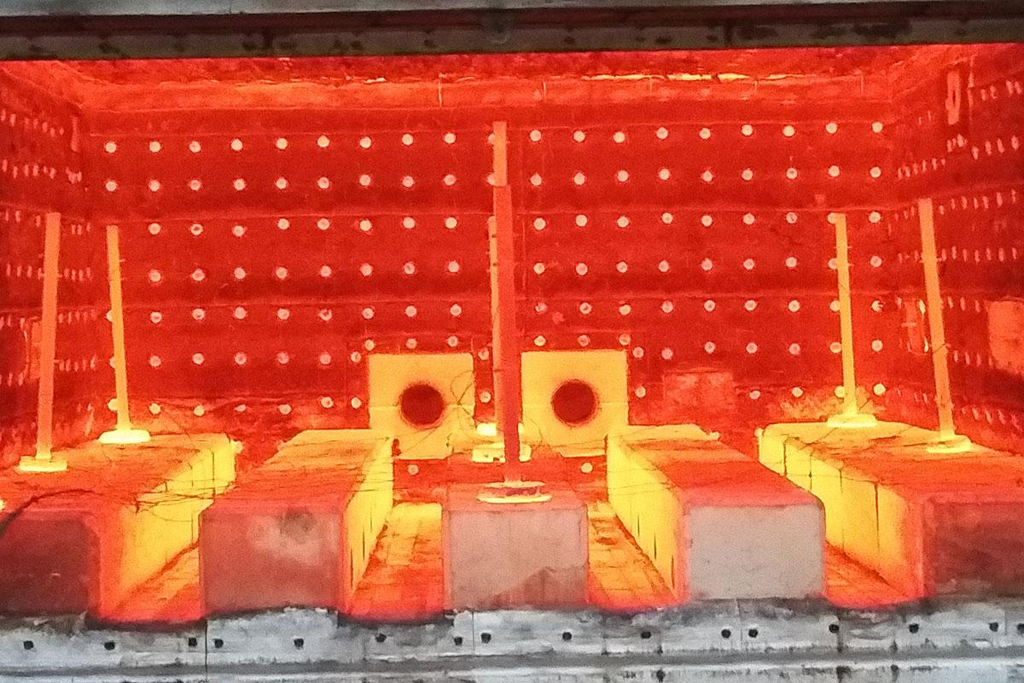
- Preheat in one or several stages in order to reduce thermal shock.
- Austenitise: heat to the grade’s hardening temperature and soak. Too high or too long risks grain growth and excess retained austenite. Too low gives incomplete hardening.
- Quench in oil, air, gas, or salt, according to grade and section.
- Temper immediately, usually more than once, in order to remove quench stress and achieve desired hardness.
- Grind finish, and stress relieve if required. Grinding and electrical discharge machining may cause stresses to be introduced, so stress relief or tempering may be desirable in this case.
Pre-hardened grades such as P20 skip steps 4 to 7, which is why they carry a lower distortion risk. Temperatures and times vary by grade, so always follow the producer’s datasheet.
How can you reduce distortion further?
- Gradually preheat. Holding the part a one or several intermediate temperatures reduces the temperature difference between the surface and core. Big, complicated tools often require more than two stages of preheat.
- Select the correct quench. See Table below.
- Restrain if necessary. Fixtured or press quenching retains shape while cooling.
- Temper immediately, and frequently. Most of the datasheets begin tempering after cooling of the tool to about 50–70°C, and H13-type datasheets ask for at least three tempers for die casting dies.
- Consider sub-zero treatment when applicable. It may convert retained austenite in some types.
- Provide adequate support in the furnace to prevent sagging of long or thin parts.
- Design for heat treatment. Symmetry of the shape, uniform wall thickness, and large radii contribute.
- Provide enough grinding allowance. No universal value exists, so come to an agreement with your heat treater.
- Do not straighten hardened tool steel by cold means. It increases the risk of cracking.
Which cooling method distorts least?
Slower, more even cooling generally means less distortion, so air-hardening grades usually distort less than oil-hardening ones. But not every section is big enough or alloyed enough to harden in air. Use the gentlest quench that still reaches the hardness you need through the section.
| Quench | How it cools | Distortion tendency | Notes |
| Oil | Fast and severe | Higher, because thermal and transformation stress are higher | Used for oil-hardening grades; complex shapes are at greater risk |
| Air or forced air | Slower and more even | Lower | For air-hardening grades; limited by section size |
| Vacuum with high-pressure gas | Controlled, uniform, clean surface | Low | Well suited to air-hardening grades and high speed steels; check furnace gas pressure for your section |
| Salt bath or interrupted quench (martempering) | Equalises temperature before the structure transforms | Low | Common for high speed steels; the part is held at an intermediate temperature |
Common mistakes that cause Tool Steels Distortion
- Saving a day by skipping stress relief. Semi-finished repairs are always cheaper than repairs on finished parts.
- Single-side roughing. Uneven stock removal creates uneven stresses, and the workpiece bends after removal of clamps.
- Too fast heating or omission of the preheating stage. Surface heating exceeds core heating, and thermal stresses manifest themselves in movement.
- Use of sharp angles and blind holes. They heat and cool unevenly, concentrating stresses in themselves. Radii and reliefs should be provided where possible.
- Quenching harder than the section needs. Employ the most mild quenching that guarantees the required hardness.
- Lack of grinding allowance. Hardening deformation has no place to move.
- Neglect of stresses generated by EDM and grinding. They may introduce stresses into the workpiece again, thus requiring precise tools to undergo light stress relieving or tempering treatment.
- Late tempering of the tool. Almost all data sheets suggest starting tempering at the temperature between 50-70°C.
- Cold straightening of the hardened tool. Risk of cracking.
Tool steel groups, DIN numbers and distortion notes
The AISI markings for the alloy steel group include O oil-hardening, A air-hardening, D high-carbon high-chromium (HCHCR), H hot work, P plastic mould, M/T high speed. DIN numbers below are common equivalents; your mill certificate shows the exact grade. DB6 is the trade name for DIN 1.2714.
| Grade | DIN no. | Typical use | Typical cooling | Distortion note |
| D2 | 1.2379 | Blanking, piercing, forming dies | Air or vacuum/gas | Air-hardening, so lower quench stress; size change varies with tempering temperature and direction |
| D3 | 1.2080 | Blanking and wear parts | Oil (typical) | Generally holds size well on simple shapes; confirm on the datasheet |
| H13, H11 | 1.2344, 1.2343 | Die casting, extrusion, forging dies | Air, gas or vacuum | Stress relieve after rough machining; staged preheat; multiple tempers |
| H21 | 1.2581 | Hot forging, extrusion | As per datasheet | Slow, staged heating for large blocks |
| DB6 | 1.2714 | Forging dies and blocks | Usually oil or polymer; check datasheet | Large sections need slow, staged heating |
| P20, P20+Ni | 1.2311, 1.2738 | Injection moulds | Usually supplied pre-hardened | No hardening cycle; stress relieve after heavy machining, below the prior tempering temperature |
| M2, M35, M42, T1 | 1.3343, 1.3243, 1.3247, 1.3355 | Cutting tools | Vacuum, gas or salt, at high temperature | Multiple tempers; support parts to avoid sag |
Tool steel grades at a glance
These notes are qualitative. Check the datasheet for the grade you buy.
- D2 / D3 (HCHCR): high wear resistance, used for blanking, piercing and forming. They machine well enough when soft, though they’re harder on cutting tools than low-alloy steels. Usually finished to size by grinding after hardening. See our cold work tool steel range.
- H13 / H11 / H21: good strength and thermal fatigue resistance at service temperature. Common in pressure die casting, aluminium extrusion and forging dies. Machined annealed, then hardened.
- DB6 / DIN 1.2714: forging dies and blocks, including large sections.
- P20 / P20+Ni / DIN 1.2738: plastic mould steels, often supplied pre-hardened, which avoids a hardening cycle. Verify machinability, polish and weldability for each grade.
- M2 / M35 / M42 / T1: high speed steels for cutting tools. Cobalt-bearing M35 and M42 are picked for extra hot hardness.
Why distortions should be controlled: Forging, pressure die casting, aluminium extrusion, automotive, oil & gas, plastics, glass, and railways. Why distortions should be controlled: Reduced scrap, reduced grinding, reduced lead time, and reduced tool cost.
How do you choose the right tool steel grade?
Virat Special Steels holds 35+ tool and die steel grades in ready stock and is an authorised partner of NLMK Verona, Italy. Use this checklist to narrow your choice:
- Start with the job: cold work, hot work, plastic moulding or cutting.
- Match the dominant demand: wear resistance points to D2 or D3; toughness and heat resistance to H13, H11 or DB6; mould polish and machinability to P20 or DIN 1.2738; hot hardness in cutting edges to M2, M35 or M42.
- Consider size and shape: large or complex parts favour grades that harden with gentler cooling. Talk to your heat treater early.
- Choose the supply condition: annealed grades are machined then hardened; pre-hardened grades such as P20 skip hardening, which lowers Tool Steels Distortio risk for suitable jobs.
- Check your heat treatment of tool steel route: access to vacuum or gas quenching can change the best grade.
- Ask for documentation: grade, producing mill, size, condition and test certificates as required for the order.
Our technical team advises on material choice, heat treatment of tool steel and machining. The more you share, the more useful our answer will be.
Frequently asked questions
Why do Tool Steels Distortion during heat treatment? Three reasons come together: the release of residual stress caused by previous machining, temperature variation within the workpiece, and change in volume due to transformation from austenite to martensite. The design of the tool, the method used for heating, and the state of the tool steel affect these factors.
What is stress relieving tool steel? It refers to a heat treatment of tool steel process carried out below critical temperature. Here, the tool is heated gradually, held up at high temperatures until uniform heat is attained and cooled down slowly to relieve stresses from machining and forming operations.
When should tool steel be stress relieved? Usually after rough machining and before semi-finish machining and hardening. Precision tools often get a light stress relief or temper again after grinding or EDM. Pre-hardened grades are relieved after heavy machining or welding.
Is stress relieving the same as annealing or tempering?No. Annealing is used to soften the steel. Tempering comes after quenching and fixes the hardness and toughness. stress relieving tool steel involves the removal of the stresses introduced during machining or cold forming.
What temperature should tool steel be stress relieved at? It depends on the grade and section, so refer to the datasheet. To get an idea of the values, several Uddeholm datasheets indicate 650°C for 2 hours followed by slow cooling down to around 500°C. Pre-hardened steels should be stress relieved below the last tempering temperature.
How long should tool steel be held at stress relief temperature? Until the whole section is hot, plus the hold time on the datasheet. Several Uddeholm datasheets specify 2 hours once the tool is heated through. Thick blocks take longer to heat through, so total furnace time is longer.
Does stress relieving tool steel stop distortion completely? No. It removes machining and forming stress, but hardening still causes some size change. What you get is movement that’s smaller and easier to predict.
Which Tool Steels Distortion the least? None is Tool Steels Distortion-free. Air-hardening and pre-hardened grades are popular when stability matters, but geometry, process and the producer’s data decide the result.
Does oil quenching cause more distortion than air quenching? In general, yes because the oil cools much faster and hence creates thermal and transformational stresses. However, the quench needs to match the steel grade and provide the necessary hardness required throughout the cross-section.
Is vacuum hardening better for reducing distortion? Often, yes Since the gas cooling process takes place in a controlled environment and under a vacuum, it provides uniformity and cleanliness of the surface of the steel. The vacuum hardening process is used for air hardening steel grades such as D2 and H13. Gas pressure limits the cross-section size.
Do tool steels grow or shrink after hardening? Either. It depends on the grade, the hardening and tempering temperatures, and how much retained austenite is left. Ask the steel maker for dimensional change data for your grade rather than relying on general figures.
What is retained austenite and why does it matter? It’s austenite that didn’t turn into martensite in the quench. It can transform later and change the size of the part, which is why tool steels get tempered, and sometimes sub-zero treated.
Can distorted tool steel be corrected? Sometimes, by grinding or machining within your stock allowance. Straightening hardened steel risks cracking, so leave that to an experienced heat treater.
Should I stress relieve before or after EDM? Before hardening, after rough machining. EDM also leaves a stressed layer on the surface, so precision tools are often tempered or stress relieved again afterwards.
Does pre-hardened P20 need stress relieving? It can help after heavy machining or welding on complex moulds. Stay below the steel’s previous tempering temperature, typically 30–50°C below according to producer datasheets, or the steel will soften. Follow the datasheet for your grade.
How much machining allowance should I leave? There’s no universal number. It depends on grade, size and geometry, so agree it with your heat treater and supplier. The aim is enough stock that hardening movement can be corrected in final grinding.
How do I reduce Tool Steels Distortion in an H13 die casting die? Rough machine, stress relieve, then semi-finish. Harden with staged preheating and a controlled gas or vacuum quench, then temper soon after and more than once. Leave finishing stock, and agree the cycle with your heat treater before the die goes in.
What should buyers ask a tool steel supplier? The grade and standard, producing mill, size, supply condition, test certificates as required, lead time, and what technical guidance comes with the steel.
Does Virat Special Steels offer technical guidance? Yes. Our technical team recommends material, heat treatment of tool steel and machining. Attach your drawing and working conditions along with heat treatment of tool steel schedule with your inquiry.
Conclusion
Tool Steels Distortion has three predictable causes: machining stress, uneven heating and cooling, and the volume change during hardening. Stress relieving tool steel Stress relieve after rough machining, preheat in stages, use the gentlest quench that still hardens the section, and temper promptly. Choosing the right grade and supply condition up front removes most of the remaining risk.
Need a tool steel supplier in India with technical support? Virat Special Steels stocks 35+ tool and die steel grades, including D2, H13, DB6 and P20. Send your drawing, grade and heat treatment of tool steel plan to info@viratsteels.com or call +91-98140 21775.